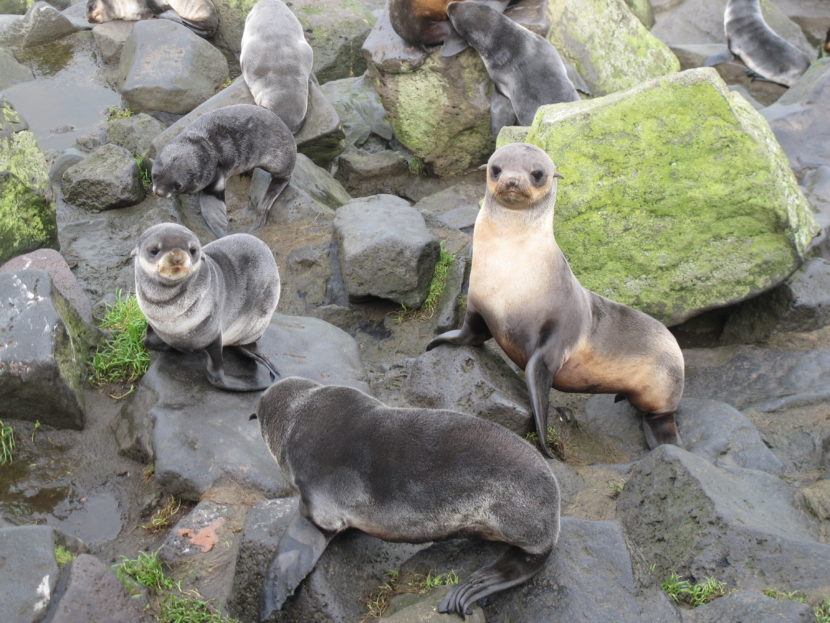
Seal pups on St. Paul Island. (Photo courtesy of Justine Kibbe)
This October marks the 50th anniversary of the Marine Mammal Protection Act, the conservation law that prohibits the killing of marine mammals. It does have an exception for Alaska Native people, and the federal government now works with Tribes to co-manage animals for subsistence use.
On St. Paul Island there’s a model for how this kind of partnership might guide Alaska’s marine mammals – and the people who depend on them – through dramatic climate shifts.
The Aleut Community of St. Paul Island Tribal Government has a partnership with federal scientists at NOAA Fisheries to manage Steller sea lion and fur seal populations.
“It’s actually just gotten better as the years go,” said Aaron Lestenkof, a local hunter who works for the Tribe. “And we have weekly meetings with them. And, you know, try to keep up to date on things happening here.”
Lestenkof is an Island Sentinel—a Tribal member who monitors hunting and stranded marine mammals on the island, among other duties. Federal biologists work only seasonally on the island, but Sentinels are there year round.
Lestenkoff says the changing climate has made fur seals more available over the last decade. They used to leave St. Paul in winter, but he says now some of them stay on the island over winter due to climate change. The Tribe worked with the federal government to update local regulations so hunters could take advantage of the longer seal season. That’s important because the changing climate means a decrease or even a crash in other subsistence foods, like halibut and crabs, respectively.
Lauren Divine is the director of the ecosystem office for the Tribal government on St. Paul. She says the federal regulation change was a milestone. Now the Tribe runs a research project on northern fur seals.
“We’re leading as a Tribal government, rather than kind of supplementing something that NOAA is doing,” she said. “This is something that addresses our Tribal member concerns, and is led and funded by our Tribal government.”
She says federal management needs to do more to keep up with climate change, but recent co-management decisions have given her hope for the future.
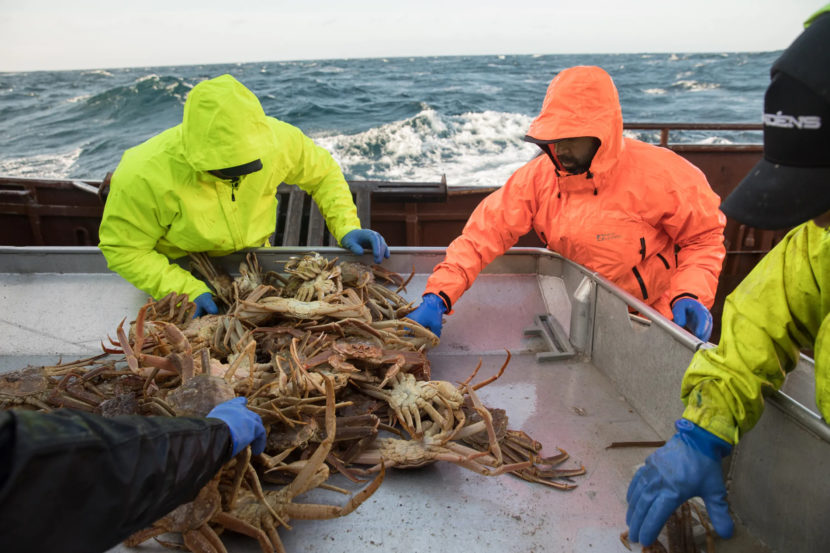
Gov. Dunleavy requested disaster declarations for the Bering Sea snow crab and Bristol Bay red king crab fisheries, citing the closure of both this year. (Photo courtesy Corey Arnold/Alaska Bering Sea Crabbers)
Gov. Mike Dunleavy has requested federal disaster declarations for two Alaska crab fisheries after their populations crashed. The Alaska Department of Fish and Game announced earlier this month that the Bering Sea snow crab fishery will not open, for the first time in its history.
The governor requested expedited disaster designations to jump-start the process of sending money to fishermen in both the 2022 Bering Sea snow crab and Bristol Bay red king crab fisheries, citing the complete closure of both this season.
Dunleavy also requested a disaster declaration for last year’s Bristol Bay red king crab fishery, which will remain closed for the second year in a row this season.
Rep. Mary Peltola has also requested emergency relief funding in a letter addressed to U.S. House Speaker Nancy Pelosi and the chair of the House Appropriations Committee.
In a letter to U.S. Secretary of Commerce Gina Raimondo dated Oct. 21, Dunleavy blamed “warming ocean temperatures” for the collapse of both Bering Sea crab stocks — and said the closures would be a $287 million hit to Alaska’s economy in seafood landings alone.
In a press release Wednesday, Alaska Bering Sea Crabbers Executive Director Jamie Goen said that total economic losses to supporting industries, workers and coastal communities would likely be hundreds of millions of dollars more than that. Alaska Bering Sea Crabbers is a trade organization that advocates for Bering Sea fishermen.
Goen also said the closures represent a “defining moment in U.S. fisheries management” and that financial relief will likely take years to reach fishermen, even with the expedited disaster requests.
King crab numbers have been on the decline for years, and snow crab stocks in the Bering Sea crashed between the years 2018 and 2021. Researchers don’t know exactly what happened, but they believe warmer ocean conditions caused by climate change is a main driver of the snow crab’s population decline.
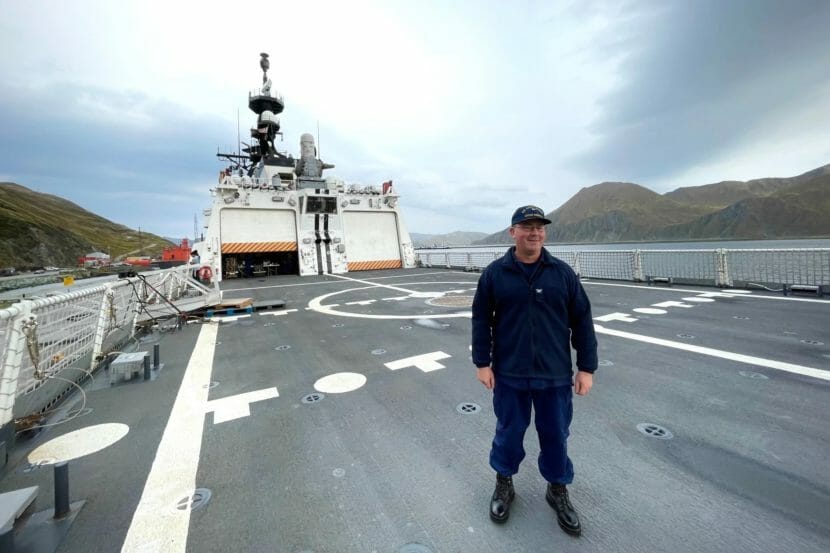
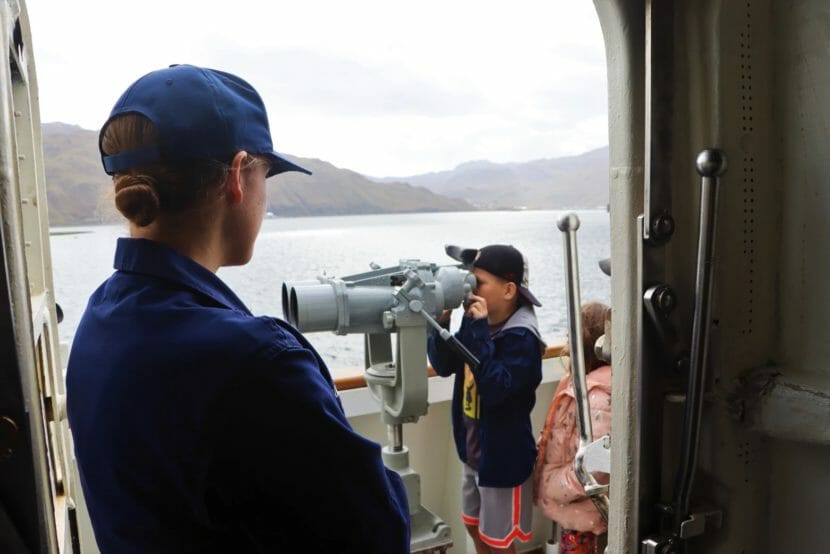
U.S. Coast Guard Capt. Thomas D’Arcy aboard his command, the cutter Kimball, during an Unalaska port call. The Kimball encountered several Chinese and Russian warships off Alaska in late September. (Maggie Nelson/KUCB)
The U.S. Coast Guard cutter Kimball calls Honolulu home, but recently it’s seen a lot of action in the Aleutians.
“We tracked them from about Kiska Island and then down through the pass,” D’Arcy said, pointing at a map of the Bering Sea. “So I’m assuming that they came up into the Bowers Ridge area and then moved in formation.”
The Kimball — which carries about 120 crew members, defensive weapons and a helicopter — came within about a mile of the group and made radio contact with them. Crew members on the foreign warships responded, but never declared who was coordinating the formation, he said.
While the group didn’t break any rules or give reason for direct contact, D’Arcy said the Kimball accompanied the ships until they passed into the Pacific side of the Aleutian Islands, where they split up.
He said they encountered the warships in the Bering Sea, in the U.S. Exclusive Economic Zone — an area up to 200 nautical miles offshore, where the U.S. has jurisdiction over natural resources. The formation never entered U.S. territorial seas.
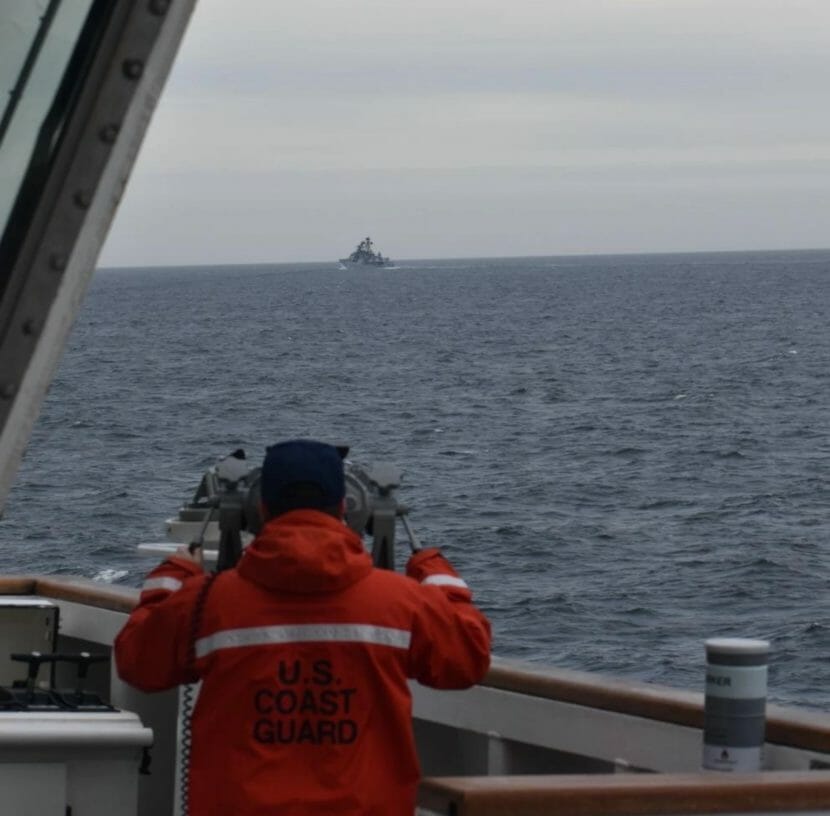
A Coast Guardsman aboard the cutter Kimball monitors a vessel from a group of Chinese and Russian warships in late September 2022. (Courtesy U.S. Coast Guard)
NATO officials have warned of a strategic Arctic partnership between Russia and China that challenges the organization’s values and interests. For D’Arcy, Russia’s persistence to militarize and develop a presence in the Arctic is concerning. But, he said part of the Coast Guard’s duty is to ensure that the U.S. sovereign interests are protected and to spend more time in the region.
“The most important piece for the Coast Guard is to make sure that we’re there and that we’re observing what’s happening, whether it’s a foreign vessel that’s coming up to do research or another naval vessel from a different country that’s operating in that area, especially if it’s anywhere near our interested waters,” D’Arcy said.
On Saturday, the crew of the 418-foot vessel welcomed more than 100 guests for tours, while docked up at Unalaska’s spit.
D’Arcy said he was excited to host the community, especially after about two years of limited interaction with locals due to the COVID-19 pandemic.
“It’s great to have the crew interact with the local community,” D’Arcy said. “The Coast Guard’s presence has been here since like the 1880s. We’ve been part of Unalaska. We’re not always the same ship or the same crew, but I think being able to demystify what we’re doing here was one of the goals that we had for this visit.”
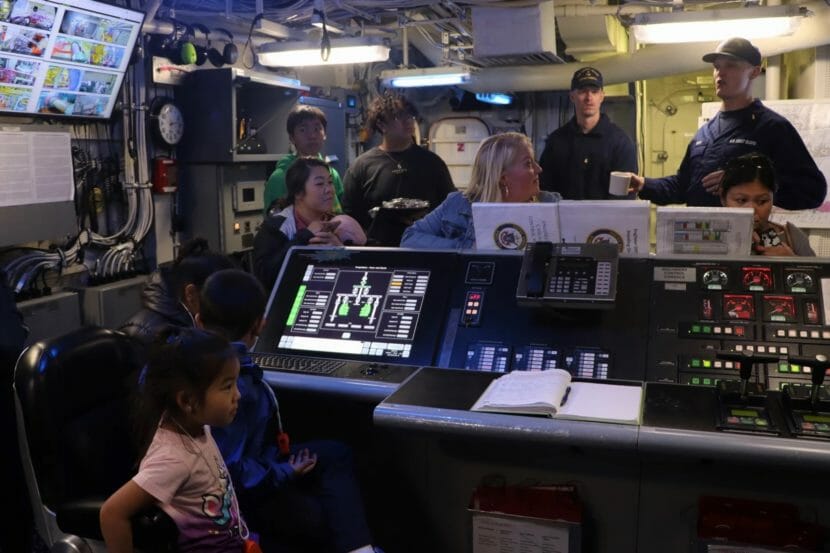
Unalaska residents tour the U.S. Coast Guard cutter Kimball during an October 2022 port call. (Courtesy U.S. Coast Guard)
About half of the visitors that boarded the ship throughout the day on Saturday were school-aged kids, he said.
“We had stations out where they could try on gear, ask questions of our specialists — whether that was our cooks or maritime law enforcement specialists,” D’Arcy said. “We had our unmanned aerial surveillance aircraft out.”
D’Arcy said the event is meant to show Unalaskans that the Coast Guard cares about their well being and safety, but it’s also a great chance for the crew to get to know the island community.
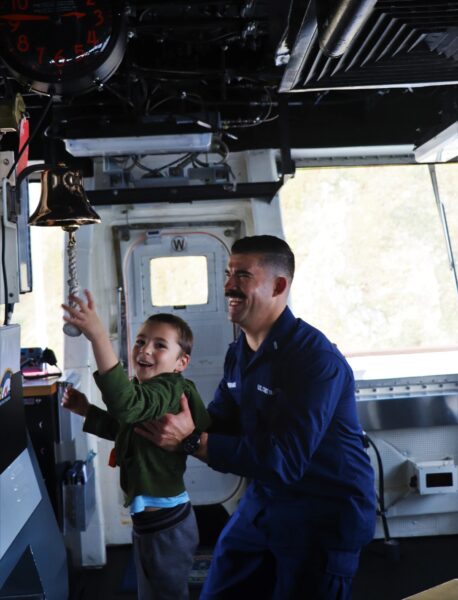
Unalaska residents tour the U.S. Coast Guard cutter Kimball during an October 2022 port call. (Courtesy U.S. Coast Guard)
“When we say, ‘Hey, we want to do open tours,’ we have more volunteers than needed,” he said. “Everyone was like, ‘Come on, can I wear (my fancy uniform)?’ … They’re eager to show what they do. And it makes me proud.”
Unalaska residents tour the U.S. Coast Guard cutter Kimball during an October 2022 port call. (Courtesy U.S. Coast Guard)
This is D’Arcy’s second trip to Unalaska, and it’s the Kimball’s second deployment to the state. Right now, the ship is about two months into its roughly three-month station in the area.
D’Arcy didn’t comment on the strategic implications of the foreign warships the Kimball encountered last month. But he said the cutter is staged for just about anything and will continue monitoring the area for foreign military activity.
“Kimball will be ready and respond,” he said. “But if there is no foreign presence and no threat there, no adversarial strategic competitor operating in our waters, then we shift to the next tasking and priority.”
For now, the Kimball will continue patrolling near Unalaska in the Bering Sea region and into the Arctic.
As the fall weather builds and fishing seasons begin picking up, D’Arcy said the crew is preparing for weather-related accidents and enforcement of fishing regulations.
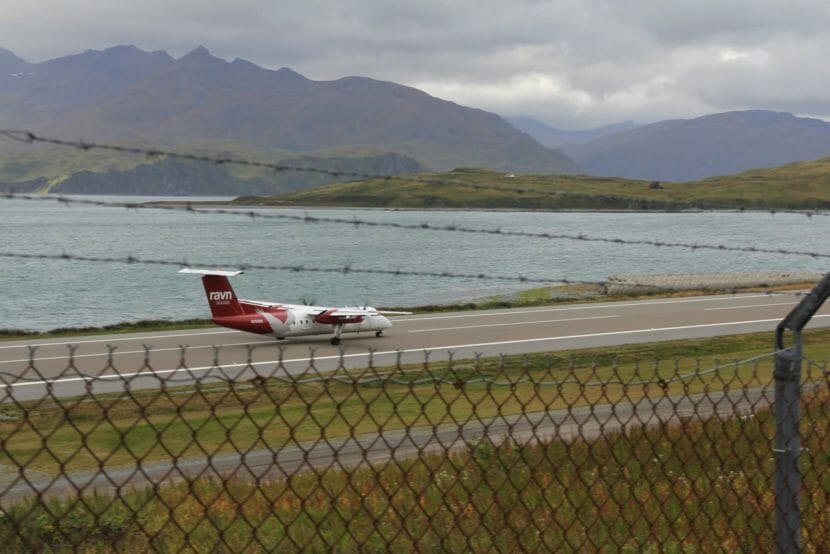
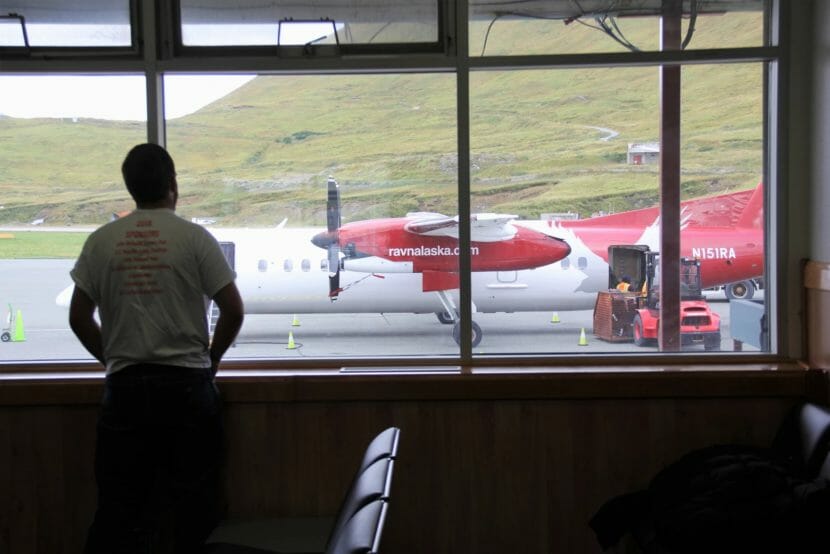
A Ravn Alaska plane at Unalaska’s Tom Madsen Airport. (Photo by Theo Greenly/KUCB)
Unalaska Fire Captain Ben Knowles was elated when he heard the news: after roughly two years of waiting, he could use his Alaska Airlines miles to purchase flights to Unalaska. Like most locals, the firefighter relies on using the mileage sharing program to afford steep airline tickets on and off the remote Aleutian island.
But that excitement quickly turned to anger and frustration when he found out just how many miles it would cost.
“Oh, great, thanks…40,000 miles,” Knowles said. “I can fly first class from Anchorage to New York for 40,000 miles. Why would I want to spend 40,000 miles on a Ravn flight that takes three hours, and my bags aren’t gonna get there, or I might not make it?”
The exorbitant cost of air travel has become a — if not the — major topic of conversation in Unalaska.
With Russia’s invasion of Ukraine earlier this year, fuel costs spiked across the nation, inciting a rise in air travel costs. Then a slew of factors compounded the problem: inflation, bad weather, pilot shortages and loads of people traveling sent those prices even higher. And in Unalaska, 800 air miles from Anchorage, nestled between the Bering Sea and the North Pacific Ocean, those costs are landing a hard blow.
It costs more miles to fly from Anchorage to Unalaska than it costs to fly to Paris.
If you’re paying cash, a one-way ticket off the island on Ravn Alaska — the regional airline that services the community — will be a minimum of about $650, but is usually closer to $750. And if you want a refundable ticket, it’ll be nearly $950, which is more than a seat on the average charter.
Even Sen. Lisa Murkowski, who visited Unalaska in August for a matter unrelated to travel, opened a speech by addressing the airfare issue.
“The cost of an airplane ticket to get out here is attention-getting,” she said. “When it’s close to $1,000 one-way to move you and your family, that’s a problem. When you have multiple cancellations and the airport packed with people, trying to come and trying to go, that’s a problem.”
It’s pretty much always been expensive to fly to and from Unalaska. It’s a doozy of a trip, involving inclement Aleutian weather and a very small runway surrounded by water and mountains.
Still, recent airfare hikes are bringing some Unalaskans to their breaking point.
“It makes everybody rethink their life moving forward,” said Unalaska City School District Superintendent Dr. Robbie Swint Jr. “And I will say, I am rethinking mine too.”
A Ravn Alaska plane at Unalaska’s Tom Madsen Airport. (Photo by Theo Greenly/KUCB)
As costs rise, spirits drop
Up until a few months ago, locals could get a one-way ticket to or from Anchorage on a Ravn Alaska flight for around $400-450 with the company’s Aleutian resident fare. But Ravn abruptly ended that program this summer. Around the same time, ticket prices began jumping. And recently, Ravn announced they would be charging for all bags, citing increased operation and fuel costs. Previously, Alaska residents were able to check two free bags.
Swint said he left the island with his family at the beginning of summer. When he went to book his tickets back, he got a startling surprise.
“Ravn did all this pretty much at one time,” he said. “We went out in June with one price, and then when we came back, it almost doubled.”
The cost for him and his family of six to leave the island is around $7,000 now, and that’s just airfare and just one-way, he said.
“I mean just to travel back and forth to Anchorage, just to Anchorage, you’re not doing anything else, no hotel, no car rental, no food, no travel — if you want to go somewhere else — it’s astronomical right now,” Swint said.
Ravn is the only airline currently providing the island with regular commercial air service to Anchorage. Charters are available through a few different companies, but several don’t offer individual seat sales. Charters also might have to make a stop or two on the way and ticket sales are generally last-minute and will probably cost just as much or more than a commercial flight.
And while Ravn and Alaska Airlines started allowing customers to purchase Ravn tickets by redeeming their Alaska Airlines miles in April, most people are still paying cash because it costs a huge amount of miles to get to or from Anchorage. Travelers used to be able to redeem a flight between Anchorage and Unalaska for about 10,000 miles, under a similar mileage program with a now-defunct airline that covered the region.
Ravn Alaska CEO Rob McKinney told KUCB that Ravn has “no control over how many miles Alaska Airlines charges for redemption.”
But Tim Thompson, a spokesperson for Alaska Airlines, told KUCB Ravn does have a choice between two award levels.
Neither McKinney nor Thompson would specify which level Ravn chose.
KUCB also made multiple queries to McKinney asking why Ravn opted to eliminate the Aleutian rate altogether, rather than raise the price. McKinney didn’t directly address those questions, but did respond in an email saying the company’s fuel cost has more than doubled over the past two years, and labor has averaged a 60% increase. He said they’re only pricing tickets based on their costs to operate to Unalaska.
Still, Unalaska Mayor Vince Tutiakoff Sr. said he’s disappointed that Ravn removed the Aleutian resident pricing, and voiced concern that community members will be forced to leave the island in light of these increasing expenses.
“A majority of our people who live here year-round depend on the opportunity to leave and go out for a vacation with their family, and a lot of them don’t make what is necessary to get out today,” he said.
Local organizations take a hit
Ravn offers discounts to certain organizations in the city, like the school district. And even though the airline sometimes gives priority to clinic patients who need to get to Anchorage but may not be in bad enough shape to require a medevac, some still struggle to fly out.
So much so, that they’re avoiding seeking medical care all together, according to Dr. Megan Sarnecki, medical director for the Iliuliuk Family and Health Services clinic.
“Now people are hesitant to go in at all because of the cost of just flying [to Anchorage],” Sarnecki said. “If your insurance doesn’t cover travel, you’re not going to get your colonoscopy and you’re probably not even going to go get that cardiology workup. So people are putting stuff off.”
She says that can be dangerous, leaving her and her staff facing scary questions like, “are we sitting on a cancer because this person can’t afford to fly in?”
Sarneck said even folks who can afford to fly are often making those trips on their own, rather than with family members.
“People are going off and getting chemo and their family can’t go be there with them,” Sarnecki said. “It’s heartbreaking.”
The clinic isn’t the only local institution taking a hit. High school principal, athletic director and longtime community member Jim Wilson said the cost of flying right now is a huge hurdle for the district.
“If you’re a young teacher making $55,000 a year, and you need to spend $5,000 to $10,000 of that on airfare, it’s difficult to make it,” Wilson said. “And so I think it’s going to impact, not only teacher retention, but I also think we’re going to see it ultimately impact — I really, truly believe — the size of the community as well. People are having to make really hard decisions about whether they want to stay or go.”
There’s no extra money in the school’s budget to help offset the cost of increased ticket prices, he said. That means fewer students will be able to travel for events. He said coaches, staff and families will have to find new ways to come up with extra money, if they want their students to compete.
“They will need to fundraise an additional amount for every one of those tickets, which is going to be anywhere from $1,500 to $2,000, depending on the price,” Wilson said.
Searching for solutions
Part of Unalaska’s problem is its notoriously challenging runway. Landing a small plane in the temperamental Aleutian weather is difficult, but it’s the only current option.
There is some glimmer of hope on Unalaska’s horizons, though. Many locals have been awaiting the return of the Saab 2000 aircraft — a larger plane that previously flew to the island, prior to its involvement in a fatal crash in 2019.
Representatives from the new regional airline previously told KUCB that they would begin offering regular flights to the island in fall 2021. Now, almost a year later, the company has run its first test flight to the island with hopes to begin selling flights soon. The airline still needs to get certification through the Federal Aviation Administration and launch a schedule, which representatives from the company said they anticipate in the fall.
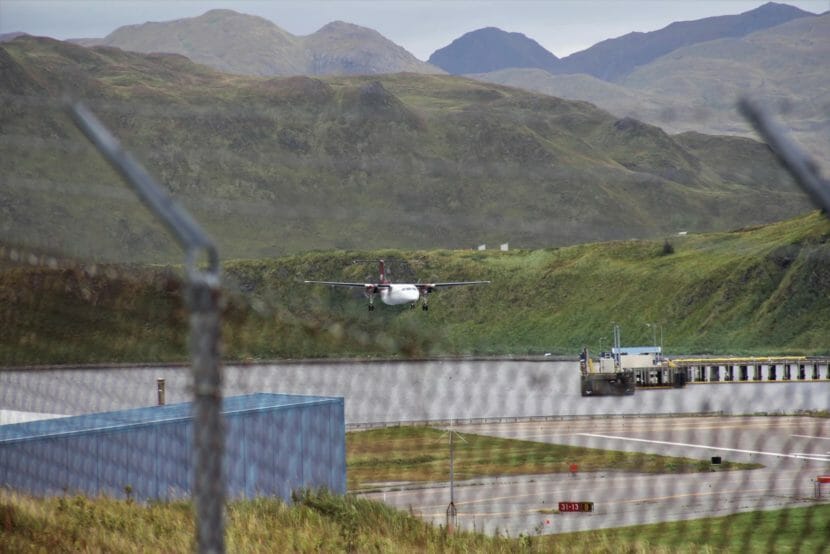
A Ravn Alaska plane on its final approach at Unalaska’s Tom Madsen Airport. (Photo by Theo Greenly/KUCB)
While many locals were excited to see the Saab 2000 on the Tom Madsen runway and the promise of competition that comes with it, the new airline doesn’t guarantee lower ticket prices for Unalaskans.
Meanwhile, city officials said they are working to arrange meetings with Ravn and Alaska Airlines, as well as the Alaska Department of Transportation and the FAA to discuss ways of alleviating current airfare costs.
There are also tentative plans to renovate Unalaska’s airport in the future, but the groundbreaking for those expansions would be millions of dollars and years away.
For now, the city is looking at appropriating some of the funding for that renovation plan toward more immediate concerns, according to Acting City Manager Bil Homka.
“I think we as a city would rather put money towards that immediate need,” Homka said. “If we can get a million dollars just to fund local airfares and spend $1,000 each, that would be about 1,000 flights, at least for locals. It’s not a permanent fix. We haven’t applied yet. We’re still looking into what we can do and what the requirements are.”
Like Homka said, some of the solutions the city is looking at aren’t permanent. They might only patch up the problem for now and most are still a ways out from actually happening. In the meantime, locals will just have to wait out the storm — or fork out the cash to leave the island, if they can afford it.
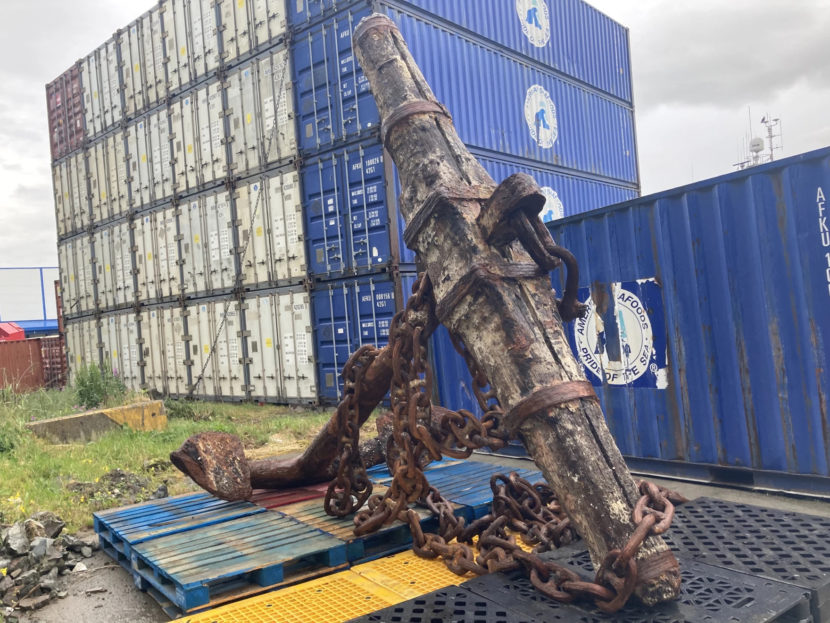
Anchor dropped off by a cargo ship in Unalaska. (Photo by Laurelin Kruse/KUCB)
A very old anchor showed up at the dock in Unalaska on Saturday. A cargo ship accidentally pulled it up while in Bristol Bay for the salmon fishery. Now someone in Unalaska has to figure out when and where that anchor came from, and how to preserve it.
Andy Pillon is the terminal manager for the cold storage company Kloosterboer, where the anchor was dropped off on Saturday. He says the refrigerated cargo ship Orange Sea had been anchored in Bristol Bay, taking on salmon. And when it heaved up its own anchor, another one came up attached to it.
“We knew they were coming with an anchor fouled on their anchor, because that’s not unusual,” said Pillon. “We just didn’t know this would be the anchor that was coming.”
By Pillon’s estimate, the anchor weighs close to 6,000 pounds. It’s made of iron and wood, and though a few barnacles are attached here and there, it’s been well preserved by the ocean water.
When Pillon and others at the dock first researched the anchor with a quick Google search, they thought it might date back to the 1600s. Pillon has since been in touch with an expert at a maritime salvage company who, at first glance, said the anchor likely dates somewhere closer to 1850.
No one from the salvage company was available for an interview on Thursday.
Pillon says the anchor is a piece of history and wants to preserve and showcase it here in Unalaska.
“We became the custodians of a really neat maritime artifact,” said Pillon. “So let’s take care of it. We’ll put it somewhere around here [where] people can come to look at it. And hopefully, in that process, we’ll learn more about it.”
For now, Pillon says the anchor is going back in the water. He was told by a preservation expert that’s the best way to keep it in shape until he can make plans to preserve it on land. After all, the water has kept this anchor intact for more than a century already.
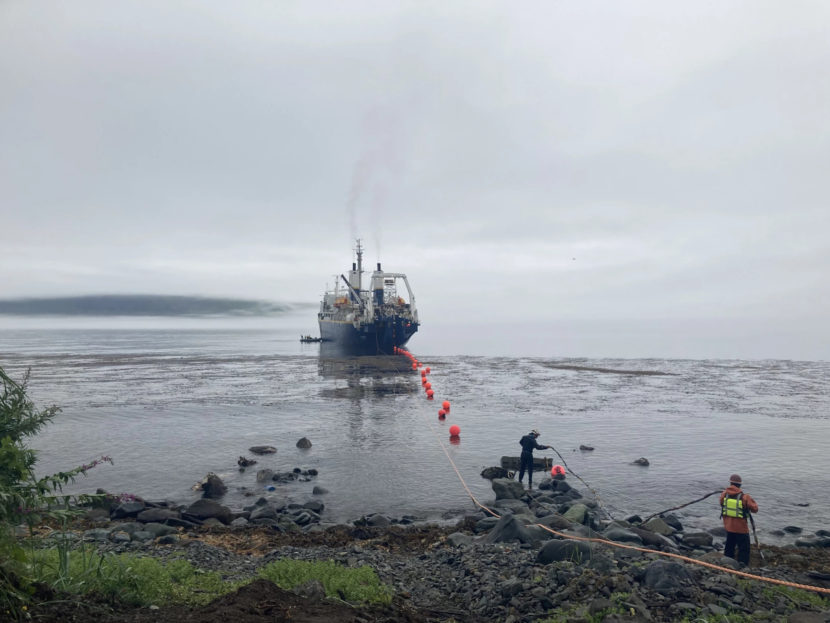
The C/S IT Intrepid begins deploying subsea fiber in Unalaska. (Photo by Laurelin Kruse/KUCB)
Work has started to lay 800 miles of subsea fiber-optic cable that project engineers say will bring high-speed internet to Unalaska and Akutan by the end of the year.
“What you will get in Unalaska is what you would get here in Anchorage,” said GCI Rural Affairs Director Jen Nelson. “It’s going to open up so many capabilities, whether it be education, commerce, or entertainment.”
GCI began surveying for the cable network — called the AU Aleutians Fiber Project — in 2017. Last week, the ship responsible for laying the cable left Unalaska for Kodiak.
Geoff Dunlop is the captain of the C/S IT Intrepid, the 377-foot ship that’s laying the cable.
“Planning a cable route is much like planning a railroad, or a goat trail,” he said. “You take the path of least risk and least resistance. Cables don’t like going over things. They want to follow a contour.”
To find the best possible route, engineers surveyed the geology and marine habitat of the ocean floor. They also met with local fishermen to make sure the cable isn’t in a position where it could get dug up by trawlers.
Once the route was set, the cable had to be specifically engineered to fit the conditions of where it will sit on the ocean floor.
The IT Intrepid typically lays cable at speeds from one to two-and-a-half miles per hour.
While en route to Larsen Bay on Kodiak, the ship will lay cable to Akutan, Sand Point, King Cove and Chignik Bay. It’s expected to complete its work by early fall.
Dunlop said bringing internet to these remote communities is part of a bigger picture — creating infrastructure for the globe.
“The reality is that there’s literally hundreds of thousands if not millions of kilometers of cable on the bottom laid by people like ourselves,” said Dunlop. “It’s not just a local event where small islands are being interconnected. It’s the global network.”
If all goes according to plan, Unalaska and Akutan will have high-speed internet by the end of this year. Service to Sand Point and King Cove will follow by the end of 2023, and Chignik Bay and Larsen Bay in late 2024.
Close
Update notification options
Subscribe to notifications
Subscribe
Get notifications about news related to the topics you care about. You can unsubscribe anytime.