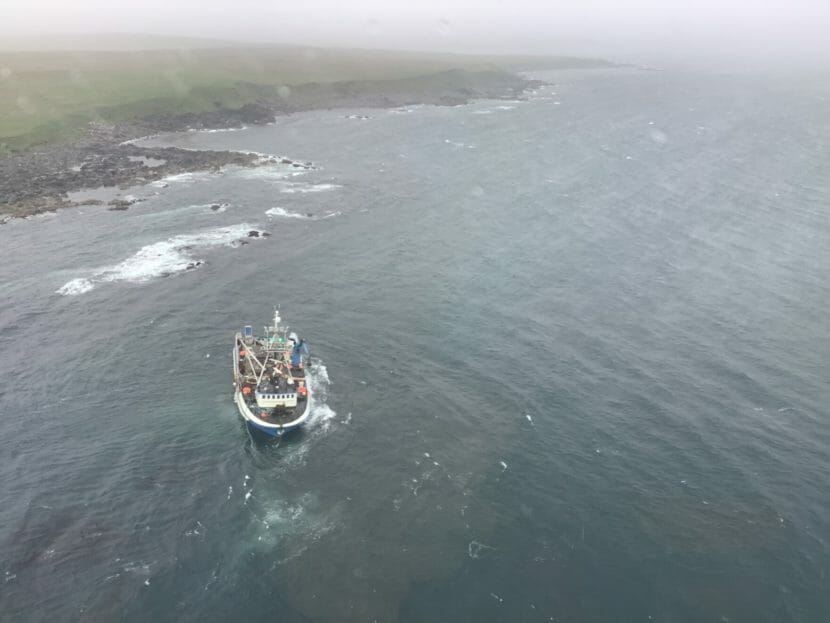
The 98-foot Pacific Sounder hailed a MAYDAY call at 10:43 Friday morning, but the crew waited three hours before they were rescued. Eventually, the Good Samaritan boat, the Polar Sea, arrived and found the crew unharmed. (U.S. Coast Guard photo)
A 98-foot fishing boat ran aground in the Eastern Aleutians on June 17 will be scuttled.
Four people were on board the F/V Pacific Sounder when it got stuck along the western shore of Unimak Island, between Unalaska and the Alaska Peninsula.
The Pacific Sounder hailed a mayday call at 10:43 Friday morning, but the crew waited three hours before they were rescued. Eventually a good Samaritan boat, the Polar Sea, arrived and found the crew unharmed.
“They were still on the boat when they ran aground,” said Nate Littlejohn, a spokesperson for the U.S. Coast Guard. “By the time the Polar Sea arrived on scene, they were wearing their survival suits.”
Littlejohn says the boat owner has hired Resolve Marine, a salvage and wreck removal company out of Dutch Harbor, to recover the boat. The first thing they will do is make sure the diesel on board doesn’t spill into the ocean. And there’s a lot of it: 21,000 gallons, to be exact.
“We sent out a Coast Guard helicopter crew Saturday who did not observe any pollution,” Littlejohn said. “That’s not to say there hasn’t been any diesel that has escaped, but we don’t know of any at this time.”
Resolve said the Pacific Sounder is too stuck for them to be able to tow it. Instead, they’ll have to scuttle it. In other words, they’ll sink it, and Littlejohn said he doesn’t know how long that will take.
“It cannot be understated how complex this operation is,” Littlejohn said, “and to make a prediction about how long it’s going to take is just not a good idea. It’s just very unpredictable how long it’ll take based on the weather.”
No reason has been given for what caused the boat to run aground. The Coast Guard is investigating.
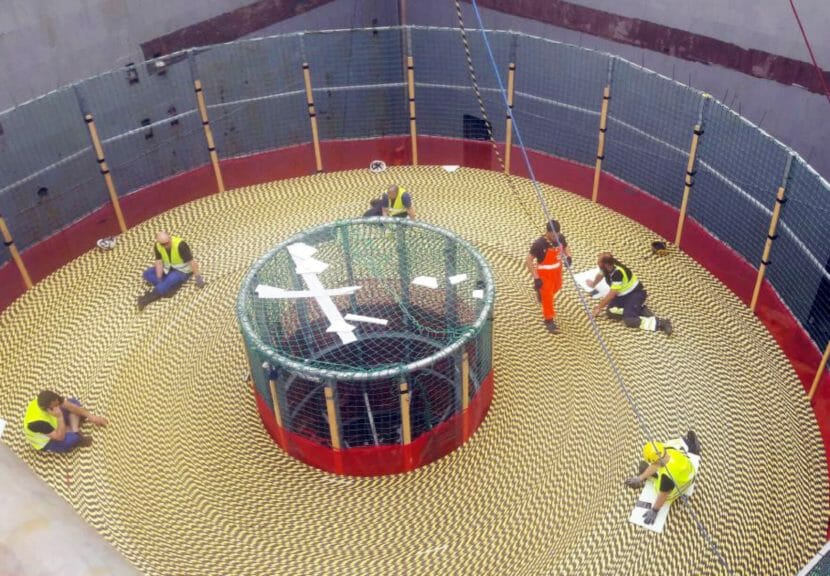
Crews carefully coiled more than 800 miles of subsea fiber into two tanks that were built on the M/V Vertom Thea in Germany. (Photo courtesy of John Edge/GCI)
Nearly 2,000 tons of subsea fiber has begun the journey from Europe to Alaska and its eventual home on the ocean floor along the Aleutian Chain.
The fiber — which is the foundation of GCI’s 800-mile Aleutians Fiber Project — would close the digital divide and bring high speed internet to homes in some of the most remote communities in the nation, including Unalaska.
In a statement, GCI said the construction and delivery of the specialized fiber is a major project milestone amid global production and supply chain issues.
“Subsea fiber, like what will be used in GCI’s AU-Aleutians Fiber Project, isn’t something that’s just sitting in a warehouse, waiting to be loaded onto a plane for its next deployment, and it’s not something you can buy from your local electronics store,” said Rebecca Markley, GCI’s principal portfolio program manager.
“It takes a highly specialized facility to build hundreds of miles of armored, sealed fiber specifically designed and made to order for large-scale infrastructure projects,” Markley added. “There aren’t many companies in the world capable of meeting the material needs of a project like AU-Aleutians — and even if they can, it doesn’t happen overnight.”
Because there are so few companies that can build the fiber needed for the project, GCI contracted with a cable producer in Germany late last year.
More than 3.7 million pounds of subsea fiber – with segments up to 230 miles long – has now been loaded onto a cargo ship and is traveling the 12,000 miles to Unalaska, according to the company.
It will make its way through the English Channel, across the Atlantic Ocean, through the Panama Canal, and up the Pacific coast to British Columbia where it will then be loaded onto two cable installation vessels and complete its journey across the Gulf of Alaska to Unalaska.
The Aleutians Fiber Project will run from Kodiak along the south side of the Alaska Peninsula and the Aleutians.
The project is scheduled to deliver service to the communities of Unalaska and Akutan by the end of this year, Sand Point and King Cove by the end of 2023, and Chignik Bay and Larsen Bay in late 2024.
“While some GCI projects have required us to practically move mountains, the AU-Aleutians Fiber Project has practically required us to part the proverbial seas,” said GCI Rural Affairs Director Jen Nelson. “The logistics of making a project like this possible are complex, but the end result of delivering transformational levels of connectivity to the Aleutians makes every foot of fiber and years of work worth it.”
The project is expected to cost $58 million. GCI was awarded a $25 million grant from the U.S. Department of Agriculture in support of the project in late 2020.
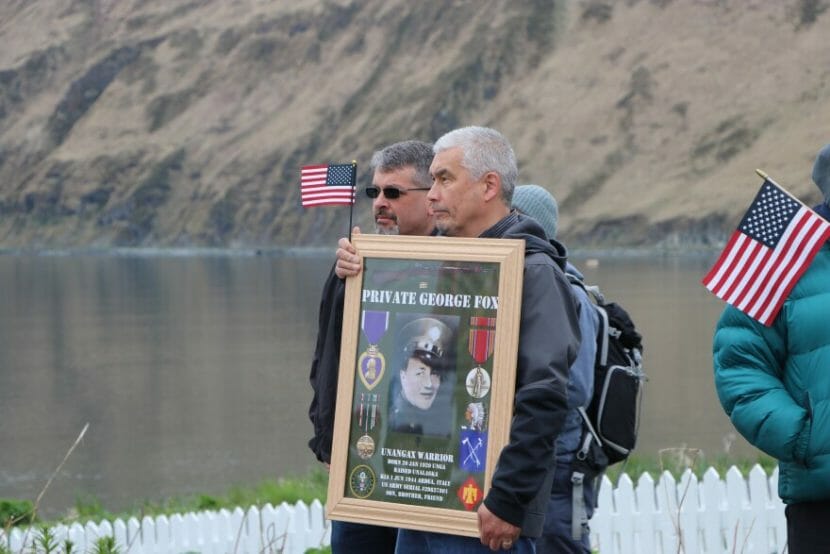
Jim Shaishnikoff holds an image of Fox outside of Unalaska’s Church of the Holy Ascension during the procession. (Kanesia McGlashan-Price/KUCB)
For nearly 80 years, a small American flag placed by an old friend was the only thing that stood above the tundra marking Pvt. George Fox’s plot in Unalaska’s cemetery.
That changed last week when the decorated veteran’s resting place was finally recognized.
Fox is the only known Unangax̂ soldier killed fighting in World War II, or in any war since. For decades, he was buried in an unmarked grave. This Memorial Day, he was finally honored with a gravestone in a long-awaited burial ceremony that drew crowds from across the state and Lower 48 to the remote Aleutian community.
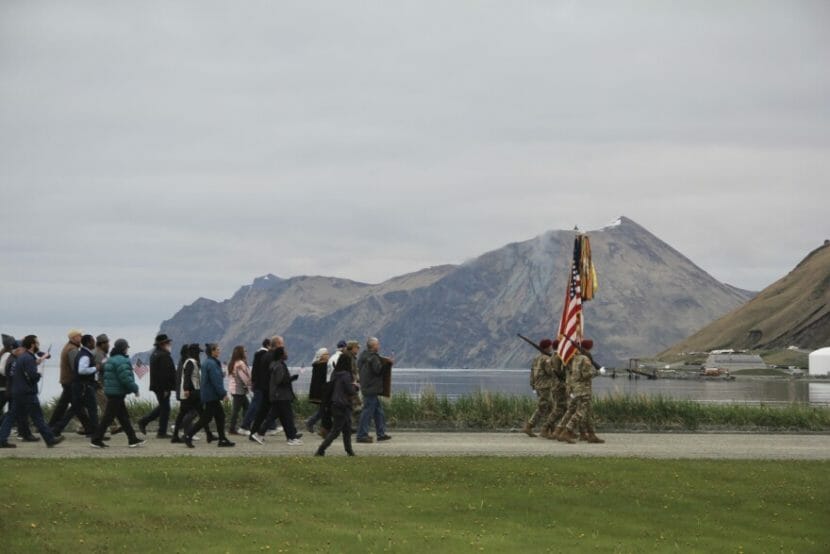
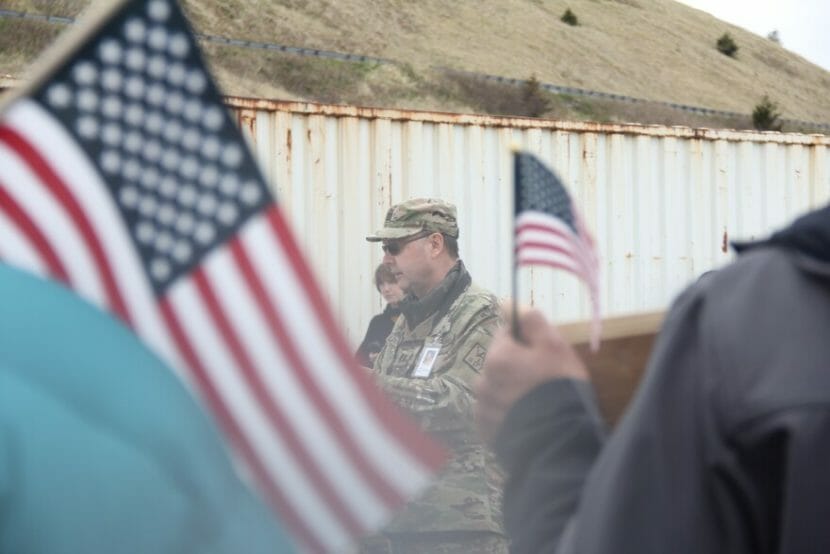
Officials unveiled an honorary gravestone during the ceremony, which included an Army color guard, a 21-gun salute and a speech from Fox’s former neighbor following a procession down Unalaska’s Front Beach.
Had it not been for the heavy Aleutian fog, members of Fox’s family and Sens Dan. Sullivan and Lisa Murkowski also would have flown in to speak in his honor. Representatives from the Aleutian Pribilof Islands Association, the Aleut Corporation and members of the VA Alaska Health Care System were in attendance.
During the ceremony, which included an Army Color Guard, a 21-gun salute and a speech from Fox’s former neighbor, officials unveiled an honorary gravestone, following a procession down Unalaska’s Front Beach. (Theo Greenly/KUCB)
Fox was born in 1920 on Unga Island, the largest of the Shumagin islands, about 250 miles northeast of Unalaska. Census data shows that he and his mother moved to Unalaska by 1929, and he joined the military when he was about 21 years old, according to Michael Livingston, who played an integral role in getting Fox’s gravestone ordered. Livingston works for the Aleutian Pribilof Islands Association and spent years uncovering lost details about Fox’s past.
Fox was killed fighting in Ardea, Italy, in 1944. About five years later, his remains were returned to Unalaska. Following a small ceremony, Livingston said he was buried in an unmarked grave next to his mother at the island’s cemetery. It took a lot of work and perseverance to confirm that his body was in Unalaska, he said.
While Sen. Sullivan tried but failed to make it to the special ceremony, Livingston said he played a key role in finally moving the process forward and ordering the grave marker last May.
Livingston and a few others have been researching and battling for years to get Fox his deserved recognition.
“It really is a decade in the making,” Livingston said. “A lot of people have been working on this to try to find out the information we needed to honor Pvt. George Fox. And a lot of people have been working to get the gravestone ordered. We’re just grateful for all the support.”
He said two locals recently discovered that in 1941, Fox signed a petition to incorporate Unalaska, also making him a founder of the Aleutian town.
Unangax̂ Elder Gertrude Svarny was Fox’s neighbor growing up. She said he was a friend to her older brother.
After Fox died in the war, Svarny would walk to his grave every Memorial Day and place a small American flag on the overgrown plot. This year, thanks to Livingston’s planning and outreach, her small flag was just one of several dozen that were brought by supporters from across the state who made the trek up the hill to his grave.
Micheal Livingston gives a speech during the procession. Livingston and a few others have been researching and battling for years to get Fox his deserved recognition. (Theo Greenly/KUCB)
Following a prayer and hymn from Unalaska’s Father Evon Bereskin, Svarny and Livingston pulled an American flag shroud from the stone, revealing the new marker to the locals and visitors gathered at the base of Mount Newhall.
In a speech following the unveiling, Svarny said that to fully understand what this recognition means, people need to know the region’s history.
“When I was 12 years old, my village survived the bombing of Unalaska Island by the Japanese,” Svarny said. “Shortly thereafter, we were forced to leave home.”
“We were dropped off in abandoned canneries, gold mines and logging camps in Southeast Alaska, stripped of our civil liberties,” she told the crowd. “And it changed our lives forever. Even as this was happening to us, our sons and daughters, our brothers, sisters were signing up to fight for the United States in the war.”
She said that spirit is in part why she and others survived the camps.
“This ceremony today symbolizes the recognition of the many Unangax̂ people who served in their country,” Svarny said. “If I could wish anything, I would wish that we would all teach our children to care deeply about the welfare of their friends and neighbors. We are nothing without the community around us.”
Fox’s marker is engraved with his own words: “Wish all love.” They come from a letter he wrote to his father just weeks before he died.
Livingston read that letter in Monday’s ceremony.
“‘I would sure like to be fishing,’” Livingston read. “‘This makes three seasons that I have missed fishing. We have transferred into infantry and are seeing some action. I’m getting along fine. Don’t worry about me. Write often, and I wish you all the love. Will write more later. Your son, George.’”
The gravestone also includes Fox’s name, his date of birth, his honors, including a Purple Heart, and his recognition as an “Unangax̂ warrior.”
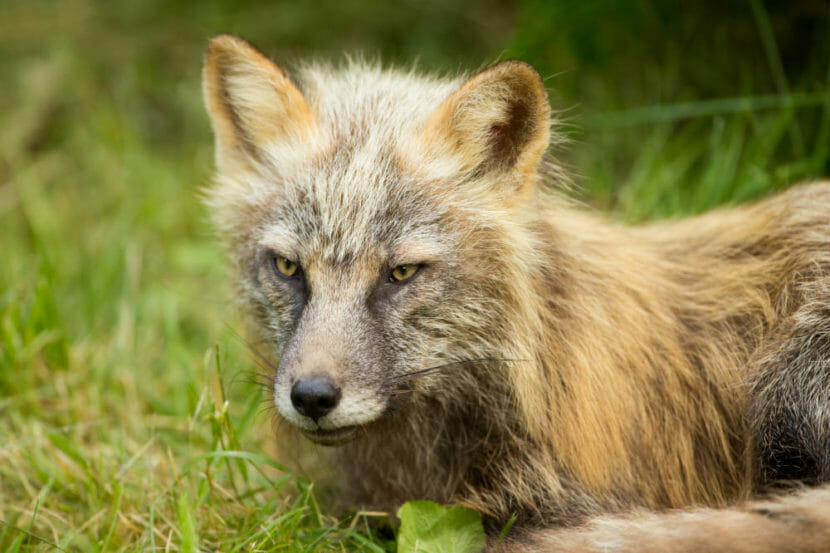
The red fox is found throughout much of Alaska. (Lisa Hupp/U.S. Fish and Wildlife Service)
The new strain of bird flu that arrived in Alaska with the spring migration has now been detected in a fox that died in the Aleutian Islands.
Wildlife officials say the red fox, as well as eagles, found dead in the Unalaska area, were most likely feeding on birds that had died from the H5N1 avian influenza.
State veterinarian Dr. Bob Gerlach says that’s different from previous strains of bird flu.
“We generally don’t see avian influenza causing problems in these species, but this is an unusual case,” Gerlach said. “So between that and the significant number of mortalities among waterfowl, it’s a concern and significant.”
The H5N1 bird flu has caused the deaths of millions of poultry in the Lower 48, as well as wild birds and some foxes there.
In early May, Alaska confirmed its first case of the virus. It was found in a non-commercial flock of chickens and ducks in the Matanuska-Susitna Borough. But so far, wildlife officials say, it has not impacted domestic mammals in Alaska, and this strain and previous strains have not proven to be a significant health concern for humans or domesticated dogs and cats.
Those pets could still be susceptible, and Gerlach says there are plenty of other reasons to keep pets away from wildlife, especially dead birds.
“If there is a dead bird or dead animal there, we don’t know what they died from,” Gerlach said. “If it’s not influenza that’s transferred, it could be either bacteria or maybe another virus that is transferable, and the most common ones we see are salmonella and E. coli. And then obviously those can be transferred to people, too.”
Alaskans harvesting birds or other wildlife for food are urged to use the usual safety precautions, like wearing gloves, thoroughly cooking meat and not eating animals that appear to have been sick.
Anyone who sees a sick bird or one acting strangely, or the carcass of a bird, if the cause of its death is not readily apparent, can call the U.S. Fish and Wildlife Service’s Alaska Sick or Dead Bird Hotline. That number is 1-866-527-3358.
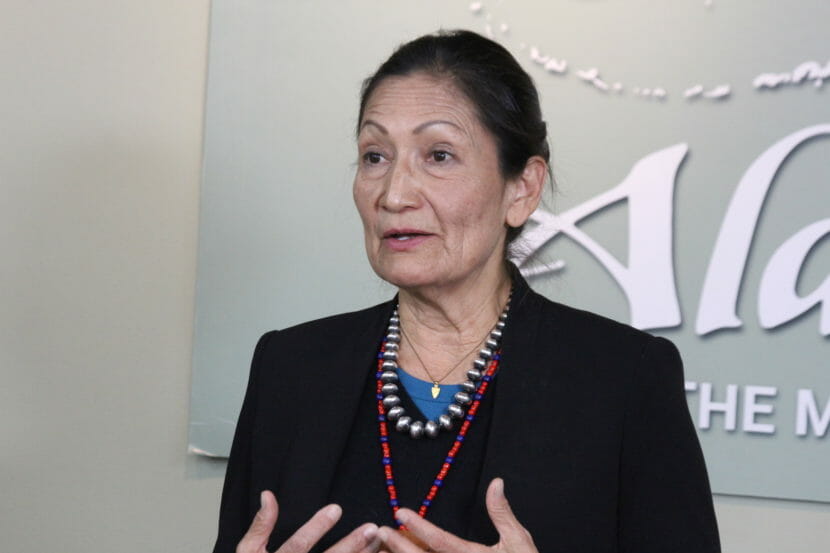
Interior Secretary Deb Haaland speaks at a news conference at the Bureau of Land Management-Alaska headquarters in Anchorage on Thursday. (Photo by Wesley Early/Alaska Public Media)
Interior Secretary Deb Haaland says she’s still undecided on the proposed 11-mile gravel road that would link the Southwest Alaska village of King Cove with the nearby community of Cold Bay.
Haaland took a tour of the village Wednesday during her first visit to the state. At a news conference Thursday in Anchorage, Haaland said the trip was an opportunity to hear from the community first-hand.
“I know it’s been a decision that’s been in the atmosphere for the last three decades,” Haaland said. “I wanted to go to hear, to visit with the community, to see the geography and understand the challenges they face.”
The King Cove road has been discussed for decades. The predominately Aleut residents of King Cove, as well as Alaska state and federal lawmakers, have long pushed for the road. They say it’s a safety issue. The road would connect the village to Cold Bay’s all-weather airport and emergency flight services for evacuating patients. But the road would go through the Izembek National Wildlife Refuge, which environmentalists oppose due to the potential impact on birds on those federal lands.
Haaland was in King Cove with U.S. Sen. Lisa Murkowksi and Gov. Mike Dunleavy. During her trip, she said, she heard from residents about the importance of the road due to various transportation and medical challenges. As of now, she said, she’s made no decision on the road project.
“I can say that I’m still in a learning process at the moment, and I don’t have anything else to announce today about that decision,” Haaland said.
In a statement from the Aleutians East Borough, which includes King Cove, village health care provider Bonita Babcock described the medical necessity of the road to Haaland.
“We’re not asking for a lot,” Babcock said. “We’re just asking for the federal government to care about our people enough to permit a dirt road across our ancestral land so that we can get our patients over to a medevac plane.”
Haaland has long championed environmental protection for federal lands. During her confirmation process last year, she committed to meeting with residents of King Cove to talk about the road project.
Last month, a federal court ruled in favor of a Trump-era decision to approve a land exchange between the federal government and King Cove’s village corporation that would allow for the road to proceed. The ruling reverses a 2020 federal court decision banning the exchange. President Biden’s administration defended the land exchange agreement last March.
The final decision on approving the exchange now rests with Haaland. She said the land agreement is pending legal review and a decision could come in the near future.
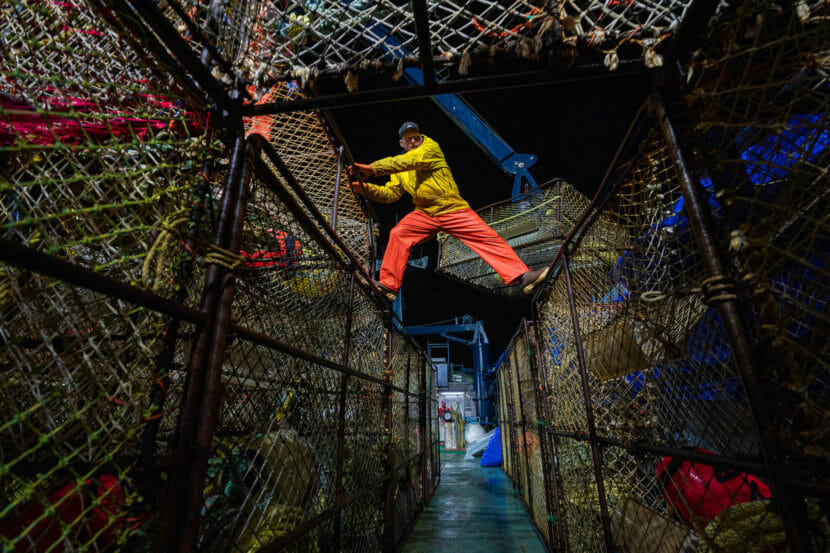
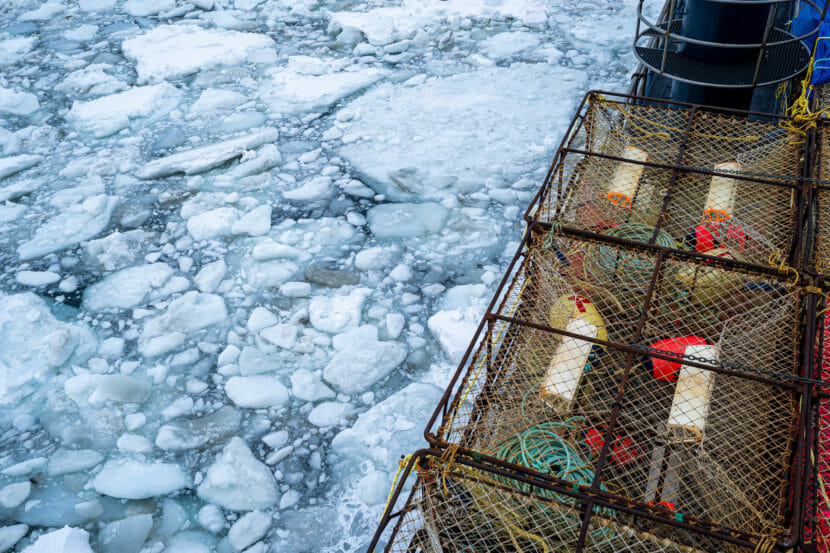
Jerret Kummer helps secure crab pots aboard the Pinnacle on Saturday, Jan. 15, 2022 in Dutch Harbor. For this particular trip, captain Mark Casto decided to bring 150 crab pots and 15 cod pots, which must be carefully stacked and secured for the multi-day journey from Dutch Harbor to the fishing grounds north of St. Paul Island. (Photo by Loren Holmes/ADN)
Bering Sea crabbers and communities in the region are struggling with a steep decline in snow crab this year, likely the result of climate change.
That caused the crab fleet to push farther north than usual and forced places like St. Paul to consider major budget shortfalls, because the Pribilof Island city depends on taxes from fish and crab processing.
The snow crab crash and its impacts are the subject of a recent reporting collaboration between the Seattle Times, the Anchorage Daily News and the Pulitzer Center’s Connected Coastlines reporting initiative.
As part of the “Into the Ice” series, Seattle Times reporter Hal Bernton and ADN photographer Loren Holmes spent two weeks in January aboard a crab boat called the Pinnacle, one of the biggest in the fleet at 137 feet.
Bernton says he felt safe on the Pinnacle, but the potential for problems from ice — both on the water and the boat — were always in the back of his mind.
Listen here:
The following transcript has been lightly edited for length and clarity.
Hal Bernton: Very early on, we started to see small bits of ice, and then kind of rivers of ice. And as we moved away from this ice, though, the winds were blowing quite strong, and we started to accumulate quite a bit of freezing spray. And that was somewhat concerning to me, since I have written a lot about what can happen with freezing spray undermining vessels’ stability. And I do remember one conversation with Skipper Mark Casto, where I was kind of watching the ice accumulate on the bow, and Mark looked at me and said, “Well, Hal, are you nervous? Because I’m not nervous. And until I’m nervous you shouldn’t be.” And really, he took things slowly and cautiously through most of the trip. So while we accumulated ice, we always took the time to get it off the boat, and I began to feel more comfortable with the conditions that we were facing.
The crab fishing boat Pinnacle eases through an icy patch of water north of St. Paul on Monday, Jan. 17, 2022. Most fishing boats that operate in the Bering Sea can travel through some amount of unconsolidated sea ice, although at a greatly-reduced speed. An ice floe with pieces like this can damage buoys, increasing the risk of a lost crab pot. (Photo by Loren Holmes/ADN)
Casey Grove: I just have to ask, as somebody who has dealt with this myself in the past, do you get seasick?
Hal Bernton: Yeah, I do. And that was a serious concern. I was going to bring along with me, I did bring along with me, scopolamine patches, and they worked remarkably well. I can honestly say, much to my surprise, that I didn’t get seasick on this trip. I just kept waiting for those waves of nausea to come over me, and it just never did. I was very happy about that.
Casey Grove: Well, at the heart of this reporting that you did were snow crab numbers. So what’s going on with those snow crab numbers? And how steep of a decline have they seen?
Hal Bernton: Well, it’s really pretty stunning for some of the biologists who do the surveys because, of course, in 2020, because of COVID, they were unable to do the summer surveys of crab population. So they did them in 2019. And when they came back in the summer of 2021, they found these staggering drops in abundance of different populations of the snow crab. The juvenile females were down by more than 99%. The juvenile males were also way down. And they’re also less of the mature males and the mature females. So this really triggered a major reassessment of what would be a safe level of harvest for this 2022 season. And they ended up still having a harvest, but reducing it by nearly 90%. And where people found the crab, where they could find the crab, also changed quite a bit from many years past, because it used to be that around the Pribilof Islands in the southern areas of the Bering Sea, the crab were quite abundant. But the surveys indicated, and also the crabbers experience from last year, that most of the remaining strong pockets of mature males that they were looking to harvest were much farther to the north. So trying to find the crab in the north meant encountering some pretty tough conditions.
Casey Grove: Why are they being found farther north, and what do researchers think happened that led to that crash?
Hal Bernton: Well, the ice — as hard as it was for the crabbers to deal with — really was an encouraging sign. Because the ice helps form — as it freezes and melts — this cold pool at the bottom of the Bering Sea. And the snow crab, they really do very well in this cold pool, and it acts as kind of a refuge for them, because Pacific cod and other predators don’t like the cold pool as much. And when the cold pool shrank, scientists think that basically that opened up the snow crab, they became a lot more vulnerable to predators like Pacific cod. And that was one of the causes of their dramatic decline. But they’re still not sure all the reasons why the populations have dropped so sharply. But clearly the ice. And the ice this winter has been an encouraging sign that perhaps there’ll be a bigger cold pool in the summer and more protection for the snow crab, and they can start — at least over the short term — to rebound. But, over the longer term, as I reported, forecasts are that winter ice will become much more scarce, and that the temperatures will climb in the Bering Sea, and it will likely become a lot less hospitable to the snow crab.
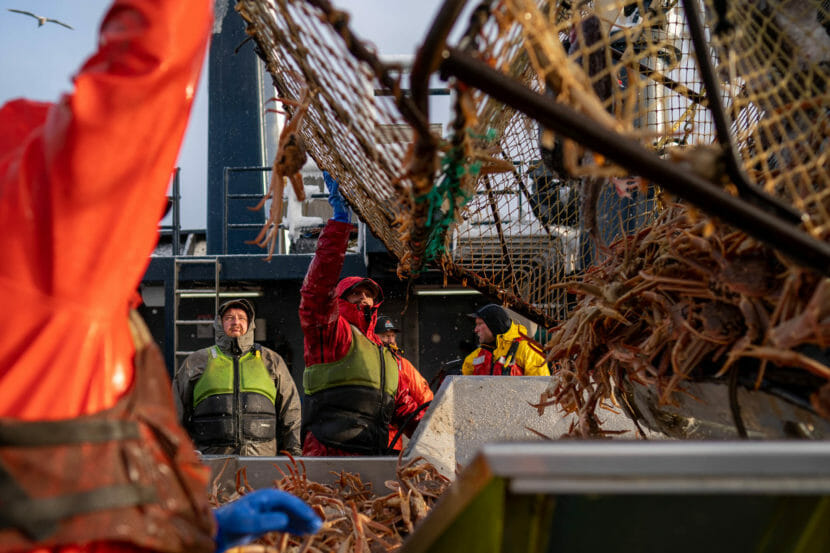
The crew of the Pinnacle unload a crab pot on Monday, Jan. 24, 2022 in the Bering Sea southwest of St. Matthew Island. Each pot is large enough to hold over 1,000 crab, but catches of that size are no longer common. (Photo by Loren Holmes/ADN)
Casey Grove: I want to ask you about St. Paul and those other Pribilof Island communities. Because I can imagine for the crabbers, if there’s less crab to catch, they might make less money, depending on what the price is. But if that decline in population continues, what are the practical implications for folks that just live in the region?
Hal Bernton: On St. Paul, there is a Trident Seafoods crab plant that takes more than 160 people during the crab season to harvest crab. But for the most part, they bring workers in from other parts of the country or they also recruit in some other countries. So in terms of actual jobs, the plant isn’t hugely important to the people who live on St. Paul. But it generates a lot of revenue for taxes. The city of St. Paul depends significantly on the taxes that flow from processing the crab. So with this big downturn in the crab processing, they face some really significant budget shortfalls as they look to make their budgets for next year. And really, this is an island that has had a lot of investments to try to broaden the economy and shift from the old days, prior to the 1980s, when there was a commercial fur seal harvest, to an economy based on the seafood industry. Like the halibut fleet, there’s a local halibut fleet that is very important for people on the island and offers a lot opportunities for summer fishing. I found that despite all the efforts to broaden the economy and some significant success stories, the population had declined from over 700 in the early 1990s, to what I was told from some of the city officials, a population of about 360 currently. So it’s dropped, you know, a lot, and that surprised me somewhat.
Casey Grove: It sounds like there’s the potential for a significant revenue loss there in the city budget. How is the city bracing for that? And does it seems like the community is preparing for cutbacks?
Hal Bernton: What I found was that the big concern is that there’ll be an acceleration of the population decline that’s already taken place. You know, some people have moved to Wasilla, or Southcentral Alaska has been a popular destination for people who have left the island. And they’re worried that if the crab resource stays in decline, that that will just sort of accelerate an exodus from the island. And people who live on the island, of course, they’ve worked really hard to develop the opportunities — the economic opportunities. We haven’t talked much about the Central Bering Sea Fishermen’s Association, which is a CDQ (Community Development Quota) group basically vested with shares of the seafood resources in the Bering Sea. They’re based in St. Paul, and they operate vessels and help actually subsidize fuel costs for residents. And that group has done a lot to try to maintain economic opportunities in St. Paul.
Casey Grove: Yeah, that is interesting. And there are different user groups that have different ideas about these issues. But you reported that some tribal leaders are pushing for more involvement in how those fisheries out in the Pribilofs are managed. Have you heard any specifics on how they would better manage the resource?
Hal Bernton: The tribal government on St. Paul basically developed an application submitted to the Commerce Department for the designation of a national marine sanctuary that would encompass a 100-mile perimeter of waters around the Pribilofs. And they are not trying to, they say, manage the fishery resources. What they want is more input into the North Pacific Fishery Management Council about how that area might be managed. And they described the process to me where they would get together with the fishing industry and other, what they called, stakeholders and say, “Hey, what could we do differently to perhaps give more protection to the fur seals, which had been in a long-term decline, bird populations, other marine mammals, and how better could this area be protected?” They would also like to have more input into how different types of research is conducted around the islands. And they have a new facility there that they would like to see more involved in the research. So this is all very much a work in progress. Not a lot of details in terms of specifics about what those types of proposals would be. But first, the Commerce Department has to go through this fairly lengthy review process and decide over, I would imagine, a course of years about whether this would indeed get a designation as a national marine sanctuary.
Casey Grove: Is there anything else you want to add, Hal, that I didn’t ask you about?
Hal Bernton: I did want to say that we thought that the trip would maybe take eight to 10 days, and it ended up we were at sea for almost two weeks, because it was a very slow harvest. Often we had to slow down to avoid taking on too much freezing spray, or we had to stop and shovel ice. And then the crabbing itself was initially kind of spotty. Mark Casto would study maps, he would talk with his brother and he would consult his old records of where he’d crabbed in the past and found a lot of crab. And you’d find this year that there were pockets of really pretty good crabbing, but that they quickly sort of petered out. And if you strung too many pots in a certain line, maybe that had worked in years past, but this year, only a portion of those pots were really catching significant quantities of crabs. So the whole thing proceeded very slowly. And we were very grateful that the crew put up with us journalists, kind of underfoot, for as long as they did.
Casey Grove: I can only imagine. That just reminded me of there was a piece in your in your story about how the “Deadliest Catch” reality TV show folks did not want to film on the Pinnacle, because things were too smooth and there wasn’t enough drama or something like that?
Hal Bernton: Yeah, it was interesting to us to see how big of an impact “Deadliest Catch” had in Dutch Harbor. This year, they’re featuring nine boats from the fleet all going out fishing, and because of the diminished harvest, the last time I checked, there was less than 40 boats that were actually registered to harvest. And so almost a quarter of the fleet was going to be appearing on “Deadliest Catch.” And, you know, you could tell those boats because of course they had cameras mounted on the boats and maybe a producer. One boat, when it jogged around the harbor, had a helicopter flying overhead. And basically, Mark Casto, the skipper of our boat, he told us that at one point there had been discussions, many years ago, about possibly including the Pinnacle as part of that fleet. But they basically had taken a look at the boat, and it has a lot of protection from waves, the crew is kind of a no-drama crew, and they decided it really wasn’t a good fit for them. So I thought that was kind of interesting, because of course the show really thrives on drama and conflict.