Aleutians

Unalaska fisherman hopes youth program can revitalize island’s fishery

On nice weekends, F/V Raven Bay captain and owner Dustan Dickerson takes about three local teens on a short trip just a few miles from town for a behind-the-scenes look at the life of Unalaska’s small boat fishermen. (Photo by Maggie Nelson/KUCB)

It was still dark at Unalaska’s Robert Storrs Small Boat Harbor, just before 5 a.m. on a fair spring morning. Normally, Dustan Dickerson and his three-man crew would be warming up the engine of the 54-foot Raven Bay by now so they could head out a few miles to haul and set cod pots, eat, sleep and repeat for a couple days before returning home.

But on this mid-March morning, the crew was joined by three sleepy-eyed greenhorns: Corynn Lekanoff, Kaidon Parker and Anatoly Fomin.

The three local teens were headed out for a day trip to get a glimpse into the life of Unalaska’s small boat fishermen. The trip is part of an outreach program led and started earlier this year by Dickerson, captain and owner of the Raven Bay. It’s meant to provide local youth with the chance to get on a boat and see what fishing is all about.

Kaidon Parker, 14, had just started his spring break that morning. Despite the heavy bags under his eyes, he was eager to set sail.

“I’m not [sick] yet,” Parker said when asked if he gets seasick out on the open ocean. “On ‘Deadliest Catch’ when the waves are hitting the boat and they’re all like falling over and stuff — I thought that would be kinda fun.”
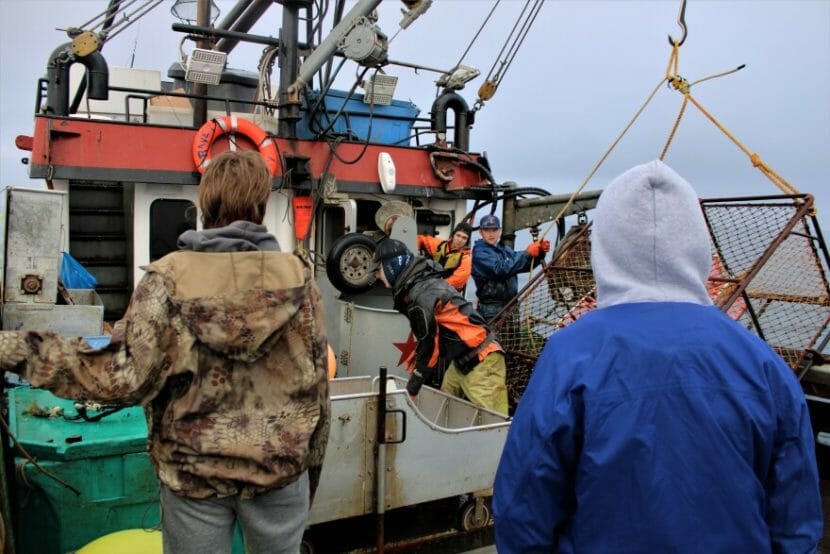
Deckhands on the F/V Raven Bay. “There’s a beauty to it,” said 20-year-old local deckhand Scott Lorenzen. “It’s just fun to be able to go out there and experience the raw Aleutian wilderness.” (Maggie Nelson/KUCB)

Unfortunately for Kaidon — while there was no “Deadliest Catch” galley drama, cranky captains or climactic 50-foot waves — he learned the hard way that he does in fact get seasick.

But that lesson was, in part, what he came for — a chance to test the waters and learn more about fishing in the Aleutians.

“Last summer, I actually asked [Dickerson] if he could take me and some friends out, and he told us that we should invest in a little boat and a tote and a jigging machine for fish,” Kaidon said. “But we couldn’t do that. We didn’t have any money.”

Ultimately, Parker got a better deal: a free trip to the fishing grounds and a behind-the-scenes look at how a local fishing veteran runs his boat.

Dickerson owns and operates the Raven Bay and has been working in Unalaska’s fishing industry since the late ‘80s when he came to the island. He bought his first boat, the Katie Jean, in ‘93.

“I was 25 years old in Corvallis, Oregon visiting a friend,” Dickerson said. “And this guy from Alaska came over and started telling these incredible stories. And I thought, ‘I’ve got to go there.’ And so I bought a plane ticket to Dutch Harbor and never left.”
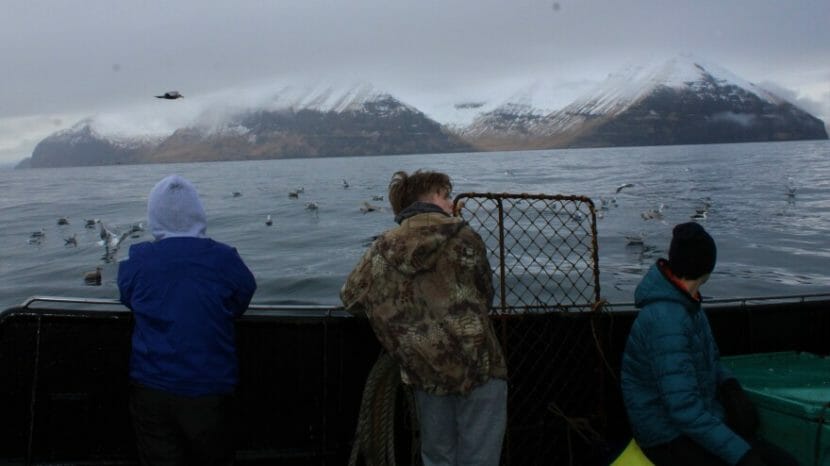
The three local teens watch seagulls trail the boat, as the crew waits to haul another string of pots. Pictured left to right: Corynn Lekanoff, Kaidon Parker and Anatoly Fomin. (Photo by Maggie Nelson/KUCB)

Since then, Dickerson has seen the industry ebb and flow and watched the small boat fisheries and once-young fishermen evolve and start to grow old. Dickerson said things like a lack of local boats along with the aging community have led to a shortage of younger Unalaska fishermen today.

Rather than sit back and watch the fishery dwindle, he got some help from the Unalaska Native Fishermen’s Association’s youth program and took things into his own hands.

“If we can’t find deckhands, then we need to mentor them,” he said. “We need to make them ourselves and that means we need to get them involved.”

On nice weekends, Dickerson takes about three local teens along for a short trip just a few miles from town. He shows them how a commercial fishing vessel runs. UNFA is helping fund the program by paying for things like crew licenses and survival suits for Dickerson’s extra passengers.

Dickerson, who is a UNFA board member, said working with the organization to revitalize the local fishery is not only important for his generation of fishermen and boat owners, but also for younger folks. It’s not as easy for fishermen to get a foot in the door as it once was, he said.

“It’s important to preserve opportunities for people that are just getting started, otherwise we will have a big problem,” he said. “Otherwise there won’t be any more small boats because once I retire unless I pass this boat along, how is somebody in the community gonna get started?”
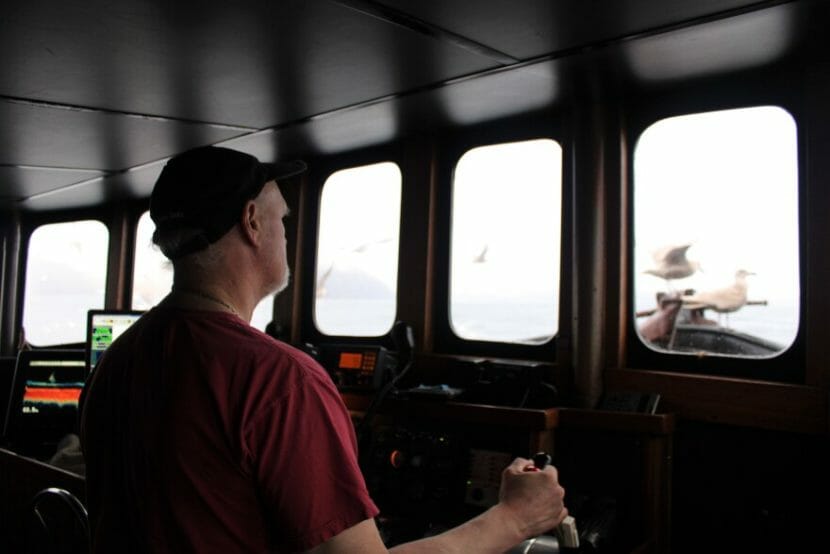
Dickerson owns and operates the Raven Bay and has been working in Unalaska’s fishing industry since the late ‘80s, when he came to the island. He bought his first boat, the Katie Jean, in ‘93. (Photo by Maggie Nelson/KUCB)

Dickerson’s story is one that he said is less feasible now. He entered the fishing industry first through processing, then went to longlining, bought his first boat and finally got into pot fishing in the under 60-foot fleet, which locally he said saw major growth around the early 2000s.

He said, prior to that, it was easier for a local to buy a skiff and get a jigging machine, then jump to longlining and eventually buy an entry-level boat. Now, Dickerson said it’s much harder to jump from jigging on a skiff to owning and operating a smaller boat like the Raven Bay, or even just long-lining in a skiff. A big part of that, he said, is the combination of how cod is allocated and the growing number of larger boats in the under 60-foot fishery.

Part of the solution lies in the hands of fisheries boards and councils who determine how the catch is allocated, but it’s also about exposure, he said. Cue the youth outreach program.

Since the program started, Dickerson said they’ve taken a total of three trips, and they’ve got teens on standby now, waiting for their turn to hop on board.

“What it’s doing is creating a labor pool that we really need in the industry,” he said. “Kids that have been exposed to commercial fishing are far more likely to get into the industry than having graduated from high school without ever being on a boat.”

While the program may be fulfilling a more complex purpose, Dickerson modestly describes it as a simple way of facilitating an already existing interest in local fisheries. It’s as basic as bringing curious youth, like Parker, along for a quick trip out to the fishing grounds.

The idea for all of it came about organically, he said.

“It hadn’t occurred to me a year ago to hire somebody that was just out of high school,” Dickerson said. “I normally like to have experienced people on the boat, but we were missing a guy and Scotty Lorenzen’s name came up.”
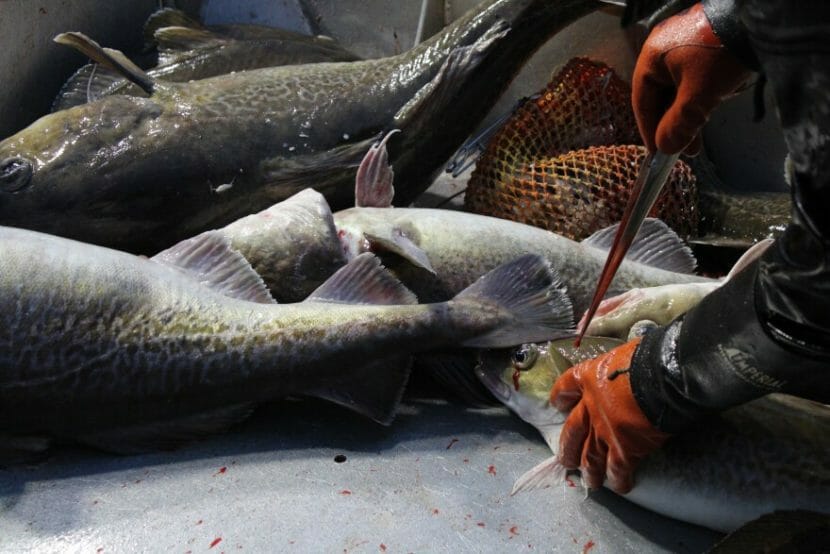
Fish on the F/V Raven Bay. (Photo by Maggie Nelson/KUCB)

Eventually, Lorenzen hopped on board. He started out as the bait guy and now, just a year later he’s switching out with his deck boss, working the hydraulics. Along the way, Dickerson said 20-year-old Lorenzen recruited some friends, including local Alex Schliebe.

“It was just a breath of fresh air to work with young people,” Dickerson said. “It was a good way to re-observe my surroundings through fresh eyes.”

For the hesitant, sleepy and seasick teens, the most effective part of the recent trip in March was the example the young fishermen set on deck.

Eighth-grader Corynn Lekanoff watched the fishermen from a window in the galley, leaning over the sink to get a closer look at the sorting table.

“When you cut gills on fish, normally, you rip them out, but they have like a thingy,” Lekanoff said, making a stabbing motion with her hand.

Lekanoff said she does subsistence fishing, but this was her first time getting to see the commercial side. She said she came to see how things work, but she isn’t sure if she’ll pursue a career in commercial fishing.
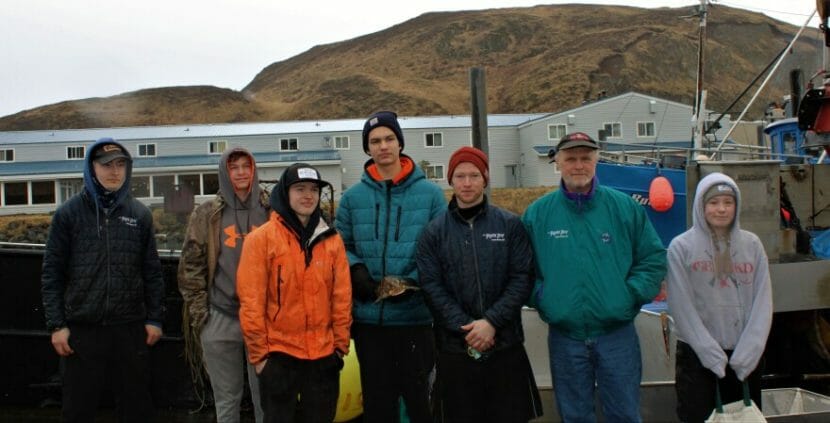
From left to right: Alex Schliebe, Kaidon Parker, Scott Lorenzen, Anatoly Fomin, Kevin Herron, Dustan Dickerson and Corynn Lekanoff. (Photo by Maggie Nelson/KUCB)

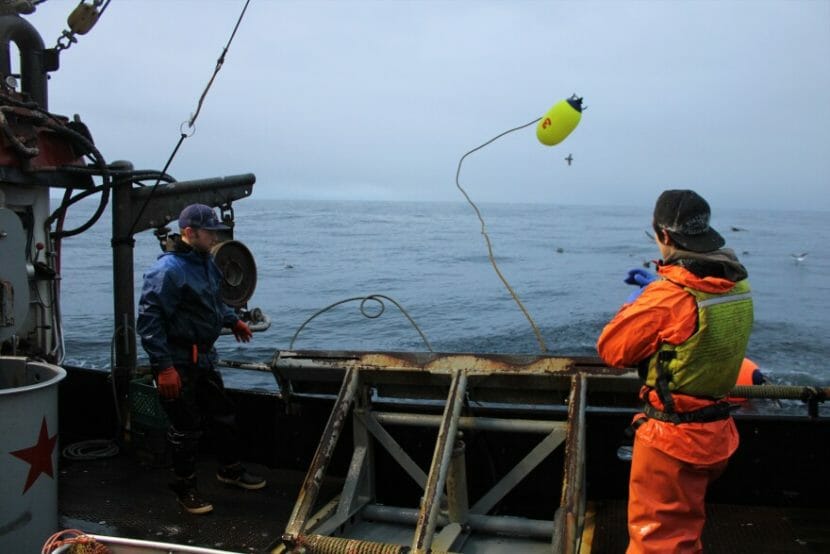
As the sun rose, the three fishermen worked in rhythm on deck. One would throw the hook, another ran the hydros, the third would count the fish and coil the line. They all worked together, cracking jokes, baiting the pots and launching them back into the sea, hoping to find more cod in the next haul.

There’s a beauty to it,” said local deckhand Scott Lorenzen. “It’s just fun to be able to go out there and experience the raw Aleutian wilderness and to be able to have that life that a lot of people would really appreciate to live.”

Lorenzen grew up in Unalaska and recently joined the UNFA board. He said growing up around the island’s famed fishing industry initially piqued his interest. And now that he’s a part of it, he said he wants to advocate for other young fishermen.

 “It’s really a dying industry, especially the small boat fleet,” Lorenzen said. “This boat and just a couple others are pretty much the last of the small boats really that are out fishing near town and come home just about every night. It would just be nice to help my captain out with what he’s trying to do and repopulate the small boat fleet.”

According to Dickerson, as long as there’s youth on the island interested in fishing, he plans to keep taking them out.

“We’re gonna continue this program until I retire,” Dickerson said. “It’s just too convenient to be fishing, you know, 10 miles out of town and not take people out to expose them to this.”
Unalaska tribe gets federal money for geothermal project to source energy from active volcano

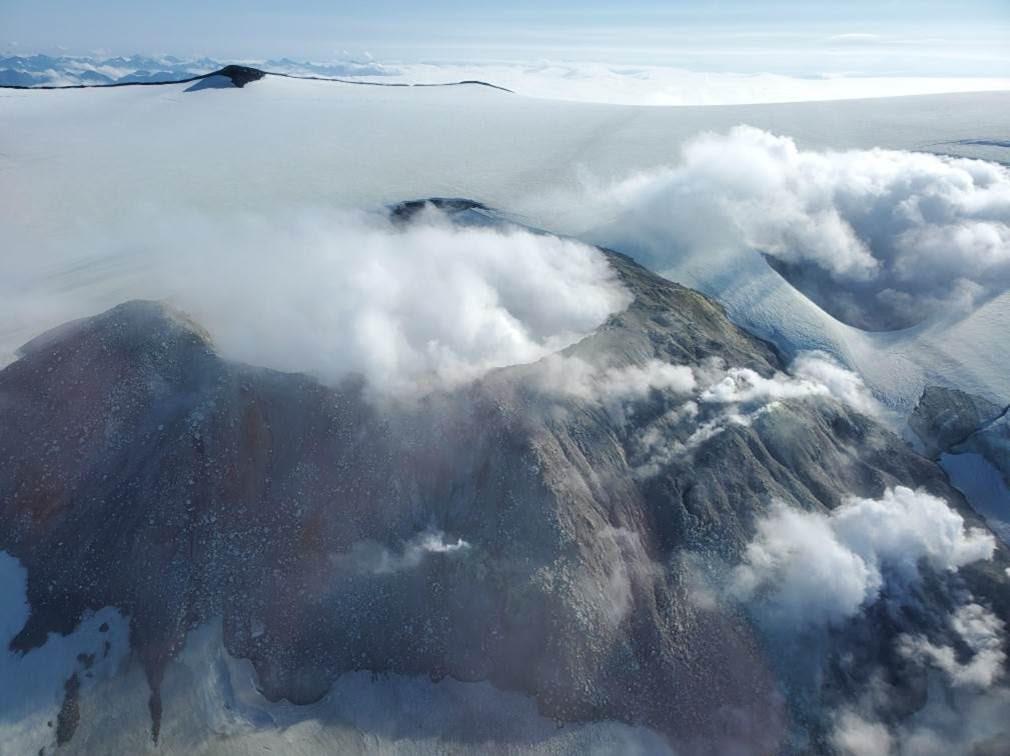
The 6,000-foot Makushin volcano’s molten magma could provide a fuel source for the Unalaska, a city of 4,500 people. (Photo by Givey Kochanowski/U.S. Department Of Energy)

For decades, green energy proponents have been trying to harness geothermal energy from an active volcano on Unalaska Island. And although there have been hurdles trying to bring geothermal energy to Unalaska, the clean energy source is one step closer to fruition.

The 6,000-foot Makushin volcano last erupted in the 1990s and its molten magma could provide a fuel source for the Aleutian community.

The Qawalangin Tribe of Unalaska has received more than $2 million in federal dollars to go towards the Makushin Geothermal Project to harness a local source to power the island’s community and industry. It’s part of the $1.5 trillion spending bill that President Biden signed on March 15.

Unalaska is a city of around 4,500 people that’s host to several large fish processing plants and the Port of Dutch Harbor. The city has relied exclusively on diesel to power the electrical grid since World War II but has sought new power sources for decades.

The power project is being led by Ounalashka Corp./Chena Power, LLC, a joint partnership between Unalaska’s Native village corporation and a Fairbanks-based private energy firm.

Although the Qawalangin Tribe is not a partner with OCCP, the tribe’s chief executive Chris Price says they are helping out and providing funding.

“We came up with this proposal to Congress to support the geothermal project and we were able to secure $2.5 million to go towards geothermal diversification, education programs, and to support the Makushin Geothermal Project,” Price said.

The city currently uses around 3 million gallons of diesel per year, according to Richard Owen, the city’s powerhouse supervisor.

The city signed an agreement to purchase about $16 million of electrical energy per year from OCCP in 2020 to replace its reliance on diesel. That amount would increase each year.

Unalaska City Manager Erin Reinders has said the city’s ratepayers would likely be paying slightly more initially, but the cost would go down over time, especially if industrial customers — like seafood processors — get on board with purchasing geothermal produced electricity.

The three main processors in Unalaska largely provide their own power by burning diesel generators and have not agreed to any purchase arrangement with the city, but Unisea wrote a letter of interest for the project — at least in principle.

Tribal President Harriet Berikoff said she is optimistic the fish plants would see the writing on the wall and get on board with locally produced energy that would bring rates down.

“I hope our electricity becomes cheaper, and everybody else kind of joins in together,” Berikoff said. “We’ve been [talking for years and years], but I’m sure the canneries and the other businesses will eventually join and support us.”

Originally, the geothermal project was expected to be completed by the summer of 2024.

But OCCP has needed several extensions. The most recent was in February; now the project is expected to be complete in 2027.

The City of Unalaska, the Qawalangin Tribe, and the Ounalashka Corp. all say they are working together more closely to capitalize on an agreement they signed to move forward united on some of the community’s key infrastructure projects.

And Berikoff said that will help pave the way for the future.

“Well, I’m hoping that, as a team, we can all work together and make it work,” Berikoff said. “I’m sure it’s gonna work, with the rest of us trying to do the best for the community here.”

Representatives from OCCP did not respond to several requests for comment.

Coast Guard cutter Alex Haley medevacs its 2nd patient in 4 days

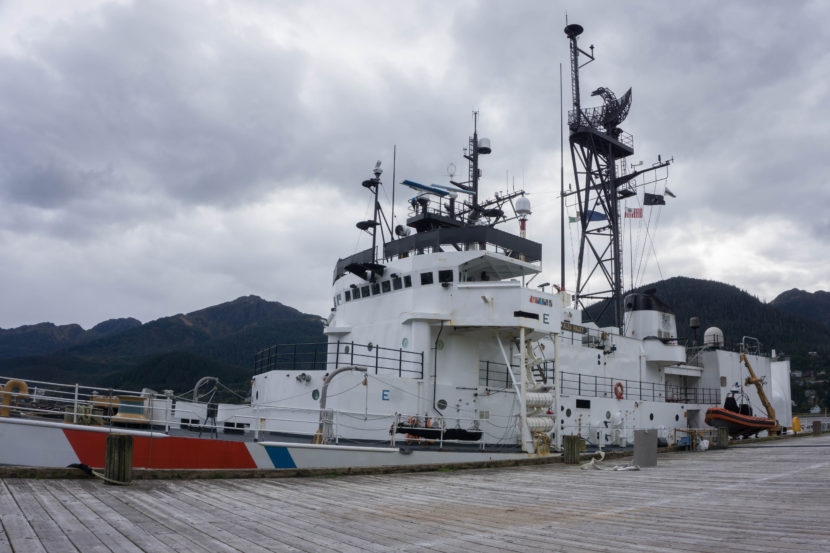
The Cutter Alex Haley in port at Coast Guard Station Juneau. (Photo by Jeremy Hsieh/KTOO)

The U.S. Coast Guard medevaced a man from a fish processing boat north of Cold Bay Monday.

The 62-year-old man was hoisted from the 254-foot Phoenix after he experienced stroke-like symptoms, according to a USCG news release. Officials at the command center in Juneau received the initial medevac request shortly before 11 a.m. Monday morning.

The vessel was about 50 miles north of Cold Bay Monday afternoon when the Alex Haley sent its MH-65 Dolphin helicopter crew to rescue the sick man. He was flown to Cold Bay, where he was put in the care of an ambulance crew.

Winds were gusting up to 40 mph and seas were at a height of 10 feet during the hoist, the statement said.

Master Chief Petty Officer Christopher Cole said this week has been busy for the cutter and its aircrew.

“They had two medevacs in four days and were essential in getting these individuals to a higher level of care,” he said in a statement.

USCG officials didn’t elaborate on the man’s condition.

The Aleutians have a rat problem. Scientists are trying to solve it.

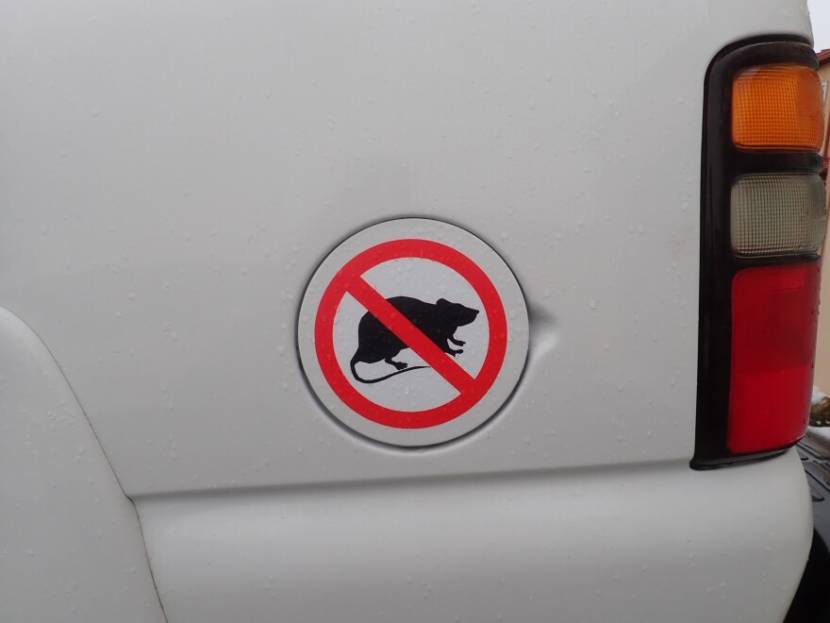
A "no rats" sticker on the gas cap cover of a white vehicle
A U.S. Fish and Wildlife vehicle on Adak Island promoting rat eradication. (Photo by Jennifer Pemberton/KTOO)

For millions of years, birds lived nearly predator-free on the Aleutian Islands. The volcanic archipelago stretches westward for 1,200 miles from the Alaska Peninsula, dotting a border between the North Pacific Ocean and Bering Sea. Hundreds of bird species thrived here.

Then came the rats.

When a Japanese boat sank in the Western Aleutians around 1780, stowaway rats jumped ship and made it to one of the islands, wreaking havoc on the ecosystem.

The rodents proliferated during World War II, when American Navy ships traveled along the chain, expanding the rats’ domain.

“The rats are like an oil spill that keeps on spilling year after year,” said Steve Delehanty, the refuge manager for the Alaska Maritime National Wildlife Refuge. “We would never allow an oil spill to go on for decades or centuries, nor should we allow rats to be a forever-presence on these islands.”

Rats bring a list of challenges to the islands. One: They’re a threat to birds.

The federal refuge that Delehanty manages consists of nearly five million acres of land and thousands of islands, where more seabirds breed than all of the rest of the United States and Canada combined.

But those birds are in trouble. Massive seabird die-offs in recent years have conservationists scrambling for solutions. And while there are many reasons for the decline in bird populations — rising ocean temperatures, algal blooms, and changing food sources — rats certainly play a role.

“You can have a colony that contains thousands, or hundreds of thousands, or sometimes even millions of birds,” he said. “Sadly, rats can just absolutely devastate bird populations. Seabirds, but also waterfowl and songbirds, and really the whole ecosystem.”

A couple years ago, Delehanty met with representatives from a wide range of groups, including the U.S. Department of Agriculture and the Aleutian Pribilof Islands Association, to figure out a plan to manage the Aleutians’ rat problem.

And they arrived at a fairly straightforward solution: kill the rats. All of them.

“That group collectively developed a vision of a rat-free Aleutian Islands someday, recognizing that that’s really an aspiration,” Delehanty said. “There’s no current plan to eliminate rats from every single Aleutian island. But wouldn’t that be a wonderful thing to achieve in the coming decades?”

Already, federal agencies and conservancy groups have taken steps to at least have fewer rats.

Back in 2008, before the group decided to end the rats’ Aleutian vacation once and for all, a team of scientists traveled to Hawadax Island, formerly known as Rat Island. They dropped poison pellets out of a helicopter all over the island. And they killed the entire rat population on that island.

Unfortunately, that’s not all they killed.

“We killed a considerable number of bald eagles,” Delehanty said. “They’re not out there consuming the bait, but what they are doing is consuming a rat that died that consumed the bait. Or consuming a gull, perhaps … and you can end up with this second or third order of killing that you don’t want to have happen.”

But the bird populations rebounded and thrived. A 2021 study published in Scientific Reports found that killing the rats led the island to rebound to its natural state. And now, Hawadax is touted as a success story for ecosystem recovery.

To be clear, the recent seabird die-offs have nothing to do with the Hawadax rat extermination. The rats were the main threat to birds on that island, and eradicating them is what led the ecosystem on that island to rebound.

Still, Delehanty and the team want to minimize collateral damage as much as possible. In August, around half a dozen scientists are planning to visit Great Sitkin Island in the Western Aleutians. Their plan is to put a small number of nonpoisonous pellets in strategic locations around the island. They’ll deposit the pellets by hand, then study how the pellets interact with the ecosystem.

“They are taking the same style of grain pellet that someday would include rat poison. But this year they’re using it without any rat poison in it, just to see how it breaks down in the environment,” Delehanty said. “Does a fish eat it? Does it last in the stream for hours, or days, or weeks? That sort of thing we want to learn.”

Delehanty said they’ll report their findings to see how feasible it will really be to eradicate rats from the Aleutians. He expects to complete the study by winter 2023.

Historians uncover Benny Benson’s Unangax̂ heritage nearly a century after he designed Alaska’s flag

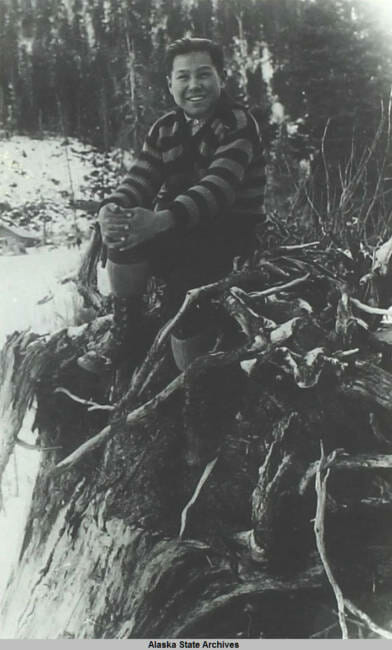
Benny Benson, designer of Alaska’s flag, in Seward circa 1927. A judge recently ordered the state to correct Benson’s birth certificate after historians found details about his age and cultural heritage. (Photo courtesy of Alaska State Archives, Juneau)

Historians announced Thursday that they’ve uncovered evidence that key details about the teenager who designed Alaska’s state flag have been wrong for more than a century.

Benny Benson, a Seward boarding school resident, won the state’s flag design contest in 1927. But he was a year older than previously thought, according to Michael iqyax̂ Livingston who works for the Aleutian Pribilof Islands Association’s community health services.

“I’ve been working for several years with several other family tree researchers focused on Benny Benson’s cultural heritage,” Livingston said. “And in the process of that research, we found what we believe were errors in his date of birth and his mother’s maiden name.”

He led a team of nearly 20 researchers and historians, who discovered that Benson was actually 14 years old when he designed the flag, not 13 as previously thought. They also uncovered illuminating details about Benson’s cultural heritage.

The team worked for more than five years examining Benson’s family tree, deciphering and translating historical records, interviewing family members and finally compiling all of that information to be submitted to the state.

“We started digging deeper and deeper, trying to figure out where his mother was born, where his grandparents were born, on his mother’s side, and where his great grandparents were born,” Livingston said. “And then we tried to corroborate as much information from as many different sources as we could.”

After reviewing the documents on Feb. 28 — 109 years after Benson was born — Anchorage Superior Court Judge Adolf Zeman ordered the State of Alaska to issue a corrected version of Benson’s birth certificate.

Benson was also thought to be Sugpiaq, or Alutiiq, likely because he moved to Kodiak Island as an adult. But Livington said new research shows that Benson’s mother was actually born and raised in Unalaska and that Benson was Unangax̂.

“Alaska Native cultural heritage is not determined by where we move to or where we pass away or where we’re buried,” he said. “It’s not even determined by where we’re born. For example, many Alaska Natives are born in Anchorage at the Alaska Native Medical Center. That doesn’t make those people Dena’ina.”

What’s important about Benson is where his ancestors were from, he said.

Benny’s mother, Tatiana, was born and raised in Unalaska,” Livingston said. “Benny’s grandparents were from Unalaska, so Benny is a member of the Qawalangin Tribe of Unalaska. His great grandparents were from Amlia Island, which is really close to Atka village. So Benny is a descendant of the Native Village of Atka.”

Benny Benson was born in Chignik — a small village on the peninsula, about halfway between Unalaska and Kodiak islands — in 1912.

His mother died when he was about two years old. His father sent him from Chignik to the Jesse Lee Home in Unalaska around 1916, after their family home was destroyed in a fire. And he moved to Seward when the Methodist boarding school was relocated there. That’s where he entered and won the contest to design the Alaska state flag in 1927.

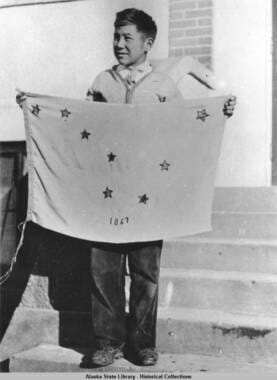
Benny Benson pictured at the Jesse Lee Home in Seward holding his design of the Alaska State flag, which features the North Star and the Big Dipper. (Photo courtesy of Alaska State Library, Historical Collections)

Benson received a $1,000 scholarship and a watch for his design, which features the North Star and the Big Dipper on a blue background. He eventually moved to Kodiak, where he worked as an airplane mechanic.

He died of a heart attack in 1972, at the age of 59.

Livingston said the corrections to Benson’s birth certificate and cultural heritage are important to properly honor his accomplishments.

“Benny was such an amazing role model for Alaska Natives,” he said. “And this was in the 1920s when racism was just blatant, in your face, against Alaska Natives. There were signs up that said, ‘No dogs allowed, no Natives allowed.’ And it was in that kind of environment that Benny won the Alaska flag contest.”

Some published information about Benson’s date of birth will have to be corrected, Livingston said. But he added that this is a great start for continuing research in preparation for the 100-year anniversary of the raising of the Alaska State flag, which is coming up in just five years.

Along with the official correction, Livingston and four other researchers have published an 81-page paper on Benson’s hidden Unangax̂ heritage.

US and Russian scientists are still working together to solve salmon mysteries

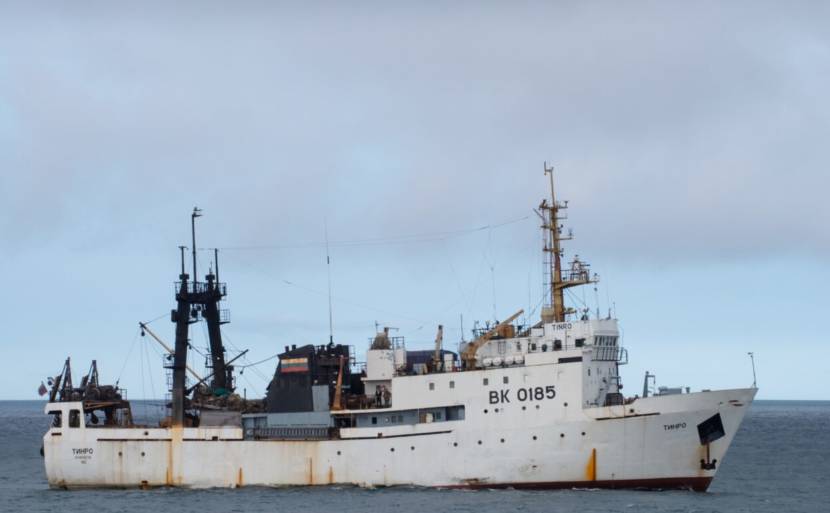
A side view of a white research ship at sea.
The Russian R/V Tinro at sea. (Photo courtesy North Pacific Anadromous Fish Commission)

Tensions continue to simmer between Moscow and Washington in the wake of Russia’s invasion of Ukraine.

Oil companies are canceling partnerships with Russian firms. State legislators are calling for the state’s sovereign wealth fund to dump Russian investments. President Joe Biden announced Tuesday the U.S. would close its airspace to Russian aircraft.

But the United States and Russia are still working together on at least one issue: salmon.

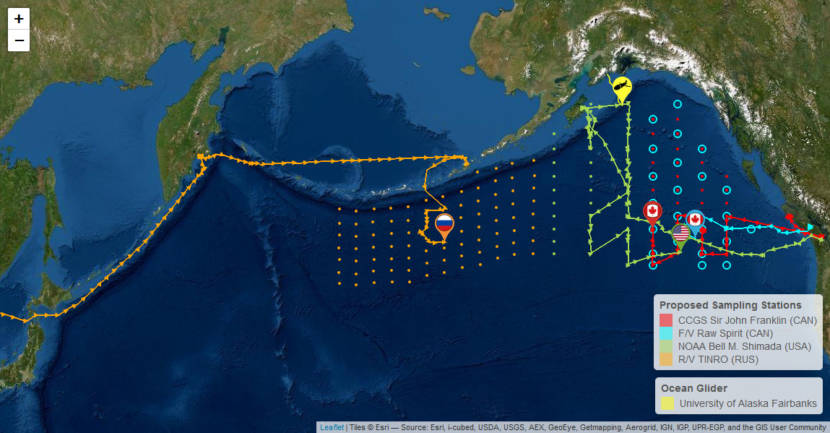
There’s a map scattered with orange, green, blue and red dots spanning most of the North Pacific above 46 degrees latitude.

On the map are three flags of Arctic nations: the U.S., Canada and the Russian Federation.

“This interaction between the countries in this is really something that has never happened to this scale before,” said Mark Saunders, the executive director of the five-country North Pacific Anadromous Fish Commission.

He’s talking about the 2022 Pan-Pacific Winter High Seas Expedition.

Vessels from both sides of the Pacific are braving gale-force winds and 13-foot seas as they crisscross the ocean from the edge of the Aleutian Chain to the Strait of Juan de Fuca.

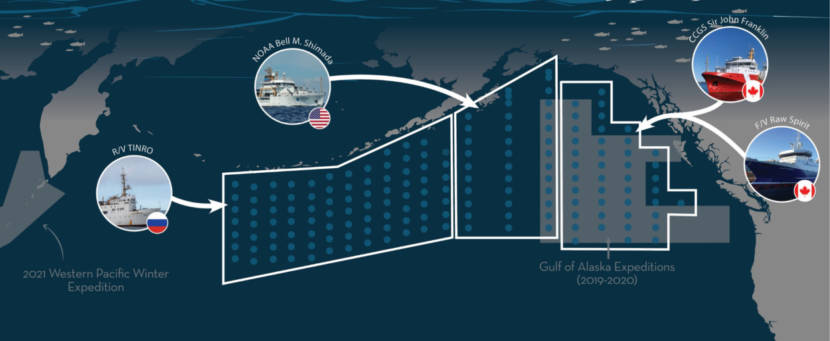
A map showing the current expedition along with past surveys conducted in the western Pacific and Gulf of Alaska. (North Pacific Anadromous Fish Commission)

All in the name of research into the challenges to wild salmon runs that are important to people on all sides of the north Pacific Rim.

A historic shortfall

Last year, the chum salmon run on the Yukon River collapsed.

“This past summer, the Yukon River did not fish for food. Zero,” said Mike Williams Sr. He’s the chair of the Kuskokwim Inter-Tribal Fish Commission, an organization that manages and researches fisheries using a combination of traditional knowledge and Western scientific methods.

Never before had so few fish swum up the nearly 2,000-mile river. Regulators closed all fishing on the Yukon to preserve what little of the run remained.

Williams says in recent years, he’s watched runs on the Kuskokwim dwindle, too. In the past, he says fishing was relatively unrestricted. Residents would return to their fish camps shortly after the ice on the river broke up in the spring.

But in recent years, he says residents have had to wait until June — long after breakup — to start stockpiling fish.

“We depend on the salmon to sustain us through the winter, and we’re very concerned about the returns of our salmon in all of the rivers in Western Alaska” Williams said in a phone interview Wednesday.

It’s not clear what was behind the collapse. The Inter-Tribal Commission — and the Alaska Department of Fish and Game, for that matter — spend most of their effort studying what happens in freshwater. But that’s just a small part of a salmon’s life.

‘Something happens in the ocean’

“The salmon spawn in our headwaters, they go down to the ocean, and something happens in the ocean,” Williams said.

And it’s not just Western Alaska that’s struggled with salmon runs in recent years — in Southeast, chinook runs from Haines to Ketchikan are listed as stocks of concern. Salmon fishing on the Unuk River has been banned outright for years.

Some, including Williams, say too many salmon in the Bering Sea and the North Pacific are pulled out of the ocean as bycatch from trawlers that scrape the seabed for sole and flounder. Others say fish from hatcheries all over the north Pacific Rim are outcompeting native fish. Some say climate change is affecting the food web — or that it’s a combination of all these factors.

But one thing is clear: something is happening to chum and chinook salmon in the open ocean.

“We know that a lot of the poor survival for chum and other salmon is related to the marine environment,” Saunders, of the North Pacific Anadromous Fish Commission, said Tuesday from his home office on Vancouver Island.

There’s quite a bit known about how the ocean is changing, “but you need to know where the fish are and have actually had your hands on them, and understand how they’re interacting with the environment,” Saunders said.

“I think a lot of that is a large black box — in particular, this winter period we know very little about,” he added.

He says the goal of the survey, the largest ever conducted, is to shine some light in that black box.

Scientists are hoping to map out the distribution of salmon across the North Pacific using new DNA techniques developed over the past decade or so to understand where salmon interact with predators, prey and each other — not to mention a generally warmer, more acidic ocean.

“And the big question is, how is the changing North Pacific Ocean affecting our salmon? And improving our ability to understand how that change is going to impact people and fish and fisheries into the future,” he said.

That brings us back to the map.

A map of the North Pacific showing the present locations of research vessels
A screenshot of a live map tracking vessels from the U.S., Canada and Russia during the 2022 Pan-Pacific Winter High Seas Expedition on March 2, 2022. (YearOfTheSalmon.org)

A long-planned voyage meets geopolitical realities

Earlier this winter, ships from the U.S., Canada and Russia set sail for the North Pacific. Each is assigned its own area to sample: The U.S. and Canada are tackling areas in the Gulf of Alaska and west of British Columbia, and a vessel from Russia is surveying an immense swath of ocean spanning areas south of the Alaska Peninsula all the way out the Aleutian Chain southwest of Adak.

The Russian vessel’s survey work started late last month  — it actually tied up in Dutch Harbor a day after Russian troops started their assault on Ukraine’s capital, Kyiv. Unalaska’s port director told KRBD the visit was tightly scrutinized by U.S. border agents.

Alaska’s chief salmon scientist, Bill Templin, says a few thoughts crossed his mind as he watched the invasion unfold.

“My first concerns were for the people of Ukraine,” Templin said by phone Wednesday. “But then when I walked into my office and I sat down, I was thinking, Oh, OK, so what does this mean?”

He says it’s not the first time international tensions have come up in his work with the five-country commission. He recalls Russian scientists including islands disputed with Japan on maps of salmon stocks — all in good fun, as he recalls it.

“The first two years, they got it past me, and the Japanese had to come over and correct me very politely,” he said.

But this is more tension than usual.

Saunders, the head of the anadromous fish commission, says an American scientist was scheduled to board the Russian vessel to allow it to survey within the 230-mile U.S exclusive economic zone.

That didn’t happen. And that means the Russian research vessel can’t work close to the Aleutian Chain, where some salmon are thought to spend the winter. Templin says that means salmon activity within that zone will remain a blank spot for now.

“It doesn’t ruin the results. It’s not a failure — but it is going to limit what we get,” he said. “And it’s taken years to get this winter coordinated, so it’s a little disappointing.”

But Templin says scientists from Japan, Canada, South Korea, Russia and the United States have always put their work first, and their political leaders’ policies second. And he says that’ll continue.

“The salmon all go to the same place. So they’re all grazing in the same field, so to speak. For all of us to work together to understand what’s happening out there, and the way it affects our nations, is — I think it’s a pretty huge deal,” he said. “And I’d hate to see it go away.”

Site notifications
Update notification options
Subscribe to notifications