Aleutians

The eruption near Tonga was so powerful you could hear it in Alaska

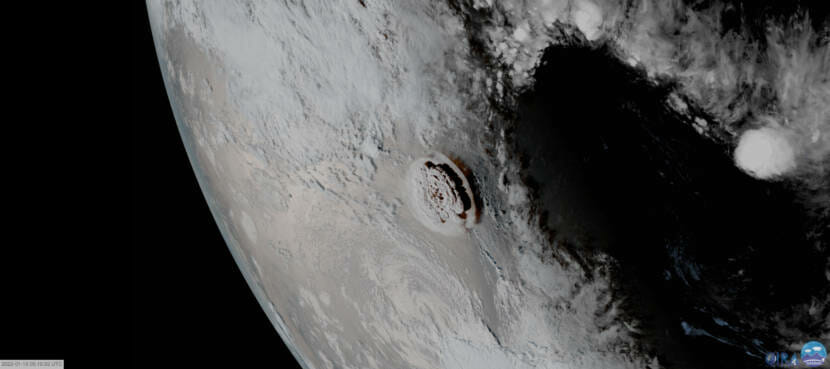
An eruption of an underwater volcano bear Tonga, which triggered a tsunami that was seen throughout the Pacific. In Alaska, people reported hearing the eruption several hours before the tsunami made it to shore. (Image courtesy CIRA at Colorado State University)
An eruption of an underwater volcano near Tonga, which triggered a tsunami that was seen throughout the Pacific. In Alaska, people reported hearing the eruption several hours before the tsunami made it to shore. (Image courtesy CIRA at Colorado State University)

Communities across the West Coast woke up Saturday morning to tsunami advisory alerts. An underwater volcano near the Kingdom of Tonga had erupted and sent waves thousands of miles across the ocean.

Waves of up to about three feet reached parts of Alaska by Saturday morning. But hours before those waves arrived, sounds from the blast reached the homes of many Alaskans — all the way from Juneau to the Aleutians. 

Iris Caldentey and her kids were sleeping peacefully in their home early Saturday morning in Palmer when she woke up to loud, strange noises.

“How I would envision Pearl Harbor sounded — just constant, boom, boom, boom,” she said. “I mean, it was intense.”

Could it be avalanche control? A burglar? Maybe the kids bouncing off the walls? Like many people, Caldentey had no idea what she was hearing.

“I went outside to check the cars because then I was like, well, maybe there’s a burglar trying to get into our cars. And they’re opening, closing the door. Not a very good burglar,” she said.

In Unalaska, Laresa Syverson woke to similar sounds and vibrations.

“I thought for sure it was my cat — like, what’s my cat doing? So he got blamed for most of it,” she said.

First she thought her cat, then maybe fireworks, then she thought it could have just been bass coming from someone’s car.

While Syverson says she wasn’t immediately alarmed, neither she nor Caldentey would have guessed that the sounds were coming from an underwater volcano erupting near Tonga.

But that’s what it was — an eruption so massive it sent sound waves and a tsunami throughout the Pacific.

In Alaska, the largest tsunami waves hit the Aleutians and the Alaska Peninsula. King Cove recorded waves just over three feet. The tsunami destroyed property in Hawaii and Japan, caused flooding in California and killed two people when the waves reached Peru.

Syverson says she saw on social media that people had posted about hearing similar things — and that the booming sounds were from an eruption in the South Pacific.

“To be honest, I still didn’t even really believe it after that until I saw the satellite images of the actual eruptions. I was like, “Oh, yeah, that’s probably what we were hearing,” she said.

But how did so many Alaskans hear a sound from so far away? The short answer is that this volcanic blast was so big it traveled thousands of miles.

For the long answer, Ken Macpherson has some good insight. He’s a scientist at the Wilson Alaska Technical Center at the University of Alaska Fairbanks. The center has listening stations and seismic monitoring all over the world.

But usually they’re listening for something completely different — they’re monitoring the world for secret nuclear testing.

“And of course, those sensors are good at detecting things like nuclear bombs, but they’ll also pick up any kind of atmospheric blast of volcano being a good example,” Macpherson said.

He says they pick up all kinds of earthquakes and landslides and volcanic blasts. He slept right through this one, but he says the listening sensor in Fairbanks picked up the blast. And it’s interesting because those sensors are built for listening to frequencies that are lower than human hearing.

Think of it like a foghorn. They have this very low frequency sound.

“And the reason for that is a long period or low frequency signal like that will travel a longer distance. For higher frequencies, they attenuate,” Macpherson said. “That is, they just kind of get filtered out by the medium that they’re moving through.”

In other words, a higher-pitched sound won’t travel as far.
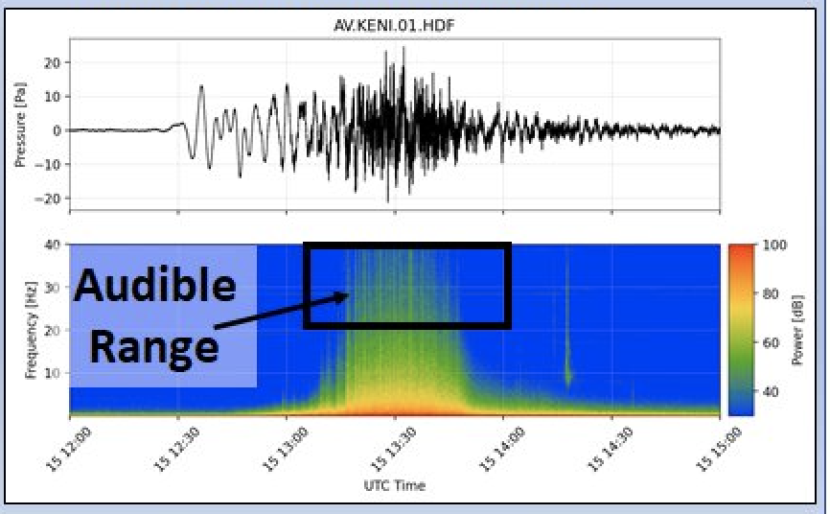
The top panel shows the pressure wave as recorded by an infrasound station on the Kenai Peninsula. The spectrum in the lower panel shows how the energy of the wave is distributed across frequencies. The times with the most audible energy are about 4:30 a.m. Alaska Time which fits with reports from Alaskans. (Courtesy of David Fee University of Alaska Fairbanks/Alaska Volcano Observatory).
The top panel shows the pressure wave as recorded by an infrasound station on the Kenai Peninsula. The spectrum in the lower panel shows how the energy of the wave is distributed across frequencies. The times with the most audible energy are about 4:30 a.m. Alaska Time, which fits with reports from Alaskans. (Courtesy of David Fee/University of Alaska Fairbanks & Alaska Volcano Observatory).

“But it looks like this Tonga blast was so big that even a high-frequency signal that’s audible to the human ear was able to travel almost 6,000 miles to Alaska and be heard widely across the state,” he said.

Data from UAF researchers clocks the sound wave from the blast moving at roughly 700 mph.

“And so it still took a long time to get to Alaska, because that’s almost 6,000 miles away,” Macpherson said. “But around eight hours after that huge explosion down in Tonga, those sound waves started to arrive in Alaska.”

He says if he hadn’t seen that data for himself, he’s not sure he’d believe it.

“And to be honest, when I first heard reports of this being heard, I was like, skeptical of that,” Macpherson said. “But it looks like it was possible to hear it. And the timing looks right. And so it does seem like it was widely heard across the state, which is just amazing.”

Macpherson says it’s scientifically interesting, but it’s important to keep the human toll of such an event in mind. What sounded like a loud boom to Alaskans can be devastating up close.

And the true toll on the people on the islands nearest to the volcano still isn’t clear. Communications with Tonga have been largely cut off since Friday. Surveillance flights showed significant damage to boats and buildings along the coastline. The country’s capital is covered in thick volcanic dust. 

And many people around the world are still anxiously waiting to hear from friends and family on the islands

Engineering professor fosters university community for Alaska Native students: ‘It’s full circle’

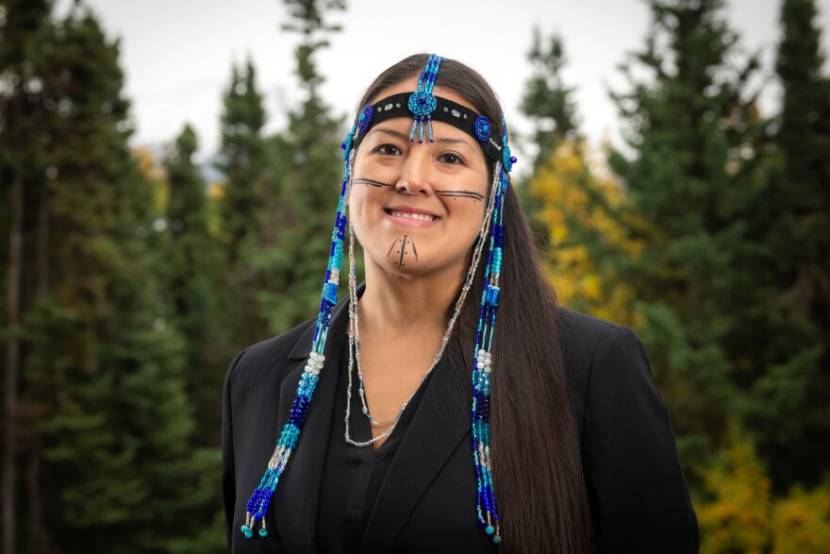
A photo portrait of Dr. Michele Yatchmeneff
Dr. Michele Yatchmeneff, the executive director of Alaska Native education and outreach at UAA, says there shouldn’t be a need for programs to support Alaska Native students. “But until we’ve gotten to that point, we need programs like ANSEP to be there,” she said. (Photo by James Evans/University of Alaska Anchorage)

Michele Yatchmeneff knew she wanted to be an engineer from the time she was a teenager. Yatchmeneff grew up in False Pass and King Cove, in the eastern Aleutians. She was raised in an Unangax̂ household, living a subsistence lifestyle.

Right after high school, she enrolled in engineering classes at the University of Alaska Fairbanks in 1999. She was looking forward to it.

Almost immediately, she began to feel many of the other students didn’t want her there.

“You would have students either not talk to you, or look at you in a certain way,” Yatchmeneff said. “Sometimes it’s subtle, sometimes it’s actually a slap in the face. You get called ‘villager,’ you get called names.”

There are more Indigenous people living in Alaska than anywhere else in the United States. But Alaska Native students are vastly underrepresented on college campuses. And when it comes to Science, Technology, Engineering and Math — fields that are especially dominated by white men — Alaska Native students face even greater barriers to entry.

When Yatchmeneff attended school, there had only been two Alaska Native students who had graduated with engineering degrees from the University of Alaska system. She felt isolated being surrounded by students and faculty who didn’t look like her.

After a year, she transferred to Anchorage. But after a year there, she left Alaska altogether. She moved to Arizona and enrolled in Arizona State University, hoping it would be better there.

Instead, Yatchmeneff says the further along she got in school, there were even fewer women and people of color.

Yatchmeneff felt alienated — and she internalized the blame.

“I always thought it was my problem, why I didn’t belong,” Yatchmeneff said. “I always thought there must be something wrong with me, I must not be good enough.”

She says her grades began to decline, and that she even started losing interest in engineering.

Yatchmeneff moved back to Alaska. She was lost, didn’t know what to do, and wondered if she’d ever make it through college.

But then some friends told her about an organization that helps Alaska Native students in STEM fields. Her first meeting showed her a world she didn’t know existed.

“There were all these other students that looked like me, and they were all doing internships, and they were sharing what they did during their internships,” Yatchmeneff said. “It was like coming home.”

Since the Alaska Native Science & Engineering Program started in 1995, it has helped hundreds of college students with scholarships, internships and mentoring. They also have programs for elementary, middle and high school students.

After finding the program, Yatchmeneff finally felt she had the support she needed. She was able to earn her bachelor’s degree, her master’s and a doctorate from Purdue.

In 2015, Yatchmeneff became the first Alaska Native female engineering professor in the Department of Civil Engineering at the University of Alaska Anchorage. She’s earned awards from organizations like the National Science Foundation. And last fall, she became the executive director of Alaska Native education and outreach at UAA, working directly with the chancellor to help boost enrollment and graduation among Alaska Native students.

Alaska Native undergraduates earning STEM degrees has more than quadrupled between 2000 and 2018, according to a 2019 study by ANSEP. But even today, Yatchmeneff faces a lot of the same hurdles as when she was a student.

“A lot of the time, students still don’t think I have the credentials to be teaching, they still don’t think I fit their picture of what an engineer looks like,” she said. “So therefore, I must have cheated or I don’t belong.”

But not every student feels that way. Yatchmeneff says especially students from marginalized communities have told her it was because of her leadership, and because they saw someone who looked like them teaching the class, that they knew they belonged.

Yatchmeneff says that teaching and working with the school to support Alaska Native students is her chance to give back to her community.

“It’s an Indigenous value that we always give back,” she said. “Because I had the support and because I got help from people along the way … it’s full circle.”

Still though, there’s a long way to go.

“We’re just scratching the surface, Yatchmeneff said. “What you want it to be is that you don’t need a specific Alaska Native program for science and engineering. We shouldn’t need that,” Yatchmeneff said.

She added, “But until we’ve gotten to that point, we need programs like ANSEP to be there.”

Tsunami advisory canceled for Alaska after volcanic eruption near Tonga

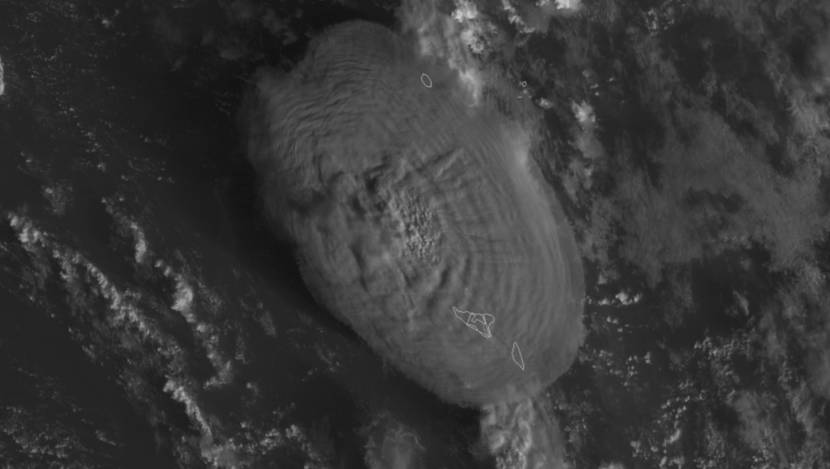
A NOAA satellite image of an eruption of the Hunga Tonga-Hunga Ha’apai volcano, located in the South Pacific Kingdom of Tonga. According to local officials, the eruption had a radius of 260 km (161.5 miles) and sent ash, steam, and gas 20 kilometers (12.4 miles) into the air. The volcano has been erupting for more than a day but two large eruptions sent a tsunami warning throughout the Pacific Ocean.  (Photo courtesy NOAA)

A tsunami advisory has been canceled for Alaska after an undersea volcano erupted near Tonga. Some Alaska communities did see significant waves, but officials did not issue an evacuation warning.

“We’re not going to try to put you in a warning right now,” Scott Langley, senior electronics technician for the National Tsunami Warning Center, told KUCB Saturday morning.

An advisory means a dangerous wave is on the way, according to the National Weather Service — but the wave is expected to be between 1 to 3 feet. 

The Tsunami Warning Center canceled the advisory for Alaska in a bulletin issued at 3:31 p.m., though it remained in effect for the California coast. Earlier bulletins included coastal areas from Southeast Alaska to the western Aleutians.

In Alaska, the largest waves hit the Aleutians and Alaska Peninsula, Langley said. He said the 900-person community of King Cove has recorded waves of just over two feet. If those waves were to reach one meter — about 3.2 feet — he said the center would issue an evacuation warning.

The center hasn’t received any reports of damage from King Cove, Langley added — the only damage reported so far in the U.S. has been in Hawaii and California.

Dave Snider, the tsunami warning coordinator for the National Tsunami Warning Center in Palmer, said the volcano — Hunga Tonga-Hunga Ha’apai — has been erupting for at least a day. 

But early Saturday morning there was a massive eruption. 

“And then another eruption occurred, and this one seemed to be even larger and it sent a wave across the Pacific of basin-wide impact overnight,” Snider said. 

By 7 a.m. on Saturday morning, the weather service reported waves arriving in the Aleutian Chain of just over a foot in Nikolski and just under a foot in Atka and Adak. 

“We’re waking up to an expectation of the possibility of 1-2 feet of a tsunami along the Alaska shoreline,” Snider said. 

While that wave height wouldn’t necessarily send coastal Alaskans running for the hills, it’s still dangerous, especially for people who live or work on boats or low lying coastal areas. 

“So, if you’re a person in a liveaboard in Juneau or anywhere else in the Alaska coastline, you need to take this seriously. It would be a good time to get away from your boat, move to higher ground and away from the marina. Move up above that really low coastal area there,” Snider said. 

It doesn’t take much of a tsunami wave to toss a boat around. 

“We do have some minor damage, I think, reported in Hawaii. Nothing too significant coming in yet, but it did include a boat that was moved up out of the water and onto the dock,” Snider said. 

A twitter user named Dr. Faka’iloatonga Taumoefolau reported hearing a violent volcanic eruption and that the sky was getting darker, raining ash and tiny pebbles.

There are no immediate reports of injuries or damage on Tonga, though communications with the small island nation are cut off according to the Associated Press. 

“What we saw in Hawaii was impacts lasting for several hours, at least two to three hours after the initial wave continued,” Snider said. “So we’ll be watching this throughout the morning here.”

This story has been updated.

Magnitude 6.8 quake near Nikolski was part of an ‘energetic’ seismic cluster

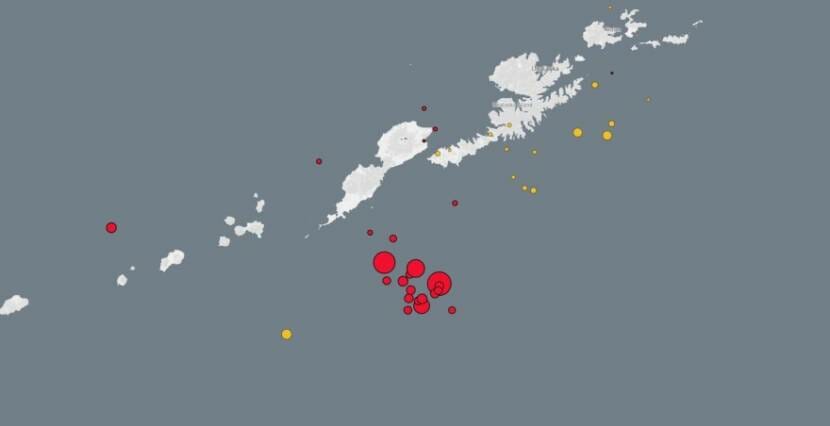
A map showing the locations of earthquakes south of Nikolski
Locations of earthquakes in the seismic sequence south of Nikolski on Tuesday, Jan. 11, 2022. (Alaska Earthquake Center)

A magnitude 6.8 earthquake hit about 58 miles southeast of Nikolski early Tuesday morning, according to the Alaska Earthquake Center.

Natalia Ruppert, an Earthquake Center seismologist in Fairbanks, said the quake hit at about 2:30 a.m. and was preceded and followed by more seismic activity.

“It triggered a very energetic sequence of aftershocks,” Ruppert said. “The largest aftershock was a magnitude 6.6 — about an hour after the magnitude 6.8 — at 3:40 a.m. today, and we are still recording seismic activity in that cluster.”

The center had recorded about 20 other earthquakes of magnitude 4 and above by about 10 a.m. Tuesday morning, she said.

“This is unusual,” she said. “We normally don’t see such an energetic sequence in such a quick succession.”

There’s no reason for Aleutian Island residents to be alarmed at the moment, according to Ruppert. But there is a small chance this sequence could be followed by a larger earthquake. She said the AEC will continue to monitor the seismic activity.

Ruppert advises that people stay alert and pay attention to earthquake activity in the area in case the sequence develops into something more serious.

No tsunami alert was issued, and as of Tuesday morning, Ruppert said none of the activity was large enough to generate a tsunami.

As of about 2:30 p.m., the U. S. Geological Survey had published 21 felt reports, which are online surveys the public can use to describe the location, intensity and overall effect of earthquakes. Reports were submitted by people in Nikolski, Unalaska and Akutan.

Alaska prepares to sue federal government over contamination on Native corporation land

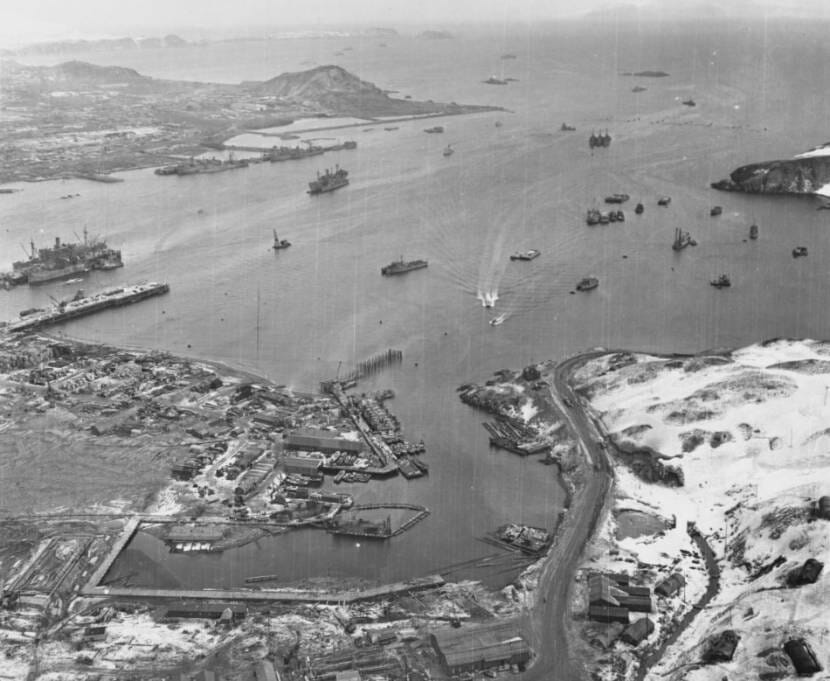
A black-and-white aerial photo of a naval base in the Aleutians, with many ships in the harbor.
This 1944 photo shows part of the Naval Operating Base on Adak. Much of the island, which has at least 17 contaminated sites, has been conveyed to the Aleut Corp. (National Archives)

The state of Alaska is preparing to file lawsuits against the federal government over hundreds of contaminated sites that the federal government conveyed to Alaska Native corporations.

Alaska Commissioner of Environment Conservation Jason Brune said the corporations weren’t aware of the pollution when they selected the lands as part of the Alaska Native Claims Settlement Act.

“The village corporations (and) the regional corporations were promised lands as a direct offshoot of the 1971 ANCSA law and they didn’t expect to get damaged goods,” Brune said.

Much of the contamination is on former military installations and dates back to the Cold War or World War II. Sites include a chemical weapons dump in Adak as well as old tank farms all over Alaska and abandoned buildings that contain lead and asbestos.

There are 548 sites, and the state filed 548 notices of intent to sue in mid-December.

“We want the sites cleaned up,” Brune said. “That is our ultimate goal here.”

Brune said he pursued the matter with the Trump administration also but didn’t get results.

Organizations representing Alaska’s Native village and regional corporations have endorsed the state’s proposed action.

“Despite the federal government’s own reports on this contamination and our repeated requests for something to be done, it has been 50 years of inaction,” ANCSA Regional Association President Kim Reitmeier said, in a written statement issued by DEC.

A spokeswoman for the Bureau of Land Management said the BLM can’t comment on pending litigation.

St. Paul couple accused of killing toddler who was in their care

Troopers say 2-year-old Joshua Rukovishnikoff was medevaced to an Anchorage hospital where he died earlier this month. On Tuesday, troopers arrested the 2-year-old’s guardians, 31-year-old Steven Melovidov and 28-year-old Sophie Myers-Melovidov. (Hope McKenney/KUCB)

Two people from St. Paul have been charged with killing a toddler who was in their care, according to troopers.

Earlier this month, 2-year-old Joshua Rukovishnikoff was medevaced to an Anchorage hospital with a serious head injury, according to a report Wednesday from Alaska State Troopers. He died at the hospital and his remains were sent to the State Medical Examiner for autopsy.

Troopers say after a thorough investigation, they determined the child’s guardians, 31-year-old Steven Melovidov and 28-year-old Sophie Myers-Melovidov, had killed him in their home and attempted to mislead investigators over the course of the investigation.

Troopers traveled to St. Paul on Tuesday and arrested the couple. They were taken to the Anchorage Correctional Complex.

This is the second murder investigation in a matter of months in the remote island community of about 350 people. The toddler’s mother, Nadesda “Lynette” Rukovishnikof, died in St. Paul in September, said troopers spokesperson Austin McDaniel. The toddler’s father, Joshua Rukovishnikoff, was charged with second-degree murder, criminally negligent homicide and reckless endangerment.

Before that, there hadn’t been any homicides on the island since 2006, according to local police.

The City of St. Paul and St. Paul police declined to comment on the investigation into Rukovishnikoff’s death. The city said it’s an active and ongoing investigation being conducted by troopers.

Site notifications
Update notification options
Subscribe to notifications