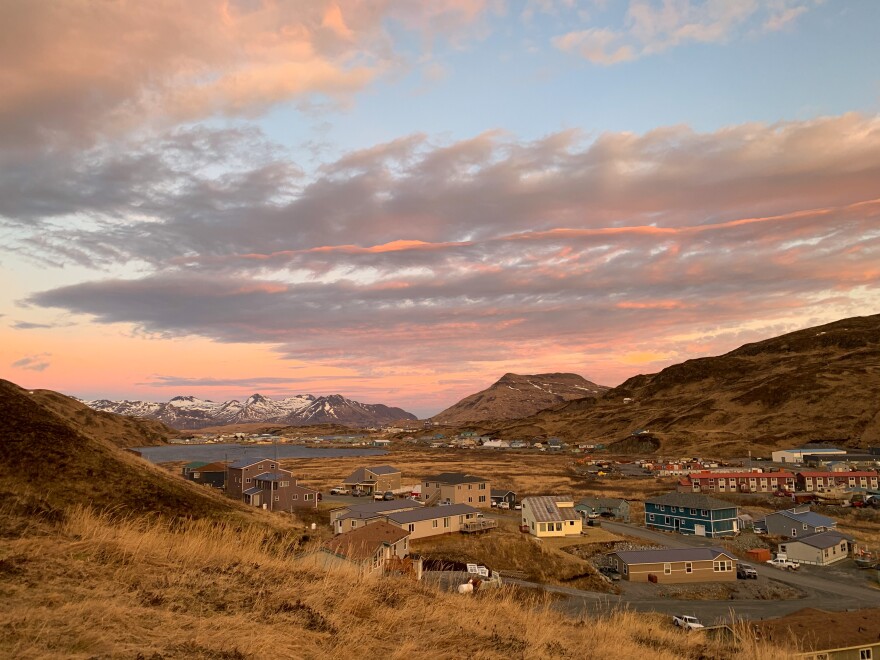
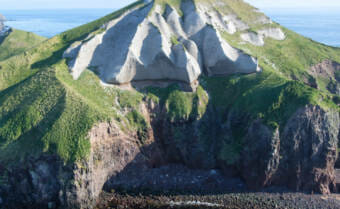
The town of Unalaska, where temperatures soared to 56 degrees on Christmas Day 2021. (Photo by Hope McKenney / KUCB)
Unalaska has set a new record for the warmest Christmas in Alaska.
Temperatures in the island community soared to 56 degrees on Saturday. That broke the prior Christmas Day record of 55 degrees set in the Southeast Alaska community of Metlakatla in 2009, according to climatologist Rick Thoman, who works for the Alaska Center for Climate Assessment and Policy at the University of Alaska Fairbanks.
There’s no record of a warmer Christmas in Alaska than 56 degrees, he said, and there’s been climate stations keeping track for at least a century.
“We can probably say it’s the warmest [Christmas] in at least a century, and realistically, more like 110, maybe 120 years,” Thoman said.
Over Christmas weekend Kodiak Island broke the record for the warmest December temperature in the state. The Kodiak Tide Gauge station on the east side of the island recorded 67 degrees on Sunday. That balmy high comes after one of the coldest Novembers on record for the island.
“It was a very rare occurrence,” said Tim Markle, a meteorologist with the National Weather Service in Anchorage. “This is really due to a really strong kind of warm ridge of high pressure that was just sitting just to the southwest of Kodiak, and very warm temperatures aloft and that, combined with those westerly winds along the mountains right along the spine of the island.”
Those downsloping winds compress and warm as they come off the mountains. The entire Alaskan Peninsula saw near record highs this weekend. Kodiak’s Benny Benson Airport also set its own December record of 65 degrees on Sunday.
This weekend’s warm weather comes after Kodiak Island experienced what meteorologists say could have been its coldest November on record – measuring equipment on the island was broken for the first nine days of the month. Data for the rest of the month shows temperature swings between 2 and 24 degrees below normal.
Markle says record-breaking events like 60-degree weather in December can’t be directly linked to climate change, but it does increase the likelihood of extreme temperature swings.
“Things are just becoming much more variable,” he said. “We’re kind of seeing that a little bit with the pattern we’ve been in with a very cold, almost record-breaking November followed by record-breaking warmth across the state at least for the month of December.”
Rick Thoman said unusual weather across the state over the weekend is all linked to a massive high pressure system over the Gulf of Alaska. It’s among the biggest high pressure systems ever recorded in that part of the world for this time of year, and it made warm winds blow clockwise across the Aleutians.
“In this case, there is a direct connection from just west of Hawaii, straight north, across the Aleutians into the Bering Sea,” he said. “And then that warm, moist, tropical air turns the corner and heads due eastward across mainland Alaska.”
In Interior Alaska, the system produced a storm like the area hasn’t seen in nearly a century. The rain and snow caused massive power outages and closed down highways in the Fairbanks area over the weekend and the storm picked back up again Tuesday.
“The amount of moisture that came north with this most recent push – there’s really nothing like it probably since the mid-1930s in the climate record,” Thoman said.
As the climate continues to warm, he said, Alaskans will likely keep experiencing these abnormal weather patterns and temperatures.
“In a warming environment, warmer ocean temperatures are going to have more moisture. And, you know, we put the thumb on the scales for these kinds of events,” Thoman said.
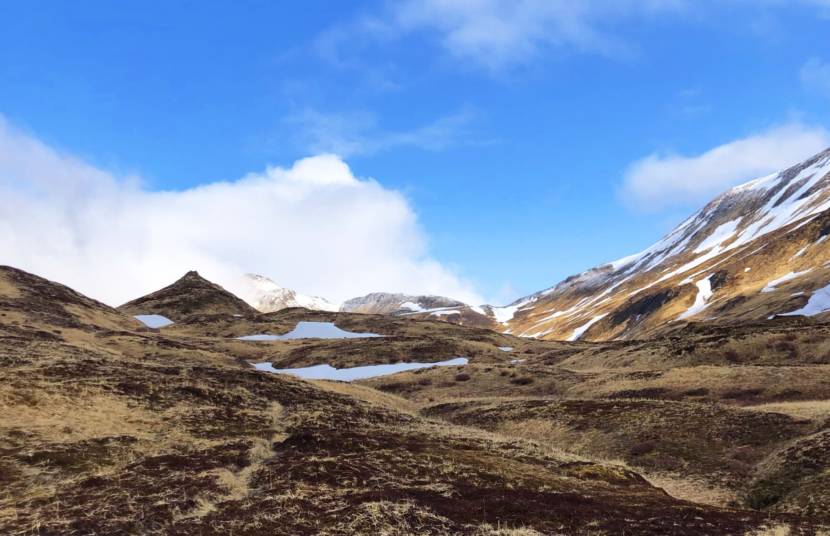
In 2020, SpinLaunch identified Ugadaga Bay as a possible location to build a large centrifuge to launch satellites into low Earth orbit. The project would likely require building a road down Ugadaga Trail, a popular hiking trail and historic Unangax̂ trading path. (Photo by Maggie Nelson/KUCB)
A tech startup that visited Unalaska in 2020 as a potential satellite launch site says they are finalizing their choice of location. And while communication between the company and the city began to fade earlier this year, the startup says Unalaska is still in the running.
SpinLaunch identified Ugadaga Bay as a possible location to build a large centrifuge to launch satellites into low Earth orbit. The project would likely require building a road down Ugadaga Trail, a popular hiking trail and historic Unangax̂ trading path.
While the land at Ugadaga Bay is owned by the Ounalashka Corp., the island’s Native village corporation, visitors have to cross public land to access it.
The Los Angeles-based startup aims to launch satellites using kinetic energy, as opposed to a traditional rocket launch system that relies heavily on fuel.
“SpinLaunch is in the final stages of examining a large number of launch sites,” Diane Murphy, a SpinLaunch spokesperson told KUCB. They won’t comment until that decision is made.
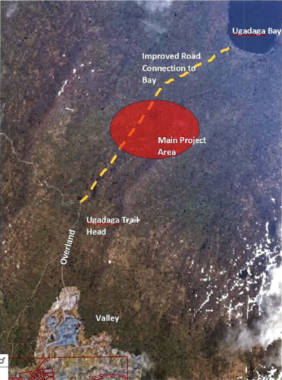
A 2020 mock-up from city emails shows an approximate location for the proposed SpinLaunch satellite launch site. (City of Unalaska)
The Ounalashka Corp., which is a private company, owns much of the land that would be used, and city officials were reluctant to discuss the matter. So KUCB requested records from the city to get a window into the situation.
Notes from the city’s planning department suggest the 20-acre site would sit along the Ugadaga Bay Trail, one of the community’s most popular hiking trails, and a historic trading path between Iliuliuk and Biorka villages.
Representatives from the space technology company visited Unalaska in September of 2020 and gave a presentation to city officials about their plans to work with the community.
Emails between city officials shortly after discuss the potential risks and benefits of having SpinLaunch in Unalaska.
In correspondence between city officials, Unalaska Director of Public Utilities Dan Winters called SpinLaunch a “good project for Unalaska.”
“This is a good opportunity to bring more money into its economy through new technology,” Winters wrote in a September 2020 email.
Tom Cohenour, the director of Public Works for Unalaska, lauded the potential for SpinLaunch to help diversify the local economy.
But Ports Director Peggy McLaughlin raised concerns about the long-term economic benefits to Unalaska.
“It sounds [like] Unalaska may provide SpinLaunch the ideal location, but SpinLaunch [has] little or nothing long-term to offer in return,” McLaughlin responded.
McLaughlin told KUCB this week that she asked questions about the long-term opportunities for Unalaska, such as job opportunities, housing development and an influx of students into the school. She says SpinLaunch was unable to provide satisfying responses and she left the September 2020 meeting with more questions than answers.
After that meeting last year, the city’s associate planner, Thomas Roufos, stressed the importance of SpinLaunch developing a public outreach plan, and having a clear aim for “how they’ll invest back into the community.”
Roufos also stressed the importance for the Ounalashka Corp. to handle the loss of the Ugadaga trail.
The Ounalashka Corp. owns the land at Ugadaga Bay and has been tight-lipped about any plans to develop it. The corporation’s chief executive, Chris Salts, has not responded to several requests for comment.
A rough diagram of the proposed 20-acre site shows the approximate location of the launch site and a road to the bay from the pass at the top of Overland Drive.
SpinLaunch launched its first successful test flight this October from a base in New Mexico. According to the company’s website, the New Mexico accelerator measures more than 160 feet. And the next site they build could measure three times the size.
According to a note from the planning department, the proposed site would cover around 20 acres, with an additional five to 10 acres for road and access.
Emails from 2020 suggest the road would be open to the public — which would make the beach accessible for people with limited mobility — but it would be blocked off during launches. The company estimates they would conduct approximately 10 launches a day, which could last around two hours each. If accurate, that would render the road essentially closed to the public.
Emails also show discussions around the sonic booms the centrifuge would create every time it launches. But the company says the blasts would not affect Unalaska city residents because the site is too far from the center of the community and faces the opposite direction.
City officials discussed the benefits of SpinLaunch as having the opportunity to create jobs and to generate significant tax revenue for the city, which has been a chief concern of late.
In recent months, city officials have stressed the importance of diversifying Unalaska’s economy. The city estimates it could lose more than $2 million in tax revenue from the closure of the red king crab fishery, and has been taking steps to diversify the local economy.
An illustration from SpinLaunch’s website depicts an accelerator and launch site. (SpinLaunch)
In 2018, SpinLaunch considered developing a base in Hawaii, but public opposition prompted representatives from the company to travel to Hawaii to hold a public meeting. A video on YouTube shows angry residents disrupted the April 14 meeting several times and SpinLaunch ultimately scrapped plans for the project.
The company would need to apply for a commercial space license from the Federal Aviation Administration, and the application process would require an environmental review.
An FAA spokesperson said the agency “has not received any commercial space license application that would support launches from Unalaska.”
An email SpinLaunch sent in January 2021 said they are “still very interested in Unalaska.”
But emails show that correspondence between SpinLaunch and city officials ceased this summer, and the city’s planning director says he hasn’t been in contact with the company since then.
Representatives from the company said last month they are in the final stages of picking a location for their next launch site and will inform the community with any further updates.
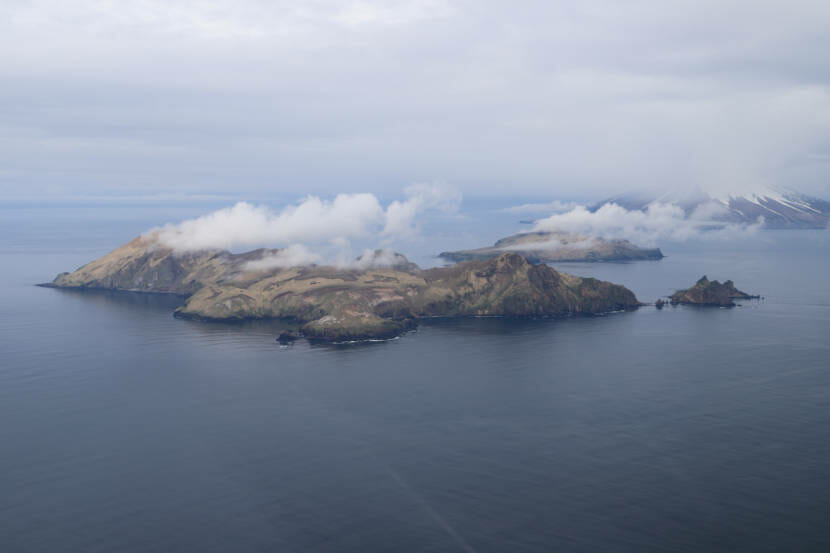
Davidof Volcano with Segula in the distance on May 25, 2021. (Hannah Dietterich/Alaska Volcano Observatory)
The three Aleutian volcanoes that have been erupting simultaneously in recent months could be joined by a fourth. Davidof Volcano in the Western Aleutians has remained inactive for thousands of years. But a series of earthquakes measured around the dormant volcano has some researchers wondering if Davidof is waking up.
The remnant of an ancient caldera, Davidof rises over 1,000 feet out of the Bering Sea. It’s located in the Rat Islands in the far Western Aleutians, nearly 200 miles west of Adak — so far west that it’s in the Eastern Hemisphere.
The volcano hasn’t been active at least since the time Russian explorers started keeping records in 1760. Researchers say it has likely remained dormant for much longer than that, perhaps as long as 10,000 years.
But a swarm of earthquakes shook the area beginning Dec. 7, and that has researchers keeping a close watch.
Davidof rises over 1,000 feet out of the Bering Sea. It’s located in the Rat Islands in the far Western Aleutians, nearly 200 miles west of Adak. (Matt Loewen/Alaska Volcano Observatory)
Matthew Haney is a geophysicist with the Alaska Volcano Observatory in Anchorage. He said that even though Davidof is not considered historically active, “the process of subduction that leads to volcanoes along the Aleutian Arc hasn’t stopped,” and “the possibility remains for there to be activity.”
He says the earthquakes increased in magnitude over the week, which could suggest the earthquakes weren’t caused by tectonic shifts, but rather by magma flowing beneath the volcano.
“With tectonic earthquakes, typically the first one is the largest one, and then there’s a bunch of aftershocks afterwards. So I think this one caught our attention last week because the largest earthquake was not the first one,” Haney said. “So that is something that catches our attention that’s more like a volcanic earthquake sequence.”
Davidof is too remote to threaten any communities, but Haney says it could pose a hazard to airline traffic. AVO raised the warning level at Davidof to yellow last Friday due to that possibility.
Haney says that in 2008, a similar string of earthquakes hit an area east of Adak around Kasatochi Volcano.
“A similar question arose: are these earthquakes that we’re measuring tectonic or volcanic? And in that case, the earthquake activity intensified and the volcano ultimately erupted in 2008 in a large eruption,” Haney said.
The earthquakes around Davidof continued through the weekend, but they don’t seem to be intensifying.
Still, Haney says, AVO’s team will be keeping a close watch from their vantage point 1,200 miles away.
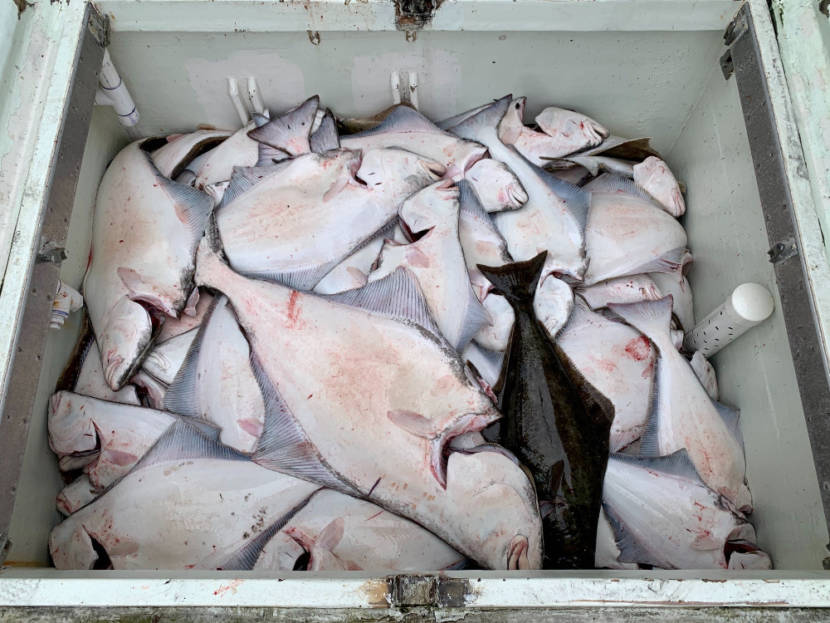
Bering Sea trawlers tend to scoop up juvenile halibut in their nets. Commercial and subsistence fishermen in Western Alaska say that doesn’t leave enough halibut for them to catch in years when abundance is low. (Angela Denning/KFSK)
The council that manages fishing in federal waters voted this week to link groundfish trawl fishing in the Bering Sea and Aleutian Islands to halibut abundance. The action caps — at least for now — a six-year debate about curbing halibut bycatch in Alaska.
For many who have been following that debate, the decision comes as a surprise because it’s expected to deal what trawlers say is a crushing blow to their fishery.
But members of the North Pacific Fishery Management Council said it was also important for them to consider how high levels of bycatch hurt small-boat halibut fishermen in Western Alaska — even if they didn’t go quite as far as advocates from those communities had hoped.
The action that ultimately passed Monday came from Rachel Baker, the deputy Fish and Game commissioner who represents Gov. Mike Dunleavy’s administration on the council. She said it will incentivize the trawl industry to reduce the halibut they incidentally catch in their nets.
When halibut stocks are low, the cap on prohibited species catch, or PSC, will also drop.
“Mr. Chair, this council clearly would rather not impose additional costs that could result in reduced groundfish harvest and revenues, if we had other management options,” Baker said. “But again, halibut is fully used in the Bering Sea and Aleutian Islands, and at the low and very low index state, mortality from PSC should decline in response to reduced amounts of halibut available for all users.”
The new limits apply to a group of fishermen and processers called the Amendment 80 fleet, which catch and process groundfish in the Bering Sea.
Halibut is a prohibited species for the fleet and must be discarded. That trawl sector catches the largest amount of halibut bycatch in the region — an estimated 2.8 million pounds each year. Other Bering Sea fishermen say that reduces their opportunities to catch halibut, particularly as spawning halibut stocks decline there.
As it is now, the bycatch cap in place for the fleet is fixed and is not adjusted to halibut abundance. So when halibut abundance is low, bycatch is a larger slice of the overall pie. The last time the cap was changed was five years ago.
The council voted to make that cap dependent on the abundance of halibut in the area. Under the new guidelines, when halibut abundance is high, the fleet could catch the same amount of bycatch it is limited to now. But when halibut abundance is very low, that cap would drop by 35%.
Chris Woodley is executive director of the Groundfish Forum, the fishery association that represents those trawlers. He said the fleet has been working to lower its halibut bycatch already and called Monday’s decision “devastating.”
“Because we’re being told to do better without more tools,” he said. “And that’s going to harm crew members, it’s going to reduce our revenues …. and harm our crewmembers’ families.”
He said without new tools to curb halibut bycatch, the fleet will have to stop fishing earlier in the season to meet those lower caps. Woodley said the 2,200 crew members the fleet employs — many from out of state — will bear much of the impact as the fleet’s fishing opportunities change. Analysis suggests the action will result in tens of millions in losses for the fishery.
Anne Vanderhoeven, a member of the council who works with Arctic Storm Management Group in Seattle, found that concerning.
“I find cuts at the levels in the motion to be punitive — cuts to the Amendment 80 fleet — to reallocate halibut from one user group to another with no real conservation benefit,” Vanderhoeven said. “And cuts at these levels could put some Amendment 80 companies out of business and I don’t think that’s the right thing to be doing here.”
But council members said they’re also taking into account the social and cultural impacts of bycatch.
The halibut fishery in St. Paul, a small island community in the Bering Sea, originated in the 1980s as the commercial seal harvest there was phased out. Today, it’s the primary source of income for the 355 residents there, according to a packet submitted to the council by the Central Bering Sea Fishermen’s Association ahead of the decision.
Lauren Divine, with the Aleut Community of St. Paul Island, said that value is immeasurable — and not purely economic.
“What is the value of the health of the halibut population?” she said. “The Bering Sea ecosystem? The connected, large marine ecosystems of Alaska that are vital to our people, family, communities, business cultures and the nation?”
Divine and other tribal leaders had been pushing for another option this week, Alternative 4, which would have taken an even bigger swing at reducing bycatch. They said that would have also opened up more fishing opportunities for small-boat fishermen like those in St. Paul.
That alternative was also backed by a bipartisan coalition of Alaska legislators and fishermen’s associations across the state, who provided hours of testimony to the council last week.
Marissa Wilson is a member of the council’s advisory panel and a fisherman based in Homer. She said the council’s impact analysis did not take into account the impacts of bycatch on communities around Alaska.
“There are values involved in this decision that are not adequately captured,” she said. ” And there are grave, intergenerational consequences of choosing any alternative besides four.”
The council said it can’t guarantee reducing bycatch will help out halibut fishermen.
It’s actually a different council that manages halibut stocks — the International Pacific Halibut Commission. Commission scientist Allan Hicks told council members changing the cap will have little impact on halibut spawning biomass in the region.
But it will likely change the amount of halibut commercial and subsistence fishermen are able to catch. Council Member Andy Mezirow, a charter operator in Seward, said it’s important to share the burden of halibut conservation between sectors.
“The Amendment 80 fleet may in fact have to face doing more with less,” he said. “But we are moving this action one step closer to having all fishermen share in this burden.”
Mezirow voted “yes” on Monday’s motion, as did the other representatives to the council from Alaska. The motion passed the council 8-3.
Jeff Kauffman is celebrating that decision. He’s the vice president of the Central Bering Sea Fishermen’s Association and a commercial halibut fisherman.
He said while the measure doesn’t go as far as he would’ve liked, it’s an exciting step in the right direction.
“This is a big day for St. Paul and the Indigenous small-boat fishermen that live there,” he said. “Because the halibut fishery is so important for St. Paul, we spent six years and tremendous resources and efforts to get to this better place.”
This week’s decision marks the first time the federal council has linked halibut bycatch to abundance, Mezirow said. The council will likely take up more bycatch issues next year.
NOAA Fisheries will have to review the final action before it goes into effect.
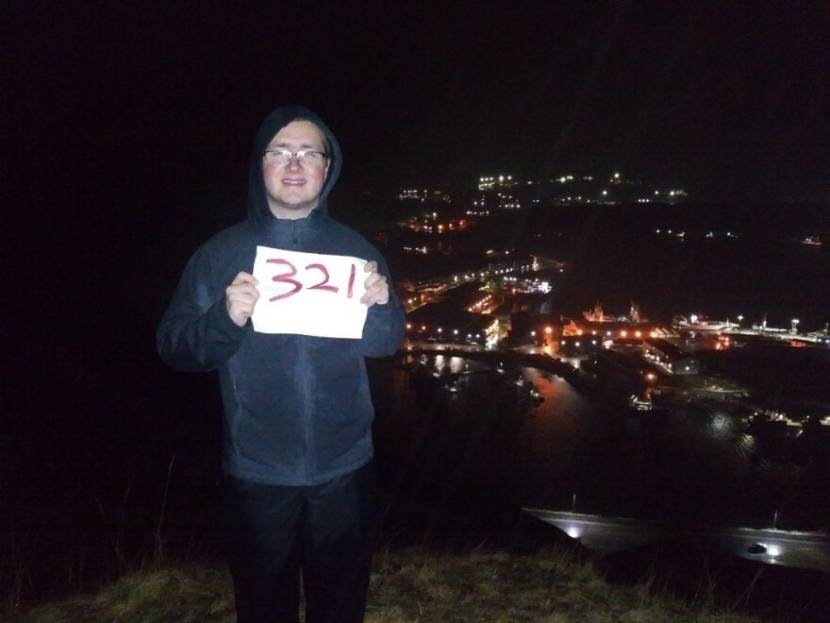
Sean Peters completed his 321st trip up Bunker Hill on Tuesday night, beating his personal record up the iconic Unalaska landmark. (Courtesy of Sean Peters)
Unalaska resident Sean Peters broke his personal record this year by making the one-mile hike up Bunker Hill 321 times. The 24-year-old says that averages out to more than once a day for every day he’s been on island in 2021.
Peters said he’s leaving town this weekend and won’t be back until the new year. But before heading out for the holidays, he wanted to break his personal climbing record up the iconic Unalaska landmark.
KUCB’s Hope McKenney sat down with Peters on Wednesday to talk about why he hikes Bunker and how it felt to reach that milestone on Tuesday night.
Listen here:
Sean Peters: In 2017, I just got 19 [hikes up Bunker Hill]. But in 2018, I got 155. My dad and I got it together. In fact, my dad actually was the one who kind of got me started on that. He and I both wanted to see how many we could do. And we both ended at 155 together in 2018. In 2019, I got 111. But in 2020, I wanted to get 201 because I knew someone who got 200 in a year. I was like, ‘I gotta get just one more,’ but I had over a month left. So I went from doing once a day to twice a day so I could get past 250 and I ended up getting 255. And then yesterday, I got, you know, 321.
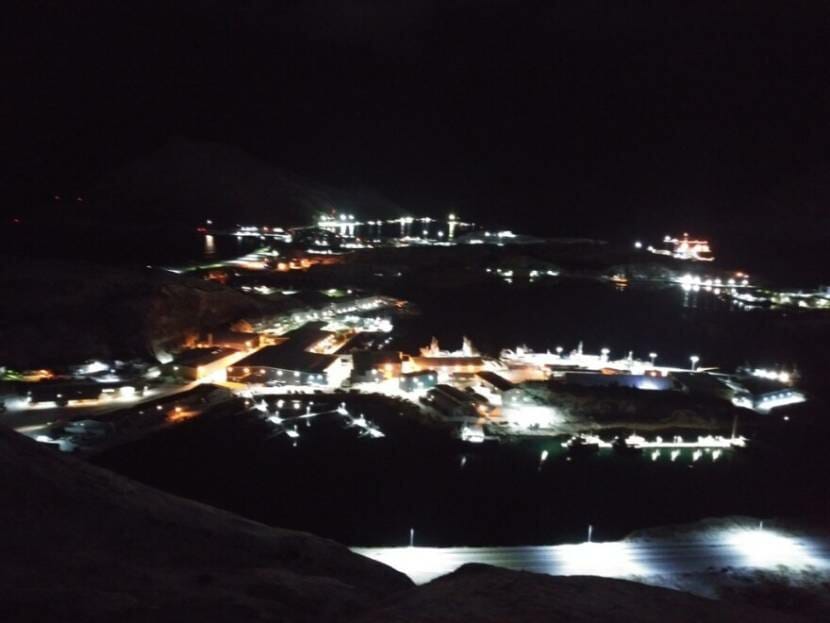
Hope McKenney: Wow. I love going up Bunker, because not only can you do it kind of in any weather — there’s a road that you can go up — but also when you get to the top, it’s just such a beautiful view of kind of every part of Unalaska. Can you talk a little bit about what it’s like when you get to the top?
Sean Peters: Oh, it’s just a beautiful view. On windy days, you got to be careful though, because sometimes, like if you go up the backside, especially, you’re protected and then you get pretty much to the top and then you could get blown off. The day after that major storm in October that we had that was blowing over 100, my dad and I went up there and it had calmed down a lot, but it was still pretty windy. So you have to climb the rocks to get to the bunker. I was afraid I’d get blown off, so I crawled to make sure I was safe. And it’s amazing what I’ve seen on that hike too, though, like I’ve run into people I haven’t seen for years on that hike. It’s just always exciting, you never know who you’re going to run into. Sometimes I’ve run into over a dozen people just on one trip. But last year — I’ve only seen one here in my entire life — it was a night hike up Bunker Hill, I saw snowy owl and my first thought was there was a seagull, but I was like, ‘Why would a lone seagull be flying around at night?’ And it was flying different than a seagull flies. But like I was shining the flashlight at it and it was like kind of hovering over me looking at me and I got to see its flat face. I got to see its feathers and I got to know for sure it was a snowy owl. That was last year. This year, I saw some sort of falcon. I’m not sure what kind of raptor it is. It could have been a kite, a falcon, a hawk or whatever. But I saw one. And then just last week when it was night, down towards the bottom, I saw some sort of black raptor flying around.
Looking down on Unalaska from Bunker Hill. (Courtesy of Sean Peters)
Hope McKenney: Yeah, I was gonna ask you, do you have kind of a most memorable trip up Bunker Hill? Sounds like you’ve had a few pretty beautiful experiences.
Sean Peters: Oh, man, it is tough to pick a single most memorable one. Because whenever I hike it with friends and family and stuff, those are my favorite. I know, oftentimes, they’ll say, ‘Go on ahead of me, I’ll slow you down.” But like no, I’d rather go slowly with people than fast on my own. But probably the most memorable one would be my 10th trip up during the endurance challenge. Like, I mean, it wasn’t pleasant at the time. I mean, every step was really exhausting, but I was thinking I’m actually going to do it 10 times in one day, I’m actually going to walk 20 miles today. And I set so many new records on my Fitbit, like I’d never come even close to doing that much since I had my Fitbit, so that was a pretty memorable one.
Hope McKenney: And so what’s next? We’re almost to the end of the year. You’re about to leave town this weekend till early next year. Are you going to continue to try to beat your record next year do you think?
Sean Peters: I hope so. But like, I don’t know if I’ll be able to or not. It all depends on how much I’m gonna be on island and everything. Basically, like this year, I was hoping I’d get 300. But if it’s nice weather, I’ll usually do it twice, if it’s nice weather and I have the time. If it’s kind of iffy, I’ll probably do it once. If it’s bad weather, I won’t do it. I just take it day by day. I would like to get to 365 sometime though, but I don’t know when that’s gonna happen.
Hope McKenney: And, I mean, 321 times in one year is a lot. It’s multiple times a day, a lot of the time. How do you feel? Are you proud of yourself? How do you feel?
Sean Peters: Yeah, it’s uh, it is really nice. I am really happy to be able to do this. I’m blessed to live in a place where I have that option. I mean, I would much prefer doing that over going to the gym, going on a treadmill or elliptical. I’d much rather be going up Bunker Hill or something, because it is a satisfying experience to get to do it that much.
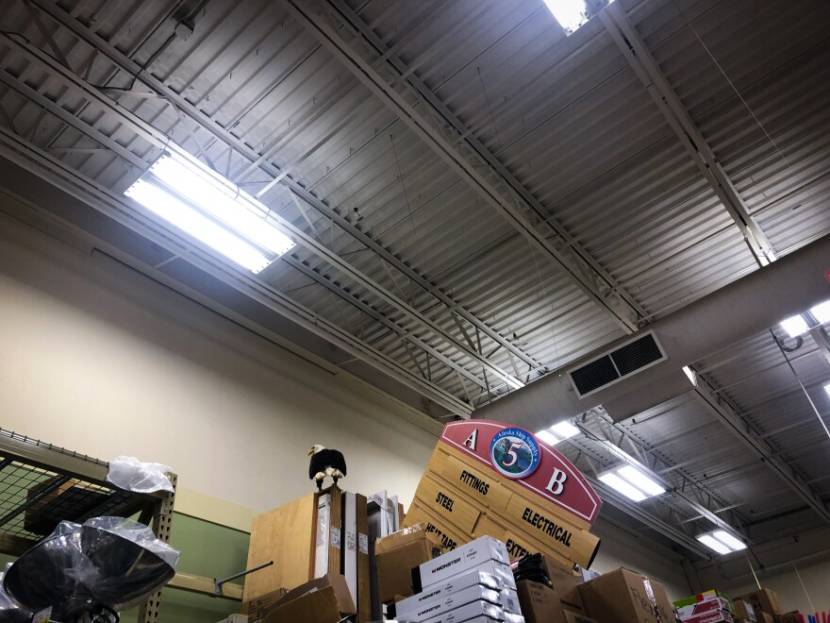
A large female eagle entered Alaska Ship Supply on Thursday evening, knocking down aisle signs and occasionally swooping down toward the people and merchandise below. (courtesy of Megan Dean)
As staff at a local shop opened the back door for a delivery last week, they got an unexpected visitor. An adult female eagle dashed in and headed for the rafters, occasionally swooping down at people and merchandise below.
Or as Megan Dean, one of the rescuers put it: “An eagle decided to go shopping at Alaska Ship Supply.”
Dean regularly helps rescue injured or sick eagles on the island, which are then flown to the Bird Treatment and Learning Center in Anchorage. She said the eagle at the store on Thursday flew around for more than an hour as staff tried to evict her.
When Dean arrived, the eagle was high up in the store’s rafters. She and another volunteer, Brianna McGrath — a local fisheries biologist who heads the group of four local eagle wranglers — had to tire the large bird out by making noise and waving blankets and long objects in the air until she landed on the ground.
Then they were able to catch her and release her back outside.
“The eagle did not appear to sustain any injuries, and was met by her impatiently waiting mate in the parking lot,” Dean said.
Eagle-human interactions like this one are a common affair in Unalaska. There are about 300 to 600 eagles on the island, according to the Christmas Bird Count — a census of birds performed annually by volunteer birdwatchers for the National Audubon Society. The eagles often get injured or killed by cars or in fights and need to be flown off island for rehabilitation or to be euthanized.
“I was talking to someone in Connecticut, and they said, ‘If we see an eagle, we talk about it for two weeks,’” Dean said. “I just drove past the landfill the other day, and there were at least 100. And so they behave and interact with humans a little differently, I think, here than they do in other places because of that.”
She’s responded to two dozen calls about potentially injured eagles in the past six months. And about half of those, she said, have been flown out to Bird TLC.
“There were a lot that had extensive injuries and most of them had to be euthanized, unfortunately,” Dean said.
The process of securing the giant injured raptors would be daunting to most.
Dean said volunteers have to throw a thick blanket over them and secure their talons and beak to avoid getting hurt. Even when eagles are severely injured, she said, they still have extensive strength.
“Their talons have a psi of about 400 pounds per square inch. I read somewhere it’s about the same strength as a lion’s mouth,” she said. “So they’re pretty strong. There was one this summer where before the talons were secured, it reached up and it went through two layers of a fleece blanket like butter.”
Dean said the majority of birds that get sent off island to Bird TLC don’t return because they have to be euthanized or aren’t strong enough to be released back into the wild. But earlier this year, she said, a large female eagle that was injured on a fishing vessel was successfully rehabilitated and released this summer near Cook Inlet.
Close
Update notification options
Subscribe to notifications
Subscribe
Get notifications about news related to the topics you care about. You can unsubscribe anytime.