Aleutians

Bad wiring, lax oversight and poor judgment factored in fatal 2019 Unalaska crash, regulators say

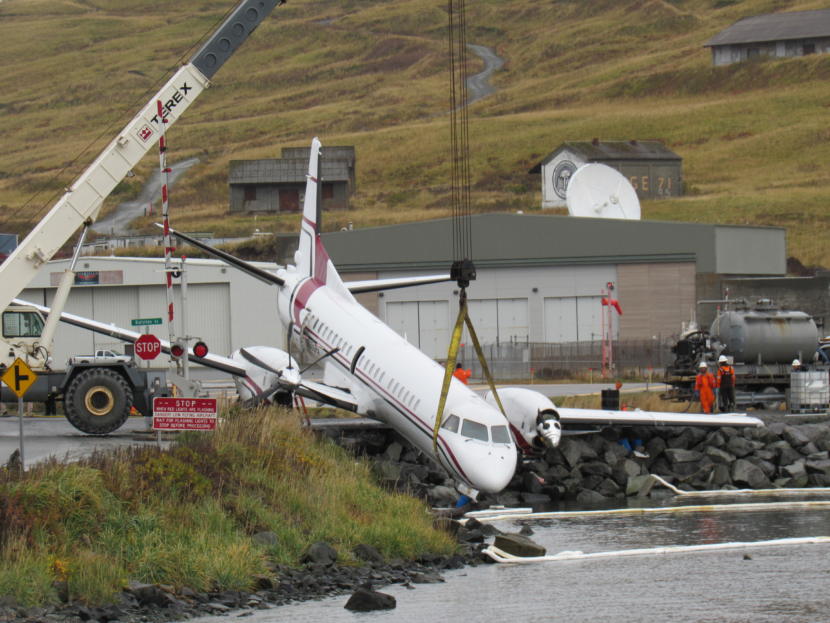
A crane hoists PenAir’s Saab 2000 airplane on Oct. 18, 2019. One person was killed and multiple people were injured when the plane went off the runway while attempting to land the evening before.
A crane hoists PenAir’s Saab 2000 airplane on Oct. 18, 2019. One person was killed and nine were injured when the plane went off the runway while attempting to land the evening before. (Laura Kraegel/KUCB)

Faulty wiring, lax oversight by regulators and inexperienced crew were all factors leading up to Unalaska’s fatal 2019 plane crash, according to the National Transportation Safety Board. The board revealed its findings on Tuesday after a two-year investigation.

Investigators found that the PenAir Saab 2000 aircraft overran the island’s short runway because an anti-skid brake malfunctioned due to a bad wiring job. That caused a tire to burst upon landing and released brake pressure on two of the three remaining wheels, preventing the flight crew from stopping on the runway.

The crash killed one passenger and injured nine others.

NTSB Chair Jennifer Homendy said the pilot made a questionable decision to land with strong tailwinds. But also, the Federal Aviation Administration approved the plane to land on Unalaska’s runway despite it falling short of safety guidelines.

“Even though the airplane, the pilot, the weather and federal oversight all had a role in this tragedy, it was entirely preventable,” Homendy said. “The brake system should have been designed to protect against human error during maintenance, the pilot shouldn’t have landed on a runway with such a strong tailwind and federal regulators should have considered the runway safety area dimensions when authorizing the airline to fly the Saab 2000 into that airport.”

It was a blustery day at the island’s Tom Madsen Airport on Oct. 17, 2019, and the crew was making a second attempt to land on the notoriously challenging runway when they crashed.

According to investigators, the local weather observer reported a 24-knot tailwind shortly before the plane touched down — that’s faster than the airplane manufacturer’s operating limit. The pilots did it anyway, landing with a tailwind later estimated at 15 knots.

The pilot and co-pilot were inexperienced on the island route. Both men had about 100 hours of flight time into Unalaska — far less than the 300 hours historically required by the route’s former carrier, PenAir. That company had sold the airline to RavnAir Group the year before that fatal flight.

The NTSB said the decision to land with such a tailwind was “intentional, inappropriate” and indicative of a bias to continue their original plan in spite of evidence that they should reconsider.

At their meeting Tuesday, the five-member transportation safety board unanimously approved 10 safety recommendations to avoid similar accidents in the future. Six of those are for the FAA, three for the European Union Aviation Safety Agency and one for Saab, the aircraft’s manufacturer.

“The only way we’re going to prevent a future accident is by making sure these recommendations are implemented, and we’ll do all we can to make sure that’s done,” Homendy said.

The final NTSB report will be published on the agency’s website in coming weeks.

PenAir Flight 3296 was operated by a RavnAir Group subsidiary, which bought PenAir’s name and assets after PenAir declared bankruptcy in 2018.

RavnAir Group also went bankrupt in the months after the crash. It was subsequently rebooted with a similar name under new management and ownership structure from a different investor group.
Power restored in Adak after a nearly weeklong outage closed school and city offices

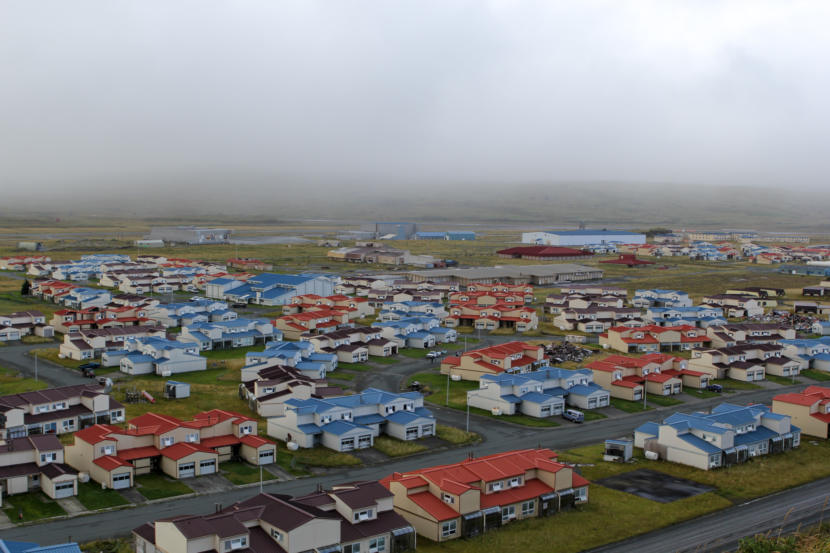
While long-term plans call for wind and hydro to be integrated into the city’s grid, City Manager Layton Lockett said it’s critical to replace the current diesel system. (Zachariah Hughes/Alaska Public Media)

The community of Adak has electricity again after issues at its power plant shut down local operations for nearly a week, according to City Manager Layton Lockett.

Two failures in the system forced the nation’s westernmost city to close city offices, the school and the local clinic for six days. Community members were forced to rely on small generators for power, Lockett said.

The community of roughly 100 people has a single diesel powerhouse. In the days when the Navy was operating on the western Aleutian Island, there were five power plants there, according to Lockett. But it’s been more than two decades since the Pentagon shuttered the large naval air base that once housed 6,000 service members and their families.

“We do not have the demand to have multiple power plants,” Lockett said. “Even the existing powerhouse was built for many megawatts of power generation. The power plant being used was the central hub, if you will, and was built in the early days. In fact, it still has the old steam boilers that burned bunker oil, sectioned off of course due to asbestos concerns.”

While long-term plans call for wind and hydro to be integrated into the city’s grid, Lockett said it’s critical to replace the current diesel system.

During last week’s outage, Alaska Airlines was able to continue to fly to the remote community thanks to the use of generators to power critical equipment, Lockett said. But the city did have to resort to manually pumping its sewage lift stations after several days.

Lockett said he hopes the issues at the powerhouse won’t be ongoing. The city and TDX Adak Generating — which took over utility operations in 2008 — have been working with other stakeholders for the last couple of years to secure funding to put a new power plant in City Hall’s backyard.

“This will bring the plant much closer to town while also allowing flexibility, should another catastrophic event occur in the future,” Lockett said.

One of the benefits of moving the power plant, besides the fuel efficiency, is that the city will have a direct feed into its building, allowing them to have power even if something happens on the grid, he said. They’re also developing a plan to allow the new water treatment plant and City Hall to utilize the waste heat.

Lockett estimates it’ll be another six to nine months until the new plant is in place, hampered in part by manufacturing delays and the logistics of installing a new plant in the remote community.

Hurricane-force winds cause widespread damage in Unalaska

Unalaska after the storm. (Maggie Nelson/KUCB)

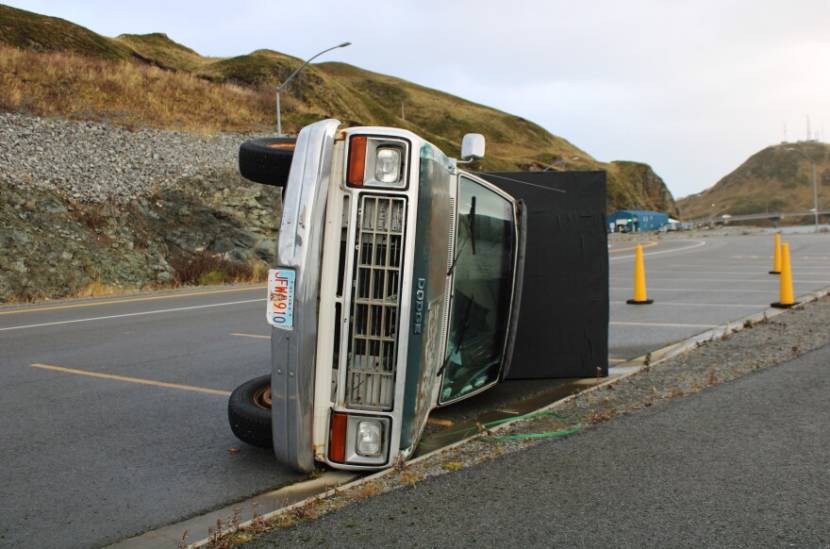
Hurricane-level winds slammed the Aleutian Islands Thursday night, tearing off roofs and tearing boats from their docks.

In Unalaska, the region’s largest city, the National Weather Service recorded wind gusts of up to 132 mph.

“This was a very, very strong storm for so far east,” said climatologist Rick Thoman, who works for the Alaska Center for Climate Assessment and Policy at the University of Alaska Fairbanks. “And for the Eastern Aleutians, you were right in the worst place of the storm.”

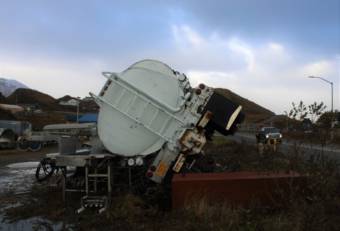
Hurricane-level winds slammed the Aleutian Islands Thursday night, toppling trucks in Unalaska. (Maggie Nelson/KUCB)

The storm’s strength didn’t come so much from high wind gusts, but from how long they lasted, according to Thoman. Last night’s storm produced sustained winds over 40 mph for 11 consecutive hours, which he said marks the longest sustained winds there in at least a decade.

“It’s not that winds as high as they gusted in this event don’t happen — they do,” he said. “But [they] don’t have that sustained wind at 40 to 60 miles an hour for hours on end very often.”

At this point, there have been no reported injuries or 911 calls about the storm, according to Unalaska Police Chief Jay King.

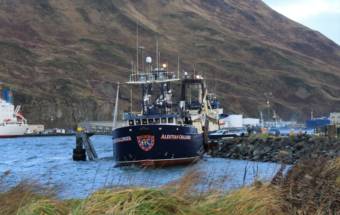
The Aleutian Challenger is being inspected after breaking loose from the dock at Unalaska’s spit, according to Ports Director Peggy McLaughlin. (Maggie Nelson/KUCB)

Storms are not unique to the region and Unalaskans are accustomed to strong winds. A record-breaking storm hit the island in August 2020, damaging structures and overturning boats.

King said it appears the damage from this storm is more widespread than last year’s, but it’s still too soon to say for sure.

Thoman, the climate specialist, said weather models predicted the storm well in advance, and locals braced for it. When it comes to low-pressure storms centered so close to Unalaska, he said this was likely a once-in-a-decade event.

Coast Guard medevacs fisherman pinned by crab pot

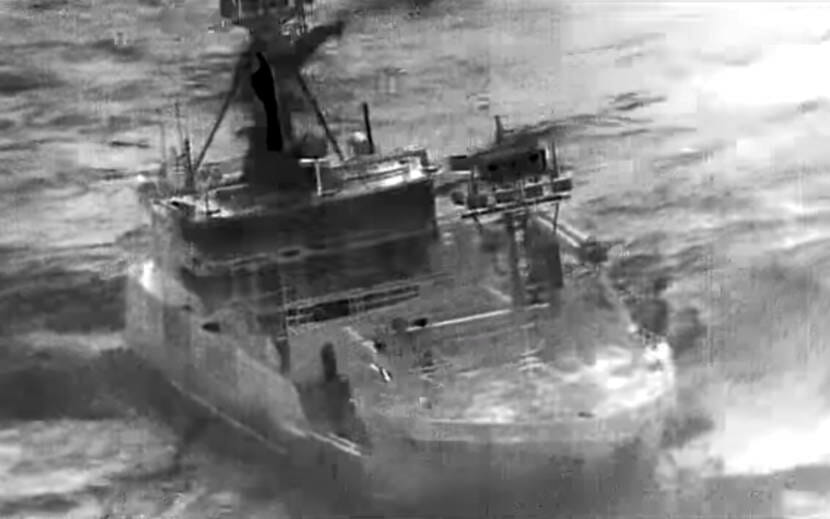
Screenshot from a U.S. Coast Guard video of the medevac of an injured fisherman from the Patricia Lee.

The U.S. Coast Guard medevaced a man Tuesday night from a fishing boat approximately 200 miles southwest of Unalaska, according to a USCG statement.

The Coast Guard command center in Juneau received a call from the fishing boat Patricia Lee at about 4 p.m. requesting a medevac after one of their crew members “sustained serious injuries to his pelvic region” from getting pinned by a crab pot.

A Coast Guard MH-60 Jayhawk helicopter crew from Air Station Kodiak hoisted the injured fisherman from the fishing boat at about 11:50 p.m, according to the statement. He was flown to Unalaska and placed in the care of LifeMed personnel.


While the 117-foot vessel made its way toward Dutch Harbor, the command center directed the launch of the Air Station Kodiak helicopter crew from Cold Bay, the statement said. A Coast Guard C-130 Hercules aircraft crew and an additional MH-60 Jayhawk aircraft crew were also launched from Air Station Kodiak to provide back up.

“Thanks to the cooperation among air crew members, the command center team and the crew aboard Patricia Lee, our Kodiak team was able to hoist and deliver this young individual to a higher level of care,” Lt. Robert McConnel, Air Station Kodiak operations duty officer for the case, said in a statement. “Our crews routinely train for the treacherous Alaska night conditions they encountered yesterday. It feels good to see our team execute when someone’s life is on the line.”

Weather at the time included 40 mph winds gusting to 55 and 14-foot seas, with rain, snow and sleet squalls.

Judge rejects Bering Sea seafood companies’ request to block penalties for alleged violations of federal shipping law

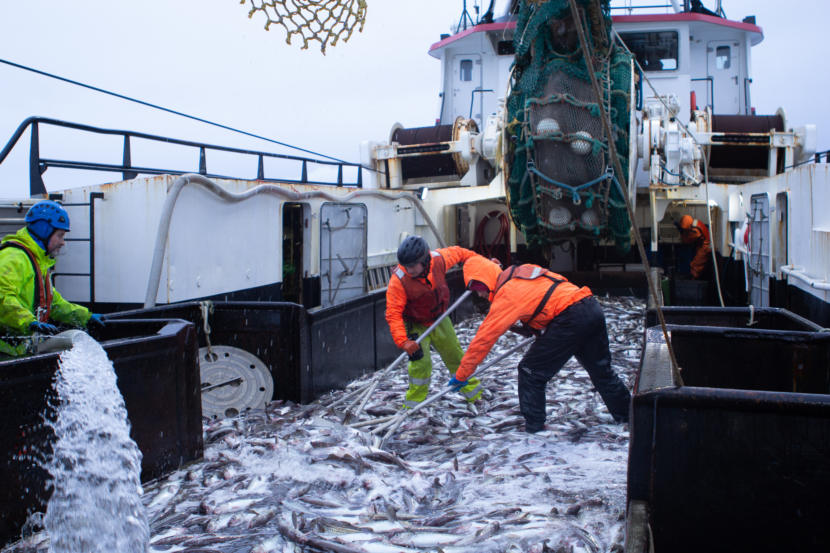
Crew members shovel pollock on the deck of a Bering Sea trawler last year. (Nathaniel Herz/Alaska’s Energy Desk)
Crew members shovel pollock on the deck of a fishing vessel after a harvest on the Bering Sea in 2019. (Nat Herz / Alaska Public Media)

A federal judge has denied, for now, a request by some of the largest Bering Sea seafood companies to block the Biden administration from levying additional fines on them for alleged violations of federal shipping laws.

U.S. District Court Judge Sharon Gleason issued her 25-page decision Tuesday rejecting the request by a subsidiary of Bering Sea pollock harvesting giant American Seafoods, and a related company, Kloosterboer.

The seafood companies had turned to an array of lawyers to make their case, including former President Donald Trump’s personal attorney, Marc Kasowitz. They said U.S. Customs and Border Protection had threatened them and other businesses in their supply chain with penalties exceeding $300 million.

The penalties were for using a miniature Canadian railway to satisfy a provision in a federal law called the Jones Act. It allows goods to be shipped between American ports on foreign-flagged vessels only if their route includes Canadian rail lines.

Gleason, in her ruling Tuesday, denied the companies’ request for a temporary restraining order and a preliminary injunction.

She said the companies had met one legal standard required for her to issue the injunction, by raising valid questions about whether the penalties are causing irreparable harm to the seafood companies’ business.

But she added that the businesses have not shown that they’re in compliance with the federal shipping law, nor have they pursued all of their options to appeal to CBP directly.

Gleason dismissed the request without prejudice, which means the companies can resurrect it if they appeal to CBP and fail.

Kloosterboer and Alaska Reefer Management, in a prepared statement, called Gleason’s decision “mixed” and said the ruling invited them to renew their request after taking the procedural steps the judge suggested.

“As a result of this outcome, which in large part is positive, we will not be able to resume trucking goods as fast as we had hoped,” the statement quoted Per Brautaset, ARM’s president, as saying. “However, we are encouraged and will continue to pursue the available legal and administrative options to resolve this issue.”

Pollock fishery may be cause of decline in Bering Sea fur seals, study says

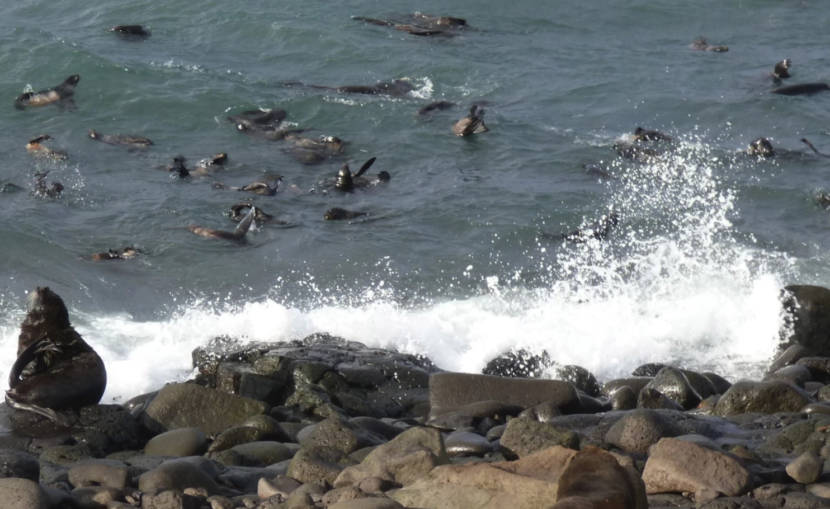
The number of northern fur seals in the Bering Sea has dropped by around 70% since the 1970s.

Fur seals are an essential subsistence food for the Unangax̂ communities in the Bering Sea’s Pribilof Islands. But for years, scientists have been unable to explain why the seals’ populations have been falling.

Now, a new study points its finger at an industry that’s long been suspected, but never definitively linked with the population declines: Alaska’s huge commercial pollock fishery, which harvests the same species that nursing female seals rely on to feed their pups.

Jeffrey Short is the lead author of a study published in the Journal of Marine Science and Engineering on Sept. 9, which he says presents for the first time clear evidence linking the pollock fishery with fur seal reductions.

Some scientists have suspected the pollock fishery, but evidence-based research linking the two has been scarce. According to Short, that’s because much of the existing literature has focused on the overall abundance of pollock, which is quite high.

By contrast, this new study focuses on the pollock catch — that is, the amount of fish being pulled out of the water.

“I was just astonished at how well it worked,” Short said. “Just that single number of pollock catch can explain nearly all of the [fur seal] population trajectory since about the mid-1970s.”

The team found evidence to suggest that the pollock industry, by breaking up the dense schools of fish the mothers rely on while fattening their pups, has made it harder for lactating fur seals to feed their young.

“What a female lactating fur seal wants to do is find a dense aggregation of food right next to where her pups are,” Short said. “So she can spend the minimum amount of energy to go find it, sit on top of it and eat to her heart’s content, and then swim right back and nurse her pups and repeat that all summer long.”

But commercial fishing boats also seek dense schools of fish. By fishing those schools, the fleets break them up, and the fish disperse. Which means the mother seal can’t fatten up her pups as quickly as she once could.

That’s a problem because the pups swim south in the fall. If they haven’t built up enough reserves, those seal pups likely won’t survive their first year.

And that, according to this study, is why fur seal populations are declining so steeply.

The number of northern fur seals in the Bering Sea has dropped by around 70% since the 1970s.

“I think it’s possible for the fur seal herd to eventually go extinct or become extirpated off the Pribilof Islands,” Short said.

The fur seal rookeries in the Bering Sea hold special importance to the Unangax̂ communities in the Pribilof and Aleutian Islands which rely on fur seals for subsistence.

Martin Stepetin grew up on St. Paul Island — the most populated of the Pribilof Islands — but now lives in Juneau where he advocates for Alaska Native rights.

“We eat those seals, so it gets scary,” Stepetin said. “If you’re trying to support your family, and you’re trying to put food in the refrigerator, you worry about the future. What about your kids? How much food is there going to be whenever your kids come of age? Are they going to be able to support their families?”

The study suggests that to make any real changes, the fishery — which is one of the most lucrative in the United States — would likely need to limit pollock catch to around a million tons in the areas surrounding the Pribilof Islands. That’s nearly a quarter of the total 1.375 million tons currently allowed.

One pollock industry booster, Stephanie Madsen, said she’s worried about a one-size-fits-all solution.

“It would be devastating to just have a blunt tool. And that’s what I think this is. It’s a blunt tool,” said Madsen, executive director of an industry group that represents large factory trawlers, the At-sea Processors Association.

Madsen said she welcomes the paper into the growing body of research on the subject, but she said there needs to be more precise measures than simply limiting the total allowable catch. She also expressed skepticism that limiting catch would improve the seals’ fate.

“When you’re talking about drawing circles around rookeries, and preventing fishing from occurring in there, you’re making quite a few assumptions about the pollock staying inside that circle, that the fur seals aren’t going to go outside the circle,” Madsen said.

The pollock industry employs around 30,000 people nationwide. In the eastern Bering Sea and Gulf of Alaska, the fishery brought in around $420 million in 2020, according to the National Oceanic and Atmospheric Administration.

“Thousands of jobs and tens of thousands of families depend on that income,” Madsen said. “I think depending on the size of those circles, for the most part, it could be quite damaging to the pollock fishery’s ability to harvest our quota.”

Madsen said that while she is moderately concerned about the authors’ findings, she doesn’t anticipate they will lead to immediate changes in the industry.

The North Pacific Fishery Management Council, which manages fisheries in the region, receives updates on marine mammals at the beginning of each year.

“We have great science, we have rational thinking heads,” Madsen said. “And I think the North Pacific council will take this information [when] they get their annual marine mammal updates at their February council meeting.”

Site notifications
Update notification options
Subscribe to notifications