Aleutians

The westernmost city in the US made it 18 months into the pandemic with only one case, until now

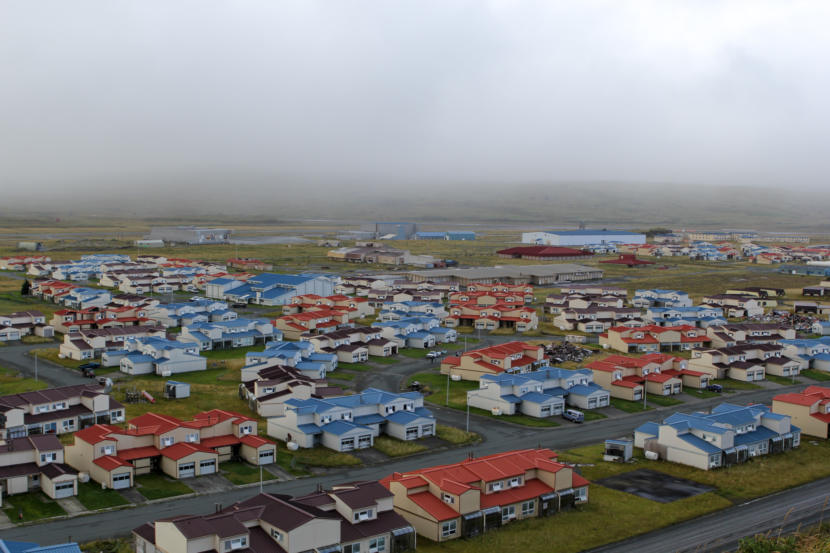
Lockett said the majority of eligible residents are vaccinated and that medical staff will continue to test locals this week to figure out if the virus has spread to the community. (Zachariah Hughes/Alaska Public Media)

Nearly nine months after Adak reported its first case of COVID-19, the nation’s westernmost city is seeing a spike in infections.

City Manager Layton Lockett said the city has nine new cases of the virus — all of them visitors to the remote island. This marks the first time the virus has reached the community of roughly 100 people since they recorded their first case last December.

Lockett said the city is investigating the outbreak along with the local school district and Eastern Aleutian Tribes — the local medical provider.

“What we wanted to ascertain was how far it has spread and the impact to the unvaccinated portion of the community, which I believe is just the children that are ineligible to receive vaccinations at this point,” he said.

Lockett said the majority of eligible residents are vaccinated and that medical staff will continue to test locals this week to figure out if the virus has spread to the community.

“Our community members have decided that they do want the vaccine and they have it,” he said. “I think that has been a positive aspect for us and hopefully we’ll find out if that has helped us with the impact of this outbreak or not.”

Since the Pentagon closed a large naval airbase on the island in the late 1990s, Lockett said there are only a few reasons non-locals travel to the Aleutian community. Adak serves as a transfer point for fishermen on boats fishing out west. It also attracts tourists looking to hunt caribou or go bird watching, as well as officials conducting environmental remediation projects. He did not say why the group of people who tested positive traveled to the island or if they are vaccinated.

To curb the spread of the virus, city leaders decided to mandate masks and to limit access to City Hall.

“It’s really hard at this point to implement travel measures — like the travel applications we’ve had — because there’s a large administrative burden,” Lockett said. “And you really have to have an enforcement component, and we’re really hampered with having no village public safety officer or police force to help implement that.”

He said the city is still trying to understand how far the virus has spread to determine if additional safety measures should be taken. He said the city council planned to hold a special work session Tuesday night to discuss what direction they hope to head.

Lockett said the recent cases have highlighted that the pandemic isn’t over and that the community needs to remain vigilant. The small island community has a health clinic with just one provider and one support staff, he added.

“What we’re ultimately trying to prevent is a medevac that is COVID-related to a place where they may or may not be able to get care because the other facilities are filling up,” he said. “That’s a big issue. We don’t have ventilators — just like a lot of other small communities. And do we see that day where patients are turned away from emergency care because there is no space available? Then what? That truly is a fear.”

With low stocks and closures looming, Bering Sea crab fleet braces for another blow

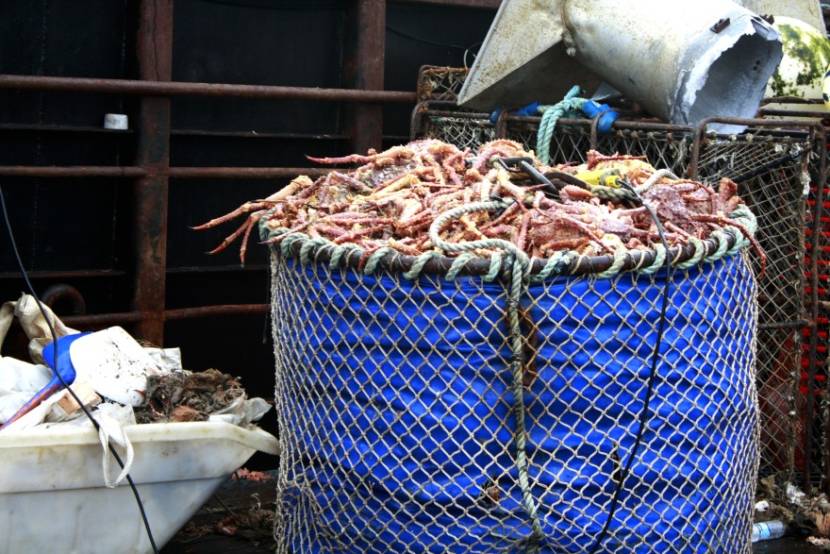
For the City of Unalaska — home to the nation’s top fishing port — officials estimate the community will take about a half-million-dollar hit to the annual budget from the Bristol Bay red king crab closure. (KUCB file photo)

The Alaska Department of Fish and Game announced earlier this month that all major crab stocks are down. And for the first time in over 25 years, the Bristol Bay red king crab fishery will be closed.

The species is world-renowned and was largely made famous by the popular reality TV show Deadliest Catch. In the glory days of king crab fishing, locals describe hundreds of boats rushing into the cold Bering Sea to harvest millions of pounds of crab worth even more millions of dollars.

The commercial fishery has been around since 1966. In the 55 years since then, there have been just two other closures: once in the 1980s and again in the 1990s.

Now, the Bering Sea crab fleet and fishing communities around the state and the Pacific Northwest are bracing for another blow to their industry and are calling for new conservation efforts.

“It’s big news, and it’s hitting our industry really hard,” said Jamie Goen, executive director for Alaska Bering Sea Crabbers, a trade association representing commercial crab harvesters. “We’re disappointed and deeply concerned.”

Goen said they estimate the closure of the Bristol Bay red king crab fishery — which historically opens in mid-October — and the anticipated reduction in snow crab harvest could cost harvesters well over $100 million.

But, she said, it’s not only the fishermen who will be impacted. This hit affects everyone in the industry — roughly 70 vessels and over 400 fishermen and their families, along with the processors and fishing communities that rely on crab revenues.

“It’ll be a big reach,” she said. “[If] you look at the dollar value for Bristol Bay red king crab, it’s about a $30 million hit on our industry. So that affects the vessels and the crew, it affects the shipyards that they go into, it affects the processors that take the crab and the fishing communities that rely on it. But even more than that, it’s one of America’s and Alaska’s iconic species. It’s going to be a hit to the U.S. to not have Bristol Bay red king crab on the market.”

Every summer, federal and state agencies survey crab stocks — with the exception of 2020 due to the coronavirus pandemic, said Miranda Westphal, the area management biologist with the Alaska Department of Fish and Game in Unalaska/Dutch Harbor.

For red king crab, she said management looks for mature males and females that can contribute to population growth. If numbers fall below a certain threshold, regulators don’t allow fishermen to harvest in order to give the stock time to bounce back.

And, Westphal said, they’ve been flirting with a closure for a while now. For the past decade or so, regulators have seen a stark decline in numbers. And this year, there just aren’t enough mature females to justify an opener.

“We could kind of see a closure was coming, we just didn’t quite know when,” she said.

The last closure was in the mid-90s. And at that time, Westphal said, they could see there was what she called a “recruitment pulse” coming — or juvenile crab coming up into the fishery — and that they could kind of tell it would be a short closure.

“[But] we can’t really say that this time,” she said. “It could be next year that the females hit the survey and everything’s back to normal. Or it could be that this is just part of the continuous decline we’ve been seeing over the last decade, and it’s going to be a few years or longer. We just don’t know right now.”

But Westphal said the data doesn’t suggest overfishing, and she hopes a one-year closure will be enough for the stock to rebound. Still, even a short closure would have far-reaching impacts.

For the City of Unalaska — home to the nation’s top fishing port — officials estimate the community will take about a half-million-dollar hit to the annual budget from the king crab closure. But king crab isn’t the only problem.

Abundance estimates for mature male snow crab declined 55% from 2019 estimates, and estimates for mature bairdi crab also declined slightly, based on the NOAA Fisheries 2021 Eastern Bering Sea Continental Shelf Trawl Survey Results for Commercial Crab Species.

While the survey results don’t translate directly to harvest levels, they generally follow the same trend and reductions are likely, according to Alaska Bering Sea Crabbers. So throw the anticipated reduction in snow crab into the mix, and the total loss to the city could be about $1.7 million.

“It’s a significant amount of revenue, especially for the fleet and the city based on our fish tax revenues and a small amount of sales tax revenues generated,” said Frank Kelty, a fisheries consultant with the City of Unalaska.

Kelty arrived on the island more than 50 years ago to work as a crab processor, acted as the city’s mayor for more than 10 years and now consults on fisheries issues from his new home in California.

Kelty said the red king crab fishery — although high in value — has been low volume for many years, and Unalaska’s industry now relies on other species. So the impact to the community won’t be as dire as it was when the fishery crashed in the early 1980s, when there was no groundfish industry to fall back on.

“Basically, the revenue for the community was devastated when we had that crash in 1981,” he said. “It took us years to get back on our feet from that. And luckily, groundfish started up in 1986 in the community to get us going again. So yeah, it was devastating. We had major layoffs at the city and the plants closed their doors.”

But this year, plants won’t be closing their doors. That’s largely because Unalaska’s high dollar fish these days is pollock — which goes into products like McDonald’s fish sandwiches, fish sticks and sushi.

Tom Enlow is president and CEO of UniSea, Unalaska’s largest fish processing plant. Pollock now makes up about 85% of its operations in terms of overall pounds processed. Enlow said the biggest adjustment from the king crab closure will be laying off some seasonal workers who would normally stick around after pollock season wraps up this month.

“We’ll keep a crab crew around for golden king crab, but we’ll probably have a layoff for more people than we normally would after the pollock season ends,” he said.

Enlow said many in the industry have suspected a closure might be around the corner. UniSea purchased about 560,000 pounds of red king crab in 2019. Last year, that number dropped to only around 400,000 pounds.

While this closure may not carry the financial impact as those of the ’80s and ’90s, Enlow said it could hurt in other ways.

“UniSea started out as a crab processing plant,” he said. “And we still take a lot of pride in our reputation in the marketplace for the products we produce from crab, even though we’re more of a pollock-centric company. There’s something about red king crab that you just can’t replace with any other type of species of critter swimming in the sea.”

Another impact UniSea will likely see this year, Enlow said, is in the company’s hospitality division. UniSea owns Unalaska’s only hotel as well as about half of the restaurants in town. And because of the closure, he said the Original Productions crew — which films the popular Discovery Channel series “Deadliest Catch” about crab fishermen in the Bering Sea — likely won’t block out their usual 40 to 50 hotel rooms and meeting spaces in October.

A representative from Original Productions told KUCB they’re planning to do another season of Deadliest Catch. They did not say what that would look like.

Coast Guard encountered Chinese warships in the Aleutians in August

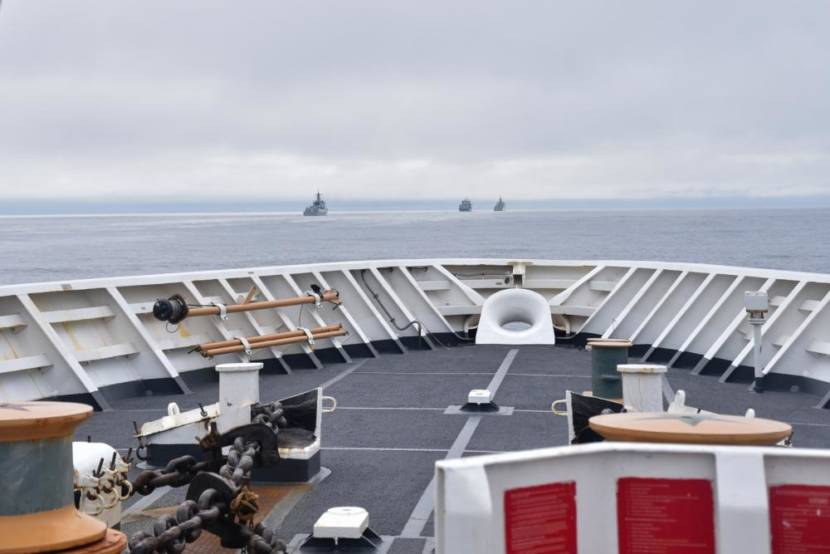
During a routine maritime patrol in the Bering Sea and Arctic region, U.S. Coast Guard Cutter Bertholf spotted and established radio contact with Chinese People’s Liberation Army Navy task force in international waters within the U.S. exclusive economic zone, Aug. 30, 2021. (U.S. Coast Guard photo by Ensign Bridget Boyle)

The Coast Guard encountered a flotilla of Chinese warships 46 miles off the Aleutian Islands at the end of August, inside of the U.S. Exclusive Economic Zone, according to a news release Monday evening.

The exclusive economic zone extends off the country’s coastline, including off the coast of Alaska. The U.S. has jurisdiction over natural resources in the waters.

The Coast Guard said the four Chinese warships included a guided missile cruiser, a guided missile destroyer, a general intelligence vessel and an auxiliary vessel.

No interaction occurred between Chinese vessels and American Coast Guard or American fishing vessels, according to the Coast Guard’s release. It said the Chinese vessels have right of passage through the economic exclusion zone and were in full compliance with international maritime law.

Scott McCann, a Coast Guard spokesperson, would not speculate on the reason for the Chinese warships’ visit when asked Tuesday morning. He said it’s been several years since Chinese warships last entered the economic zone off Alaska.

The Coast Guard encountered the vessels with the Bertholf and Kimball legend-Class national security cutters and Healy, a medium icebreaker.

This is a developing story. Check back for updates.

3 volcanoes erupting across Aleutian Range

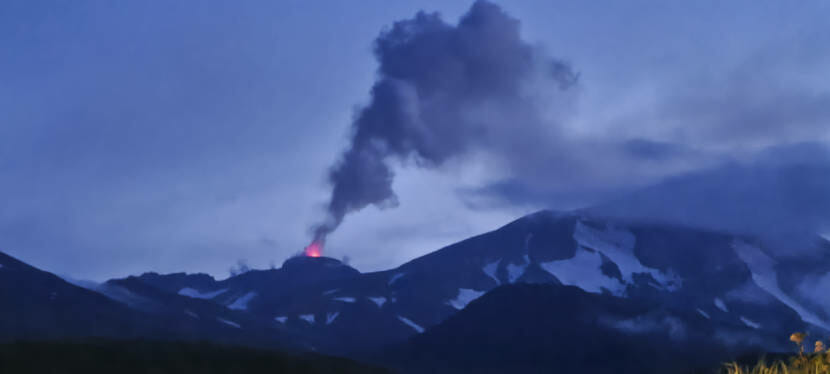
Active lava fountaining at Great Sitkin volcano on Aug. 5, 2021. (courtesy of Peggy Kruse)

Three volcanoes are erupting across the Aleutian Range — Great Sitkin and Semisopochnoi in the Aleutian Islands and Pavlof Volcano on the Alaska Peninsula.

Hannah Dietterich, a research geophysicist with the Alaska Volcano Observatory, said three simultaneous eruptions may seem like a lot, but it’s not unheard of for the region.

“Our average number of … volcanoes that erupt in a year in Alaska is only two. So this is unusually busy,” Dietterich said, “but all of these volcanoes have erupted in recent years as well.”

https://www.facebook.com/alaska.avo/posts/4210137452414071

Semisopochnoi is the westernmost of the active volcanoes, sitting near the far end of the Aleutian chain. The volcano has been erupting since 2018, but has seen increased explosions in recent weeks.

Meanwhile, Pavlof Volcano on the Alaska Peninsula is also producing ash clouds. But Dietterich says the small puffs disperse quickly.

In the center of the Aleutian Islands, about 26 miles northeast of Adak, Great Sitkin volcano erupted at the end of May.

“A lava dome began erupting just from the center of the summit crater,” Dietrich said.

She warned pilots to use caution when flying nearby and to follow the observatory’s advisories, but added that the eruptions “don’t pose any significant threat to people.”

For more information and to see a timeline of volcanic eruptions, go to avo.alaska.edu.

Unalaska boosts COVID risk level after potential spread at weekend festivals

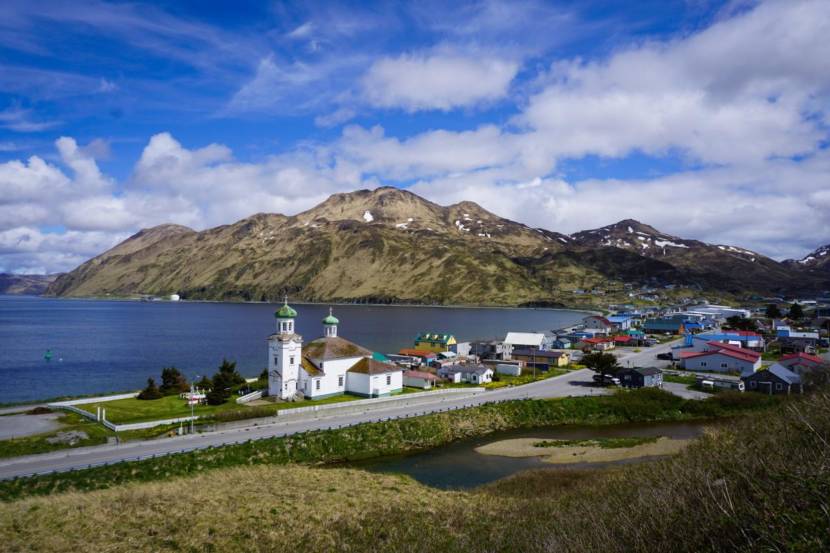
Downtown Unalaska. City officials said wastewater testing had recently shown an uptick in COVID-19 positivity. They also said they’re on guard after two major public festivals last weekend brought residents together in close quarters. (Hope McKenney/KUCB)

The City of Unalaska confirmed what it called a “widespread community exposure” of COVID-19 on Tuesday, after identifying two new community-acquired cases of the virus.

City officials said wastewater testing had recently shown an uptick in COVID-19 positivity. They also said they’re on guard after two major public festivals last weekend brought residents together in close quarters.

In response to the new cases, the city has raised its COVID-19 risk level to high and closed certain municipal buildings to the public.

Despite the uptick in cases, the city isn’t mandating any extra public health protocols. However, the city council will meet next Tuesday to review community-wide protective measures.

City Hall and the public library are also temporarily closing to the public, while the pool and Community Center will remain open at limited capacity, and by appointment only.

Other local organizations, like the Museum of the Aleutians, have also temporarily closed.

Unalaska’s schools still opened for the first day of classes Wednesday. But district officials said that face masks will be required at all times, in light of the recent spike in cases. Unalaska City School District families were notified of the change on Tuesday. Prior to the increase in local cases, students had the option to wear masks at school.

The island recently saw one of its busiest weekends since the start of the pandemic, with two community events taking place. One was the Aleutian Electrocution, an annual metal art, music and dance festival held at the end of Captains Bay Road.

The other was the city’s annual Heart of the Aleutians festival, a community event where local vendors sell food and artwork, and Unalaskans gather for lip-syncing and food-eating contests.

Unalaska Fire Chief and acting Incident Commander Patrick Shipp said while there are only two community-acquired cases confirmed, local officials are aware that the island is vulnerable in the wake of those public events.

“It was a really busy weekend on the island, and people were all out and together,” Shipp said. “We just want to make sure that we don’t have this huge outbreak of positive cases.”

Shipp said the shift to a higher risk level is a chance to find out how widely the virus is spreading in Unalaska.

“What we’re doing right now is kind of just taking a pause and seeing what’s next,” Shipp said. “We don’t know a lot. And we’re hoping the next few days will tell us [more].”

This is the first time the city has returned to the high COVID risk level since late April.

As of Tuesday evening, the city was reporting a total of six active cases of COVID-19 in Unalaska, half of which are travel-related. Two of the remaining three are community spread, while just one is industry-related. At least three of the recent cases were vaccinated individuals, said Shipp.

The new cases were detected after multiple people asked to be tested at the local clinic, Iliuliuk Family and Health Services, said Melanee Tiura, the clinic’s chief executive.

Others were tested because they were exposed to someone who had previously tested positive.

While the positive tests have not yet been analyzed, Tiura said it’s very likely these are cases of the delta variant, which according to the Centers for Disease Control and Prevention, spreads about twice as fast as other forms of the coronavirus.

Delta represented 88% of all the positive tests analyzed by Alaska’s public health labs in the state’s most recent variant report.

“Most of the cases in the state are delta, so the likelihood that this is delta is very, very high. It’s almost a guarantee,” Tiura said. “So, we expect it will move faster than our previous cases.”

Tiura said local officials were first aware of a COVID spike when it was found in the island’s wastewater over the weekend, but that didn’t correlate with known cases at the time. Local officials will continue to test and track levels of the virus in wastewater to see how it corresponds to the currently known cases.

In the meantime, Tiura said that if people are feeling sick with even just mild symptoms, they should get tested and stay home.

“This is our time to do what we can do, short of a mandate,” she said. “We’re all making those decisions that will help to allow this to just fizzle out. And I would say it’s going to take a couple-week window here, kind of a washout period, where we know there’s exposure, we know there’ll be more positive [cases].”

Unalaska’s outbreak comes on the heels of a recent case uptick in the Aleutians East Borough, which has reported 27 confirmed cases since July 16.

Those cases were mainly in the community of Sand Point, said Paul Mueller, Chief Executive of Eastern Aleutian Tribes.

“The rest of the Aleutians East Borough region has not seen a huge uptick. I think we had one case in King Cove back at the end of July,” Mueller said. “So, really, we’ve only seen the uptick in Sand Point, and that was at a community gathering.”

Sand Point City Administrator Jordan Keeler said the rate of new infections appears to be declining, and that only one new case was reported over the past seven days — a steep drop from the 15 cases reported over the preceding seven days.

Mueller urged travelers to exercise caution when visiting communities in the region.

“We’re not going to be able to stop people from traveling,” he said. “But we can ask them, urge them, beg them to be safe. Mask up, get tested before you come back into the region.”

Unalaska youth learn Unangax̂ values, language and medicine at Camp Adgayux̂

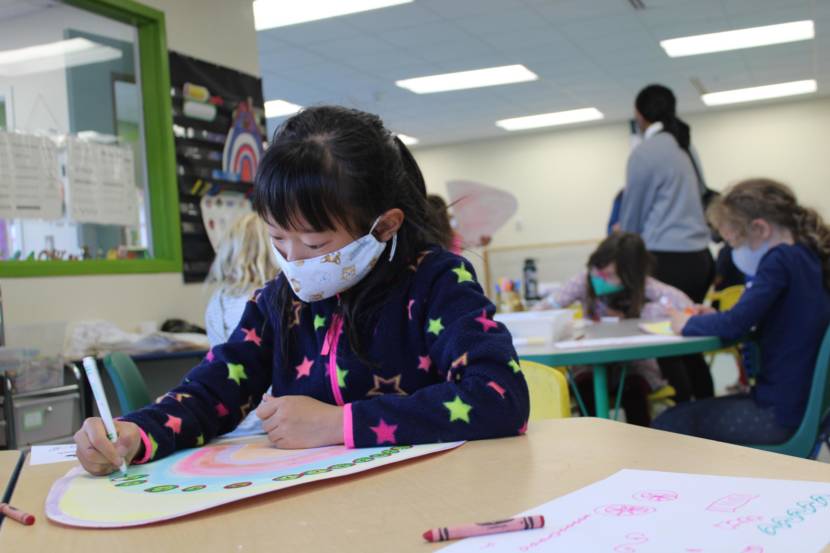
A student colors a paper version of an of Unangax̂ bentwood hat, or chagudax̂, at Camp Adgayux̂. During camp, kids learn to harvest local plants and use them as medicine for things like burns from pushki or as soothing lip balms. (Maggie Nelson/KUCB)

Listen to this story:

Fletcher Bagley, a soon-to-be second grader, held a small glass vial in the air filled with a dark green liquid. It’s wormwood oil, which can be used to cure dogs who are sick with worms, he explained. Then he grabbed another small jar with an illegible but colorful label.

“We’re going to turn it into angelica salve,” Bagley said,  holding the jar in the air. “And I think that we get to eat it.”

Bagley’s right about almost everything he says — he did fill the small jar with a salve made from the local plant angelica. And wormwood is an herbal remedy for dogs with worms, though he didn’t eat any of those items.

But by the end of his time at Camp Adgayux̂, Bagley and about 15 kids will be whizzes at making salves from local plants, while they learn about Unangax̂ values, language and art.

Camp Adgayux̂, also known as Camp A, resumed in 2021 at Unalaska’s Community Center after it was canceled last year due to coronavirus concerns.

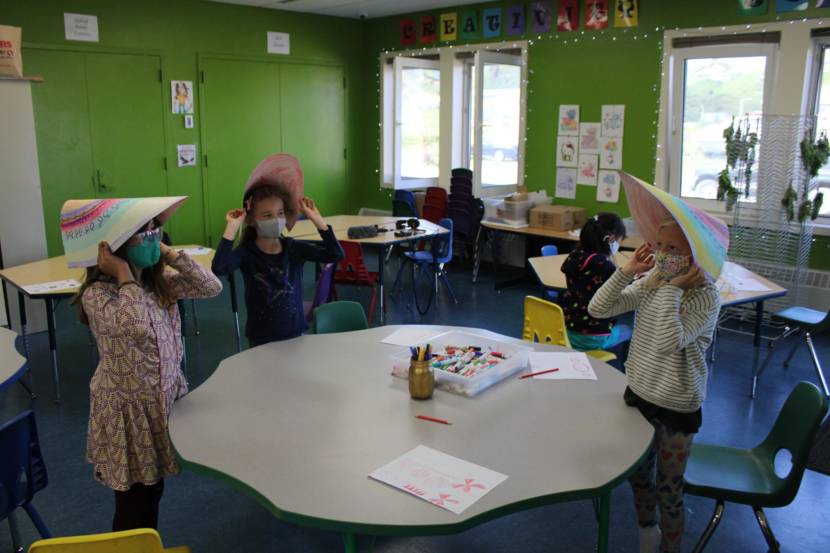
The kids learn about local flora — what they can use for medicine and what is dangerous to eat or touch. They learn to harvest local plants and use them as medicine for things like burns from pushki — known in other parts of Alaska as cow parsnip — or as soothing lip balms. They also make paper versions of Unangax̂ bentwood hats, or chagudax̂, and learn about the values and language of the local Unangax̂ who’ve lived on the island for thousands of years.

Kids at Camp Adgayux̂ make paper versions of Unangax̂ bentwood hats or chagudax̂. (Maggie Nelson/KUCB)

Sharon Svarny-Livingston helped start the class about 10 years ago with longtime Unalaska resident Harriet Berikoff.

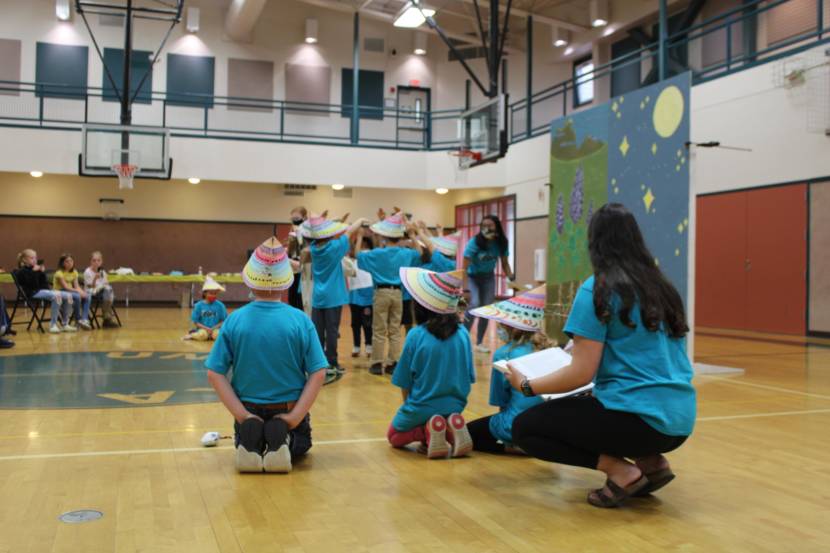
The camp culminates in a play at the end of the week. This year, Svarny-Livingston said the kids acted out a story about the moon’s sister, who descends to the villages on the earth and has a son.

“She takes [her son] on a journey, and she takes him through the constellations — just as they are today. We have different names for them, of course,” Svarny-Livingston said. “And eventually, they get to the moon’s house, and [the moon’s sister] dies on the trip because she got very old. And of course, the moon was getting old too, and so his nephew took his place.”

Svarny-Livingston said this year was also unique because she had the help of local teen Rylee Lekanoff, who attended the camp when she was in elementary school.

“She stepped up quite a bit because I needed an Unangan helper who wasn’t just a volunteer,” Svarny-Livingston said. “I needed her to be able to take on certain aspects of the project and run with them.”

Lekanoff led the Unangam Tunuu language and Unangax̂ values sections.

“Ugigdada — that one means ‘share,'” Lekanoff said. “Tutada, is ‘listen.’ Chxadalgaax̂txin is ‘don’t steal,’ and txin ugutada is ‘be happy.'”

Campers act out a story about the moon’s sister at Camp Adgayux̂. (Maggie Nelson/KUCB)

Svarny-Livingston said she’s excited to see Lekanoff returning to the camp as a mentor.

“That’s the whole purpose, you know, of trying to preserve culture and save culture, is making sure that you always pass on your knowledge to somebody else, so that they can continue to pass it on,” she said.

For the young ones, Svarny-Livingston said part of that preservation work involves breaking down some of the larger and more challenging concepts, values or practices, even in the artwork.

“They’re looking at the design posters and they’re going, ‘we can’t do that stuff,'” she said. “And I go, ‘you’ve just got to break them down into little pieces. Break it down — you know, it’s a line, it’s a circle, it’s a dot and it’s repetitive and it just goes on and on.'”

As the kids work on their paper bentwood hats, a few chant Svarny-Livingston’s mantra: “circle, line, dot, circle, line dot.”

Site notifications
Update notification options
Subscribe to notifications