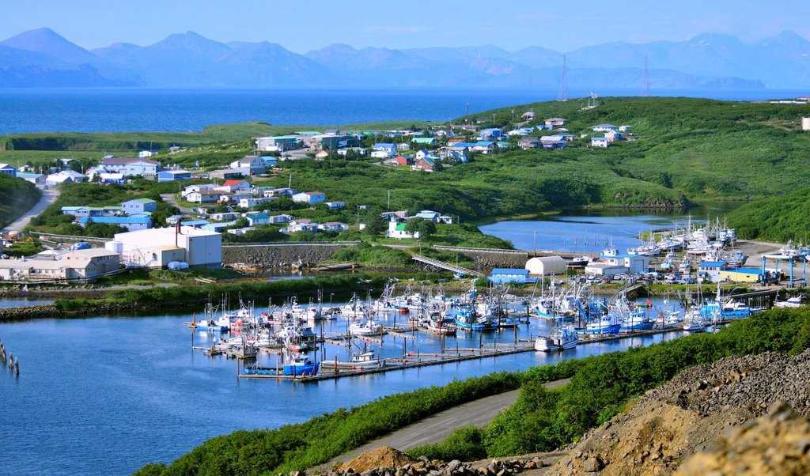
A DeHavilland Dash 8 airplane lands on Tom Madsen Airport’s short 4,500-foot runway. (Hope McKenney / KUCB)
Ravn Alaska announced a new agreement last week that will allow customers to use Alaska Airlines miles to purchase tickets for Ravn flights.
After prolonged negotiations, executives from both companies reached the agreement to bring a mileage sharing program to Unalaska. The Aleutian community had previously relied on codeshare agreements between regional airlines, like the former RavnAir Group and Alaska Airlines, but had been without any such arrangement since RavnAir’s fatal plane crash in October 2019.
Now, Ravn Alaska has new owners and management from the previous RavnAir Group, which filed for bankruptcy last year.
The company’s website has a new option that allows customers to earn Alaska Airlines miles from its flights. Customers should be able to redeem miles in about two or three weeks, according to an Anchorage Daily News report.
Ravn representatives did not immediately respond to requests for additional information.
St. Paul in 2016. St. Paul is one of the rural communities in Alaska with residents who receive subsidized power from the state’s Power Cost Equalization program. (Ian Dickson/KTOO)
On St. Paul Island, in the Bering Sea, Phyllis Swetzof is anxiously awaiting an Alaska Superior Court ruling that may decide whether or not her monthly electric bill will double.
Swetzof, a retired city clerk, is one of about 82,000 Alaskans who receive subsidized power from the state’s Power Cost Equalization program, which reduces the cost of home electricity in 192 rural Alaska towns and villages. After an extended budget debate, the Alaska Legislature failed to fund it past July 1. On Friday, an Anchorage Superior Court judge heard arguments in a lawsuit that could determine whether the program resumes this year.
A ruling is expected soon, but the first bills without the subsidy are already starting to go out across Alaska. In some cases, the price of home electricity will double. Towns and villages, also eligible for lower-cost power, may need to raise rates for water and sewer service.
“Everybody’s going to go, ‘holy smokes,’” Swetzof said. “Then it’s real, and you’ve got to figure out what to do.”
Without the program, home electricity prices in St. Paul — which has fewer than 400 year-round residents — will more than double. A normal electric bill of 500 kilowatt-hours will rise from about $95 per month to $205.
“I think the impact here will probably be hardest on residents who are a fixed income, on unemployment or elders getting Social Security checks,” said St. Paul city manager Phillip Zavadil.
Earlier this month, the city began advising residents to cut back on their electricity use by lowering their thermostats, watching less TV and washing laundry in cold water instead of hot.
“My first thought, of course, will be food. We’ll readjust the food menu so that we eat cheaper by $100 a month,” Swetzof said. “Which doesn’t sound like a lot, maybe in Anchorage, but $100 here maybe buys you a bag of groceries.”
Effects are statewide and go beyond the home
No part of rural Alaska will be immune from cost increases, and places with the highest electricity costs will see the biggest increases.
In the Yukon River community of Galena, a normal bill will rise from $180 to $300 per month, said Dave Messier, Rural Energy Coordinator at Tanana Chiefs Conference. In Huslia, another Interior village, a normal bill will go from $120 per month to $285.
“This is a major, major issue for us, because it’s a — do we buy food, or do we buy electricity — issue,” said Kevin Theonnes, director of the Council of Athabascan Tribal Governments.
In a letter to the Alaska Legislature, council chief and chair Rhonda Pitka said, “In rural Alaska, and for the 84,000 Alaskans that rely on the PCE funding, there are no neighborhood supermarkets that keep food in cold storage. Subsistence hunters and fishers cannot provide for their families properly without power.”
In Nome, a normal bill will rise from $120 per month to $180. In Kotzebue, the same bill would go from $110 to $205, according to figures published by the Alaska Energy Authority at the start of this year.
“The hardship associated to participating electric utilities and their customers with the reduction of PCE payments will be considerable,” the state’s electricity regulator wrote on July 22.
The increase is not limited to individual homes: PCE also subsidizes the cost of electricity at municipal facilities. Things like streetlights, water treatment plants and tribal halls are eligible for a subsidy under a formula based on the population of the town.
The village of Tanacross uses some of its municipal subsidy to keep fire hydrants thawed during the winter, Messier said.
“Often, the municipalities own that infrastructure, and so they operate and take care of it, but if their bills double or triple, it’s going to be unsustainable,” said Jodi Mitchell, president and CEO of Inside Passage Electric Co-Op, which serves small towns in Southeast Alaska.
“I predict they’re going to have to charge customers more for infrastructure,” she said.
That would affect businesses, which don’t receive PCE directly. In many small towns, including St. Paul, the biggest local business is a fish processing plant, which consumes large amounts of fresh water. Higher utility costs would discourage business. Swetzof worries that if residents try to buy more things from Amazon, Target or Walmart, places with free shipping to the island, the town’s store will suffer.
“We’re rolling downhill. It’s turning into a snowball, it’s getting bigger and bigger, and it affects all of us,” she said.
St. Paul’s city-owned utility system receives about $220,000 per year in PCE payments, according to figures from the Alaska Energy Authority, and state regulators warn that power companies can expect to see more people unable to pay their bills as costs rise.
Zavadil said he expects the St. Paul city government’s cost to rise about $9,800 per month. The town’s entire budget for last year was $3.6 million.
“For the city itself, it’s going to be tightening up the belts where we can, but for residents, it will have more impact upon them, especially those on fixed incomes,” he said.
A program built to provide equity
The Alaska Legislature created the program in 1984. Natural gas prices in Southcentral Alaska are subsidized by the state through tax waivers and credits. In Southeast Alaska and on the Kenai Peninsula, state-built dams supply relatively low-cost electricity.
In rural Alaska, lawmakers concluded that no single project or effort could satisfy the various needs. As part of a grand legislative bargain, legislators agreed to create PCE to subsidize power costs while other parts of the state received physical infrastructure.
“That was the deal,” said former state Rep. John Sund, a Ketchikan Democrat who worked on the legislation behind the program.
But because PCE was an annual appropriation, subject each year to the whims of legislators working the state budget, rural legislators were at a political disadvantage and had to regularly argue in support of continued funding.
In 2000, the Legislature created an endowment to pay for PCE. By investing $178 million — money from the Constitutional Budget Reserve and the sale of four dams — lawmakers believed they could fund the program in perpetuity.
The idea worked — by 2017, the fund was worth more than $1 billion, so large that its proceeds were also being used for renewable energy projects and direct payments to communities, not just the power subsidy.
The Alaska Constitution forbids the Legislature from creating “dedicated” funds, and under the terms of a 1990 constitutional amendment, any surplus money left over at the end of the state’s fiscal year is supposed to be deposited into the state’s Constitutional Budget Reserve.
To get around this provision, the Legislature has traditionally taken a “reverse sweep” vote each year. On the eve of July 1, the money from various state funds is swept into the budget reserve, and with the approval of three-quarters of the House and three-quarters of the Senate, it is swept back out of the reserve and into the original funds one minute later. Those funds are used to pay for programs as varied as anti-smoking programs and education.
But in 2003, when legislative Democrats blocked the reverse sweep for political leverage, the PCE endowment was not affected. In 2018, when legislative Republicans prepared to do the same, the endowment would have again been unaffected.
After Gov. Mike Dunleavy came into office, his administration rewrote the list of funds affected by the sweep. That rewrite added the PCE endowment.
That act — combined with the willingness of House Republicans to use the reverse sweep as leverage for a larger Permanent Fund dividend — has turned the fund into “a political football,” Mitchell said.
Republicans in the state House support PCE and proposed to fund the program without an endowment, but that idea wasn’t accepted by the House’s predominantly Democratic coalition majority.
“For many of us, voting down the reverse sweep was about honoring the constitution and our oath of office, not defunding the PCE or any other programs,” said Rep. Christopher Kurka, R-Wasilla, in a written statement.
Funding PCE without an endowment would return the program to what it was before 2000, an item that could be fought over every year.
A proposal by Dunleavy to constitutionalize the Permanent Fund dividend would also provide a constitutional guarantee for the PCE program, but it isn’t yet known whether that idea has sufficient support to pass the Legislature.
For that reason, supporters of the program have filed suit, challenging the Dunleavy administration’s decision to put the PCE endowment on the list of sweepable funds. The lawsuit, led by the Alaska Federation of Natives, was heard in court Friday, and a ruling is expected sometime next week, said Jahna Lindemuth, a former Alaska attorney general representing the plaintiffs.
Regardless of the verdict, the losing side is expected to appeal to the Alaska Supreme Court.
Mitchell, from Southeast Alaska, said legal and political battles like this make her really worried about the sustainability of rural Alaska.
“We’re so frazzled already, and it’s our culture that’s at stake. If people move into a larger town, they’re away from their culture, they’re away from their home. I just think that we should be taking care of this better. Alaska is Alaska because of the many cultures that we have,” she said.
In St. Paul, Swetzoff said she was “really really hoping” the lawsuit would be resolved this past week. Life is already hard in rural Alaska, she said: The phones are bad, the internet is slow, and costs are high. She doesn’t know how to make legislators in Anchorage and urban Alaska understand.
“Enjoy where you live, because it’s easy for you. I don’t know how to make them aware of this. We lose contact with people, sometimes because our internet is slow. So many things are tough in rural Alaska. … I can’t get online. That happens a lot. You’re trying to send a PDF to somebody — it grinds, and grinds and grinds. It’s hard to do business here. But yet, we like it so much we stay. I don’t know how to explain that, either.”
The small Aleutian Islands community of Sand Point has seen a surge of COVID-19 infections. (Photo courtesy KSDP)
Eastern Aleutian Tribes reported seven new COVID-19 infections in Sand Point on August 5. That brings the total to 17 new cases reported in the Eastern Aleutians city since July 16.
Paul Mueller, the CEO of Eastern Aleutian Tribes — which operates the city’s principal health clinic — said the recent uptick in cases is “not just affecting Sand Point, it’s affecting all the other parts of the region as people travel,” during a discussion on KDSP, the public radio station in Sand Point.
Mueller attributed the increase in cases to an event that took place in Sand Point last week. “And from that gathering, the cases have increased, and we’re seeing them on a daily basis go up and up,” he said. He didn’t specify which event caused the outbreak.
Several people who attended Sand Point’s culture camp, a large gathering held last week, are currently in Unalaska. Officials from Iliuliuk Family and Health Services in Unalaska said people who travelled from Sand Point to Unalaska have all been tested for the virus.
Many organizations in Sand Point have closed to in-person business due to the outbreak, but municipal officials have not yet mandated any city-wide closures.
Mueller would not respond to questions about whether neighboring communities have been notified about the rise in infections or what caused this uptick in cases.
Dr. Lisa Rabinowitz, a staff physician with the Alaska Department of Health and Social Services, and a member of the state’s COVID-19 task force, reinforced the importance of wearing masks, social distancing and getting tested.
But Rabinowitz also offered some hope.
“Although this seems daunting and scary when there’s a surge in cases in such a small community, you guys know how to work together and communicate well, because you are a small community,” she said. “That’s how you make it through every winter — helping each other out, helping find resources for individuals that have a harder time navigating the system. That’s what’s going to get everyone through this.”
Healthcare professionals advise anyone who may have been in contact with someone infected with COVID-19 to isolate and get tested.
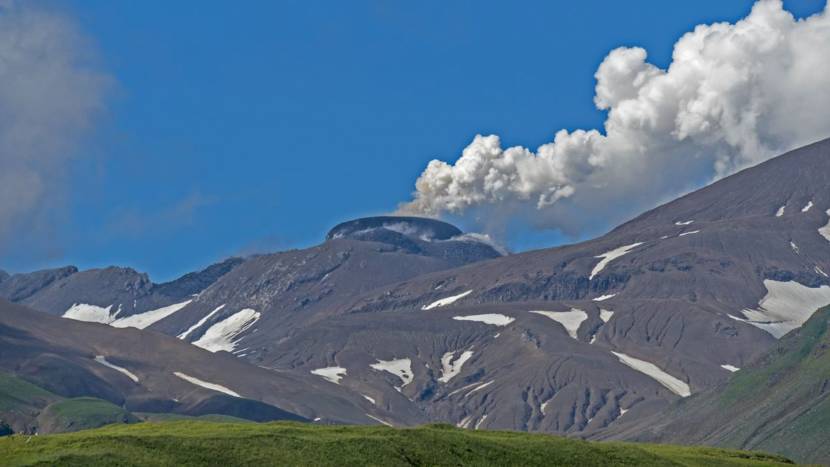
Lava dome within the Great Sitkin summit crater, August 4, 2021. View is toward the north-northwest. (Dave Ward/Jacobs Engineering)
A stream of lava flowed down the side of the Great Sitkin volcano in the Aleutian Islands Thursday morning and was visible from the nearby community of Adak, an official with the Alaska Volcano Observatory said.
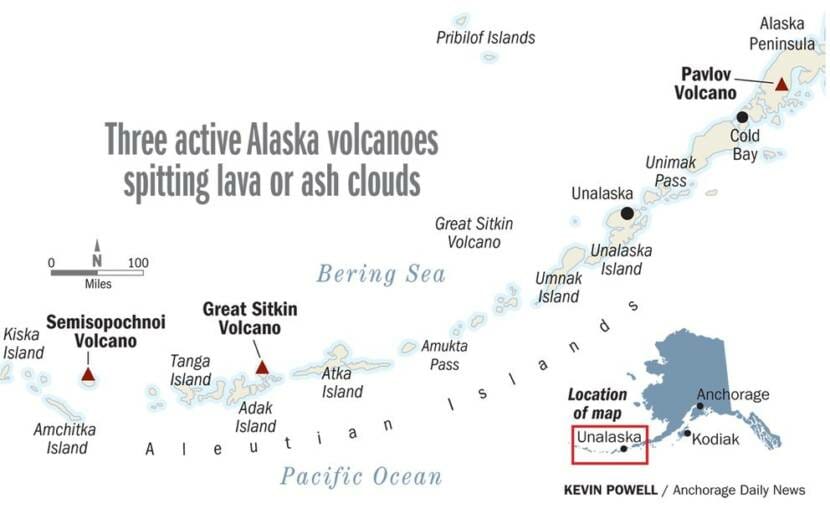
Meanwhile, minor clouds of ash spewed from the Alaska Peninsula Pavlof volcano and the Aleutian Islands Semisopochnoi volcano.
No communities were immediately impacted by the volcanic activity.
The Great Sitkin volcano, which is located along the Aleutian chain about 26 miles east of Adak, has experienced unrest for about the last two weeks, said Chris Waythomas, a geologist for the USGS.
“There’s been a lava accumulation growing above the active vent, so there’s a small crater of the active area and lava is coming out of that and it’s forming this dome-shaped accumulation of lava,” he said.
“This morning, clear views from Adak and on the island indicated some minor lava fountaining happening at the summit,” he said.
Waythomas described the eruption as a “Hawaiian-style ejections of incandescent material maybe 50 to 100 meters above the vent.”
A volcanic cloud has since formed over the volcano, but Waythomas said it’s mostly made from water vapor and gas. The cloud was not composed of dense ash Thursday afternoon and Waythomas said he did not expect it to immediately impact Adak or aviation in the area.
The volcano was in an orange code warning Thursday and Waythomas said it could switch to red if the eruption becomes more explosive or produces a significant cloud of ash. Volcanoes, he said, are highly unpredictable, but for now Great Sitkin is not showing any signs that would signal a larger eruption.
The lava could continue to spout off intermittently throughout the next few months, Waythomas said.
“It might start and stop,” he said. “It just depends on how much magma is involved. From the information that we’ve got, it doesn’t appear that there’s lots of magma involved, so we don’t think it’ll go on for decades or anything like that, but it could go on for some months yet.”
The volcano erupted briefly in May, spewing ash 15,000 feet high. But the Great Sitkin had not erupted since 1974 before then.
A minor cloud of ash also spewed from Pavlof volcano around 8 a.m. Thursday, Waythomas said. The volcano is located on the Alaska Peninsula and is about 37 miles northeast of Cold Bay and 600 miles southwest of Anchorage.
The Pavlof volcano spewed ash for about an hour, Waythomas said.
The volcano is one of the most active in the state and Waythomas said it would not be surprising for conditions to continue to escalate. The last eruption happened in 2016 and Waythomas said there is generally an eruption every few years. Pavlof is known for erupting with little notice, he said.
Officials are monitoring the volcano for further activity, Waythomas said.
Another Aleutian volcano, Semisopochnoi, released steam and ash clouds Wednesday night, but the remote volcano is far from any communities and in an area without much air traffic, Waythomas said. Semisophochnoi Volcano is located on an isolated island on the western end of the Aleutian Islands and is about 160 miles west of Adak.
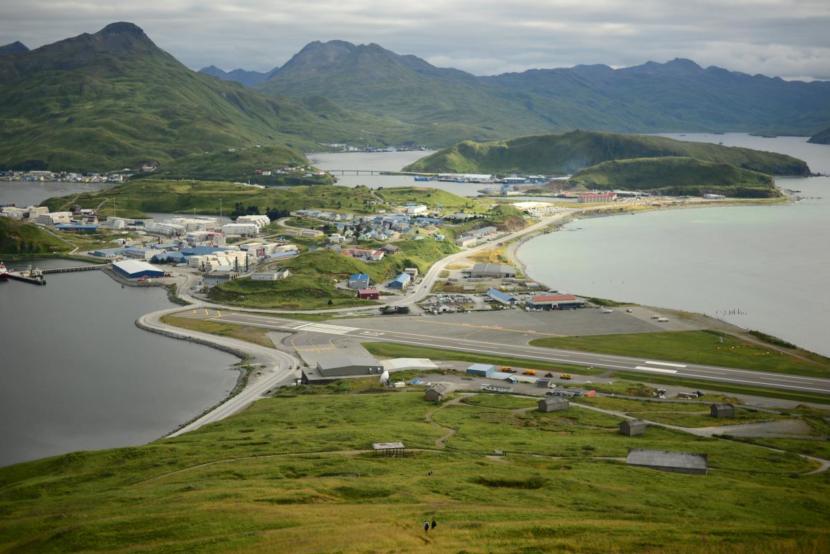
The runway at Unalaska’s airport, photographed from Mount Ballyhoo in 2017. (Berett Wilber/KUCB)
A new airline startup says it will soon be offering daily flights between Unalaska and Anchorage.
The new carrier, branded Aleutian Airways, is a partnership between Juneau-based Alaska Seaplanes, Florida-based Sterling Airways and two venture capital firms.
The group announced the new service Tuesday.
Kent Craford, co-owner of Alaska Seaplanes, is a senior executive at the new outfit. Starting this fall, he said, the company will begin flying Saab 2000 turboprops daily between the Aleutian hub and Alaska’s largest city.
“It’s such a tough nut to crack — Unalaska — because of the short runway, because of how remote it is, (its) distance to alternate airfields,” Craford said. “There’s a very, very unique key that unlocks this airport, and we’ve got it — the Saab 2000 is it.”
The PenAir Saab 2000 planes haven’t flown in Unalaska since RavnAir Group’s fatal plane crash in October 2019. The island has since been without regularly-scheduled, consistent nonstop commercial flights to Anchorage. The DeHavilland Dash 8-100 turboprops, which RavnAir flew on the route following the crash, often require a refueling stop.
A reboot of Ravn Alaska airline with different ownership began flying the Dash 8-100 series on the Unalaska-Anchorage route last November, after the former airline went bankrupt and Ravn Alaska acquired the company’s operating certificates.
The new Aleutian Airways partnership will add competition to the 800-mile route.
Alaska Seaplanes has been working for more than a year to enter the Aleutian market. Last spring, it lost a bid to acquire PenAir certificates and operations from the bankrupt RavnAir. But since then, Craford said, they’ve been able to dial in on the island’s needs for reliable and safe air service.
“We did our own analysis on our various aircraft options for Unalaska, and that independent, objective analysis determined that the Saab 2000 was simply the best platform to serve Unalaska,” he said.
Craford said he understands there’s baggage surrounding the Swedish Saab 2000 because of the crash that killed one person and left more than a dozen injured. But, he said, they’ll be sticking with former operator PenAir’s relatively strong safety record by enforcing high operational standards and employing former PenAir pilots.
“They required their pilots to have so many hours of flying into Dutch Harbor before they were allowed to be pilot in command,” Craford said. “They had very stringent risk assessments that were required for flying out to Dutch. And we’re going to be instituting a lot of the same policies with the same pilots who flew under those policies, so they know it firsthand. They know it well.”
He said the combination of Alaska Seaplanes’ experience serving rural Alaska, along with Sterling Airways’ experience operating larger equipment, will hopefully fill the gap in Aleutian air service.
Aleutian Airways plans to announce its schedule later this month. It has not yet announced fares.
The new airline will be a partnership between Alaska Seaplanes, Connecticut-based Wexford Capital, which wholly owns Sterling Airways, and Anchorage-based McKinley Private Investment.
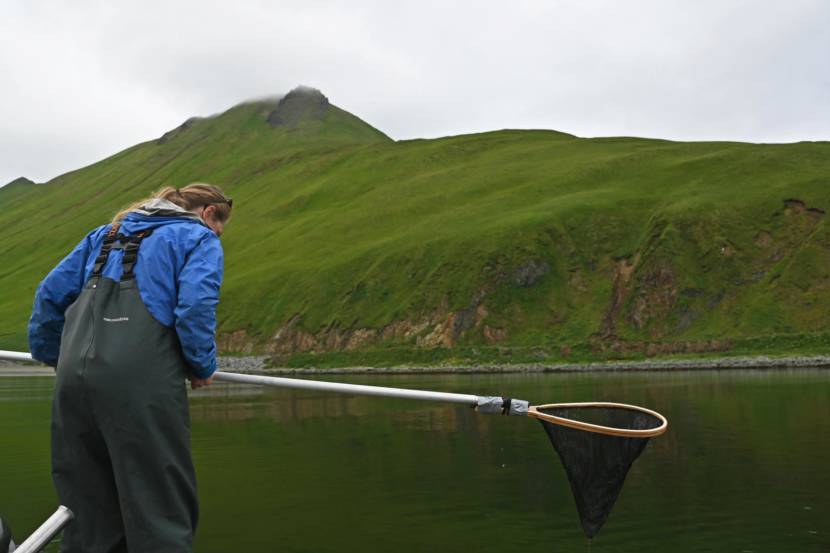
USGS wildlife biologist Sarah Schoen surveys the water for fish samples to test for saxitoxin. (Courtesy of Elizabeth Mears)
Paralytic shellfish poisoning, caused by eating seafood contaminated with toxins from harmful algal blooms, can be deadly to humans. Now, using marine samples from Unalaska, scientists are trying to understand if those harmful algal blooms could also be responsible for seabird die-offs.
There’s not much data on how saxitoxin — a harmful compound produced by algal blooms that cause PSP — spreads through the larger food web. But in July, a group of biologists with the United States Geological Survey visited Unalaska to collect samples of plants and animals in hopes of learning more about how saxitoxin levels magnify and diminish as they move through the food chain, from phytoplankton to mussels and up to seabirds.
“We don’t really know how this toxin moves through the food web,” said Sarah Schoen, a USGS wildlife biologist that recently collected marine samples in Unalaska. “There’s still a lot of unknowns, but the more information we can collect about it, the more we’ll understand it.”
“When we picked up some of the carcasses, the birds were all starving; they were emaciated,” she said. “But we weren’t sure if there was another factor that was contributing to their deaths. So we became interested in knowing if something like toxins — biotoxins — could have contributed to their deaths.”
Schoen and other researchers collected tissue from the dead birds to test for saxitoxin and found some lower levels of toxins in about a third of the birds, but she said they weren’t sure what that meant for their overall health.
“It was still unclear if algal blooms — toxins — could have played a part in their death,” Schoen said. “The project has kind of expanded from there.”
Since then, she said they’ve also looked at tissues from live murres in breeding colonies and found that a similar proportion of birds had toxins, but the levels were lower.
Very little work has actually been done to look at the saxitoxin levels in seabirds, according to Schoen. Most people focus on intertidal invertebrates like mussels or clams and how those affect humans.
The extremely high toxin levels recently found in Unalaska make the island a good place for studying how the toxins travel up the food chain, specifically for learning when the levels may become deadly for animals that are further up that chain, like seabirds, Schoen said.
In July, a group of UGS biologists visited Unalaska to collect samples of plants and animals in hopes of learning more about how saxitoxin levels magnify and diminish as they move through the food chain. (Courtesy of Elizabeth Mears)
The U.S. Food and Drug Administration says it is safe for humans to consume meat with up to 80 micrograms of toxin per 100 grams of tissue. Around the beginning of July last year, some samples of blue mussels collected in Unalaska showed toxin levels that were more than 100 times higher than that. And in June of this year, some sampling showed toxin levels of more than 6,000 micrograms per 100 grams of tissue.
“Those are levels that make us interested in what’s going on with the whole food web,” Schoen said.
Schoen and her team want to discover if these toxins play a role in the recent record-breaking bird deaths and to see whether they transfer to seabirds in higher levels or not.
Sometimes it can be tricky to trace samples back to a singular, specific algal bloom, but she said it was easy to make those connections in this recent sampling in Unalaska.
“In this case, everything looks to be super connected,” Schoen said. “The mussels are filtering in the plankton that we’re collecting right offshore. Fish are eating the plankton. The birds are eating the fish, and they’re all in the same system.”
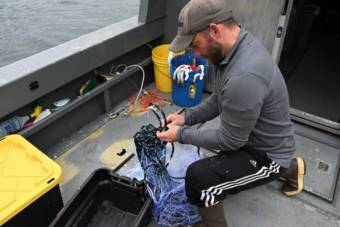
Schoen and her colleague Daniel Donnelly — another biologist on the team — collected samples of various fish including sand lance, Pacific sandfish, cod and halibut, as well as species of seabirds like horned puffins and black-legged kittiwakes.
They only had about a day to collect the samples, and Donnelly said finding all of the animals, coordinating and setting the different gear and properly recording everything made for a hectic day.
“We got samples from different trophic levels, meaning all the way from zooplankton to small plankton, foraging fish to predator fish, to birds — so a whole bunch of different levels in the ecosystem,” he said.
Donnelly is an avid hunter and shot some of the live birds to bring back to the lab to study. Others were collected from local fishermen who found and froze a dead puffin, for example, after a recent die-off.
Schoen said collecting and tracking data in a place like the Aleutians where there are few scientists can be tricky. But getting help from locals is a useful way to keep track of marine behavior and things like strange die-offs.