Aleutians

GCI launches marine survey in hopes of bringing fiber service to the Aleutians

GCI is partnering with a Matanuska Valley-based geophysical and geotechnical surveying company, Benthic Geoscience Inc., to chart the subsea floor along the fiber’s proposed route from Kodiak to the Aleutians. (Courtesy of GCI)

Unalaskans could see a significant boost in internet service by late 2022 if GCI completes work to lay fiber cable as planned.

The telecommunications company launched a marine survey as part of its AU-Aleutians Fiber Project last month. That work will take place into the summer, according to GCI senior manager of corporate communications and community engagement Jenifer Nelson.

“What they will do during the marine survey is really x-ray the ocean floor of our proposed route to make sure that it is the best possible route — identifying places where the fiber can be buried,” Nelson said. “So it’s really establishing the blueprint for the construction of the house.”

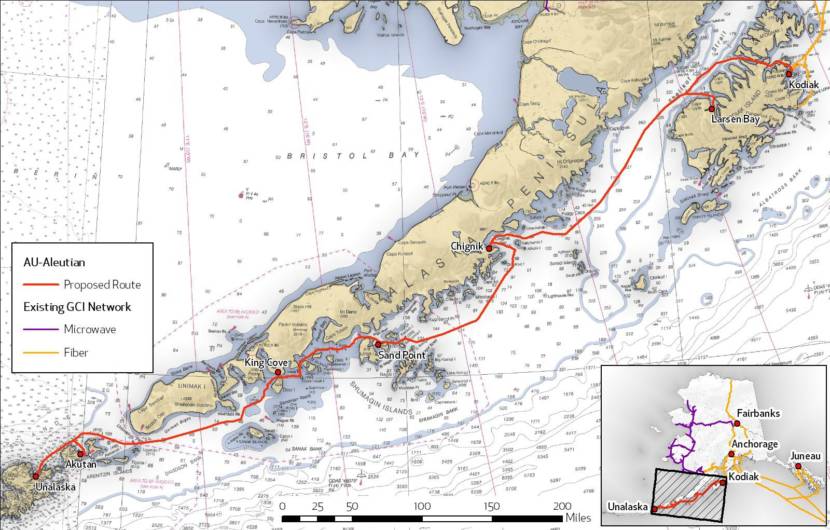
GCI is partnering with a Matanuska Valley-based geophysical and geotechnical surveying company, Benthic GeoScience Inc., to chart the subsea floor along the fiber’s 860-mile proposed route from Kodiak to the Aleutians.

When it eventually arrives in Unalaska, Nelson said each individual home and business will be connected to the fiber. Customers will have access to one gigabit internet speeds, which GCI says is among the highest level of internet speed available to consumers in the U.S.

That’s a major improvement for the island and for other communities along the Aleutian chain, where connectivity and bandwidth can often be unreliable or difficult to come by.

Nelson — who is from King Cove — said she understands the struggles of having poor connectivity and looks forward to bringing faster communication and more accessible internet access to the region.

“I’m just really excited for the day when somebody turns on their cable modem for the first time and can experience one gigabit speeds with unlimited data,” she said. “And you can just stream and stream and stream to your heart’s content.”

Unalaska will be the first community to come online through the project, according to Nelson. The next stop will be Akutan, then more communities along the peninsula, and eventually Larsen Bay on Kodiak Island.

John Burnett is the GCI AU-Aleutians senior program manager and has been on the island for about two months, surveying local sites and helping develop plans for where the fiber will be laid when it reaches Unalaska. He said he’s working to find the best path for the fiber to travel locally, from the sea to each Unalaska home or business.

“The first phase of this will be coming through and entrenching a mainline fiber in the ground, in the city easements and road right-of-ways,” Burnett said. “But then the next phase will be running what we call a ‘drop’ — that’s the fiber line that goes from the main trench to a home or a business.”

Before those drops are placed, Burnett said he’s working with property owners to choose the most ideal route for each individual or company.

“I spent a lot of my time talking initially with business owners to make sure that we agree on the routing of that drop,” Burnett said. “We want to minimize conflicts with things they have in their property.”

He said that includes things like landscaping and native plant life.

I lived in Kodiak for a long time,” he said. “And we had a similar project done at our house and my wife said, ‘You know, I don’t care what you do, just don’t go through my salmon berries.’ And they did. So I’ve been there, and don’t want to do that again.”

The timeline for when exactly they will start digging is not yet set. But as the fiber is being laid in the ocean floor, Burnett said GCI plans to start laying the conduits on the island for when the fiber eventually arrives. He said the fiber distribution will begin near the airport.

While the digging process is unavoidable, Burnett said they are working to make it as seamless as possible. Part of his job is to address questions or concerns locals have, and he’s eager to keep the community informed.

According to Nelson, pricing for the internet service hasn’t yet been determined, but the goal is to offer the same plans as those in urban areas like Anchorage.

GCI’s AU-Aleutians Fiber Project is estimated to cost almost $60 million. GCI is paying for over half of that, and the remainder is being funded through a grant from the U.S. Department of Agriculture’s ReConnect Program, which is intended to help boost connectivity in rural areas.
After 77 years buried in unmarked grave, Unangax̂ WWII soldier will receive grave marker

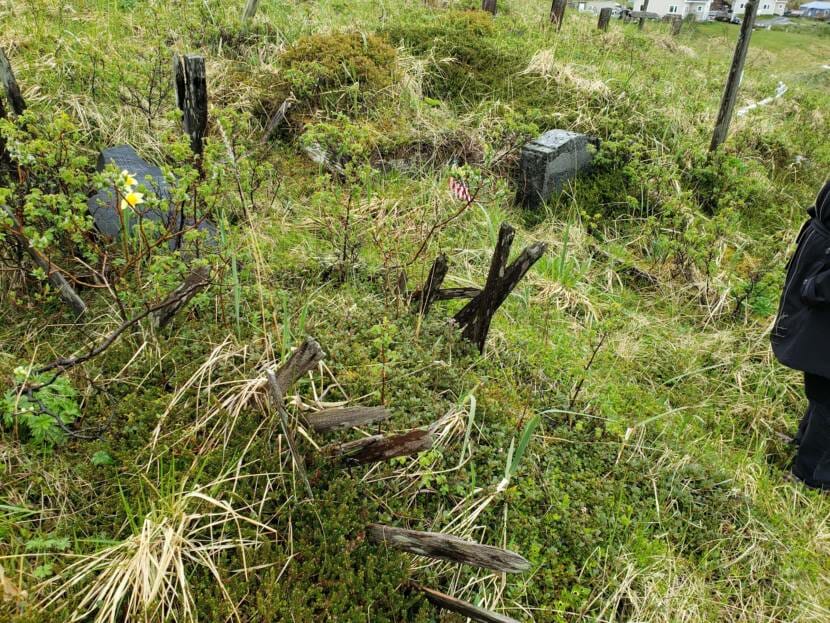
A single small U.S. flag marks the grave of World War II soldier George Fox, who was killed in action in Italy in 1944 and is buried in Unalaska. (Photo courtesy of Michael Livingston)

For years, a small American flag was all that marked the grave of George Fox. Now, his resting place will finally be recognized.

Every year, Unangax̂ elder Gertrude Svarny visits the Russian Orthodox cemetery in Unalaska and puts a tiny U.S. flag on an unmarked grave.

The grave is for her childhood friend, George Fox who was an Unangax̂ soldier who died during World War II.

“It is very powerful that Gertrude Svarny remembered him and has taken the time to honor his memory every Memorial Day to go up to his gravesite and to place the United States flag on his grave,” said Michael iqyax̂ Livingston, a cultural heritage specialist with the Aleutian Pribilof Islands Association. Livingston worked with others to get a grave marker for the World War II soldier.

“Here we are about 77 years later and his sacrifice is basically gone, almost gone. Had it not been for Gertrude Svarny, it would have been completely forgotten,” Livingston said.

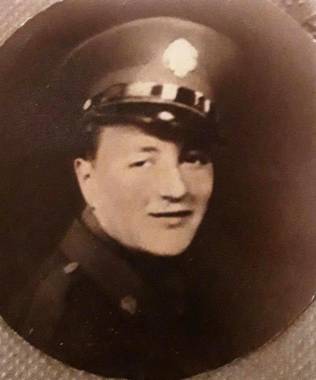
George Fox (Photo courtesy Georgean Scott)

Fox was born in 1920 on Unga Island, off the Alaska Peninsula about 250 miles northeast of Unalaska. He joined the U.S. Army in January of 1941 and served in the military police during World War II

The German occupation of Rome began in September 1943, and Allied forces led an offensive campaign that would eventually capture the Italian city.

Fox was killed in action in Ardea, Rome, Italy — just three days before the American forces took possession of the city on June 4, 1944. He’s the only known Aleut/Unangax̂ soldier killed in action during World War II.

When Fox’s body returned to Unalaska, Livingston said his funeral service was at the Russian Orthodox Church.

“He’s buried right next to his mom,” Livingston said. “And his mom was Russian Orthodox and he was Russian Orthodox, too.”

The grave of his mom, Emma Fox, is marked with a large solid black stone with her name on it.

And at 91, Gertrude Svarny, who is an accomplished Unangax̂ artist and culture bearer, continues to visit the grave of her friend.

But he never received a marker. Fox’s grave has been unmarked for more than 70 years, and his name is missing from World War II killed in action memorials in Alaska.

“We really don’t know why this grave was not marked,” Livingston said. “Times were different back in the 1940s. It was basically open-faced racism against people of color, including soldiers of color. And so that might have been a play in it”

“When you compare Private George Fox’s grave, two other graves — for example, out at Fort Richardson National Cemetery — those are, those graves are immaculate lawns and very beautifully placed stones and flags and sidewalks,” Livingston said.

Livingston and others worked for at least five years to get Fox a marker. They managed to get some records from the National Archives. And applied for one.

“We were able to enlist the help of United States Sen. Dan Sullivan. And since Sen. Sullivan’s office got involved and helps us, has helped us in the project, we have finally able to get some resolution from the Veterans Affairs,” Livingston said.

This May, the U.S. Department of Veterans Affairs approved the order of a gravestone for Fox.

“We’re just grateful that the stone is being ordered and hopefully it will arrive in Unalaska soon,” Livingston said.

Livingston estimates the stone will arrive about mid-July, and this will likely be the last Memorial Day without a marker for George Fox’s grave — besides a small U.S. flag from a friend.

Dutch Harbor named nation’s top fishing port for 23rd consecutive year

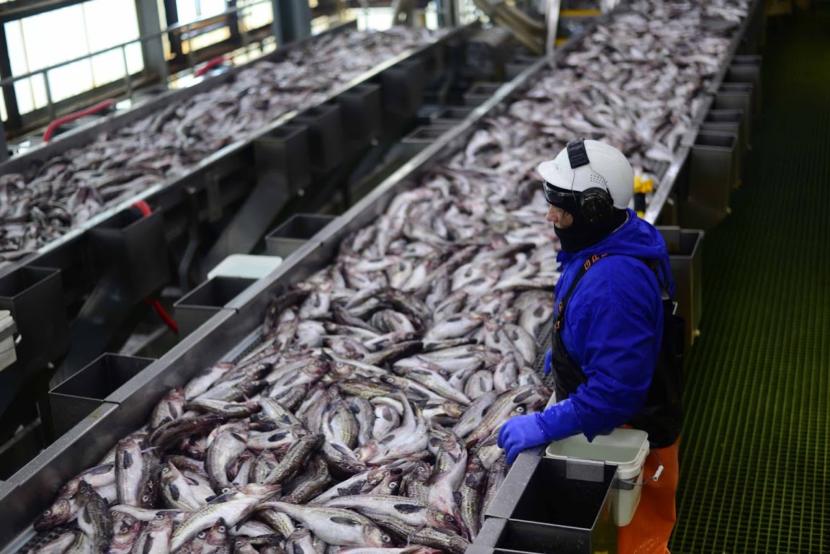
Pollock, seen here at a processing plant in Dutch Harbor, in the Aleutian Islands, are one of the species being found in increasing numbers in the northern Bering Sea. (Photo by Berett Wilber)

Dutch Harbor has been named the nation’s top fishing port in terms of volume of seafood landed for the 23rd consecutive year, according to an annual report on the status of U.S. fisheries in 2019.

The National Oceanic and Atmospheric Administration released the report earlier this month. The Aleutians East Borough — which includes Akutan, False Pass, Sand Point and King Cove — rose from third to second place.

Frank Kelty currently works as a contractor with the City of Unalaska, updating officials on fisheries issues and revenue projections. He was also mayor of the island community for 13 years before retiring in late 2019.

According to Kelty, NOAA’s annual reports are a bit dated — we’re just now getting data from 2019 when we’re halfway through 2021. But even so, he said, the reports provide an important snapshot of fishing seasons, how production is going and the value of landings being processed.

“It’s a good tool to point out the importance of what goes on in this community, the high volume of product that’s produced here and the importance of Unalaska/Dutch Harbor to the seafood industry not just in Alaska, but in the nation as a whole,” Kelty said.

According to the federal report, Dutch Harbor landed 763 million pounds of seafood in 2019, valued at $190 million.  That’s the same weight as 2018 and about $8 million more in value.

And what does 763 million pounds in seafood look like exactly? Well, it’s equivalent to roughly 50,000 pretty big elephants or roughly 1,000 Boeing 747 jets.

The majority of that volume in 2019 — 93% — is from Alaska pollock, which goes into products like fish sandwiches, fish sticks and sushi.

But while the number of fish landed in Dutch Harbor is far greater than any other port in the country, the Aleutian community remains in third place in terms of dollar value — topped by New Bedford, MA in first place and Naknek in second. That’s because of the lower-value seafood landed on the island, according to Kelty.

“The pollock fishery is the largest fishery in the nation,” he said. “But the value is very low compared to lobster, scallops, Alaska king crab and things like that.”

Kelty moved to Unalaska to fish for crab in the Bering Sea and spent about 50 years on the island. He said that Unalaska keeping its spot as a top port in the nation is a testament to the health of the seafood industry in the Aleutians. But, he cautioned: Things can change quickly.

“I was here when we had the red king crab collapse,” he said. “We went from one year of 130 million pounds, down to 30 million and then no season after that — and that was just in a two-year timeframe. So things can happen.”

The seafood industry is the only major economic engine of Unalaska. And as the climate changes, water temperatures rise and some species migrate further north, Kelty said, it could be bad for a shore-based operation like Unalaska.

“It’s definitely something that we have to keep our eye on,” he said. “But it’s nice to have this snapshot from the federal government that shows us what’s been going on and the timeline that it lays out over the years.”

In total, U.S. fishermen landed 9.3 billion pounds of seafood valued at $5.5 billion in 2019. Sixty percent was caught in Alaska.

Aleutian volcano sees first major eruption since 1974

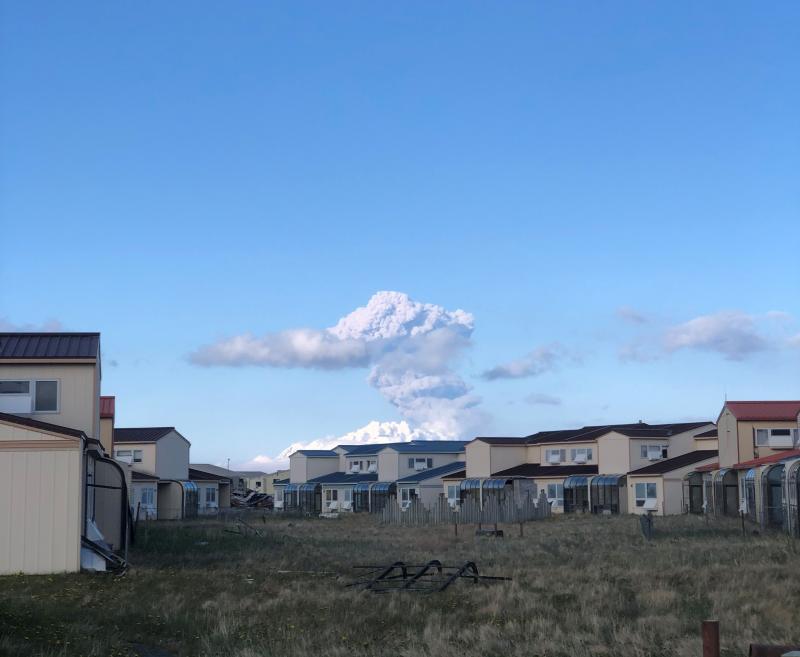
Great Sitkin eruption column, as seen from Adak on May 25, 2021. (Photo courtesy of Finn Spitler)

Scientists have downgraded the alert level at Great Sitkin Volcano near the Aleutian Island of Adak following an eruption Tuesday night.

The event took place at around 9 p.m. and produced an ash cloud up to 15,000 feet above sea level and impacted flights.

“The eruption itself occurred for over about a minute,” said David Fee, coordinating scientist for the Alaska Volcano Observatory. “It had a very loud, audible and low frequency sound to it. I guess a good analogy would be if you shake up a bottle and then you pop the cork and get an explosion out the top. That’s kind of what happened here.”

Following the eruption, Fee said, they issued a red alert warning for planes in the area, because there was likely a high emission of volcanic ash in the atmosphere.

Since then, activity has decreased at the volcano.

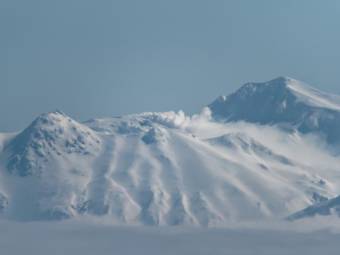
Steaming at Great Sitkin, seen from White Alice seismic station on May 20, 2021. (Photo courtesy of Malcolm Herstand/Alaska Volcano Observatory, Division of Geological & Geophysical Surveys)

“We lowered the advisory back down to orange this morning,” Fee told KUCB Wednesday morning. “And there hasn’t been much activity —  I think it’s mainly just steaming since the eruption last night.”

According to Fee, the activity at Great Sitkin isn’t “normal,” but it’s also not unexpected, given some small explosions that have happened there over the past few years.

He said the AVO will continue to watch closely for increased seismic activity or gas emissions that could indicate another eruption, but for now, it’s pretty quiet.

“We haven’t seen an eruption like this from Great Sitkin at least as long as I’ve been around here,” he said. “So it could quiet down or we could expect continued activity. We’ll just have to wait and see.”

This is the first significant explosion at Great Sitkin since 1974.

Bill protecting Unangax̂ cemetery in Funter Bay passes Alaska Legislature, awaits Gov. Dunleavy’s signature

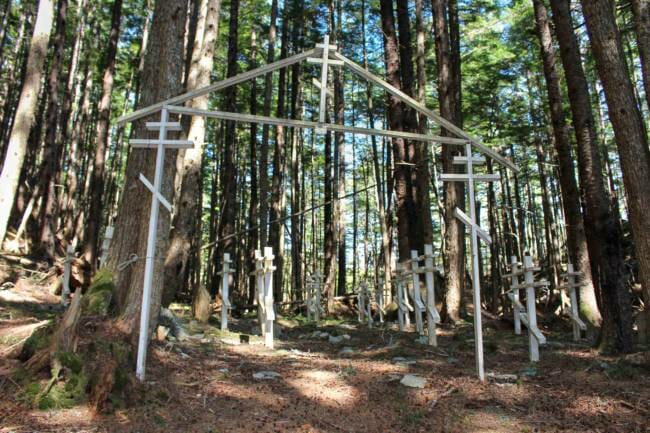
A recent photo of the Unangax̂ cemetery at Funter Bay. (Courtesy of the Juneau-Douglas City Museum)

A bill protecting the graves of Unangax̂ people forced to live in internment camps in Funter Bay passed the Alaska Legislature on May 17 and now awaits Gov. Dunleavy’s signature. 

When the Japanese military invaded the Aleutians during World War II, the U.S. government forced Unangax̂ people to live in two internment camps in Southeast Alaska. They were held there for two years and were not provided with basic necessities like clean water.

About 10% of people died at the Funter Bay internment camps. Most of them were children or elders.

House Bill 10 will protect the graves of Unangax̂ people who died in Funter Bay. Rep. Sara Hannan of Juneau sponsored the bill.

“This camp in particular, you know, it’s just a compounding of errors of history,” Hannan said.

The Unangax̂ people interned at Funter Bay were some of the first Unangax̂ people to come into contact with the Russians. The Russians enslaved them, forced them to relocate to the then-uninhabited Pribilof Islands and made them hunt seals for their fur.

A couple hundred years later, the U.S. government also forced the Unangax̂ in the Pribilofs to hunt seals.

“The men placed in internment in Funter Bay are still forced to return to the islands in the summer to seal for the government and told ‘If you don’t do this, we’ll never let you return home,’” Hannan said.

Not a lot of people know about this history. That is why the group Friends of Admiralty Island sought legislative action to protect these graves. They went to their Juneau representative at the time, former Rep. Sam Kito, to talk about the issue. Kito then passed the issue along to Hannan when she was elected. 

Hannan introduced a bill to protect the Funter Bay cemetery to last year’s Legislature. She and her staff, along with Unangax̂ elders and the Friends of Admiralty Island, worked hard to educate Alaska lawmakers about the Funter Bay internment camps and the lasting effects of these camps on the families.

The bill was making headway in the Legislature — until the pandemic disrupted the session.

When the bill was reintroduced this year as House Bill 10, it went pretty smoothly. Most Alaska lawmakers already knew about the bill from last year and were supportive.

Martin Stepetin advocated for the bill during last year’s and this year’s Legislatures. He is also a member of the Friends of Admiralty Island.

“It went kind of unnaturally fast in the legislature this year, which is really great, you know? We’re super proud of that,” Stepetin said.

Stepetin is Unangax̂ (Aleut) and Tlingit, and his grandparents were interned at Funter Bay. To Stepetin, the state recognizing the violent past of the land they own at Funter Bay was a crucial aspect of the bill. 

“What happened to the Aleuts in 1942 by the federal government was a really bad thing,” Stepetin said. “It was a really bad thing that we don’t ever want to happen again. And the only way we can ever protect ourselves from things that happened to us, by us, is to remember it. That’s why we have history class. That’s why we have history.”

To Stepetin and the Friends of Admiralty Island, the work has just started. There are other cemeteries in Southeast Alaska that are not protected, such as the cemetery in Killisnoo on Admiralty Island. Stepetin would like to seek protection of this cemetery next.

Juneau residents can visit the Juneau-Douglas City Museum throughout the summer to see an exhibit about the Unangax̂ internment camps during WWII. The exhibit is open through Oct. 18.

‘One of the craziest things I’ve ever signed up for’: Meet Unalaska’s new bald eagle wrangler

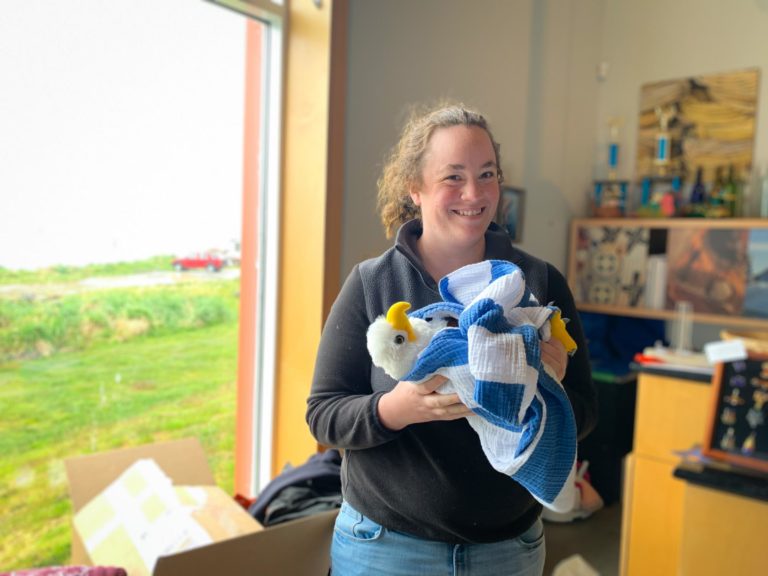
Megan Dean demonstrates how to rescue an eagle at the Museum of the Aleutians store. (Hope McKenney/KUCB)

There’s a new bald eagle wrangler in Unalaska.

That’s right: The island has volunteers who, under a U.S. Fish and Wildlife Service permit, help rescue injured eagles or salvage dead ones.

Normally, local fisheries biologist Brianna McGrath heads a group of four volunteers to do the job. But nearly all of them are leaving the island for the summer — a busy time for pulling eagles out of warehouses or rescuing injured ones from Unalaska’s docks and local spit.

That’s where Megan Dean comes in.

McGrath tapped Dean as Unalaska’s newest raptor wrangler to help bridge the summer gap in volunteers.

“I know that Meg is a little bird nerd like me, so I figured she might be interested,” McGrath said.

And Dean was interested — very interested.

Dean works at the Museum of the Aleutians and is a self-proclaimed “bird nerd” like McGrath. She grew up in Connecticut, fascinated by red-tailed hawks and other raptors. She also lived in Bethel, where she worked with a falconer who had a gyrfalcon and a goshawk.

“We didn’t have cable, so I’m one of those freaks that thought everyone watched PBS’s NOVA series,” Dean said. “And then in Springfield, Massachusetts — right across the border — WGBY has a peregrine falcon cam. It’s a show I thought everyone watched, which was not the case. I’ve just always loved raptors.”

Brianna McGrath rescues an eagle in Sept. 2020. (Photo courtesy of Sarah Spelsberg)

Dean was “nervously excited” to be asked to become a volunteer eagle rescuer.

“They’re distantly related to the dinosaurs of Jurassic Park that caused that whole ruckus,” she said. “So I was like, ‘This is probably one of the craziest things I’ve ever signed up for in my life.’ But here we are. And we survived.”

Over the past three years, McGrath said her team of volunteers has rescued or retrieved more than 50 eagles. But, she said, that doesn’t include five to 10 additional releases of uninjured eagles that get themselves caught up trying to get fish from a warehouse or crab tank.

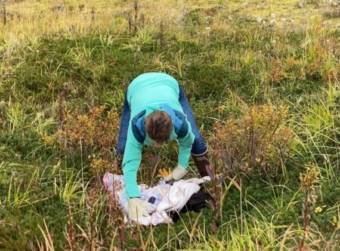
McGrath started training her new volunteer recruit, Dean, last Monday. That meant the two spent time throwing a thick blanket over stationary objects and stuffed animals near Sitka Spruce Park and watching videos of eagle rescues. Just a day later, Dean got her first call.

“There was an eagle — it looked like a female. She was very large,” Dean said. “She was over at UniSea and had a couple of different injuries. Brie called me and we went over to scoop her up.”

Dean and McGrath put on heavy jackets and thick leather gloves, approached the female eagle and threw a blanket over her. Dean said she grabbed the large bird and cradled it in her arms, making sure to hold on tight to the raptor’s strong legs.

“That’s so they can’t talon your face or the artery in your arm,” she said. “And it helps keep them immobile, so you’re safe and they’re safe.”

They put the injured eagle into an extra-large dog crate and took it to the airport, where it would fly out on an ACE Cargo flight to the Bird Treatment and Learning Center in Anchorage. The center takes about 1,000 injured birds every year from around the state, according to its website. McGrath said if the eagle can be rehabilitated there, it will be.

“But if they can’t, then they’re euthanized,” she said. “I always feel like even if they’re euthanized, we’re doing a good thing, because either way, we’re helping them out. If they’re taken for rehab, they’re getting better. And if they’re being euthanized, we’re putting them out of their misery.”

McGrath said dead eagles are sent to Colorado’s National Eagle Repository, operated by the U.S. Fish and Wildlife Service.

“At the eagle repository, Native Americans across the country can apply for their parts and their feathers,” she said. “And they’ll use them for ceremonial purposes, religious purposes. It’s just a cool, cool system.”

Site notifications
Update notification options
Subscribe to notifications