Aleutians

‘We deserve to feel safe:’ Unangax̂ activists speak up about missing, murdered Indigenous people

“We have the responsibility now, to take care of our kin and our women, our sisters,” said Haliehana Stepetin, an Unangax̂ dancer and scholar from Akutan. (courtesy Mariza Tovar)

Indigenous women in the United States are murdered 10 times more often than the national average, and nearly half of all Alaska Native and Native American women have experienced intimate partner violence in their lifetime, according to the Department of Justice.

Since 2017, May 5 has been recognized as National Day of Awareness for Missing and Murdered Indigenous Women, Girls and Two-spirit People. The day is often referred to as MMIWG2S or MMIW.

Indigenous activists leading the movement are speaking up about the issue, saying this day of awareness is not enough, and it’s time for action.

Taytum Robinson is one of the people working to shed light on the MMIWG2S movement. She uses her creative work as an artist to help advocate for those who have been murdered or gone missing. She said she believes that MMIWG2S is a transnational crisis.

“I wouldn’t describe it as a pandemic or epidemic because, in my opinion, it’s a crisis that is directly linked to genocide,” Robinson said. “It’s a very serious topic. And unfortunately, Indigenous peoples don’t have the support from law enforcement that I feel they really deserve.”

In 2018, a survey by the Seattle-based Urban Indian Health Institute (UIHI) reported  almost 6,000 Alaska Native and Native American women and girls were missing from 71 urban cities. Of these missing women, less than 120 were registered in the Department of Justice database.

According to Robinson, missing and murdered Indigenous women, girls, and two-spirit people fall under the radar far too often.

“I think it’s really important to keep spreading awareness and to hold each other accountable, not only for women to speak up and speak on this, but also for the men as well,” Shaishnikoff said. (Kanesia McGlashan-Price/KUCB)

“One time is too many to see a post saying ‘this person is missing [in] Fairbanks, Anchorage, etc.; height, weight, details about what they were last wearing, who they were last with,'” Robinson said. “When you see that on a post on Instagram or Twitter, any social media, it’s like that sinking feeling of , ‘god, I really hope that they make it home. And I hope that the police take it seriously.'”

Social media has become a large platform for sharing information about MMIWG2S. Posts are shared to raise awareness, but have also become a form of searching for missing people. By creating a public post about a missing person, people are able to reshare the content, which helps spread information quickly. The ultimate goal is to help bring a missing person home or find a lead to their whereabouts, but that doesn’t always happen.

“It’s a sobering realization, especially as an Indigenous person and knowing Indigenous people and having tight-knit communities and friends and family, that if myself or any one of them were to go missing, that there’s a possibility that the report and support that we would need from law enforcement wouldn’t be as big of an impact as you would regularly see for [a non-Indigenous person] who was missing or murdered,” Robinson said.

According to Robinson, harmful stereotypes about Alaska Natives and Native Americans contribute to the lack of response from law enforcement.

“We deserve to feel safe,” Robinson said. “We deserve to feel valid, regardless of our background, habits — whatever it might be — our story, our upbringing, that we deserve the same treatment. We really do because there is a drastic inequality that I feel like will only be addressed if we keep being loud about it.”

While there may be more effective ways to take action in the future, Robinson said she believes that having a vocal and aware community is the most reliable way to bring home missing persons.

Robinson recently graduated with her Bachelor of Science in Biology from University of Hawaii Manoa and is the artist behind Qawax̂ Creations, a seal intestine jewelry line. She uses her social media platform to raise awareness about various social justice issues, including MMIWG2S.

As part of raising awareness, Shayla Shaishnikoff, climate resilience coordinator for the Qawalangin Tribe of Unalaska, said attention must also be brought to those who might be causing these crimes. And according to Shaishnikoff, there is a direct connection between resource extraction and violence against Native women.

“MMIW is an epidemic that we have in our country, as well as in other countries, as a result of the presence of extractive industry, largely due to man camps and things like that,” Shaishnikoff said. “And that’s only one form of violence that we’re seeing from extractive industries. There’s a lot more that come with that, but missing and murdered Indigenous women is definitely a consequence.”

Man camps, or work camps, are temporary housing communities set up for laborers hired by extractive industries. In the case of oil, pipelines often cut through or around reservations and other marginalized communities.

Kaye Gumera paints an original design to honor MMIWG2S at the Qawalangin Tribe office. (Kanesia McGlashan-Price/KUCB)

While migrating across Native land, the transient workers in these camps may also be committing violent crimes, Shaishnikoff said. And for reservations already underserved by law enforcement, responses to missing persons cases are low.

With little action being done to protect Indigenous women, girls, and two-spirit people, Indigenous groups have been the stewards bringing this crisis to the light. According to Shaishnikoff, while it is important for Indigenous people to do that work, it’s also unfortunate that those communities have to bear the weight of providing support.

“A lot of the people committing these crimes are slipping through jurisdictional cracks,” Shaishnikoff said. “And so it’s left to us to stand up and say something about it and make sure that these voices are heard because Indigenous women are oftentimes sexually assaulted and murdered at rates that are like 10 times higher than any other ethnicity.”

According to Shaishnikoff, the responsibility is a community-wide effort.

“I think it’s really important to keep spreading awareness and to hold each other accountable, not only for women to speak up and speak on this, but also for the men as well,” she said.

Last year, the Qawalangin tribe had a fundraising event where they encouraged people to wear red and post it on social media using the hashtag #nomorestolensisters.

For every person that shared a picture, the tribe donated to MMIWG2S. This year, in partnership with other local organizations, the tribe hosted a socially distanced craft night to honor those lost and murdered and to spread awareness.

Shaishnikoff has helped plan MMIWG2S events at the tribe for the last two years and is a vocal activist in the cause. She is currently finishing her second Bachelor of Science in Environmental Science, attending classes at Western Washington University remotely. Last summer, she also completed her first traditional iqyax̂, or Unangax̂ skin-on-frame sea kayak build. She hopes to continue living in the Aleutian region and being a passionate advocate for her people.

Haliehana Stepetin is an artist, scholar and activist from Akutan. As an Unangax̂ dancer and PhD candidate at University of California Davis, she uses her performance and knowledge as a form of activism for the MMIWG2S movement.

According to Stepetin, safety rests in the hands of community, and it’s in part their responsibility to take action to protect women, girls and two-spirit people alike. But she said that responsibility requires more than just recognizing the problem.

“Awareness is just the first thing,” Stepetin said. “And I don’t even think awareness is what we need to be focusing on. We need to be focusing on the safety of missing and murdered Indigenous women — of living Indigenous women so that they don’t become missing or murdered. And that’s something that’s always in my head — how do I protect my kin from becoming missing or murdered?”

For Stepetin, the question of how to help is a call to action.

“We have the responsibility now, to take care of our kin and our women, our sisters,” Stepetin said. “It’s our responsibility to ensure their safety. And so safety to me is community-based. It’s community-created, and it’s community-constituted. It doesn’t rest outside of our communities. It’s our own responsibility.”

One of the ways that Stepetin creates space for dialogue is through dance.

In 2018, Stepetin performed with Indigenized Productions, an Indigenous production company based in Seattle, Washington. Stepetin’s performance was dedicated to MMIWG2S, but also to all of the Unangax̂ that were forcibly relocated during World War II.

After the Japanese invasion of the Aleutian Chain, many villagers from the region were forced to relocate to Southeast Alaska. Poor living conditions and a lack of medical care led to the death of one in 10 people, she said. Many were buried there and never made it home, similar to the Indigenous women, girls and two-spirit people that are still missing today.

Stepetin’s performance materializes the resilience of those Unangax̂ who never returned home.

“The performance is called Slaĝux̂ Chiĝanax̂ Alakax̂, which means, ‘the wind is not a river,'” Stepetin said. “And this was a common phrase that they said in the World War II internment, as a way to remind us that nothing is permanent, like the wind.”

Some of the inspiration for her performance was influenced by traditional hunting stories told by her late father, Thomas Stepetin.

“My dad said we would use the soot of the fire and put it on ourselves to cleanse and before hunting to hide your scent,” Stepetin said. “And I was like, ‘I need a fire. And I need like black paint. I’m going to paint myself, smudge myself, as a performance.’ But I was also like, ‘I think I need red paint because I want to bring in the MMIWG movement and bring attention to the fact that a lot of our people never came home after that.'”

“We deserve to feel safe,” Robinson said. “We deserve to feel valid.” (Kanesia McGlashan-Price/KUCB)

Stepetin said WWII was a significant marker in history that changed the way culture was embraced by Unangax̂ people.

“It affected our dance, the transmission of our dance, and our language and our spirituality,” she said. “It affected a lot of these things — it interrupted them. I’m not going to say that we lost anything because I don’t like the rhetoric of loss. I don’t like saying that and allowing outside influences to have that sort of impact on us. We’re stronger than that.”

She said those outside influences shouldn’t determine what Indigenous communities get to lose and keep.

“So I don’t ever say that we lost anything,” Stepetin said. “It went to sleep. And it went to sleep for good reason, we were mourning.”

According to Stepetin, that lack of permanence means that cultural practices can be reawakened. For example, when she received traditional tattoo markings from Unangax̂ artist Dustin Newman, that was a chance to recover a sleeping tradition. And with each transmission of ink, stories old and new were being weaved.

“We reawoke a tradition of, [about] 150 years that was [practiced] before the WWII internment,” Stepetin said. “Because in Russian Orthodoxy, we’re not allowed to tattoo. So it had been stopped for a long time, but these things are reawakening now.”

Making jewelry, building traditional iqyan and dance are just some of the ways Unangax̂ are leading the revitalizing movement in the region. Robinson said, with a growing sense of community among Indigenous people, voices are growing louder — and these voices want protection.

As it is said in Unangam tunuu, tumaniin ayagan agliisax̂tan — protect our women.
Alaska Supreme Court upholds legality of fish landing tax

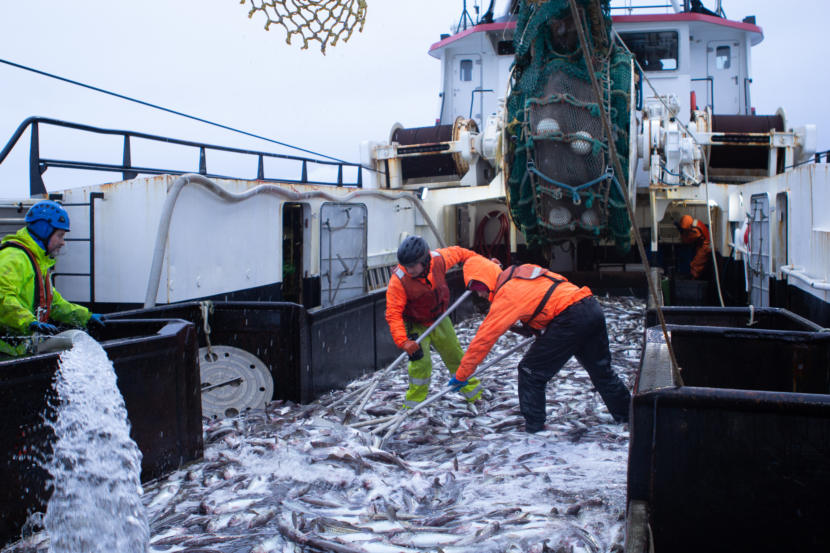
Crew members Brian Hagen, left, and Derrick Justice shovel pollock on the deck of the Commodore on Thursday, January 24, 2019. (Photo by Nathaniel Herz / Alaska’s Energy Desk)

A raw fish tax that has pumped tens of millions of dollars into coastal communities over the past decade has survived a legal challenge before Alaska’s highest court.

The state can tax seafood caught beyond the 3-mile line in federal waters, then loaded on a bulk carrier at the dock for foreign export, without violating provisions of the U.S. Constitution.

That’s according to the Alaska Supreme Court, which released its 31-page ruling Friday.

Fishermen’s Finest, a Washington state seafood company that operates factory trawlers and exports most of its product overseas, had challenged the state’s tax in court. It argued that there are protections against state taxation on shipping in coastal state waters, and a lower state superior court agreed.

But the justices, writing in a unanimous opinion, found that the fees assessed on Fishermen’s Finest’s products are not unconstitutional

“The landing tax is not opportunistic taxation of vessels ‘merely transiting’ adjacent waters without landing or benefitting from any local services,” the justices wrote.

At stake was about $47 million dollars in revenue collected since 2017 — half of which goes to the state, and the other half goes to coastal communities. In the Aleutians, the case was watched with interest, as taxes on the lucrative pollock fishery is a major economic driver in the port of Dutch Harbor and its neighbors

Unalaska’s Vice Mayor Dennis Robinson says the raw fish tax is a major source of the city’s municipal revenue, and local officials had been anxious about the impact of a decision against them.

“I’m pretty relieved of that,” he told CoastAlaska on Monday. “Because that is roughly 17% of our budget, and it would be devastating to this community.”

The Fisheries Resource Landing Tax has existed since the 1990s and is designed to capture revenue for raw seafood that’s landed on Alaska port docks before it’s transshipped on cargo vessels and sold overseas.

‘It’s going to hurt’: Hopes of a lucrative summer tourism season in Unalaska are fading

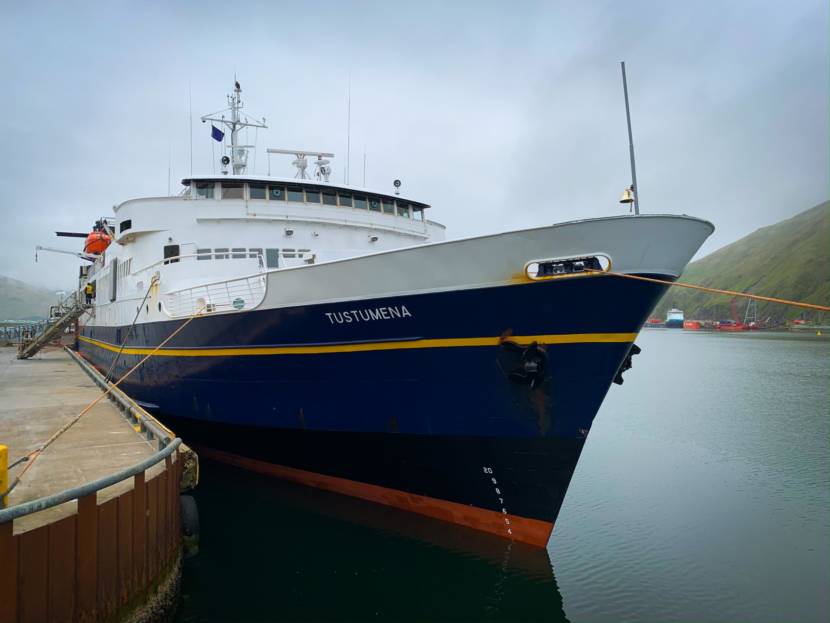
The ferry M/V Tustumena is scheduled for just five sailings to Unalaska this summer. And Carlin Enlow, executive director of the Unalaska Visitors Bureau, said the island will likely only see about four or five smaller cruise ships. (Hope McKenney/KUCB)

This summer is shaping up to be another quiet tourism season in Unalaska. While public health mandates and regulations loosen, things like reduced ferry service to the island, ongoing regulatory battles keeping large cruise ships out of port and lingering fears about the risks of COVID-19 will likely mean Unalaska’s shores will remain mostly void of visitors for the second year in a row.

The ferry Tustumena is scheduled for just five sailings to Unalaska, rather than its twice-monthly service that was the norm through 2019. And while Carlin Enlow, executive director of the Unalaska Visitors Bureau, said the island was expecting roughly 18 cruise ships this summer, the community will likely only see about four or five vessels.

Enlow said when it comes to planning around mandates and protocols that frequently change, preparing for this year’s cruise ships has been a rollercoaster.

“It’s so much to keep up with because it changes every single day,” Enlow said. “And you have so many different guidelines, whether it’s local, state, federal or corporate, or whatever these cruise ships are having to adhere to.”

While the possibility of Alaska seeing any foreign-flagged cruise ships this summer is waning, she said the island may see some smaller vessels, of 250 or fewer passengers. But that could be a good thing, in terms of keeping Unalaskans’ exposure to the virus low.

You’re going to see them meeting some pretty high COVID protocols to be able to make these sailings work for them,” she said. “But that’s easier for them because they have a smaller passenger capacity.”

Like cruise ship traffic, Unalaska’s port director Peggy McLaughlin said she’s not sure how many tourists to expect visiting through the Alaska Marine Highway System. But with a loss of eight Unalaska City School District faculty and two other staff members this year, she does expect to see some significant movement of residents on the Tustumena.

“We’ve had a kind of a mass exodus of many of our teachers and school people,” McLaughlin said. “And that is a preferred choice of moving families and households for the school system.”

The 57-year-old Tustumena provides crucial services to rural areas like Unalaska, she said. It’s not just essential for moving people and their belongings on and off the island. But it also provides cheaper and more accessible means for connecting workers and goods in Alaska, especially in remote regions.

“There’s a whole other layer of commerce that the Tustumena provides,” McLaughlin said. “It’s really critical to the Aleutians because it is an affordable way to move certain goods and equipment for contracts in these rural areas that are tough to get into and expensive to ship to — and may not have other means of regular shipping services.”

The Alaska Marine Highway System recently increased passenger capacity on its ferries, which was originally limited due to the pandemic, from 50 to 75%. But at just one sailing per month starting this month, McLaughlin said the limited schedule will still make planning a challenge for everyone, from city planning departments or contractors to people in the Aleutians who may rely on the ferry system for groceries or medical care.

For local organizations like the Museum of the Aleutians, those limited sailings and the lack of cruise ship tourism is a blow.

“We’re going to see those losses,” said MOTA Director Virginia Hatfield. “And it’s going to hurt.”

Hatfield said the museum is hoping to see some tourists this summer and staff is grateful that the ferry will still be visiting once a month. But as of right now, they’re expecting to take hits similar to those they suffered during last summer’s tourism season.

“It actually feels a lot like last year, when all of the grants started popping up in April, May and June,” she said. “And I felt like I was playing whack-a-mole with ‘write-a-grant.’ I was just working real hard to see what was out there and to apply for what was available.”

MOTA recently received over $300,000  from the City of Unalaska, but Hatfield said without tourists in the later summer months, they’re going to have to find more grant money to fill that gap.

Enlow, UVB’s director, echoed Hatfield’s concerns with finding extra funds.

I honestly was really nervous this past fall and into the winter about how we were going to make it through this and [had] fleeting thoughts of having to dissolve the visitors bureau and just little things like that would get to me,” Enlow said. “And then come January, there was some stuff that started making it apparent that it’s gonna be alright, it’s gonna figure itself out.”

Some of the cruise lines UVB works with are helping to connect them with grants and possible funding, she said. And the community, including the city, which also awarded the visitor’s bureau a significant chunk of money, has stepped up to show support.

UVB recently moved to a new location, which is in the Safeway plaza next to GCI. They are hoping to host an open house and be officially open to the public sometime in June.

The Tustumena began its sailings this month. Its first stop in Unalaska is scheduled for May 22.

Governor, lawmakers unveil plan to use $76.8M federal windfall to fund ferries for 18 months

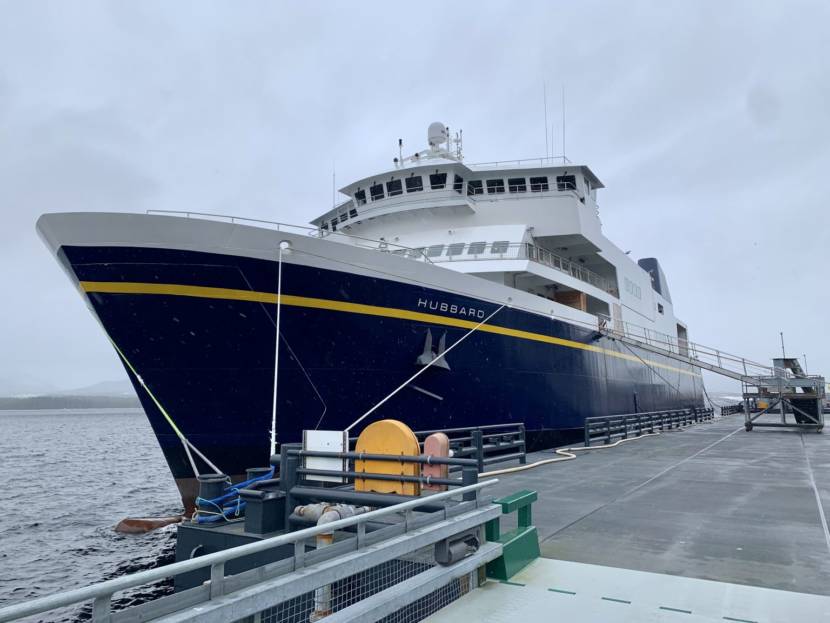
The 280-foot Hubbard is an Alaska Class Ferry tied up in Ketchikan on January 29, 2021. (Eric Stone/KRBD)

The governor and legislative leaders have agreed on a rough plan to use federal pandemic relief from Congress to help stabilize Alaska’s beleaguered ferry system.

Gov. Mike Dunleavy and lawmakers say a nearly $77 million windfall would allow the state to fund the Alaska Marine Highway System for the next year and a half. The governor visited Ketchikan on Thursday and discussed his proposal.

A $900 billion bill passed by Congress in the final days of 2020 included $14 billion for mass transit. This month, state leaders learned that $76.8 million of that could be used for the Alaska Marine Highway System.

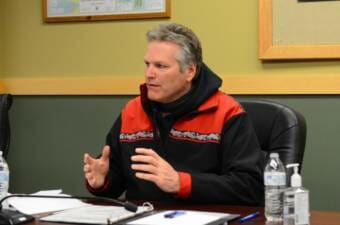
Gov. Mike Dunleavy speaks to reporters after meeting with Ketchikan-area mayors and other local officials Thursday. (Eric Stone/KRBD)

Now, Gov. Mike Dunleavy proposes funding the ferry system in next year’s budget for 18 months rather than the usual 12. That means this year’s budget would cover ferry operations from July 1 of this year through the end of 2022, he said during a stop in Ketchikan.

“What we’ve said we always want to do is stabilize the system, modernize the system and sustain the system so that it’s not up and down one year to the next,” Dunleavy told reporters.

Longer-term planning has long been a rallying cry for supporters of the marine highway. It was also a key recommendation of the governor’s working group which studied the ferry system last year.

Sen. Bert Stedman (R-Sitka) exits Ketchikan’s White Cliff Building after meeting with local officials alongside Gov. Mike Dunleavy on Thursday. (Eric Stone/KRBD)

Sitka Republican Sen. Bert Stedman, who accompanied Dunleavy, says this will be an important step towards stability for the ferry system.

“Not only should they increase their ridership, and what we’ve been told from the Alaska Marine Highway is that when they have an early schedule, they get about a 5% boost in sales, so that’s good,” Stedman said.

After that, Dunleavy proposes syncing the ferry system’s budget with the calendar year rather than fiscal year used by the state government.

“This little change in the fiscal, the funding across the fiscal calendar years seems like it’s an easy step, but it’s going to help with the scheduling. But just also scheduling the capital projects on boats,” Dunleavy said.

This one-time injection of $76.8 million comes from the Federal Transit Administration and Federal Highway Administration.

Another key reform will be allowing the ferry system to keep the money it makes on passengers, vehicles and cargo.

“What’ll end up happening then is the marine highway would be able to take their farebox — their sales — and basically bank them, hang on to them,” Stedman said.

It’s an idea Ketchikan Rep. Dan Ortiz has been advocating for as co-chair of the House Finance Committee. The infusion of federal dollars has at least temporarily eased the tension between lawmakers who support the marine highway and the governor and his fellow ferry skeptics.

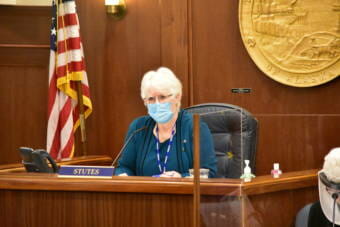
Photo of Alaska House Speaker Louise Stutes as she sits at her bench. She is wearing a disposable facemask and is looking into the House gallery.
Speaker Louise Stutes, R-Kodiak, presides over a short floor session of the Alaska House of Representatives on Wednesday, Feb. 24, 2021. (Peter Segall/Juneau Empire via AP, Pool)

Reached for comment, Kodiak Republican House Speaker Louise Stutes says she’s still studying the details but is feeling good about this new direction.

“It’s been really a positive experience being able to work with the governor instead of in opposition. And I have a very optimistic, positive attitude in more than just the Alaska Marine Highway System,” Stutes told CoastAlaska.

The governor proposed a $51 million operating budget for the marine highway. That’s slightly more than last year but much less than what lawmakers had approved before his vetoes trimmed it back.

Asked whether he still supports investing $51 million in state subsidies in light of the federal money available, Gov. Dunleavy said that’s a conversation to have with the legislature.

“Like any budget you introduce, it doesn’t look exactly the same as it was introduced,” he said. “There’s other other considerations, and we’ll see what this this federal money does to the budget, but I think what we want to do is get the budget done and then deal with the federal money.”

The governor also expressed for the first time his support for steering $15 million in federal highway dollars towards crew quarters for one of the state’s two Alaska-class ferries. That would expand the range of the Alaska-made vessels which are currently limited to 12 hours of continuous operations because crew members have no place to rest. The legislature had appropriated state money for that project last year, but it was erased by the governor’s veto pen.

Volcanic activity at Semisopochnoi prompts ashfall warning for fishing boats

Dave Schneider, a geophysicist with the AVO, said Semisopochnoi is still emitting some ash, but at a much lower rate than it was last week. (Courtesy of the Alaska Volcano Observatory)

Scientists have downgraded the alert level for an Aleutian volcano that began showing an increase in signs of eruption and emitting harmful ash late last week.

According to Dave Schneider, a geophysicist with the Alaska Volcano Observatory, satellites and pressure sensor data showed ramped up activity at Semisopochnoi last week. The volcano is on an uninhabited island in the Rat Islands, about 600 miles southwest of Unalaska.

Scientists detected steady ash emissions coming from the volcano Thursday, prompting them to upgrade the aviation color code to “red” and the alert level to “warning.”

“Ash started coming out on a more routine basis,” Schneider said. “And it was forming a plume that was going several hundred miles downwind, not at very high altitude.”

The ash wasn’t high enough to impact high-flying aircraft, but Schneider said it was persistent, and boats had been notified of possible ashfall.

He said the volcano is still emitting some ash, but at a much lower rate than it was last week. Even when emissions were more frequent, Schneider said the ashfall would likely be a minor issue for nearby fishermen, who often face more hazardous conditions.

If they were near the island, they could end up with an accumulation of ash on the deck,” he said. “If there’s any fish that are on deck, there could be an issue, perhaps just with some contamination, but this is not a huge eruption.”

Some small explosions are still occuring, and scientists observed sulfur dioxide gas emissions yesterday via satellite data, which indicates continued unrest at the volcano. But satellites also show that there is no longer a significant ash plume, and the AVO has returned the aviation alert level to “watch” and the color code to “orange.”

Schneider said the recent 5.3 earthquake reported Thursday evening near Attu was likely unrelated to the heightened activity at Semisopochnoi.

Activity at the volcano has been infrequent over the past few years, he said. Prior to 2018, the most recent eruptive activity at Semisopochnoi was in 1987.

After 5-month wait forces fuel rationing, barge arrives in St. Paul

The North Pacific Fuel barge arrived in St. Paul Tuesday. The small community had been waiting on its arrival since November of last year. (Phil Zavadil)

Fuel rationing in the Pribilof Island community of St. Paul ended last week after more than a month and a half of restrictions for residents and fishermen.

City officials announced the ration in late February after bad weather repeatedly canceled the arrival of a fuel barge.

The North Pacific Fuel barge finally arrived at the dock on Tuesday, according to City Manager Phil Zavadil. The city had been waiting on its arrival since November of last year.

“I think we’ve been expecting it each month and then it didn’t arrive because of weather and timing with delivery to other communities,” he said.

In late February, the island of 370 residents got down to just 1,200 gallons of usable gasoline. Zavadil said they had to ship in 55-gallon drums and ration locals to five gallons per vehicle each week.

“It’s been rough on people because they weren’t able to get out and drive,” he said. “And having to plan how you’re going to get to the store, to school, go to work and do all that on five gallons a week — it’s been rough for some.”

Then about a month ago, St. Paul also got low on diesel fuel. That’s the fuel used to power the town and the Trident Seafoods fish processing plant — which nearly doubles the island’s population.

Zavadil said the city also had to limit fuel to crab boats, and later cut them off completely, forcing crews to travel hundreds of miles out of their way to refuel.

“That impacted those vessels, where in some cases, they might have delivered crab down to Unalaska or Akutan instead of here because they couldn’t get fuel here,” he said.

In his 20-plus years on the island, Zavadil has seen at least two other fuel shortages where the city limited gas to locals and prices rose to $13 a gallon.

But that’s part of living 800 air miles from Anchorage, he said, with over 300 miles of open water between them and mainland Alaska.

Because of St. Paul’s remote location, Zavadil — who also serves as the island’s volunteer fire chief — said he encourages locals to have extra food and supplies on hand.

“It’s part of living out in the location that we do,” he said. “It’s not the easiest to get to, and then we have our challenges with weather — like most other places in Alaska. So I always try to encourage people to plan ahead and think about what if something were to happen? Are you prepared for that?”

Zavadil said he thinks the island now has enough gasoline to get them through the end of the year, but he’s already thinking about their next supply of diesel and preparing for the next crabbing season.

Meanwhile, a “hunker down” order on the island expired last week. Officials implemented the order after the small community confirmed its first case of COVID-19 on April 1 — more than a year after the pandemic arrived in the state.

No one else in the community has tested positive for the virus since then, according to Zavadil.

“We’re essentially COVID-free again, but we have one case on our record now,” he said.

Nonessential businesses will be allowed to reopen Friday, and students will be able to return to their classrooms for the first time in two weeks, Zavadil said.

The St. Paul City Council is scheduled to consider a new ordinance next week that would exempt fully vaccinated people from quarantining. They would still be required to social distance and wear masks.

“I think that’ll be a relief to some people that are traveling for medical and other reasons —  not having to come back and do that strict quarantine and have a little more freedom to move around,” he said.

About 48% of the island is already vaccinated, according to Zavadil. Officials are planning a raffle with prizes including a four-wheeler, king crab and a round-trip plane ticket to incentivise more eligible St. Paul islanders to get their shots.

Site notifications
Update notification options
Subscribe to notifications