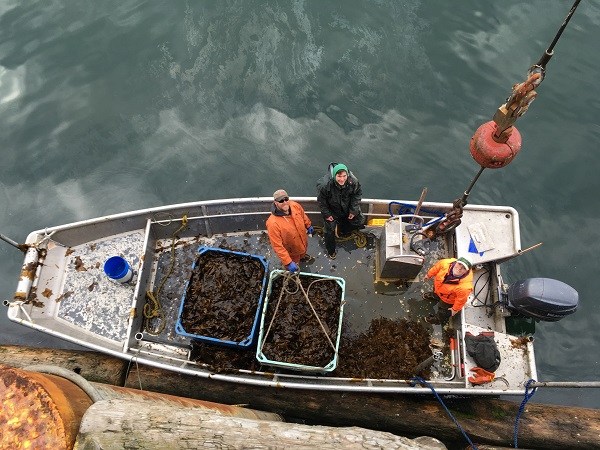
A kelp harvest in Kodiak. Tamsen Peeples is at far right. (Kayla Desroches/KMXT)
Representatives from the Alaska Fisheries Development Foundation visited Unalaska last week as part of its push to expand the state’s mariculture industry.
Gov. Bill Walker created the Alaska Mariculture Task Force in 2016. Since then, the organization has been focused on developing the state’s mariculture industry to meet its long-term goal of $100 million by 2038.
Mariculture refers specifically to farming and enhancing shellfish and seaweeds. The state’s mariculture industry was valued at approximately $1 million in 2018.
Julie Decker, executive director of the Alaska Fisheries Development Foundation, sees opportunities in the shorelines and beaches of the Aleutian coast.
“You have lots of water, so you have lots of space. Relatively little population, which means relatively little conflict,” Decker said. “The people that do live here are used to working on the water. There’s North America’s largest processing port. These are some pretty significant assets.”
Oyster and kelp farms have been springing up in Alaska’s coastal communities from Southeast Alaska to the Kenai Peninsula and Kodiak Island, but there’s only been one permit so far in the Aleutians.
Decker says that a lot of the infrastructure from the fishing industry could be used to expand mariculture in the Aleutians and that people could reconfigure much of their fishing equipment. And while shellfish could do well in the Aleutians, Decker says seaweed offers an easier point-of-entry.
Seaweed provides a quicker return than most shellfish because it is an annual crop, unlike oysters, for example, which can take about three years to harvest. That’s not to say mussels, oysters or sea cucumbers wouldn’t thrive here, but kelp happens to time well with the fisheries already in place.
Industry experts say the timing for kelp farming fits well between pollock or salmon seasons.
“You want to have your kelp out of the water by the beginning of June,” said Tamsen Peeples, a commercial seaweed mariculture specialist whose job is to counsel businesses and investors interested in mariculture. “And guess what else happens at the beginning of June: the salmon come back.”
Peeples says growing kelp also offers environmental benefits.
“Seaweeds are carbon negative because they do draw carbon out of the ecosystem. And if you’re familiar with ocean acidification, that can have huge ramifications and benefits for the ocean, as well as just the entire global environment,” she said.
It also provides economic opportunities for kelp farmers to sell carbon credits.
Peeples says countries like Norway, France and Chile are competing with Asian nations for the seaweed market while the United States largely sits on the sidelines.
“We’re one of the only large countries in the world that’s not producing or harvesting wild seaweeds,” she said, “so we’re a little bit behind the curve.”
A United Nations report valued the global seaweed industry at over $6 billion in 2018. And while Alaska may be a global leader in fishing, the state falls behind in mariculture.
By comparison, aquaculture in New Zealand — which does include finfish farms — generated over $450 million in 2020.
Decker says growing Alaska’s mariculture into an operation on a competitive scale won’t be easy.
“I want to be clear with people that when you’re developing something new, there’s always challenges,” she said.
For new farmers, those difficulties may include picking farm sites and navigating the application process. But Peeples says that she is available specifically for those purposes.
“I would be assisting with site selection, as well as business planning and the permit process and then application assistance,” she said.
Decker and Peeples also say there are various funding opportunities available, including the Mariculture Revolving Loan Fund.
Alaska Fisheries Development Foundation’s website has more information about mariculture training and funding opportunities. There are also pamphlets and other materials available at the Unalaska Visitors Bureau.
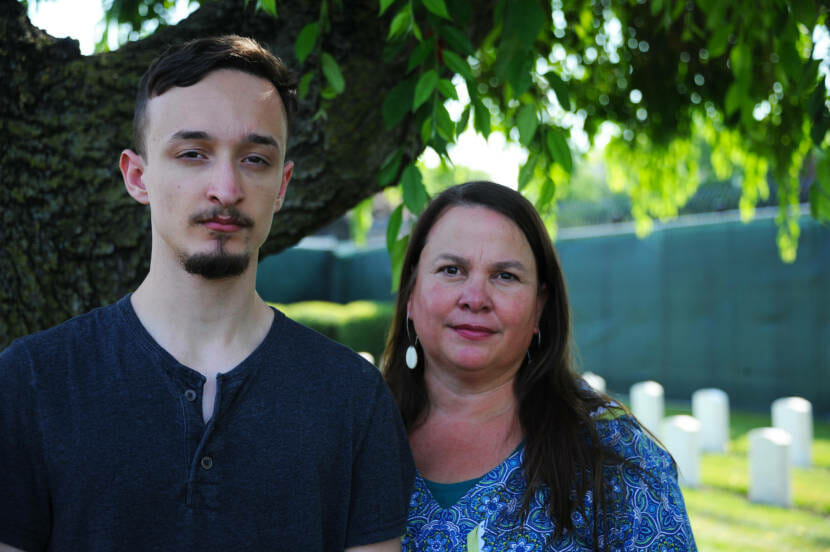
Andrew Peters (left) poses with his mother, Lauren Peters, at the cemetery of the former Carlisle Indian Industrial School in Carlisle, Pennsylvania. For about four years, Lauren Peters has been working to repatriate the remains of an Unangax̂ student and relative back to St. Paul Island, Alaska. (Photo courtesy of Lauren Peters)
Content warning: This story contains accounts from descendants and others of boarding schools and may be distressing for some audiences. A list of available services and organizations is available for people in Alaska, Canada and the Lower 48 at the bottom of the story.
At the turn of the 20th century, the federal government created boarding schools in an attempt to assimilate Indigenous children into “American society.” The lasting legacy of the boarding school era devastated Native cultures across North America.
Now, people all across the country are demanding accountability and working to bring the remains of boarding school students home.
Sophia Tetoff is the first Alaska Native student buried at the former Carlisle Indian School in Pennsylvania to return to Alaska. She wanted to come home.
“Sophia is my grandmother’s aunt and so she’s my great-grandfather’s stepsister,” said Lauren Peters, who is Unangax̂ (Agdaagux Tribe of King Cove) and the Alaska Native adviser at Fort Ross Conservancy in California.
Up until four years ago, Lauren Peters didn’t even know Sophia existed or that they were related. The way Peters tells it, Sophia found her.
We’ll get to that. But first — a little bit about Sophia.
She was orphaned in the early 1900s.
For most of the 19th century, Russia had used Unangax̂ people as forced labor in the fur seal trade — transporting many of them to the Pribilof Islands. Sophia came from a large family. Her father had been married previously and had 13 kids. He remarried after his first wife died. The new couple later had Sophia’s older sister, Irene, and then Sophia.
In the 1900s, a measles epidemic — called “The Great Sickness” — hit Alaska. Many Unangax̂, Yup’ik and Inpuiat became infected. First Irene and Sophia’s father died, then their mother.
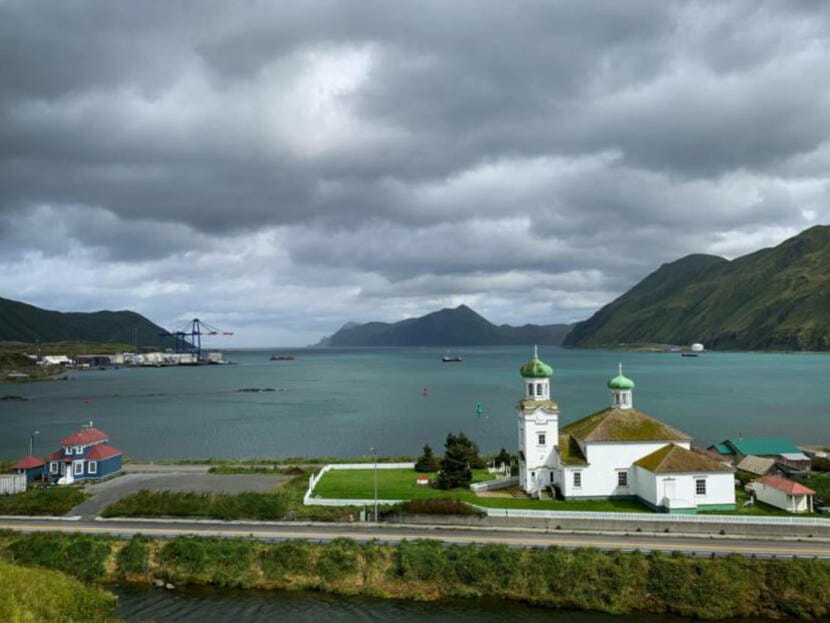
The two girls were moved from St. Paul Island to Unalaska where the Jesse Lee Home housed mostly coastal Alaska Native children.
“There are quite a few orphans that were removed — a lot of them just went down to the Jessie Lee home,” Peters said. “And then from what I’ve read, if they found the children either troublesome or promising, they would send them to Carlisle.”
Irene died in Unalaska. Sophia was sent on to the Carlisle Indian Industrial School in Pennsylvania.
“Going from St. Paul to Unalaska was, what, 400 miles? It’s still Unangax̂ and it’s still treeless and volcanic and windswept and all the beautiful weather,” Peters said. “And then to go 4,000 miles, imagine landing in Washington state and then going all across the Plains into the big cities and whatnot, and then ending up at Carlisle. And I saw the actual tracks that she would have ridden the train up on and get out. And there’s a platform right there that would walk up into the school.”
Carlisle was established in 1879. It was a non-reservation, federally-funded boarding school established by the military. Carlisle was considered a flagship model for other institutions of its kind. Similar boarding schools were later established in Alaska.
“I was imagining how foreign that had happened to her and how frightening that had been to end up in this landscape that you don’t know anything about. You don’t know what’s poisonous. You don’t know what’s edible,” Peters said. “Must have been really disorienting.”
While the Carlisle site returned to military use in 1918, other schools continued to operate into living memory. Many Alaskans have heard stories of schools in White Mountain, the Copper River Valley, the Wrangell Institute, and even Mount Edgecumbe — which continues to run as a public boarding school in Sitka.
Traditional and cultural ways of knowing and being were intentionally severed as Native children were removed from their homes and families and forced into boarding schools in an attempt to assimilate them.
Barbara Landis is the former Carlisle Indian School archives and library specialist for the Cumberland County Historical Society in Carlisle.
Landis said she first became involved with the boarding school when Tribes began reaching out to the society to track down information on Native students.
“But there are some universal issues. For example, children dying at boarding schools. That touched every nation. And so, it’s a very conflicted response that descendants have to what happened to their relatives who were at the boarding schools. And there’s not just one black and white. So it’s a really tricky episode in United States history and clearly in Canada’s history also,” she said.
In 2021, news surfaced that ground-penetrating radar was used to uncover the location of hundreds of unmarked graves at residential schools in the community of Kamloops in Canada.
Since the announcement about Kamloops, Landis has been fielding phone calls from families and media outlets.
“I really believe that the Kamloops discovery has been a catalyst for people starting to become aware of the residential boarding school system, the mission schools and the government-run schools,” Landis said. “And then, Deb Haaland’s assignment as cabinet secretary and her dedication … to investigating the children from the boarding schools, the deaths and all the children, what happened to them. That adds a whole layer of heft to the importance of getting to the bottom of these stories.”
U.S. Interior Secretary Deb Haaland announced a national initiative to investigate the traumatic legacy of boarding schools run by the Bureau of Indian Affairs.
“Our communities are still mourning,” Haaland said in June. “The federal policies that attempted to wipe out Native identity, language and culture continue to manifest in the pain our communities face, including long-standing intergenerational trauma, cycles of violence and abuse, disappearance of Indigenous people, premature deaths, mental disorders and substance abuse.”
The new initiative will document boarding school policies and also identify burial sites near schools.
“I come from ancestors who endured the horrors of Indian boarding school assimilation policies carried out by the same department that I now lead, the same agency that tried to eradicate our culture, our language or spiritual practices and our people. To address the intergenerational impact of Indian boarding schools, and to promote spiritual and emotional healing in our communities, we must shed light on the unspoken traumas of the past, no matter how hard it will be,” Haaland said.
She ordered a final report from the investigation of BIA boarding schools to be issued by next April.
Back in California, Peters often plans an Alaska Native Day for Russian-era Fort Ross. She incorporates dancers, artists, storytellers, and more. Four years ago, she invited Tlingit Elder and storyteller Bob Sam. He’s a cemetery caretaker from Sitka who also works on repatriation.
“In 2017, he called me and said, ‘Hey, I’ve been trying to get the orphans at Carlisle deemed wards of the state.’ But when they were taken, there wasn’t a state. That was just proving impossible and time was ticking,” she said.
Sam asked whether she could track down information on students in the Unangax̂/Alutiiq region and gave her six names — three from St. Paul and three from Kodiak.
Sophia was first on the list.
Again during a summit with the Native American Boarding School Healing Coalition that Peters attended, Sophia’s name was on another list. Peters still had no idea they were distantly related.
Peters researched Sophia’s origins on St. Paul Island, tracing the student’s family tree when branches with Peters’ own family history matched up. She worked with others to ensure Sophia’s remains were returned to St. Paul Island, Alaska.
In May 2016, the Northern Arapaho Tribe began the process to exhume three of their children from the Carlisle cemetery. But one of the graves contained two sets of remains — and neither were the child supposed to be buried there. In 2018, four children were returned to their family and Tribes; and six in 2019.
After COVID-19 complicated repatriations in 2020, 10 children are scheduled to be returned, at full cost to the Army. Nine were Rosebud Sioux. The other was Sophia.
Peters hopes Sophia’s story inspires others to seek the return of their ancestors.
“She felt clever and brave and leading the Alaskans out of the cemetery, you know, through Bob and me. And I just really admire her and felt really at peace and good about the whole process and some other people who are trying to get their kids out of the cemetery. At the same time, we’re feeling the anguish of these children that are still stuck in there. And several of us got together and said, I feel like these children are saying, ‘What about me? Aren’t you going to take me?’ And it was very powerful. But Sophia, with the process, I felt really good at the end. And I’m really happy to be taking her back to St. Paul and I’m really happy to be reuniting her with our family up there. It’s a really good feeling,” she said.
Lauren’s 21-year-old son, Andrew, joined her at Carlisle to begin the process of returning Sophia’s remains to St. Paul.
“He was my absolute rock up there. He took care of her person,” Peters said. “That’s not something I could do. I didn’t have the strength as a mom to look at some, you know, at her person. And he checked in with her. He made decisions about how he wanted her to be handled respectfully. And he put her to bed at the end and carried her to the ceremony and carried her out to be placed in the container that is taking her to St. Paul. And I’m really proud of him. But as a parent, you know, she’s my girl. I’m really fiercely protective of her,” she said.
Lauren Peters was scheduled to return to St. Paul after the Fourth of July holiday to re-inter Sophia’s remains but travel was postponed due to weather.
Years ago, the military relocated the graves at Carlisle but the information became misplaced.
Eleanor Hadden’s great-aunt is one of about 180 buried at Carlisle, but she’s one of many under a marker labeled unknown.
For Hadden, the return of one student and the larger conversation around boarding schools is a good first step.
“I’m glad it’s happening now. It would have been nice if it happened earlier, but there’s too much that has gone on within the Native community that, you know, how many battles can we fight? How many things can we get out in the open to let people know these things are happening, or these things did happen to us?” Hadden said.
Because of some Indigenous cultural taboos against further disturbing remains, the graves can’t be disinterred, nor can DNA testing be performed, despite Hadden’s willingness in an effort to find her aunt.
“We get overwhelmed with all the sad news that’s making us want to fight more, which is good,” Hadden said. “I would say it’s a very complicated scenario that we all have to go through. And to heal from all of this.”
Family members of Carlisle students must fill out the Army-required affidavits to return the remains. But in many, many cases, the children were orphaned when they arrived at Carlisle. Family can be hard to find.
LifeMed started carrying its own blood supply at its Anchorage base around 2016. But last April, Unalaska became the first LifeMed location outside of Anchorage to carry blood products. (Maggie Nelson/KUCB)
When someone who’s injured or sick needs blood, medical providers can clot the blood or increase blood pressure to buy some time before they can get a patient to the hospital.
But when it comes down to it, LifeMed flight paramedic and Unalaska base chief Angela Niemi says no amount of saline solution or clotting medication will save someone who needs a transfusion.
“You’ll watch a person just kind of bleed out and die in front of you,” Neimi said. “And there’s nothing you can do.”
That’s why providers in rural Alaska have been pushing to store blood supplies closer to the communities they serve. But getting blood from the blood bank in Anchorage is complicated by strict storage and transportation requirements, limited infrastructure and an overall shortage of blood donations.
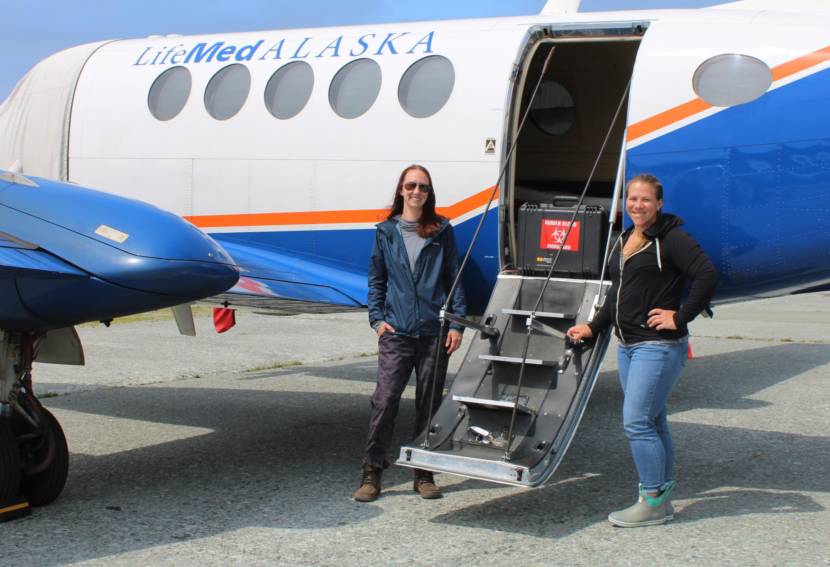
One company that’s been working to get better access to blood supplies is LifeMed Alaska, a first responder and emergency transport company that serves communities all over the state — from St. Paul Island in the Bering Sea to Wolf Lake in the Mat-Su Valley.
The emergency medical care providers respond to all kinds of trauma and illnesses. They help people in generally remote areas get to hospitals when they’re hurt or sick, often under inclement Alaska conditions and with limited resources — one of those being blood.
The company started carrying its own blood supply at its Anchorage base around 2016. But last April, Unalaska became the first LifeMed location outside of Anchorage to carry blood products.
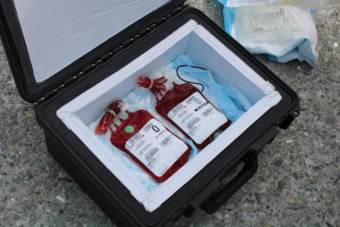
When patients need blood, Niemi and her crew pull two units of type O out of what she calls an ‘astronomically expensive’ refrigerator at their home base in the Unalaska Valley. (Maggie Nelson/KUCB)
Neimi has worked as a paramedic for LifeMed for eight years, about five of which she’s spent at the Unalaska and Dutch Harbor base. She said having access to blood on the island — which is about a 3 hour flight from Anchorage — is a huge deal for providers and patients.
“There’s lots of times when you watch the patient and wish you could give them some blood because you know if you had blood products, you could — for lack of better words — nurse them through to get them to a doctor, to get them to a surgeon or [operating] suite where they can get what they ultimately need,” she said.
LifeMed has been working with the Blood Bank of Alaska to improve access to blood products in remote areas of the state for roughly five years. Unalaska was the first of the seven LifeMed bases outside of Anchorage to carry blood products. Prior to that, the nearest blood that LifeMed providers had access to was in Kodiak.
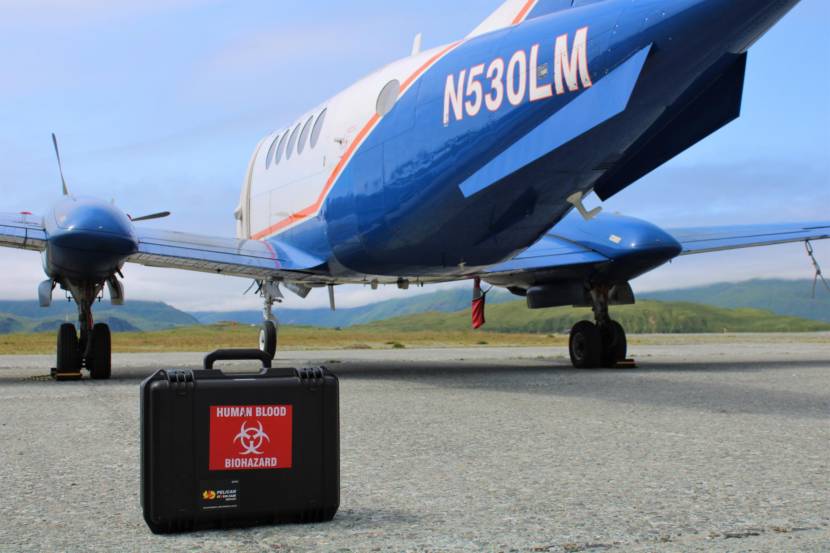
Now, when patients on the island need blood, Niemi and her crew pull two units of type O out of what she calls an “astronomically expensive” refrigerator at their home base in the Unalaska Valley. Then they throw it in a black refrigerated carrying case labeled “Human Blood” and head to the plane.
The Blood Bank of Alaska is the only blood bank in the state, and LifeMed is the only first responder flight team that stores blood at its remote locations and carries it on transports. LifeMed Clinical Services Director Erik Lewis said the company only has three bases where it actually keeps blood products: Anchorage, the Wolf Lake helicopter base in the Mat-Su Valley and Unalaska.
Part of the reason why blood is so scarce in remote places is that it’s really tricky to get access to it, Lewis said. It’s even tougher to transport.
“It gets packed in special boxes and checked in and checked out when it exchanges hands,” he said. “It’s very much like it’s a medication. We document who signed it out to whom. We keep track of each blood unit number, and how long it was out of the refrigerator and in the cooler.”
Lewis didn’t say how much the company pays the Blood Bank of Alaska for each unit of blood, but he did say the significant logistical challenges of carrying and storing it — such as detailed tracking and special equipment like sensors and cameras on the refrigerators and coolers — speak to the costs, as well as the company’s commitment to rural Alaska.
LifeMed pilot Natoshia Burdick (left) and Unalaska/Dutch Harbor base chief Angela Niemi (right). (Maggie Nelson/KUCB)
The units have to be replaced every three weeks. And if they’re not used, Lewis said they’re returned to the Blood Bank of Alaska, assuming all documentation is sound.
In order to store and transport blood, LifeMed also has to work with several regulatory agencies, such as the American Association of Blood Banks and Clinical Laboratory Improvement Amendments. But Lewis said what makes getting blood to remote parts of the state particularly challenging — and what keeps more first responders from getting access to it — is that Alaska just doesn’t have a whole lot of donors.
“They didn’t have an unlimited supply of blood to give us because blood has a fairly limited shelf life. And it wasn’t like they had a large backstock,” Lewis said.
Ashere Chait, the director of marketing for the Blood Bank of Alaska, said the company is using tactics like mobile blood banks to help get more donors so that they can be a resource for more Alaskans in need, especially in places where there aren’t hospitals that have quick and easy access to blood products.
“[LifeMed] allows us to provide blood in places that maybe wouldn’t [have access] without them,” she said. “So they’re a critical piece to that infrastructure to make sure that people are safe.”
LifeMed is working to expand the reach of its miniature blood bank system to other rural areas in Alaska, according to Lewis. And those efforts are appreciated by staff at clinics in isolated areas like the Aleutians.
Sarah Spelsberg is a physician assistant that often works at Unalaska’s Iliuliuk Family and Health Services Clinic.
“The clinic has never really been in a position where we could manage and monitor something like [blood],” she said. “And so to have LifeMed having that resource on island is a pretty incredible gift.”
To find out more about the precious resource of blood or to learn about becoming a donor, visit the Blood Bank of Alaska’s website.
Now, the Oceania Regatta is the only ship that is still planning to make a stop on the island. But Unalaska Visitors Bureau Executive Director Carlin Enlow said the ship, which is scheduled to arrive at Unalaska in October, likely won’t make it, either.
“We assume that one in October will likely cancel as well,” Enlow said. “But they’re still on the books for multiple locations for [their] sailing.”
The majority of the ships canceled because of coronavirus concerns, she said. While there are nearly 25 ships scheduled for next summer, Enlow said another bleak tourist season is going to be rough on the community.
“It’s definitely a big hit compared to a couple years ago, when we had almost 18 vessels in town and the number was supposed to be growing every summer,” she said. “And people were really starting to rely on some of that income from the cruise season — whether it was nonprofit entities or businesses in town. And so to have [the season] completely vacant for two years in a row now is kind of concerning.”
While Unalaska may not see any cruise ship tourism for the second year, the island has three more Tustumena ferry sailings scheduled.
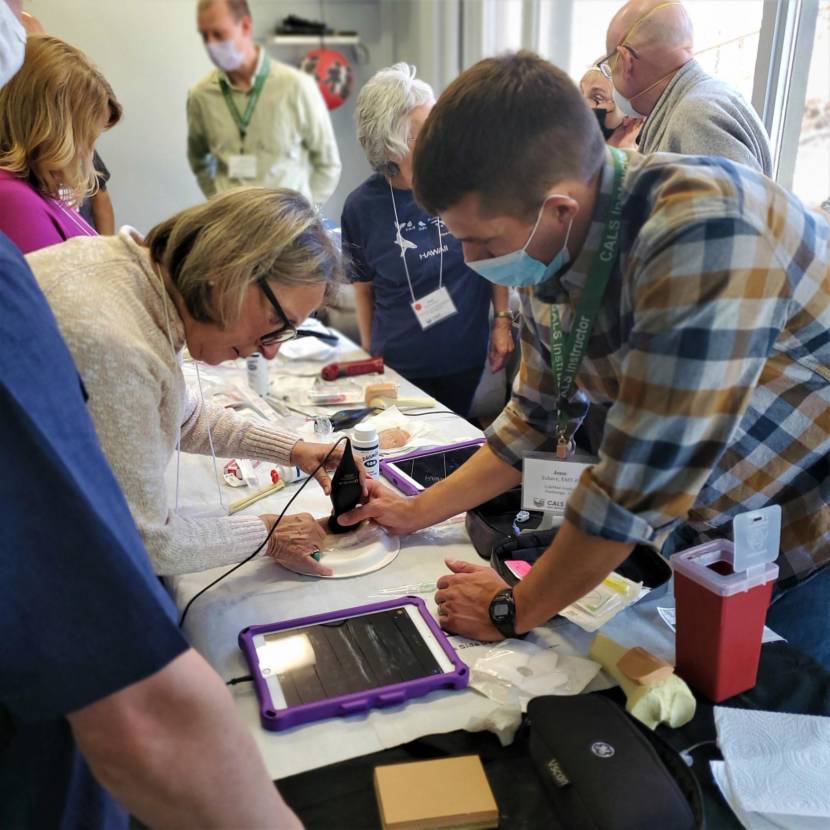
The Comprehensive Advanced Life Support rural medical education course has been held in several states and even in other countries. But never in Alaska — until last month, when a group of health care professionals from across the state gathered in Anchorage to attend the training. (Photo courtesy of Ann Gihl, CALS Executive Director)
In resource-constrained environments like rural Alaska, time and education can mean the difference between life and death.
When the plane touched down, instead of slowing and stopping at the end of the short runway like it should have, it kept going until its nose had tipped over the edge of a rocky embankment just above the waters of Iliuliuk Bay.
Dr. Murray Buttner, a family medicine physician with Unalaska’s Iliuliuk Family and Health Services clinic, witnessed the crash.
“I ended up running down there,” Buttner said. “And I ended up being the first person to get on the plane.”
While he and a group of other health care professionals were unable to save one fatally injured passenger, Buttner said a particular training he had just completed made a big difference in how he handled the crash.
“I don’t want to say I wasn’t panicked but, that whole ‘deer in the headlights’ thing — which really happens when you step into emergencies if you’re not used to them, and can be hard to get out of — the course kind of gets you through that,” he said.
The training is called Comprehensive Advanced Life Support and it equips people working in resource-constrained environments with life-saving skills. It has been held in several states and even in other countries for the past 25 years. But never in Alaska — until last month when a group of health care professionals, like Buttner, from across the state gathered in Anchorage to attend the training.
Additional training fills a critical gap
Health care in Alaska is unique. Many places, like Unalaska, are hundreds of miles from hospitals or are located completely off the road system. Physicians, nurses, and nurse practitioners are all often on the front lines of emergencies like snowmachine, boating and aviation accidents.
Traditional medical training for professionals like family practitioners doesn’t necessarily cover emergencies that rural health care personnel, like Buttner, may have to address in the field or a small clinic when there isn’t a hospital nearby.
He said the CALS training provides a chance for rural practitioners such as doctors, nurses or physician assistants to get hands-on trauma training.
“It’s a window into paramedic training for medical practitioners,” Buttner said. “Because paramedics do get trained in dealing with every emergency you can name: in someone’s house, on the side of the highway, on the ski hill, in the swimming pool, etc. Whereas, health care practitioners are trained for how to handle that once it hits the door of the hospital. And so this course kind of fills that gap.”
Like Buttner, other Alaska medical professionals have traveled Outside to take the course.
Jenny Brown is an EMT instructor in Fairbanks and course coordinator for the CALS training. She is one of the people who helped gather the nearly 50 medical professionals in Anchorage to hold Alaska’s first CALS training in May.
She said she was looking for an ’emergency trauma’ training for her staff when she found the CALS course.
“It kind of combined a little bit of the street care that we see in EMS, but along with the critical thinking that we have at the provider level,” Brown said.
Dr. Darrell Carter has been practicing medicine in a small Minnesota town since the early ’70s. Carter co-founded and helped organize the first CALS course 25 years ago, after he noticed a lack of preparation and training in the medical field as well as in his own practice.
“I began to wonder if I should be continuing to practice in a situation where I knew that sometimes I couldn’t take care of what came in,” Carter said.
Rather than abandoning his trade, he decided to work with other providers and develop a curriculum he couldn’t find elsewhere. With the help of what he calls “local champions,” he’s since been expanding the training to other remote places around the world.
When waiting on a medevac, even simple refreshers are invaluable
Anna Frisby is a physician assistant from St. Paul — a small Pribilof Island community located in the Bering Sea, nearly 800 air miles from Anchorage. Frisby said she’s taken several other trauma and emergency courses, but the CALS training provided a bridge connecting her knowledge in those other courses.
“I feel like it gave me confidence in what I can do,” Frisby said. “For instance, gaining an airway to a patient who we cannot use an endotracheal tube [on] — we were able to practice and really understand the anatomy around the neck and how to access the airway [on them].”
Frisby said those skills, and simple refreshers on things like where best to place an electrocardiogram, or EKG, on certain patients can be invaluable in an isolated place like St. Paul.
“When it comes to a medevac, they talk about a ‘golden hour’ — we [in St. Paul] can say we have a golden three to six hours,” she said. “It takes a while for a medevac to come out here to us. And not only does it take time, we also have to factor in the weather.”
Part of the confidence the course gives, especially for health care providers in remote areas, Buttner said, is a reassurance that they’ve done everything to the best of their abilities to help those in need. He said a lot of times, people won’t survive certain traumatic accidents and there can be a lot of guilt that comes from that.
“People [in the CALS course] are trained to do what can be done and know that they did what could be done,” he said. “And to therefore not beat themselves up that there was something they did or didn’t know how to do, that kept the person from living.”
Roughly 10 attendees were also trained to be CALS instructors at the course in Anchorage. Organizers are hoping to offer about two courses per year in Alaska starting around September. Anyone can attend the course, but participants are encouraged to have medical practice experience and at least some previous training in a life-support course, as the class contains advanced content and only spans a couple of days.
As the course develops in the state, coordinator Jenny Brown said the curriculum will hopefully be adapted to fit uniquely Alaska emergency scenarios.
ProPublica is a Pulitzer Prize-winning investigative newsroom. Sign up for The Big Story newsletter to receive stories like this one in your inbox.
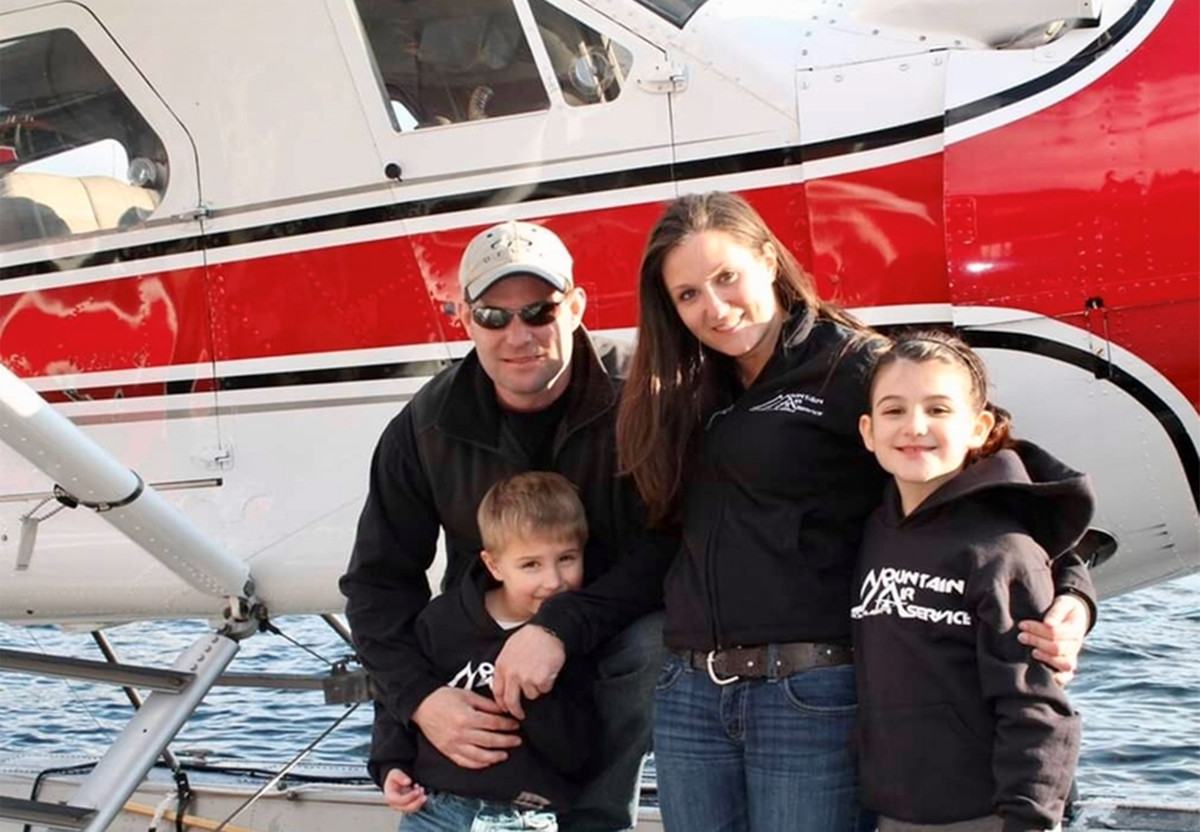
On a clear day in May 2019, the tourist season was just starting up in Ketchikan, Alaska, a southeastern city of 8,000 that had become a cruise ship hot spot. For Randy Sullivan, that meant another day — his fifth in a row — of flying sightseeing tours and charters. Sullivan and his wife, Julie, owned Mountain Air Service, a single-plane family business that had allowed Randy to realize his dream of becoming his own boss. Randy was born and raised in Alaska. He grew up in Ketchikan and had been flying in the area for more than 17 years. He, more than most, knew the dangers of commercial aviation in the state.
“When Randy first started flying up here in Alaska, he learned from some of the best pilots up here and he valued everything they taught him,” Julie said. “Safety was number one for Randy.”
For the 10 a.m. flight, his first of the day, he met his four passengers from the Royal Princess cruise ship at the dock. They boarded his single-engine, propeller-driven, red-and-white floatplane for a tour of Misty Fjords National Monument, 35 miles northeast of Ketchikan. This picturesque landscape, filled with glacial valleys and steep cliffs, is such a popular and crowded flightseeing destination that local operators banded together a decade earlier to create their own voluntary safety measures for flying in the area, including designating radio channels for communication and routes for the planes to follow.
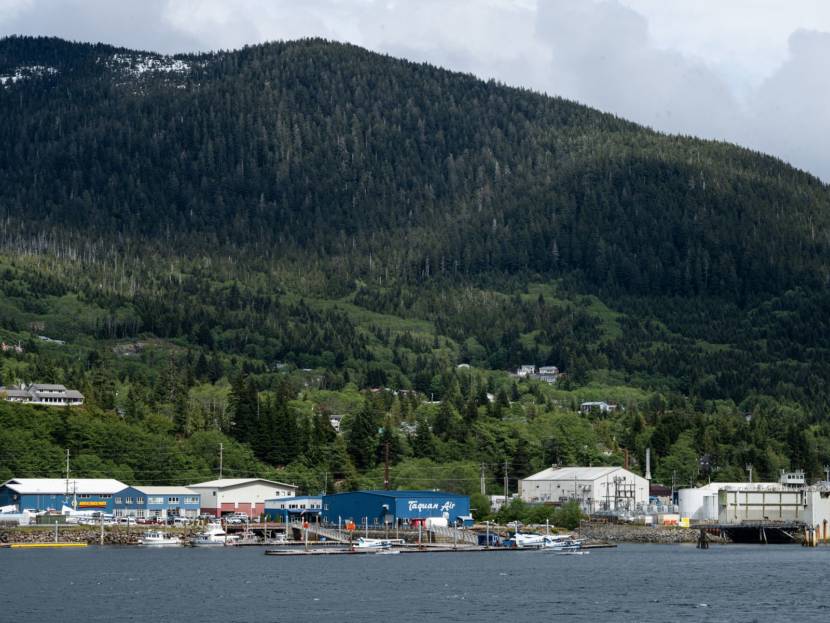
After noon, Sullivan’s de Havilland DHC-2 Beaver was on its way back to town. Another commercial carrier, Taquan Air, was flying one of its own airplanes, also on a flightseeing tour, back to Ketchikan. The two planes collided at about 3,350 feet. The accident destroyed the Beaver and killed all five aboard, including Sullivan, as well as one passenger from the Taquan Air plane. All 10 survivors were injured.
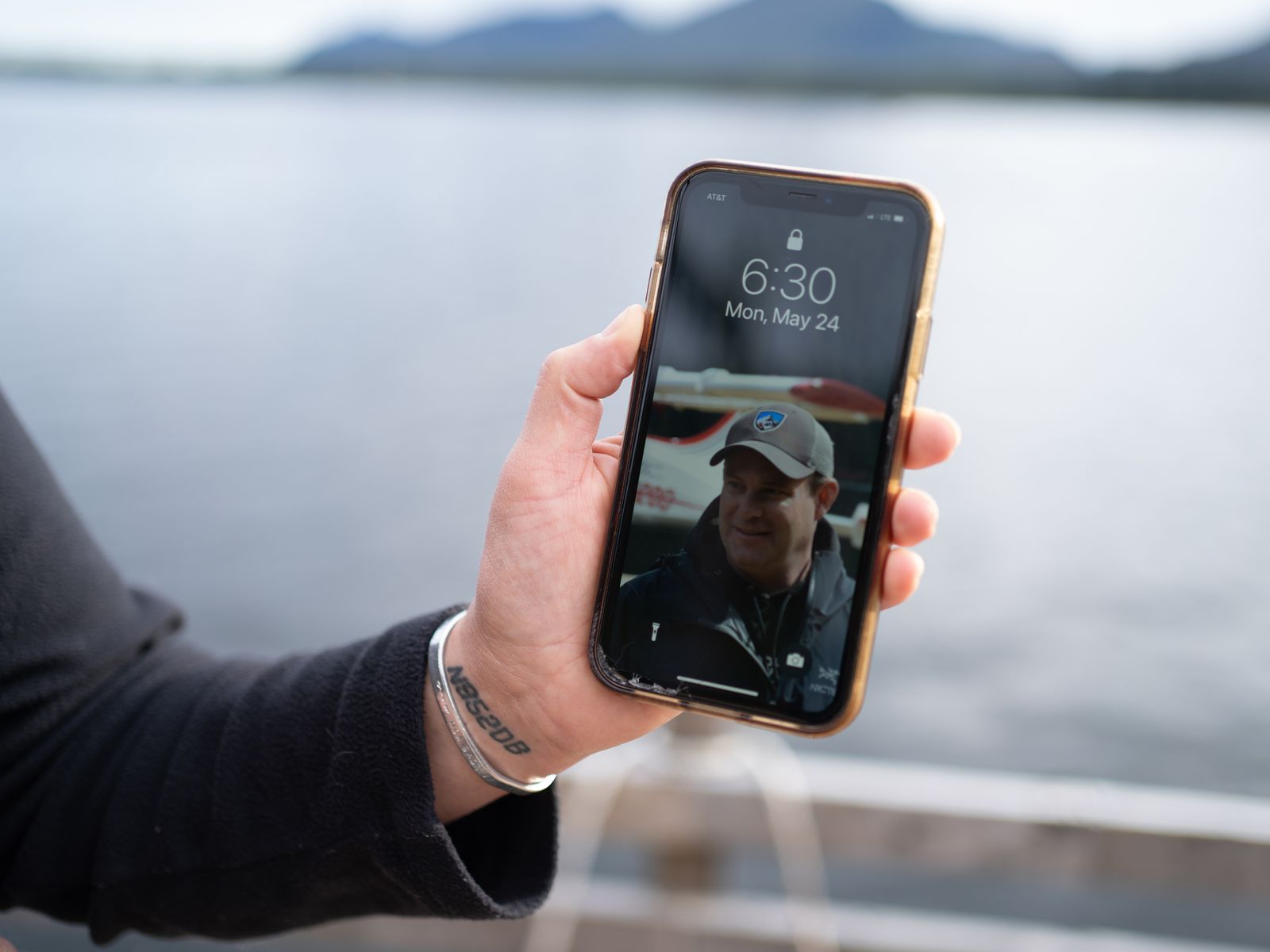
Julie Sullivan’s husband, Randy, was killed in a plane crash in 2019. She has the tail number of the plane Randy flew tattooed on her wrist. (Credit: Ash Adams, special to ProPublica)
Shannon Wilk lost three family members in the midair collision, including her brother Ryan, who was on Sullivan’s plane.
“I didn’t think the next time I’d be in the same room with him, he would be in a casket,” Shannon said. The crash also claimed the lives of Ryan’s wife, Elsa, and Elsa’s brother, Louis Botha. “I thought he’d get home, we’d keep getting pictures, we’d talk about it and we’d just keep going.”
The National Transportation Safety Board, an independent governmental agency that investigates transportation accidents, eventually determined that the pilots of the aircraft saw each other too late to take evasive action, calling it an example of the limitations of avoiding midair collisions by relying only on what pilots can see through the window.
Fatal midair collisions involving commercial aircraft are practically unheard of in the rest of the country, but in Alaska, there have been five in the past five years alone. In each of them, at least one plane either lacked a key piece of optional safety equipment or wasn’t using it properly.
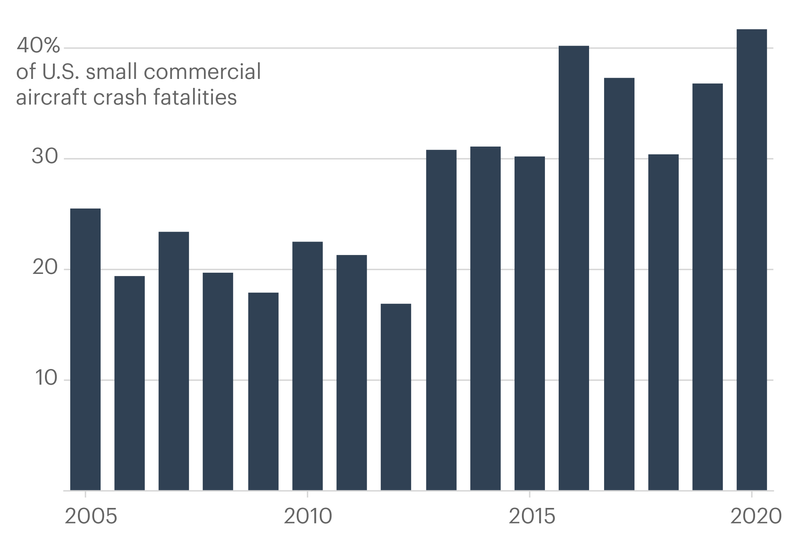
More broadly, in recent years Alaska has made up a growing share of the country’s crashes involving small commercial aircraft, according to an investigation by KUCB and ProPublica. In the past two decades, the number of deaths in crashes involving these operators has plummeted nationwide, while in Alaska, deaths have held relatively steady. As a result, Alaska’s share of fatalities in such crashes has increased from 26% in the early 2000s to 42% since 2016. Our analysis included crashes involving at least one plane or helicopter flying under the Federal Aviation Administration’s typical rules for commuter, air taxi or charter service. (The flight safety record of large air carriers is strong in both Alaska and nationally.)
Alaska’s Growing Share of Small Commercial Aircraft Fatalities
The state’s share of deaths from crashes involving commuter, air taxi and charter planes made up an increasing portion of the country’s total in the past decade.
Note: Each bar in the chart depicts the percentage from the preceding five years; the listed year is the last in the range (i.e. the bar labeled 2020 represents the share from 2016-2020). Crashes involved at least one aircraft that fell under Part 135 of the FAA’s regulations. (Credit: Agnel Philip/ProPublica; Source: National Transportation Safety Board)
Alaska’s increased share of aviation deaths can be attributed, at least in part, to its continued reliance on smaller operators, which have worse safety records than large airlines but appear to have waned in popularity outside the state, according to experts.
In interviews with KUCB and ProPublica, federal officials, lawyers and aviation safety experts said the FAA, which oversees air travel in the country, carries much of the responsibility for improving aviation safety in the state. Some say the agency has been slow to adopt rules and provide additional support for the unique conditions in Alaska, leaving pilots and customers to fend for themselves. Some critics also say the FAA has struggled to hold operators accountable for questionable safety track records.
While it has long been known that flying in Alaska is more dangerous than in the lower 48, there are fewer safeguards in the state than almost anywhere else in the country. Because much of Alaska is considered uncontrolled airspace, pilots flying in large areas of the state have limited access to weather and traffic information.
That leaves pilots, many of whom come to the state to get their first commercial flying experience, on their own to navigate rapidly changing weather, mountainous terrain and challenging landings at small rural airports with unpaved, poorly lit runways. Flights can turn deadly even in the hands of experienced pilots.
The NTSB has been among the most vocal entities pushing the FAA to change its approach in the state. The NTSB is responsible for making recommendations to prevent future accidents, but it lacks the authority to enact them. Following a roundtable meeting in 2019 focused on improving small-plane aviation, the NTSB issued a safety recommendation asking the FAA to review and prioritize Alaska’s aviation safety needs and ensure it’s making progress on implementing safety enhancements.
“I think the FAA has acknowledged that they can do something. They have indicated a willingness to make some improvements,” NTSB Chairman Robert Sumwalt said. “We want them to quit studying this issue. We want them to move forward and implement this.”
The FAA, however, hasn’t implemented many of the NTSB’s recent safety recommendations, including requiring small operators to collect and analyze their flight data in ways that many large commercial air carriers do voluntarily. The NTSB also has asked the FAA to install equipment throughout Alaska that would allow pilots to fly using navigation systems, which is safer than operating by sight, especially when pilots encounter poor weather and visibility.
The FAA declined an interview request but said in a written statement that it had created a new program, the Alaska Aviation Safety Initiative, to look at how the agency is providing resources to the state, their effectiveness, and what more can be done. This group is seeking feedback from the aviation community on the most pressing issues.
“Improving aviation safety in Alaska has long been and remains one of the FAA’s top priorities,” the agency said in its statement. “The FAA’s approach is based on the understanding that safety is a journey, not a destination, and our work will never be done.”
Some experts say additional regulations may not effectively address existing safety concerns and instead put the onus on individual operators to raise their standards.
“Additional rules are not necessarily the immediate answer,” said Jens Hennig, vice president of operations at the General Aviation Manufacturers Association and a member of several FAA rule-making committees. “In many cases, realizing that level of safety gets into many intangible things. What’s the safety culture in the operator? I can’t regulate that.”
Hennig and others say companies can adopt many tools and technologies to improve safety, although they acknowledge that the FAA could do a better job of outreach in Alaska.
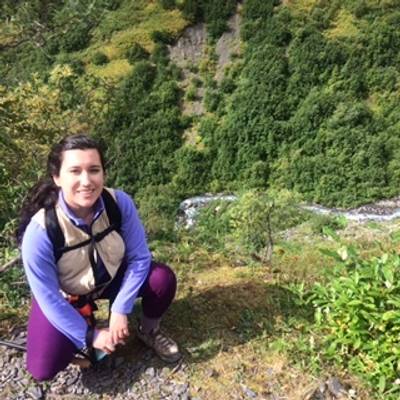
One week after the May 2019 crash that killed Randy Sullivan and five others, another Taquan Air floatplane, a type of aircraft that allows for water landings and is popular in Alaska, flipped upon landing in Metlakatla’s harbor and killed 31-year-old epidemiologist Sarah Luna and pilot Ron Rash. It was Rash’s first commuter flight with Taquan.
Sarah Luna (Credit: Courtesy of Laura Luna)
The NTSB determined the probable cause of the accident was the pilot’s failure to compensate for an off-center tailwind while landing. New pilots, like Rash, were not expected to perform tailwind landings, so they were not taught how to do them during Taquan’s flight training, the NTSB said in its final investigation report. Also contributing to the crash, according to the NTSB, was Taquan’s decision to assign an inexperienced pilot to a destination prone to challenging downdrafts and changing wind conditions.
Taquan declined requests for an interview.
In a letter to the NTSB in 2020, Taquan’s chief pilot said the company had identified significant safety issues, including pilot competency and hazards in water takeoffs and landings. In response, it added pilot competency checks, created checklists to grade new hires on certain tasks, and requires each new pilot to get a minimum of 10 hours of initial operating experience.
Luna’s parents said she knew the risks inherent in commercial aviation in Alaska. But her dedication to her work at the Alaska Native Tribal Health Consortium and her commitment to improving the health of Alaska Native people were greater than her fear. Luna began working in Alaska in June 2018 as part of the consortium’s liver disease and hepatitis program. The flight to Metlakatla, where she’d be meeting patients in person, was her first floatplane ride and her first trip off the road system.
“What happened is not acceptable,” Sarah’s mother, Laura Luna, said in March. “Even though it’s almost two years, it’s like it happened yesterday.”
“Aviation Is Kind of a Lifeline”
Flying in the country’s largest state is unlike flying anywhere else. Because of the state’s small, spread-out population, commercial aviation is dominated by small planes. While larger planes fly to hub communities like Bethel, Nome or Unalaska, they cannot fly to smaller villages because there’s neither the passenger demand nor the infrastructure to support them.
About 80% of Alaska communities are not on the road system, and for the people who live in those places, flying is simply unavoidable. Planes serve as buses for kids traveling to sporting events and other school activities. They transport pregnant women to hospitals where they can safely deliver, and they carry residents to medical appointments not available in their hometowns. They take sexual assault victims to big cities for forensic examinations.
“In Alaska, aviation is kind of a lifeline,” said John Hallinan, a retired FAA flight standards officer who worked at the regional office in Anchorage. “If you shut down service for any particular reason, there’s an impact that’s felt within the community.”
But Alaska lacks infrastructure that is standard in the lower 48. For example, it has 235 state-owned rural airports, of which only 47 are paved. Plus, rural airports are not staffed at all hours of the day.
“What it means is you’re on your own more,” said Tom George, the Alaska regional manager for the Aircraft Owners and Pilots Association, a national nonprofit aviation group. “The weather you see out the window is the weather you have to consider and use as your basis for making decisions, as opposed to being able to call up on the radio and find out 50 to 60 miles ahead of you what conditions are like at the moment.”
Despite the state’s inherent dangers, there are limited safeguards in place.
When most people fly commercially in America, they travel on large jet planes from companies like Delta, United and American Airlines. These airlines face the strictest regulations because fatal crashes involving these planes have killed large numbers of people. For example, their pilots typically need to have at least 1,500 hours of flying experience.
While some large air carriers do operate in Alaska, particularly the eponymous Alaska Airlines, there are far more small, often piston or turboprop planes that are well-suited to the state’s unique terrain and limited infrastructure. Pilots for small operators, like Taquan Air, can have as little as 500 hours of experience. They can also fly more hours annually than pilots working for large carriers and are subject to different rest-time requirements.
Nationally, commuter, air-taxi and charter flights were involved in fatal crashes at a far higher rate than large air carrier flights in the past decade.
But it isn’t possible to calculate what the crash rate of small commercial flights was in Alaska compared to the rest of the country because such calculations require knowing the varying amounts of activity between different areas. But the FAA doesn’t release data on the number of flight hours for most of these operations by state or region, and it denied a Freedom of Information Act request from the news organizations because the data is collected and kept by a third-party contractor on behalf of the FAA. KUCB and ProPublica have appealed the denial.
Alaska’s dangerous flying conditions have claimed the lives of numerous high-profile figures, including several politicians.
In 1972, a plane crashed on its way to Juneau carrying then-U.S. House Majority Leader Hale Boggs and Rep. Nick Begich of Alaska. The plane has never been found.
On Aug. 9, 2010, a float-equipped 11-seat airplane carrying guests from a company lodge owned by telecom company GCI to a camp for an afternoon of fishing crashed into mountainous tree-covered terrain about 10 miles outside of Aleknagik, a small city in the Bristol Bay region. The crash killed the pilot and four passengers, including former U.S. Sen. Ted Stevens of Alaska, who had survived a 1978 plane crash that killed his first wife. The four surviving passengers were seriously injured.
The Stevens crash was strongly felt in the state’s aviation community, as he had been a champion for additional funding and Alaska-specific modifications to federal aviation regulations.
“Anybody that lives here knows somebody, it seems, that has died in an accident. People that are this close to a lack of safety are very invested in making it better,” Hallinan said. “Sen. Stevens was very invested in trying to get Alaska up to some kind of level of safety that was on par with the contiguous 48 states.”
Last July, the private plane of Alaska State Rep. Gary Knopp and a chartered plane carrying six people collided south of Anchorage, killing all seven.
And in March, five people — including the Czech Republic’s richest man, billionaire Petr Kellner — were killed on a heli-skiing trip when their helicopter crashed near Knik Glacier.
Combating “Bush Syndrome”
It’s been 41 years since the NTSB first issued a special report on air-taxi safety in Alaska. Data collected between 1974 and 1978 showed that the nonfatal air-taxi crash rate was almost five times higher than the rate in the rest of the nation, and the fatal crash rate was more than double.
The study found three main culprits for Alaska’s high crash rate: “bush syndrome,” defined as a pilot voluntarily taking on unnecessary risks to complete a flight; substandard airport facilities and poor communication of airfield and runway conditions; and inadequate weather information and navigational aids.
Fifteen years later, the NTSB published another safety study specifically about Alaska, which reiterated many of the same concerns, saying pilots and operators faced pressure to provide reliable air service in “an operating environment and aviation infrastructure that are often inconsistent with these demands.”
“I cannot tell you how many phone calls I’ve gotten over the years from people in Unalaska and other parts of the state, calling me personally on my cell phone, saying, ‘Why did you cancel the flight? The winds are not blowing now,’” said Danny Seybert, the former owner and chief executive of PenAir, once Alaska’s second-largest commuter airline, which offered scheduled passenger service as well as charters. PenAir closed in 2020 following a series of bankruptcies and a fatal 2019 plane crash in Unalaska while under the ownership of Ravn Air Group. “There’s a lot of pressure generated from people that live and work in these communities to travel on time and exactly when the flight is scheduled to go, no matter what.”
The FAA has embarked on numerous programs to improve safety in the state. For example, in 1999, the agency began a program to deploy weather cameras that would help provide a near-real-time view of conditions in sites across Alaska. Some 230 cameras have been installed.
One of its most significant efforts occurred between 1996 and 2006, when a joint industry and FAA research project called Capstone equipped aircraft in southeast Alaska and the Yukon-Kuskokwim Delta in the western part of the state with Automatic Dependent Surveillance-Broadcast systems. The ADS-B tech and its associated ground infrastructure was hailed as a marked improvement over traditional radar systems because it could provide information on weather and the location of nearby aircraft to pilots in areas radar didn’t reach before.
The FAA deemed the project so successful that it moved to implement ADS-B nationwide. However, the rule only applies to most controlled airspace, which the agency defines in a way that excludes most of Hawaii and Alaska. According to Hennig, the GAMA vice president, Alaska lags far behind the rest of the country in terms of ADS-B-equipped planes.
The cost of ADS-B has gone down over the years. Today, Garmin sells full ADS-B devices for $5,295. The costs are relatively minor for even small operators, especially compared to the cost of their planes.
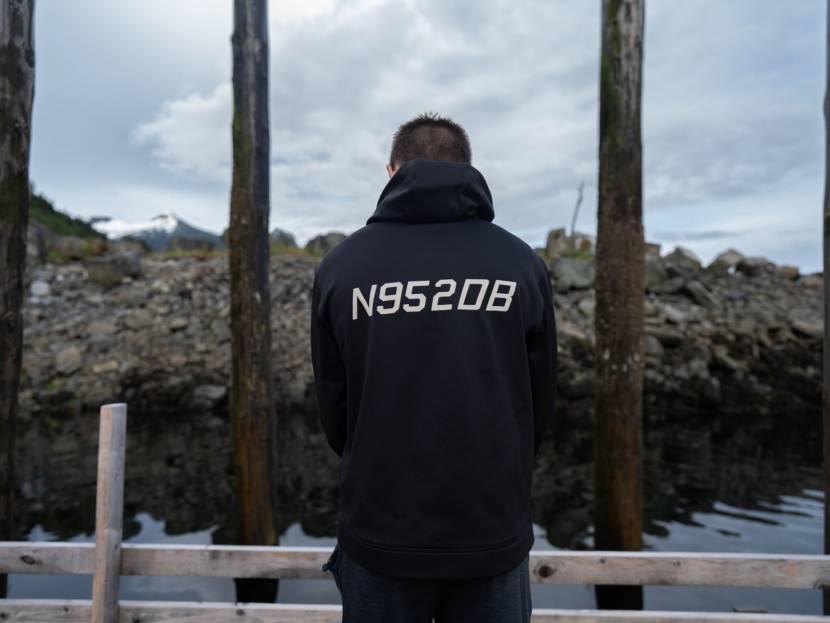
Some pilots, like Mountain Air’s Randy Sullivan, chose to install the technology because of its safety enhancements.
“[Randy] wanted to have the ADS-B in his plane because he knew how many floatplanes flew in the area and he wanted everybody to see him and to be able to see them,” Julie Sullivan said. “It was very important to have that device in his aircraft.”
Randy Sullivan’s son, Spencer, wears a hoodie with the tail number of his late father’s plane printed on the back. (Credit: Ash Adams, special to ProPublica)
Not Enough Deaths to Bring About Change
On Oct. 2, 2016, two pilots departed the Quinhagak Airport in the Yukon-Kuskokwim Delta with one passenger, headed for a 70-mile trip to Togiak. This was the pilots’ third of five scheduled flights that day, on a route that would ultimately bring them back to Bethel.
The captain, Timothy Cline, had worked for Hageland Aviation Services Inc. since 2015, while the second in command, Drew Welty, was in his first flying job, having finished flight training that spring at the University of Alaska Anchorage.
Just before noon, the turboprop Cessna 208B Grand Caravan collided with steep mountainous terrain, killing everyone on board.
Cline’s widow, Angela, told investigators that her husband was a fantastic pilot and that she didn’t believe this accident could have happened without some mechanical error, according to notes of the interviews included in the NTSB report. Cline had lost two friends in plane accidents in recent years — one had died two months before — and while he was a little worried, he didn’t have any specific concerns. “The accidents made him more safe and he did not take any chances. [Cline and his wife] had a fantastic life together and he did not ever want to lose that,” according to a summary of the interview. She could not be reached for this article.
The NTSB found the probable cause of the accident to be the pilots’ decision to continue flying into deteriorating weather and visibility. But the agency also cited Hageland’s policies, inadequate training and poor FAA oversight as contributing factors.
In May 2014 — two and a half years before the Togiak accident — the NTSB issued an urgent recommendation for the FAA to audit all aviation operations and training for operators owned by Hageland’s then-parent company HoTH Inc. This followed a 16-month period where the NTSB investigated five accidents involving Hageland aircraft and another incident in which one of its planes went off the runway. The audit resulted in at least 20 changes to company operations or policies, including flight training, aircraft maintenance and evaluating the riskiness of flights.
A number of associated entities — Ravn Air Group Inc., Ravn Air Group Holdings LLC, JJM Inc., HoTH, PenAir, Corvus Airlines Inc., Frontier Flying Service Inc., and Hageland Aviation Services — filed for Chapter 11 bankruptcy in April 2020. Many of the assets have since been sold and are now operated by new owners. Representatives for Hageland are winding down the estate of the former operating entity and declined to comment on this story.
The Togiak crash is one of Alaska’s most recent accidents that resulted in NTSB recommendations for improvement, including providing small commercial operators with access to better weather information. Nearly five years after the crash, none have been fully adopted by the FAA.
“The thing is the FAA has always been good at reacting to an accident and establishing a requirement after a major crash,” said Tom Anthony, director of the University of Southern California’s Aviation Safety and Security Program and a former FAA regional division manager for civil aviation security in the Western Pacific.
Experts noted that the nature of crashes in Alaska — typically involving small aircraft with few casualties — partly explains why those accidents get limited attention. When there are enough fatal accidents, said Hallinan, the retired Anchorage FAA flight standards officer, the issue gets more attention, which can help speed up changes in regulations and improve safety.
“Safety comes at a cost. It comes down to the flow of money. It’s awful to think about it like that,” he said. “What it comes down to [is] the expense that you can ask of a 737 operator versus what you can ask of somebody that is operating a couple of [small planes] — there’s just a different level of burden that’s associated with that.”
Sumwalt agreed. “I think perhaps from a policy point of view, once you have a large number of accidents, a large number of fatalities, that’s when it really gets the attention of the right people to make things happen,” he said. “I’m certainly not suggesting we need more fatalities, but I think oftentimes it is blood that gets things done in Washington.”
Unadopted Recommendations
The FAA doesn’t always move forward with the NTSB’s recommendations, and the agencies have disagreed more often in recent years.
A KUCB and ProPublica analysis of NTSB data found the safety board deemed that the FAA didn’t take adequate action on 37% of the recommendations it closed in the past decade, up from 20% in the 2000s and 15% in the 1990s. Other agencies within the Department of Transportation also saw increases over that time, but the FAA, which received far more recommendations than others, had among the highest overall percentages.
“I think it’s important to note that the NTSB doesn’t just pull safety recommendations out of thin air and say, ‘You need to do this,’” Sumwalt said. “These recommendations are written in blood. They’re a result of tragic, tragic accidents and crashes. And so therefore, we think it’s imperative that the regulator move forward with implementing these recommendations and implementing them in a timely fashion.”
Some of the unadopted recommendations relate to cost. The FAA is required by law to conduct a cost-benefit analysis before issuing new regulations; NTSB recommendations are not subject to that requirement. Sometimes the FAA opts to implement voluntary measures or guidance to improve safety rather than making the changes mandatory.
The FAA and NTSB often agree on the nature of a problem, but political forces get in the way of change, said Anthony, the former FAA regional division manager.
“In almost all cases, the FAA is in concordance with the NTSB on these recommendations, but there is frequently political pushback to say, ‘No, we don’t want that regulation. We shouldn’t have it. It’s too expensive. Can’t do it,’” he said. “I was actually shocked when different aviation organizations would say, ‘No, we don’t want to do that’ [to] ideas we felt in our division were obviously needed.”
The FAA said in its statement that it “has a close working relationship with the NTSB” and pointed to its progress on some of the NTSB’s recently released top priorities for 2021 and 2022. For example, the FAA has started drafting rules to mandate safety-management systems, which standardize how companies evaluate and manage risk, for charter and air-taxi operators.
These systems have been required for large air carriers since 2015 but have been voluntary for everyone else. The NTSB first proposed mandating them for small commercial operators in 2016. Currently only 20 of 1,940 small commercial operators nationwide have an FAA-approved system.
Mike Slack, a Texas-based aviation attorney who represents multiple clients involved in Alaska plane crashes, said the FAA has failed to adequately oversee individual companies. He sent a letter to the agency in April 2019 expressing concern that the Taquan Air pilot in a 2018 crash — when a plane carrying 10 passengers from a remote fishing lodge to Ketchikan flew into the side of a mountain — should have been sanctioned by the FAA. Seven months later, FAA officials responded saying the agency had “used appropriate mechanisms to address safety concerns with the pilot.”
In May 2019, the month after Slack’s letter was sent, Taquan Air had two fatal crashes.
“The FAA could have made a difference in preventing those two crashes,” said Slack, who represents Julie Sullivan and her family in their claims against Taquan Air, which he says have been settled. But he said in hindsight it is clear Taquan didn’t do anything meaningful to address safety concerns. “The FAA just looked the other way.”
The FAA said multiple offices examined the performance of the pilot in the 2018 crash and determined the evidence did not support revoking his credentials.
As a result of the collision between Sullivan’s plane and the Taquan plane, a group of 14 Ketchikan commercial operators — including Taquan — modified their voluntary safety measures and agreed to equip all of their aircraft with full ADS-B systems. Taquan also requires its pilots to sign a document agreeing to abide by the new guidelines.
Taquan declined to comment, stating that it is “referring all questions to the NTSB.” Six separate cases filed in federal court by crash victims against Mountain Air, Princess Cruises and Venture Travel, which does business as Taquan Air, were confidentially settled in April. This month, another wrongful death suit filed against Taquan in state court was settled. In that case, brought by the families of two Mountain Air passengers, Taquan denied claims that the company has a “significant, documented history of unsafe operations” and that it was liable for the deaths.
What the Future Holds
Randy and Julie Sullivan and their children. (Credit: Courtesy of Sullivan Family)
Nearly two years after the midair collision in Ketchikan that killed Randy Sullivan and five others, the NTSB board gathered virtually to vote on the findings, probable cause and safety recommendations stemming from their investigation.
Until COVID-19 hit, the NTSB, headquartered in Washington, D.C., had never held a virtual board meeting. But because of the pandemic, this was the agency’s 12th virtual board meeting in 51 weeks, and most staff had replaced their background with the official NTSB backdrop in varying shades of blue.
While both planes were outfitted with full ADS-B systems, the NTSB concluded, the Taquan plane wasn’t broadcasting its altitude because a piece of equipment was turned off. The NTSB was not able to determine who turned off the equipment, but the last time this plane broadcast its altitude was two weeks before the accident. Without this information, the iPad application Sullivan used to look at ADS-B data could not provide visual or spoken alerts of the impending collision. Sullivan’s tablet was destroyed during the accident, so the NTSB was unable to determine whether he was using it or how the application was configured. Taquan’s ADS-B was incapable of providing visual or spoken alerts even if it had been turned on.
Following this accident, the NTSB issued safety recommendations encouraging the FAA to identify high-traffic air tour areas — not only in Alaska, but also in Hawaii and the lower 48 — and require the use of ADS-B technology when flying in those areas. Furthermore, the NTSB asked for all commuter and charter operations, regardless of where they fly, to be fully equipped with ADS-B so that aircraft will be able to see each other’s locations.
“From the earliest days of powered flight, pilots have been taught to avoid other airplanes by watching out for them,” Sumwalt said in a post-board-meeting press release. “This accident clearly demonstrates why that’s just not enough. Our investigation revealed that it was unlikely that these two experienced pilots could have seen the other airplane in time to avoid this tragic outcome.”
Interested Alaskans had to wake up early to attend the meeting, which began at 5:30 a.m. local time. Julie Sullivan was one of those tuned in. She got up around 4 a.m for a pre-board-meeting call for survivors and family members of the victims. She had a friend come over to her house for support, and they watched the meeting together.
It was a relief to see the meeting held, but it was hard for her to watch animations of the crash. Though the NTSB doesn’t fault either pilot for the accident in their final report, Sullivan believes the report holds her husband responsible for a collision he couldn’t have seen coming due to the other plane’s location and technological problems, and that it does not factor in Taquan’s recent history of crashes.
Shannon Wilk — who lost three family members in the same midair collision that killed Randy Sullivan — often feels hopeless and helpless. She doesn’t live in Alaska, and while she doesn’t want anyone else to lose a loved one in an accident, she doesn’t feel like she has the power to change the state’s system, with its history of commercial crashes.
“When you see that these crashes continue to happen and you see that more well-known people have died in these kinds of crashes and still nothing is being done about it, little you is not going to be able to do anything about it,” Wilk said.
The Sullivan family has settled their claims against Ketchikan-based Taquan Air. (Credit: Ash Adams, special to ProPublica)
Close
Update notification options
Subscribe to notifications
Subscribe
Get notifications about news related to the topics you care about. You can unsubscribe anytime.