Aleutians

US Seafoods apologizes to Unalaska after COVID-positive crew caused widespread exposure at bar

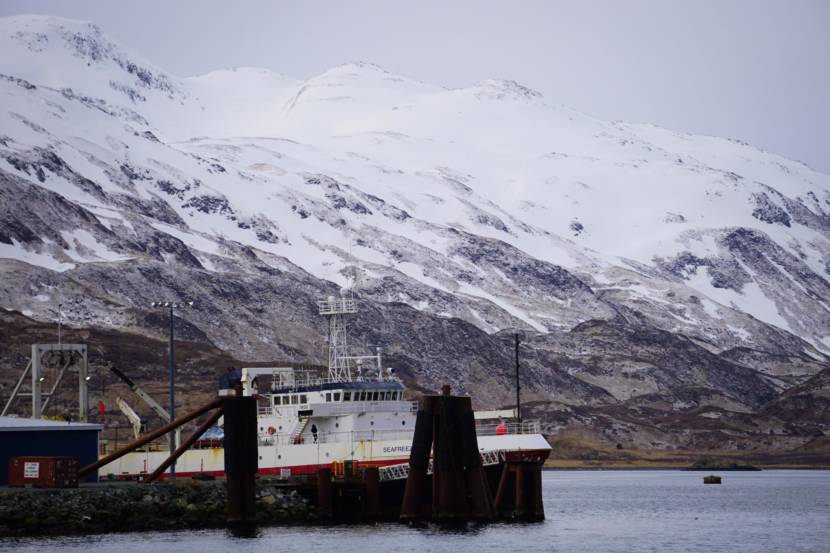
The 240-foot Seafreeze America docked in Captains Bay on Tuesday, April 13. (Hope McKenney/KUCB)

A Seattle seafood company has issued an apology to Unalaska after crew members from one of its vessels breached isolation protocols to visit a crowded local bar last weekend.

The resulting widespread exposure forced the city to move from the “medium” to “high” coronavirus risk level after nearly a month and a half at the lower threshold. And dozens of locals who visited the Norwegian Rat Saloon have been asked to quarantine and test for the virus, if they haven’t been vaccinated.

“We are extremely sorry about the events that occurred,” said Dave Wood, U.S. Seafoods’ chief operating officer. “We regret that these individuals made terrible decisions, put a lot of people at risk and harmed a lot of people. We are as outraged as you are.”

U.S. Seafoods officials say they’re still trying to figure out exactly what happened that night, shortly after the Seafreeze America arrived in port.

The 240-foot vessel was fishing for yellowfin sole in the Bering Sea last week when a few of the 51 crew members on board started feeling symptoms of COVID-19. The company tested the symptomatic crew on board and rerouted the boat to Dutch Harbor to confirm those results and be closer to medical care, according to Wood.

He says the boat was last in Dutch Harbor in late March, when the company brought a group of new crew members on board. By the time they’d boarded, they had tested negative for COVID-19 two separate times, and gone through nearly 20 days of quarantine — though most of the quarantine was what’s known as “self-monitored,” where the company did not have guards or security personnel ensuring compliance.

“That’s our protocol for 2021,” Wood said. “And it has worked pretty good until this trip.”

Wood said he thinks it’s likely that whoever brought the virus on the boat picked it up during travel, given the multiple checks in the process. But he can’t be certain.

The boat reached Unalaska on Saturday, about 20 hours after the crew initially developed symptoms. By that point, eight people had tested positive onboard. According to Wood, all eight went immediately to Unalaska’s isolation bunkhouse, while the rest of the crew stayed put.

That’s where Wood said the story gets murky.

“We have not been able to complete a thorough investigation,” he said. “We are getting some conflicting stories by those individuals, so that’s something that we’re continuing to try to work through.”

While the details aren’t clear, company and city officials say it appears that as many as four of the COVID-positive crew at Unalaska’s isolation facility decided to head to the bar Saturday, just before midnight.

“Getting an accurate picture on what happened that night on land in Dutch Harbor — it’s been challenging for us,” Wood said. “The other crew on the Seafreeze America needed to be confined to the vessel, so we didn’t have eyes and ears [at the facility].”

Unalaska officials say that city staff periodically send a patrol past the isolation facility when it’s being used. But after last weekend’s breach, companies that use it will be required to provide their own security.

According to local health officials, initial estimates taken from video footage indicate that as many as 60 people could have been exposed at the Norwegian Rat that night. But that doesn’t account for the fact that many customers may have been vaccinated, their distance from the fishermen or how long they were at the bar.

“Some individuals that were exposed — we’re confident they are vaccinated, but many were not, so certainly there is risk,” Melanee Tiura, chief executive at Unalaska’s clinic, said at a city council meeting Tuesday. “Where they were sitting and how much distance was around them is helpful, but of course sitting in the same space for a couple of hours — certainly that bubble begins to grow around a person.”

As of Tuesday night, contact tracing from the bar was only about 40% complete, Tiura said, and it was still too soon after the exposure to begin testing.

The entire Seafreeze America crew was ultimately tested or re-tested at the local clinic. Twenty-six came back positive, and two are presumed positive but refused retesting, according to Wood.

He said the U.S. Seafoods employees who breached isolation effectively fired themselves.

Violation of the island’s public health mandates is also a misdemeanor, and the fishermen could face up to a $500 fine and even prison time.

“We have a strict zero-tolerance policy with regard to alcohol and being disruptive,” he said. “These individuals, whether there’s one, two or three of them, or more, chose to disregard that, and disregard the clear direction from the vessel, the vessel captain, the company and the Dutch Harbor authorities. So on one level, they terminated their employment when they made those poor choices.”

While the majority of COVID-positive crew have been flown on medical charters to Anchorage, the company is still working to figure out what’s next for the boat and its crew still on board.

Company officials are having almost daily calls with state and local officials to make a plan and keep them up to date on the health status of crew still on the boat, according to Matt Upton, an attorney who manages vessel operations for U.S. Seafoods.

Upton said they’re also working to continue to vaccinate the Seafreeze America crew. To date, just two of the 51 crew are fully vaccinated and 14 have their first dose. While vaccination numbers are low on the large boat, he said 90% of crew on one of the company’s other vessels has been vaccinated. Upton largely attributes the difference to the greater availability of vaccines when that crew left to fish, but Wood also acknowledged that some workers are hesitant about getting the shots.

“It’s no surprise that the seafood processing workforce has some initial reservation to the vaccine,” he said. “We’ve spent a lot of time and energy trying to educate, answer questions, point them to good resources and get them to understand the importance of it. And I think we’ve made a lot of good progress.”

This is the second major coronavirus outbreak on a U.S. Seafoods vessel since the start of the pandemic. Nearly the entire crew of the trawler Legacy tested positive for the virus in early December while wrapping up their season fishing for Pacific Ocean perch in the Bering Sea.
Bering Sea fishermen likely had COVID-19 but still went to Unalaska bar. Now, locals have to quarantine.

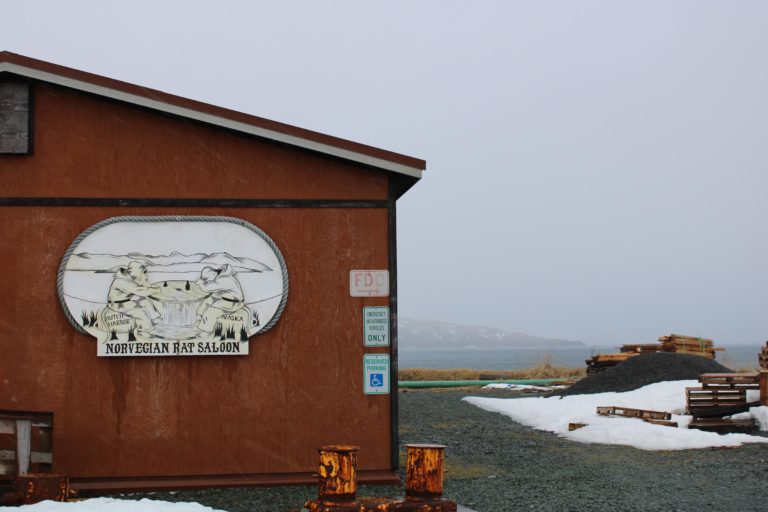
Quarantine and testing is recommended for people who are not fully vaccinated and visited the Norwegian Rat Saloon after 10 p.m. on Saturday, April 10, due to possible COVID-19 exposure. (Maggie Nelson/KUCB)

Unvaccinated people who visited Unalaska’s Norwegian Rat Saloon late Saturday are being asked to quarantine this week after officials say they shared the space with fishermen who broke their company’s own quarantine plans while they were awaiting COVID-19 testing results.

The fishermen came from a United States Seafoods vessel where COVID-19 cases were suspected, but they still visited the popular bar after 10 p.m., Unalaska City Manager Erin Reinders said Monday.

“There was a vessel that came into town on Saturday, and on that vessel, there’s been 26 confirmed individuals who tested positive for COVID-19 and then two additional presumed positive for COVID-19,” Reinders said. “There was a breach in the company’s isolation plan with some of those positive individuals, and due to that breach, that did cause a community exposure.”

Reinders said the fishing company is working on its plan for isolation and quarantine of its 51-person crew aboard the factory trawler Seafreeze America. She didn’t say whether they are quarantining on or off the boat.

The city, meanwhile, is considering what kind of action it could take against the crew members who knew they may have been COVID-positive and still breached quarantine to visit the saloon, said Reinders.

They could face up to a $500 fine, and the city’s Department of Public Safety is “fully engaged” in the discussion, Reinders said.

Meanwhile, Monday afternoon, the city raised the local coronavirus risk level from “medium” to “high.” The island had been at the lower threshold for nearly a month and a half. The Unalaska City Council is expected to discuss implementing additional health measures at its meeting Tuesday night.

“Once there has been two weeks of no additional community spread cases in Unalaska, consideration may be given to step down to medium risk,” the city said in a statement. “With the vaccine widely available and yesterday’s notice, we hope the impact of this exposure will be limited.”

The Norwegian Rat is a popular spot for both fishermen and locals, with pool tables and shuffleboard, and it’s the closest bar to the docks used by many large fishing vessels. Saturday was margarita and taco night.

People who were at the bar after 10 p.m. don’t have to quarantine if they are fully vaccinated — meaning that it’s been at least two weeks since their final vaccine dose. That’s also the case for people who have tested positive and recovered in the past three months, according to CDC guidance.

But quarantine and testing is recommended for those who are not fully vaccinated.

Reinders urged all Unalaskans to get vaccinated to prevent similar situations in the future. And she said people should continue following local and statewide health guidance.

“Really remember to keep wearing your mask, limit your gathering size, stay out of large group gatherings, keep washing your hands and stay six-plus feet away from other folks,” she said.

Testing is encouraged as early as five days following potential exposure to COVID-19, and people should monitor for symptoms and minimize contact with others during that time.

Unalaska City School District Superintendent John Conwell said in an email to staff and families that Unalaska schools will remain open for now.

Key federal fisheries advisory panel loses Alaska Native voice

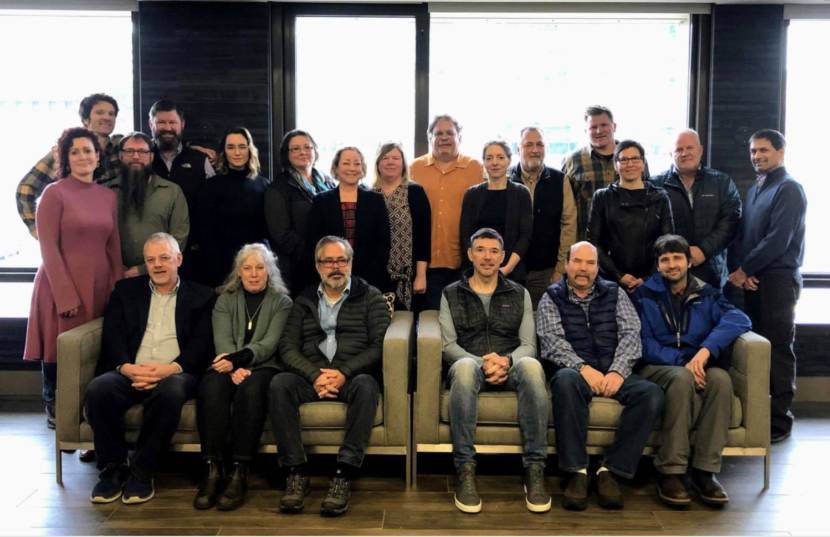
Natasha Hayden (back row, third from right), pictured here in the 2020 advisory panel, was seeking reappointment for another term. But her seat, along with that of Ernie Weiss, was eliminated at the end of last year. (Courtesy of North Pacific Fishery Management Council)

The North Pacific Fishery Management Council often flies under the radar, meeting in dimly lit conference rooms and delving into technical questions about fish stocks and ecosystems. But it has a hugely important job: conservation of species and managing offshore fisheries for species like cod, pollock and crab, which are huge economic drivers for coastal communities on the Bering Sea and Gulf of Alaska.

At the end of last year, the council went into a closed door meeting. When it emerged, it had eliminated two seats on its key advisory panel: Ernie Weiss of Anchorage who had reached his cap for reappointment on the panel, and Natasha Hayden of Kodiak, a vocal advocate for smaller vessels and Alaska Natives, who had been seeking reappointment.

The blowback of Hayden’s ouster was immediate, especially among stakeholders advocating for Indigenous voices in fisheries management.

At the council’s February meeting, more than 20 people — from conservation council representatives, to well established commercial fishermen, to policy directors at Native non-profits — provided public testimony calling for Hayden’s reappointment.

“This is a time when we should be adding more Indigenous voices to council bodies and not less,” Marissa Merculieff, director of justice and governance administration for the Aleut Community of St. Paul Island Tribal Government, told the council.

The tribal government runs affairs for the Pribilof Island community in the Bering Sea.

Merculieff says Hayden represented an essential voice for Alaska Native and fishing-dependent communities.

St. Paul’s tribal government representatives, like Ecosystem Conservation Director Lauren Divine, said they lost a key ally with Hayden’s departure.

“It was a huge loss for Indigenous communities and Indigenous voices in the council process,” Divine told KUCB. “And that’s why there was so much outrage — at a time when we were really hoping that the council would hop on the racial equity movement.”

Native communities already are underrepresented in fisheries management, she said. And that’s a problem because the health and management of fish stocks are a big deal for communities that rely on commercial fishing and subsistence.

Hayden was born and raised in Kodiak. She’s from an Indigenous Alutiiq family and the daughter of a commercial fisherman and subsistence harvester. She and her husband own a commercial vessel and fish in federal waters. And as vice president of lands and natural resources for the Afognak Native Corporation, she told KUCB she was well-qualified for fisheries management.

“I’m a civil engineer. I’m an elected tribal member,” she said. “What else do you have to do to be considered worthy to participate in the process?”

It’s not unusual for the council to adjust the number of seats on its advisory panel, which are not designated to any particular stakeholders or geographical areas. And the council generally makes these types of decisions over appointments behind closed doors.

But their removal of Hayden didn’t quite add up, says Heather McCarty who works government affairs for the Central Bering Sea Fishermen’s Association.

“Normally, unless people have been obviously incompetent or inappropriate or absent, those reappointments are without issues,” said McCarty who’s been involved with the council process for roughly 20 years. “There’s no reason to remove somebody if they wanted to have another three years.”

She wouldn’t speculate why the council eliminated Hayden’s seat, but she said council members should provide that explanation.

However, that hasn’t happened. While KUCB reached out to all Alaska-based voting council members as well as Alaska Department of Fish and Game officials — who oversee Alaska’s representatives — none would speak publicly about why Hayden was removed.

The council’s full-time Executive Director David Witherell released a short statement in response to questions from KUCB.

“The council evaluates the relative representation across the fishing sectors and geographic areas, as well as the expertise, performance and attendance of [advisory panel] members and the expertise of the nominees based on their nomination letters and resumes,” Witherell wrote in an email.

The relative silence and gaps in understanding have left others to fill the void with speculation.

Critics said that some of the big corporate players in Alaska’s federal fisheries can often drown out the perspectives of smaller members of the fleet.

Advisory panel member Julie Kavanaugh, also of Kodiak, said Hayden was a well-balanced representative. She had been an effective advocate for Alaska Natives as well as smaller fishing boats — those less than 60 feet — but Kavanaugh also noted that there were several other small boat operators on the panel.

“Natasha was one of four people that own and or operate a vessel that is in that 60-foot-and-under class,” she said. “And I think that that was a really easy thing to pick out and highlight as being repetitive on the [advisory panel] and gave credence to maybe not reappointing her.”

Kavanaugh said it’s unfortunate that Hayden’s representation of the Alaska Native community wasn’t considered worthy enough for her to keep her seat.

Brian Ritchie of Homer, who was appointed to the panel this year, said he doesn’t think her removal had to do with race or politics. Like others, Ritchie said it was as simple as bringing the panel back down to 20 seats. There are still 11 Alaskans on the 20-member panel, which also has representatives from Oregon and Washington, as the council manages species that affect federal fisheries in that region.

“I don’t think that this is an instance of systemic racism,” Ritchie said. “I think that fisheries in Alaska are very nuanced and I don’t think that the council has currently, or in the future, any plans to limit Indigenous representation or opportunities.”

The council itself, unlike at least one other management council outside of Alaska, doesn’t have a designated tribal seat. But it has implemented some outreach efforts to improve communication with rural and Alaska Native populations, such as the Community Engagement Committee and task forces designed to incorporate traditional and local knowledge and subsistence information into the council decision making process. In response to a recommendation from the CEC, the council is working to assign responsibilities for a rural fisheries community or tribal liaison position to an existing staff member.

But because sitting council members refuse to say why they eliminated her seat, Hayden said she can’t give them the benefit of the doubt.

“If they truly wanted to have equitable participation by Alaska Native people, they wouldn’t have eliminated me,” Hayden said.

The newly constituted advisory panel held its first meeting in February and met again this month. And while at least two Alaska Native members remain on the advisory panel, according to the council’s data on advisory panel representation, none identify as representing tribal governments, ANCSA regional or village cooperatives, or regional Native nonprofit associations.

More than a year into the pandemic, St. Paul Island has its first case of COVID-19

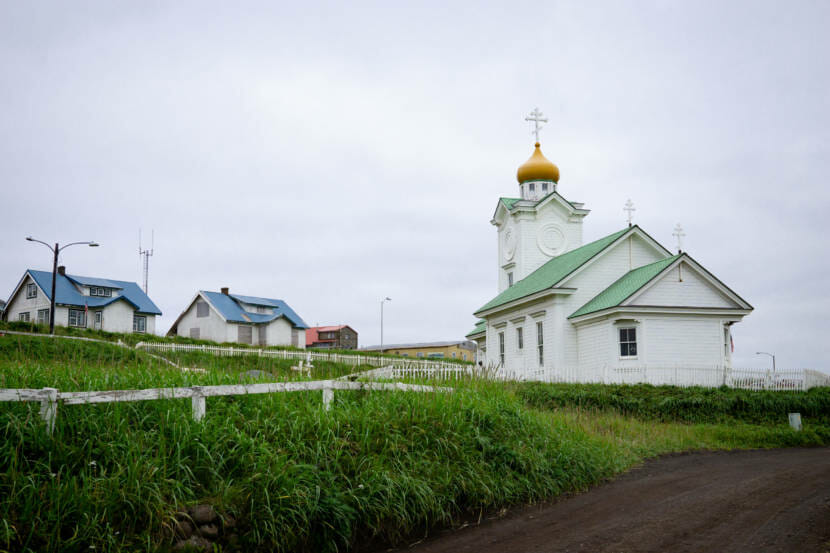
Saints Peter and Paul Church on St. Paul Island. (courtesy of Ian Dickson/KTOO)

St. Paul has implemented a two-week hunker-down order after officials confirmed the island’s first case of COVID-19 Wednesday — more than a year after the pandemic arrived in the state.

An essential worker tested positive Wednesday in the small community of 371 residents in the Pribilof Islands, according to City Manager Phil Zavadil. There are an additional 300 seasonal workers and contractors on the island as well.

More than 60% of the 277 eligible residents have received the COVID-19 vaccine, according to Zavadil. Another 20 are currently waiting for their second dose of Moderna.

Zavadil said the person tested negative for the virus before traveling to the island on March 26, but was tested again after exhibiting symptoms Tuesday and will now complete a 10-day isolation.

The city’s “hunker down” order, which was passed by the St. Paul City Council in a special meeting Thursday morning, will go into effect at 6 p.m. on Thursday and expire at 6 p.m. on April 15. It requires people to stay home as much as possible.

“Because we are small, we’ve had the luxury of being COVID-free up until yesterday,” said Zavadil. “We’ve had the luxury to go visit family and do things that other communities can’t — still being cautious while we’re doing that. We want to keep [the virus] out as long as we can, and hopefully, this is the only case and it doesn’t go further, and we can get back to somewhat normal business after the ‘hunker down.’”

Eight people have been identified as close contacts of the person who tested positive, according to Zavadil. All passengers who traveled with the positive person on the plane to St. Paul were already in travel quarantine but began a new 14-day quarantine Wednesday, he said. Anyone working with the positive person and the people those workers live with have also been instructed to quarantine for two weeks to contain spread.

Starting Thursday, the local health center is setting up an outdoor COVID-19 testing location to test any community members that think they may have been exposed.

With fishing slowed by pandemic, Bering Sea crabbers push for extended season

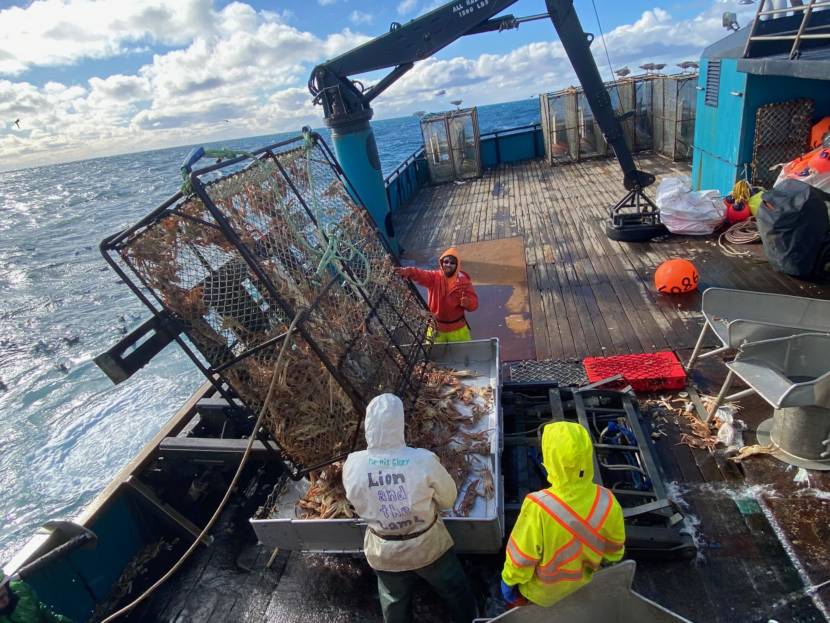
Crew from the Silver Spray empty snow crab pots while fishing in the Bering Sea. (Courtesy of Bill Prout)

A group of Bering Sea crabbers say the pandemic has slowed their fishing season, and they want more time to catch their quota before the state shuts down their season next week.

But the Alaska Department of Fish and Game has denied their request for an extension, citing low population numbers and an upcoming mating season.

For the few boats fishing bairdi crab this year, there could be a lot at stake if they don’t have time to catch their full quota.

“I’m thinking they don’t quite understand what we’re going through out here,” said Oystein Lone, captain of the 98-foot crab boat Pacific Sounder, which is based out of Dutch Harbor.

Until recently, Lone has been fishing in the Bering Sea for snow crab, also known as opilio. But right now, he and his five-person crew have switched to fishing for a different type of crab called bairdi, which is also known as tanner crab.

Both bairdi and snow crab seasons open in October. But Lone recently switched to fishing for bairdi because that season is nearly over — even though as of Wednesday, only 46% of the total quota had been caught.

“The closure is looming on us here,” he said. “So my rationale was to try to get fish and game to give us a month extension to help us out here and keep us from switching back and forth in the middle of the season.”

The department quickly denied formal requests by Lone and two other boats to extend the season, but Lone said he hasn’t given up. He’s still pushing for an extension to catch his full quota before switching back to snow crab.

Going back and forth between the fisheries has added stress, safety risks, extra fuel burn and gear work on top of an already long and difficult season amid the COVID-19 pandemic, Lone said.

“We have changed the way we do business,” Lone said. “And I think the whole industry has changed to adapt to this. But saying that, things are taking a lot longer to get done out here. And we’re going to be pushing right up against the closure to get our business done.”

Because of bad weather, a fuel shortage in the Bering Sea community of St. Paul that’s forced him to travel hundreds of extra miles to fill up, and pandemic-related plant closures and delays, Lone is left with a lot of bairdi quota that he likely won’t be able to catch.

“Traditionally, right now, a lot of vessels would be heading to port and tying up and be done for the season,” he said. “But most of us are still fishing here.”

According to Lone, this year’s pandemic-related complications will add as much as a month and a half to his fishing season.

Bill Prout, who owns and operates the 116-foot crab boat Silver Spray out of Kodiak, is in a similar situation. He and his six-man crew, which includes three of his sons, are wrapping up fishing for snow crab before making a last-ditch effort at catching some of their bairdi quota.

“We’re probably only going to end up getting maybe four or five days of actual fishing time for the bairdi,” Prout said.

Extra wait time for crab deliveries, parts and supplies, and crew changes have roughly tripled Prout’s time to catch crab this season, he added.

And what makes the looming closure especially stressful for some fishermen is that they have payments to make on quota they either own or lease from others — and they might not have the money if the quota isn’t caught, Prout said.

“I have a couple of people that I’ve leased from for a long time who will be fairly understanding of the situation,” Prout said. “But they still might say, ‘Well, an agreement’s an agreement,’ and we could have to pay for crab that we didn’t even catch.”

While the crabbers are still pushing fish and game for an extension, it doesn’t look like they’ll get one.

After talking to industry groups and boat captains, the agency decided not to extend the fishing season for several reasons, said Miranda Westphal, a fisheries biologist with the local fish and game office in Unalaska.

The primary one is biological.

Some crab species mate all year when they come across each other on the seafloor. But bairdi gather together to molt and mate only during the early spring.

“This is the time of year that’s really critical for the future of the stock,” Westphal said. “So it would have to be a pretty large emergency for us to justify fishing into that season.”

There also haven’t been many harvest-size bairdi crab in recent years. While they were unable to survey the size of the bairdi population last year because of the pandemic, Westphal said that in 2019, the agency saw some of its lowest numbers in nearly 15 years.

Because abundance is low and fishing is slow, Westphal said, just six crab boats are currently fishing for bairdi in the western Bering Sea. The rest of the fleet is focused on catching snow crab further north.

“Boats are struggling, people are struggling due to COVID, and also abundance levels are low in the fishery,” she said. “It’s this really unfortunate coinciding of events right now. And we feel for our fishermen — we wish things could be better. But we’re very cautious about not sacrificing the future fisheries for current times.”

Despite Fish and Game’s rejection, Lone — the captain on the Pacific Sounder — said that with just six days left of the season, he’s still pushing.

“I’m going to fight to the last hour of the season to try to get an extension,” he said. “I know they said no. But no means just another way to get a yes out of them for me. So, we just have to keep fighting here and hope for the best.”

Unalaska cashes in on new Biden administration boon to vaccinate 1,800 at mass clinic

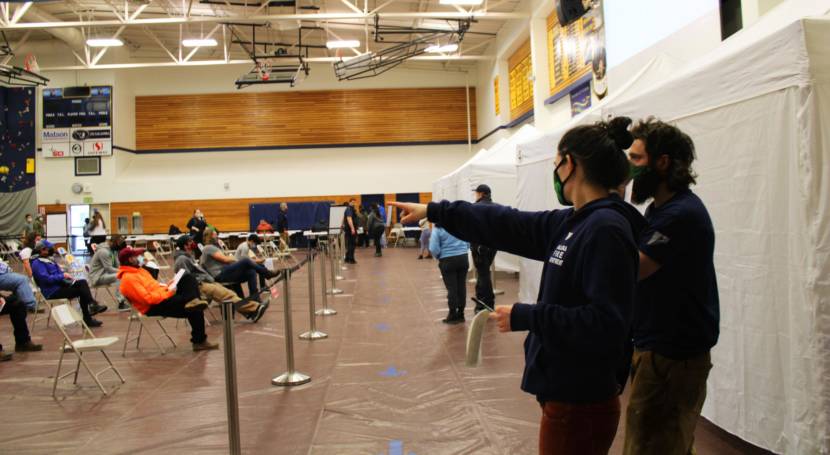
Despite difficulties with getting access to COVID-19 vaccines earlier in the year, roughly 1,800 people in Unalaska were vaccinated at a mass vaccination clinic on Thursday. (Maggie Nelson/KUCB)

Despite difficulties with getting access to COVID-19 vaccines earlier in the year, roughly 1,800 people in Unalaska were vaccinated at a mass vaccination clinic on Thursday.

The effort was part of a new Biden Administration health center vaccine program that sends COVID-19 vaccines directly to community health centers. Under the federal program, Eastern Aleutian Tribes is working to vaccinate several communities in the Aleutian Islands and Alaska Peninsula regions.

In just one day, hundreds of local residents, kids as young as 16, seafood processors and boat crews all filtered into Unalaska’s high school gym to receive their first dose of the Pfizer vaccine.

Joseph McMillan, a community health practitioner and medical operations manager for EAT, traveled to Unalaska from the 950-person eastern Aleutian community of Sand Point to help distribute the vaccines that were recently allocated to the regional tribal healthcare provider.

“It’s a great opportunity,” McMillan said. “We had the vaccine, so it’s great to be able to share it with our neighbors.”

Unalaska is just one of the communities along the Aleutian Chain not generally served by EAT that they’re sharing the vaccine with. Before coming to the island, McMillan said they stopped in the nearby community of Akutan to administer vaccines there.

And with the help from Iliuliuk Family and Health Services clinic staff — as well as staff from Unalaska’s Department of Parks, Culture and Recreation, the fire department and local volunteers — EAT helped vaccinate an estimated 1,800 people in Unalaska Thursday.

If that sounds like the makings for a long, busy day, that’s because it was.

“We can handle 100, 200 people at a time — kind of weaving through the hallway, in line, staying distanced,” said Dr. Megan Sarnecki, medical director at the IFHS clinic. “And then we vaccinate in these six tents, and then they wait their 15 minutes here — [using] a color code to know who leaves when.”

Sarnecki arrived at the school’s gym first thing Thursday morning, and by about 6 p.m., with help from the community and partner agencies, they’d already vaccinated about 1,000 people, she said.

It was around then that seafood workers were filtering out and locals started filing into the school. Among those making their way in, were several high school students.

“I was just wondering how long the needle was,” said high school junior Alexa Esnardo, as she waited the recommended 15 minutes in a folding chair after getting her first Pfizer shot.

Esnardo is 16 and wants to get her driver’s license. And because the local Division of Motor Vehicles requires anyone taking a road test to be fully vaccinated, she decided to get the vaccine along with a number of her peers.

While Esnardo said she’d only signed up for the vaccine because she wants to drive and maybe go on vacation, she had this message for others: “Just get it.”

But high school senior Zara Alvarado got the vaccine for a different reason. She said she chose to get it because it’s an important step for her as she prepares to attend college at the University of Alaska in Anchorage next year.

Overall, getting the vaccine was a painless process, said Alvarado.

“It was really simple,” she said. “You just go in, mingle for a second, and get the shot and that’s it. It was really easy, surprisingly, for something so intense.”

During Thursday’s clinic, before community members lined up to receive their shots, the majority of the industry workers who wanted the vaccine got it, according to Unalaska Fire Chief Patrick Shipp.

“We got all of UniSea who wanted shots today done,” Shipp said. “We got all of Westward who wanted shots today done. We got all of American Seafoods who wanted shots done today and we got all of Icicle who wanted shots done today.”

The crew members of eight vessels were also vaccinated, according to Jeremy Zidek, a public information officer with the state’s Division of Homeland Security and Emergency Management.

Zidek said it’s critically important to get as many people vaccinated as possible, especially in rural areas like Unalaska, where the nearest emergency room is over a thousand miles away.

“[Eastern Aleutian Tribes’] ability to access the vaccine and then distribute it has been really a monumental effort that will protect the community and the seafood workers,” he said. “And it’s just a tremendous effort that Eastern Aleutian Tribes has gone through to make that happen.”

The regional tribal healthcare provider is expected to return to Unalaska to administer second doses in early April, according to Dr. Sarnecki.

Site notifications
Update notification options
Subscribe to notifications