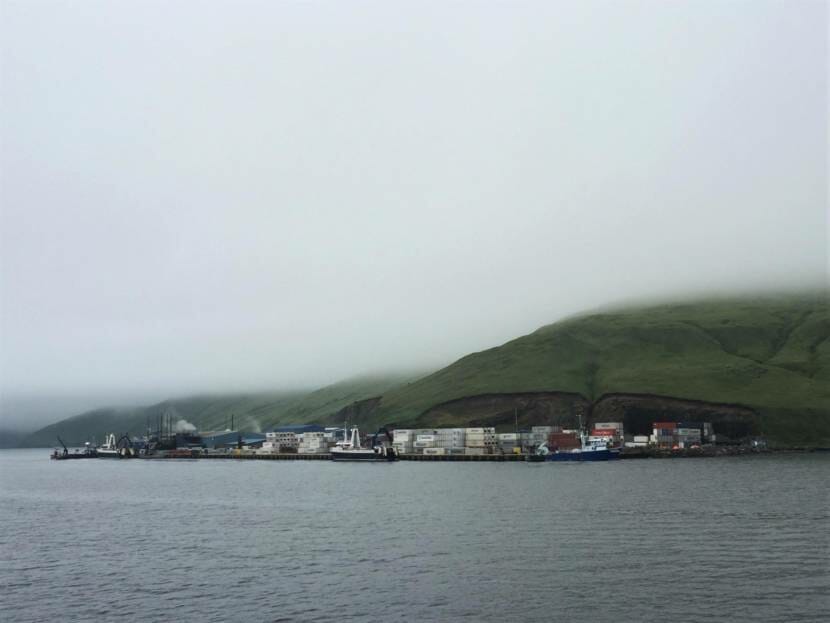
115 workers who have been quarantined in Sand Point and Anchorage arrived back in Akutan over the past several days to help with crab and cod processing, the company said. It’s preparing to resume pollock processing this week. (Laura Kraegel/KUCB)
Trident Seafoods’ huge processing plant on the remote Aleutian island of Akutan reopened Friday after a nearly month-long COVID-19 closure.
An outbreak at the plant forced the fishing giant to close the facility in late January just as the lucrative winter season was set to kick off. In the course of the outbreak, 45% of Trident’s 700-person workforce ultimately tested positive for the virus, company officials said Monday.
Multiple rounds of comprehensive testing brought welcome news last week that COVID-19 cases had been isolated on site, Trident said in a statement. Surveillance testing, symptom screenings and the use of PPE and distancing protocols will remain throughout the season.
The company said it’s developed additional measures to speed response if the virus is detected again. Those include new shift schedules to limit contact between workers and capacity limits to allow distancing outside of workstations, from the galley to the area for donning and doffing rain gear.
“While these new measures are burdensome, we anticipate cooperation and understanding, given everyone’s eagerness to safely return to work,” said Stefanie Moreland, a Trident executive. “The management team on site has been working to make sure these operational changes do not come as a surprise, and to ensure our employees know their safety is our priority.”
Over the past several days, 115 workers who have been quarantined in Sand Point and Anchorage arrived back in Akutan to help with crab and cod processing, the company said. It’s preparing to resume pollock processing this week.
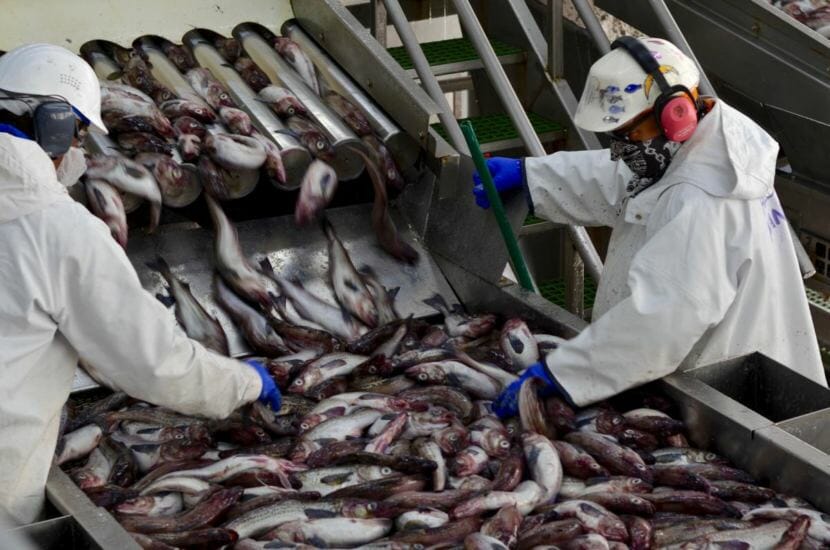
Workers inspect pollock offloaded at Unalaska’s UniSea processing plant in 2018. (Photo by Sarah Hansen/KUCB)
The City of Unalaska warned residents Thursday of possible transmission of the coronavirus between seafood industry workers and the larger Unalaska community.
“The community is most definitely at a high local risk factor for COVID-19, in fact, more serious than at any time since the start of the pandemic,” the city said in a statement. “The vaccine provides hope, but vaccine supply has limited our ability to vaccinate everyone who wants to receive it.”
The news release from the city came one day after they reported 109 new cases of COVID-19 — the island’s largest daily case count since the pandemic began, and nearly a fifth of all local positive cases reported to date.
The recent cases are considered industry-related, which means they are people employed at local seafood processing plants or on vessels in port. The category also includes incoming industry workers and cases where transmission of the virus likely occurred within the workplace, according to the city.
But they added that many of the recent cases aren’t workers testing positive during their mandated two-week travel quarantine after arriving on the island. Instead, they’re primarily industry workers who have tested positive during surveillance testing at local processing plants.
The majority of Wednesday’s cases are linked to a COVID-19 outbreak at Alyeska Seafoods, according to the city. Officials at Alyeska and their parent company, Westward Seafoods, did not respond to a request for comment.
Three out of four of Unalaska’s fish processing plants, including Alyeska, don’t operate as closed campuses and many employees have families who live or work in the community.
“We must assume that some of the people with positive tests have been out and about in the community, with multiple contacts,” the city said.
Only Icicle Seafoods’ Northern Victor facility — a 380-foot processing vessel permanently docked at Unalaska’s spit — operates as a closed campus, where employees live in facility housing without their families and are restricted to company property to prevent the spread of COVID-19.
“Having a closed campus can definitely provide some benefits when it comes to preventing the spread of COVID,” said Julianne Curry, public affairs manager for Icicle. “But really, we’re still learning more about this virus every single day. And that’s certainly true for both open campuses and closed campuses.”
Curry added that everyone in the seafood industry and processing sector in Unalaska has gone “above and beyond” to help prevent the spread of the virus.
“And sometimes, the virus still gets into the facility anyway, no matter how many precautions and protocols that you put in place,” she said.
To date, the city has reported 627 cases of the coronavirus in Unalaska. 191 of those are currently active and all but two are considered industry-related. The city’s risk level remains high.
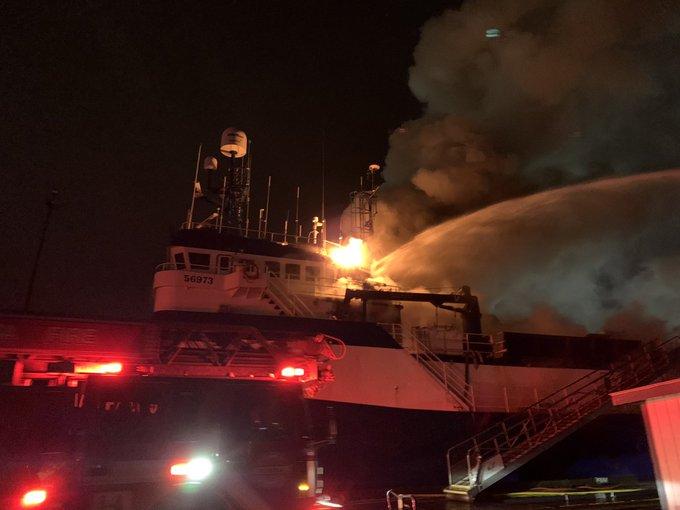
The 233-foot Aleutian Falcon caught fire shortly before midnight Wednesday, according to the Coast Guard. It was one of two floating processors Trident operates during the herring and salmon seasons in Alaska. (Courtesy of Tacoma Fire Department)
A 233-foot floating processor owned by Trident Seafoods caught fire shortly before midnight Wednesday. The processor, the Aleutian Falcon, was docked at the Port of Tacoma, Washington.
Trident has said the vessel is a total loss, according to multiple news outlets.
The Aleutian Falcon was one of Trident’s two floating processors that operate in Alaska. According to the company’s website, the processors follow herring from Southeast Alaska to Bristol Bay and then operate in salmon fisheries throughout the summer. The Aleutian Falcon could support 120 crewmembers.
The Tacoma Fire Department responded to the scene. Firefighters on the pier and three other boats used water to fight the blaze. They were joined by a Coast Guard response boat.
Coast Guard Petty Officer Steve Strohmaier said they worked to minimize the damage to the surrounding area.
“When they were fighting it, they had to be very careful about ensuring that the vessel would not capsize to cause a further problem of marine pollution,” he explained. “That being said, there was chlorine, there was ammonia, and then of course oil and diesel fuel on board.”
Strohmaier said that at this time, the amount of each substance on the ship is unknown.
On Friday afternoon, Tacoma Fire said in a Twitter update that it and a salvage company were coordinating to extinguish the fire and turn the vessel over to Trident.
The dewatering of the vessel has been successful, there is still a small part of the vessel that has active heat/fire deep in the hull, and TFD will be working with the salvage company on a remediation plan.
The cause of the fire is under investigation by multiple agencies. So far, no injuries have been reported.
Trident has not responded to phone calls or emails requesting comment as of this story.
Trident has faced a number of challenges since the start of the year. A large COVID-19 outbreak at its huge processing plant on the remote Aleutian Island of Akutan has infected more than a third of its workforce and forced the plant to shut down in January — just as the lucrative winter fishing season kicked off.
In Unalaska, it’s also been the rainiest start to February since 2004. So far, the island has recorded more than eight inches of rain this month, with more than a week left to go. The normal February precipitation for Unalaska is six and a half inches. (courtesy of Tacho)
While much of Alaska has been bitterly cold this month, the Aleutian Islands and Alaska Peninsula have been extraordinarily mild.
It’s part of the recent warming pattern in the Bering Sea, and communities along the Aleutian Chain can expect a similar trend moving forward, says Rick Thoman, a climate specialist with the University of Alaska Fairbanks.
“Because the oceans are warming, and the climate of the Aleutians is so dominated by the oceans — unless the atmosphere does something particularly unusual, we’re aiming for a warmer than what used to be considered normal February,” Thoman said.
Much of Interior Alaska has been cooler than normal this month because of cold air coming out of Northwest Canada or down from the high Arctic, he said. But the lower Alaska Peninsula and Aleutians Islands haven’t seen a similar trend, and it’s shaping up to be one of the mildest Februaries on record for the region.
“There really hasn’t been a push of colder air from Siberia across the Bering Sea,” Thoman said. “That’s how the Aleutians can get their cold weather, and that just has been completely lacking so far in February.”
At Unalaska’s Tom Madsen Airport, temperatures haven’t dropped below freezing yet this month. And in Cold Bay, the average temperature is running more than eight degrees Fahrenheit above normal, making this the second warmest start to February since World War II.
“The only warmer start to February was in 2019,” he said. “And the third warmest is 2018. So three of the last four years in Cold Bay have been exceptionally mild — far above normal. And that is undoubtedly related to the large scale warming of the oceans that we’ve seen in recent years.”
In Unalaska, it’s also been the rainiest start to February since 2004. So far, the island has recorded more than eight inches of rain this month, with more than a week left to go. The normal February precipitation for Unalaska is 6.5 inches.
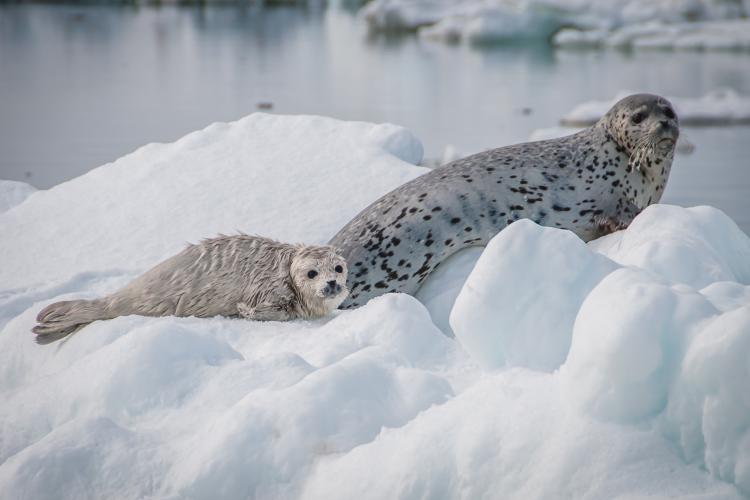
Spotted seal mother and pup in the Bering Sea. (NOAA Fisheries photo)
As global temperatures rise and warm the coldest parts of the world, scientists are watching for changes to species that live there. A new study has found evidence connecting the rapid warming of the region with a physical decline in three species of Alaska seals.
For 12 years, researcher Peter Boveng with the National Oceanic and Atmospheric Administration led a team that monitored ribbon and spotted seals in the Bering Sea. They were specifically monitoring body condition, or how fat the seals were. Boveng says what they found was the youngest seals were getting smaller.
“The fatness of the pups, the young of the year, declined on average over that time period,” Boveng said.
Boveng says this is one of the first major studies that shows evidence of a noticeable change in the seals’ body condition related to global warming.
“There hadn’t been, up until now, really much of any documentation of impacts that we think are climate related,” Boveng said.
Both of these species of seal tend to gather on the edge of the sea ice to hunt for food and raise their young. However, sea ice extent has drastically diminished over the past decade, with an average loss of just over 18,000 square miles a year. Boveng says that could impact how much seal mothers are able to forage.
“The mothers, maybe, were not finding as much food in the period prior to the birth of their pups, when they were pregnant,” Boveng said. “And also maybe not having as much fat or finding as much food during the nursing period.”
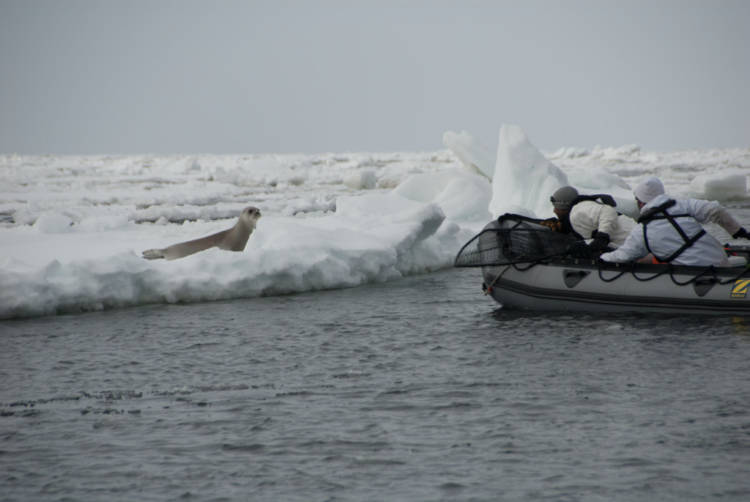
NOAA Fisheries scientists approach a ribbon seal. (NOAA Fisheries photo)
Between 2007 and 2018, the time period of the study, Boveng says that the two species of seals experienced two unusual mortality events, or an unexpected rapid decline in population. During the first event, the seals acted more lazy, with many showing sores on their bodies and loss of hair. Boveng says there was no evidence linking those things to a loss of food or a warming climate. He says the second however, saw more evidence that the decline was food-related.
“So this second UME which occurred right in the years of record low ice extent in the Bering Sea, really seemed to line up with the things we were seeing,” Boveng said.
A related study of harbor seals in the Aleutians found a similar decline over a three-year period, with an average decrease of 13 pounds per year — that’s about 10% of their weight. Boveng says that decrease is tied to a heat wave in Southwest Alaska between 2014 and 2016. He says it’s clear the dramatic decline in weight hadn’t been going on for long.
“The decline in harbor seal body condition over that period was pretty rapid,” Boveng said. “Something like that wouldn’t be something that had been going on for a long time, because they would’ve just wasted away.”
Looking to the future, Boveng says that scientists forecast warmer Arctic conditions will become more normal, and he anticipates that changes to seal bodies will be much clearer as time goes on.
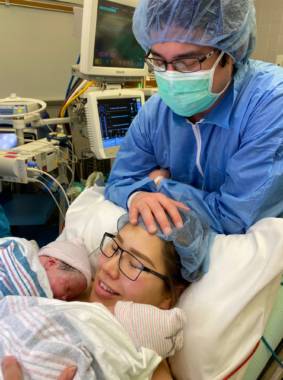
Cara Lestenkof-Mandregan after the birth of twins Ana and Mila. (Photo courtesy of the family)
Alaska women who live in rural and remote communities usually travel to city centers to give birth against incredible geographical odds. COVID-19 can make a hard trip longer and lonelier. That disproportionately affects Alaska Native women, who are more likely to live in remote areas.
When Cara Lestenkof-Mandregan and her boyfriend John found out they were pregnant, they were surprised and delighted. So were their families.
“Everybody was just thrilled for us,” she said.
They live on St. Paul Island, an Unangan community that’s part of the Pribilof Islands. It’s in the middle of the Bering Sea. Lestenkof-Mandregan works at the clinic as a health aide, so she knows the drill when someone gets pregnant. The first appointment is on the island, then a referral out to Anchorage.
“Typically, if it’s low-risk pregnancy, all as well, their prenatals will happen here in St. Paul because they’re capable of doing that,” she said.
There’s usually one more ultrasound in Anchorage and then everything happens on the island until 36 weeks when women leave to wait to deliver near a hospital.
“That’s typically what’s done here, but that’s not the story that I have,” Lestenkof-Mandregan said.
At that first Anchorage appointment, Lestenkof-Mandregan and her partner found out they were expecting twins. It’s considered a high-risk pregnancy.
“I had the doctor come in and tell me all these things that could potentially go wrong. And that after 16 weeks, I would need to travel out to Anchorage every two weeks for appointments. My jaw dropped. Just imagining the fact that you know, I’m 800 miles away if anything were to go wrong, I know how long it takes to get a medevac here,” she said.
This was January. COVID-19 hadn’t yet shaken the system in Alaska, so she weathered the bi-weekly trips between St. Paul and Anchorage.
But by March travel wasn’t recommended. Hospitals postponed elective procedures. Her clinic only let patients in the door. As a health aide, Lestenkof-Mandregan has watched cold and flu spread across the island like wildfire. She said it started to feel scary, but she still had to travel to Anchorage for her appointments. She didn’t want to be the one who brought the virus back from the city. She said the risk of illness weighed on her each trip.
“It was very nerve-wracking. We didn’t know what to expect, I knew that I was high risk … so I tried to be as prepared as I possibly could. I brought Lysol wipes with me at the time, I brought a mask, and I didn’t really know what else to do,” she said.
Flights were often delayed. She’d have to get to appointments late or get stuck in Anchorage alone waiting for a flight. She had to spend weeks in quarantine. Something had to give.
Doctors at Alaska Native Medical Center gave her a choice: Leave for months or risk the safety of the entire island and keep traveling. There were no cases of COVID-19 in St. Paul and lots of cases in Anchorage.
“I was going to have to go to ‘COVID ville’ and possibly contract the infection and the risk of bringing it home just did not sound good to me. So we decided that we were going to leave and just stay out in Anchorage until it was time to deliver. I believe I was 26 weeks [pregnant] at that point,” she said.
Separation, isolation
Most women while live in rural areas without hospitals spend three or four weeks away from home while they wait to deliver their babies. She and her boyfriend would spend 10 weeks in hospital housing. They left their room only for medical appointments.
“We really need to start working on how do we support these moms as best we can, said Dr. Matt Hirschfield, the medical director for Maternal Child Health Services at ANMC. A lot of women from remote villages travel there to give birth.
“Because they’re not delivering near their families. And they’re not delivering with their aunties and grandmas and, you know, everybody around them.”
He said the transition from giving birth in villages and on islands happened in the 80s. Alaska had one of the highest neonatal mortality rates in the nation. More than 1 in 50 infants died within their first 30 days.
Moms started making a choice like Lestenkof-Mandregan’s—to do something new and uncomfortable if it meant a better chance for their unborn babies. Her mother and grandmother were born on St. Paul Island. But she, and now, her twin daughters were born in city hospitals.
Now, Hirschfield said the neonatal mortality rate is about a quarter of what it was then.
“The biggest thing that changed was Alaskan Native women who were in villages, as a group, and with their health care providers, and lots and lots of education and public health reach-out by the Tribal Health System decided that delivering in the village was not the best thing for them anymore. And that completely changed the way, you know, babies have been delivered for 10,000 years in Alaska,” he said.
The hospital has a whole floor for women from rural villages. It’s long-term housing for expectant mothers with a communal kitchen, so they can cook with visiting family members. It’s meant to take the edge off of loneliness and offer a cozy contrast to the big, impersonal city.
But COVID-19 shut all that down.
“We definitely missed all our home cooked meals,” said Lestenkof-Mandregan.
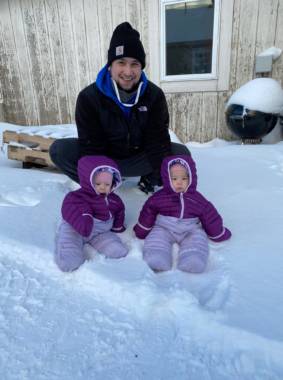
Twins Anna and Mila with their father, John Melovidov, in St. Paul. (Image courtesy of the family)
She said she’s grateful they were housed and fed, but the salmon served at the hospital is not what they’re used to on the island. She said she especially missed her boyfriend’s father’s cooking.
“We have northern fur seals out here that we subsistence hunt in the summers. And so he does a stewed meat with it. That’s really good. He actually taught me how to cook it as well. We missed that; we missed seal soup. We missed halibut fish pie. We missed his steaks, his pork chops. His gravy. I love his gravy. We missed all of that,” she said.
They made the best of things. They had each other, and the hospital’s high-speed internet.
COVID-19 meant their families couldn’t come to the hospital like they’d planned. So while Lestenkof-Mandregan was in labor, her parents and John’s family stayed up all night in St. Paul. They were all reunited in July, including the newborn twins, Anna and Mila, after four months apart.
“It’s a story they’ll hear their entire lives,” Lestenkof-Mandregan said.
Close
Update notification options
Subscribe to notifications
Subscribe
Get notifications about news related to the topics you care about. You can unsubscribe anytime.