Aleutians

As the once-lucrative Bering Sea crab harvest resumes, Alaska’s fishers face challenges

A red king crab is seen in the water at Kodiak in 2005. Surveys this year indicated that stocks in the Bering Sea are strong enough to allow a small Bristol Bay red king crab fishery after two years of closures. (Photo by David Csepp/National Oceanic and Atmospheric Administration)

In the short term, Alaska crab fishers and the communities that depend on them will get a slight reprieve from the disastrous conditions they have endured for the past two years, with harvests for iconic red king crab to open on Sunday.

In the long term, the future for Bering Sea crab and the people who depend on it is clouded by environmental and economic upheaval.

The decision by the Alaska Department of Fish and Game to open harvests of Bristol Bay red king crab after an unprecedented two-year shutdown was a close call, a state biologist told industry members during a meeting on Thursday.

Red king crab are the largest of the commercially harvested crab species, and their meat is prized as a delicacy.

The department’s decision to allow a small harvest, announced on Oct. 6, was based on preseason surveys by the National Oceanic and Atmospheric Administration’s National Marine Fisheries Service.

Biologist Mark Stichert said the surveys suggest that the crash that forced two years of closure in the Bristol Bay red king crab fishery, the major Alaska source for that highly prized seafood species, has bottomed out.

“The decline has stopped. But whether or not we’re seeing a rebound in the biomass is hard to say,” Stichert said during the Thursday briefing. He is the Department of Fish and Game’s Kodiak-based groundfish and shellfish fisheries management coordinator.

A red king crab harvest returns, but at much lower levels than the past

The allowable harvest that opened on Sunday, as set by the state, is 2.15 million pounds, a little less than the 2.6 million pounds allocated for harvest in the 2020-21 season, the last time Bristol Bay red king crab was fished. It is considerably lower than in past years; in the 2016-17 season, for example, the total allowable harvest was nearly 8.47 million pounds. Those totals were dwarfed by the annual harvests four decades ago, which peaked in 1980 at nearly 130 million pounds.

The conclusion that crab numbers are now adequate to support a Bristol Bay area harvest hangs on a slender thread — the discovery of 382 adult female crabs in the preseason surveys, 121 more than were pulled up in last year’s surveys, Stichert said. The bulk of the adult females found this year were in a single spot, he said.

Red king crab harvested in Alaska is seen in this undated photo. Red king crab are the largest of Alaska’s commercially harvested crab species, and their meat is prized as a delicacy. (Photo provided by National Oceanic and Atmospheric Administration)

“One single 30-minute tow dictated whether you meet the threshold or do not meet the threshold,” he told crab harvesters.

The positive signs for high-value red king crab, as tenuous as they may be, are not yet emerging for Bering Sea snow crab. That marquee Alaska fishery, which in the 1990s supported harvests in the hundreds of millions of pounds, was closed last year for the first time ever, after stocks crashed by about 80%. It will remain closed for the coming year because the stock is continuing to decline, the Alaska Department of Fish and Game announced on Oct. 6.

Climate change looms, threatens future harvests

Scientists are questioning whether full recovery is possible in a warming world for these ailing crab populations that have supported some of the world’s most lucrative fisheries.

Snow crab appear to be particularly vulnerable to climate change, scientists say.

“They stand out because they are a true Arctic species,” said the University of Alaska Fairbanks’ Gordon Kruse, a professor emeritus in the College of Fisheries and Ocean Sciences.

There are already signs that Alaska’s snow crab range is shifting north – as expected by NOAA Fisheries scientists –  which means ocean currents carry the larvae even farther north, he said. But the growth appears to hit a barrier north of the Bering Strait, he said. The Chukchi Sea does have a population of snow crab, “but they’re stunted,” he said. The Chukchi and the Beaufort Sea to its east appear to be unable to support what might be commercial stocks, he said.

Stichert, in his presentation to industry members, described how climate change may be creating some “bottlenecks” for Bristol Bay red king crab in their early life stages.

The females lay their eggs in time for the spring algal bloom that emerges from the underside of the sea ice, he said in his briefing. But reduced ice affects the bloom of plankton on which the larvae depend for the two to three months they are floating around in the water, he said. If they survive that period, the larvae’s fate depends on where they land on the seafloor, he said.

“There are a lot of risks and a lot of opportunities to die for a larval king crab,” he said.

In briefings during the October meeting of the North Pacific Fishery Management Council, biologists described some of the risks to young red crab survival. They include ocean acidification, which inhibits shell growth, and a more robust population of sockeye salmon, which feed on crab larvae when they are at sea.

Another risk comes from the trawl nets used to catch pollock in the same areas used by crab.

The problem is not bycatch in the usual sense, or the unintended harvest of crab caught in nets used to harvest pollock, Kruse said. Those numbers are very low and “do not rise to the level of making a population effect on snow crab or other crab species,” he said.

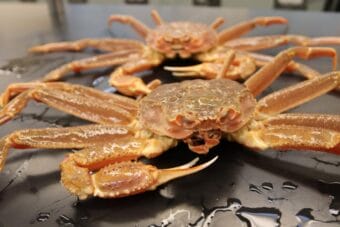
Bering Sea snow crab, with two specimens seen in this undated photo, support an iconic Alaska seafood harvest, but a crash in population since 2018 triggered the first ever closure of the fishery in 2022. That closure was extended for the 2023-24 season. (Photo provided by National Oceanic and Atmospheric Administration)

Rather, the danger is from pollock trawl gear that touches the seafloor, which fishery managers and biologists said happens more frequently than previously believed. That contact can harm crab habitat or injure or kill the crabs themselves, which often are in the vulnerable shell-less molting phase at the same time trawlers are fishing for cod.

“We now know that this gear’s on the bottom a majority of the time,” Kenny Down, a North Pacific Fishery Management Council member, said on Oct. 10, the last day of the October meeting. He noted that the council banned bottom trawling for pollock more than two decades ago, in 2001. The objective of that ban “is currently not being met,” he said. “This gear is in the bottom, it’s in areas that we’ve designated as sensitive, and we’ve prohibited bottom trawling in those areas for a variety of reasons.”

The council is now preparing to consider additional protections for a 4,000-square-nautical mile section of the eastern Bering Sea that has since the mid-1990s been designated as the Bristol Bay Red King Crab Savings Area. Although the council in December rejected a request from crab harvesters for a complete closure of the area to trawling during the first half of the year, it is set to revisit the issue at upcoming meetings.

Another regulatory response to the crab crisis is expected to come in a mandatory review of the quota system that divvies up the Bering Sea crab harvests among fishers and processors. The system of assigned Bering Sea crab quotas, part of a process called “rationalization” that is taking hold in fisheries globally, began in 2005. Rationalization is intended to preserve the safety of fish stocks and people by eliminating the race to harvest that can happen in open-access fisheries. The Magnuson-Stevens Fishery Conservation and Management Act requires period reviews of quota systems; the crab review has now come due.

The Bering Sea snow crab and Bristol Bay red king crab fisheries are the first rationalized harvests in the nation to suffer such massive collapses, industry representatives said repeatedly.

“One of the main goals of the program is to create economic stability, and we’re seeing anything but that right now,” Jamie Goen told the council. Goen is the executive director of the Alaska Bering Sea Crabbers, the industry group for harvesters.

There are some other crab harvests that are proceeding this year in Alaska’s Bering Sea, but they are relatively small. A harvest of Bering Sea bairdi tanner crab, a species related to snow crab, got the go-ahead from the Alaska Department of Fish and Game, with a total allowable catch of about 2 million pounds: similar to that authorized a year ago. A relatively small harvest of the prized red king crab has been taking place farther to the north, in Norton Sound near the Bering Strait, with a little over 350,000 pounds caught over the summer. But harvests of rare blue king crab continue to be closed, as they have been for the past several years.

Alaska faces competition

While Alaska’s Bering Sea crab populations struggle, stocks and fisheries are flourishing elsewhere.

In eastern Canada, snow crab harvests are high and quotas have been increasing. There, Kruse said, the population has the advantage of an ocean current that sends cold water down from Greenland: the Labrador Current.

“That southern-flowing cold water is very, very favorable to the Arctic population snow crab,” he said. In contrast, the Bering Sea has warm water flowing north from the Pacific Ocean through the Bering Strait, he said.

In the Barents Sea on the Atlantic side of the Arctic, snow crab are recent arrivals, but they are thriving and supporting commercial harvests.

“The thinking is that it’s a natural extension of snow crab in the oceans in the northwest Atlantic, around Canada,” Kruse said. “They’re growing in an area that hasn’t had snow crab in the system, so as invaders, they’re doing quite well.”

Frozen snow crab from Canada is seen on sale at a Carrs grocery store in South Anchorage on Feb. 10, 2023. (Photo by Yereth Rosen/Alaska Beacon)

Though Alaska is famous for its big crab, those other sources could take away market share, particularly as the Bering Sea enters its second consecutive year of snow crab shutdowns, Kruse said.

“If you turn off the spigot and have no crab to catch, that’s going to be replaced by something else, and probably snow crab from someplace else in the world,” he said.

John Sackton, a Massachusetts-based fishery analyst and consultant, gave a sobering assessment of the Alaska crab industry’s position in global markets.

The interrupted harvests make it difficult for buyers who previously bought and advertised the Alaska product, he said.

“It definitely changes the behavior of people who would normally be the consumers of Alaska crab,” he said. And once consumers have switched to other sources of crab, Canada or Norway, for example, they will not easily switch back to Alaska products. If and when Alaska stocks recover and harvests return to normal levels, it will take a long time to regain those markets, he said.

The allowable bairdi tanner crab harvest is a consolation, as bairdi is an excellent product that many chefs and knowledgeable consumers prefer to snow crab, he said. But there is a downside even to the bairdi harvest, he said. “The problem is bairdi has been that over the last 10 years or so, the harvests have been very erratic. Because it’s been erratic like that, it’s been very hard to know what might be available.”

Yet more concerning, Sackton said, is that the troubles that have plagued Alaska’s crab stocks have wider reach beyond those shellfish.

“I personally feel that there’s a severe threat with the warmer temperatures in the Bering Sea and fisheries becoming erratic. It’s not just crab,” he said. Other species are affected, too, notably salmon runs outside of Bristol Bay – resulting in bitter fights over salmon crashes along major rivers, allocation decision and at-sea bycatch, he said.

“All of that does make people, to be honest, lose faith in Alaska fisheries,” he said. “I think the Alaska brand is damaged, no question about it.”

This story originally appeared in the Alaska Beacon and is republished here with permission.

Researchers say Unangax̂ knowledge can help solve the mystery of Unalaska’s ancient bear bones

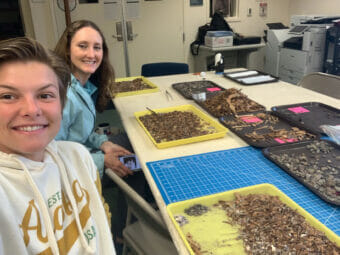
Lilly Parker and Kaylee Tatum at the Museum of the Aleutians helping sort fish, mammal, and bird remains from an archeological midden site in Unalaska. (Photo courtesy of Lilly Parker)

Archaeologists found brown and polar bear bones – some over 5,000 years old – at two dig sites on Unalaska and Amaknak Islands in the Aleutians during the early 2000s. Since then, the bones have puzzled scientists. There are no bears on either island today and no historical records of bears ever living there.
Lilly Parker and Kaylee Tatum, researchers from the University of Oklahoma, spent two weeks in Unalaska this summer. They shared their research findings with the community and asked for any information about bears that was passed down through generations. Tatum said Unangax̂ knowledge could help explain how the bones got there.

“Anything is helpful,” Tatum said. “Whether it’s a story that you heard around the campfire as a kid and you barely remember it … I still care. I still want to hear that.”

Kaylee Tatum at the University of Fairbanks Museum of the North, where her and Lilly Parker took photographs of brown bear and polar bear mandibles. (Photo courtesy of Lilly Parker)

According to carbon dating, the polar bear bones are about 5,500 years old and the brown bear bones are about 3,000 to 5,500 years old.

Parker said the bones were found at two different midden sites, which are historical dump sites used by Unangax̂ people thousands of years ago.

“They were just kind of in a jumble, in a mix of other remains,” Parker said. “There were around 23,000 animal bones found at the sites.”

Parker and Tatum spoke to many Unangax̂ elders about the mystery of the bear bones during their two-week stay in Unalaska.

While the elders were largely unsure of how the bones got there, one story suggested that people thousands of years ago may have transported bear meat by sea from the neighboring island of Unimak, which has a population of bears. Oral tradition has been passed down that says locals may have eaten bear when other food was scarce, such as during a particularly long and cold winter.

Parker and Tatum are planning to return to Unalaska next year to present follow-up scientific data. They will look for genetic clues, including a link between the bear bones found on Unalaska and Amaknak Islands and the bears on Unimak.

If they find a connection, it could solve the mystery of how the bear bones ended up on islands where bears were not previously known to live.

EPA fines largest at-sea Alaska pollock processor nearly $1M for Clean Water Act violations

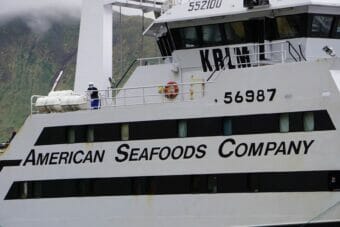
An American Seafoods Company vessel in the Port of Dutch Harbor in June 2020. (Hope McKenney/KUCB)

The U.S. Environmental Protection Agency has fined one of Alaska’s biggest fishing companies nearly $1 million for Clean Water Act violations.

American Seafoods Company is the world’s largest at-sea processor of Alaska pollock and holds the largest allocation of wild Pacific hake. The company operates a fleet of seven vessels in the North Pacific Ocean and Bering Sea.
The EPA cited the company and the owners of its vessels for hundreds of violations along the Oregon and Washington coasts, including discharging waste in a protected area, failure to monitor discharges and reporting inaccurate information in required annual reports, according to a Thursday statement.

“Discharge of seafood processing waste in prohibited areas and within the 100-meter depth contour of Washington and Oregon exacerbates already existing low-oxygen conditions which negatively impact most fishes, crabs and other marine life,” the EPA said.

An American Seafoods spokesperson said the company was notified of the allegations in March. Since then, he said the company has provided all documentation to the EPA, and that it’s assigned additional staff and updated its processes to ensure reporting is “complete, accurate and timely.”

The EPA found that American Seafoods and the owners of its vessels had noticeably more severe and much higher number of violations than other Oregon and Washington offshore fish processors during a compliance check of the industry. The vessels are the American Dynasty, American Triumph, Northern Eagle, Northern Jaeger and Ocean Rover.

The EPA is requiring American Seafoods to conduct “corporate-wide, systemic improvements” to ensure compliance with its permits, and requires they pay $999,000 in penalties.

“In amassing hundreds of violations from illegal discharges to sloppy and even non-existent record-keeping American Seafoods Company demonstrated a clear disregard for the fragile and valuable resources that sustain its business,” said Ed Kowalski, director of EPA’s Enforcement and Compliance Assurance Division in Seattle. “When issuing a permit, EPA confers to the permit holder the responsibility to protect our nation’s resources. We expect the company-wide, systematic overhaul of its operations will re-focus American Seafoods Company on the true value of its permit, the importance of tracking compliance with the permit, and the resources that permit entrusts it with protecting.”

When asked about the company’s Alaska operations, an EPA spokesperson did not say whether or not the agency is currently bringing any enforcement actions against them.

In August, a crew member on an American Seafoods factory trawler died at sea near Unalaska/Dutch Harbor, likely from an ammonia leak on board.

Activists urge reforms after Bering Sea trawlers hauled up 9 dead orcas this year

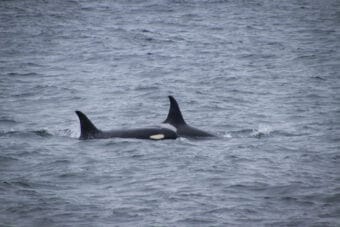
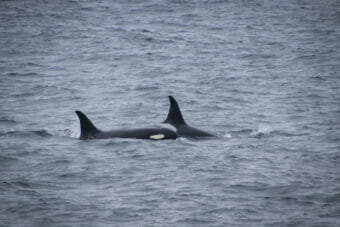
Orcas spotted in the Bering Sea in August 2023. (Courtesy Of Dustin Unignax̂ Newman)

Federal officials are looking into the deaths of nine orcas that were hauled up by groundfish trawlers in Bering Sea and Aleutian Islands fisheries this year, and conservation groups say more needs to be done to prevent such deaths.

According to NOAA Fisheries, a tenth whale was released alive, but the nine other orcas incidentally caught in trawl nets weren’t so lucky.

“NOAA Fisheries is analyzing collected data to determine the cause of injury or death and determine which stocks these whales belong to through a review of genetic information,” said Julie Fair, public affairs officer with the federal agency’s Alaska office, reading from a statement published Thursday. She declined to be interviewed, except to read the statement aloud.

Killer whales are protected under the Marine Mammal Protection Act, which requires boat owners or operators to report the deaths and injuries of the mammals during commercial fishing and survey operations.

Fair said NOAA Fisheries monitors bycatch of protected species to determine whether the animals were dead before being caught or were killed or seriously injured by commercial gear.

The vessels involved in these incidents weren’t named, but Fair said the boats involved were all required to carry two federal observers on board.

This isn’t the first time killer whales have been caught in trawl gear off Alaska, but the numbers seem to have spiked this year.

“Nine, ten killer whales is too many,” said Shari Tarantino, head of the Seattle-based advocacy group Orca Conservancy, which advocates for the endangered Southern Resident killer whale population that roams from California to Southeast Alaska. “And if it’s just this year, something needs to be done in the future to mitigate these atrocities, frankly.”

Chris Woodley, head of the Groundfish Forum — the Seattle-based association that represents Bering Sea trawlers — declined to be interviewed, providing a written statement to KUCB instead. In it, he said that vessels are experimenting with gear modifications that may prevent whales from entering trawl nets, and that the Amendment 80 trawl boats voluntarily stopped fishing on Sept. 9, with more than three months left in the season, because of the orca bycatch.

Fishing boat encounters that harmed or killed orcas in Alaskan waters were rare until recently, according to the statement, first reported by the Anchorage Daily News. NOAA reported just seven killer whale mortalities or serious injuries resulting from fishing gear entanglement between 2014 and 2020.

“In 2023, our captains have reported an increase in the number of killer whales present near our vessels, where they appear to be feeding in front of the nets while fishing,” the statement reads in part. “This new behavior has not been previously documented and marine mammal scientists are not sure why this change has occurred.”

Tarantino said it’s important to protect orcas for future generations.

“We’re not saying stop trawling, even though I think trawling is unbelievably devastating to the ocean animals and the beings that live there,” she said. “But to continue taking this bycatch is just insane. It’s destroying our future, in my opinion. You know, if the ocean goes, we go.”

Biologist Deborah Giles, the science and research director for the Washington-based nonprofit Wild Orca, said she wasn’t surprised when she heard about the nine orca deaths.

“I was glad that [NOAA was] finally recognizing it publicly,” she said. “Of course, my cynical brain wonders how often this is happening when it was not reported — or at least not released publicly. I’m very glad that this is going to be investigated.”

Giles said the industry needs to figure out a safe way to keep animals from interacting with fishing vessels and reduce bycatch of non-targeted species.

“We’d ask NOAA to come up with some new protocols for ensuring that this doesn’t happen again in the future,” she said. “NOAA is responsible for marine mammals, like killer whales, and they’re also responsible for making sure that the fisheries are not jeopardizing non-targeted species. And especially in the trawl industry, bycatch is massive. And it’s unsustainable. Initially, what we need to know is what are they doing about this? What steps are going to be taken to minimize this?”

Activists with the “Stop Factory Trawler Bycatch” campaign planned to hold a protest Thursday outside the annual meeting of Genuine Alaska Pollock Producers at Seattle’s Four Seasons Hotel.

“Nothing I have seen yet clearly states which trawl vessels were involved,” anti-bycatch activist David Bayes said in a text message.

Genuine Alaska Pollock Producers did not immediately respond to a request for information Wednesday afternoon.

In a written statement, NOAA spokesperson Julie Fair said the agency is working quickly to evaluate the orca-harming incidents and will share findings as soon as possible.

Ultra-rare whales swimming in Alaska waters could get bigger areas of protection

Two Eastern North Pacific right whales are seen swimming in the Gulf of Alaska in August of 2021. They were among four right whales spotted just south of Kodiak Island during a survey by scientists with the National Oceanic and Atmospheric Administration. Scientists believe there are only about 30 animals in the population, and sightings are rare. NOAA Fisheries is now considering a revision to its designated areas of critical habitat in waters off Alaska, a response to a petition from environmental groups seeking broader areas of protective zones for the right whales. (Photo provided by NOAA Fisheries)

Some of the world’s rarest whales could get enhanced protection under a plan announced by federal regulators on Tuesday.

The National Oceanic and Atmospheric Administration’s National Marine Fisheries Service said it will reevaluate the habitat designated as critical for the tiny population of right whales that swim in the waters off Alaska.

The move is in response to a petition filed last year by the Center for Biological Diversity and an organization called Save the North Pacific Right Whale. They argued that the areas of critical right whale habitat designated 15 years ago by NOAA Fisheries are far too small to effectively conserve the tiny population.

Scientists believe there are only about 30 animals in what is called the Eastern North Pacific right whale population. The critically endangered population that shares Alaska waters with fishing vessels and cargo ships is distinct from other highly endangered right whale populations in the world, including the few hundred in the Western North Pacific population and the North Atlantic population.

Critical habitat, as defined in the Endangered Species Act, is an area that is considered essential to conservation of a listed population. The act requires that any endangered or threatened listing be followed by a designation of critical habitat, as long as there is enough information available to do so. Within critical habitat, any activities requiring federal permits must be vetted for potential impacts to the listed species.

NOAA Fisheries in 2008 designated critical habitat consisting of 1,175 square miles in the Gulf of Alaska south of Kodiak Island and 35,460 square miles in the southeastern Bering Sea.

The environmental petitioners are seeking a vast expansion, to include a large swath south of the Alaska Peninsula and eastern Aleutian Islands and a larger chunk of the southeastern Bering Sea north of the Aleutians. Included in the groups’ proposed expansion is a heavily trafficked area called Unimak Pass, an important marine transit zone used by ships, marine mammals and fish traveling between the Gulf of Alaska and the Bering Sea through the easternmost section of the Aleutians.

A map shows existing critical habitat for North Pacific right whales in Alaska waters and an expansion proposed by environmental groups in a petition submitted in 2022 to the National Oceanic and Atmospheric Administration’s Fisheries service. The map also shows many of the locations where the rare whales were spotted in recent years. (Map provided by NOAA Fisheries)

NOAA Fisheries has not yet committed to any particular expansion, said Jenna Malek, the agency’s North Pacific right whale recovery coordinator.

“It’s unknown at this time what a revision is going to look like,” Malek said.

In addition to Unimak Pass, other areas the environmental groups are seeking to add as designated critical habitat overlap with areas used for commercial fishing and shipping. Malek said NOAA Fisheries will have to consider possible impacts to those industries as it evaluates options for critical habitat revisions.

Since 2008, there have been visual sightings or acoustic recordings of right whales in areas outside of that designated critical habitat, according to NOAA Fisheries.

In one notable case, an Eastern North Pacific right whale was spotted in 2018 well to the north of existing designated critical habitat in waters off St. Lawrence Island at the southern tip of the Bering Strait, then later in nearby waters off Russia. Another St. Lawrence Island sighting occurred in 2019.

Two North Pacific right whales were spotted in February of 2022 feeding in waters near Unimak Pass, according to NOAA. The most recent sighting was in February, made by people aboard a whale-watching ship off Monterey, California, Malek said. It is unclear whether they migrate and, if so, how they migrate, she said. “We know that they can be popping up pretty much anywhere any time of the year,” she said.

Sightings are rare. “Only a handful of folks have actually seen them,” she said.

While a couple of sightings of juveniles are considered encouraging, there are continued mysteries about the population, Malek said.

“There is a lot more that is unknown than is known about this species, unfortunately,” she said.

The North Pacific right whale population was once feared extinct, the victim of commercial harvests of past centuries. They were considered the “right whales” to hunt because they swim slowly and have such a high blubber content that they floated when killed.

A rare North Pacific right whale is seen swimming in the Gulf of Alaska in August of 2021. The whale, spotted during a scientific survey conducted by the National Oceanic and Atmospheric Administration, is demonstrating the distinctive V-shaped exhale for which right whales are known. (Photo provided by NOAA Fisheries)

Now the major threats cited are, along with climate change, ship strikes and entanglements in fishing gear. Such events have been documented among the North Atlantic right whale population, but so far not among the tiny Eastern North Pacific population swimming off Alaska, Malek said. But given the remoteness of the habitat, incidents are possible, she said. “We don’t have any evidence, but that’s not to say that it’s not happening.”

The groups seeking expanded critical habitat welcomed NOAA Fisheries’ action.

“I’m encouraged that North Pacific right whales may get these badly needed protections,” said Cooper Freeman, the Center for Biological Diversity’s Alaska representative, said in a statement. “There’s no time to waste in helping these whales, who are teetering right on the brink of extinction.”

Kevin Campion, founder of Save the North Pacific Right Whale, said in the statement: “As one of the rarest whales on the planet, North Pacific right whales require a dedicated effort to recover. … We’re grateful to NOAA for recognizing these areas are critical to the whale’s survival.”

However, the Center for Biological Diversity is critical of another federal action in waters used by right whales and other marine species.

The center last week sent a notice of intent to sue the U.S. Department of Transportation’s Maritime Administration over its recent decision to include barge routes in the Gulf of Alaska and Bering, Chukchi and Beaufort seas in the federal marine highway system.

The designation of what is being called the M-11 route through Alaska waters, announced last month by Transportation Secretary Pete Buttigieg, failed to consider impacts of increased ship traffic to endangered and threatened species, including North Pacific right whales, the center’s Sept. 21 notice said.

“There can be no doubt that vessel traffic on the M-11 Route ‘may affect,’ and is ‘likely to adversely affect,’ these listed species. Increasing vessel traffic heightens the likelihood and risk of ship strikes, strandings, and spills of fuel, oil cargo, or chemicals, intensifies vessel noise, and may adversely affect prey abundance,” the notice said.

This story originally appeared in the Alaska Beacon and is republished here with permission.

Russian military conducts exercises in Bering Sea

A Coast Guardsman aboard the cutter Kimball monitors a vessel from a group of Chinese and Russian warships in late September 2022. (Courtesy U.S. Coast Guard)

The Russian military is running naval exercises in the Bering Sea this month, and the U.S. Coast Guard is keeping watch.

The Coast Guard cutter Kimball is patrolling an area along the U.S./Russia Maritime Boundary Line as Russian vessels perform various tactical exercises.

On Friday, the Russians launched a missile approximately 600 miles northwest of Dutch Harbor.

The Department of Defense released a warning advising mariners of Russian missile operations in the Bering Sea, including within the U.S exclusive economic zone south of St. Lawrence Island, until Sept. 24. (From U.S. Coast Guard)

Rear Adm. Megan Dean, a representative from the Coast Guard, said in a statement the exercises are lawful, but said the Coast Guard “will continue to ensure there are no disruptions to U.S. interests or commerce in the maritime environment around Alaska.”

The U.S. Department of Defense issued a warning for the area that will remain in effect through Sunday.

Site notifications
Update notification options
Subscribe to notifications