Aleutians

Unalaska jostled by magnitude 5.6 earthquake Sunday

Nearby volcanoes Makushin and Okmok are unlikely to be affected by the quake, an expert said. (Alaska Earthquake Center)

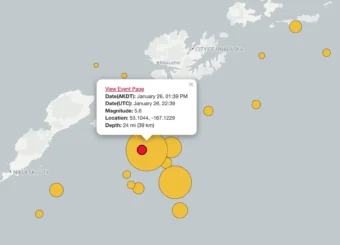
magnitude 5.6 earthquake struck about 58 miles southwest of Unalaska Sunday afternoon. While many locals felt the event, including in Nikolski and Akutan, experts said there was no threat of a tsunami or cause for further concern.

Alaska Volcano Observatory geophysicist John Power said the quake, which hit at 1:39 p.m., isn’t a likely precursor to another seismic event. Power noted that the quake was quite deep. The Alaska Earthquake Center currently estimates the event’s depth at 24.1 miles. Deep earthquakes don’t usually bring a lot of aftershocks, Power said.

“We see earthquakes like this very, very frequently in the Aleutian chain,” he said. “This one’s pretty big, but not unusually big.”

Initial calculations on magnitude, location and depth are subject to change as researchers refine their data.

Power noted that nearby volcanoes Makushin and Okmok are unlikely to be affected by the quake.

To report any seismic activity you felt, head to the United States Geological Survey website. For more information on earthquake preparedness, visit the Alaska Earthquake Center’s website.

A community’s fight to save Unangam Tunuu on St. Paul Island

Classes like this one are rare. Unangam Tunuu is taught in only a handful of classes in the public school system, and outside these sessions, the language is seldom spoken. The struggle on St. Paul mirrors trends across Alaska. A 2024 report from the Alaska Native Language Preservation and Advisory Council, a legislative council that advises the governor’s office, found that all of the state’s Indigenous languages are critically endangered, with some spoken by fewer than a dozen people. (Theo Greenly/KUCB)

In a classroom on St. Paul Island, Aquilina Lestenkof stands before a group of students, guiding them through an Unangam Tunuu language exercise. Her voice is steady and encouraging as she repeats a phrase, which the children repeat back. Some stumble over the syllables, but Lestenkof smiles.

“We focus on speaking, and it doesn’t matter if you mumble, fumble, fail fast, go ahead. Speak it,” she says. “Because putting it out there into this wonderful Unangax̂ universe is keeping it alive.”

Lestenkof runs the community’s language center on St. Paul, a remote island in the Bering Sea, where educators and elders are fighting to preserve Unangam Tunuu, the traditional language of the Unangax̂ people. Despite their efforts, the language faces a steep decline, with few fluent speakers left and even fewer opportunities to use it outside the classroom.

“We focus on speaking, and it doesn’t matter if you mumble, fumble, fail fast, go ahead. Speak it,” says Lestenkof, right. “Because putting it out there into this wonderful Unangax̂ universe is keeping it alive.” (Theo Greenly/KUCB)

Classes like this one are rare. Unangam Tunuu is taught in only a handful of classes in the public school system, and outside these sessions, the language is seldom spoken. The struggle on St. Paul mirrors trends across Alaska. A 2024 report from the Alaska Native Language Preservation and Advisory Council, a legislative council that advises the governor’s office, found that all of the state’s Indigenous languages are critically endangered, with some spoken by fewer than a dozen people.

Following the fur seal

The challenges facing Unangam Tunuu are rooted in a history of colonization. While Unangax̂ people historically traveled to St. Paul to hunt, they did not live on the remote Pribilof Islands. That changed when Russian settlers forced many Unangax̂ to relocate there as laborers during the fur trade.

The United States continued the practice after purchasing Alaska in 1867, designating the Pribilof Islanders as “wards of the state.” It wasn’t until 1983 that the U.S. government withdrew from the Pribilofs, allowing the community to regain independence.

Today, St. Paul celebrates its freedom with Aleut Independence Day, held each year on Oct. 28. The event brings the community together at the school gym, where residents cook, sing, and honor their heritage.

Zinaida Melovidov, known as Grandma Zee, is one of the few remaining fluent speakers in St. Paul. At this year’s celebration, she prepared “million dollar soup,” a dish made with corned beef that reflects the government’s compensation to the people of St. Paul.

“We call corned beef ‘million dollar’ because that was what the government gave to the people,” she said.

For Melovidov, the celebration is bittersweet. She remembers the injustices her people endured under colonial rule.

“It was sad,” she said. “Oh, I was so angry they treat our people like that.”

The loss of fluent speakers, many of whom are elders, has only deepened her frustration.

“All the people are gone that can speak, have a conversation, talk together. And these little kids, these younger ones, they don’t understand,” she said.

Melovidov says the only person left with whom she can really hold a conversation in Unangam Tunuu is her uncle, Gregory Fratis Sr., the oldest person on St. Paul at 83 years old.

Looking forward, glancing back

The state report emphasizes the importance of intergenerational learning, where elders pass their knowledge to younger generations. Events like Aleut Independence Day are aimed at fostering those connections.

With bellies full of fry bread and million dollar soup, attendees gathered in the gymnasium for closing ceremonies. Lestenkof addressed attendees over the school’s PA system.

“This is what we’re gonna do,” she said. “We’re going to say Malgaqan samtalix, and we’re going to walk a wonderful clockwise circle.”

“Malgaqan Samtalix” is an Unangax̂ song rooted in the idea of accepting the past.

“What has happened before has happened, and we must respect that,” said George Pletnikoff Jr., a young Unangam Tunuu instructor from Saint Paul who teaches alongside Lestenkof.

“We’re all here right now,” he added.

“Malgaqan Samtalix” is an Unangax̂ song rooted in the idea of accepting the past. “What has happened before has happened, and we must respect that,” said George Pletnikoff Jr., a young Unangam Tunuu instructor from Saint Paul. (Theo Greenly/KUCB)

While Alaska has made strides in incorporating Native languages into public education, programs remain limited. Most Indigenous students in Alaska’s public schools still lack access to Native language instruction.

Studies show that integrating cultural elements into language education can boost learners’ motivation and sense of ownership, a goal Lestenkof says is central to events like Aleut Independence Day.

“Something like today’s celebration, it’s strength building, and keeping our techniques and tools, and having the kids understand that it’s all in our hands,” she said.

The community forms a ring around the inside of the gymnasium, placing their hands on the shoulders of the person in front of them. Pletnikoff starts banging a drum, and the attendees chant, “Malgaqan Samtalix.” Everyone chants in unison and walks in a circle.

As Alaska schools close, one Aleutian village bucks the trend

Nikolski School students gather on couches as teacher Lynette Hall and teacher’s aide Tatyana Hillhouse review homework assignments at the end of the school day. (Sofia Stuart-Rasi/KUCB)

Nikolski’s one-room purple schoolhouse sits on the outskirts of the 30-person village, facing a vast, grassy valley. The western Aleutian village stretches along Umnak Island’s Nikolski Bay on the Bering Sea, with Okmok volcano on the horizon. Students come to school each morning by foot, bicycle or ATV — none of their houses are more than a couple of miles away.

One afternoon last September, the school’s 10 students — from kindergarten through 11th grade — sat listening on sofas as teacher Lynette Hall prepared them for the next day’s lessons. She asked them to take out their planners.

“Because you have homework today,” Hall said.

Some grumbled. A few cheered. These days, that’s a typical end-of-day scene. But for about a decade, it wasn’t.

In 2009, the Nikolski school closed its doors because enrollment had dropped below 10 students — the state’s minimum for funding. Many feared that could spell the end of yet another rural Alaska community. When schools close, families often leave.

Mike Hanley is the superintendent of the Aleutian Region School District. He says ensuring there are enough students to keep a school open is always on the radar of small Alaskan districts. Hanley says he focuses on building strong schools for residents to stay or draw family members back to the area.

“The best thing that we can do as a district is to continue to provide a good, positive education and work with families,” Hanley said. “So that the education is not separate from the community, that it’s seamless together.”

Schools closing across the state

Nikolski’s reopening counters a statewide trend. Over the past decade, 51 schools have closed in Alaska while only 32 have opened or reopened, according to the Alaska Department of Education and Early Development.

In 2015, the school in Cold Bay in the eastern Aleutians closed due to low student enrollment. In 2017, the school on St. George Island in the Pribilof closed. And in 2023, low enrollment forced the closure of the school on Adak Island, one of the region’s most remote communities.

Even in Anchorage, administrators are closing schools due to falling student numbers.

As schools close across the state, Hanley says that where families choose to live is changing, too.

“I don’t believe it’s a flaw in the educational model,” Hanley said. “It’s just a change in the way we live today — you know, a change in the world.”

‘Everybody here is involved’

The Nikolski school’s revival came through combined efforts of the Aleutian Region School District and the local tribal organization. It was possible in part because the families with children were still living there. When the school closed in 2009, most chose to homeschool or send their children to schools off-island.
Hall said when the island’s student numbers met state requirements again, parents approached the district about reopening.

“The parents in the community definitely are what brought it to life,” she said.

The tribe converted its community center into the schoolhouse — the village store is now where the old school used to be. They also secured housing for Hall, the teacher, who came from West Virginia.

Hall says the students’ mothers helped her understand her new students’ educational needs, and the community rallied behind the parents’ efforts.

“Everybody here is involved in making sure these students become the best they can be,” Hall said.

Tatyana Hillhouse, who works alongside Hall as a teacher’s aide, moved to Nikolski as a child and has lived on the island intermittently since then. Having seen the village both with and without its school, she says the reopening means more than just the return of formal education.

“I really hope that it stays for quite a while, because it’s nice seeing all the kids be all together,” she said.

The students now work together daily on projects, as Hall and Hillhouse guide them through assignments like exploring Nikolski’s biodiversity. And the school’s future looks promising. As these students graduate, younger ones are already waiting to take their place.

This story is part of CoastAlaska’s “Evolving Education” series. You can find other stories in the series online at kcaw.org.

In surprising move, Bering Sea snow crab fishery to reopen after 2-year closure

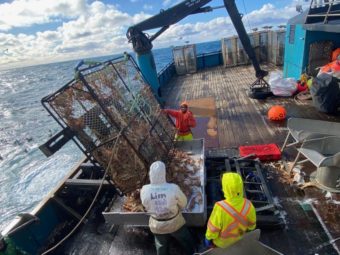
Fishermen load Alaska snow crab in the hold of a crabbing vessel. (Courtesy Tacho)

The Alaska Department of Fish and Game announced Friday afternoon that Bering Sea fishermen will be allowed to harvest a total of about 4.7 million pounds of opilio, also known as snow crab, for the first time in two years.

According to Fish and Game, estimates of total mature male biomass are above the threshold required to open the fishery.

The announcement comes as a surprise to many fishermen, after roughly 10 billion snow crabs disappeared from the Bering Sea over a span of four years, prompting Fish and Game to close the fishery in 2022. Recently, scientists have learned that the disappearance was likely due to ecological shifts, and there’s been little hope within the industry that stocks would recover anytime soon.

Still, the National Marine Fisheries Service and Fish and Game have analyzed the results from this year’s bottom trawl survey and agree that the volume of male crabs is at a safe limit for fishing. Fish and Game’s decision to open the fishery is based on the recommendation of the North Pacific Fishery Management Council, which met Friday morning to determine sustainable harvest limits for Alaska’s big three crab stocks.

Fish and Game has set the total allowable catch, or TAC, for snow crab at 4.72 million pounds, including Individual Fishermen’s Quota and Community Development Quota. The last time the fishery was open, harvesters were allotted 5.6 million pounds, although the year before they had a harvest of 40.5 million pounds.

The department also opened the Bristol Bay red king crab fishery, which closed for two years in 2021 and reopened last year. Fishermen will have 2.3 million pounds to catch this year, just above last year’s humble but welcome harvest.

Both the red king crab fishery and snow crab open Oct. 15.

Coast Guard crews spot 4 Chinese warships near Aleutian Islands

The Coast Guard cutter Kimball moored in Unalaska (Maggie Nelson/KUCB)

The U.S. Coast Guard encountered four People’s Republic of China military warships in the Bering Sea earlier this month.

The foreign vessels spotted July 6 and 7 were following international law, and told Coast Guard personnel they were practicing “freedom of navigation operations.”

Coast Guard spokesman Lt. Cmdr. Michael Salerno said encounters with groups of Chinese vessels have been an annual occurrence in the Bering Sea since 2021, and Chinese naval ships have been spotted in the area since 2017. He said he didn’t have information about encounters with Chinese vessels prior to that.

In 2021, the Coast Guard spotted four warships in the region. About a year later, the Coast Guard cutter Kimball stumbled upon Chinese and Russian military vessels traveling together near Kiska Island. Then in 2023, U.S. Navy warships were dispatched to the Aleutians, after 11 Chinese and Russian military vessels were found operating in the region.

The latest four ships were in international waters inside the U.S. Exclusive Economic Zone, an area up to about 200 nautical miles offshore, where the U.S. has jurisdiction over natural resources.

The crew of the Kimball detected three of the latest ships 124 miles north of Amchitka Pass in the Aleutian Islands. Crew on an HC-130J airplane found another ship northeast of Atka Island.

None of the ships broke any international rules or norms. Still, the 418-foot Kimball contacted the Chinese vessels to ensure there were no disruptions to Alaska’s coastline or national interests. The Kimball continued monitoring the ships until they entered the North Pacific Ocean, south of the Aleutians.

Possible rat sighting on remote St. Paul Island raises alarm

For more than two decades, the Pribilof Islands have implemented a rat prevention program to keep the island rat-free. (John Ryan/KUCB)

It may sound silly to outsiders, but for the remote Pribilof Island of St. Paul, a possible rat sighting could be a big deal.

The community of about 300 residents has worked for decades to be rodent-free. Officials with the island’s tribal government have said the invasive species would devastate local seabirds and permanently change the wildlife populations.

According to a Facebook post from the Aleut Community of St. Paul Island Tribal Government, a rat was potentially spotted last Wednesday. The tribal government’s Ecosystem Conservation Office is working to confirm the sighting using trail cameras at the city fourplex where the unconfirmed sighting was reported.

In 2018, local and federal officials spent almost a year trying to eradicate a rogue rat on the island. They believed the rodent likely snuck in on a boat.

Millions of seabirds descend each year on the rocky oasis near the middle of the Bering Sea. It’s one of the few places that has successfully protected its rich natural habitat and wildlife from invasive rodents.

According to Lauren Divine, the director of the tribal government’s conservation office, there have been no signs of a rat and the sighting is still unconfirmed. She said their staff immediately put out traps and trail cams, and are working with the U.S. Fish and Wildlife Service’s Maritime Refuge staff to place additional materials like black lights, which they will use to detect feces.

Traps are baited with peanut butter, and staff is monitoring daily for any signs of the rat. Signs include things like droppings, chew marks and shredded fibers or debris.

The tribal government asks locals to keep all food and waste properly stored or disposed of. If you spot a rat or evidence of one, or if you’d like to have traps placed around your home, call the conservation office at 907-615-5306.

Site notifications
Update notification options
Subscribe to notifications