Pouring gold at Kinross’ Fort Knox mine in Alaska’s Interior. (Kinross photo)
A year ago, Alaska’s miners were selling gold at what seemed like a great price: around $2,200 per ounce. Today, that number sounds like a steal.
After a historic surge in value, gold is now selling at an all-time high: more than $3,000 an ounce, or an increase of some 35% since the beginning of 2024.
That’s great news for gold miners across the state, from Nome to Ketchikan — and for businesses of all sizes, from the multi-billion-dollar Kinross Gold Corp. to mom-and-pop placer operations.
Owing partly to the hot market, the value of gold produced statewide shot up more than 60% last year from the year before, according to a recent report in the trade publication North of 60 Mining News.
“We’re in uncharted territory. And we’ve gotten here very quickly,” said Rick Van Nieuwenhuyse, the chief executive of Contango Ore, a Fairbanks-based company developing several gold deposits in the state.
The staggering rise in gold’s value, driven by global economic uncertainty and a range of other factors, is translating into a windfall for Kinross and the other multinational companies that operate Alaska’s four major gold mines, which reported huge earnings last year.
The price of gold is the “largest single factor in determining profitability,” according to financial statements from Kinross, which owns the massive Fort Knox mine near Fairbanks and the smaller Manh Choh mine, in partnership with Contango, near the Interior town of Tok.
But it’s not just the billion-dollar companies that are benefitting: Gold’s surge also could buoy Alaska’s 150 or so placer operations.
Placer mining for gold near McCarthy in Alaska’s Interior in a historical photograph. (Robert H. Thompson family papers, Archives and Special Collections, Consortium Library, University of Alaska Anchorage)
Those smaller mining businesses use water to wash heavier gold out of sand and other sediments, often along creekbeds. They tend to be family-run and have smaller profit margins than the large corporations that own Alaska’s biggest hardrock mines — meaning that the rising prices make a big difference.
“It’s good for everyone. It’s good for the big mines, small mines,” said Click Bishop, a former state senator from Fairbanks who runs a placer mine in the Interior. “The biggest thing is: It makes a lot more marginal ground minable.”
When gold was selling for less, some lower-grade deposits weren’t worth mining, Bishop added. “But at $3,000, that’s a different story,” he said.
Click Bishop, a former Alaska state senator, prospecting for gold. (Photo courtesy Click Bishop)
Gold mining has come under heightened scrutiny in recent years, as the metal has relatively few industrial applications and mostly is snapped up by banks and financial speculators, and for use as jewelry.
But gold remains a key part of Alaska’s economy, as the backbone of the state’s mining industry. The nearly 850,000 ounces produced by Alaska mines in 2024 accounted for some $2 billion — about half of the total value of minerals, including coal, sand and gravel, produced in the state, according to estimates from the Alaska Department of Natural Resources.
At Fort Knox — the state’s largest gold mine — sales rose 64% between 2023 and 2024. That was due partly to a big increase in production, with ore trucked in from the new Manh Choh mine. But the high price of gold also contributed, according to Kinross’ financial reports.
Other large gold mines, like Kensington north of Juneau and Pogo near Delta Junction, also reported increases in sales and earnings. Gold’s rising price boosted revenue at Kensington by nearly $40 million last year, according to its owner and operator, Coeur Mining.
“Anybody with an operating gold mine is in a happy spot right now,” said Van Nieuwenhuyse.
For his company, Contango Ore, which owns 30% of the large Manh Choh project, the outlook is a bit different than for bigger companies like Kinross. Contango, given its relatively small size, is still paying off debt and sells most of its gold at prices pre-set by banks that loaned the company money to build its share of Manh Choh.
It makes some money on those sales, but a lot more on the 30% of its gold that it sells at current prices, according to Van Nieuwenhuyse. “The higher the gold price goes, the more money we make, and the faster we pay off the debt,” he said.
Gold miners across the state say it’s shaping up to be a good year.
In Nome, a summer hotspot for placer mining, “things are looking shiny” for the industry, Ken Hughes, a local miner and gold buyer, wrote in an email.
Given the growing challenge of finding labor and the usual obstacles from Bering Sea storms, “it may well take the recent record price of gold to keep operators in the field,” Hughes said.
“Existing producers are licking their chops at the upcoming season’s prospects,” he added.
Northern Journal contributor Max Graham can be reached at max@northernjournal.com. He’s interested in any and all mining related stories, as well as introductory meetings with people in and around the industry.
This article was originally published in Northern Journal, a newsletter from Nathaniel Herz. Subscribe at this link.
Gov. Mike Dunleavy and the Premier of the Yukon Ranj Pillai, pose for a photo in the Cabinet office during a visit to Whitehorse on Thursday, February 8, 2024. (Photo by Justin Kennedy/Government of Yukon)
President Donald Trump’s recent threats to start a trade war with Canada and to turn it into the 51st state of the U.S. have not landed well with the populace of the sovereign nation to Alaska’s east.
Canadian sports fans have hurled boos at the U.S. anthem at recent hockey and basketball games. Leaders of border towns like Windsor, Ontario, long-integrated with Detroit, have protested by pulling funds for cross-border bus service and event sponsorships.
But in the far north, the historically tight bond between Alaskans and Yukoners has remained intact amid the fraught federal politics — at least for now.
If anything, the recent belligerence at the national level has inspired local pleas for pacifism. Alaska border-town officials have penned effusive letters to their Canadian counterparts, reinforcing commitments to traditions that have long united people on both sides of the remote, 1,500-mile border.
“This whole business with Trump and the tariffs and potential annexation that he’s throwing out there — it has upset a lot of Canadians. But we also recognize that our friends and family and neighbors across the border, we can’t paint them with that same paint brush,” said Diane Strand, mayor of Haines Junction, a small Yukon Territory outpost about a three-hour drive north of the larger-but-still-tiny Southeast Alaska town of Haines.
Strand recently received a letter from Haines’ mayor, Tom Morphet, saying that “as northerners, we sometimes have as much in common with our Canadian neighbors as we do with our own countrymen in the southern latitudes.”
Higher-level elected officials in Alaska and the Yukon territory also appear committed to maintaining a cordial relationship — even as Alaska Gov. Mike Dunleavy, a Republican and longtime Trump ally, remains quiet on the president’s rift-provoking ideas.
Jeff Turner, a spokesperson for Dunleavy, described the governor’s relationship with Yukon Premier Ranj Pillai as “productive and positive.” Dunleavy and Pillai spoke by phone earlier this month about “shared priorities,” including the potential effects of tariffs on both Alaskans and Canadians, according to Laura Seeley, a spokesperson for Pillai.
But Turner would not say whether Dunleavy supports Trump’s tariff proposal, which Pillai has called a “blatant attack” on Canada. Nor would Turner say whether Dunleavy supports Trump’s idea to annex Canada.
Pillai also discussed tariffs during a recent trip to Washington, D.C., where he met with Republican U.S. Sen. Lisa Murkowski and Republican U.S. Rep. Nick Begich III, Seeley said in an email.
“The Yukon and Alaska have a long-standing relationship built on mutual respect, trade, and shared challenges,” wrote Seeley. “That foundation remains strong, regardless of political shifts at the national level.”
Seeley added: “On the question of annexation, Canadians have been clear that is not going to happen.”
In a phone interview this week, Morphet, the Haines mayor, said he has worried that President Trump’s rhetoric about annexation and tariffs could make Canadians more hesitant to visit Haines, and he fears the town could see a drop in tourism as a result.
Strand, the Haines Junction mayor, said she has heard some constituents say they are now leery of traveling farther from town to the Alaska cities of Anchorage and Fairbanks — where they fear they’d no longer feel welcomed. But they’re still open to going to the small, nearby towns of Haines and Skagway where they know more people, Strand added.
The Haines Community Marching Band, featuring Tom Morphet, who has since been elected the town’s mayor, on trumpet, serenades a visitor from the Yukon Territory in November 2021. (Photo by Max Graham)
Efforts to maintain the cross-border bond could face a test at the upcoming Kluane Chilkat International Bike Relay, an annual bike race in June that runs from Haines Junction to Haines.
A Haines member of the relay’s board, a mix of Canadians and Americans, described some “animosity” at a recent meeting, according to KHNS, Haines’ public radio station.
But event planners told Northern Journal that they’re fully committed to holding the race in spite of the deteriorating national relations.
“We just want people to have a good time,” said Monika Kozlerova, a Whitehorse resident who coordinates the event. “We are trying to stay away from any politics.”
Another yearly event that brings together hundreds of people from both Alaska and the Yukon, the Buckwheat International Ski Classic, is also still expected to happen, according to event organizers.
That race, organized by a group mostly of Alaskans, is held on the Canadian side of White Pass, which is 45 minutes by car from the Southeast Alaska town of Skagway.
Costume-clad finishers eat burgers in a snow castle at the finish of the annual Buckwheat Ski Classic in White Pass last year. (Photo by Nathaniel Herz/Northern Journal)
“I’ve heard nothing but interest in the Buckwheat,” said Jon Hillis, a Skagway resident who helps plan the race, which is scheduled for March 15. “I think we’re relatively on pace in sign-ups. So, I don’t see a lot of impact so far.”
Hillis added, though, that Trump’s proposed 25% tariffs on Canadian goods — initially set to start Feb. 1 but now delayed until March 4 — could affect not only Yukoners but also people from Skagway.
Many Skagway residents, who have only small stores in town, frequently drive two hours north to shop at big box stores in Whitehorse.
“If those tariffs came into place, they would hurt a lot. I go up to Whitehorse at least monthly,” said Hillis, who buys supplies for his cleaning business there. “We’re all kind of holding our breath.”
Skagway’s elected officials last week voted to send a letter to Alaska’s congressional delegation voicing concerns about Trump’s tariff proposal. They also signed a letter to Pillai, the Yukon premier, saying that “economic lifelines” between Skagway and the Yukon “must not be hindered by policies that fail to recognize our unique cross-border relationship.”
Those words echoed Morphet’s letter to Strand, the Haines Junction mayor, and a nearly identical one from Morphet to the mayor of Whitehorse. Both of those letters affirmed that Haines “stands steadfast for continued warm and peaceful relations with our Canadian neighbors and family members, in perpetuity.”
Strand, in a phone interview this week, said she had drafted but not yet sent a response to Morphet. It notes, she said, that all the camaraderie is great, but urges Haines officials to go a step further and take a public stance in defense of Canada’s nationhood.
Morphet signaled support for that idea. “I think I can speak for most people in this town, if not all, that we’re not interested in invading Canada,” he said. “We like Canada the way it is. We like that they have great ice rinks. We like that they have great parks.”
Morphet also gave shout-outs to the country’s health care system and the veterinarians, winter apparel shops and ice-skate sharpeners of the Yukon — all of which have, at one point or another, served the Alaskans of Haines and Skagway.
Instead of making Canada a state, then, might Morphet want his town to become a part of Canada?
“I have more than a few friends who wouldn’t mind that,” said the mayor.
Northern Journal contributor Max Graham can be reached at max@northernjournal.com. He’s interested in any and all mining related stories, as well as introductory meetings with people in and around the industry.
This article was originally published in Northern Journal, a newsletter from Nathaniel Herz. Subscribe at this link.
Greens Creek is one of the largest silver mines in the world. It recently lost access to its supply of hydroelectric power, which its owner, Hecla, says could cost the company $5 million to replace with diesel generation. (Photo courtesy of Hecla Greens Creek Mine)
Juneau’s elected officials and a local entrepreneur have recently been pushing two major power projects that could reduce the city’s carbon pollution.
Their efforts also could boost a pillar of the region’s economy: mining.
One of the projects, a private proposal to build a new hydroelectric plant, could help one of Juneau’s two large-scale mines sharply cut its dependence on expensive, carbon-intensive diesel power.
But the other proposal, a public effort to electrify the city’s cruise ship docks, might have an opposite, unintended effect: It could force the area’s other large mine to burn more fossil fuels, potentially adding to that mine’s operating costs and climate impacts.
Both infrastructure proposals, still years from being built, are part of a broader push in Juneau and across the country to use more renewable energy as climate change, driven by the burning of fossil fuels, ramps up.
They come also as mining companies in Alaska face mounting financial and political pressure to find alternatives to carbon-based fuels.
The state’s hardrock mines — which need a huge amount of energy to crush, grind and separate valuable minerals from rock — still largely run on diesel and coal. Industry leaders have warned in recent years that Alaska’s high electricity prices and planet-warming emissions could stifle growth.
“Energy is a major cost driver at mines and anything we can do to be more energy efficient, or seek out cheaper sources of energy, adds value to our operations,” said Mike Satre, director of government affairs at Hecla, the publicly traded company that operates one of the two big Juneau area mines.
The complications around mining and power supply in the region underscore the challenge of translating lofty green energy goals into reality, even in areas like Juneau where there’s broad agreement about the need to leave fossil fuels behind.
Utilities across Alaska have struggled to advance large renewable projects even with generous tax credits offered by the Biden administration, and some projects have already experienced setbacks as the Trump administration aims to pull those incentives back.
Renewable energy advocates say obstacles include high construction costs and tricky politics among mining companies, other energy-intensive industries, electric utilities and state regulators.
“The interests do align,” said Steve Behnke, a long-time board member of Renewable Juneau, a local advocacy group. “But the nitty-gritty economic, financial issues don’t.”
Fissures between various energy players are now driving a heated debate in front of state utility regulators over a Juneau entrepreneur’s proposal to build the new hydroelectric plant. An anchor customer would be Kensington, a major gold mine some 45 miles north of Juneau.
An aerial view of part of Southeast Alaska’s Kensington gold mine. (James Brooks via Wikipedia under Creative Commons 2.0)
Kensington is off the grid and generates its own electricity by burning imported diesel. It consumed about 4.5 million gallons of fuel last year, said Rochelle Lindley, a spokesperson for the mine’s multinational owner, Coeur, which is also publicly traded.
Kensington’s burning of diesel spews some 46,000 tons of carbon dioxide into the air annually and accounts for roughly 15% of Juneau’s total greenhouse gas emissions, according to a city-commissioned report from 2021.
To limit pollution, Coeur upgraded its power plant in 2019, reducing the mine’s fuel consumption by 25%, Lindley said in an email. The company also has spent more than $200,000 to offset some of the mine’s emissions in a partnership with Renewable Juneau, which helps local residents install power-saving electric heat pumps in their homes.
But Coeur is still looking for alternative energy sources to lower its emissions, Lindley added. Companies like Coeur are facing global pressure from investors and government regulators to reduce their use of fossil fuels.
“We would be supportive of any provider that could bring clean, renewable energy to our mining operation,” Lindley wrote. She said Coeur has explored multiple options to reduce its dependence on diesel and carbon emissions, including an onsite fleet of batteries.
Kensington’s demand for cleaner power is central to the long-running hydroelectric proposal from a local businessman and energy advocate, Duff Mitchell. His company, Juneau Hydropower, wants to install a dam at a lake some 30 miles south of Juneau, build a power plant and battery storage system and run transmission lines that would connect the project to Kensington.
The company says its $170 million proposal could increase the region’s energy capacity as much as 25%.
Mitchell first announced the idea more than a decade ago but submitted a new application to state regulators in November.
Coeur has already signed a power purchase agreement with the firm, according to filings to the Regulatory Commission of Alaska, which oversees the state’s utilities.
Juneau Hydropower also says it would sell electricity to a smattering of proposed developments north of Juneau, outside the service area of the city’s existing electric utility, Alaska Electric Light and Power. The potential buyers include a new state-proposed ferry terminal, another gold mine that’s still years from construction and a private ore dock under development on land owned by a local Alaska Native corporation.
But it still faces hurdles, including questions about financing and how the company would transmit electricity across infrastructure currently used by privately owned Alaska Electric Light and Power, or AEL&P.
AEL&P, a subsidiary of Washington state-based Avista Corp., opposes Juneau Hydropower’s proposal, arguing that it lacks evidence of financial viability and risks unintended impacts on AEL&P’s existing customers.
Mitchell said Juneau Hydropower looks forward to proving that “we are fit, willing and able,” the legal standard it must meet for regulators to approve its operating certificate.
Juneau Hydropower’s effort to increase regional energy capacity comes at the same time that city officials are, separately, pursuing a project that could increase the city’s demand for electricity — a plan that could come at the expense of Juneau’s other major mine, Greens Creek.
Eager to slash emissions from the massive cruise ships that call on Juneau in huge numbers each summer, city officials want to electrify two public docks — allowing the vessels to run on hydropower instead of burning diesel while they’re in port.
Boosters say the project, which could cost some $25 million, would cut down on air pollution from ships that Juneau residents periodically complain about.
Even with one of Juneau’s docks, privately owned by Princess Cruises, already connected to the grid, cruise ships still account for about 8% of the city’s yearly carbon emissions.
But rather than fully eliminating those emissions, connecting the city’s two public docks to the grid might just shift the burden of burning diesel to another major energy consumer: the Greens Creek mine.
A truck rumbles down a road at the Greens Creek mine. (Hecla Greens Creek Mine)
Greens Creek, unlike Kensington, is already tied to Juneau’s grid and benefits from surplus hydropower.
During rainy years, the mine can operate almost entirely on relatively affordable, renewable energy. In a typical year, it gets some 90% of its electricity from the grid, according to Hecla.
But the mine only gets renewable power when AEL&P has some to spare. And that’s not always the case.
During droughts, when the region’s reservoirs are low, AEL&P shuts off power to Greens Creek, which then must barge in and burn vast amounts of pricey diesel fuel.
Southeast Alaska is expected to experience more droughts due to climate change. And the mine is already in that position right now: Citing dry conditions, a rise in energy use and weather delays on a construction project, AEL&P cut power to Greens Creek in January.
The interruption could last six months and increase Hecla’s costs by $5 million, a company executive said in a recent call with investors.
If the city plugs its docks into the grid, and AEL&P adds more cruise ships to its customer list, Greens Creek could face new competition for an already limited supply of surplus hydropower.
The grid’s energy supply is like a balloon, said Clay Good, a Juneau-based clean energy advocate and educator. “If you squeeze it at one end, it’s going to bulge at the other,” he said.
For now, AEL&P says electricity sales to the mine would be unaffected if the city ties its cruise docks into the grid.
The utility would add cruise companies as “interruptible” customers, according to Debbie Driscoll, a spokesperson for the utility.
That means that, like Greens Creek, cruise ships would receive excess grid power only when it’s available, Driscoll said in an email. Greens Creek, because it’s a preexisting customer, would have priority over the ships, she added.
Still, a 2022 study commissioned by Juneau’s city government contemplates an array of other scenarios, including one where the utility limits power to Greens Creek in favor of cruise ships.
The study suggests that spending millions of dollars to electrifying the cruise docks won’t pencil out unless ships do have priority over Greens Creek. Putting them lower on the list would be “problematic,” says the study.
Satre, with Hecla, said the mining company keeps in close touch with AEL&P, but added that the “only assurances we have are based on our current contract to purchase surplus power.”
“If additional surplus customers come online, then yes, we have priority,” he said. “However, there is always the possibility of different arrangements.”
Increasing other uses of excess hydropower and forcing Greens Creek to generate more of its own energy with diesel would “reduce predictability and increase costs,” Satre added.
Greens Creek’s current contract with AEL&P also helps make electricity more affordable for Juneau residents. The utility uses revenue from its sales to the mine, its biggest buyer of excess power, to offset costs for higher-priority customers, said Driscoll, the utility spokesperson.
Greens Creek has saved Juneau ratepayers close to $90 million since it plugged into the grid in 2009, she said.
Behnke, the renewable power advocate, said many Juneau residents view the mine’s deal with the utility as positive for both the city and the mine. He suggested it could serve as a model for other major energy users looking to save on energy and lower their emissions, like Kensington and the cruise industry.
“We don’t see why a deal with Kensington and shore power couldn’t be just as good,” Behnke said.
Northern Journal’s work depends on reader support. Please consider a voluntary membership or encouraging a friend to join. If you’re already a member, thank you.
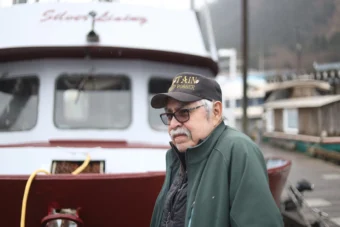
Nick Katelnikoff learned to fish from his father, and he says his first paycheck as a fisherman came when he turned 8 years old. Now 76, pictured aboard his boat, the MZ L, he’s the last skipper running a commercial fishing vessel from his home village of Ouzinkie, on an island just north of Kodiak. (Photo by Nathaniel Herz/Northern Journal)
This story was produced as part of the Pulitzer Center’s StoryReach U.S. Fellowship. It was reported and edited by Northern Journal and APM Reports, with support from Alaska Public Media.
KODIAK — On an early, foggy summer morning, Nick Katelnikoff steered his boat through the treacherous waters off Kodiak Island’s Spruce Cape and chuckled.
“Trust a blind guy through the rock pile?” he asked.
Katelnikoff, 76, is a veteran fisherman — the kind of guy who, friends say, can call his catch into his boat.
He’s made a career chasing the bounty of the North Pacific, building up a storehouse of knowledge about his maritime backyard that allows him, even with failing eyesight, to confidently steer his 38-foot craft away from rocks that have sunk other vessels.
The MZ L motors past Kodiak Island’s Spruce Cape in July. (Photo by Nathaniel Herz/Northern Journal)
Katelnikoff describes his heritage as Aleut; he’s one of the Indigenous people who have been pulling fish out of these waters for millenia. Their catches helped sustain trading networks long before white people arrived on Kodiak and began setting up fish traps and canneries — businesses that were supplied, in part, by the harvests of Katelnikoff’s more recent ancestors.
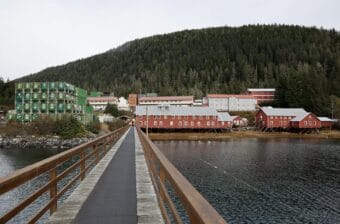
When Katelnikoff was still beginning his career in the 1970s, he was one of a dozen or so skippers in Ouzinkie — a small Indigenous village on an island just off Kodiak’s coast.
But today, that tradition is all but dead: Katelnikoff is the last skipper running a commercial fishing boat from Ouzinkie’s harbor.
A similar story has played out in villages up and down the Gulf of Alaska coast. Angoon, Nondalton, Old Harbor — each of those small Native communities is home to a fraction of the commercial salmon fishermen who were once the lifeblood of their economies.
Over the last 50 years, hundreds of Alaska’s most valuable salmon permits have drained out of its Indigenous coastal villages. Now, the profits flow increasingly to those who live in Alaska’s population centers or in other states.
“We used to be people who fished,” an anonymous respondent wrote in a recent survey of thousands of Indigenous people with ties to the Gulf of Alaska. “Now, we don’t have access to our resources located in our backyard.”
Salmon dry on racks in Old Harbor in 1889. (U.S. Fish Commission photo via National Archives)
The outflow was set in motion in the early 1970s. At the time, new fishermen were flooding into the industry as salmon harvests had plummeted from historic highs, making it more difficult for each boat to turn a profit.
In response, Alaska’s government made a monumental change in the way it regulated those fisheries.
No longer could just any commercial fisherman set out in a boat and cast their net — even Alaska Natives whose ancestors had fished for generations. The new system, approved by voters in 1972 and put into effect three years later, placed caps on the number of permits available in each fishery.
The policy was known as “limited entry” because it restricted who could enter the industry, and it created permits that have since been valued collectively at more than $1 billion.
Scholars diverge on how effective the policy has been at preserving the salmon population, with critics arguing that limiting the number of fishermen on the water doesn’t necessarily prevent overfishing.
But one result is clear: The policy has dragged down the economies of many Indigenous villages along the Gulf of Alaska. Places that once called themselves “fishing towns” have been hollowed out, with little-used harbors and even dilapidated boats grounded on shore.
Rural local ownership in Alaska salmon purse fisheries
Alaska salmon permit values
Estimated earnings
Data source: Commercial Fisheries Entry Commission Zac Bentz for Northern Journal
The people who live in those Gulf communities, which are disconnected from the road system and reachable only by plane or boat, are overwhelmingly Alaska Native.
They face high prices for groceries, fuel and other supplies, which have to be flown or barged in from afar. Jobs outside of fishing are scarce, and fishing jobs are increasingly sparse, too. Residents who can’t afford permits have to leave their homes, families and cultures to find full-time jobs.
“If you’ve got young people who live in the fishing communities where the fisheries occur and they don’t see that as an opportunity, that’s bad public policy,” said Rachel Donkersloot, a researcher who grew up in the Bristol Bay region and has spent more than a decade studying obstacles to fisheries access. “Being able to provide for yourself from that fishery should be a birthright.”
When limited entry started in 1975, many Alaska Natives in coastal villages received permits without having to buy them, based on their long histories working in the industry.
With some exceptions, the permits were permanent — entitling holders to fish until they died or retired, then pass the permit on to an heir. But a controversial provision known as “free transferability” also meant that they could sell them to the highest bidder at any time.
Where did Nondalton’s permits go?
A total of 15 Bristol Bay salmon drift gillnet permits were issued in the Native village of Nondalton in the early years of limited entry. Today, none remain. Here’s where they went.
Data source: Commercial Fisheries Entry Commission Zac Bentz for Northern Journal
The limited supply turned those permits into valuable assets. At their peak in the 1980s and early ’90s, prices for some permits hit more than $500,000 in inflation-adjusted dollars, before the advent of farm-raised salmon began depressing their value. Still, just three years ago, some Bristol Bay permits were selling for $250,000.
Those eye-popping sums created a powerful incentive for rural fishermen to cash out. And those who sold at the top of the market likely came out ahead.
But the one-time windfalls severed an Indigenous tradition of commerce tied to Alaska’s ocean harvests — a trade that could now require a permit to access. And the high prices put them out of reach for many rural Alaskans who lacked a credit history or who didn’t have collateral for a loan.
“We should never have been allowed to sell them,” said Freddie Christiansen, a tribal member and longtime fisherman from the Kodiak Island village of Old Harbor. “We’re Indigenous people. We’re from here. We take care of it. Everyone else comes and goes.”
Freddie Christiansen flies in a bush plane between the city of Kodiak and the village of Old Harbor. Christiansen, an outspoken critic of the limited entry system, grew up commercial fishing in Old Harbor, where, at the time, “everybody fished,” he said. Today, the village has a fraction of the salmon permits once held there. (Photo by Nathaniel Herz/Northern Journal)
Some of the exodus can be explained by rural fishermen relocating to urban areas, bringing their permits with them. But many permits were simply bought up by city dwellers who had better access to capital — and far more experience working with western institutions like banks and government-sponsored loan programs.
At the time, many of Alaska’s Indigenous communities were just beginning to encounter those systems. And in some cases, sophisticated urban operators took advantage of that inexperience to buy their permits at low prices, according to people who witnessed the transactions.
The state has dozens of fisheries and types of fishing gear, and the losses vary across different regions and classes of permits. But they’ve tended to be more acute in fisheries where more money is at stake.
Each permit’s sale effectively marked the loss of a small business from the rural villages. Those businesses produced cash for captains and crew to feed families and heat homes over the winter, along with extra fish to eat and share during the off-season.
Old boats sit onshore in Angoon. The Tlingit village, 50 miles south of Juneau on Admiralty Island, used to have a fleet of small salmon fishing vessels, but many have fallen into disrepair and few permits remain in the village. (Photo by Johnny Hunter for Northern Journal)
“It’s just terminated this ability to be self-sufficient and self-determined,” said Jonathan Kreiss-Tomkins, a former state legislator from Sitka who tried and failed to reverse the permit losses before he left office in 2023. He described spending time in struggling rural villages in his district that were once “thriving, bustling communities 40 years ago that ran on commercial fishing.”
“That contrast was stark and depressing,” he said.
Kreiss-Tomkins described limited entry as “the opposite of a panacea”: Instead of a cure-all, it turned out to be the root of countless ills.
“It was an alien construct that got dropped onto all these communities. And even if they’re as good or better fishermen, or as good or harder workers, it didn’t really matter,” he said. “The structure was so foreign. And once in motion, it just got worse.”
Scholars have been raising alarm about the problem since the 1980s. But Alaska’s elected leaders, most of whom live in regional or urban hub communities, have largely ignored it. And many people who currently own permits are leery of change, which they fear could reduce the value of their investments.
Some larger Alaska communities like Kodiak, pictured here, and Homer have seen an increase in permits since the limited entry system was created. (Photo by Nathaniel Herz/Northern Journal)
After decades of inaction, state lawmakers are reconsidering parts of the limited entry system amid a broader effort to aid the fishing industry. Alaska’s seafood businesses and fishermen have faced major upheaval in the past two years, stemming from reduced demand and low-priced competition from Russian harvesters.
In a draft report released in January, a legislative task force noted the “large loss of permits held in rural and Alaska Native fishing communities.” And the new speaker of the state House, Bryce Edgmon, believes there’s growing interest from legislators in addressing the issue.
But he said it also faces competition from other policy problems like school funding and a shortage of the natural gas used to heat urban Alaska homes.
Most lawmakers still do not see stemming permit losses in villages “as a public policy change that’s urgently needed at this point,” said Edgmon, an independent from Dillingham, a fishing town of 2,100 in Bristol Bay.
‘It was what would work’
Terry Gardiner still remembers fishing outside Ketchikan in the 1960s and seeing all the other boats.
There were hundreds of them, nets stretching almost continuously a couple of miles out into the ocean from shore.“It was just, like, a wall,” he said.
Bristol Bay fishing boats sit at a dock, likely in the 1960s. (Amos Burg, Alaska Department of Fish and Game Historical Photograph Collection, 1950-1991, Alaska Resources Library and Information Services, on behalf of Alaska Department of Fish and Game)
Scores of new fishermen had entered the industry in the 1950s and 1960s amid Alaska’s postwar boom. Many were newcomers to the state, and fishing wasn’t their main occupation. Often they were teachers or out-of-staters with office jobs who could afford to take summers off to fish.
Gardiner wasn’t a full-time fisherman, either. He was still in high school, just looking for a fun way to earn a few bucks. He and a buddy made perhaps a “couple grand” in profit each summer, he said.
So, at the end of one season, Gardiner was surprised when a seafood processing company told him that his boat was one of the highest earners in the fleet.
“It was like, ‘Holy smokes, we’re a top boat? This is a joke,’” he said. “How would a family make a living?”
A poster advertising Terry Gardiner’s campaign for the Legislature, featuring his 36-foot fishing boat. (Photo courtesy Terry Gardiner)
Gardiner’s experience was a symptom of what he describes, more than a half-century later, as a “sickness” that was afflicting Alaska’s fishing industry.
Salmon populations had crashed in the 1950s and were starting to rebound in the 1960s just as the number of fishermen exploded.
In 1972, Gardiner ran for the state House at age 22. His campaign slogan, he said, was “too many fishermen, fishing for too few fish, at too low a price.” At the Capitol, he became one of the most vocal advocates for limiting the number of fishing boats on the water.
It was an approach supported by influential natural resource economists, who argued against what they called open access to the ocean. Fisheries in the United States at the time were “marked by obsolescence, waste, and poverty,” James Crutchfield and Giulio Pontecorvo wrote in a 1969 book about the economics of Pacific salmon harvests.
When fisheries are “common property,” they said, there are no ways to prevent “declining yields and the disappearance of net revenues to the industry.”
The economists said that far fewer boats and nets could catch the same amount of fish, allowing the industry to return to profitability.
Fishing boats are tied up at a dock in Juneau in a historical photo. (Alaska Department of Fish and Game Historical Photograph Collection, 1950-1991, Alaska Resources Library and Information Services, on behalf of Alaska Department of Fish and Game)
The limited entry program was not Alaska’s first attempt to restrict the number of fishermen. Legislators had initially approved policies aimed at making it harder for people from other states to access its waters.
The courts, however, struck down those efforts, saying, in one case, that they violated the U.S. Constitution’s Equal Protection Clause.
So the final limited entry legislation prioritized permits for the fishermen who were most financially dependent on the industry for their livelihoods.
That meant that when the permits first rolled out, nearly half of them went to Alaska Native people, who at the time represented some 18% of the state’s population.
Ouzinkie’s harbor in the 1950s. The village had as many as 17 salmon seine permits in the 1970s, but just three remain, with only one commercial fishing boat operating out of the harbor. (Arnold Granville/Alaska and Polar Regions Collections, University of Alaska Fairbanks)
But after that, there was nothing to stop permits from leaving rural, Indigenous communities.
Gardiner said that “nobody was really a big fan” of the transferable permits.
“But it was what would work, what would be constitutional,” he said. “And everybody was tired of passing a law, getting everyone excited, spending all this effort and then boom, it fails after a year or two.”
Alaska voters approved a constitutional amendment paving the way for the limited entry system in 1972, and state lawmakers passed a bill to implement the policy the following year.
Lawsuits and a statewide referendum campaign both challenged the new system. But the program held up.
And in rural Alaska, the invisible hand of the market went to work.
‘They all went one way’
Jerry Liboff grew up in Southern California, and in his early 20s he signed up with Volunteers in Service to America, a program that has since become part of AmeriCorps. In 1969 the program dispatched Liboff to Koliganek, a Yup’ik village of 140 in the Bristol Bay region.
Liboff didn’t know it, but he had arrived just in time to witness an immense change to the economic and cultural fabric of his new home.
At the time of Liboff’s arrival, Koliganek, like many other Native villages, was barely connected to urban Alaska.
Bush planes, the only way to reach the road system, arrived in the village just once or twice a week, Liboff said. Many Koliganek residents spoke no English, only their Indigenous Yup’ik language. Most finished school after eighth grade; there were just a handful of full-time jobs.
Subsistence harvests of fish and game were essential to survival. There was, however, one strong link connecting Koliganek to the cash economy.
Each spring, about half the village’s 30 families would push their fishing boats into the water, run the 120 miles down the Nushagak River into Bristol Bay and spend the summer catching salmon that they would sell to local canneries.
Their harvests would pay for the fuel and food they needed to get through the winter. Fish canning businesses in Bristol Bay, like others across the Gulf of Alaska, formed close ties with the Native skippers and would often float them with supplies on credit if they had a bad year.
“You didn’t need a full-time job to survive,” Liboff said. “People got by. I don’t remember anybody being hungry.”
Liboff’s fluency in English and in navigating bureaucracy made him useful in the village, and he decided to stay, developing a passing facility with the Yup’ik language. He also drummed up a tax preparation business — working with residents of Koliganek and, eventually, more than a dozen surrounding villages.
Jerry Liboff works in his home office in the Bristol Bay hub town of Dillingham in January. (Photo by Margaret Sutherland for Northern Journal)
Many of his clients were fishermen, giving him a unique chance to observe the effects of the new permit system in the years after its approval.
In Koliganek, Liboff said, residents hadn’t been informed or consulted about the limited entry program beforehand, though at first, it seemed to work. All the village’s boat owners initially got permits, and “nobody really thought much about it,” he said. But after a few years, troubling signs began popping up.
A man with a drinking problem in a neighboring village went on a weeks-long bender after selling his permit for $1,500 in cash and a rickety snowmachine that the buyer claimed was worth $2,500, Liboff recalled.
Two brothers who had fished in an equal partnership realized that only one could pass their single permit on to their children.
Liboff said he witnessed teachers and pilots — non-Natives who lived in and traveled through the villages — acting like speculators. They found local fishermen in Bristol Bay who needed money and bought their permits on the cheap, then flipped them for a profit, Liboff said.
“In villages, we had a bum season, they couldn’t meet their family needs, they sold their permits,” said Robin Samuelsen, a Native leader from Bristol Bay. “It reoccurred, reoccurred, reoccurred, reoccurred. Anything of any value, like a permit, you sold — you had to feed the family. You had to buy stove oil.”
Robin Samuelsen poses for a photo at an office in Dillingham, the Bristol Bay salmon fishing hub town, in October. His father harvested Bristol Bay salmon from a sailboat — powered boats were banned in the area until 1951. Samuelsen says he initially supported limited entry as a way to limit the number of outsiders in the fishery. “But the problem with limited entry permits is, you could sell them,” he said. (Photo by Nathaniel Herz/Northern Journal)
In another village, Liboff knew a Native woman who didn’t speak English and had what he said was a common misunderstanding about the permit system. She thought that if her children needed to generate some cash by selling the permits they initially qualified for, they could simply earn new ones later.
“That was her very incorrect version of how the law worked: If you fished enough years, you’d get another permit,” Liboff said. Today, he added, “there’s one permit left in the family, out of eight.”
Liboff spent his career as a tax preparer trying to find ways to stop the outflow of permits from the villages — as did other advocates, researchers and local and regional groups.
But they were fighting the pervasive power of the market.
“There are a whole ton of different reasons why permits went. But the bottom line is they all went one way,” Liboff said. “Whether a guy lost it because his taxes were bad. Whether a guy lost it because he bought a boat he couldn’t afford. Whether a guy lost it because he didn’t want to give it to one of his kids and have the rest of his kids pissed at him.”
Limited entry is one of multiple ways in which 1970s-era policymakers imposed Western systems of private ownership on Alaska’s natural resources and lands — systems that fundamentally changed Native people’s relationships to their ancestral territory.
Congress also passed legislation in 1971 that terminated Indigenous land claims in Alaska. In exchange, the Alaska Native Claims Settlement Act transferred some 10% of the state to Indigenous people — but it did so through newly created, for-profit corporations. Native leaders and advocacy groups, in recent years, have increasingly questioned how well that for-profit model serves their interests and aligns with their culture.
“This Westernized model, one-size-fits-all, does not work,” said Christiansen, the tribal member and fisherman from Old Harbor, on Kodiak Island. “We’ve proven it over and over and over again.”
Years of warnings, little action
Rural Alaska residents weren’t the only ones to notice permits trickling out of the villages.
Within a decade of limited entry’s passage, scholars and government agencies had begun to document the phenomenon.
A 1980 paper by Anchorage anthropologist Steve Langdon described a “clear and escalating trend” of diminishing rural permit ownership.
“The outflow of permits that has occurred and that potentially can occur must be regarded as (a) significant threat to the rural Alaskan economic base and the well-being of rural Alaskans,” Langdon wrote.
Four years later, the state agency that oversees commercial fishing permits said that Indigenous ownership of Bristol Bay salmon permits had fallen 21% since the new system went into effect — a dynamic that called for “serious attention,” according to the agency’s commissioners.
One driving force that appeared to be behind the trend, according to Langdon: The permits were worth more money to fishermen who could catch bigger hauls with them.
Urban and out-of-state fishermen were more likely to own cutting-edge boats and gear that allowed them to catch more fish and reap bigger profits. As a result, they were willing to pay more for a permit than fishermen without those advantages.
Courtney Carothers speaks at a community meeting in Ouzinkie in July. (Photo by Nathaniel Herz/Northern Journal)
“The economic rationale of why you want to privatize the rights to fish is all about efficiency. It’s eliminating inefficient users,” said Courtney Carothers, a University of Alaska Fairbanks anthropologist whose scholarship has focused on Native fishing communities on Kodiak Island. “The ideology is that those who don’t fish efficiently could better serve society by getting other jobs.”
Carothers said that logic may make sense in an urban environment where there are lots of employment opportunities. But, she added, it breaks down in intensely isolated rural areas like the coastal villages. “Their lives are from the sea, and if you’ve displaced people from sea-based livelihoods, there’s not a whole lot to pick up.”
A view of Old Harbor from the mountainside that looms behind the village. (Photo by Nathaniel Herz/Northern Journal)
There were a few efforts in the early years of limited entry to keep more permits in Alaska Native hands — one, started in 1980, was a short-lived loan program targeted at residents of rural communities.
But it was shut down a few years later, after a state agency said it had the unintended effect of driving up the cost of permits. Langdon’s research concluded that an earlier state loan program had actually contributed to the losses from rural areas, because it was used mainly by urban residents.
Langdon has suggested that the state allow tribes to own permits, so they can stay in Indigenous hands. But those and other ideas got little traction. Most legislators, Langdon said in an interview, live in more urban areas where their constituents are buying up permits — not selling them.
“They’re the ones benefiting,” he said.
Where did the Kodiak village permits go?
There were 73 Kodiak salmon purse seine permits initially issued in the island’s six Native villages. Ten remain, along with roughly a dozen more that have come into the villages from other communities. Here’s where the rest of the initial-issue permits are now.
Data source: Commercial Fisheries Entry Commission Zac Bentz for Northern Journal
Kreiss-Tomkins, the former Sitka legislator, is the only lawmaker who’s made a major push to tackle the problem in recent years.
He said he and his aides put thousands of hours into developing and pushing legislation that would have allowed local trusts or regional organizations to buy and own permits, then lease them to new fishermen.
But the bill never got to the House floor for a vote. Kreiss-Tomkins said he thought the proposal “bewildered” some of the legislators from urban communities who weren’t familiar with the limited entry system. There was also a wariness from fishing industry stakeholders who represented existing permit holders, he said.
“I think, to some extent, the idea was written off at the outset because of political cues from opponents in the commercial fishing world,” he said. “There was never a rich, policy-based conversation or understanding.”
Gardiner, the legislator who promoted the limited entry bill in the 1970s, put it more bluntly: “There’s not a whole lot of votes in all those small, coastal communities.”
The sale of permits isn’t the only factor driving the losses in rural Alaska. Migration — when a rural resident moves with their permit to urban Alaska or out of the state — has also been responsible for the loss of hundreds of rural permits statewide. Experts say the closure of many remote processing plants in coastal villages also makes it harder for rural fishermen to turn a profit.
Empty slips in the harbor in Angoon. (Photo by Johnny Hunter for Northern Journal)
But residents across coastal Alaska say that permit costs remain a significant barrier for people seeking to enter the industry. In the Kodiak island villages, there are “a bunch of young guys” who would love to be a skipper and the owner of a boat, Christiansen said. But the cost of a modern vessel, combined with a seine permit and gear, is out of reach, he added.
“They love fishing. But they don’t have the opportunity,” Christiansen said. “How are you going to be able to come up with half a million dollars to get in?”
Christiansen is one of many Alaska Native people and groups — including Kodiak’s and Southeast Alaska’s regional Native corporations — that are increasingly agitating for reforms to the limited entry system.
Those two Native corporations, working with nonprofit organizations and scholars, released the January survey of Indigenous people with ties to the Gulf of Alaska. Some 80% agreed that villages are in “crisis” because of loss of access to fisheries.
“We’re ready to go to work” on policy reforms, said Joe Nelson, interim president of Sealaska, the Southeast Alaska Native corporation. “We’re working all together.”
In the meantime, communities like Ouzinkie — the home of Katelnikoff, the aging skipper with the failing eyesight — face existential questions.
At a community meeting last summer, as Katelnikoff was finishing up a trip, residents described how the village is steadily shrinking. A few decades ago, there were more than 200 people there, with dozens working in commercial fishing. The population is now down to just 100.
Jimmy Skonberg is retired from commercial fishing in Ouzinkie, but he still owns a salmon seine permit there. He’s skeptical that the commercial fishing culture can be revived in the village. “It’s gone forever,” he said. “Limited entry, I have to blame that.” (Photo by Nathaniel Herz/Northern Journal)
The community, through a federal program, has purchased rights to a small halibut harvest that it wants to make available to residents to fish. But many of the young people that old-timers hope would get into fishing have moved out of Ouzinkie, making them ineligible to participate.
“Our younger generation can’t afford to buy a skiff, or the equipment, or the permits,” said Sandra Muller, who once fished commercially with her husband and young children. “It is a big crisis for our young people. I feel for them.”
The village’s sole remaining commercial fishing boat, meanwhile, motors on.
Katelnikoff has renewed his state permits for 2025. More than six decades after he began fishing, he says he’s still “too young” to retire. But when he does, he’ll likely pass his operation on to a daughter, who was onboard for his summer trips.
Nikolai Katelnikoff’s boat, the MZ L. (Photo by Nathaniel Herz/Northern Journal)
Other Ouzinkie old-timers say it’s too late to resurrect the village’s commercial fishing culture, that the loss of collective knowledge and experience is too great to overcome.
But Katelnikoff isn’t so sure. He pointed out that permit prices have fallen in recent years — making it, he said, a good time for aspiring fishermen to buy in.
“Things could happen where it could come back,” he said.
Brian Venua contributed reporting, and Zoë Scott contributed research and reporting.
Do you have a story about the loss of a permit from your family or village, or do you have feedback on this piece? Take Northern Journal’s brief survey that will inform future reporting on fisheries access in Alaska.
Nathaniel Herz welcomes tips at natherz@gmail.com or (907) 793-0312. This article was originally published in Northern Journal, a newsletter from Herz. Subscribe at this link.
A rocky stretch of coastline near Nome. (Laura Kraegel/KNOM)
A western Alaska tribal consortium has appealed a key permit for a proposed gold dredging project in waters near Nome.
Kawerak, a nonprofit that serves some 20 Iñupiaq and Yup’ik tribes in the Bering Strait region, last month asked state regulators for a hearing on a wastewater discharge permit for the project.
The permit, a federal Clean Water Act authorization that’s administered by the state, would allow the Las Vegas-based company behind the project, IPOP, to discharge a limited amount of pollutants into an estuary about 30 miles from Nome, in the scenic Safety Sound area.
In its appeal, Kawerak says the Department of Environmental Conservation, the state agency that issued the permit, “failed to consider the project’s effect on the surrounding Native communities” in its analysis.
The appeal says that IPOP’s development would come “at the direct expense of the Native economy” and that “local Native subsistence and cultural practices will be directly and adversely affected — if not outright destroyed.”
IPOP’s project is opposed by several regional and local groups, including Bering Straits Native Corporation and the City of Nome.
Last spring, the U.S. Army Corps of Engineers approved a different permit for the project, reversing an earlier decision to deny it.
Northern Journal contributor Max Graham can be reached at max@northernjournal.com. He’s interested in any and all mining related stories, as well as introductory meetings with people in and around the industry.
This article was originally published in Northern Journal, a newsletter from Nathaniel Herz. Subscribe at this link.
Mike Sfraga, then chair of the U.S. Arctic Research Commission, speaks on April 10, 2024, at the Arctic Encounter Symposium in Anchorage. He later became U.S. ambassador-at-large for Arctic Affairs. (Photo by Yereth Rosen/Alaska Beacon)
Earlier this month, a crowd gathered at a Fairbanks venue to celebrate the confirmation of U.S. Ambassador-at-Large for Arctic Affairs Mike Sfraga — an Alaskan and the first-ever person to hold the newly created position.
Sfraga’s confirmation was a priority of Republican U.S. Sen. Lisa Murkowski, who pushed for the creation of the Arctic ambassador post and was seen personally lobbying her colleagues on the Senate floor during the vote.
It took more than a year after Sfraga’s nomination for the U.S. Senate to confirm him, amid opposition from some Republicans. But now, not even three months in, he may soon be out of a job.
Sfraga was appointed by President Joe Biden, and it’s typical for politically appointed ambassadors to resign their posts during presidential transitions; others, like those serving as ambassadors to Kenya and South Africa, have already announced their departures.
Sfraga, a geographer who has also worked at a think tank and University of Alaska Fairbanks, has not publicly made such an announcement.
A spokesperson for Sfraga declined to comment, as did a spokesperson for Murkowski.
Republican U.S. Sen. Dan Sullivan said in a brief interview that Sfraga’s fate is likely up to Donald Trump.
“The tradition is, when a new administration comes in, most ambassadors, they just resign or step down,” said Sullivan, who missed Sfraga’s confirmation vote due to a trip to the United Nations. “But I have no idea. I truly don’t.”
Sfraga’s nomination faced close scrutiny from some Republicans, who criticized his links to Russia and China.
Republican U.S. Sen. James Risch of Idaho, the ranking member of the Senate Committee on Foreign Relations, said Sfraga had spoken at one Russian government-sponsored conference headlined by Vladimir Putin and also at a panel sponsored by a “sanctioned, state-owned Russian energy company.”
Sfraga, at a Senate hearing, called Russia “half of the Arctic” and said that because the region is a small community, “you must engage.”
“Indeed, at one of those conferences, President Putin did provide a keynote address,” he said. “But I had no interaction with President Putin at all.”
Among those voting against Sfraga’s confirmation was the man who would be his new boss, Republican U.S. Sen. Marco Rubio of Florida, whom Trump has chosen to be the new Secretary of State.
Many of Sfraga’s friends and allies are hoping to see him remain on the job. Fran Ulmer, a former Alaska lieutenant governor who served with Sfraga on the U.S. Arctic Research Commission, said Sfraga has spent many years working on Arctic issues and science, and establishing relationships with officials from other nations.
“He has a kind of credibility with them that would help the U.S. when it comes to pursuing a particular Arctic agenda,” she said. “Those relationships matter, and those relationships don’t happen overnight — they happen over years. So, it would be to the next administration’s advantage to have someone in there who has that kind of credibility but also those connections.”
Another friend of Sfraga’s, Mark Myers, a federal government veteran who is a former head of the U.S. Geological Survey, said that “if you were to bet, the bet would be against him.”
“But has some strong support,” added Myers.
Myers said the Fairbanks celebration of Sfraga’s confirmation drew dozens of people, including some from Alaska’s university system and the military and even Murkowski, who teleconferenced in.
“At his core, he is our neighbor, our friend — and he is just so important,” Murkowski told the audience, according to the Fairbanks Daily News-Miner.
Nathaniel Herz welcomes tips at natherz@gmail.com or (907) 793-0312. This article was originally published in Northern Journal, a newsletter from Herz. Subscribe at this link.
Close
Update notification options
Subscribe to notifications
Subscribe
Get notifications about news related to the topics you care about. You can unsubscribe anytime.