Alaska Native Corporations

Above the Yukon River, on Native land, Hilcorp is set to drill for oil this summer

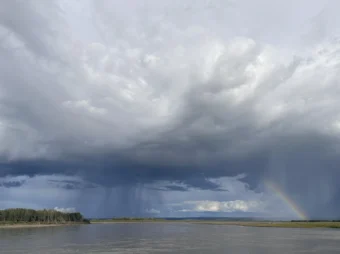
Rain falls along the Yukon River in the Yukon Flats region, where oil company Hilcorp is planning to drill exploration wells this summer. (Bathsheba Demuth)

Later this spring, barges of heavy equipment will pull away from a launch on Alaska’s road system and begin a journey up the Yukon River.

More than 100 miles upstream, a tributary, Birch Creek, branches off.

The equipment’s destination is along that creek, on remote property owned by Alaska Native corporations in a huge basin called the Yukon Flats.

There, an oil company will set up a specially designed rig to drill the basin’s first-ever deep wells, which the landowners hope could lead to the discovery of the state’s next big oil field.

If found, petroleum could create well-paying jobs for Yukon watershed residents and generate big dividend payments for the 20,500 shareholders of Doyon, the for-profit Native corporation for Alaska’s Interior region.

Doyon’s leaders describe the drilling effort as a rare opportunity — one that could deliver a lucrative resource sought from its lands for decades, though never produced.

But the campaign has engendered a broad backlash from tribal governments in the region.

Much of the opposition stems from the track record of the business that will be doing the drilling: Hilcorp, the large, privately held oil company founded by a Texas billionaire, Jeff Hildebrand.

Hilcorp has substantially increased its holdings in Alaska in recent years and now operates the massive Prudhoe Bay field on the state’s North Slope, where it partners with major firms like ExxonMobil and ConocoPhillips.

A Hilcorp drilling rig operates on the shore of Cook Inlet, not far outside Anchorage. The company will use a different rig for its exploratory wells in the Yukon Flats this summer. (Nathaniel Herz/Northern Journal)

But it also has a history of leaks and accidents, prompting fears from Yukon watershed residents about the risks of its new drilling program.

“We’ve seen it so many times, that these big corporations come in and they take and take. They say they’re going to reinvest and it never happens,” said Rhonda Pitka, chief of the tribal government in Beaver, a Yukon River village some 20 miles downstream of the Birch Creek confluence. “What will we end up with at the end of all this?”

Whether the Yukon Flats will support commercial fossil fuel production remains highly uncertain, and likely won’t be known for years. More exploratory drilling will almost certainly be needed to better define a deposit even if Hilcorp finds evidence of petroleum this summer, and the infrastructure to extract and move it to market would require an array of environmental permits.

Even at this early stage, opponents are aggressively fighting the drilling plans. At a meeting last month, Interior Alaska’s consortium of 42 tribal governments, Tanana Chiefs Conference, approved a resolution against oil development by Hilcorp in the Yukon Flats, saying it’s too risky for the “ecologically and culturally significant region.”

But leaders of Birch Creek, the tiny Indigenous community closest to the drilling sites, have endorsed the effort, saying it could produce desperately needed jobs.

Birch Creek’s Native village corporation also owns some of the land where the drilling will take place, and like Doyon, it stands to benefit from a discovery.

“Without the economic activity this exploration project could create, Birch Creek and the other Yukon Flats villages may simply cease to exist, and our way of life will be lost forever,” the community’s tribal government said in a 2020 resolution endorsing the program. Birch Creek’s population is now just 30 people, and its school closed more than two decades ago because it had too few students, according to the state of Alaska.

The support from Birch Creek has given Doyon and Hilcorp the “social license to operate in that area,” Doyon’s chief executive, Aaron Schutt, said in an interview.

If oil is found, Doyon’s agreements with Hilcorp would require the company to hire shareholders and local residents, he added.

Aaron Schutt, Doyon’s chief executive, stands in his Anchorage office. (Nathaniel Herz/Northern Journal)

Schutt said that Doyon’s early leaders, a half-century ago, chose to claim land in the Yukon Flats specifically because of its potential to yield oil and gas.

“We can’t re-select. We can’t undo those deals that were done by our leaders 50 years ago,” he said. “We’re stuck with the hand we were dealt from 1972 to 1975. And we have to balance all of these various constituencies and opportunities and concerns, and do the best job that we can.”

Birch Creek leaders, through a Doyon official, declined to comment. Hilcorp released its own prepared statement saying it’s “excited to work with Doyon and community stakeholders to advance this meaningful exploration project in the Yukon Flats.”

“Together, we are developing a tailored program to responsibly evaluate the region’s energy and resource potential,” said spokesman Matt Shuckerow.

A geologic enigma

The Yukon Flats basin covers more than 10,000 square miles, bounded by the Brooks Range mountains to the north and the White Mountains to the south. The Yukon River sweeps across from east to west, and the trans-Alaska pipeline snakes over the land from north to south.

The basin began forming at least 60 million years ago, according to Marwan Wartes, a veteran geologist with the Alaska Department of Natural Resources.

It’s still sinking today, making it difficult to study. Often, petroleum-rich regions of the state have experienced uplift, producing rocky outcroppings that give glimpses of their geologic histories — but those clues aren’t present in the flats, Wartes said.

A United States Geological Survey map of the Yukon Flats. (USGS)

Experts suspect that the area contains sedimentary deposits that could produce natural gas, or even oil. But no one has drilled deep wells to confirm those theories, so the flats’ subsurface remains something of a geologic enigma.

“When I look at the whole map of Alaska, it always catches my eye, and I always am frustrated that we know so little about it — because it’s mostly burying itself,” Wartes said. “It is a mystery, and I think most geologists would agree to that.”

Today, the region, home to the Yukon Flats National Wildlife Refuge, is important habitat for as many as 2 million migratory ducks, as well as several species of fish. Its salmon and moose have long sustained the region’s Native people, who now live primarily in seven Indigenous villages within or near the refuge.

For nearly two centuries, the Yukon Flats have also been the source of global commodities — starting in the mid-1800s with furs, and continuing with the 1893 discovery of gold in Birch Creek.

The region has never produced oil; nearly all of Alaska’s petroleum comes from the other side of the Brooks Range, on the North Slope.

But Doyon and oil companies have long eyed the flats for its potential, dating back to the years after the 1971 Alaska Native Claims Settlement Act. That federal legislation terminated Indigenous land claims in the state by transferring some 10% of Alaska’s land to newly formed, Native-owned corporations — which, with certain limitations, could choose the land that they wanted.

Doyon, owned by Alaska Natives with ties to the Interior region, became the state’s largest private landowner.

Working at the time with smaller Indigenous-owned corporations connected to the region’s villages, Schutt said, Doyon selected additional land in the Yukon Flats, hoping that it would yield petroleum. The idea was to capture areas with oil potential while also leaving room for the region’s residents to continue their subsistence-based lifestyles.

A view of the Yukon River near the village of Beaver. (Bathsheba Demuth)

Doyon formalized that strategy, Schutt said, in agreements with five village corporations. A 1974 agreement with Beaver’s Indigenous-owned corporation refers to the “potential for oil and gas” in the area around the village, “the development of which would benefit all of the shareholders of Doyon.”

Pitka, Beaver’s current tribal chief, said that oil was not the driving force behind the village’s participation in the Doyon agreement.

“The village corporations picked land for subsistence,” Pitka said. “People were living on the land.”

In the years after the land deals, major oil companies prospected for oil in the Yukon Flats; Exxon even signed an exploration agreement with Doyon. But Exxon pulled out of the region after its major 1989 oil spill near Valdez.

Studies continued, however.

Doyon contractors have collected hundreds of sediment and soil samples throughout the basin. The corporation has also conducted seismic testing, and it collaborated with federal and state agencies that drilled a research well to a moderate depth in 2004. The United States Geological Survey has estimated that the Yukon Flats contain 173 million barrels of oil, with a smaller chance of as much as 600 million barrels.

“This has been a basin that’s been on everyone’s radar as having potential for a long, long time,” said Wartes.

Hilcorp’s involvement began in 2019, when it signed an exploration agreement with Doyon covering some 2,500 square miles of the Native corporation’s land.

Since then, Hilcorp has flown airborne surveys to gather geologic data, and it’s also drilled more than a dozen shallow test wells. Last year, it narrowed its focus, signing oil and gas leases with Doyon that cover 94 square miles near Birch Creek.

This kind of remote oil and gas exploration work, known as wildcatting, is not Hilcorp’s specialty; the company is better known for buying aging oil fields and making them more productive.

“They must see something that really captivates them, because there’s no shortage of oil on the North Slope,” said Phil Wight, an energy and environmental historian at the University of Alaska Fairbanks.

Even Schutt, the Doyon chief executive, said he’s not sure exactly what’s driving Hilcorp’s interest.

“I actually don’t know the answer to that,” he said. “It’s still kind of a mystery.”

A big upside for Doyon

This summer, Hilcorp plans to drill two exploration wells on separate sites.

The company has not publicly announced its plans, but some details have trickled into public view through documents submitted to the state. Hilcorp’s drilling effort requires an array of permits, among them a contingency plan that includes how the company would respond to a blowout.

The locations of the company’s two planned wells are 10 and 15 miles, respectively, from the Yukon River and the village of Birch Creek, according to the permitting documents. The sites will be supported by a worker camp staffed 24 hours a day.

The area is along a lower branch of Birch Creek and is accessible only by barge, helicopter or skiff, depending on water levels. Schutt said the work will leave a light footprint.

“If there’s no further development, those lands will be indistinguishable from the lands next door in 10 years,” he said.

A stretch of Birch Creek above where Hilcorp’s summer wells are planned. (Craig McCaa/BLM Alaska)

Opponents of the plan have focused their efforts on a pending Hilcorp request to state land managers to pump water from Birch Creek and a nearby lake for its drilling operation.

The company says it will take a maximum of half of one cubic foot per second from the creek, which it describes as 0.05% of its flow. Ten different tribal groups have objected, according to their comment letters released by regulators in response to a Northern Journal public records request.

Allowing Hilcorp’s proposed withdrawal “would degrade water quality and jeopardize the ecological integrity of Birch Creek,” said one comment letter, from the Yukon River Inter-Tribal Watershed Council.

“We, the Indigenous Tribes and First Nations from the headwaters to the mouth of the Yukon River, urge the department to join us and put all of our future generations first,” the letter said.

If Hilcorp finds oil, the discovery would likely be just the start of more intense environmental battles to come.

Given the large cost of building a new oil field, construction would only make financial sense if it contained at least 200 million barrels of oil, according to Doyon’s estimates. Tying a development into the trans-Alaska pipeline would entail crossing federal land and require environmental permits that would face stiff opposition.

But for Doyon, the effort is worthwhile because of its big upside, according to Schutt. The company is already invested in the oil and gas industry; it owns a drilling subsidiary that maintains some of the largest rigs on the North Slope.

A new field in the Yukon Flats could produce a “massive royalty check” each year, much of which would be shared with Alaska’s other Native corporations under federal law, according to Schutt. Doyon’s subsidiaries would be in line for contracts to work on the development, he added, and Yukon Flats villages likely could save money by tapping into newly available natural gas for heating.

“It would economically support the whole subregion and Doyon for generations,” he said. “Those are the types of opportunities that don’t come along very often for us.”

Nathaniel Herz welcomes tips at natherz@gmail.com or (907) 793-0312. This article was originally published in Northern Journal, a newsletter from Herz. Subscribe at this link.

Alaska Native corporation’s shareholders question migrant detention contracts

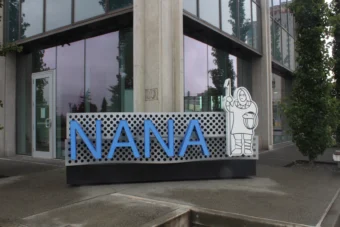
The downtown Anchorage corporate office of NANA Regional Corp. (Lex Treinen/Alaska Public Media)

An Alaska Native corporation’s shareholders are questioning its subsidiary’s lucrative government contracts for migrant detention, while the Trump administration’s immigration crackdown continues.

Akima, a subsidiary of northwest Alaska’s NANA Regional Corp., has faced accusations in national news stories about the poor treatment of migrants at detention facilities it runs. Now, a small but vocal group among NANA’s 15,000 Iñupiaq shareholders want the company to get out of the migrant detention business.
One recent story in the Guardian included a federal inspector’s report of excessive force used on a man detained at an Akima-run center in Texas and poor living conditions at the facility. Another story by USA Today detailed how detained women on buses in Florida were forced to urinate on the floor on their way to an Akima facility, where they were packed into cells and did not have easy access to drinking water. One woman held there told USA Today she wasn’t fed anything for 36 hours.

Akima’s contract to run an Immigration and Customs Enforcement detention center at the U.S. base in Guantanamo Bay, Cuba has also drawn scrutiny.

Jackie Qataliña Schaeffer is a former NANA board member who helped craft a recent survey of her fellow shareholders. She said there had been a lack of transparency from NANA leadership about the ICE contracts, and the survey was meant to gauge how the shareholders felt about the contracts after the recent news about Akima-run facilities.

While a minority of the survey respondents said they supported the contracts or weren’t sure how they felt about them, Schaeffer was unequivocal in her opposition.

“We are Iñupiaq, from the northwest Arctic, that are founded on Iñupiat illitqusait, which is our foundation of who we are,” she said. “And those values do not align with any of this type of work.”

‘Not all money is good money’

The survey circulated on Facebook, and Schaeffer said all of those who responded were verified to be NANA shareholders. More than three-quarters of the roughly 100 respondents said their corporation should not allow its subsidiaries to provide detention services for ICE.

“There must (be) and are other ways to make money in a more positive way for humanity’s sake,” wrote one survey respondent.

“If we want to continue to say we treat people with dignity and respect we must immediately end all relations with ICE and detention centers,” wrote another.

“Not all money is good money,” someone else wrote.

NANA’s communications staff and executive leadership team did not respond to multiple requests for comment this week. The chair of its board of directors declined to comment.

At a recent shareholder meeting, NANA’s leaders disagreed with the notion that Akima should get out of the migrant detention business.

Schaeffer and two other shareholders crafted and distributed the survey, and another shareholder presented the results at the meeting.

Two shareholders who wanted to remain anonymous, because they feared retribution from the corporation, said the chair of NANA’s board of directors, Piquk Linda Lee, defended Akima at the meeting and said staff at the detention centers had NANA’s Iñupiaq values in mind.

The shareholders said Lee also invoked Iñupiat illitqusait – which means “those things that make us who we are” in Iñupiaq – and said NANA and Akima would never treat anyone badly.

“Our employees are trained to recognize the difficulties individuals face and treat them as they would want their family members treated,” reads a slide NANA leadership shared at the meeting.

Led by chief executive Bill Monet, who is also NANA’s chief operating officer, Akima and its subsidiaries comprise NANA’s federal contracting branch. They generate a majority of the Alaska Native corporation’s overall profits, according to information presented at the shareholder meeting. Charts showed that Akima’s revenue each year is often higher than that of NANA’s Red Dog Mine, one of the world’s largest zinc mines, located in northwest Alaska.

Akima brought in about $2.2 billion last year, NANA executives told shareholders at the meeting.

‘Let’s support them as they support us’

Government contracting rules consider Alaska Native corporations to be small businesses, so they have an easier path to getting the contracts. NANA is not the only Alaska Native corporation that has subsidiaries with ICE contracts, but the scope of each corporation’s involvement is difficult to understand because of the many subsidiaries nested within each other. For example, within Akima itself are more than 40 companies, each aimed at getting contracts to provide different government services.

But some of NANA’s shareholders, who are technically the corporation’s owners, were not aware of Akima’s ICE contracts. A little more than half of those who responded to the survey said they did not know the NANA subsidiary was involved in migrant detention.

Still, others who responded to the survey were aware of the contracts and unbothered by the recent news reports, which some called “fake news.” One respondent said the survey questions were based on a prejudiced view of ICE, law enforcement, contracting and the current presidential administration.

“As a NANA shareholder, I am impressed and proud of the work Akima does and trust that Akima employees do their best,” the survey respondent wrote. “Let’s support them as they support us.”

Along with issuing dividends twice a year, NANA helps its shareholders with things like supporting their travel for healthcare, providing scholarships for post-secondary education and awarding grants for economic development in villages.

But Schaeffer, the former NANA board member who helped create and distribute the survey, said she couldn’t understand the viewpoint that shareholders should be proud of what Akima is doing or that the company shared NANA’s Iñupiaq values.

“I honestly can’t be in the skin of those people who say those things,” she said.

There’s a certain grim irony to the detentions and deportations, Schaeffer said, noting that Indigenous people were the original occupants of what became the United States.

“All the rest of America was founded on immigration. Every single person who’s not Indigenous to this land is an immigrant, or they come from immigrants,” she said. “How do you decipher who you choose to send away? The whole concern here is that these are inhumane behaviors coming from our contractors. Regardless, you’re choosing money over humane situations, so money over people.”

Huna Totem’s cruise ship dock proposal heads to Juneau Assembly, with public comments in tow

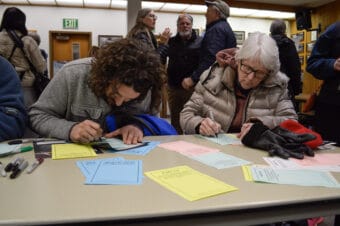
Juneau residents write comments about the plan for Áak’w Landing, Huna Totem Corporation’s proposed cruise ship dock in Juneau at a public meeting on Jan. 22, 2025. (Photo by Yvonne Krumrey/KTOO)

Juneau residents had a chance to ask questions and offer comments on a proposed fifth cruise ship dock at two public meetings this week. The city will soon decide whether or not to approve a tidelands lease to Huna Totem Corporation for the project.

Juneau Tourism Manager Alix Pierce said these meetings give the city a sense of what the community wants and doesn’t want to see in a fifth cruise dock. 

“The lease is the Assembly’s ultimate opportunity to approve or deny the project,” she said. “And right now, our job and goal as staff is to bring something to the Assembly for final consideration that provides our best attempt at something that’s going to be good for the community.”

Huna Totem Corporation is an Alaska Native village corporation. The project is called Áak’w Landing, named after the original inhabitants of the Juneau area, the Áak’w Ḵwáan. 

On Wednesday at City Hall, the plan for the project was laid out with renderings of the proposed building, graphs of marine traffic in the area and a timeline of the project so far, including next steps. The dock would be built on the edge of the downtown area at the corner of Egan Drive and Whittier Street.

The proposal includes spaces for retail and a 40,000-foot Indigenous knowledge, science and cultural center. 

This rendering depicts Huna Totem Corp.’s proposed new downtown development project. (City and Borough of Juneau)

Attendees were given sheets with prompts like “how could the project support and create a more vibrant waterfront for Juneau?”

Concerns ranged from blocked views of the channel to the proposed dock’s distance from downtown businesses.

Attendee Kathy Coghill said it’s important that those leading this decision consider how the project affects the lives of Juneau residents.

“But I think there’s a lot of fear that we can’t ask for a fair shake, because we’re going to scare away the tourists,” she said. “We are not going to scare them away.”

Huna Totem’s Susan Bell said the meetings offered a chance for residents to get reacquainted with the proposal, after an appeal filed in the summer of 2023 stalled it for months. That appeal argued that the proposal didn’t do enough public outreach on the project, among other concerns — especially the availability of shore power.

In 2023, the planning commission approved permits for the dock and the waterfront development. 

“The pace of the project will be at the discretion of the city,” Bell said. “So I think having good turnout and good feedback, they’ll feel like they’re doing their job and making sure that the people have a chance to be informed and engaged.”

Next, the Assembly will review the proposed lease at a future Committee of the Whole meeting, using feedback given this week. There will be further opportunities to give public testimony at that meeting. Comments can also be emailed to assembly@juneau.gov.

Clarification: This story was updated to better reflect the scope of the 2023 appeal and the next steps in the process. 

Tidal Network works to meet FCC’s timeline for Hoonah broadband license

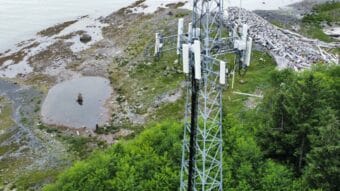
A wireless tower in Wrangell. (Courtesy of Tidal Network)

The Central Council of Tlingit and Haida’s broadband service is working to expand access to a federally awarded broadband service in Hoonah, to ensure they can keep the license.

“It’s important to defend and keep wireless spectrum in Tribal communities to help uphold and preserve sovereignty and infrastructure,” said Chris Cropley with Tidal Network, the broadband service run by Tlingit and Haida. 

He says that digital sovereignty helps keep tribal communities strong. 

Hoonah Indian Association won a broadband bid from the Federal Communications Commission in 2020, thanks to a program that allowed rural tribes to get licenses.

Cropley says high-speed internet from this spectrum service — which uses radio waves to deliver information to and from households — will have to reach 80% of Hoonah’s population in just a couple of years. That’s a timeline set by the FCC.

SnowCloud Services — a Southeast Alaska internet provider — already provides Hoonah with access to high speed internet. 

Chris Ruschmann owns SnowCloud Services. He said the city of Hoonah, tribal organizations, and corporations have worked together since 2014 to build the service for the community.

“Because there’s just never money for it, so we grew it our own,” he said.

Ruschmann says they’ve been able to provide strong and fast connections to everyone in the city. That’s made it easier for kids to go to remote classes, for people to use telehealth, and to retain seasonal employees. 

“We’ve put a lot of effort into allowing people coming from outside of Hoonah, when they come to Hoonah, they still have the amenities that they have elsewhere,” Ruschmann said. 

If Tidal Network doesn’t meet the FCC’s timeline for the federal bid, the awarded spectrum could go back out to auction. Cropley said the network will coordinate with existing services like SnowCloud to get the service out to people. 

Correction: A previous version of this story inaccurately stated that Hoonah doesn’t currently have access to high-speed internet. We’ve added comment from Snowcloud Services and changed the headline.

Chevak hardware store and corporation headquarters destroyed by fire

Flames engulfed one of the largest buildings in Chevak on Jan. 29, 2024. It housed the village’s hardware store and corporation headquarters. (Photo Courtesy Of Chevak Resident Stella Lake)

Chevak Company Corporation President Roy Atchak’s office is on the second floor of a building in Chevak that was entirely engulfed in flames on Jan. 29.

“I’m glad there was only a couple of workers in there at the time it was starting up. We were just going to work,” Atchak said. He was late to work because he was having trouble with his Toyo stove at home.

The local hardware store took up the bottom half of the building. It was owned and operated by the corporation. Shelves were stocked with propane, ammunition, and other highly volatile supplies. And without adequate firefighting equipment to extinguish the blaze, Chevak’s public safety team decided to let the fire burn.

“It’s very important,” said Justina Cholok, who was born and raised in Chevak and works at the corporation’s grocery store just down the street. “People get stuff like washers, dryers, fridge, beds, bed frames, ammo, propane.”

She said that the hardware store was where residents could buy home appliances, parts for snowmachines and four-wheelers, motor oil, and other supplies.

Chevak’s corporation headquarters took up the building’s second floor, one of the largest in the village of nearly 1,000 residents. A landmark for decades, it was visible from almost anywhere.

“It’s gonna be weird going that way because we’re not gonna see that building no more,” said Cholok.

It’s unclear exactly what started the fire that totaled the building.

“It might have started around the furnace or Toyo stove,” Atchak said.

A cold snap has impacted most of the state of Alaska for the past week. Atchak believes that subzero temperatures in Chevak may have contributed to the cause of the blaze.

“Nowadays in villages I know they’re having problems with Toyo stoves, you know: too cold and might have been overworking. I am just speculating without the fire marshal’s verification on what really happened,” he said.

As of the afternoon of Jan. 29, the electricity was out to one section of the community, and residents who live in about a dozen homes were evacuated to the local school. Peter Tuluk, the general manager of the community’s local public radio station, KCUK, said that the station was briefly off the air. The station also serves two other nearby villages: Scammon Bay and Hooper Bay.

Three years ago, fire destroyed an old school building Chevak residents planned to renovate into a community center. In the fall of 2022, Typhoon Merbok damaged nearly all of Chevak’s boats and had a heavy impact on food security in the village. Atchak said that no community is immune to disaster.

“Cup’ik people, they go through hardship in life,” Atchak said. “At the same time, they don’t look back and say, ‘Okay, well I had that, I had this.’ But you just recover, and rebuild, and keep going forward, you know. There’s no such thing as stopping.” He said that’s a Cup’ik value.

According to Atchak, it will be about a week before he has a plan to to set up a temporary office for the corporation. He said that it will be a few months before corporate operations can resume. There’s no plan yet for a new hardware store.

Sealaska Heritage Institute seeks art for this year’s Celebration

Celebration 2018 grand processional June 6, 2018, Juneau. (Photo by Adelyn Baxter)

Sealaska Heritage Institute is seeking Alaska Native artists to pitch designs for Celebration – the every-other-year gathering of Indigenous people in Southeast Alaska. The multi-day event takes place June 5 through 8.

SHI President Kaaháni Rosita Worl says this year’s theme is “Together we live in balance,” and designs should depict that using Northwest Coast style art. The winning design will appear on all Celebration materials, including t-shirts and the event program.

Worl said creating a balance between the different Southeast Alaska Native people in the region is essential to maintaining lasting relationships for future generations. 

“The whole concept of social and spiritual balance is a basic underlying theme or value in our culture,” she said. “We need to have both social and spiritual balance to maintain a healthy society.” 

Worl said balance is an important belief in Lingít culture that goes back thousands of years. An example of that can be seen with the Lingít moieties of Raven and Eagle. She said even today, it’s essential that a balance is struck between the moieties during gatherings. 

“When we have someone from a Raven clan speak, we have to have balance and so an Eagle has to respond,” Worl said. “If we don’t do that, our belief is that, you know, the spirits can go wandering, and cause harm. 

Worl said SHI is asking artists to encapsulate that balance not only between Alaska Native peoples but also in the natural world around Juneau. The sketches of proposed concepts are due Jan. 12 and artists can apply online. The winning artist will receive a cash award.

Site notifications
Update notification options
Subscribe to notifications