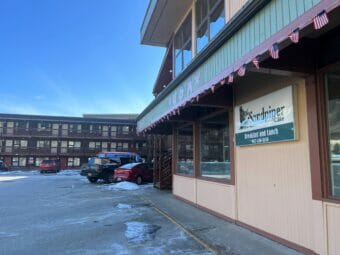
“This was a solid investment with sustainable profit projections and an important land acquisition as the Tribe continues to develop its campus in the downtown area,” Chief Development Officer Will Ware said in a statement.
The acquisition comes two months after President Peterson signed a deed to put a nearby parcel of land into federal trust. The State of Alaska has challenged the federal government’s decision to put the land into trust, saying it violates the Alaska Native Claims Settlement Act.
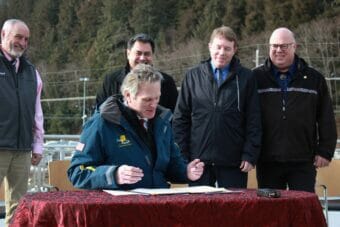
Gov. Mike Dunleavy signs a memorandum of understanding between the state and Goldbelt, Inc., in Juneau on March 9, 2023. (Photo by Katie Anastas/KTOO)
A new ferry terminal at the end of Juneau’s road is one step closer to becoming a reality.
Standing aboard the Tazlina at the Auke Bay ferry terminal on Thursday, state transportation officials signed a memorandum of understanding with Goldbelt Inc., Juneau’s urban Native corporation, to collaborate on construction of a ferry terminal at Cascade Point.
Leaving from Cascade Point instead of Auke Bay could shave 30 miles off the trip from Juneau to Haines and Skagway, reducing travel time on the ferry by an hour and a half or more.
That could be enough time to fit two trips into one day, said Department of Transportation spokesperson Sam Dapcevich.
“This is one of our highest-volume routes,” he said. “The more service we can add between here and there, the better.”
Goldbelt operates Juneau’s tram. Todd Antioquia, chair of Goldbelt’s board of directors, said the partnership between the state and Goldbelt could be a model for other Alaska Native corporations and tribes.
“I think this partnership is illustrative of a really profound future for us, as we look at all the ports throughout the region,” he said. “Every one of our communities has Native institutions that have wisdom, passion, vision [and] infrastructure.”
Now that the memorandum has been signed, the design process can begin. Steven Sahlender, Goldbelt’s vice president of operations for Alaska, said the terminal will meet the needs of both Goldbelt and the state Department of Transportation.
“The memorandum of understanding allows us to negotiate and work with a pre-engineering group to design Cascade Point to the uses of DOT as well as mixed-used space for future opportunities — maybe barges or our vessels to go to the Kensington Mine,” he said.
Gov. Mike Dunleavy said it’s part of a broader effort to improve Southeast Alaskans’ access to the road system.
“This has been a long time coming,” he said. “This is a major step. This is a commitment to see this through.”
Capt. Patrick Phillips on the Tazlina on March 9, 2023. (Photo by Katie Anastas/KTOO)
Captain Patrick Phillips said the ferry trip from Juneau to Haines usually takes four and a half hours. He thinks the shorter travel time and potential for multiple trips per day would increase demand. He said that was the case when the fast ferry ran between Juneau and Haines.
“We had a lot of traffic on the fast ferry because people didn’t have to take their kid out of school for three days to go to Haines,” he said. “We may end up getting more people off the couch and on the ferry with this new terminal. That’s my hope.”
Supporters of the project say there are environmental benefits, too. Duff Mitchell, managing director of Juneau Hydropower and a member of the Juneau Commission on Sustainability, estimates that ferries burn about 250 gallons of fuel every hour. Reducing travel time and distance would reduce emissions.
“When you add that up, the amount of savings is phenomenal over a year,” he said.
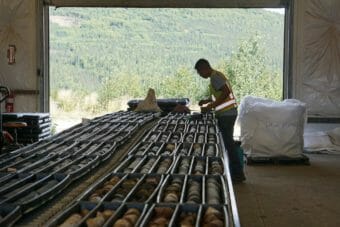
Mine worker Justin Andrew examines and core samples at the Donlin mine camp on Aug. 11. Outside is the hillside that would be dug for its gold if the huge mine is developed. (Photo by Yereth Rosen/Alaska Beacon)
In the rolling uplands of Southwest Alaska’s Kuskokwim River basin is a massive deposit of gold that poses some profound questions about the future of the region’s Yup’ik people and Indigenous people elsewhere in the state.
The Donlin Gold mine, which is on the cusp of being constructed after two decades of exploration and planning work, would be one of the largest open-pit gold mines in the world. A project being pursued by a partnership that includes one of the world’s largest mining companies, Donlin would produce 39 million ounces of gold, operate for nearly three decades and employ hundreds of workers a year, according to the partnership’s plan.
Donlin is especially exciting, say supporters, because of its location — on Alaska Native land, with Alaska Native ownership of the mineral rights, and in a predominantly Native region long plagued by economic woes and public-service deficits.
“That region happens to be one of the places suffering the most significant poverty and infrastructure deficit of any place in America,” Matt Singer, an attorney for the Yup’ik-owned Calista Corp., the Bethel-based regional corporation that owns site’s subsurface minerals, said at a state court hearing this week on a dispute over the mine plan. The Kuskokwim Corp., the Yup’ik-owned village corporation for the area, owns the surface rights.
But Indigenous opponents in the region say the costs of the mine to fish, wildlife and culture, in the form of damaged habitat and long-term pollution, outweigh any potential dollar gains.
“While this area of Alaska is one of the lowest in cash income, it is the highest in community harvest of fish and game resources not only for basic nutrition, but as the bedrock of identity and cultural values for the people of the region,” the Orutsararmiut Native Council, a Bethel-based tribal government, says on a website devoted to opposition to the Donlin project.
While there is much debate over the environmental impacts of the project — which Donlin Gold LLC, the developer, insists can be minimized — a key point of contention is the role that Donlin could play in the economic well-being of all Alaska Native corporations.
The Donlin Mine airstrip, with the camp at the far end, is seen from the air on Aug. 11. The mine site is in the hilly terrain near the Southwest Alaska’s winding Kuskokwim River. (Photo by Yereth Rosen/Alaska Beacon)
Should Donlin go into production, all regional and village Native corporations would be entitled to some of the revenues. That is because of a provision in the 1971 Alaska Native Claims Settlement Act that directs 70% of the profits from natural-resource development by one corporation to be shared among all the 12 regional Native corporations. Related to that profit-sharing provision, called 7(i) after its legal nomenclature, is another provision called 7(j) that mandates redistribution of shared profits from regional corporations to the smaller corporations representing Alaska’s approximately 200 villages.
The profit-sharing is unique among Indigenous institutions in the world, and it is intended to reflect Alaska Native values of sharing and community.
The revenues are critical to some corporations to “keep their lights on and their doors open,” Kristina Woolston, external affairs manager for Donlin Gold LLC, said during a tour of the mine site last summer. “This is really the project on the horizon that could have the biggest impact on the intent of ANSCA.”
But Beverly Hoffman, a tribal elder in the region, contends the promise of wealth distribution is giving false hope.
“It sometimes hurts my heart, sitting here in my home in Bethel, Alaska, to know that there’s revenue sharing and the way corporations are set up,” she said in a telephone interview. Her view, after collecting what she characterizes as paltry corporate dividends over decades, is that 7(i) revenues tend to wind up concentrated in corporate offices rather than in the regions where shareholders have needs.
“Turn around and look at the corporate salaries,” she said. “Who’s really going to benefit? Me, my people, the shareholders? Absolutely not,” she said. “
Donlin’s potential role as a profit-sharer is highlighted by the case of another mine: the Red Dog Mine, which began production in 1989. Long one of the world’s biggest zinc producers, Red Dog operates on property owned by NANA Corp., the regional Native corporation for the Inupiat people of Northwest Alaska.
Through 2021, Red Dog had produced a cumulative $1.6 billion in 7(i) payments to other Native corporations, along with the more than $1 billion in revenue that went directly to NANA. That is aside from payments to the state and borough in taxes, shareholder wages and other economic benefits.
A group photo from a “No Donlin” march held in Bethel in 2018. (Photo provided by Mother Kuskokwim coalition)
Red Dog profits are among the dominant sources of 7(i) revenues, though Native corporations’ North Slope oil profits have been the top contributors, according to a 2018 study conducted for the ANCSA Regional Association. Red Dog’s role has grown over the years. Until about 2004, total 7(i) profit sharing was usually under $50 million a year, but the total jumped in the years following to four to six times that amount, thanks in part to the way increased zinc prices boosted Red Dog’s profitability, according to the study.
But Red Dog is aging, and the mine’s NANA-owned resources are expected to be depleted by 2031. Plans are for the mine to live on and continue producing revenue for the region and its employees; NANA and the company’s corporate partner, mine operator Teck Resources, are seeking to extend operations to different zinc deposits located farther inland. However, those deposits, called Aktigirup and Anarraaq, are on state land, where production would yield no 7(i) or 7(j) revenues to be shared.
Donlin, if developed, would do much to fill in the gap expected to be created by the loss of NANA’s Red Dog distributions. Not only that, but it would also provide enough revenue to fund a level of local government in the region, which currently lacks any borough-level structure, according to a report from the University of Alaska Anchorage’s Institute of Social and Economic Research.
Like some other development projects that affect Alaska’s indigenous people, the Donlin debate has exposed a schism between corporations, many of which favor the project, and tribal organizations, many of which oppose it. Some organizations are addressing the schism by being officially neutral, including the Bethel Native Corporation, where Hoffman won a board seat last May.
The relationship of money to the traditional subsistence lifestyle comes up in the debate.
Even in its exploration phase, the mine has been an economic boon in the region and “one of the most successful Alaska Native-hire businesses in Alaska,” said the ISER report. It said that 90% of those hired at the 200-person Donlin camp are Native corporate shareholders.
Yago Jacob of Napaskiak, one of the Calista shareholders employed at the Donlin Mine, holds up a sliced piece of a geological core on Aug. 11. About 90% of the workers at the mine’s camp are shareholders of the Native corporation that owns the mineral rights, a high rate of hire that has won praise. (Photo by Yereth Rosen/Alaska Beacon)
Generating such personal income is important even to those pursuing traditional subsistence lifestyles, mine supporters argue.
One Alaskans who is looking favorably at Donlin is Willie Hensley, an architect of the Alaska Native Claims Settlement Act and a longtime leader from the NANA region that has benefitted from Red Dog. He said he is impressed with Donlin’s planning and outreach, and that it is unrealistic to dismiss the economic payouts that Donlin could provide, even from a traditional perspective.
“It takes money to be on subsistence,” Hensley said. “You can’t take a boat trip up and down the river for moose and not pay $10 a gallon.”
Opponents see the promise of Donlin money as destructive.
“This is a make-or-break deal for the Yup’ik culture as a whole and goes against every ounce of our culture,” said Sophie Swope, the director of an anti-Donlin coaltiion called Mother Kuskokwim and a newly elected member of the Bethel City Council.
Among those who say the mine’s costs are overlooked is the Yukon-Kuskokwim Health Corp., which in 2016 passed an anti-mine resolution that acknowledged the promised revenues but cited the “extreme hazards and excessive risks it would pose to the health and welfare of the people of the Yukon-Kuskokwim Delta Region.”
Beverly Hoffman, far right, poses with fellow opponents of the Donlin Mine in Bethel. The mine is proposed for development in the hilly terrain near the Kuskokwim River. (Photo provided by SalmonState)
Positions are also mixed among elected officials who are highly regarded by Yukon-Kuskokwim residents. U.S. Sen. Lisa Murkowski favors the mine, for example, while Tiffany Zulkosky, a former Bethel mayor who represented the region for two terms in the state House, is an outspoken opponent, as is her successor, newly elected state Rep. C.J. McCormick.
Some people and organizations have changed their positions over time, like the Association of Village Council Presidents, a consortium representing 56 tribes in the Yukon-Kuskokwim Delta. The association in 2006 announced its support for the mine but in 2019 passed a resolution rescinding that support.
Even within families and among close friends in the region, Donlin is a divisive subject. That includes Beverly Hoffman’s family.
Pete Kaiser, who in 2019 became the first Yup’ik musher to win the Iditarod Trail Sled Dog Race, is related to Hoffman by marriage, for example. He is sponsored by Donlin — support that is in addition to the mining company’s role as one of the main sponsors of the race — and that makes for some awkwardness reminiscent of the way national political polarization has affected personal relationships.
“His mother and I are close friends,” she said. “We don’t really talk about Donlin. It’s like Trump for some people.”
Oliver Aveogan Leavitt speaks at the 2007 Alaska Federation of Natives convention. (Courtesy ASRC)
Alaskans are mourning the loss of a North Slope leader who grew up running sled dog teams to collect firewood along the Arctic coast and came of age in the time of snowmachines, borough governments and Native corporations.
Oliver Aveogan Leavitt died Sunday at the age of 79.
Oliver Leavitt was a whaling captain and a cultural beacon for his people, fluent in Inupiaq and known for his ability to make skin whaling boats, or umiaks, without a blueprint.
Richard Glenn, an executive vice president at the Arctic Slope Regional Corp., called Leavitt his mentor. The two men served together on the board and in management roles.
“Without a piece of paper in your hand, to go from dimensional woods, hard woods, to end up with a whaling boat is a skill,” he said.
Glenn said he admired Leavitt for his ability to fight for his region — and to move comfortably from the boardroom to both the whaling camp and the halls of Washington, D.C.
In a break from the Arctic Slope Regional Corp. boardroom, Oliver Leavitt plays cards and laughs. (Courtesy ASRC)
“He was adept at it. He made it effortless,” Glenn said. “He has a diplomat’s skill, but he also has a hard-won, nuts-and-bolts kind of education.”
Leavitt used that education to help turn ASRC into Alaska’s largest private company.
Former Democratic state Sen. Willie Hensley, a leader in Alaska Natives’ land claims fight, met Leavitt when he got out of the Army.
“I’ve known him for 50 years,” Hensley said.
After Leavitt’s military service, Hensley said, he dedicated himself to a life of public service — working to form a new borough, teaming up with other leaders to turn ASRC into a company that earns billions in revenues every year.
“He was persistent,” Hensley said. “And in order to do the things he had to do, he had to work hard and practically camped in Washington, D.C.”
Oliver Leavitt at an early Alaska Federation of Natives caucus. (Courtesy ASRC)
Hensley said one of Leavitt’s biggest accomplishments was his battle to help the North Slope Borough gain access to a gas field controlled by the U.S. Navy. That access enabled the borough to bring heat and power to homes in the region.
Although Hensley was from Kotzebue, a community on the northwest coast of Alaska, he said the two men bonded over their upbringing — growing up in a time when there were no modern amenities, just lots of hard work.
“The reason we are good friends: I understand exactly what he was saying,” Hensley said.
Hensley said Leavitt was passionate about improving life in the Arctic. Although they didn’t always agree about how to do this, their friendship endured. Hensley was at Leavitt’s side to offer comfort when he died in his home village of Utqiaġvik, surrounded by loved ones.
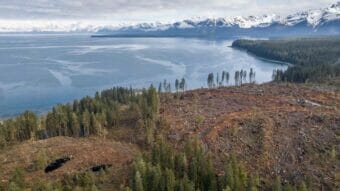
Clear-cut logging site at Humpback Creek near Yakutat. (Courtesy of Defend Yakutat)
Controversy over a logging project near Yakutat in Southeast Alaska has intensified. The local tribe, an archaeologist and others say a site that’s being logged is home to centuries-old ruins that could provide clues into the history of Southeast Alaska’s Indigenous people.
Yakutat elder Victoria Demmert says her ancestors — for hundreds of years — harvested the abundant salmon that returned to Humpback Creek every summer.
“I don’t know how you could live here, grow up here and not know,” said Demmert, a council member for the Yakutat Tlingit Tribe.
Just this past August, the tribe passed a resolution calling the site sacred and culturally historic. Elders like Demmert and anthropologists say the tribe purchased the site from previous inhabitants hundreds of years ago. Tom Thornton with the University of Alaska Southeast visited the site in August and found “there is evidence of house remains and culturally modified trees and other landscape features.”
So Demmert says she was taken aback when she learned that the local Native village corporation, Yak-tat Kwaan Inc., had begun clear-cutting the forests around Humpback Creek. She says the company never publicly announced that its subsidiary, Yak Timber, planned to log the area.
“We had to find out by seeing what was going on,” Demmert said. “And then seeing some drone footage of it in addition to pictures that were being taken.”
This is an aerial view of the logging near Humpback Creek. The yellow circles indicated boulders found at the site. The black lines represent rock walls. (Courtesy of Defend Yakutat)
In a Dec. 8 letter to Yak-tat Kwaan, the tribe called on the company to stop logging the area. The tribe wants time to investigate the site.
“We know we had a village there,” Demmert said. “And we know there are historical sites there, and we want Yak-Tat Kwaan to stop and let archaeologists get in there before everything’s destroyed.”
Now there’s physical evidence of the history, says Sealaska Heritage Institute. That’s the regional Native nonprofit organization dedicated to preserving the history and culture of Indigenous people in Southeast.
A Yak Timber equipment operator found what could be several house pits and a series of parallel stone walls at the site being logged. That was at the beginning of December.
The institute announced the findings in a joint news release with the Yakutat Tlingit Tribe and Sealaska Corp. on Dec. 15. The groups called on Yak Timber to stop logging the area until it can be investigated.
“There are cultural and spiritual dimensions of it, that’s really important to us,” said Rosita Worl, the institute’s president and a Ph.D. anthropologist. “The rock wall…I’m just so curious about what, what is that? What kind of fishing occurred with that rock wall?”
Stone wall found near Humpback Creek. (Photo courtesy of Defend Yakutat)
In the joint news release, he says “A remarkable set of cultural features related to salmon harvesting appears to be preserved. . . cultural layers at the site could provide a unique record of traditional lifeways and subsistence practices extending back 700 years. Although part of the site has been clearcut, the cultural features do not appear to have been substantially damaged, and their future preservation should be a high priority.”
But later in the fall, Yak Timber reversed course and started logging near Humpback Creek.
“Yak Timber is harvesting. We’ve been harvesting,” said Marvin Adams, CEO of Yak Timber, on December 13, two days before Sealaska Heritage announced their findings. He says the site has never been documented as historic and was approved by the Alaska Division of Forestry after they inspected it in 1975. A 2007 letter (page 1, 2) from Sealaska Corp. discussing historic sites did not identify the area either.
After the findings were announced, Adams said he had yet to be formally notified of Humpback Creek’s cultural significance. He said the company would follow all relevant laws and regulations, but declined to say whether Yak Timber would continue logging the area.
“Obviously, we’re not going to go over some historical site to destroy it,” Adams said. “I think we all respect that. But right now, I have not been able to get any documentation from the tribe or anybody else.”
He points to the work of anthropologist Frederica de Laguna. She researched and wrote extensively about the Yakutat Tlingit Tribe from notes she gathered in the 40s and 50s.
Adams says she never mentioned Humpback Creek as a sacred site.
“If there was actually a historical site and a settlement there, I can assure you that that would have been listed and the specific house and the clan house that was supposed to be there would have been listed,” he said. “But it never was.”
But Demmert sees it differently. Though de Laguna’s work doesn’t go into detail, she says the anthropologist’s notes do mention Humpback Creek as an important salmon-harvesting site. It’s where her people Kwaashk’iḵwáan got their name, which means “people of the Humpback Creek.”
“It’s part of our history, it’s part of who we are,” Demmert said. “And to see it desecrated. . . it just hurts spiritually and physically. It just breaks our heart and brings tears.”
Worl, the Sealaska Heritage president, says the tribal groups are working with Crowell and the state to see how they can investigate the site further.
Aerial view of the trees in the Tongass National Forest (Photo courtesy of Elizabeth Graham/National Forest Service)
Alaska’s state government raises hundreds of millions of dollars each year through the sale of oil that when burned contributes to climate change. Now the state is looking to also make money by preventing some of these gasses from entering the atmosphere.
Gov. Mike Dunleavy plans to introduce a bill this upcoming legislative session aimed at turning the state’s capacity to absorb and store carbon into a source of revenue. And he said it could bring in several hundred million to a billion dollars in revenue a year.
“Alaska has a real opportunity to sequester carbon in many different ways in the state – through our forests, through our depleted oil and gas basins, as well as the potential for seaweed sequestration off our coasts,” Dunleavy said during a press briefing Thursday where he and his cabinet released the proposed budget for the fiscal year that starts in July 2023.
Carbon sequestration is the process of capturing and storing atmospheric carbon dioxide, which is the most commonly produced greenhouse gas. Sequestration is one method of reducing the amount of carbon dioxide in the atmosphere.
Dunleavy said Alaska’s depleted basins, like Cook Inlet, are perfect places to sequester carbon. He said Cook Inlet could store upwards of 50 gigatons of carbon.
“As a matter of fact, Alaska probably has more capacity to sequester carbon underground than anywhere on the West Coast,” he said.
Dunleavy also mentioned Alaska’s forests and coastlines as assets for carbon monetization. Tree and forests take in carbon dioxide from the atmosphere, and that absorption can become carbon credits that are sold to companies interested in offsetting environmental impacts. Alaska Native corporations, like Sealaska and Ahtna, developed forest carbon projects several years ago. And research has shown seaweed cultivation could be a carbon removal strategy.
Dunleavy said the bill he plans to introduce this coming session will be a starting point to figure out what carbon sequestration would look like in the state and explore things like how the state can contract with companies and other entities, what’s in the contract, and what lands, basins and coastlines could be involved.
Meredith Trainor, executive director for Southeast Alaska Conservation Council, said the organization is encouraged to hear the governor thinking about the opportunities presented by carbon sequestration in Alaska, “but, of course, the devil is in the details.”
“From our perspective at SEACC, the easiest way to increase carbon sequestration in Alaska is to protect the Tongass National Forest. That’s not necessarily up to Gov. Dunleavy, but seeing the governor think more broadly about ways to protect forested areas over which the state does have influence would be critical, although we think it’s equally as important that the governor not seek to remove land from federal holdings in the process of doing so,” Trainor said.
Dunleavy said he hopes to see action on a broad bill that will enable the state to start to entertain potential contracts with entities. No potential entities at this point have been identified, his office said later.
The multi-year revenue option “doesn’t gore any ox,” Dunleavy said.
“For years the conversation on revenue was: Whose ox are we going to gore? Are we going to do an income tax on the people of Alaska. Are we going to do corporate taxes? With the advent of the monetization of carbon, we have a real possibility of receiving revenue that doesn’t gore any ox,” Dunleavy said.
No revenue from carbon sequestration is included in the proposed budget, but a target for potential new revenue is included in Dunleavy’s 10-year plan. It imagines $300 million in fiscal year 2024, $500 million the next year, increasing to $750 million the year after, and leveling out at $900 million in subsequent years – revenue that would help balance out what is needed to keep the state functioning.
State Sen. Bert Stedman, R-Sitka, doesn’t think revenue from carbon sequestration will come in that quickly.
“That’s a big issue that’ll take quite a bit of analysis and discussion,” he said. “My guess is it’s a two-year process.”
Stedman said successful legislation could create an opportunity for “multigenerational contracts” between the state and investors, so lawmakers should be careful.
“If we make a mistake, it could be very expensive for the development opportunities,” he said.
James Brooks contributed reporting to this story.
Close
Update notification options
Subscribe to notifications
Subscribe
Get notifications about news related to the topics you care about. You can unsubscribe anytime.