Alaska Native Corporations

Juneau residents get a closer look at the proposal for Aak’w Landing

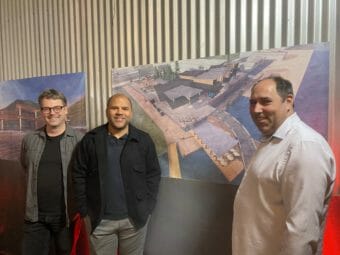
Corey Wall, Russell Dick, and Mickey Richardson stand with color renderings of what future development on Juneau’s waterfront could look like. December 2, 2022. (Photo by Claire Stremple/KTOO)

Juneau residents got to see huge, color posters of what future development on the city’s waterfront might look like. Not at a municipal meeting, but at a local bar during Gallery Walk.

In August, Huna Totem Corporation — a Juneau-based village corporation that represents Hoonah shareholders — announced an agreement with Norwegian Cruise lines to develop what’s known as the subport, next to the U.S. Coast Guard Station downtown.

HTC is calling the development Aak’w Landing. Large, full-color conceptual designs for what it could look like lined the walls of a back room at The Crystal Saloon on Friday night.

Organizers of the event said the goal was to allow more of the public engage with the plans. Huna Totem CEO Russell Dick credited Mayor Beth Weldon with the idea.

“Not everybody tunes in to the Assembly meetings,” said Dick. “So getting out here and experiencing it in this fashion and listening to folks talk about it — things they like, things they don’t like — it’s a good way to do it.”

Bluegrass concert-goers from the other room meandered through the images, with cocktails. Some chatted with Huna Totem leadership or one of the architects behind the drawings.

The event pulled John Hillman and his wife off the street while they were enjoying Gallery Walk.

“Walking by, we saw the Huna Totem sign here. We didn’t know it was gonna be here,” he said.

Hillman and his wife are shareholders, so they popped inside.

“Well, it’s exciting,” said Hillman. “Finding out for the first time what it’s going to look like and all that, and meeting with the guy that’s planning it and knowing Russell since Russell was a little young man himself, and now he’s leading the charge.”

They sipped wine and toured the images with Corey Wall of Juneau design firm Jensen Yorba Wall. Wall said the firm has been working with Huna Totem for nearly two years.

He said the current design will include elements from Norwegian Cruise Lines’ original plan for the lot.

“I think a lot of people are just trying to see now, with Huna Totem taking it over, if it’s still going to be a similar project,” he said. “And I think people are very happy to see that we still have the below-grade bus parking, and we’ve got the park over the top of it.”

Huna Totem aims to complete construction on a 10,000-foot visitor center and a new cruise ship berth with a curved trestle by 2025. Wall said cruise ship infrastructure and parking will be hidden by retail and landscaping. There’s also room in the plans for 35,000 feet of what the company calls “flex space,” which could be anything from apartments to an ocean center that could be constructed later.

That’s the plan, but there are many steps to go in the public process. There will be more opportunities for feedback on a project of this magnitude.
“The Juneau waterfront is complex,” said Alexandra Pierce, CBJ’s Tourism Director. “We need to make sure that all the uses on our working waterfront are accommodated.”

After Huna Totem Corporation submits its request for a conditional use permit, the project will begin the public process. City meetings will determine if the plans comply with code, then Assembly meetings will determine if the project serves the whole community. The Assembly will have the final say over whether the project can make use of the city’s tidelands property or build a new dock.

“It’s exciting to see the possibility of something happening there,” Pierce said. “And it’s our duty at the city to make sure that if that site’s developed, it’s developed in a way that is positive for the community.”

Huna Totem Corporation estimated that more than 450 people filtered through Friday’s event. Architect Corey Wall looked around the room at his designs.

“I think people are really excited about the park, and the idea that that’s gonna be something for Juneau,” Wall said.

More than a dozen images show intricate plans to keep tour buses out of view and scenic outlooks from big-windowed buildings.

“It looks probably far more finished than it is,” he said. “It’s still very, you know, malleable, depending on the feedback we get.”


This article has been updated to correct the spelling of Juneau design firm Jensen Yorba Wall.

Plans move forward for Goldbelt investing $10M in Eaglecrest’s gondola project

gondola in Galsterberg 04 2022
Eaglecrest Ski Area General Manager Dave Scanlan was at a ski area called Galsterberg in Austria in April 2022 to inspect this gondola system. Eaglecrest is buying the system and having it shipped to Juneau. (Photo courtesy of Dave Scanlan/Eaglecrest Ski Area)

In March, Goldbelt, Inc. offered to invest in the gondola system the City and Borough of Juneau bought from Austria for Eaglecrest Ski Area. At an assembly meeting this week, Goldbelt and the assembly hashed out what that deal would look like.

What they’re working on is a revenue sharing agreement. The city has spent over $2 million so far. Goldbelt will contribute $10 million to the project and would get between 10-25% of gross revenue the gondola makes. 

The deal lasts 25 years, and Goldbelt will take a share of the profits of ticket sales over that time, with a goal of getting $20 million back from their investment. If that takes longer than 25 years, the city and Goldbelt can extend the agreement. 

The agreement says the opening day for the gondola will be May 31, 2027. If that doesn’t happen, Goldbelt can back out.

The proposal aims to have 75,000 visitors to the gondola in the first year. That’s about 750 tourists a day during the summer months. Juneau city manager Rorie Watt said he thinks having a partnership with Goldbelt would help reach that number.

“If it was CBJ going it alone, I would not be very comfortable,” he said.

He referenced Goldbelt’s experience operating the tram and said, “I think [it’s] quite plausible, and small, really, in the context of the number of visitors that come.”

McHugh Pierre, Goldbelt’s president and CEO, said the gondola at Eaglecrest offers future visitors something the current Mt. Roberts tram does not: more access to outdoor sports.

“We’re not going to have mountain bikes on Mount Roberts. Goldbelt Tram is never going to authorize that,” Pierre said. “But we could see in the future where you might be riding a mountain bike down Eaglecrest. And so those are some of the things that we’re excited about.”

Pierre said he believes this partnership will pan out.

“We think this is a really great opportunity to participate,” he said. “And we believe 75,000 visitors in the first year is acceptable and doable.”

Pierre predicts tickets will cost around $100.

The next step on the gondola project is to formally introduce an ordinance to the assembly on Dec. 12, followed by public commentary in January.

Sealaska to pay $15.4 million in shares

This chart shows Sealaska’s growth in operations and shareholder permanent fund in recent years. (Image from Sealaska)

Southeast Alaska’s regional Native corporation plans to distribute $15.4 million to its shareholders November 9.

Sealaska has approximately 23,000 shareholders who are Lingit, Haida and Tsimshian people living in Southeast Alaska and elsewhere. The for-profit corporation is based in Juneau.

The amount of the dividend per shareholder ranges from $374 to $695 per 100 shares and depends on the class of shareholder.
About half of Sealaska’s payout ($7.6 million) comes from operations income. The other half comes from natural resource revenue sharing funds ($5.1 million) with the Alaska Native Claims Settlement Act Section 7(i) and the Marjorie V. Young Shareholder Permanent Fund ($2.8 million).

While the ANCSA funds are more volatile, the shareholder permanent fund has seen steady earnings in recent years. The corporation’s operations have seen increased profits the last seven years.

In a press release, Sealaska CEO Anthony Mallot said the corporation’s dividends remain solid despite the economic volatility seen across the globe.

“I think we’ve all been feeling the impact of the tough financial market we’re currently in. But because of the way Sealaska dividends are structured, with the five-year averaging of operations income and the permanent fund, we can help limit large movements in the dividend during years like this one, where investment markets face significant decline,” he said in the statement.

The fall dividend brings the year’s total payout to shareholders to $36.7 million. $21.3 million was paid out in April.

Norwegian Cruise Line is giving a Juneau waterfront parcel to Huna Totem after buying it for $20M

A large, mostly empty waterfront lot with Gastineau Channel in the background
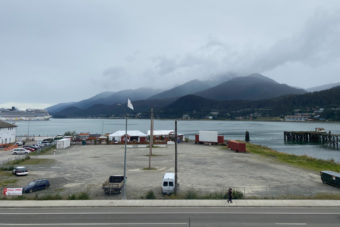
Part of the Juneau waterfront area known as the subport on Aug. 23, 2022. (Photo by Claire Stremple/KTOO)

Norwegian Cruise Line Holdings spent $20 million for nearly three acres of prime waterfront property in 2018, beating out the City and Borough and Juneau and other bidders with an offer that was more than five times the appraised value of the land.

Yesterday Norwegian gave that property to Huna Totem Corporation, an Alaska Native corporation tied to Hoonah that’s headquartered in Juneau.

Norwegian shared its ideas for the property in 2020, but it hasn’t been developed yet. Huna Totem plans to work with Juneau-based Goldbelt, Inc. and other Alaska Native corporations to complete the project.

“This is an astonishing gift for Juneau and our Goldbelt shareholders,” said Goldbelt President and CEO McHugh Pierre in a press release. “Giving ownership back to the Tlingit people is a tremendous way to honor the culture of this community.”

Mickey Richardson, Huna Totem’s head of marketing and public relations, said the corporation likes to invest in local projects, and the majority of its shareholders live in Juneau.

“Being locally owned and operated, we hope that the project will reflect the values of the Native people from Juneau and also the community of Juneau,” he said.

The corporation aims to submit plans to local planning officials for a tourism facility and dock by the end of the year. Richardson said the goal is to complete the project for the 2025 cruise season.

Alexandra Pierce, Juneau’s tourism director, says the change is unlikely to lead to an overhaul of Norwegian’s concept.

“We have been told that they’re planning to maintain the core elements as presented to the community: the underground parking, public open space and ocean center,” she said. “But we haven’t seen a revised plan yet.”

Pierce has worked with Norwegian on its plans since the company purchased the property. She said Huna Totem will need to show the Juneau Planning Commission that its plans are consistent with the goals and criteria set forward by the Visitor Industry Task Force.

She says the next step for Huna Totem will be to apply to the Planning Commission for a conditional use permit. That will be the public’s next opportunity to provide comments.

Huna Totem and Goldbelt still need permission from the city to develop and operate in the city-owned tidelands around the property. The Coast Guard and NOAA must also be on board if the project impacts their water access.

Pierce said she’s looking forward to having a definitive answer on what development at the parcel will look like so the city’s own long-range planning can move forward.

“We’re just looking forward to having an answer, yes or no, on this project,” she said. “We have a lot of plans and ideas that hinge on whether or not a fifth cruise ship dock is constructed.”

Norwegian did not immediately respond when KTOO asked why the company gave away land it spent millions to acquire. But in a press release, a Norwegian executive said the company wanted the project to be integrated with the local community and that it became “abundantly clear” that Huna Totem should lead the effort.

Norwegian and Huna Totem have worked together before. This March the companies agreed to develop a dock in Whittier.

This is a developing story and may be updated.

Alaska Federation of Natives convention will be held in person for the first time since 2019

U.S. Sen Dan Sullivan addresses the Alaska Federation of Natives Convention, Oct. 15 (Photo by Mikko Wilson/KTOO)
U.S. Sen Dan Sullivan addresses the Alaska Federation of Natives Convention on Oct. 15, 2016. (Photo by Mikko Wilson/KTOO)

The Alaska Federation of Natives convention will be in person for the first time in three years this fall.

The annual three-day gathering of the state’s largest Alaska Native organization was held virtually in 2020 and 2021 due to the COVID-19 pandemic. The last in-person convention was in 2019 in Fairbanks.

Holding the convention in person will mean the return of art vendors and nightly Quyana performances from Alaska Native dancers.

AFN represents members from 11 of the 12 regional Alaska Native Corporations and more than 191 federally recognized tribes. Conventions typically include panels on topics related to Alaska Native people, appearances from state and federal officials and debates between political candidates.

This year’s convention will be held from Oct. 20-22 at the Dena’ina Center in Anchorage. The theme will be “Celebrating our Unity.”

Blood quantum requirement dropped for Sealaska Corporation enrollment

A Sealaska corporate logo adorns the roof of the Southeast Alaska Native corportation's headquarters in Juneau on May 2, 2018.
A Sealaska corporate logo adorns the roof of the Southeast Alaska Native corporation’s headquarters in Juneau on May 2, 2018. (Photo by Jeremy Hsieh/KTOO)

Sealaska Corporation shareholders have voted to get rid of the blood quantum requirement for enrollment. The vote was tallied at the annual shareholders meeting in Juneau on June 25.

The change means descendants of original shareholders no longer need to prove they have onequarter Native blood to become a shareholder, which was a requirement set by the Alaska Native Claims Settlement Act in 1971.

“It was super exciting to see the vote,” said Angela Michaud.

Michaud is a corporation board member and was the first person to enroll after the vote. Previously, she had just one share gifted from her grandmother. This new enrollment gives her 100 more shares, which will last her lifetime.

But she was most excited for her four children, who can also enroll when they come of age.

“When my kids get 18 they’ll also be a part of this,” Michaud said. “It means that you’re able to be part of it and that you’re Native enough. It didn’t matter that your parents or grandparents married somebody who wasn’t Native. You’re still Native.”

ANCSA limited shares to those enrollees born by 1971. After that, descendants had to be gifted original shares or, starting in 2007, get a different class of shares known as descendant shares. But they still had to prove a quarter Native blood.

Board President Joe Nelson says it’s an issue he’s heard a lot about from shareholders, which he understands personally as well. While he was an original shareholder, his sister, born a few years later, wasn’t. He calls the 1971 ANCSA cut-off date arbitrary and the blood-quantum requirement archaic.

“The blood quantum issue itself continues to literally divide families pretty quickly and within a few generations the pool of eligible descendants would be dwindling,” Nelson said.

Now, people just need to prove they are descended from an original shareholder through a birth certificate.

Sealaska Corporation has 23,000 shareholders who are Lingít, Haida, and Tsimshian people with roots in Southeast Alaska. Many now live elsewhere.

Not all of them agree with the change. 40% of shareholders did not support dropping the blood quantum requirement.

Vikki Mata was one of them. She’s a former Sealaska communications vice president. She says the change devalues shareholders’ dividends and voting power.

“If you add more shareholders, then the voting strength of the current shareholders is diluted,” Mata said.

Mata is an administrator of the social media group, Shareholders of Sealaska, that includes 6,000 members. She says many dissenters agreed that the blood quantum issue needed to be talked about. But she says the vote was rushed — shareholders had 6 weeks to consider the question — and the timing was bad.

“Food prices, gas prices, everything is hitting all at once, so every dollar counts when it comes to making ends meet, especially those on fixed income and our elders,” she said.

Sealaska shareholders are paid dividends twice a year. Original shares pay more than those allocated to descendants. That’s due to a formula sharing natural resource earnings among regional Native corporations.

The corporation predicts that approximately 15,000 shareholders over a 20-year period would be eligible to enroll with the loosened requirements.

Sealaska Corporation is the third of Alaska’s 12 regional Native corporations to eliminate the blood quantum requirement.

Site notifications
Update notification options
Subscribe to notifications