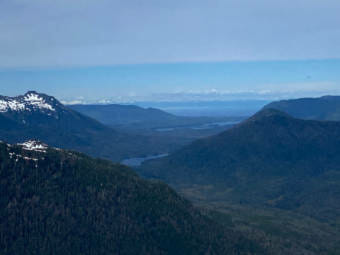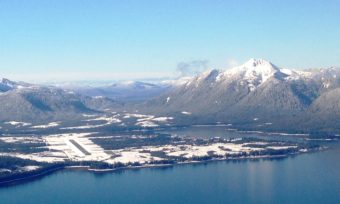
Petersburg seen from the air in February 2014. (Photo by Ed Schoenfeld, CoastAlaska News)
Five communities in Southeast Alaska were left out of the Alaska Native Claims Settlement Act: Ketchikan; Wrangell; Petersburg; Haines and Tenakee Springs, and it’s left more than 4,000 Native people in the region without land.
Getting land to these communities was a big theme during the 87th Tribal Assembly meeting of the Central Council of the Tlingit and Haida Indian Tribes of Alaska this week.
Cecelia Tavoliero is from Petersburg and part of the organization Alaska Natives Without Land. She said getting Native land into Native ownership is a win for all Native people. And the land back movement has helped the cause.
“Land back has highlighted important issues like ours and has helped us build awareness, and even support, from among groups historically opposed to a land solution,” Tavoliero said.
The controversy is around the land selections landless communities have made. The communities want to get land as close to home as possible, but selections are limited and people in neighboring communities — and groups outside of Alaska — have doubts about some of the selections.
But Tlingit and Haida citizens want progress to be made. Delegates repeatedly brought the issue up with the tribe and with Sealaska, the regional Native corporation.
Delegate Joe Williams Jr. of Saxman urged the tribe and the corporation to make this the year that the landless people get their land.
“As the Alaska Native Claims Settlement Act in 1971 was made history, we once again need to make history for our very own people,” Williams said.
Jaeleen Kookesh is a vice president at Sealaska. She said that this issue has been a top priority for Sealaska and that the lack of success isn’t from a lack of trying.
She has met with legislators and groups concerned with the land selections. She said that they need the help of tribal citizens in key states that have representatives in the Natural Resources Committees in the House and Senate. Especially Senator Maria Cantwell of Washington and Representative Raúl Grijalva of Arizona.
“Mainly because they want to protect the Tongass and keep those lands in public ownership as opposed to Native ownership,” Kookesh said.
And she hopes that whoever gets elected to Alaska’s Congressional seat in the House understands the landless issue and continues to be an advocate in D.C. as late Congressman Don Young was.
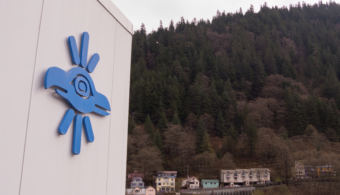
A Sealaska corporate logo adorns the roof of the Southeast Alaska Native corporation’s headquarters in Juneau on May 2, 2018. (Photo by Jeremy Hsieh/KTOO)
Shareholders of Sealaska will vote in June on whether to get rid of a blood quantum requirement for descendant shareholders.
Sealaska is the regional Alaska Native Corporation of Southeast Alaska. When the corporation was formed under the Alaska Native Claims Settlement Act, only Alaska Native people in Southeast Alaska who were already born could be shareholders. Those people are original shareholders.
In 2007, those shareholders voted to allow their descendants to enroll — but only if they had one quarter Alaska Native blood and had proof of it on a Certificate of Indian Blood from the U.S. government.
Sealaska surveyed its shareholders in November 2021 and about 4,000 of the corporation’s 23,000 shareholders responded. Sixty-nine percent of respondents want to get rid of the blood quantum requirement, 23% want to keep it and 8% are neutral.
In the survey, people who want to get rid of the requirement said that it’s keeping their children and grandchildren out of the corporation, and it’s keeping them from learning about their culture. They said that blood quantum is a colonial construct created by the federal government to erase Native people and that it’s not how Native people identify themselves.
People who took the survey also have concerns about letting more shareholders in because it will dilute their stock and dividends will be smaller. And they don’t want smaller dividends to negatively impact elders.
If the requirement is eliminated, Sealaska estimates that about 10,000 more people would be eligible to enroll.
Shareholders will be able to vote online in early May up until Sealaska’s annual meeting on June 25. The meeting will be streamed live and in person at Centennial Hall in Juneau.
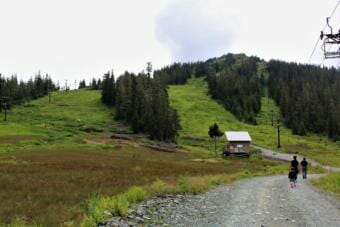
Eaglecrest Ski Area officials have lots of ideas for expanding summer operations on the mountain, most of which hinge on installing an aerial gondola that could run year-round. (Photo by Adelyn Baxter/KTOO)
Juneau’s urban Native corporation wants to help Eaglecrest Ski Area pay for its gondola project and expand summer operations.
Officials with Goldbelt Inc. could not be reached for comment, but city officials said the company is interested in backing Eaglecrest with up to $10 million. In return, Goldbelt wants a slice of summer ticket revenue. It’s unclear for how long.
“We can all keep our fingers and toes crossed,” Eaglecrest General Manager Dave Scanlan said to an Eaglecrest board committee on Thursday. “I think this potential partnership with Goldbelt is really, really exciting in many, many ways.”
The particulars of the deal would have to be negotiated, which requires action from the Juneau Assembly. The city manager could get permission to start those talks as soon as April 11. In a memo, City Manager Rorie Watt called the potential partnership a “remarkable turn of events.”
But several assembly members were reluctant because they felt rushed, unsure about the public’s desire, and that they were unfairly leapfrogging other established priorities. The Assembly did not fund the installation of the gondola, which ski planning consultants recently estimated at an additional $5.5 million.
Scanlan said Goldbelt wants to finance more than a barebones gondola experience.
“The installation of [a] gondola, a small summit house and the mountain coaster are the things they want accomplished,” he said.
A mountain coaster is a gravity-driven ride, where people sit in one- and two-person carts attached to a rail or fed down a chute.
According to the estimates, that’s all doable with $10 million.
Eaglecrest and city officials were eyeing an upcoming local ballot question for possible funding of the gondola’s installation. In October, Juneau voters are likely to be asked to extend a 1% sales tax to cover debt financing for a package of city projects.
“I know a lot of our assembly members were very nervous about $2 million for the gondola because of the big price tag that followed behind it, and how are we going to handle that? If this partnership handles that, then it may create opportunity,” Scanlan said.
That means there could be opportunities for other Eaglecrest projects to go into the package. Scanlan suggested replacing the nearly 50-year old ski lifts. He even floated an idea for an employee dormitory, because the lack of affordable housing is often a deal breaker for potential seasonal employees. The ski area has been especially short staffed this season.
Lingít activist Wanda Culp. (Photo by Melissa Lyttle, courtesy of Southeast Alaska Conservation Council)
It has been 21 years since the 2001 Roadless Rule for the Tongass National Forest was first established.
For the people involved in the battles between industry and subsistence, the tug-of-war over land use in the Tongass National Forest has been going on even longer.
KTOO’s Lyndsey Brollini sat down with Lingít activist Kashudoha Wanda Culp to talk about the impact of such a long history and the role that Indigenous women have played in this conflict.
Listen:
This interview has been edited for length and clarity.
Lyndsey Brollini: Do you think you could kind of go a little bit into the background on the issue? How it came up?
Wanda Culp: My involvement came about in the early 1980s when I moved from Juneau and into Hoonah and needed to know firsthand how to hunt, fish and gather. And through that process, I was literally taken under the wings of my Lingít grandmothers, who taught me a lot about the history of our people and where we come from.
When the clear cut started in Hoonah, it happened right in one of our hunting areas. We always, you know, would drive around when we had vehicles just for something to do. And I was up on Hoonah mountain, ran into one of my grandmas. Her and her husband were driving around, and she looked at the fresh clear cuts. And she was crying. And she said, “See what they’re doing to us. Do you see what they’re doing to us?” It broke my heart, and I did not realize because we’re so isolated in Hoonah — those days with no, you know, no access to internet technology like today — so I had no idea that others in Southeast were also voicing their objections to the clear cut business happening all around us. So it was our combined voices that I believe helped create the 2001 Roadless Rule. It was so politically controversial back then, after the 1990s when the boom basically busted. I became a recluse. It was pretty harsh.
Maybe six years ago, Osprey Orielle Lake in WECAN International — Women’s Earth in Action Climate Network — called me up, got my name somewhere, and literally pulled me out of moth balls as she made me aware of what was occurring politically with the Roadless Rule again. We’ve been to Congress through WECAN and partnering with Earth Justice. They helped us, four of us from Hoonah, in early 2019 to meet with 14 Congress people in D.C. face-to-face. We wore our regalia and spoke to them through our regalia representing who we are as Indigenous women.
So once it was a change of hands through our last administration, it beefed up the temperature, you know, in the realization that we can no longer allow the Roadless Rule to be a political puppet at their whim. We need to put it into law now.
There’s been plenty of silence to what we have brought forward and publicized. One of my elders told me when it comes to us, when I was worried about why isn’t anybody saying anything, she’s like, “It’s called tacit approval.” Silent approval. And we have that. The need for grassroots solutions, we just need a way to process it and get it out from the ground up all the way to D.C. this way, not from the top down.
Lyndsey Brollini: Do you think that the momentum is already there, that grassroots momentum?
Wanda Culp: It is. It was already there in the 80s and 90s. That momentum created the 2001 Roadless Rule. And that rule never stopped being challenged. This is old hat, what we’re doing, always defending the Roadless Rule. The momentum has only grown.
And at one meeting, there was ex-loggers, teachers, and, you know, they were so relieved to hear when I said, “You folks have a right to say your objections to what’s happening on this clear cut logging.”
They were being quiet because they thought — they didn’t want to step on our toes— and they thought that we initiated the clear cut logging to destroy our own land.
So once that conversation was opened, I began to realize how many people love the Tongass and realize that it’s not so controversial within our own region.
What’s controversial is the misuse of it.
Lyndsey Brollini: It was really good to hear from you.
Wanda Culp: Yeah, it’s good to talk about this. Thank you for the opportunity.
Two Alaska Native Corporations have joined up to form a new business, and its first move is investing in a Juneau-based tour bus company.
The new joint venture is between a huge regional Alaska Native corporation from the Interior and a smaller Southeast village corporation. Doyon, Ltd. is Alaska’s largest private landholder and a major force in Denali tourism. Early this year, Doyon joined with Huna Totem, owners of a successful cruise destination at Icy Strait Point.
The venture is called Na-Dena’. Doyon president and CEO Aaron Schutt says its aim is to fill some gaps in tourism infrastructure statewide.
“There’s an opportunity to bring more people to Alaska and to give them a better experience,” Schutt said.
Schutt says transportation, lodging and visitor experience are all areas where the new joint venture can grow.
They’re starting with transportation. Na-Dena’ has acquired an 80% majority share in Alaska Coach Tours, a Juneau-headquartered company they think can expand statewide.
“It’s not like we’re just buying a bunch of buses from somebody. They have a good team providing a very good product to the same customers we already serve,” Schutt said.
Dennis McDonnell started Alaska Coach Tours in 2004. He said he wasn’t necessarily looking to sell his company, but he saw opportunities for growth that could come from new capital. He said the new partnership’s goals were in line with his company’s ethos of telling real Alaska history to visitors.
“What better situation, to have two very well respected Native corporations join forces with an Alaskan employee-owned company,” McDonnell said. “I just got really excited about what the potential was.”
It’s a big investment after two years of extreme economic downturn in the tourism industry due to the pandemic. Mickey Richardson, who runs marketing for Huna Totem Corporation, says the lull gave them time to start the new company.
“We have time to develop and to think further into the future and not be so wrapped up with our day to day operations,” Richardson said.
Southeast residents won’t see any major changes to Alaska Coach Tours this season — except that McDonnell expects his tours to be fully operational for the first time since before the pandemic.
The Head of the Bay concept by Huna Totem Corp. would include a new cruise ship dock in Whittier. Photographed on Thursday, Jan. 20, 2022. (Photo by Bill Roth/ADN)
An Alaska Native corporation is pursuing plans to build a second cruise ship dock in Whittier, potentially bringing more than 100,000 new visitors each summer to the tiny townon Prince William Sound.
Huna Totem has already created a cruise-based tourism industry in Hoonah, a Southeast Alaska village. It’s now proposing to build a 1,200-foot dock to moor ships in Whittier at the picturesque head of Passage Canal, about an hour’s drive southeast of Anchorage.
In public meetings with Whittier residents, Huna Totem has presented a project, called Head of the Bay, that would essentially create a new business district on the west side of Whittier,with a boardwalk for housing and shops, a gondola, a trolley as well as a new cultural center, boat harbor and fish hatchery.
But Huna Totemofficials say they are currentlyfocused only on the first phase. That consists of the dock, the terminal where guests board buses and the train heading out of town, a road and small rail extension, and a bus staging area, said Mickey Richardson, marketing director with the company.
Initial estimates for the cost of the first phase exceed$80 million, with Huna Totem seeking third-party financing, Richardson said. The corporation is pursuing cruise lines to sign long-term agreements to use the dock.
Future phases of the project are more uncertain and could be many years away, according to Whittier Mayor Dave Dickason.
They would be built only if demand is there and the town supports it, Richardson said. That could involve partnerships between the city and private entities, possibly Huna Totem.
Whittier residents who support the project say it will bring much-needed city revenue, more jobs and business opportunities. But they want more information and say the town’s involvement will be critical to properly shaping the project.
Some who live and work in Whittier are skeptical of the idea, however. They worry more cruise ships and guests will hurt the town’s scenic setting and overcrowd the harbor and roads, including the only road out of town through the one-lane, World War II-era Anton Anderson Memorial Tunnel.
Huna Totem sees opportunity in Whittier
The existing dock in the community, owned by Princess Cruises, brought about 60,000 travelers to Whittier in 2019 before the COVID-19 pandemic haltedcruise travel to the city, Whittier officials say.
The Island Princess was docked at Whittier in June 2019. (Photo by Anne Raup / ADN)
This proposed new dock could bring an additional 110,000 visitors to Whittier each summer, Richardson said.
Most cruise visitors are expected to leave town quickly, arriving at night and catching the morning Alaska Railroad train through the tunnel, he said.
But some will want to see Whittier sites including the 14-story Begich Towers, a curiosity for tourists because it’swheremost of the town’s 300 residentslive.
Begich Towers, home to most of Whittier’s residents, photographed on Thursday, April 22, 2021. (Photo by Loren Holmes/ADN)
The project was conceived last year. Huna Totem was looking for a tourism opportunity in Alaska when it settled on Whittier, Richardson said.
At the same time, the city of Whittier was acquiring 58 acres at a cleaned-up tank farm at the head of the bay from the Department of Defense, said Dickason, the mayor.
The timing was good, Dickason said. The city now owns the land, which is near the tunnel, and the terminal and bus staging area could be built on five of those acres.
Whittier is now in the process of creating a lease agreement with Huna Totem, he said.
The dock and other facilities could be built and ready for a trial run in late summer 2023, with full operation in 2024, Richardson said.
‘We need more information’
The mayorsaid the project could be a “turning point” for Whittier, opening up a new area in a city that owns little land for expansion.
Whittier Mayor David Dickason points to the areas in red that would be part of the first phase of the Head of the Bay concept on Thursday, Jan. 20, 2022. (Photo by Bill Roth/ADN)
The first phase could boost Whittier revenues by $2.6 million, or 40%, Dickason said. That could help upgrade infrastructure that in some cases dates back to World War II, when the city was a military supply post, he said.
“It would provide the revenue we need that secures the future of Whittier,” Dickason said.
Whittier Seafood office manager Cathy McCord in their fish processing plant on Thursday, Jan. 20, 2022. (Photo by Bill Roth/ADN)
Cathy McCord, the seafood plant office manager and a city council member, said the project is a rare growth opportunity.
“It will help establish a future for children growing up in Whittier,” she said.
Other council members are less certain about the project.
Dan Blair said the first phase could be good for Whittier, though he and other community members have many questions that need answers.
He said the first phase could increase competition for hard-to-find workers, hurting businesses. And it will place new demands and costs on local services such as police and emergency response, he said.
Some in the community worry that Whittier’s already crowded boat harbor will become more so as more cruise tourists book small boats for fishing trips or for wildlife and glacier viewing. They foresee longer lines at the state-run tunnel.
Small boats move through the harbor in Whittier, Alaska on Thursday, April 22, 2021. (Photo by Loren Holmes/ADN)The M/V Aurora maneuvers before docking in Whittier on Thursday, April 22, 2021. The ferry, named for the Aurora Glacier in Glacier Bay National Park, was built in 1977 and can carry 250 passengers and 34 vehicles. All ferries operated by the Alaska Marine Highway System are named for glaciers in Alaska. (Photo by Loren Holmes/ADN)
Dean Rand, a longtime resident who operates Discovery Voyages with a 65-foot touring boat that can sleep a dozen guests, said Whittier doesn’t need more cruise ships.
Cruise visitors usually follow a preset land package that benefits the cruise lines but not mom-and-pop shops, he said. And cruise guests often don’t spend much money compared to people traveling on their own. He asserted that the industry looks out for its own interests first, not a community’s.
“Where is the positive economic impact of their presence? I don’t see it,” he said.
Kelly Bender, president of the local chamber of commerce, owns Lazy Otter Charters with her husband.It’s a sightseeing and water taxi service in Whittier.
Growth will bring new business and opportunities, so that’s good, Bender said.
But the project needs to be done right, she said: If not, the extra guests could hurt Whittier’s small-town charm and mountain-studded scenery. The city may need to look at requirements to encourage local ownership for new businesses and placing limits on sportfishing to protect fish stocks, she said.
“Being in favor of this project hurts my wilderness values a little bit,” Bender said. “It feels like I’m being disloyal. But we consciously support it and really want to be at the table to make sure Whittier gets what we’d like.”
Long-time Whittier resident Joe Shen, owner of the Anchor Inn and Glacier View Condo Suites, among other businesses, shares his thoughts on the Head of the Bay concept on Thursday, Jan. 20, 2022. (Photo by Bill Roth/ADN)
At the Anchor Inn restaurant in Whittier recently, owner Joe Shen sat at a table catching up on bookkeeping. He said he supports all phases of the proposal.
“I think it’s good,” he said. “Otherwise, this town goes nowhere.”
Anchor Inn waitress Veronica Fausto said she’s OK with a new dock, but the plan must include requirements to treat businesses fairly. In the future, she said, a trolley should be built to shuttle cruise guests to each of the town’s three restaurants.
Veronica Fausto takes an order from tourists visiting from Missouri at the Anchor Inn in Whittier on Thursday, Jan. 20, 2022. (Photo by Bill Roth/ADN)
“I don’t think it’s bad, but we need more information,” she said of the project.
Hoonah a possible model
Richardson said the company has created a sustainable tourism industry in Hoonah, a Huna Tlingit village of 800 in Southeast Alaska.
Icy Strait Point, as the cruise destination in Hoonah is called, highlights the local Native culture.
Since first building a giant zipline ride in 2007, Huna Totem has added two cruise ship docks in Hoonah and built two gondola systems that eliminated the need for 100 buses, Richardson said.
The New York Times in January listed Hoonah as one of its annual “52 Places” for travelers to visit in 2022.
The Head of the Bay concept by Huna Totem Corp. would build a new cruise ship dock in Whittier. (Photo by Bill Roth/ADN)
In Whittier, Huna Totem’s goals include extending electricity to the dock so ships can cut diesel engines while in port, he said. Richardson said the location of the proposed cruise dock will separate most cruise visitors from the town, as Huna Totem has done in Hoonah.
Guests who linger in Whittier could create opportunities for new businesses and tours, he said. Whittier’s rich history, near an ancient portage for Chugach people trekking into the Turnagain Arm area, provides opportunities for cultural tourism, he said.
Whittier is “one of the most beautiful places in the state to dock, and we’d like to see more people spend time there,” he said. “Our goal is to find a right balance for the city and to encourage new tour products that benefit people from the community of Whittier as well.”