Alaska Native Corporations

‘Being good relatives’: New program aims to increase collaboration between Alaska Native tribes and corporations

(Photo courtesy of Sealaska)

There is a phrase that Iñupiaq elder Vernita Sitaktun Qutquq Herdman likes to say: “When Natives fight Natives, someone else is winning.”

It’s the mentality behind a new initiative from First Alaskans Institute, a non-profit that focuses on empowering Alaska Native people. The program, called “Being Good Relatives,” aims to increase collaboration between Alaska Native tribes and Alaska Native corporations.

“People have noted for many years about the need for our tribes and corporations to bring their power together, and work through some federally created divides that make it hard for tribes and other entities to have the relationship that we know that they could have,” said La quen náay Liz Medicine Crow, Lingít and Haida, president and CEO of First Alaskans.

Alaska’s Indigenous legal landscape is unique when compared to the rest of the Lower 48: there are Alaska Native regional and village corporations, which oversee around 44 million acres of Indigenous land. And then there are 231 federally recognized Alaska Native tribes, which have a government to government relationship with the United States.

“They’re different entities that derive their authority from different places, each operating to take care of our Alaska Native people, but operating with different missions, drivers, and responsibility,” said Barbara ‘Wáahlaal Gidáak Blake, Haida, Lingít, and Ahtna Athabascan, who works as the Alaska Native Policy Center Director at First Alaskans Institute.

It’s an interesting dynamic. The corporations and tribes technically serve the same Alaska Native people in their region, and sometimes even have overlap in leadership. Still, in the past there have been times that the two entities were at odds with each other over community decisions like resource development. Even when there aren’t disagreements, some have found it difficult to fully coordinate plans.

(Illustration by Holly Mititquq Nordlum of Naniq Design)

Medicine Crow doesn’t think this is a coincidence, but rather the result of federal policies intended to divide the community.

“Our tribes and our corporations were not set up to have a great relationship … And it speaks volumes to how strong and amazing our people are, that they’ve been working since the inception of these different entities, to always try to protect our people,” she explained. “People want to see our corporations and our tribes coming together and really utilizing their strengths together on behalf of our Native peoples.”

50 years after ANCSA established Alaska Native corporations, the community is finding new ways to bridge these types of institutional divides.

“Being Good Relatives” is one example. The program first started in 2018, with an event that promoted dialogue between corporate leaders, tribal councils, and the Indigenous Alaskans they both serve. The approach was simple: create a forum where everyone felt safe to have difficult conversations. Discussions highlighted specific local concerns, but also focused on strengthening relationships and laying the groundwork for better communication in the future. Most importantly, participants centered cultural solutions.

“The work comes from what they’re willing to come into the room with and share, and then be able to do with one another,” said Medicine Crow.

The forums are typically organized by region, seeing as each region has slightly different topics they might want to address. The understanding between each region also runs deep — with each one having their own separate traditions, cultural history, and family ties.

First Alaskans Institute had planned to host more in person events, but the COVID-19 pandemic put a pause on that idea. Now, they’re looking at ways they can recreate it virtually.

“Unification doesn’t mean 100 percent agreement or uniformity. But it means that we can come together and make a decision that together working on behalf of our people, we will get further than one would fighting each other,” said Medicine Crow.

This type of collaboration is increasing in other parts of Alaska as well. In early October, the Organized Village of Saxman and Cape Fox Corporation, Saxman’s village corporation, announced the creation of the joint Community Development Corporation. The new organization will lead a development project intended to revitalize the region. It’s a historic move that brings leaders together to act in unison, according to the Organized Village of Saxman’s President Joe Williams Jr.

“Never before in the history of Saxman have OVS, the City of Saxman and Cape Fox Corporation, the ANC of the Village of Saxman, met to discuss the future of Saxman. I have been working for 26 years to make this reunion happen and it finally happened!”, he said in a press release.

Similarly, the Alaska Native regional corporation Sealaska recently created a fund that will support regional solutions led by a combination of village corporations, tribes, and local businesses.

First Alaskans Institute hopes to continue facilitating programs like “Being Good Relatives” in the coming years.

“If their region is interested in doing this work, First Alaskans would love to be able to be in support of that,” said Blake.

This story is part of a joint project between Indian Country Today, Alaska Public Media, and Anchorage Daily News on the 50th anniversary of the landmark Alaska Native Claims Settlement Act. Funding for ICT’s ANCSA project is provided in part by the Alaska Center for Excellence in Journalism and the Solutions Journalism Network. Stay updated on ICT’s ANCSA project using #ANCSA50. Read more in the series here

Alaska without ANCSA? Look to Metlakatla.

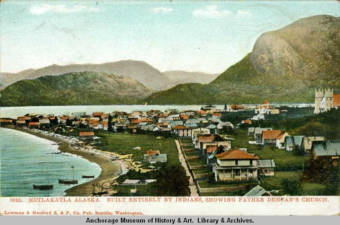
Metlakatla. (Anchorage Museum Archives)

At first glance, Metlakatla looks similar to many of the other villages in Southeast Alaska: glacier-cut coastlines, dense temperate rainforests, dramatic mountains in the backdrop. But locals know better — there is something distinctly different about the place. Spend enough time there, and you’ll notice it too. Metlakatla Indian Community is the only federal reserve in Alaska, and is not a part of the Alaska Native Claims Settlement Act.

“It’s not just a feeling or perception. ANCSA is a fundamentally different system than a reservation system,” said Gavin Hudson, Tsimshian, who is the Metlakatla Field Representative to the Bureau of Indian Affairs and was previously on the Metlakatla Tribal Council. “And those differences are reflected in how a community views itself.”

Fifty years ago, the community of 1,400 was caught in the crosshairs of a monumental decision: should they keep their reserve status, or should they join other Indigenous Alaskans as part of the Alaska Native Claims Settlement Act?

If they had chosen to participate in the ANCSA system, they would have received a sizable payment and the means to create a village corporation and regional corporation. They also would have been granted a significant portion of the surrounding acreage. However, the way they could have interacted with this land would’ve changed — their reserve status would have been revoked, and they would have to go through the corporations to manage the land, not their own tribal government.

In some ways, the island town was already different from many other Indigenous Alaskan communities, making their land claim options unique as well. Metlakatla originated in 1887, when Anglican Missionary William Duncan led a group of 826 Tsimshian people from British Columbia to start a new settlement in Alaska. Congress officially established it as the Metlakatla Indian Community, Annette Islands Reserve in 1891.

There were only a handful of other federal reserves in the state prior to ANCSA. As the Alaska Federation of Natives described, there was an eclectic mix of Indigenous groupings at the time, including tribal organizations, regional non-profits, individual village tribes, urban Native groups and tribes that had federal reservations, like Metlakatla. More than 200 village tribes did not have federally recognized reserves and therefore did not have a back-up option beyond ANCSA. If Indigenous claims were not addressed, they would have likely lost all of their land. In contrast, tribes with federal reserves still would have been able to hold on to their reserve land allotments if they did not join ANCSA. Ultimately, every other community with a reservation, apart from Metlakatla, chose the ANCSA terms.

Metlakatla, Alaska in 2019. (Joey Mendolia/Alaska Public Media)

It wasn’t an easy decision for the tribe to make, said Hudson. His dad recalled a time of intense debate, which even divided some families who couldn’t agree. In the end, it came down to a community-wide vote, resulting in today’s dynamic: Alaska’s lone reservation.

“Our council at the time refused to take part in [ANCSA] because they wanted to keep their sovereignty, and make their own decisions on what to do with the lands and waters within the reservation — and there was no price for that,” he said.

The pressure to choose ANCSA would’ve been intense, according to Charles Wilkinson, professor of law emeritus at the University of Colorado. Wilkinson specializes in public land law and federal Indian policy, and has done extensive research on history in the Western U.S. From his historian’s perspective, Metlakatla’s decision stands out.

“The truth is, there was huge pressure to terminate. It was a huge decision, and it was hard. You had to have to really want it,” said Wilkinson.

Metlakatla wasn’t the only tribe that faced these options.

Around 20 years earlier, the Klamath tribe in Oregon had the choice to terminate their reserve status as well. The termination would remove their federal services and land ownership, in exchange for a monetary payment. Like in Metlakatla, the debate in the Klamath community was highly controversial. Some wanted to accept the deal, others felt they should keep their tribal sovereignty. Outside forces only made the pressure worse — both the federal government and the logging industry heavily lobbied Klamath to accept the terms.

The motivations behind the lobbying were clear. At the time, Klamath managed one of the largest ponderosa pine forests in Oregon and was one of the wealthiest tribes in the nation. The logging industry wanted access to this land, but couldn’t do so as long as Klamath’s sovereign status remained.

“It was resource land that characterized most of the terminated tribes,” Wilkinson said. In Metlakatla’s case, it was the oil industry that sought a speedy settlement. For Klamath, it was loggers pushing the deal forward. Different resources, but the same idea.

(Courtesy of Visit Metlakatla)

In 1954, the Klamath Termination Act officially ended the tribe’s oversight of the area after a majority of the community accepted the new arrangement. Years later, the tribe’s sovereign status was restored, but their original land base was never returned.

Both Metlakatla and Klamath were part of a larger tribal termination trend common during that era, although in some cases it was only years later that the termination aspect of a policy became clear.

“I don’t think Metlakatla thought it was termination at the time, but I do think they recognized they had special hunting and fishing rights, and thought that it was really important to get that aspect of it right,” Wilkinson said.

Even with this recognition, there still would have been some aspects of the outcome left to chance. Tribal sovereignty, in a legal sense, was different 50 years ago. The Bureau of Indian Affairs was oftentimes the primary governing power, rather than a tribe’s own government. There were also fewer legal protections for hunting and fishing rights.

“There wasn’t anything to make you think sovereignty was a really good option either,” Wilkinson said.

This dynamic caused many Alaska Natives to be wary of an unproductive trustee relationship with the federal government. In this lens, ANCSA represented an opportunity for self-determination and further autonomy over their homelands. Ideally, this definition of land would include fishing and hunting rights.

“When they said land, they meant more than what American law means when it says land. In American law, if you’ve got land you got some things, but there are a lot of other rights you don’t have,” he said.

The ambiguous legal future of land, sovereignty, and subsistence rights would have made any termination decision at the time more unclear. Sovereignty and tribal land rights have evolved since the 1970s, and the number of lawyers that specialize in this area have significantly increased. But back then, there would have had to have been some betting that their idea of the future would turn out correctly.

According to Hudson, the risk payed off.

“I would be confident saying that most of us in Metlakatla still think that it was the right decision to keep the reservation,” he said.

Google Earth image showing location of Metlakatla, Alaska. (Screengrab)

Today, the island reserve has a thriving fishing and tourism industry, with several Tsimshian cultural programs and museums open to visitors and locals alike.

Like other villages in the state, they still face a set of unique rural Alaskan obstacles. Climate change has strained the local economy, salmon runs have been weaker, and high costs of food, energy, and internet can burden households.

Where they differ from other Alaska Native villages is in management. The Metlakatla Indian Community has authority over its fisheries, forests and legal system, while most other Alaskan communities also have to coordinate with the state government.

The setup makes Metlakatla similar to neighboring tribes in the Lower 48. In fact, their community is part of the Bureau of Indian Affairs’ northwest department rather than the Alaskan department, like the rest of the state’s Indigenous communities.

“In general, I think that we have more in common with the tribes of the Northwest region in terms of governance, governing, managing minerals and forests, fisheries and hatcheries,” Hudson said.

It has also created a slight disconnect between Metlakatla and other Alaska Native communities. While many Alaskan villages encounter the same challenges in relation to climate change and rural development, the mechanisms they are able to use and institutions they must go through are different. These contrasts are reflected in policy considerations. When Hudson spends time with Indigenous Alaskans from other regions at the Alaska Federation of Natives each year, he is regularly surprised at how little he relates to conversations about community plans and present day dynamics.

Despite the contrasts, Hudson is always happy to hear about the successes of the regional corporations. He also acknowledges that there are some beneficial aspects of ANCSA, such as additional economic development opportunities or extra funds for heritage centers and cultural initiatives. However, it’s like comparing apples to oranges — the two systems are so unrelated in his mind, that it’s difficult for him to even imagine what life would be like in Metlakatla had they chosen ANCSA instead.

“Having a reservation … it goes to the very core of who we are,” he said.

Travel elsewhere in Alaska, and one might hear the inverse of this statement, with reservations seeming like a foreign concept for those who grew up part of ANCSA.

Governance distinctions aside, Hudson believes there are more parallels across Alaskan Indigenous communities than there are differences. He hopes in coming years, the southeastern region and statewide Alaska Native population will find ways to cooperate more outside of their existing institutions.

“Even though there are differences that are undeniable. We still have friends and relatives all across Alaska,” he said. “We’re still Alaska Native. And we still stand in solidarity with our Indigenous brothers and sisters across the state.”

This story is part of a reporting collaboration between Alaska Public Media, Indian Country Today and the Anchorage Daily News on the 50th anniversary of the Alaska Native Claims Settlement Act. Funding for the ANCSA project was provided by the Alaska Center for Excellence in Journalism. Read more stories from the series.

With reading and writing close behind, Juneau’s school board approves spoken Lingít teaching standards

Yeeskanaalx Tláa, cultural specialist at Sayeik Gastineau Community School puts the finishing touches on an eagle formline background she made for students who are attending in-person classes on Thursday, Jan. 14, 2020, in Juneau, Alaska. (Photo by Rashah McChesney/KTOO)
Yeeskanaalx Tláa, cultural specialist at Sayeik Gastineau Community School puts the finishing touches on an eagle formline background she made for students who are attending in-person classes on Thursday, Jan. 14, 2021, in Juneau, Alaska. (Photo by Rashah McChesney/KTOO)

Juneau’s board of education has approved new oral narrative standards for its Tlingit Culture, Language, and Literacy program. 

These are the first oral narrative standards to be developed for Lingít language to be taught to school children.

The literacy program is available to kindergartners through fifth graders in the Juneau School District. It requires an application and acceptance through a lottery process.

The school district has been working with community partners like Sealaska Heritage Institute, the Douglas Indian Association, and Goldbelt Heritage Foundation to foster the revitalization of Lingít language.
Before the school board’s vote last week, Director of Teaching and Learning Support Ted Wilson said the new standards were an important step in a long journey.

“We also have representatives from preschools and from UAS so that we can talk about what the curriculum looks like all the way through from when you’re tiny until you are in college,” Wilson said.

He said they’d like to see the program expand to other grade levels, but aren’t sure when that would be possible, considering they’d need to develop a number of fluent speakers who can teach it in order to do that.

The final reading of the standards during the school board meeting prompted several emotional responses from the public and board members, including new member Amber Frommherz. “I’m Diné from Arizona and this is a gift that you are presenting to probably many families who are not able to share it as much as we want to,” Frommherz said. “I would love to teach my children our language, but I was not taught my language.”

Paul Marks also spoke at the meeting, thanking the board, first in Lingít.

“I just want to say thank you to all those that are working toward a standard of our people to be taught to our children,” Marks said. “Our elders are the ones who taught us and they taught us so that we would teach our children.”

The district and its partners are working on developing a reading and writing curriculum for the program.

Yakutat village corporation delays board elections after criticism of its logging operations

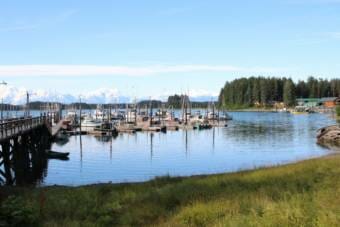
Yakutat’s Harbor in August 2017. (Emily Kwong/KCAW)

Yakutat ’s village corporation has postponed its annual board election while it confers with its attorneys over what it says are “false accusations” over its logging operations.

Yak-Tat Kwaan, Inc. has been criticized by some tribal and city leaders who believe that the corporation’s clear cuts threaten salmon streams and cultural sites. Yak-Tat Kwaan denies this.

The village corporation was created in the 1970s by the landmark Alaska Native Claims Settlement Act and granted more than 20,000 acres to benefit shareholders with ties to the traditional Yakutat village. Its annual meeting was planned for this Saturday.

But in an unsigned November 12 letter to the corporation’s shareholders, management says the election could be tainted by what it called “unfair attacks being leveled against” the corporation.

“The false accusations being leveled against the corporation have reached beyond the shareholders of the corporation, the community, and even the State of Alaska by way of social media,” the letter reads. “All shareholders deserve to have a free and fair election, which is not tainted by patently false claims about the decisions of the Board of Directors and the financial health of the company.”

Critical posts on social media were being reviewed by the village corporation’s attorneys, the letter added. In Alaska, ANCSA shareholder speech is regulated by state financial examiners, which critics say can effectively chill free speech.

The CEO of Yak Timber, the logging subsidiary of the corporation, declined to comment.

The shareholder meeting has been pushed back until Jan. 8, 2022. Its last annual meeting was January 30, 2021.

State law requires an ANCSA corporation to hold a shareholder meeting and re-elect its board of directors at least once a year.

Can Indigenous subsistence rights still be protected in Alaska?

A woman in the bow of a boat on the water with green cliffs in the background
(Photo courtesy of Haliehana Stepetin, 2021)

Rosita Worl unexpectedly grew teary eyed as she looked at the coho salmon a younger family member had brought her.

The silver fish was a sight she was used to, but one she had learned wasn’t always guaranteed.

“I just cried that our traditions were still viable, and that he was able to still bring food to me as an elder,” she said.

Worl, Tlingit, was born in Petersburg, Alaska, during the 1930s. She was brought up in a subsistence lifestyle, living off the land in Southeast Alaska as her ancestors had. As she grew older, the ceremonies, traditions, and community need for subsistence stayed constant, but the laws surrounding it changed.

She recalled the first time she realized this, as if it were yesterday. She was fishing with other kids from her village as they always did, when state officials suddenly told them that the familiar process was illegal.

“We didn’t know that it was against the law. They confiscated the fish and we couldn’t believe it. We kept saying, ‘what value is it to you to take that fish away and not return it?’ Whereas to us it meant winter food,’” she said.

Decades after this incident, similar legal disputes over subsistence are still occurring. The Alaska Native Claims Settlement Act was intended to protect this Indigenous community right, but the matter did not end up being resolved. As the 50th anniversary of the landmark legislation approaches, the question still remains: what can be done to protect subsistence rights today?

‘An unsettled and unsettling landscape’

(Illustration by Holly Mititquq Nordlum of Naniq Design)

While Indigenous land claims were being settled during ANCSA, many Alaska Natives fought to include subsistence rights in the final bill. The pairing appeared natural. After all, the legislation addressed traditional lands, which seemed inseparable from the hunting and fishing that accompanied them.

However, outright subsistence protections were left out of the final legislation, due to disagreements and a pressured timeline to develop oil. Instead, ANCSA ended up extinguishing all aboriginal hunting and fishing rights as part of the settlement. Congressional intent was for the Secretary of Interior and state of Alaska to “take any action necessary to protect the subsistence needs of the Natives.” Many believed this would be sufficient, but it soon became apparent that more concrete protections were needed.

The omission is viewed as one of the largest unintended consequences and unresolved portions of ANCSA.

“I think the ongoing, unsettled nature of subsistence has caused people to take pause; to see and ask themselves whether that part of ANCSA was a shortcoming,” said Margie Brown, Yup’ik, in an interview with University of Alaska Anchorage.

Subsistence fishing in the past. (Photo courtesy of University of Alaska, Fairbanks).

Around 10 years later, there was a second chance to protect subsistence with the passage of the Alaska National Interest Lands Conservation Act (ANILCA). While ANCSA determined the future of Native lands, ANILCA designated what would happen to the rest of state. Through the act, approximately 222 million acres of Alaskan land were put into conservation units such as parks, preserves, wildlife refuges, and national monuments. The decision meant that around 60% of the state was under federal control, making it the highest acreage of federal land ownership in the country by a long shot. Even states known for their national parks hardly compare — Alaska’s federal land is more than that of California, Oregon, Washington, Montana, Wyoming, and Idaho combined.

This time, subsistence was explicitly addressed. ANILCA protected the customary and traditional uses of fish and wildlife for food and other noncommercial use, and made subsistence the priority use on federal lands, above sport or commercial fishing and hunting.

But there was a catch. ANILCA designated subsistence to be a priority for rural residents, not Alaska Natives. Under this law, urban residents could still practice subsistence, they just wouldn’t receive priority status during times of shortage. The rural distinction was a compromise meant to protect Native subsistence, while not discriminating on the basis of ethnicity —something that several influential non-Native groups in the state opposed.

The state of Alaska set out to replicate this policy on non-federal lands, but urban hunters and fishers who considered it unfair were determined to fight it. After a few years of legal disputes, the Alaska Supreme Court ruled in their favor, deeming the rural distinction unconstitutional. The decision meant that any Alaskan resident could practice subsistence on state lands, if the state approved subsistence use in the area for that season.

An elder hangs salmon during the 1950s. (Photo courtesy of University of Alaska, Fairbanks).

Today, this dynamic has resulted in a vague and often-clashing dual system. The federal government regulates subsistence on the 60% of Alaskan land under federal control, while the state regulates subsistence on the 30%of Alaska which is under state management, the 10% which is privately owned, and navigable waters.

“You’ve got three different land jurisdictions in Alaska: you’ve got the state lands, you’ve got the federal lands, and then there’s this 40 million acres of Native lands,” said John Sky Starkey, Cheyenne River Lakota Tribe, a lawyer who has spent decades representing Alaska Native organizations in subsistence cases.

Since ANILCA passed, there have been several lawsuits between the state and federal government that have put this system to the test.

“Although the laws can potentially provide protection, the implementation of the laws is greatly lacking. And the legal meaning of the laws is also still in flux,” he explained. “In both the federal and the state regulatory regimes, Alaskan Natives have really very little say in what the regulations are going to dictate and the restrictions that they’re going to cause.”

Subsistence, a practice which past generations participated in without question, had now become a complex legal puzzle.

“It’s a very unsettled and unsettling [legal landscape] for Alaska Native people,” Starkey said.

‘An embodied way of life’

“We don’t think about subsistence as merely a quantifiable event. Subsistence is a whole structure, it’s a way of life,” explained Haliehana Alaĝum Ayagaa Stepetin, Unangax̂. Stepetin grew up subsistence fishing and hunting in her homelands on the Aleutian Islands. Today, subsistence is part of everything she does: her PhD research in Native American studies at the University of California Davis, her teachings at the Alaska Native Studies program at the University of Alaska Anchorage, and her performance and choreography of traditional Unangax̂ dance.

“It’s an embodied knowledge, an embodied way of life. And when we dance about these activities, we’re extending that process of subsistence,” she said.

Haliehana Alaĝum Ayagaa Stepetin, Unangax̂( Photo courtesy of Haliehana Stepetin, 2021)

From the Athabascans in the interior to the Inupiaq in the Arctic, this sentiment is consistently echoed. The practice itself looks different across the varying Alaska Native regions. Some communities hunt seals and whales along icy coasts, others fish for salmon during the long days of the midnight sun. The ceremonies might vary, and the passed down stories might differ. But despite these contrasts, all tribes have one aspect in common: subsistence means more than just food security, it also has greater cultural significance.

“Subsistence is absolutely critical to our survival. Without it, we don’t exist out here,” said Steve Ivanoff, Inupiaq, a subsistence hunter and fisherman from Unalakleet, a village of about 600 people in Western Alaska. For him, subsistence meant the community gathering and sharing of food from nature.

It can be difficult for those who aren’t familiar with subsistence to fully understand this concept.

“A major issue is that the general public, overall, does not understand the full significance of subsistence hunting as one, our basic food security, and then also the cultural dimensions of it,” explained Worl, who has a PhD in Anthropology and a renowned career in subsistence research and advocacy. She currently works as the president of Sealaska Heritage Institute and spent years on the Alaska Federation of Natives’ subsistence committee.

Worl believes some of the disconnect stems from antiquated views of Indigenous people, in which others expect them to be solely traditional, rather than the reality of modern people living in current times, who also practice their traditions.

“These spiritual things, they’re important to our cultural survival. And I don’t know that people realize that, because they see us driving cars and dressed up in modern clothes,” she said.

Stepetin also encountered misunderstandings surrounding subsistence, both as a teacher and a student.

In her PhD program, she found that the term “subsistence” was often corrected to “sustenance,” and that people viewed it in the same light as agriculture.

Past walrus hunting practices. (Photo courtesy of University of Alaska, Fairbanks).

“It’s always surprising to me that people don’t know what subsistence is, which is really just living a balanced and sustainable lifestyle with your local ecosystem, and stewarding that ecosystem for returns to come for generations in the future,” she said.

As a teacher of Alaska Native studies, she tries to emphasize this point for students who might be unfamiliar with the tradition.

“All of our our pedagogy revolves around transfers of subsistence, which includes sharing, storytelling, dance, song, and eating together,” she said. “It permeates into every single part of an Alaskan Native existence. So I try to make it clear in my curriculum.”

She starts by encouraging her students to think beyond what’s represented in mainstream culture, which can be a challenging exercise for anyone.

“It takes a lot of introspection to even be able to understand that there’s a whole other way of living and thinking and being in the world that exists,” she said. “So really, it’s a philosophical question of, “Can I get these students to think in a different way?’ And to think critically and to think deeper about the ways that people have adapted to living in place over time.”

For many Alaska Natives, the highlight of subsistence is the generational bonding formed over passed down knowledge and shared experiences.

“It’s an important part of our wellness, our health, and our healing culture. It’s the very center of who I am as an Alaska Native person,” said Jody Potts, Han Gwitch’in Athabascan. “And it’s important for me to be raising my kids this way.”

Jody Potts on the Yukon River.(Photo courtesy of Jody Potts, 2021)

But in recent years, the legal landscape has made the crucial generational component more difficult to fulfill. Subsistence life is usually tied to the village one is from. In the summers, people travel to their fish camps — settlements near one’s village where people fish, oftentimes in the same location their ancestors had practiced subsistence. In the winter, they trap or hunt in areas located near their village as well.

Today, an increased number of Alaska Natives have moved away from their family’s village to urban areas, such as Anchorage, for employment or educational opportunities. However, many still have ties to their home village, and return for key community events, such as subsistence practices and celebrations.

Ice fishing subsistence practices of the past. (Photo courtesy of University of Alaska, Fairbanks).

“They want to continue to engage with their village and their kin and everybody around subsistence activities. They want to bring the kids up with that culture. And because of this rural priority, if they live somewhere other than in the village, then they’re cut out, which causes a great amount of consternation to people,” Starkey said.

If the federal government exercises its authority to close a river to subsistence fishing to anyone who’s not a qualified rural resident, that means their own family can’t come out to fish camp anymore, says Starkey. Because federal subsistence protections extend to rural residents, urban Alaska Natives aren’t included.

“It’s just becoming a real tool for assimilation,” he explained.

Even those who do qualify for the rural precedent can have their access removed. For example, in 2006, the Federal Subsistence Board terminated the Southeastern village Saxman’s rural status and grouped it in with the larger town Ketchikan. For 10 years, the small community of 400 worked to restore their subsistence access before it was finally granted.

It’s situations like this that reveal how the rural precedent can be unpredictable, and demonstrate why some Alaska Natives would favor a law that more directly protects their subsistence practices.

“This does not mean that non-Natives from Anchorage and Fairbanks can’t go out and take a moose or go fishing,” wrote Thomas Berger in his 1985 Report of the Alaska Native Review Commission. “What it does mean is that I believe Congress should entrench Native subsistence rights, so they cannot be placed in jeopardy by any future state action.”

The argument that Berger made almost 40 years in his report to the Inuit Circumpolar Conference is still being debated today.

Basic rights, different wavelengths

In theory, the current legal setup is designed to provide equal hunting and fishing opportunities for all Alaskans. But some argue this approach doesn’t account for pre-existing societal inequities.

Most Alaska Native villages are located in highly remote areas, disconnected from roads and far from other communities. Food must be shipped in by plane or boat, and the unconventional transportation route can cause prices to skyrocket. Expensive airfare and unpredictable weather conditions can make grocery deliveries unreliable.

“There is currently this notion that all Alaskans, regardless of whether or not they’re living a subsistence way of life, are subsistence users. And if everyone is, then it dilutes the so called priority for real subsistence users. If everybody is a subsistence user then what does priority mean?” Starkey said, referring to the state’s subsistence laws.

Worl sees cases of these inequities all the time. For example, during the pandemic, transportation to the village of Kake was interrupted, meaning the coastal town was unable to get a steady supply of commercial goods during the health crisis. In light of the urgent situation, the village applied for an emergency subsistence use permit. The request was initially denied, briefly approved, then stalled by a lawsuit from the state government.

“It just seemed like it should be a basic right. But we must be on different wavelengths than other people,” she said.

Cutting the salmon at fish camp on the Yukon River in Alaska.(Photo by Meghan Sullivan, Indian Country Today)

To make matters worse, it occurred at a time when the health qualities of subsistence food were especially sought after.

“There was this great concern for elders who were more susceptible to getting COVID,” she said. “And the community really wanted them to be able to have this healing food.”

The case demonstrated how Alaska Native subsistence rights can often become tangled in legal conflicts focused on state vs federal power. Matthew Newman, an attorney for the Native American Rights Fund, says they should be two separate issues.

“Unfortunately, the board’s effort here has been attacked as part of a much different battle between the federal government and the state of Alaska about who gets to control fish and game management,” said Newman said in an interview with High Country News.

For those worried that an increase in subsistence practices could lead to a strain on natural resources, data says otherwise. Subsistence users take just 1% of the fish and game harvested in Alaska, according to the Department of Fish and Game, with the vast majority going to commercial fishers and hunters instead.

A worsening situation

The Alaska Native subsistence debate has been occurring for years. But the stakes are even higher in recent times, when a changing climate has altered everything from salmon runs and hunting seasons, to migration patterns and berry growth.

“There are so many threats to our subsistence and our traditional ways of life, be it climate change, be it laws, [other] hunters, and the stress on the resource,” explained Potts.

Many subsistence based communities have been impacted by this first hand. For example, the Yukon River has seen two consecutive years of record breaking low salmon runs, consistent with a decade of downward trends. Around 40 communities in the area rely on subsistence fishing. The situation was so dire that emergency shipments of salmon and other food had to be flown out to particularly afflicted regions.

This dismal data isn’t surprising news to subsistence users. Many have been seeing warning signs for years. Stepetin described how her dad taught her to observe the signs in the land, and note the interconnected nature of the wildlife that surrounded them. This knowledge was based on thousands of years of passed down insights. For instance, when there wasn’t enough snowfall, there would likely be a shortage of berries.

“We’re already Indigenous scientists and already know this. We don’t need outside sources to tell us what’s going on. We can tell them that we’re witnessing and experiencing a changing climate and returns of salmon and the different fish,” she said.

The value of traditional knowledge was apparent to outside perspectives as well. Through his legal work on subsistence, Starkey has witnessed countless times where Indigenous customs predicted food shortages, or traditional management prevented overfishing.

A fish camp in the past. (Photo courtesy of University of Alaska, Fairbanks)
A fish camp today (Photo by Meghan Sullivan, Indian Country Today)

He views this as another reason Alaska Natives should have an increased role in subsistence management.

“It’s not just for the sake of Alaska Native people, that Alaska Natives need to be much more meaningfully engaged in land management. It would benefit everyone,” he said.

50 years later, an ANCSA amendment?

From the very start of the legislative process, it was evident that many expected ANCSA lands to be tied to Indigenous subsistence. When ANCSA first passed and the various Alaska Native corporations began choosing the lands they would own, some corporations, such as Ahtna, specifically selected areas that were best for subsistence, says Starkey. Thousands of years of knowledge went into the decision. Decades later, Ahtna has had to consistently fight for hunting and fishing rights on their own lands.

“In one lifetime, we went from being the only inhabitants of our region to co-managing the resources of our homeland alongside state and federal actors,” said Ahtna chairman Ken Johns, Udzisyu Caribou clan, in an essay for the Anchorage Daily News.

It’s another example of the unsettled dynamic between subsistence and ANCSA. But there are still possibilities for change down the line.

“I think that there needs to be amendments made to the Alaska Native Claims Settlement Act that reinstates our Aboriginal hunting and fishing rights,” Potts said.

There are a few potential solutions. One change would be to enable Alaska Natives to manage and harvest ANCSA lands, as they initially believed they would be able to.

This could be accomplished through an amendment to ANCSA legislation. Many in the community, like Potts, believe this is a good compromise: if Alaska Natives aren’t legally given priority to subsistence hunt and fish on all Alaskan land, then they should at least be able to receive priority on their own lands.

Unfortunately, the amendment process would likely be extremely expensive. Already, Alaska Native subsistence advocacy has cost millions of dollars, says Worl. Furthermore, many of the Alaska Native organizations that could lead the process already are inundated with other pressing legal matters.

“There is an estimate that we’ve spent around $20 million trying to protect subsistence, because it seems that every time we try to do something, we end up with a lawsuit. And it’s still ongoing,” Worl said.

This is where the Alaska Native corporations have been able to help: funding. Any legal battle would most likely be a sort of David and Goliath dynamic, where subsistence users would have to go against resource-heavy opponents such as the state and federal government, or special interest groups like sports hunters that receive outside funding from national sporting organizations. Many villages simply don’t have the resources to counter these larger groups. But the Alaska Native corporations, which have more assets and organizing capacity, might be able to provide more assistance.

Subsistence hunting in the early 1900s. (Photo courtesy of University of Alaska, Fairbanks)

Another option would be to amend ANILCA, so that Alaska Natives have priority to subsistence hunt and fish on federal lands in addition to rural residents. This would also likely be a lengthy and expensive process.

The third option is to implement a co-management solution, which would enable Alaska Natives to have greater influence over state and federal subsistence laws.

“In both the federal and the state regulatory regimes, Alaskan Natives have very little say in what the regulations are going to dictate and the restrictions that they’re going to cause,” Starkey said. “They’re left out of control of one of the most important aspects of their way of being. And that’s just wrong. It’s been a huge problem from the beginning.”

As it currently stands, there are three Alaska Native representatives on the federal subsistence advisory board, and one representative from the BIA. However, these voices are often outvoted by the 5 other representatives that don’t have ties to Alaska Native communities. The setup can cause critical subsistence decisions to depend solely on the current administration.

“If your way of life depends on who’s in office every four years, either as a governor or president, what kind of security do you feel about that?” asked Starkey.

Worl also saw a need for a more concrete co-management policy.

“We’ve been pushing and pushing for increased co-management. I know some regions have more success with co-management, but it should be addressed on a statewide level,”’ she said.

Tribes fishing in the Pacific Northwest, where some states have adopted co-management approaches.(Photo courtesy of Linda Tanner, 2018)

This strategy has worked in other locations. In Washington, salmon and steelhead fisheries are managed cooperatively by Western Washington tribes and the Washington state government. The arrangement involves an annual agreement on salmon fishing seasons and on hatchery production objectives in Puget Sound and the Washington coast.

While the region still experiences the type of salmon population challenges that are becoming increasingly common today, the co-management approach has seen positive results overall.

“I don’t know of a better working relationship between a tribe and a state agency,” Scott Chitwood, Jamestown S’Klallam Tribe’s natural resources director, told the Northwest Indian Fisheries Commission in 2007. “By working well together, we’ve been able to make real progress toward recovering Dungeness chinook.”

Even sports fishers who had initially been against a co-management relationship eventually saw the value of Indigenous-led fishing policies.

“I had a lot of sports fishermen come directly up to me. And they put out their hand and they said, ‘Would you please tell the Yakama Nation thank you? Because we know if it wasn’t for their tribe, there’d still be no fish in that river,’” recalled Carol Craig, Yakama, in a 2016 NMAI interview.

As the Alaska Federation of Natives rolls around this year, Worl and others will be including a resolution to amend ANCSA to protect subsistence rights. Considering the cost it would take to change the law, coupled with the many other advocacy campaigns Alaska Native organizations are already handling, she isn’t optimistic that it will pass. But giving up doesn’t seem like an option, either. She’s hoping that increased emphasis on social and environmental justice might just make a difference this year.

“I was thinking this would be the perfect time to try to pursue it when people are looking at social justice and social equity. But again, it takes money to be able to push these things through Congress. So I just don’t know what it’ll take to move it past a stalemate,” she said.

Until then, Indigenous Alaskan communities will continue passing on their traditions despite legal barriers, just as they have done for centuries.

“It’s a sustainable way of life,” Stepetin said. “And we will keep it alive as long as communities with this knowledge continue to transmit it to the next generation, and keep these stories and lessons of subsistence alive within us.”

This story is part of a joint project between Indian Country Today, Alaska Public Media, and Anchorage Daily News on the 50th anniversary of the landmark Alaska Native Claims Settlement Act. Funding for ICT’s ANCSA project is provided in part by the Alaska Center for Excellence in Journalism and the Solutions Journalism Network. Stay updated on ICT’s ANCSA project using #ANCSA50 at https://indiancountrytoday.com/tag/ancsa-50.

Rifts widen over Yakutat village corporation’s expanded logging

A wooden sign with metal fish on it that says Welcome to Yakutat
Yakutat is a community of about 600 people on the Gulf of Alaska coast in uppper the crook of the Southeast Alaska panhandle. Emily Kwong/KCAW)

Yakutat is a remote Gulf of Alaska village about halfway between Juneau and Cordova. Its economy has long been tied to fishing, tourism and for the first time since the 1980s, commercial logging. That’s thanks to its Indigenous-owned Native corporation getting back into the timber game, cutting and exporting to foreign shores.

But recently that’s concerned elected officials in both the city and tribal governments, who have called for a halt to cuts in areas they say are ecologically sensitive and culturally sacred to Yakutat’s inhabitants.

Yakutat Mayor Cindy Bremner used to be president and CEO of Yak-Tat Kwaan, Inc. and serve on its board of directors of the village corporation. Since 2015, she’s only been active as a shareholder.

But a couple years back she said she had a hunch and decided to look up local timber plans on a state website. It was there that she first learned of the village corporation’s ambitious logging plans in Yakutat.

“And then the very next day, they had their barge of equipment coming in,” she said. “I just had a bad gut feeling one day, and I was pretty sad to see that they had applied for that.”

Yak Timber, Inc.

Yak-Tat Kwaan’s last public filings with state financial regulators date from 2017. Back then it said it had no plans to log any of its 23,040 acres, or 36 square miles, granted in the 1970s under the Alaska Native Claims Settlement Act.

But the following year the corporation created a new subsidiary: Yak Timber, which got to work quickly. A note to shareholders last summer said that in two years it made $1.8 million in logging and selling cabins and tiny homes.

“It is understandable that some do not like logging,” Yak-Tat Kwaan CEO Shari Jensen wrote in a June 25 letter to shareholders that was partly in response to timber critics.

“Instead of using energy to sabotage Yak Timber, it would be nice to see it being used to help make Yak-Tat Kwaan a viable and a long-term sustainable company for years to come,” she wrote.

Earlier that month, the corporation released an unaudited report that says the corporation earned some $3.8 million from timber in 2019, with a net profit across the board just shy of $800,000 that year.

But that economic boost has been contentious, Bremner said.

“The shareholders, I feel, are kind of torn about the logging going on here,” she said.

Yak Timber needed financing to get heavy equipment for its crews. Since 2019, it’s borrowed at least $7 million, according to documents and statements to shareholders who were told the debt’s necessary to carry the corporation until more timber is sold. The village corporation’s fish plant and timber rights on some of its land have been used as collateral.

The mayor says she’s concerned that Yakutat’s forestland is being sold too quickly to finance the corporation’s ventures.

“They’ve leveraged the resources on our land to be able to do this,” Bremner said. “And I don’t think that is something that they should be able to do.”

ANCSA directs Indigenous enterprises to drive profits for shareholders

Talk to another Bremner and there’s a very different view.

“You’ve got to hear the rest of the story,” said village corporation executive Don Bremner, who is related to the mayor.

“Yes, we’re related — everyone in Yakutat’s related,” he says.

The community has fewer than 600 people and has lost people in the last census.

Don Bremner is president of both the village corporation and its timber subsidiary. The long-term health of the company is good and the debt isn’t a concern, he said.

“We’re a valid business, making real serious business decisions, not based on perception, opinion, without research,” he said. He declined to get into specifics, saying that’s an internal matter for Yak-Tat Kwaan’s shareholders. And because the village corporation has less than 500 of them, it’s not required to file its annual reports with state financial regulators.

But Bremner still dismisses concerns about logging Yakutat’s lands too quickly.

“It’s not a large volume, but the people that have concerns are the folks that will always have those concerns,” he said.

His other message is that Congress created for-profit corporations to enrich Native shareholders. And that’s exactly what Yak-Tat Kwaan is doing, he said.

“We’re a profit-making business and ANCSA directed that we keep making money off of our assets, become self determined,” he said. “If they want to go try change ANCSA, have at it. It’s just not going to happen. Because you’ve got 12 very rich regional corporations making a lot of money off ANCSA. So that’s what we’re doing, is running corporations, profitably.”

Tribes, state historic office raises concerns over Humpback Bay clear cuts

An anonymous “Defend Yakutat” website has emerged criticizing Yak-Tat Kwaan’s timber practices in the community. (Screenshot by Jacob Resneck/CoastAlaska)

Yakutat’s city government opposed this year’s logging around Ophir Creek, which includes pink salmon habitat.

But that hasn’t caused the board of directors to shift course. A state fisheries biologist reported that some of the logging was too close to streams, and follow-up visits are planned for November.

But the real fight brewing is over logging planned on a 426-acre tract around Humpback Creek, about 10 miles to the northeast of the village.

As the name suggests, it’s also known for its pink salmon. And its Indigenous name comes from both the Eyak and Lingít languages, which residents say speaks to Yakutat’s history as a crossroads of Native cultures.

“Humpy Creek itself you know, has a lot of significance in our oral history,” said Judith Dax̱ootsú Ramos, who is originally from Yakutat and now teaches immersive languages at University of Alaska Southeast in Juneau. “People were kind of taken aback when they saw the plans for the harvesting in that area and nobody knew that they were going to be harvesting in that area.”

Ramos said the corporation is making its commercial timber plans without consulting elders or anyone with traditional knowledge.

The debate over logging for cash versus conserving cultural resources is a common friction that arises from ANCSA’s legacy over the past half-century.

Tribal governments urge village corporation to rethink logging plans

A resolution passed September 28 by Southeast Alaska’s regional tribal government in solidarity with the Yakutat Tlingit Tribe.

State agencies work with for-profit Native corporations to realize the commercial value of natural resources. That’s despite sustained opposition from tribal governments.

Both Yakutat’s tribal council and the regional Central Central Council of Tlingit & Haida Indian Tribes of Alaska have passed resolutions in opposition to the Humpback Creek timber harvests around Humpback Creek.

The state’s Office of History & Archaeology also recently wrote a letter to the village corporation warning that its clear cuts could threaten historic sites. It said there are irreplaceable heritage resources in and near the project area.

But good-paying jobs in Yakutat are scarce in the community, which is losing population. So the promise of timber jobs and cash dividends does resonate, said Cindy Bremner, the mayor.

“Has it been good for the local economy and putting people to work and contributing to payroll taxes?” she asked. “Yes. Do I like that? Yes, I do. I don’t like the way they’re doing it.”

She added: “They could have come up with a 20-year sustainable plan that wouldn’t have required clear cutting. And more people could have gotten on board with something like that.”

Yak-Tat Kwaan to face shareholders in November meeting

There appears to be a reckoning coming in Yaktuat. Successive shareholder meetings have been canceled this year. The corporation said that’s due to COVID-19 precautions and other scheduling problems.

“It’s not some kind of world secret that there’s a pandemic going on,” Don Bremner said.

But others suspect the corporation is delaying because of rising anger over the clear cuts near town, and an anti-logging website has sprung up calling itself “Defend Yakutat.”

Cindy Bremner said shareholders plan to try and hold the village corporation accountable when board directors are up for reelection. She said there’s a clear disconnect between Yakutat residents, village corporation shareholders and those calling the shots.

“Most of those board of directors don’t even live here anymore, and don’t have to see the devastation of clear cut logging every day like we do,” she said.

The Nov. 20 meeting could be a referendum on Yakutat’s satisfaction with the last few years of commercial logging. But it will only be open to its few hundred shareholders, many of whom make their homes elsewhere.

Site notifications
Update notification options
Subscribe to notifications