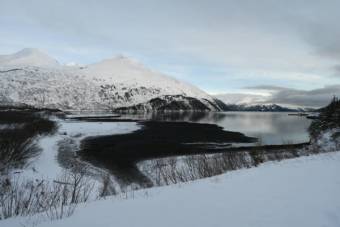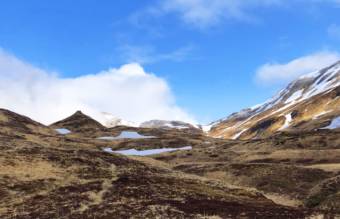
In 2020, SpinLaunch identified Ugadaga Bay as a possible location to build a large centrifuge to launch satellites into low Earth orbit. The project would likely require building a road down Ugadaga Trail, a popular hiking trail and historic Unangax̂ trading path. (Photo by Maggie Nelson/KUCB)
A tech startup that visited Unalaska in 2020 as a potential satellite launch site says they are finalizing their choice of location. And while communication between the company and the city began to fade earlier this year, the startup says Unalaska is still in the running.
SpinLaunch identified Ugadaga Bay as a possible location to build a large centrifuge to launch satellites into low Earth orbit. The project would likely require building a road down Ugadaga Trail, a popular hiking trail and historic Unangax̂ trading path.
While the land at Ugadaga Bay is owned by the Ounalashka Corp., the island’s Native village corporation, visitors have to cross public land to access it.
The Los Angeles-based startup aims to launch satellites using kinetic energy, as opposed to a traditional rocket launch system that relies heavily on fuel.
“SpinLaunch is in the final stages of examining a large number of launch sites,” Diane Murphy, a SpinLaunch spokesperson told KUCB. They won’t comment until that decision is made.
A 2020 mock-up from city emails shows an approximate location for the proposed SpinLaunch satellite launch site. (City of Unalaska)
The Ounalashka Corp., which is a private company, owns much of the land that would be used, and city officials were reluctant to discuss the matter. So KUCB requested records from the city to get a window into the situation.
Notes from the city’s planning department suggest the 20-acre site would sit along the Ugadaga Bay Trail, one of the community’s most popular hiking trails, and a historic trading path between Iliuliuk and Biorka villages.
Representatives from the space technology company visited Unalaska in September of 2020 and gave a presentation to city officials about their plans to work with the community.
Emails between city officials shortly after discuss the potential risks and benefits of having SpinLaunch in Unalaska.
In correspondence between city officials, Unalaska Director of Public Utilities Dan Winters called SpinLaunch a “good project for Unalaska.”
“This is a good opportunity to bring more money into its economy through new technology,” Winters wrote in a September 2020 email.
Tom Cohenour, the director of Public Works for Unalaska, lauded the potential for SpinLaunch to help diversify the local economy.
But Ports Director Peggy McLaughlin raised concerns about the long-term economic benefits to Unalaska.
“It sounds [like] Unalaska may provide SpinLaunch the ideal location, but SpinLaunch [has] little or nothing long-term to offer in return,” McLaughlin responded.
McLaughlin told KUCB this week that she asked questions about the long-term opportunities for Unalaska, such as job opportunities, housing development and an influx of students into the school. She says SpinLaunch was unable to provide satisfying responses and she left the September 2020 meeting with more questions than answers.
After that meeting last year, the city’s associate planner, Thomas Roufos, stressed the importance of SpinLaunch developing a public outreach plan, and having a clear aim for “how they’ll invest back into the community.”
Roufos also stressed the importance for the Ounalashka Corp. to handle the loss of the Ugadaga trail.
The Ounalashka Corp. owns the land at Ugadaga Bay and has been tight-lipped about any plans to develop it. The corporation’s chief executive, Chris Salts, has not responded to several requests for comment.
A rough diagram of the proposed 20-acre site shows the approximate location of the launch site and a road to the bay from the pass at the top of Overland Drive.
SpinLaunch launched its first successful test flight this October from a base in New Mexico. According to the company’s website, the New Mexico accelerator measures more than 160 feet. And the next site they build could measure three times the size.
According to a note from the planning department, the proposed site would cover around 20 acres, with an additional five to 10 acres for road and access.
Emails from 2020 suggest the road would be open to the public — which would make the beach accessible for people with limited mobility — but it would be blocked off during launches. The company estimates they would conduct approximately 10 launches a day, which could last around two hours each. If accurate, that would render the road essentially closed to the public.
Emails also show discussions around the sonic booms the centrifuge would create every time it launches. But the company says the blasts would not affect Unalaska city residents because the site is too far from the center of the community and faces the opposite direction.
City officials discussed the benefits of SpinLaunch as having the opportunity to create jobs and to generate significant tax revenue for the city, which has been a chief concern of late.
In recent months, city officials have stressed the importance of diversifying Unalaska’s economy. The city estimates it could lose more than $2 million in tax revenue from the closure of the red king crab fishery, and has been taking steps to diversify the local economy.
An illustration from SpinLaunch’s website depicts an accelerator and launch site. (SpinLaunch)
In 2018, SpinLaunch considered developing a base in Hawaii, but public opposition prompted representatives from the company to travel to Hawaii to hold a public meeting. A video on YouTube shows angry residents disrupted the April 14 meeting several times and SpinLaunch ultimately scrapped plans for the project.
The company would need to apply for a commercial space license from the Federal Aviation Administration, and the application process would require an environmental review.
An FAA spokesperson said the agency “has not received any commercial space license application that would support launches from Unalaska.”
An email SpinLaunch sent in January 2021 said they are “still very interested in Unalaska.”
But emails show that correspondence between SpinLaunch and city officials ceased this summer, and the city’s planning director says he hasn’t been in contact with the company since then.
Representatives from the company said last month they are in the final stages of picking a location for their next launch site and will inform the community with any further updates.
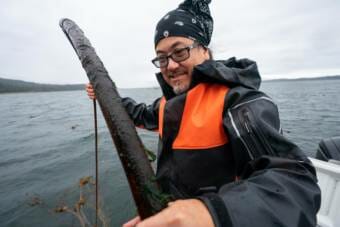
Sealaska Board Chair Joe Nelson pulls bull kelp from Saginaw Channel on Sept. 14, 2021 near Juneau. (Photo by Loren Holmes / ADN)
Joe Nelson floated his boat along a reef just outside Juneau on a drizzly September day.
With his rifle onboard, he eyed the shore for deer as he steered with the tide. But this was a business trip: He was also looking for a new product that could boost the fortunes of the Alaska Native corporation whose board Nelson chairs.
The boat drifted past dark curls in the water. Nelson reached over and grabbed a greenish tendril, hauling it into the boat: bull kelp.
The species is found up and down the Pacific Coast and can grow as long as 100 feet.
It’s also edible, in products like salsa and hot sauce. And Nelson’s corporation, Sealaska, recently bought a stake in a locally grown company, Barnacle Foods, that sells kelp products across the country.
Barnacle Foods co-owner Max Stanley boxes bottles of Bullwhip Kelp and Serrano Hot Sauce at the Barnacle Foods production facility on Tuesday, Sept. 14, 2021 in Juneau. (Photo by Loren Holmes / ADN)
Nelson, who is Lingít, grew up hunting and fishing in the remote Southeast community of Yakutat. He’d harvested seaweed. But not kelp — this was a foreign object to him.
“Like, literally from ‘Aliens,’ the movie,” Nelson said, pondering the kelp’s fronds and rubbery, tubular stalks. “I wouldn’t have thought to eat it.”
While Nelson was new to kelp harvesting, he’s been eating it for years, as an early and avid buyer of Barnacle’s salsa.
Barnacle was founded in 2016 by a Juneau couple with a shared love for Southeast Alaska lands and waters, and their bountiful harvests. The company has grown spectacularly, and is on track this year to sell more than $1 million of its largely kelp-based foods.
Sealaska and its more than 20,000 Indigenous shareholders are now helping to fuel that growth.
The company’s investment in the relatively climate-friendly kelp industry highlights a shift in its business philosophy that’s played out over the past eight years.
Bull kelp bobs near Favorite Reef in Saginaw Channel west of Shelter Island on Sept. 14, 2021 near Juneau. (Photo by Loren Holmes / ADN)
For decades, the Native-owned regional corporation sustained its business with profits from logging old-growth timber from lands it received through the 1971 Alaska Native Claims Settlement Act, which turns 50 years old this month. It also invested in other, far-flung businesses with little relevance to Sealaska shareholders.
The vast majority of Sealaska’s hundreds of millions of dollars in yearly revenue still comes from its comparatively unglamorous holdings in seafood processing and environmental services like maritime drilling and construction.
But its investment in Barnacle, while small, is a potent symbol of the corporation’s new vision. In the past few years, Sealaska has announced that it’s selling its old-growth logging business. It has sold carbon credits on its remaining uncut timber. And it has narrowed the focus of its other businesses around the theme of “ocean health,” an acknowledgment of global warming’s growing impact on Sealaska’s ancestral lands and around the world.
Sealaska is not the only Native corporation to take similar steps into conservation and sustainability. At least two others have gotten into the carbon credits business, and another, in the Bristol Bay region, has struck a nearly $20 million deal with a conservation group to place Native corporate lands out of reach of the proposed Pebble mine.
Sealaska officials are careful not to tout their new ideas as a prescription for other corporations, some of which remain heavily invested in extractive industries like oil and gas and mining.
But Sealaska leaders seem to agree that, after nearly a half-century of struggle to meld Indigenous values with their for-profit business, the corporation has finally hit on a formula that works for them. The corporation, Nelson says, has moved away from what he describes as “false paradigms” embedded in the land settlement — that, as Natives, “we’re going to be Indigenous culture bearers on the weekends, but from Monday to Friday, we’re going to be in the boardroom doing business, capitalists.”
Native people, Nelson said, are “not here all for pure resource extraction or pure conservation. Sustainability is built into our thinking.”
“You really shouldn’t separate those things,” he added. “You get to better outcomes, the world is realizing now, by having some of your groundedness and Indigenous thinking embedded in what you’re doing.”
Barnacle Foods co-owners Matt Kern and Lia Heifetz look over a checklist at their production facility on Tuesday, Sept. 14, 2021 in Juneau. (Loren Holmes / ADN) ONE TIME USE
Polarizing timber harvests
Sealaska was born out of the 1971 Native claims settlement act, which granted the corporation what it says is less than 2% of shareholders’ traditional homelands: 360,000 acres, a tiny slice amid the 17 million-acre Tongass National Forest that stretches across much of Southeast Alaska.
After the act’s passage, Sealaska and Southeast Alaska Native village corporations got into the timber business. Old-growth logginghelped fuel their expansions and programs and, in some cases, generated dividend payments for shareholders that topped $50,000.
Indigenous Alaskans outside the region also benefited, as the land claims settlement requires each regional Native corporation to redistribute 70% of their natural resource revenues to the other corporations.
The harvests were polarizing, pitting the Native corporations against conservationists and tribal groups, and even family members against each other. Critics objected to the damaged salmon streams and threatened deer populations that clear cuts could sometimes leave behind.
But even as some Sealaska officials said they felt conflicted about the harvests, they also said their surveys showed shareholders in support.
A cutter stands back as he fells a Sitka spruce tree inside the Tongass National Forest on Etolin Island in Alaska, Sept. 3, 1993. (Photo by Bill Roth/ADN archive)
Timber cutting “looks like hell,” a former Sealaska chief executive, the late Byron Mallott, told the Anchorage Daily News in 2001. But, he argued, leaving the trees standing would be ”ludicrous” for the business, and the profits bettered shareholders’ lives.
”We can make some harsh judgments now,” Mallott, the father of current Sealaska chief executive Anthony Mallott, said at the time. “But it was done under the existing regulations.”
With a finite amount of timber to cut, Sealaska looked to diversify its business, with investments in industries like limestone mining, gaming and wireless communications. But those efforts produced mixed results.
Anthony Mallott said that in their early decades, Sealaska and other Native corporations had a “heavy mantra” that Indigenous values should be kept at arm’s length from business decisions.
“Your fiduciary duty was just to make money — don’t let the community stuff or the value stuff get in the way,” Mallott said in an interview. “We called it hiding behind the fiduciary shield.”
Sealaska CEO Anthony Mallott sits in the Sealaska boardroom on Monday, Sept. 13, 2021 in Juneau. Two docked cruise ships are visible behind Mallott. (Photo by Loren Holmes/ADN)
Nelson, Sealaska’s chair, arrived on the board in 2003, after Sealaska had invested in a plastics business. The manufacturing enterprise had facilities in Mexico, Alabama and Iowa, making products like Brita water containers and laundry detergent caps.
Nelson grew up spending a month at a time off the grid at fish camp. He lived in Southern California during college and law school, going to the beach and eating organic food. He said he arrived back in Alaska with a “different level of consciousness” that gave him other ideas about Sealaska’s direction.
“All my life, I saw plastic washing up on the beaches, and it didn’t work for me personally. Philosophically, it didn’t fit,” he said. “But I never won any arguments based on my philosophy, really, in the boardroom.”
Ultimately, business imperatives forced Sealaska into a restructuring.In 2013, it reported $35 million in losses, largely attributable to a heavy construction subsidiary in Hawaii that underbid a major project. The plastics investment and others had underperformed, and Sealaska had cut down almost all of its easily accessible timber, said Anthony Mallott.
Sealaska Board Chair Joe Nelson drives his boat through Saginaw Channel on Tuesday, Sept. 14, 2021 near Juneau. (Photo by Loren Holmes/ADN)
Current Sealaska leaders say the corporation’s early decisions are understandable when seen as artifacts of colonization and assimilation.
Some of Sealaska’s original leaders attended government-run boarding schools that U.S. Interior Secretary Deb Haaland, who is Native American, describe as “an effort to eradicate our culture and erase us as a people.” Those early corporate leaders were also testing a capitalist business model with little basis in Native culture.
“They were living an assimilated life, and attempting to uplift that the best that they could,” said Barbara Blake, a Sealaska board member. “This current leadership is more in tune with who we are as Indigenous people, because we’re in a privileged space to be able to reawaken that without fear of being harmed, or being seen as less than.”
A changing model
The financial crisis, Mallott said, gave Sealaska leaders a “full mandate” to change the corporation’s business model.
Mallott said nearby all of the corporation’s other lines of business — roughly a dozen — were sold off, with logging a notable exception.
The board began developing a new vision around Haa Aaní, their ancestral homelands. The “ocean health” theme for Sealaska’s businesses emerged from the threats posed by climate change, and the corporation expanded into seafood, an industry that Mallott describes as “relevant and meaningful” to board members and shareholders — many of whom are fishermen themselves.
The timber business, however, gradually became less viable amid a decline in Southeast Alaska’s logging industry, Mallott said. Instead, over the past few years, Sealaska has been paid more than $100 million to keep its timber unharvested, for use as carbon offsets.
By 2019, a few years into Sealaska’s pivot, the owners of Barnacle, the kelp foods company, had already identified it as their best-case business partner and investor when a chance dinner encounter set off formal discussions.
A shelf of Barnacle Foods products is displayed at Rainbow Foods on Monday, Sept. 13, 2021 in Juneau. (Photo by Loren Holmes/ADN)
Barnacle’s potential
As Nelson searched the Inside Passage for seaweed in September, Barnacle co-founders Lia Heifetz and Matt Kern were on shore a few miles away, making one of their most popular products.
Inside Barnacle’s commercial kitchen, in an anonymous warehouse not far from Juneau’s landfill, employees first scrubbed and sanitized equipment. Then, they used an industrial-sized food processor to chop frozen kelp — collected locally earlier in the year — and mixed it with garlic and fermented serrano pepper in a huge kettle to cook.
In a few hours, they’d bottle it as “bullwhip” hot sauce.
Kern and Heifetz, who are engaged, both grew up in Juneau and left for college. When they returned, they reconnected around locally harvested foods.
“Every food preservation hobby that we did together was always borderline out-of-hand,” Kern said. “We wouldn’t go out to just pick a batch-of-muffins-worth of blueberries. We’re going to hike into the alpine, and we’re not coming back until we’re sweating.”
Barnacle grew out of that enthusiasm. It started with kelp salsa, which Heifetz and Kern first encountered as a distraction from slow fishing: If nothing’s biting, at least you can come home with something else to eat.
Each year, they found themselves bringing larger and larger vessels to fill with more kelp for home cooking parties.
“To the point where we were bringing out Rubbermaid totes and 50-gallon barrels and filling up our kitchen with jars and overflowing the cupboards into cabinets and garages,” Kern said.
Heifetz, Kern and business partner Max Stanley are not Native, and they’re not Sealaska shareholders.
But they’d worked on projects with Southeast Alaska tribal organizations. The vision for their business – elevating Southeast Alaska’s environment and culture through sustainably harvested foods – also seemed to dovetail with Sealaska’s new direction.
Nelson, the Sealaska chair, was one of Barnacle’s first customers at a local food festival. And in its first year operating, Barnacle won a $40,000 economic development grant from a Sealaska-funded group, Spruce Root.
The company’s salsas and pickles made it a quick sensation with locals and Juneau tourists. It has since expanded into larger markets, with attractive labels and wild ingredients that have helped Barnacle’s business double or triple every year after its founding.
Eventually, owners Heifetz, Kern and Max Stanley realized they needed an investor to finance Barnacle’s growth, and Sealaska was at the top of their list. Conversations started after Heifetz ran into the corporation’s chief operating officer at a downtown Juneau pub.
Barnacle’s relatively small size meant that it wasn’t a perfect match for a Sealaska investment. But everything else about it seemed to fit, Nelson said.
The startup came with potential local jobs, out on the water, for Sealaska shareholders. It helps boost Southeast Alaska’s regional economy, aligns with Sealaska’s ocean health theme and taps into a sustainable resource from the ocean, Nelson said.
“If you just contrast this product, which you’ll find in all the stores and my cupboard and my refrigerator, with the products that we were involved in in the late ‘90s — Philly cream cheese cups and Tide bottle caps — I would say there’s a definite contrast and a different sense of affinity,” Nelson said. “And this salsa, this hot sauce is actually pretty darn good.”
Early last year, Sealaska bought a 30% stake in Barnacle for $1.5 million, which the company’s founders say will be invested directly into its growth, and equipment and processing capacity.
While it’s a tiny sum on the scale of Sealaska’s overall operations — it reported $697 million in revenue last year — leaders say it’s an important symbol of the corporation’s direction and vision.
Sealaska still contends with a group of disaffected shareholders, though. And some who fought Sealaska’s logging business are skeptical that the corporation’s transition out of the industry will last.
Asked about Sealaska’s announcement that it’s ending harvests of old-growth timber, Wanda Culp, a longtime critic of the corporation’s logging business, said she remains unconvinced.
“‘Yeah, we’ll see,’ is the way I felt about it,” Culp said in a phone interview. “Because, where’s their approach coming from? Their approach isn’t coming from within — it’s not coming from our Indigenous point of view, or grassroots.”
Sealaska leaders, though, say they don’t envision a return to old-growth timber harvesting any time soon.
Sealaska Board Chair Joe Nelson talks on the phone with Sealaska CEO Anthony Mallott from the Sealaska boardroom on Monday, Sept. 13, 2021 in Juneau. (Photo by Loren Holmes/ADN)
The corporation has opened its shareholder base to younger Natives born after the original December 1971 deadline for receiving stock. And many of those newer shareholders place a higher value on land stewardship and cultural revitalization than they do on corporate profits.
But even as Blake, the board member, largely agreed, she also said she understands shareholder skepticism about the staying power of Sealaska’s shift.
“It’s fully warranted,” she said.
“It took a long time to get to this place of distrust within our shareholder base. And it’s going to take a long time to regain that trust,” Blake added: “But I don’t think we’re going to go back to the way things were any time soon. We’ve still got a long ways to go, but we’re head over feet closer to a better path than we were, even 10 years ago.”
Bethel citizens vote at the Yupiit Piciryarait Cultural Center in Bethel, Alaska on Nov. 3, 2020. (Photo by Katie Basile/KYUK)
The Calista Corporation, along with two private individuals from Scammon Bay and Hooper Bay, are suing the Alaska Redistricting Board. Their legal complaint alleges that the board diluted the Calista region’s voting power when they adopted new House and Senate voting districts this year.
In late October, members of the Alaska Redistricting Board traveled to Bethel for a public meeting. They came to talk with residents about the redistricting process and collect public testimony.
At that meeting, Bethel resident Myron Naneng spoke. He is originally from Hooper Bay and serves as Chairman and President of the Hooper Bay village corporation called the Sea Lion Corporation. Naneng said that the community of Hooper Bay sent him as a representative to testify on their redistricting concerns.
“For a long time, we’ve been represented by a representative from Nome and a senator from Kotzebue,” Naneng said. “But we feel that our connection to the Bethel district is stronger because our people are Yup’ik and Cup’ik from our village, and we have a lot of connections from here to Bethel.”
A map of the Alaska House voting district 38, as adopted by the Alaska Redistricting Board in November 2021. (Alaska Redistricting Board)
For example, Naneng said that Bethel serves as the transportation and medical hub for Hooper Bay. He said that a state representative and senator from Bethel’s District 38 would better understand Hooper Bay’s needs. Naneng said that Hooper Bay has been working on state and federal projects, and the support for those projects has mostly come from the state senator from Bethel, Lyman Hoffman.
“Because he understands the needs, and we run into him every so often in person and express our concerns directly to him,” Naneng said.
Naneng also spoke on behalf of his brother-in-law, Harley Sundown, who lives in Scammon Bay. Sundown serves on the tribal council and village corporation board. Naneng asked that Scammon Bay and Chevak also be included in Bethel District 38 for the same reasons as Hooper Bay.
Alaska Redistricting Board Chairman John Binkley responded to Naneng’s comments. He said that the board had looked at making these same changes after Hooper Bay sent a letter to the board requesting them. But population restrictions placed on each voting district would make the changes unlikely. Each voting district is limited to about 18,335 people.
“There’s a lot of population in Hooper [Bay], Chevak and Scammon [Bay]. Then that means we’d have to push some of the other lower Kuskokwim villages out of the region into the Bristol Bay region. So that’s the balance we’re trying to find,” Binkley said.
When the Alaska Redistricting Board adopted its new district maps in November, it included Chevak in District 38, but not Hooper Bay or Scammon Bay.
Now Harley Sundown of Scammon Bay, William Naneng of Hooper Bay and the Calista Corporation are suing the Alaska Redistricting Board.
The plaintiffs want the districts redrawn to include Scammon Bay and Hooper Bay in District 38. The change would consolidate most of the Calista region into a single senate district. And it would include Scammon Bay, Hooper Bay and Chevak in the same House district as Bethel. The lawsuit claims that these communities are socially and economically integrated, with Bethel serving as their hub. “A Bethel representative and senator is best situated to understand and address the concerns of these villages,” the complaint states.
Under the current maps, Scammon Bay and Hooper Bay are included in House District 39 to the north, along with lower Yukon River communities and the Norton Sound region. That places them in Senate District T, along with the North Slope.
Calista Corporation Communications Director Thom Leonard said that the corporation filed the legal complaint alongside Sundown and Naneng with no charge to the individuals or their communities. Calista declined an interview, but issued a statement saying, “As an Alaska Native Corporation formed under ANCSA, it is incumbent upon us to assist in protecting the voting rights and powers of our shareholders.”
Because each voting district must have approximately the same population, the lawsuit proposes a solution for accommodating Hooper Bay and Scammon Bay’s request. It suggests moving the communities of Kwigillingok, Kongiganak and Quinhagak out of District 38 and into Bristol Bay’s District 37. It also suggests moving the community of Tyonek, located in the Kenai Peninsula Borough, out of District 37 and into District 8.
The Alaska Redistricting Board has been served four other lawsuits seeking to change district voting boundaries. Legal challenges are common — and even expected — following the redistricting process.
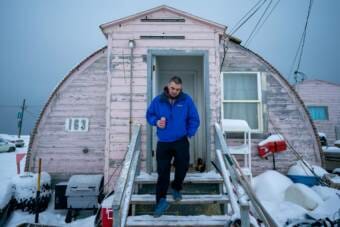
Justin Mitchak Gatten steps out of his home in NARL, a neighborhood on the outskirts of Utqiagvik, Alaska on Nov. 3, 2021. NARL, which stands for the Naval Arctic Research Laboratory, was a research facility established in the 1940s by the federal government and is now owned by the Ukpeagvik Iñupiat Corporation. (Loren Holmes/ADN)
Justin Mitchak Gatten’s Iñupiat ancestors were the original residents of Alaska’s North Slope thousands of years ago, and they once claimed millions of acres of land.
But today, Gatten can’t even find a lot to build a home in the region’s largest community, Utqiagvik. Instead, Gatten, 37, rents an aging quonset hut outside of town. He lives with his wife and four children.
The home is cozy but comes with inconveniences familiar to rural residents across Alaska: A delivery truck must replenish Gatten’s water supply as often as twice a day, and he has to warn his kids away from the septic tank, which sometimes overflows.
The North Slope’s Indigenous people lost most of their ancestral lands long ago, in a landmark settlement with the U.S. government that turns 50 years old this month, the Alaska Native Claims Settlement Act.
But after its passage, the act did transfer 340 square miles in Utqiaġvik’s vicinity to a newly created, locally owned corporation, Ukpeagvik Iñupiat Corp.
Homes in the Browerville neighborhood of Utqiagvik on Nov. 1, 2021. (Loren Holmes/ADN)
In a region long gripped by a housing crisis, where multiple generations often cram into the same home, many younger Utqiagvik residents like Gatten see the corporation’s largely unoccupied land as part of the solution.
That’s because UIC is owned by more than 3,000 Indigenous Alaskans who trace their heritage to the North Slope.
But for now, the owners with the loudest voices are those born before the settlement’s cutoff: Dec. 18, 1971. Those people each received 100 shares in UIC.
Gatten’s generation, and anyone else younger than 50, was left out. The result, he and others say, has denied them a full voice in the elections that set UIC’s leadership and direction, and a stake in their ancestral lands — until or unless they inherit stock from a relative.
UIC has made its original shareholders eligible to receive homesite lots from the corporation. But Gatten, who owns just 10 shares inherited from his mother, doesn’t qualify, and neither do his peers.
While Gatten has inherited two lots from grandparents, both are cut off from roads. And, he said, when he tried to exchange one with UIC for a more accessible lot, the only ones available were next to Utqiagvik’s sewage lagoon.
Utqiagvik, Alaska, photographed on Nov. 1, 2021. (Loren Holmes/ADN)
Alaska Native corporations have the power, if they choose to exercise it, to issue new shares to “descendants” born after ANCSA’s cutoff date.
But only about a dozen of the roughly 200 regional and village corporations statewide have done so. The indecision reflects high stakes that are both cultural and financial, as some Native corporations pay out substantial dividends that could diminish if more shares are issued.
UIC, which paid dividends of some $2,000 this year, has been studying the problem for years. But it has not yet issued new shares, with its board citing the complexity of the issue.
The same dilemma is playing out across the state, with dozens of Native-owned corporations contending with the same dynamics as their original shareholders, and descendants, grow older. And in many cases, the conflict has pitted community members and even family members against each other.
“What good is land if you’re not going to develop it?” Gatten said. “It seems quite selfish to me, for them to hold lands with road access, and we have to live in subpar conditions like this.”
UIC leaders didn’t respond to repeated interview requests.
The Ukpeaġvik Iñupiat Corporation building, photographed on Nov. 3, 2021 in Utqiagvik. (Loren Holmes/ADN)
But in newsletters, the corporation says it’s formed a board committee to explore options for issuing new shares to descendants in response to a successful 2017 shareholder ballot proposal that recommended such a step.
“The board of directors continues to explore this complex and significant step in the evolution of UIC,” Delbert Rexford, the corporation’s chief executive, wrote in a newsletter last year. “However, because descendant enrollment involves many aspects beyond land rights alone, and because the ballot proposal did not address what other rights should or might be included if a new class of stock were issued, these questions still need to be asked and answered.”
Shares and identity
Some Alaska Native leaders say that issuing shares to descendants is an obvious choice to help preserve Native corporations’ Indigenous character and distinguish them from traditional capitalist businesses.
In the early decades after ANCSA’s passage, many Native shareholders looked to their corporations for profits and dividends, and leaders prioritized expansion and growth.
But now, Native leaders say that their younger shareholders place higher value on their culture and see the corporations as a potential source of Indigenous identity and belonging, with responsibilities that extend beyond the fiduciary.
Josiah Patkotak, Utqiagvik’s state representative, drives home after work at the Arctic Slope Regional Corporation on Nov. 2, 2021 in Utqiagvik. Patkotak is a descendant and former Ukpeagvik Iñupiat Corporation board member who has inherited a handful of shares. (Loren Holmes/ADN)
“I think it needs to happen, for that continuation of community feeling,” said Josiah Patkotak, Utqiagvik’s state representative — a descendant and former UIC board member who has inherited a handful of shares. “There needs to be some kind of identity and purpose and meaning.”
Many corporations, though not all, have tried to blunt the divide between shareholders and descendants by making descendants eligible for non-cash benefits like corporate jobs and scholarships.
But economics and politics quickly complicate the discussion about the shares themselves.
One of the biggest obstacles is the potential for “dilution,” or devaluing stock owned by existing shareholders.
It’s a math problem: If there’s a finite amount of profits that a corporation can pay out as a dividend, more shares make those dividends smaller on a per-share basis. Existing shareholders have to approve the issuance of any new shares — meaning that they have to vote against their own economic interest.
There’s also the question of power. Some shareholders, and well-compensated board members, could find themselves in the minority if descendants were granted equal voting power.
The monetary impact is less significant at UIC, where the corporation’s yearly dividends to original shareholders have exceeded $1,000 only twice in the past six years, according to annual reports filed with state regulators.
A person drives a four-wheeler across a frozen lake on Nov. 2, 2021 in Utqiagvik. (Loren Holmes/ADN)
But certain other corporations pay much more, and issuing new stock could cause problems for original, older shareholders. Some of them might depend on dividends to cover their expenses, particularly in areas of rural Alaska that lack high-paying jobs and strong cash economies.
“For dividends to go down, it’s just a scary thing, because you have your budget established,” said Hallie Bissett, executive director of the Alaska Native Village Corporation Association.
Another important dynamic cited by those opposed to enrolling descendants is that original shareholders, in some cases, sacrificed early dividends so that their corporations could reinvest profits in new businesses that only paid dividends later.
Afognak Native Corp., whose shareholders have roots in the Kodiak region, has a huge government contracting business, and those with 100 shares now receive yearly dividends of some $20,000.
But Gerad Godfrey, an Afognak shareholder and former board member, said the contracting business was enabled by original shareholders who decided not to pay out their earnings from early timber harvests — unlike shareholders in a different Native village corporation not far away.
“They’ve got cousins that have a brand new outboard, a down payment on a boat, a brand new four-wheeler across the way there,” Godfrey said. “They sacrificed to get us where we are today.”
Gerad Godfrey at his home on Monday, Nov. 29, 2021 in Eagle River. Godfrey was born in 1972, a year too late to qualify as an original Afognak shareholder, and he grew up watching three of his older siblings receive dividends of thousands of dollars before he inherited some of his grandmother’s shares. (Loren Holmes/ADN)
Godfrey was born in 1972, a year too late to qualify as an original shareholder, and he grew up watching three of his older siblings receive dividends of thousands of dollars before he inherited some of his grandmother’s shares.
In an interview, Godfrey said he remembered returning home from a school event to find his father, who was campaigning for a Native corporation board seat, stuffing envelopes in the kitchen. His father asked him for help, but at that point, Godfrey said, he was feeling “a little resentful.”
“He says, ‘Don’t you want your dad to be elected to your Native corporation?’” Godfrey said. “I said, ‘It’s not my Native corporation. It’s Glenn Jr.’s, it’s Valery’s, it’s Jenna’s, it’s yours. So, I’ll take a pass.’ And I went downstairs and turned on the TV.”
Nonetheless, Godfrey has resisted giving shares to his high school-age children and still opposes issuing new shares to descendants, largely because of the potential for dilution. Descendants will still be able to inherit shares, Godfrey said, and growing up without them, he added, made him appreciate it more when he could finally participate — he’s now served on Native corporation boards and worked for them as an employee.
“I may have been more immersed and involved in Alaska Native corporation activities and engagement because I knew what it was to be without,” he said.
Mitigating dilution
Advocates for issuing new shares, meanwhile, say there are ways to mitigate the dilution problem, and that the focus on it risks distracting from the benefits of bringing younger people into the Native corporations.
“The one big reason not to do it is because it’s going to dilute the stock. And that’s just a very Western, normal corporation way of thinking — and we’re not regular, Western, normal corporations. We’re Native corporations,” said Joe Nelson, board chair of the Southeast Alaska-based Sealaska Corp. “By definition, we should be thinking about the long term, and making decisions that are in the best interests of the next generations.”
When Sealaska Corp. voted to enroll descendants, in 2007, it also approved issuing an extra 100 non-voting shares to elders, said Nelson, who was working as an attorney for the corporation at the time.
The idea was to protect those original shareholders against the effects of diluting their original stock, he added.
Other corporations have also reduced dilution by issuing fewer than 100 shares to descendants. And they can delay its effects by adjusting the timing of when shares are issued.
Sealaska doesn’t allow descendants to enroll until they turn 18, while Interior-based Doyon Ltd. issues 30 shares to descendants when they’re born, then 70 more when they turn 18. Kuukpik Corp., which is tied to the village of Nuiqsut on the North Slope, recently issued 50 shares to descendants and will issue five more every year for the next decade.
Sealaska Board Chair Joe Nelson stands on his boat in Saginaw Channel on Sept. 14, 2021 near Juneau. (Loren Holmes/ADN)
Some corporations, meanwhile, limit how many descendants can receive stock by maintaining a requirement in the original settlement legislation that shareholders be one-fourth Alaska Native.
Corporations have “levers that can be pulled” to address concerns around dilution, said Nathan McCowan, chair of the board of the Alaska Native Village Corporation Association.
One thing that many pro-enrollment corporate leaders say makes dilution less of a problem: Descendants of original shareholders tend to be less focused on dividends and monetary benefits and more interested in a source of identity.
Bissett, the Native village corporation association’s executive director, has inherited just three shares in Cook Inlet Region Inc., and she said sometimes her quarterly dividends amount to just $20.
But owning those shares, she added, has allowed her to win a seat on CIRI’s board and help shape the corporation’s future.
“It is not about the money for me,” she said. “You hear people talk about when they received their shares, and the first time they were able to attend annual meetings for the company — to have a share in taking care of these ancestral lands that were given to us to manage, forever. And that’s just an incredible feeling.”
‘Conquer and divide’
Supporters of enrolling new shareholders say it’s increasingly urgent for Native corporations to address the divide between elders and descendants, since the sooner descendants can become involved with corporate affairs, the more ready they’ll be to take leadership roles as original shareholders age out of them.
Half of Alaska’s 12 larger, regional Native corporations have already issued new shares; others are studying the question. But only a half dozen or so of the more than 150 village corporations, which tend to be smaller, have done so, according to industry leaders.
The relatively small fraction of village corporations to issue new shares is likely a reflection of how technical and expensive the process can be, McCowan said. Shareholder surveys and meetings are involved; consultants, actuaries and attorneys must be hired.
It took six years of debate and discussion before Kuukpik issued its new shares, said Isaac Nukapigak, a board member and former corporate president.
Native corporations’ generational divide was baked into the original 1971 settlement by Congress, which failed to create a mechanism to enroll new shareholders. That decision has since caused so many internal conflicts that some Natives suspect Congress was trying to provoke them.
“That was their intent,” said Gatten. “Conquer and divide.”
Qaiyaan Harcharek holds his phone, displaying a recent photo of his son with a fox, in Utqiagvik on Nov. 2, 2021. (Loren Holmes/ADN)
But today, there’s also broad agreement across the Native corporation world that a statewide, congressional fix to the problem isn’t viable, given the widely varying circumstances at each corporation and, at some, the outright opposition to descendant enrollment.
One suggestion from McCowan: Congress could budget money to support smaller corporations going through the enrollment process, which might otherwise lack the cash to hire the relevant experts.
“We’re byproducts of the public policy process in the United States, governed, like treaties are, by the laws of Congress,” he said. “If there’s a problem that Congress created then, by and large, it’s a problem that Congress has the responsibility to solve.”
But Native groups have not launched any kind of coordinated lobbying effort to push that idea, and no action from Alaska’s congressional delegation appears to be imminent — though U.S. Sen. Lisa Murkowski, whose congressional office was the only one to respond to a question about descendant enrollment, said she’s open to discussion with corporations about how to solve the problem.
“Whatever it is they choose to do, our role here in Congress should be to facilitate the promise of ANCSA, and be responsive to the fact that the world’s changed a little bit in 50 years here,” she said. “If we need to review, we should do that.”
Justin Mitchak Gatten stands in his kitchen in NARL, a neighborhood on the outskirts of Utqiagvik, Alaska on Nov. 3, 2021. NARL, which stands for the Naval Arctic Research Laboratory, was a research facility established in the 1940s by the federal government and is now owned by the Ukpeagvik Iñupiat Corporation. (Loren Holmes/ADN)
In the meantime, Gatten, in Utqiagvik, remains in his quonset hut, as his wife nudges him to try for another land exchange with UIC that wouldn’t put his new house next to the town’s sewage lagoon.
He said he understands that issuing new shares can risk diluting dividends for original shareholders, and that his ancestors made sacrifices and grew up without many of the modern comforts that corporations have helped bring to the North Slope.
But as a parent to his own children, Gatten said, he remains confounded by original shareholders who aren’t eager to share in their corporate wealth with their descendants.
“We’re grateful. I’ll shake every single one of those people’s hands that’s still alive, saying thank you. But do you deserve a dollar amount? I don’t think that’s fair,” he said. “I think everyone should get a piece of the pie.”
This story is part of a reporting collaboration between Alaska Public Media, Indian Country Today and the Anchorage Daily News on the 50th anniversary of the Alaska Native Claims Settlement Act. Funding for the ANCSA project was provided by the Alaska Center for Excellence in Journalism.
The Seacoast Trust works with the Sustainable Southeast Partnership which in turn helps coordinate the Hoonah Native Forest Partnership members (pictured) who are working to restore forestlands and watersheds on Chichagof Island. (Photo by Bethany Goodrich/Sustainable Southeast Partnership)
Seacoast Trust, an initiative put together with $17 million seed money from Sealaska Corporation and The Nature Conservancy, announced Monday that it’s received an additional $2 million from two philanthropic organizations.
“We are thrilled to be part of such a well-crafted approach to stewardship and economic development in Southeast Alaska,” Rasmuson President and CEO Diane Kaplan said in a statement. “Strong, local leaders and broad support are key. We are especially delighted to have Edgerton Foundation as a ground-floor partner.”
The Southeast Sustainable Partnership, a decade-old effort that runs projects in towns and villages across Southeast Alaska, will coordinate the Seacoast Trust projects.
Financial oversight of the Seacoast Trust comes from Spruce Root, a Juneau-based nonprofit with ties to Sealaska.
The trust has said in its statements that the long-term goal is to create a $100 million fund that could provide about $5 million annually for economic development in communities across Southeast Alaska.
Martha Wood secures her boat on Thursday, July 22, 2021 in Ambler. Wood was fishing for sheefish when her line broke, and returned to shore to get a replacement. (Loren Holmes / ADN)
To Bryant Sun, a 17-year-old from the Iñupiat village of Shungnak, plans for a nearby open pit mine and 200-mile access road pose too much of a risk to his family’s traditions of subsistence hunting and fishing.
In this remote Northwest Alaska region, where the only way in and out is on a plane or boat, groceries can be impossibly expensive: $10 for a bottle of salad dressing or a box of cereal.
So Sun’s family, and many others, depend on seasonal harvests of moose, caribou, bears, berries and fish. They have two subsistence cabins — one upriver from town and one downriver.
“Traffic that’ll be going through there, with all that equipment and stuff — they’ll just scare everything off,” Sun said in an interview outside his Shungnak home in July. “That road would affect everything, I’d say.”
Sun’s village sits on the banks of the upper Kobuk River, a murky, fertile ribbon of water that connects Shungnak with two other predominantly Native villages, Ambler and Kobuk. Just north are the Brooks Range foothills, where a mining company, Ambler Metals, is drilling to test the viability of a potentially lucrative copper prospect.
From left, Bryant Sun, Mark Griest, Baron Jones, and Kaden Douglas hang out on July 23, 2021 in Shungnak. All four boys are rising seniors. Sun’s family, and many others, depend on seasonal harvests of moose, caribou, bears, berries and fish, and he is concerned about the proposed Ambler Access Road. “Traffic that’ll be going through there, with all that equipment and stuff, they’ll just scare everything off,” Sun said. “That road would affect everything, I’d say.” (Loren Holmes / ADN)
Fred Sun, Bryant’s father, works at Ambler Metals’ mining camp in the mountains.
A map showing thr route of 211 mile Ambler Road (Kevin Powell / ADN)
His passion for subsistence is equal to his son’s. But after years in the mining industry, Fred, 47, is comfortable with the idea of the project 25 miles from his home.
“When you’re Bryant’s age, you don’t really have bills to worry about. He’s never even bought a gun before, and he uses guns all the time. He doesn’t realize everything he uses to help fill our freezer costs money,” said Fred, who’s also the president of Shungnak’s tribal council. “We can’t live our subsistence lifestyle without having a job.”
The divide between father and son reflects a wider ambivalence about the mine and road projects that extends across the three Upper Kobuk River villages. It also reflects tensions embedded in the federal legislation that settled Indigenous Alaskans’ land claims: the Alaska Native Claims Settlement Act, which turns 50 this month.
The act aimed to clear the way for construction of the trans-Alaska pipeline by extinguishing Indigenous land claims, with a transfer of 44 million acres — about 10% of the state — to dozens of newly formed Native-owned corporations.
Fishing nets and a hide hang outside Miles Cleveland’s Ambler home in July. (Loren Holmes / ADN)
Congress’ vision behind the legislation was at least partially one of self-determination: Indigenous shareholders could, in theory, sustain their urban and rural lifestyles with profits from management and development of their corporate lands.
But the act was also meant to assimilate Native people into the capitalist system. And development and natural resource extraction can clash with subsistence traditions of hunting, fishing and gathering.
The projects near the Suns’ home embody the tensions between the region’s economy and subsistence culture, as Northwest Alaska’s regional, Native-owned corporation, NANA, is participating in the preliminary stages of the mine’s development. As part of a deal it struck with Ambler Metals, NANA’s shareholders are being hired to work on an exploratory drilling effort, and NANA land is being used as a staging area.
The Bornite camp, photographed on July 24, 2021. Copper was discovered in the area in 1947, and a 328m exploration mine shaft was drilled by Kennecott in the 1960s, which showed economically viable mineral potential. In 1965 another large deposit was discovered nearby at Arctic, increasing mining interest in the area. Bornite sits on NANA Regional Corporation land, while Arctic, around 15 miles northeast from Bornite, sits on state land. (Loren Holmes / ADN)
NANA executives say the drilling and exploration process they’re participating in will help them decide if the balance is right. And that process requires deliberation and continuing discussion with affected communities and shareholders, said Lance Miller, NANA’s vice president of natural resources.
“You still have to have something that makes sense economically. It has to make sense socially, environmentally — that triple bottom line,” he said.
The mine still faces a number of obstacles before it can be built, including securing substantial financial investment and major federal permits. Environment groups and tribes near the road’s route have also filed lawsuits challenging key Trump-era environmental approvals.
But for now, the project continues to move forward.
Geo techs Samantha Horner, left, and Braden Son catalog core samples from the Arctic deposit on July 24, 2021 inside the core shack at Bornite. Horner is from Kobuk and Son from Shungnak, the two closest communities to the mineral deposits. (Loren Holmes / ADN)
Living off the land
The Upper Kobuk, like many areas of rural Alaska, straddles the modern and traditional.
Residents have internet-equipped cellphones, order packages from Amazon and can reach Anchorage by plane in a matter of hours. But yearly rhythms still largely revolve around the subsistence calendar.
In the spring, there’s duck and beaver hunting, and sometimes bear. In the summer, people harvest sheefish from the river, set nets for chum salmon and gather blueberries, salmonberries and cranberries. Fall is hunting season for caribou and moose.
Frances Williams pulls a salmon from a subsistence setnet on the Kobuk River Thursday, July 22, 2021 near Ambler. (Loren Holmes / ADN)From left, Jeremy Williams, Dwayne Johnson and Frances Williams float down the Kobuk River after checking a subsistence setnet. (Loren Holmes / ADN)
One state survey showed that in a single year, Ambler’s collective subsistence harvest added up to 600 pounds of food per resident, while Shungnak’s and Kobuk’s are both several hundred pounds.
Those resources are especially important given the high cost of groceries and the scarcity of high-paying jobs in the Upper Kobuk: In Ambler, for example, the median household income is $45,000, far below the statewide figure of $75,000.
“Food is so expensive up here. Gas is so expensive. Everything’s expensive,” said Miles Cleveland, 70, a borough assembly member from Ambler. “You need a job to go to the store.”
Clara Jones, 49, has three freezers at her home in Ambler, plus another in a tent outside, that preserve the harvests she shares with family members and friends — including many in other villages and even on the road system.
On a warm July day, she watched from the riverbank as her son motored out on the Kobuk to set a subsistence net for chum salmon; she’d already cut up and shipped 30 sheefish to relatives elsewhere.
“All the rich resources we have here, we can live off of,” Jones said. “That’s how we always were taught by our grandparents, and we continue to do it. And I’m hoping to pass it on to my children, my grandkids.”
Clara Jones shows one of her several freezers filled with subsistence foods on Thursday, July 22, 2021 in Ambler. Jones, 49, has three freezers, plus one in a tent outside her home, that preserve the harvests she shares with her family members, including many in other villages and even outside Anchorage. (Loren Holmes / ADN)
A history of prospecting
Prospectors first began searching for minerals in the Upper Kobuk around 1900. By the 1960s, a subsidiary of mining giant Kennecott Copper Co. was setting up summer camps for helicopter-assisted exploration.
One Shungnak elder, Neal Sheldon, said he used to walk several hours across the tundra into the mountains to work at the mining camp, known as Bornite. Fred Sun’s father worked with prospectors, too; he would leave Bornite late after his shift as a camp dishwasher, and drink tea that colleagues left warming over the coals of a fire they’d set at the halfway point on their walk back to their village.
Today, Ambler Metals, a joint venture between Vancouver and Australian mining firms, uses the Bornite camp as a base for its exploratory drilling sites perched on sheer cliffs deeper in the mountains.
A drilling rig platform sits near an active rig at the top of a ridge at the Arctic deposit on July 24, 2021, about 20 miles north of Kobuk. Arctic, discovered in 1965, is the most advanced exploration project in the Ambler Mining District, and has an estimated 39.5 million metric tons of mineral resources consisting primarily of copper, zinc, lead, gold and silver. (Loren Holmes / ADN)
If it’s built, the mine could employ hundreds of people and produce hundreds of millions of dollars in wages, and boosters say its minerals would aid the world’s transition away from fossil fuels. But it would place a major industrial operation in the Upper Kobuk watershed.
In spite of the risk the project poses, some residents already have a level of comfort with the mining industry because they’ve worked at the existing Red Dog project, 150 miles to the northwest.
That large mine sits on NANA-owned land and is operated by multinational Canadian company Teck; it opened three decades ago and employs hundreds of NANA shareholders, some whose yearly incomes reach $100,000 or more.
Red Dog has also made hundreds of millions of dollars in royalty and tax-like payments to NANA and the Northwest Arctic Borough, which describe the mine as a foundation of the region’s economy.
Before Red Dog was built, some residents were worried about its impacts on subsistence, and the mine has faced lawsuits and criticism from a neighboring village over its environmental record. But many local leaders and residents now hail it as a success story.
“They’ve been a good partner,” said Cleveland, the borough Assembly member. “They’ve done great things for a lot of us, as far as employment and people that work there.”
Red Dog’s supply of ore, though, is now running low, prompting tough questions about what will come next.
Miles Cleveland, Sr. sits in his home on Thursday, July 22, 2021 in Ambler. “They’ve been a good partner,” said Cleveland, 70, an elder and borough assembly member from Ambler, speaking about Red Dog, the large open-pit zinc mine which has been operating on NANA land for about 30 years. “They’ve done great things for a lot of us, as far as employment and people that work there.” (Loren Holmes / ADN)
The road
There are important differences, however, between Red Dog and the Upper Kobuk project.
The new mine would tap a deposit that is smaller and less lucrative than Red Dog. Its major deposit also does not sit on NANA land, though NANA’s deal with Ambler Metals allows the Native corporation to take a stake in the mine if it’s built.
Then, there’s the road.
Red Dog also ships out its minerals on a road built for that purpose. But its route connects the mine only to an isolated port on the Chukchi Sea coast, with no communities along the way.
The Ambler road would connect the Upper Kobuk to the rest of Alaska.
Starting from the Dalton Highway — the road from Fairbanks to the North Slope oil fields — it would end in the area of the mine, which lies near other mineral deposits that could also be developed.
The route is expected to connect to Kobuk, and potentially to Shungnak and Ambler as well.
And that makes residents nervous.
An access road runs between the community of Kobuk and the Bornite camp in the Ambler Mining District, on July 24, 2021. The area has been explored for its mineral potential since the 1950s, and contains a number of significant copper, zinc, lead, gold, silver and cobalt deposits. (Loren Holmes / ADN)
Upper Kobuk locals say the caribou they harvest already face pressure from sport hunters on fly-in trips.And many residents worry the road could bring in even more hunters from Fairbanks or Anchorage.
There’s also the potential for collisions with caribou or other impacts on wildlife from mineral-hauling trucks, which could make as many as 170 trips a day during peak production. And if the additional mineral prospects along the road’s route are built into mines, that could add to the pressure.
“I’m just worried about it messing up the migration route,” said Jones. “Everybody depends on their game.”
Alaska’s economic development agency, and others involved in the road’s planning, say the route will be open only to private use — not to hunters or for other recreational purposes.
Skeptics cite the case of the Dalton Highway, where the northern stretches were initially closed to the public before the state government opened them in the 1990s. Local and tribal interests sued to block the move, citing risks to subsistence harvests and public safety, but a 1994 Alaska Supreme Court decision allowed the opening to proceed.
The groups pushing the Ambler road say the circumstances are different. In its 1994 decision, the Supreme Court cited a federal right-of-way grant for a “public road,” while the Bureau of Land Management says the federal grant for the Ambler road would be specifically for “limited access” and not open to the public.
A mountain rises up from the Kogoluktuk River valley on July 24, 2021 near Kobuk. (Loren Holmes / ADN)
Road supporters also argue that NANA wants to keep the road closed to the public where it stretches across its lands, and NANA itself says it’s counting on an “ironclad assurance” that access remains “private and controlled.” Boosters also say federal permits can restrict use of the road and that mine operators would want to limit access to ensure the safety of their trucks.
Many locals are unconvinced those limitations can be enforced.
“They say the road is basically going to be for the mine itself. But you know how the United States works,” said Chuck Schaeffer, a NANA shareholder who works as a supervisor at the Bornite camp and still thinks the project’s benefits are worth the risks it poses. “Give it 10 or 20 years and everybody’s going to be using the roads. What does that mean? The rivers, the migration of the caribou herds — it’s going to affect everything.”
Assistant camp manager Chuck Schaeffer, left, helps George Smith prepare drilling pipe to be airlifted to a drill site on July 24, 2021 at the Bornite camp. (Loren Holmes / ADN)
The road project also faces some intense opposition in villages in the Koyukuk River valley. The route travels through that region, but residents are largely shareholders in Doyon instead of NANA.
Critics say Koyukuk River residents would take on all the risks from the road, without the benefits from NANA’s potential stake in the project.
Then, there’s a worst-case scenario of a spill or accident at the mine that could contaminate the Kobuk River.
“Every mine has a tailings — what happens if it fails?” asked Shungnak resident Anthony Norris, 31. “That’s a disaster.”
George Smith communicates by radio to helicopter pilot Andrew Chan as he lifts a load of drilling pipe on July 24, 2021 at the Bornite camp. (Loren Holmes / ADN)
A huge word
But in the Upper Kobuk, at least, some residents also say the mine and road projects could come with significant benefits.
One is the road’s potential to bring cheaper goods and access to a region that faces extremely high prices, like the $10 for a gallon of gasoline that Ambler residents were paying this summer.
Not everyone is convinced that the road would significantly reduce costs: The Upper Kobuk would still be a 450-mile drive from Fairbanks, and it’s not certain that all three villages would be able to connect to the route.
Carl Snyder fishes for sheefish with his son Carl Jr., 5, on July 25, 2021 in Kobuk. (Loren Holmes / ADN)
Carl Snyder fishes for sheefish with his son Carl Jr., 5, in Kobuk. (Loren Holmes / ADN)
But supporters envision a road link making life in the Upper Kobuk more sustainable. There’s also the potential for construction jobs and work at the mine, though projections say it would only operate for a dozen years.
Many Upper Kobuk residents already have summer work at the mining camp at Bornite, like Fred Sun.
Sun, in an interview, pointed out that more than half the members of Shungnak’s tribe live outside the village, and that many NANA shareholders live outside the region. The road and mining project could be a means to keep more of them in rural Alaska, he suggested.
“I have so many friends and relatives that live in Fairbanks and Anchorage who would rather live in Shungnak. But there are just no opportunities there — there’s no work, the cost of living is too high,” Sun said. “It kind of hurts a lot. If my kids decided to, I’d like them to have the opportunity to live at home, if they so choose.”
Children play in Kobuk on July 25, 2021. (Loren Holmes / ADN)
Ambler Metals’ final decision on whether to build the open pit mine is still likely three years away.
As the mine and road projects continue to move forward, Upper Kobuk residents on both sides of the issue, and those withholding judgment for now, say they will continue advocating for the best interests of their villages.
But in interviews, many said they don’t think their opinions will matter.
“Regardless of what we say and how we say it, that road is definitely going to be shovel-ready within three to five years. And there’s not a darn thing we can do about it,” said Conrad Douglas, 64, a city council member in Ambler.
An unfinished road leads from Shungnak northeast toward the community of Kobuk, the Dahl Creek airstrip, and the Ambler Mining District on July 23, 2021. Kobuk and the Dahl Creek airstrip are around eight miles from Shungnak. (Loren Holmes / ADN)
Ambler Metals President Ramzi Fawaz said the mine will not be built without “social acceptance” and “social license” — which, he said, his company has not yet obtained.
“I’m not there yet,” he said. “This is an ongoing thing, and it will continue to be ongoing. Nothing is taken for granted.”
Fawaz is originally from Lebanon. He has worked on resource development projects around the world and only recently moved to Alaska to oversee the mining project.
In an interview, at his company’s Anchorage headquarters at the base of a corporate office tower, he acknowledged that he can’t fully grasp the stakes for the villages nearby.
But, he added: “I have lived and done a lot of projects in similar environments, and what I’m hearing doesn’t surprise me.”
“It is genuine, it is important and it goes to the heart of how people live and what they want and what they desire and what they fear,” he said. “I’m going to do my utmost to understand and respect and do what I’m told, and what I’m being advised. And that’s all I can do.”
Ambler Metals employs some locals with long histories in the region, and who also say they appreciate the weight of the debate.
Schaeffer, the Bornite camp supervisor, believes the project offers worthy benefits. But he does not discount its risks.
Schaeffer supports “responsible development,” he said.
But, he added, the “responsible” in that phrase is a “real huge word.”
This story is part of a reporting collaboration between Alaska Public Media, Indian Country Today and the Anchorage Daily News on the 50th anniversary of the Alaska Native Claims Settlement Act. Funding for the ANCSA project was provided by the Alaska Center for Excellence in Journalism.
Close
Update notification options
Subscribe to notifications
Subscribe
Get notifications about news related to the topics you care about. You can unsubscribe anytime.