Alaska Native Corporations

A Southeast Alaska village wants to build a tourism industry from scratch as logging fades

""
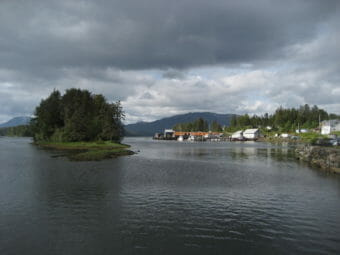
Klawock Harbor in 2012. (Photo from Alaska Division of Community and Regional Affairs)

A Lingít village in Southeast Alaska plans to transform itself into a cruise ship destination to create a new economic opportunity as logging fades in the area.

The Alaska Native village corporation in Klawock is working with other Native corporations to install a relatively low-cost floating dock and make other upgrades to receive cruise ships in the village starting a year from now, project officials said.

Klawock is on Prince of Wales Island, about 700 miles southeast of Anchorage. Alaska’s first cannery was built there more than a century ago and logging of old-growth trees continues, though much less than it once did.

Project officials are modeling the proposal after one in Hoonah, another Southeast village that turned itself into a cruise destination.

It plans to start with basic facilities like the floating dock, said Mary Edenshaw, chief operations officer for Klawock Heenya, the Native village corporation. Klawock is home to about 700 people, she said.

The ships will create opportunities for small business owners, wood carvers and other artisans, she said. Tour guides can shuttle guests to see wildlife and the village’s historic totem-pole park, or visit other landmarks on the island’s road system.

“This will create jobs, when jobs are potentially going away,” Edenshaw said.

The plans come after Sealaska, the region’s Alaska Native corporation, announced last year that it was ending its decades-old logging operations that had centered on Prince of Wales Island. The large Native corporation wanted to pursue more sustainable activities, it said last year.

Matt Carle, a spokesman with Sealaska, said Klawock’s plans can promote economic development not just in Klawock but in other villages on Prince Wales of Island.

The island is so remote many people never stop there, he said.

“Any time you travel in Alaska, it takes a day or two to get off the beaten path to really experience the rich and vibrant Alaska Native culture,” Carle said. “But in this case people can literally step off the ship and see this, and that’s really unique.”

The increasing emphasis on tourism in Klawock is happening two years after the COVID-19 pandemic halted most cruise sailings to the state.

In Southcentral Alaska, efforts are underway in Seward and Whittier to build new docks that will add to the flood of visitors to those towns.

Tiny Klawock plans to host relatively small cruise ships that bring about 600 people, Edenshaw said. Oceania Cruises plans to make the inaugural stop next May, she said.

Klawock’s mayor, Don Nickerson, said most residents support the village corporation’s idea. He’s heard concerns that Klawock will be overrun with people, but he believes Klawock Heenya will manage guests so that won’t be a problem, he said.

Nickerson said the village needs this opportunity. Logging opportunities have diminished and salmon fishing is struggling too, he said.

“I definitely think this will boost our economy,” he said. “This was a log-booming community in the ‘80s and ‘90s and part of the 2000s, and that has all gone away.”

The town’s weavers and carvers, including youth learning from elders, will be able to sell their work and share their talents, he said. It will be an authentic cultural experience compared to larger ports like in Juneau, he said.

“There is a lot of talent and history on our island,” he said. “Nothing will be manufactured, and everything will be man-made.”

Klawock Heenya is working on the project with Na-Dena`, an Alaska Native company focused on providing cultural-based tourism in Alaska.

Na-Dena` said in a statement last week that the Port of Klawock can accept cruise ships traveling from the north and south.

“With two separate fjord entrances, sailing in and out of the port treats cruisers to scenic views of the wildlife-rich archipelagos, dramatic mountains and lush islands,” the statement said.

Na-Dena` consists of Huna Totem and Doyon. Huna Totem is the village corporation for Hoonah that built Icy Strait Point into a cruise destination recognized for its ecological and cultural values. After starting with a small float dock in 2004, Icy Strait Point can now handle two massive cruise ships at a time, each bringing thousands of guests, with amenities that include a giant zip line ride and high-speed gondolas that replace buses.

Doyon is the Alaska Native regional corporation for the Interior that provides bus tours of Denali National Park and Preserve where it owns a nearby lodge.

Na-Dena` will work with Klawock to emphasize its traditions and values, said Russell Dick, president of Huna Totem, in a statement about the project.

Officials with the Klawock project declined to provide cost estimates.

The floating dock will be anchored to an old timber loading dock that today sees only a handful of ships a year through a private logging company, project officials said.

The village will build the dock and other facilities soon, Edenshaw said. Drinking water and bathrooms will be a construction priority.

“We’ll have to start with plumbing,” Edenshaw said. “There’s electricity to the dock, but we’ve never had to worry about that many people coming to this area.”

This story was originally published by the Anchorage Daily News and is republished here with permission.

EPA official says agency is committed to cleaning up contaminated Native corporation land

""
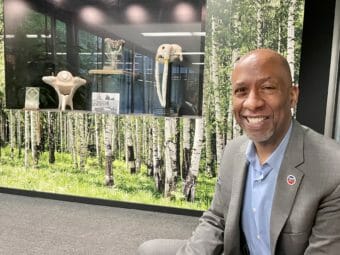
Carlton Waterhouse, EPA deputy assistant administrator for the Office of Land and Emergency Management, at the BP Energy Center in Anchorage on June 7, 2022. (Photo by Liz Ruskin/Alaska Public Media)

President Biden’s nominee to head the Environmental Protection Agency office responsible for Superfund sites said he’s committed to making progress on cleaning up contaminated lands conveyed to Alaska Native corporations.

The problem is huge but solvable, Carlton Waterhouse said.

“Obviously, there’s agencies and departments that have been doing cleanups over 50 years, but we haven’t got enough done over too long a time period,” he said. “And so now we need to strategize on how we can really meaningfully ramp up what we’re able to accomplish. And we think the key to that is working together.”

Some 44 million acres have been conveyed to Native corporations as part of the 1971 Alaska Native Claims Settlement Act. That includes more than 900 sites contaminated with military and civilian dump sites, heavy metals, PCBs and buildings containing asbestos. Several hundred sites have been cleaned up, but there are many more to go.

Waterhouse said the Biden administration will take a “whole of government” approach. Coordination is particularly important in Alaska, he said, because the cost of mobilizing to a remote contaminated site is so high.

“If you think about the federal government, each sending different people to different sites at different times to deal with the same problems, rather than us kind of collaborating on how we marshal our resources and assets to be able to address the problem, it really adds to the expense,” he said. “It really adds to the amount of time. ”

Waterhouse is still waiting for a U.S. Senate vote on his confirmation. Casey Sixkiller joined him for meetings with Native organization leaders in Anchorage. Sixkiller is the new head of EPA’s Region 10, which includes Alaska.

Bea Kristovich, first woman traditional chief of Association of Village Council Presidents, has died

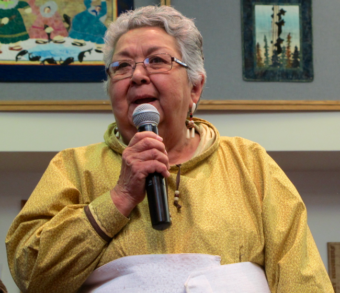
Bea Kristovich is the first woman Traditional Chief of AVCP. (Photo by Anna Rose MacArthur / KYUK)

Bethel and Napaimute elder Bea Kristovich died Thursday at the age of 83. The Association of Village Council Presidents elected Kristovich as their first woman traditional chief in 2015. Kristovich spoke with KYUK the day of that historic election.

“Women were always left out over the years,” Kristovich said. “The men were the leaders. But over the years, there’s been more people, or more ladies, more women getting more active, going into active roles as leaders from the villages. And they’re still silent. But I think being the first one, it will show these other younger generations that they can do it.”

That day Kristovich shared her vision for the Yukon-Kuskokwim Delta tribes.

“I want them to be united,” Kristovich said. “You know, there’s 56 villages, and they’re still separated by Yukon, Kuskokwim, and our area. And I think if we were all united, we’d be so strong. We could stick together and fight for issues that are very important for our people and our villages. It would work.”

Kristovich wanted younger people to lead the region. She resigned as traditional chief after one year.

Kristovich was Athabascan and a member of the Native Village of Napaimute. She was born in Napaimute and lived most of her life in Bethel. During her multiple careers, she worked for the Bureau of Indian Affairs, the Alaska Court System, and the Lower Kuskokwim School District.
Her family said that Kristovich died in Anchorage at the Alaska Native Medical Center following a long illness. The family will hold a viewing in Anchorage, a Catholic funeral in Bethel, and then a burial for the former traditional chief in Napaimute.

Larger cruise ships will start visiting Klawock in 2023

""
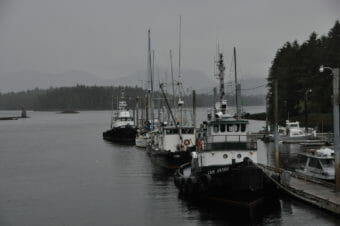
Klawock Harbor. (Creative Commons photo by Mack_L)

The Klawock Heenya Corp. is partnering with Huna Totem Corp. to bring larger cruise ships to the community of Klawock on the west side of Prince of Wales Island.

Mary Edenshaw is chief operations officer for Klawock Heenya, the village Native corporation for Klawock. She says small cruise ships have docked at the city float before. The larger ships will tie up at an existing dock on Klawock Island owned by Klawock Heenya.

“It was used in the past for exporting logs and the huge log ships that would come in,” Edenshaw said. “So we’re going to convert that into a cruise dock port.”

She says Huna Totem Corp. reached out to Klawock Heenya wanting to add the community as a destination along the lines of Icy Strait Point in Hoonah, which Huna Totem also owns. Edenshaw says the plan is to start out small, with ships that carry between 500 and 700 passengers.

“This is going to be a process to include larger vessels down the road, but we will build a float that will attach to the existing structure that we have right now,” she said.

She says some cruise lines have already agreed to add Klawock to future itineraries. Edenshaw declined to give additional details, other than that the first ships will arrive in Klawock in summer 2023.

Southeast Native Radio aired for just 16 years, but its voices live on in a new digital archive

A group photo of 11 people, standing and kneeling
KTOO transferred the Southeast Native Radio tapes to Sealaska Heritage Institute in a ceremony in 2010. The show was produced by a team of volunteers, including Arlene Dangeli, Joaqlin Estus, Cy Peck Jr., Kathy Ruddy, Kim Metcalfe, Andy Hope III, Jayne Dangeli, Laurie Cropley Nix and Rhonda Mann. (Photo courtesy of Sealaska Heritage Institute)

Hundreds of hours of Southeast Native Radio broadcasts are now archived on the internet and available for anyone to listen to.

Southeast Native Radio was broadcast over KTOO in Juneau for 16 years, from 1985 to 2001. The volunteer-produced show played as current affairs at the time, but twenty-one years later it’s become a window into the lives of the people and events that shaped Native culture in the region over the last century.

A shelf of old tapes labeled "KTOO" and "SNR"
The Southeast Native Radio collection includes over 400 programs broadcast from 1985-2001. (Photo courtesy of Sealaska Heritage Institute)

The catalog of recordings is lengthy and populated with names that make it a who’s who of Southeast Native culture at the turn of the 21st century.

Nora Marks Dauenhauer, for example, was a leading Lingít language scholar and historian, as well as Alaska’s Poet Laureate. She died in 2017, but her words are now just a click away.

The Southeast Native Radio Recordings collection is available through the Sealaska Heritage Institute, which received the donated DAT tapes, reel-to-reels, and CDs from KTOO in 2010. In all, there are 400 recordings.

Even the most seemingly mundane shows are abuzz with history because the people represent a generational bridge to an even deeper past.

In one of the archived recordings, Roy Peratrovich, husband of Elizabeth Peratrovich, talks about the first of five times he was elected Grand President of the Alaska Native Brotherhood, when he lobbied to bring the Grand Camp to Klawock:

Peratrovich: When you’re young, you do a lot of foolish things…

Host: Was this 1929?

Peratrovich: No, 1939.

Host – 1939, okay.

Peratrovich: So I told the group that if we are going to build up this group, this ANB, we’re going to have to do it big. Pride is going to help us. Not knowing some screwball was going to nominate me for Grand President. So I got elected.

Peratrovich died in 1989, a year after that appearance on Southeast Native Radio.

And there’s basketball, which is a large thread in the cultural fabric of Southeast Alaska. One of the stars of the annual Gold Medal Tournament was Sitkan Herb Didrickson.

He told Southeast Native Radio that the Sitka team had to catch a ride on a seine boat each March for the trip to Juneau.

“As I started to put my gear up in the top bunk, I found this old man was laying up there already,” Didrickson says. “He kind of got on board a little early, and no one knew that he was there. So he was trying to stowaway, you know. So we figured, well, the old fellow wants to go and see some games, and we all couldn’t sleep at the same time.”

Didrickson to this day is considered one of the greatest players produced in Southeast Alaska, whose chances at a pro career were thwarted by WWII. Didrickson died in 2017.

Sealaska Heritage Institute refers to the archive as a “treasure trove,” and that’s not far off. The recordings include a 13-part series produced in 1986 on the history of the ANB. There are also a number of Lingít language segments with fluent speakers like Dauenhauer and Walter Soboleff conversing on a range of subjects.

Note: The Southeast Native Radio Recordings project was supported by a Digitizing Hidden Collections or Recordings at Risk grant from the Council on Library and Information Resources. The grant program is made possible by funding from The Andrew W. Mellon Foundation.

Petersburg assembly will send letter opposing Alaska Native lands bill

Petersburg Lake and Portage Bay on Kupreanof Island near Petersburg. (Photo by Joe Viechnicki/KFSK)

Petersburg’s borough assembly on Monday voted to send a letter opposing a bill that would create five new urban Native corporations in Southeast Alaska and transfer land from the Tongass National Forest to those corporations. Some on the assembly thought there should be more chance for public comment.

Alaska’s congressional delegation has repeatedly introduced legislation that would change the Alaska Native Claims Settlement Act. It would provide new urban corporations in Petersburg, Wrangell, Tenakee, Haines and Ketchikan each with just over 23,000 acres of national forest land.

Petersburg’s vice mayor Jeigh Stanton Gregor proposed a letter opposing the bill.

“I have a real heartache with taking for any reason lots and lots of public land and giving it to private business with the sole goal of for-profit use,” Stanton Gregor said. “That’s the goal of that land if this goes through will be to maximize profit that’s what that does.”

Some of the proposed selections for land on Kupreanof Island near Petersburg. This particular selection no longer includes recreation cabins at West Point and Portage Bay (Image from U.S. Forest Service maps presented to the Senate Energy and Natural Resources Committee)

The five communities did not meet certain requirements for corporation status under the landmark 1971 law. However, other places that also did not meet those requirements were allowed to form corporations and granted land.

Supporters say the legislation would return a tiny fraction of aboriginal territory taken from Alaska Natives. Future shareholders say the new corporations would spur economic development with possibilities for tourism and carbon credits or other uses like food or cultural activities. The sub-surface or mining rights would go to Sealaska, the regional Native corporation. Natives in the five communities have identified the parcels they’d select.

Petersburg assembly member Dave Kensinger said he’s against the legislation because of those selections.

“I’d have a lot easier time supporting this if it was one block of land but it makes your head crazy if you look at all the selections they’ve made,” Kensinger said.

He also thought those land choices could impact the U.S. Forest Service’s ability to offer timber sales in the area. Other opponents have been concerned about the potential for logging on the land or loss of access. There’s language in the bill that would allow public access but also allow a corporation to restrict access in certain situations.

Mayor Mark Jensen requested the assembly take a position on the bill and thought it could have a hearing in a Senate committee. Two years ago, local elected officials asked for more time to learn about impacts. Since then supporters and opponents from Petersburg and elsewhere testified at multiple assembly meetings. The assembly also drafted a long list of questions about the bill’s impacts. Supporters of the legislation provided detailed answers.

Assembly member Jeff Meucci wasn’t ready to take a position and said he still had unanswered questions.

“It’s a real emotional issue in Petersburg and I get that and I want to make sure before I vote one way or the other that I’ve had the opportunity to listen to the folks in town and some of the folks who are involved with it who don’t live in Petersburg but just hear what they have to say and see what we can do,” Meucci said.

The vote was 4-3 to send a letter opposing the bill. Bob Lynn joined mayor Jensen, Stanton Gregor and Kensinger voting “yes” to send that statement of opposition.

Meanwhile, landless communities last month advocated for action at Tlingit and Haida’s Tribal Assembly.

Site notifications
Update notification options
Subscribe to notifications