Alaska Native Corporations

Alaska tribe’s members say corruption, self-serving deals brought Manh Choh gold mine to their land

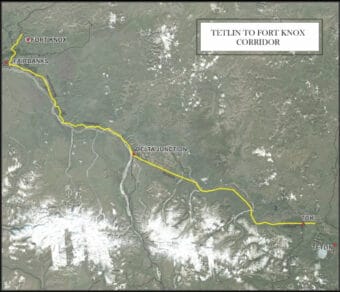
A DOTPF map of the route along which Kinross Gold plans to haul ore from the Manh Choh Mine near Tetlin to the Ft. Knox Mine mill north of Fairbanks. (Alaska Department of Transportation)

In Interior Alaska, a company is preparing to start production at a large gold mine near the Native Village of Tetlin. A former tribal chief greenlit the mine and leased mineral exploration rights to a mining venture, now led by Kinross Alaska.

But according to a story from the magazine Grist, the Tetlin Native Corporation and some tribal members are upset about the deal, alleging years of corruption and self-serving deals between tribal leaders and Kinross.

Kinross denies the allegations and says they’ve acted in good faith.

Grist reporter Lois Parshley says the saga of the Manh Choh Mine dates back decades, and includes disagreements over who owns the land around Tetlin.
Listen:

This interview has been lightly edited for length and clarity.

Lois Parshley: To understand what’s going on here, I actually have to rewind a little further back to the Alaska Native Claims Settlement Act, which granted the Tetlin Native Corporation, a tribe in Interior Alaska, 743,000 acres. And unlike many village corporations Tetlin retained rights to its subsurface resources, like minerals. So, in the 1990s, Chief Donald Adams was both chief and president of the tribal corporation. And in his role as chief, he applied for a casino license, but it was denied because the corporation owned the tribe’s land. So to solve that problem, Chief Adams transferred about 640,000 acres from the corporation to the tribal council. This left the corporation insolvent, and the corporation shareholders, who never approved the move, sued. The Alaska Supreme Court eventually held that Chief Adams abused his authority in the “wrongful transfer.”

But before a new deed could be drawn up, Chief Adams signed a mineral lease with a mining exploration company in a closed-door meeting. It included 40,000 acres more than the Tetlin Native Corporation was ever allocated. The company also hired Chief Adams as a consultant and paid him more than $250,000. This broke tribal law, but the details of all of this were kept secret for years. In a notarized testimony, tribal council members said they were shocked when they finally saw the lease. And today Kinross Alaska, the majority owner and the current operator of the project, is developing a large open pit gold mine called Manh Choh on the land.

Wesley Early: So Adams died in 2015. How did Tetlin’s local leaders after him respond to this mine?

Lois Parshley: After Chief Adams died, a man named Michael Sam was elected, and new members joined the tribal council. But this change in leadership didn’t help resolve anything. When the general manager of the corporation sat down with Chief Sam in 2016, meeting notes suggest that Chief Sam didn’t know much about the mine, though he “stressed that it was his preference to see the miners leave.”

I wasn’t able to talk to Chief Sam. He didn’t respond to repeated interview requests. But it appears somewhere along the way his opinion about the mine changed. A tribal member is now collecting signatures to find out if Chief Sam or any other tribal officer is getting payments from Kinross that haven’t been made public.

Wesley Early: You describe allegations of corruption from the local Tetlin Native Corporation in your story. What do corporation officials claim happened with respect to the mine and Kinross?

Lois Parshley: In addition to his consulting fees, the lease shows that Chief Adams also approved a finder’s fee to the man who connected him with the mining company. It called him a “friend of the tribe,” and this arrangement said that he and his heirs will receive 10% of any future net profits from mineral exploration on the land, in perpetuity. It’s pretty unclear who knew at the time that the tribe had surrendered so much of its profits. And overall, Tetlin will only receive royalties of somewhere between 3 to 5% from Manh Choh, though similar mines elsewhere in Alaska often give tribes much higher returns, as well as sometimes partial ownership.

The Tetlin Native Corporation also alleges that this joint mining venture misrepresented the tribal council to both the state and the SEC as a village corporation, which is something anyone familiar with the Alaska Native Claims Settlement Act knows is not possible. And perhaps most importantly, they’re also claiming that at least some of the mine is being developed on the 100,000 acres the corporation has always retained.

Wesley Early: So with all of this concern from tribal members, not to mention lawsuits, where does that put the Manh Choh mine right now?

Lois Parshley: In addition to all of these allegations, the project is also facing another lawsuit. Kinross plans to haul ore around 250 miles along the public highways from the mine in Tetlin to Fort Knox outside of Fairbanks, and that has sparked a lot of concern from residents. It will also require replacing bridges and other road improvements. The Federal Highway Administration says Alaska’s Department of Transportation didn’t follow the necessary process to put these bridge replacements on the state planning documents.

A lawsuit filed in October by a citizen led group is seeking an injunction requiring the Department of Transportation to follow its own regulations before allowing Kinross ore to be hauled on public roads. But despite all of these concerns, the mine is slated to begin production by the end of the year.

City leaders hope for more public participation ahead of next Juneau subport decision

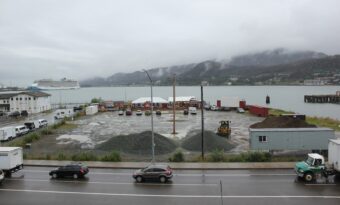
Norwegian Cruise Lines gave the property to Huna Totem Corporation in 2022. The corporation has proposed putting a cruise ship dock, underground bus and car parking, retail space and a welcome center there. (Katie Anastas/KTOO)

Juneau’s planning commission has approved a conditional use permit for a new cruise ship dock at the subport. With future phases of the project up for discussion next week, Juneau city leaders hope to get more public input about the proposed parking and retail space nearby.
The commission approved one part of the Huna Totem Corporation’s conditional use permit application on July 11 – the part related to the dock. But few members of the public were there to share their thoughts on the project.

“Several of the commissioners as well as myself were shocked by how few members of the public were at the planning commission meeting about this topic that I know many people feel deeply about,” Assembly member Christine Woll said at a meeting Monday night.

Just three members of the public spoke at the July 11 meeting, including one person speaking on behalf of the Juneau Chamber of Commerce and another on behalf of Sealaska Heritage Institute. All three supported the project. Cruise Line International Association also shared their support in a March letter.

Norwegian Cruise Lines purchased the waterfront property in 2019 and proposed building a new dock there. In March 2022, the Juneau Assembly amended the city’s Long Range Waterfront Plan to allow a fifth cruise ship dock. Then, in August 2022, Norwegian gave the property to Huna Totem, an Alaska Native village corporation. 

Huna Totem has proposed a dock, underground bus and car parking, retail space and a welcome center. They’ve named the project Aak’w Landing.

“Aak’w Landing adds to the Seawalk, it reduces congestion downtown, it fits within the five ship limit, it accommodates shoreside power and is designed for year-round operation,” Fred Parady, Huna Totem’s chief operating officer, told the commission.

But several commissioners, like Mandy Cole, wanted more details on the proposed amenities before making a decision on that part of the permit.

“I have a lot of faith in the developers and the designers that they will come back with a finished product that will balance the needs of this community and the needs of Huna Totem,” Cole said. “I just don’t think that’s what we have in front of us quite yet.”

Architect Corey Wall acknowledged that there’s still a lot of design work to be done.

“We know that we’re nowhere near ready to get a building permit,” he told the commission. “We think we have probably a 12 or 18 month design process in front of us.”

The commission spent much of the meeting talking about whether housing should be a required part of the project, as the housing shortage hampers businesses’ ability to hire workers.

“I don’t know how to ask this without assuming Huna Totem solves all of Juneau’s problems all at once with one project, but have you considered that housing is actually a critical piece of building out further tourism infrastructure?” Cole asked.

But Parady said the property may not be the best place to build it.

“It’s difficult to directly address housing on this three-acre spot when it’s, essentially, a city-wide question,” he said.

Jill Maclean, the city’s director of community development, said housing at Aak’w Landing would likely not meet Juneau’s need for affordable options.

“While I know housing is a crisis and we desperately need it, this likely is not to be workforce or affordable housing in this location,” she said. “It will likely be high-end waterfront property.”

If the commission approves the conditional use permits, it will be up to the Juneau Assembly whether to lease the tidelands to Huna Totem. On Monday, city manager Rorie Watt called it a “pivotal decision” that will provide more opportunities for public comment.

The planning commission will vote whether to permit uplands development – which could include the proposed welcome center, parking and retail space – on Aug. 8 at 7 p.m. Members of the public can speak at the meeting in person after filling out the sign-in sheet. The commission also accepts written comments before noon on Friday, Aug. 4.

Judge tosses Alaska suit against feds over contaminated ANCSA lands

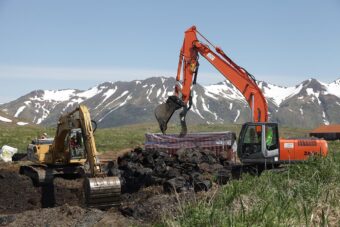
Two excavators dig up contaminated soil and rusted diesel drums on Attu Island. (Dena O’Dell/USACE)

A federal judge has dismissed the state of Alaska’s lawsuit against the federal government over contamination on Alaska Native corporation lands.

Assuming the judgment stands, it blocks one possible avenue for forcing a solution to a decades-long saga. The problem centers on dump sites, fuel depots and other pollution on land the federal government transferred to Alaska Native Corporations as part of the 1971 Alaska Native Claims Settlement Act.
“There were well over 1,000 contaminated sites that were conveyed, as part of the 44 million-acre ‘settlement’ for dealing with indigenous land claims,” said Jason Brune, commissioner of the Department of Environmental Conservation, the state agency that brought the lawsuit. “And they were given damaged goods.”

The lawsuit claimed the U.S. Interior Department didn’t fulfill a congressional mandate to address the contamination.

But U.S. District Court Judge H. Russel Holland said Congress required the Interior Department’s Bureau of Land Management to create a remediation plan, not to carry it out. The judge also said the state has no standing to sue, and no Native corporations joined the lawsuit.

A state press release accuses the government of shirking its duties.

“The dismissal of this case is a maddening excuse for the federal government to continue circumventing its responsibility,” Gov. Mike Dunleavy said, according to the press release.

Of the 1,179 known contaminated sites on Native Corporation land, only about half have been cleaned up, according to an 2019 analysis. It would take an estimated $50 billion to remediate all of them.

Congress last year appropriated $27 million to the job, spearheaded by the Environmental Protection Agency. This year, five Native organizations applied for the money, to address seven contaminated sites, according to Tami Fordham, director of the EPA’s operations in Alaska.

“Our whole commitment on this is to learn and adapt,” she said. “There will be, I’m sure, others coming in for projects and [we’re] looking to really help accelerate cleanup of contaminated lands in Alaska.”

Fordham says among the applications are proposals to address Unalaska’s Strawberry Hill dump site, a drum disposal location near Tyonek, and asbestos contamination in former Navy buildings in Utqiagvik.

Meanwhile, Alaska Attorney General Treg Taylor said the state is studying the judge’s order for possible appeal.

Hoonah set to try again to form new Alaska borough

A view from Front Street in Hoonah, Alaska’s largest Lingít village, on Aug. 7, 2021. Hoonah is again trying to form a borough encompassing a 10-million-acre region in Southeast Alaska. (Sean Maguire/ADN)

JUNEAU — The city of Hoonah is again attempting to form its own borough across 10 million acres of land and water in Southeast Alaska.

Alaska’s largest Lingít village, with a population of roughly 900, has sought to create a borough for the past 30 years, with Hoonah as the hub and seat of government. The last attempt in 2019 was put on pause, due largely to the COVID-19 pandemic.

Dennis Gray Jr., Hoonah’s city administrator, said with the pandemic in the rearview mirror that the city is set to redouble its efforts to form a borough. He said it would be “a great accomplishment” for the local community if the proposal is approved.

Hoonah Indian Association and Huna Totem Corp. — the local village corporation — have both submitted letters in support of the city’s efforts, citing one of the expected benefits of incorporation: additional state funding for the city’s public school.

Hoonah School District, which has just over 100 students, has an annual budget of $3.8 million. Incorporation as a borough is expected to net Hoonah’s school an additional $350,000 per year from the state, due partly to having a larger tax base, Gray said.

Nathan Moulton, Hoonah Indian Association’s tribal administrator, wrote in February that the additional funding would allow for more “scholastic opportunities, and provide other support for the K-12 student body that is so direly needed.” There could be more high school and middle school courses offered and vocational training could be reestablished after that had been pared back in recent years, Gray said.

Included in the city’s packet is the proposed charter for the new home-rule borough — a type of municipal government that has the maximum level of local control allowed under the Alaska Constitution. Gray said the charter was written to create “a truly libertarian borough.”

There would be no property taxes to fund local government; instead, Xunaa Borough would have a 6.5% sales tax inside the city of Hoonah and a 1% seasonal sales tax borough-wide. Much of that seasonal sales tax revenue is expected to be paid by visiting cruise ship passengers.

Icy Strait Point, a cruise destination owned and operated by Huna Totem Corp., boasts an adventure park and gondolas on Aug. 7, 2021. (Sean Maguire/ADN)

Just outside Hoonah sits Icy Strait Point on the site of a restored salmon cannery. The port, owned and operated by Huna Totem Corp., boasts two cruise ship docks, two gondolas, an enormous zipline over old-growth rainforest, and an adventure park.

Meilani Schijvens, owner of Juneau-based consulting firm Rain Coast Data, submitted documentation earlier in the year that described how the new borough would be economically viable. More than 500,000 cruise ship passengers are expected to visit Icy Strait Point this year and spend $52 million — four times as many visitors as came by cruise ship 10 years ago.

Cruise ship passengers pay the 6.5% sales tax and they would be subject to the extra 1% seasonal sales tax, which is expected to raise around $400,000 annually for the new borough.

“That’s kind of the ideal situation — where you can bring in money from the outside to supplement your local government,” Gray said. “That’s the best way to run a government, we think.”

Hoonah’s tiny outlying communities like Elfin Cove, population 24, and Game Creek, population 23, would be included in the new borough’s boundaries. Other nearby communities, like Tenakee Springs, Pelican and Gustavus, were invited to join the borough petition, but declined. Gray said the intention is that they could join the borough in the future.

The latest Xunaa Borough proposal would be over three times smaller than previous efforts. Xunaa Borough supporters have previously claimed tracts of land that are now part of Haines Borough and the City and Borough of Sitka — but not this time.

That change was made “so we could have a more easy approach with the (Local) Boundary Commission,” Gray said.

Hoonah (Wikimedia Commons)

Xunaa is pronounced like Hoonah, but has a more Lingít-stylized spelling so the new borough name would reflect the region’s Alaska Native heritage. The borough’s boundaries would include the picturesque Glacier Bay, which is an area considered to be the spiritual homeland of the Huna Lingít.

The National Park Service says that Lingít cultural practices were severely curtailed within what is now Glacier Bay National Park, which strained relations with the Huna Lingít. A memorandum of understanding was signed by the park service in 2016 to establish government-to-government relations with the Hoonah Indian Association to work cooperatively on managing cultural sites and educating visitors.

In establishing a borough, the hope is that residents would have more of a voice in what happens in Glacier Bay, Gray said.

There could be challenges in getting the application approved. The Local Boundary Commission, the state board charged with considering proposals for incorporation by municipalities, gave Hoonah’s proposal an informal review in February and flagged several concerns.

Alaska regulations state that boroughs need a minimum permanent population of 1,000 people, and the Xunaa Borough would currently just be shy of that. Supporters have said that the borough would be viable — shown partly by the major expansion of Icy Strait Point and the jobs it has created locally.

Hoonah officials are planning to submit the petition for incorporation by the end of the month, with the hope of setting up the new borough government in 2025. Voters who live within the area would need to approve the creation of the new Xunaa Borough and its new charter.

The last Alaska borough to be incorporated was Petersburg Borough in 2013.

This story originally appeared in the Anchorage Daily News and is republished here with permission.

Yak Timber files for bankruptcy after its parent company, the village corporation, is sued for $13M

This Yak Timber logging at Humpback Creek is controversial because the site is culturally and historically significant, according to the Yakutat Tlingit Tribe, Central Council of Tlingit and Haida Indian Tribes of Alaska, and Sealaska Corporation. (Photo/Defend Yakutat)

A timber company owned by Yakutat’s village corporation has filed for bankruptcy this month after a bank sued the corporation over $13 million in outstanding debts. It’s the latest chapter in the story of a contentious logging operation that many of the corporation’s shareholders didn’t support.

Yak Timber filed for bankruptcy on May 11. In a letter to shareholders the next day, the village corporation, Yak-Tat Kwaan, said they filed “only after exhausting all efforts to negotiate a resolution” with the bank.

Yakutat’s tribal government, Yakutat Tlingit Tribe, says the lawsuit is further dividing a town that was already stressed — many residents didn’t agree with the logging operation in the first place. Andrew Gildersleeve is the Tribe’s executive director. He says above all, there is grief.

“The matter itself is almost like a broken piece of glass, with so many edges it’s impossible to pick up without getting cut,” Gildersleeve said. “There’s a shock of what’s happened to tribal lands and disbelief that there could be a claim of the size against an organization that is ultimately run by our friends, family and neighbors.”

Washington bank vs. Yak-Tat Kwaan

The lawsuit, brought by AgWestFarm Credit, alleges that Yak Timber owes the Washington-based bank about $13.3 million in unpaid loans. The suit was filed in U.S. District Court in Seattle on March 31.

“Where did all that money that they borrowed go?” asks shareholder Cindy Bremner. She’s also the former CEO of the corporation and Yakutat’s current mayor. She says shareholders have a lot of questions the corporation won’t answer. It’s straining relationships in the small town of 600.

“We live in a small town — we’re all related,” she said, “and it’s caused quite a divide between those on that board, and then pretty much the rest of the shareholders.”

The suit says the corporation hasn’t made payments since the middle of 2022. The bank is seeking repayment, interest, and attorney’s fees. It lists equipment along with timber, proceeds, and property as collateral.

In a letter to shareholders on April 7, corporation leadership said their board “is united in every possible effort to address the allegations.”

Shari Jensen, the corporation’s CEO said in a written statement that they had no comment for this story. But as recently as October, Jensen told CoastAlaska that paying back the loans wouldn’t be a problem after they sell Yak Timber’s logging equipment.

“Banks don’t lend money to broke companies, they just don’t,” Jensen said. “And, you know, we had a business plan. And they bought into it.”

A large barge is one of the assets the bank AgWestFarm Credit is seeking in its lawsuit against Yak Timber. (Photo/Defend Yakutat)

A controversial project

The Yak-Tat Kwaan corporation was formed in the early 70s after the Alaska Native Claims Settlement Act took effect. The federal law exchanged Indigenous land rights for money, divvying up the remaining land among a few hundred village corporations. Those corporations are charged with making a profit for their shareholders.

The Kwaan created its timber subsidiary in 2018 to harvest 21 million board feet of timber on its land. It logged about three-quarters of that, shipping nearly 4,000 log trucks worth of wood to China.

As Yak Timber pursued different logging projects, opposition grew among shareholders. Some wanted the corporation to seek other resource revenue, such as carbon credits. Eventually, Yak Timber announced last fall that it would sell off its assets.

But the company continued to harvest timber at a place called Humpback Creek, which the local and regional tribal governments say is culturally and historically significant.

They, along with the regional corporation Sealaska, have requested Yak Timber stop logging there.

Shareholders take action in court

The corporation faces a lawsuit from shareholders as well. Some are worried that their land could be lost as collateral for their debt. Amanda Bremner is a cousin to the mayor.

“I am incredibly concerned not just for the risk to existing land, but for what this means for the future of our company and all of our shareholders,” she said.

Yak Timber logging at Humpback Creek. The creek is outside of Yakutat in Southeast Alaska. (Photo by Cindy Bremner)

Amanda Bremner and another shareholder, Jay Stevens, co-chair the Yaakwdáat Latínx’i Coalition that is seeking a change. Their lawsuit, filed on May 9 in Anchorage Superior Court, asks the court step in and force the corporation to hold an election for all nine seats on the board. Yak-Tat Kwaan hasn’t held an election in a couple of years, which led to a state fine.

Amanda Bremner says taking the corporation to court was a difficult decision, but many shareholders share her goals.

“To see our corporation flourish and thrive and be successful and ethical and rooted in Indigenous value and to have business practices reflect that,” she said.

Seattle-based law firm Cairncross and Hempelmann is representing the bank. In an email, they said their client did not want to comment.

In a separate court filing, April 7, the bank seeks to repossess a tug and barge they loaned Yak Timber for $3.3 million in January of 2022. Later, on May 5, they asked the court to ban the corporation from moving the barge, saying it was uninsured. The corporation has disputed this and filed its own motions.

Yak Timber has its own lawsuit playing out. It filed a suit November 18 accusing Bethel Environmental Solutions, an Alaska Native-owned environmental consulting firm, of owing them $443,912 for charter services.

Under new agreement, Juneau would have until 2028 to open Eaglecrest gondola

Looking up Log Jam and the west side of Eaglecrest Ski Area, seen on Wednesday 2/23/2022. (Photo by Mikko Wilson/KTOO)
Skiers and snowboarders ride up the Ptarmigan chairlift at Eaglecrest Ski Area on Douglas Island with views of the Log Jam run on the west side of the mountain on Feb. 23, 2022. (Photo by Mikko Wilson/KTOO)

The Eaglecrest Ski Area gondola will likely open a year later than expected. That’s according to a proposed updated agreement between the city and Goldbelt, Inc., Juneau’s urban Alaska Native corporation.

It’s been more than a year since Goldbelt offered to invest in the gondola project for the city-owned ski area. The Juneau Assembly approved a revenue sharing agreement in January, but the negotiation process continued for several more months.

“We thought we were there, but we weren’t,” City Manager Rorie Watt said at an Assembly committee meeting Monday. “We’re coming at it, from the CBJ side, a government perspective — and the Goldbelt side, a business perspective.”

Watt outlined the updated agreement, which still needs final approval from the Assembly.

Some key terms remain the same: Goldbelt will invest $10 million in the project and in exchange, get 10 to 25% of summer revenue for 25 years. If Goldbelt doesn’t get at least $20 million back in revenue in that time, the agreement would extend.

One change is the deadline for opening the gondola. The new agreement pushes it back a year, setting it at May 31, 2028. If it doesn’t open by then, Goldbelt can back out.

“It’s taken a while, and we’ve lost most of this construction season,” Watt said.

Another is the timing of the fund disbursement. According to the updated agreement, Goldbelt would pay the city in one lump sum by July 3, 2023, rather than in multiple payments.

“That’s really good for us,” Watt told the committee. “We don’t have to worry about things changing. Maybe the way the world looks in a year to the Goldbelt board is different. So this is a really good thing for CBJ.”

The new agreement would require the city to pay Goldbelt additional interest if the city backs out. Watt said that change in Goldbelt’s favor was worth getting the $10 million up front.

“I think the probability that we would terminate is really low,” he said.

Goldbelt owns and operates the Mount Roberts tram in downtown Juneau. President and CEO McHugh Pierre said in an interview that the gondola is an opportunity to expand tourism on Douglas Island.

“When we evaluate the future of tourism in the community, we know that there needs to be options to spread people out so the impacts are manageable,” he said. “We think that Eaglecrest, as an already developed area, is ripe for sustainable additions.”

Pierre said he hopes increased activity at Eaglecrest will lead to more development on nearby Goldbelt-owned land.

Members of the public can comment on the proposed new agreement at the next Assembly meeting on May 8.

Site notifications
Update notification options
Subscribe to notifications