I bring voices to my stories that have been historically underserved and underrepresented in news. I look at stories through a solutions-focused lens with a goal to benefit the community of Juneau and the state of Alaska.
Anne Stepetin talks to people who showed up to search for Geraldine “Gerry” Nelson on May 22, 2021, at Sacred Shine in Juneau, Alaska. It has been six days since Nelson went missing from her Lemon Creek home. (Photo by Lyndsey Brollini/KTOO)
Updated Post — May 22, 2021 | 4:50
Family of the missing Geraldine “Gerry” Nelson called off the search for her on Friday.
The 78-year-old Alaska Native woman went missing Sunday evening in the Lemon Creek area. She is a Juneau resident but is originally from Angoon.
All week, there was a widespread search and rescue effort by family, community members and law enforcement.
On Saturday, Juneau Police said that a member of the search dog team found Nelson’s body Friday afternoon. They said her death doesn’t appear suspicious.
Her grandson, Preston Nelson posted on social media Friday afternoon thanking everyone for their help in searching for her, including the dog who found his grandmother and the dog’s handler.
Original Post — May 21, 2021 | 3:45 p.m.
The widespread search and rescue effort for Geraldine “Gerry” Nelson continued on Friday.
The search is currently concentrated in Lemon Creek and out to Fred Meyer. Those are areas the family has found her in the past. The last time Nelson went missing, she was found in Lemon Creek.
Alaska State Trooper Josh Bentz gave an update at the Friday morning check-in. He said that the rain will not affect Nelson’s scent or hinder the search dogs’ ability to trail Nelson’s scent.
Bentz suggests that people who are looking for Nelson keep doing what they’re doing.
“Look under the porches, look in boats, look in cars,” he said. “Anywhere where somebody could climb in and curl up and fall asleep.”
The search party is also organizing door-to-door searches in the Switzer Village Mobile Park.
Alaska State Trooper Josh Bentz talks to people who showed up to search for Geraldine “Gerry” Nelson on May 22, 2021, at Sacred Shine in Juneau, Alaska. It has been six days since Nelson went missing from her Lemon Creek home. (Photo by Lyndsey Brollini/KTOO)
At the Friday morning check-in, Central Council of Tlingit and Haida Indian Tribes of Alaska President Richard Peterson came to offer a prayer and support for the search.
“Creator, we ask this in your name that we find Gerry, we bring her home, that we reunite her with her family. And we surround her with the love, the strength that she needs ‘til we can find her,” he said.
Peterson said that he’s heard of people getting pulled over while driving slowly around neighborhoods in the search for Nelson. He asks that people not search for Nelson alone.
“Not only do you have to worry about bears but sometimes you have to worry about people,” he said. “And if they think you’re up to no good, it’s a lot easier to explain if you’re not alone.”
The search party has bear spray so people who want to help search but don’t have safety gear can still help.
Ann Stepetin, who is helping organize the search, said people can help in other ways too.
“Our biggest request now is gas money because people have been burning up their fuel driving and driving and driving,” she said.
Other items that can help the search party are rain gear, extra layers, fruit and bear spray.
There have been a lot of false sightings of Gerry Nelson, so Stepetin asked for people to take a flyer and see what she looks like.
And to just keep an eye out when out when walking or driving.
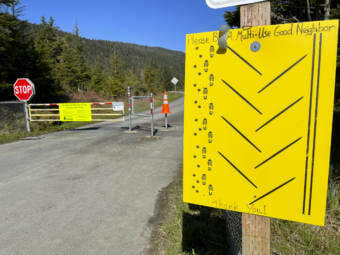
The Montana Creek area, pictured May 18, 2021, has seen conflict between multiple user groups for years. (Rashah McChesney/KTOO)
A proposal for a contentious all-terrain vehicle gravel trail in Montana Creek is out for public comment.
Darrin Crapo of the Juneau Off-Road Association submitted the proposal. He also owns Broken Rudder, a company that sells ATVs and snow machines.
The proposal requests an easement that would be 6,800 feet long and 25 feet wide. The trail itself would be eight feet wide, with a camping area at the end.
“What we really want is to have that campground built up there and have a great place where we can take friends and family,” Crapo said. “Get up and do some camping that’s got some elevation. There’s nowhere in Juneau that you can drive and get up to a higher elevation, get into the backcountry, and do some easy camping that way.”
The trail would be designed for low-speed, low-impact riding, according to Crapo.
Crapo described gravel pit riding, where riders go fast and ride up jumps, and trail riding, where people ride through the country on developed trails, as two of three types of ATV riding.
“We’re looking for a third type of riding experience in Montana Creek,” Crapo said. “And that’s where it’s really purposed for, it’s a leisurely type of a trail.”
Crapo suggested a 10 mph limit for the trail, in line with an existing verbal agreement among Montana Creek users.
Snow and tracks on the Montana Creek trail on May 18, 2021, in Juneau, Alaska. (Photo by Rashah McChesney/KTOO)
Chris Zimmer has been a Juneau resident for 20 years. He expressed concerns about ATVs in Montana Creek because riders have a history of crossing salmon-spawning streams in the area.
“And the stream crossings are a real problem,” Zimmer said. “Especially up there in Montana Creek where the fish are spawning, where the juveniles are rearing waiting to head out to sea.”
The Department of Fish and Game has documented illegal stream crossings in Montana Creek since 2010. According to a Department of Fish and Game memo, there were 13 documented ATV stream crossings in 2020.
Nine of those crossings were over anadromous streams. To ride an ATV over an anadromous stream, the rider would need a fish habitat permit. No ATV riders had a permit, making the stream crossings illegal.
“I think a lot of us are skeptical and cynical about, you know, the ability of the riders to either police themselves or change their behavior,” Zimmer said.
Kevin Maier is a local skier and former president of the Tongass chapter of Trout Unlimited. He also wrote an article for the Juneau Empire about recreation in Montana Creek.
“Definitely the crossing of anadromous streams is the illegal part of it, but there’s also, you know, sort of like trail-building,” Maier said. “Riding up into, what I take to be, relatively sensitive habitat zones for both coho and anadromous Dolly Varden, but pink and chum salmon too.”
Crapo says the land for the gravel trail was selected very carefully so it wouldn’t affect the salmon habitats in the area.
“There’s an existing brush ATV trail,” Crapo said. “The starting point for that trail is going to be relocated so that it does not pass through any salmon-rearing areas. Presently there is no spawning that happens on anything where that trail would be.”
But to Maier, those reassurances would not be enough.
“For me, it’s more, the trail represents an invitation to more pioneer riding, which represents degradation of habitats important for fish,” Maier said.
Fish habitats and illegal riding are not the only concerns locals had with off-road vehicles in Montana Creek.
The Juneau Nordic Ski Club has encouraged its members to oppose the trail. They claimed that an ATV trail would push them and other non-motorized users out of Montana Creek.
Last fall, the club attempted to ban ATVs and snow machines from Montana Creek during the wintertime. After much public comment, the City and Borough of Juneau decided to continue allowing snow machines and ATVs there.
After realizing how popular the area is, the city decided to make a master plan for Montana Creek. The public will be able to give input on the plan this summer, said Michele Elfers, deputy director of Juneau’s Parks and Recreation Department.
“The beginning of the master plan work will be public outreach in various ways,” Elfers said. “So there will be meetings, probably surveys and things like that.”
To make matters more complicated, the Alaska Department of Natural Resources reached out to the city about transferring management of state lands in Montana Creek to the city through a cooperative agreement.
According to Chris Carpeneti at the Department of Natural Resources, the gravel trail application led the state to look more closely at their Juneau State Land Plan.
This plan was created in 1993 and gives direction to the department on how to manage state land. Upon closer inspection, the department realized that the plan recommended the area be managed through a cooperative agreement.
The city is still in the beginning of exploring an agreement, Elfers said.
It is unclear how the gravel trail, if approved, would fit into the Montana Creek master plan or how management of the trail would be handled.
Zimmer agreed that a master plan at Montana Creek is needed.
“I mean we can’t keep having the same conversations every year about Montana Creek,” Zimmer said. “At some point we’ve got to create a system and a plan and stick to it. And that gives everybody some certainty.”
And ATV riders do need a place to ride, said Zimmer. But he does not think Montana Creek is the right place for an ATV trail.
“A lot of people are concerned, you know,” Crapo said. “They hear about ATV trail and think that this is going to turn into some high-speed dirt highway of hoodlums. And that’s not the case at all.”
If you want to give input on the gravel trail proposal out at Montana Creek, you can email your comment to megan.hillgartner@alaska.gov or call at (907) 465-3937.
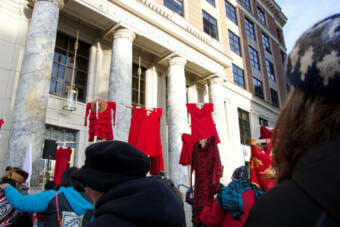
Women carry red dresses to raise awareness for Missing and Murdered Indigenous People during the Women’s March in 2019 in Juneau. (Lyndsey Brollini/KTOO)
The morning after Missing and Murdered Indigenous Persons Awareness Day, Iñupiaq advocate Jacquii Lambert noticed that half of her stories she’d shared on Instagram about that day had disappeared.
Lambert immediately tweeted about it because it was so odd.
my shared posts about MMIW on my ig stories were taken down??
“I thought it was just me, I thought it was some kind of glitch. But then I went to go look at other people I know who have also shared onto their stories, the same thing was happening for them,” Lambert said.
On Wednesday, people all across the country shared stories and pictures and memorialized the thousands of Indigenous people who have disappeared. Now, many Instagram users reported that content they shared to their stories disappeared too.
One account whose posts were deleted from Instagram stories was Jordan Daniel’s account Rising Hearts.
Daniel, who refers to the movement as Missing and Murdered Indigenous Relations, is Lakota and a member of the Lower Brule Sioux Tribe.
When she posted on her Instagram that her stories were deleted, hundreds of people commented with similar experiences.
“It feels like a never-ending hamster wheel. When you’re trying so hard and you know the community is trying so hard, and to have this one day be taken away was just heartbreaking,” Daniel said.
This is not the first time that the company has been accused of targeting Indigenous voices. Earlier this year, Indigenous beading accounts were being deactivated without explanation.
Daniel said that social media is one of the greatest tools for Indigenous advocacy — like in the case of the Standing Rock protests.
“But it’s also a double-edged sword because we are advocating for justice so we have to talk about the injustice,” Daniel said. “We have to talk about all of the problems that have created these systems of oppression. We have to talk about colonization. We have to talk about white supremacy and racism. And so that’s when censorship comes in. That’s where erasure comes in.”
To Lambert, there was a certain irony to these specific stories disappearing.
“It just felt weird, that we’re talking about Missing and Murdered Indigenous Women and then all of our content to raise awareness goes missing,” Lambert said.
Many Indigenous Instagram users tagged Instagram’s social media accounts to call them out on taking down MMIP content. Later that day, Instagram tweeted a response saying that there was a widespread issue with Instagram stories that is not related to any particular topic.
In other words, no one was being targeted.
We know that some people are experiencing issues uploading and viewing stories. This is a widespread global technical issue not related to any particular topic and we’re fixing it right now. We’ll provide an update as soon as we can.
But Daniel thinks the company’s response does not explain why so many stories specifically about Missing and Murdered Indigenous people were taken down.
“I just find that really odd, especially when it’s a lot of the content that only addressed [Missing and Murdered Indigenous people] stuff,” Daniel said. “That even allies who are not Indigenous, all of their posts that had nothing to do with this advocacy remained, but anything that had to do with advocacy and awareness for [Missing and Murdered Indigenous people] was removed.”
Regardless of whether Instagram’s removal of the posts was intentional or not, the effects of the removal of stories and content about missing and murdered Indigenous people remained.
Daniel described being put into emergency-response mode, trying to re-do all the work that was done the day before and re-share everything that was taken down.
Jerilyn Nicholson was discovered dead at Eklutna Lake near Anchorage about a week ago.
“It’s still fresh, especially for Alaskans, you know,” Lambert said. “We are facing a tragedy right now.”
On Missing and Murdered Indigenous Persons Awareness Day, Lambert felt a sense of solidarity and healing with the Indigenous community who experienced this loss. But the next day when all the stories she shared were gone, Lambert realized “they do see us and they do know us, but they’re silencing us.”
Late Friday, Instagram tweeted that they had identified and fixed the problem. The company’s communication account lays out that several communities were affected and that it wasn’t just Indigenous content creators who were having problems.
And they apologized, saying: “We are so sorry this happened. Especially to those in Colombia, East Jerusalem and Indigenous communities who felt this was an intentional suppression of their voices and stories.”
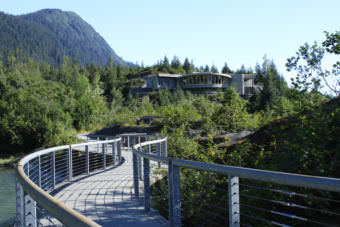
Mendenhall Glacier Visitor Center is pictured in the distance at the top of a hill. The visitor’s center will partially open on May 1, 2021 after being closed for more than a year due to the pandemic. (Creative Commons photo courtesy USDA Forest Service Alaska Region)
The Forest Service is reopening some of its facilities at the Mendenhall Glacier Visitor Center in Juneau for the first time since the beginning of the COVID-19 pandemic.
Starting on May 1, the welcome kiosk and bathrooms will be open to the public daily from 10 a.m. to 6 p.m. Forest Service staff will be at the welcome kiosk to answer questions and interact with guests.
The visitor’s center closed in March 2020 because of the COVID-19 pandemic. The main building of the visitor’s center will likely reopen later in the tourist season, according to the Forest Service. Reopening will partially depend on Juneau’s COVID-19 community risk level.
The Forest Service will begin charging its $5 daily fee to visit areas within the Mendenhall Glacier Recreation Area. A $15 season pass is also available. Fees will be required from May 1 to Sept. 30.
Areas requiring a fee include the pavilion, the Photo Point Trail, elevated walkways, restrooms, the bus shelter and the visitor’s center. All other trails and parking areas will remain free.
Close
Update notification options
Subscribe to notifications
Subscribe
Get notifications about news related to the topics you care about. You can unsubscribe anytime.