Lyndsey Brollini

Local News Reporter

I bring voices to my stories that have been historically underserved and underrepresented in news. I look at stories through a solutions-focused lens with a goal to benefit the community of Juneau and the state of Alaska.
One shot, one beer: A Juneau brewery’s bargain to get people vaccinated

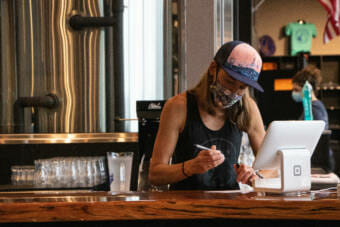
Sara Stekoll works behind the counter at Forbidden Peak Brewery. She is a co-owner of the brewery and asked the City and Borough of Juneau to host a vaccine clinic there.
Sara Stekoll works behind the counter on Friday at Forbidden Peak Brewery in Juneau. She is a co-owner of the brewery and asked the City and Borough of Juneau to host a vaccine clinic there. (Photo by Lyndsey Brollini/KTOO)

About 62% of Juneau’s total population has been vaccinated against COVID-19, and after the initial rush of people, demand has slowed down.

The city has tried a lot of things to entice residents into getting them, including offering pop-up clinics all over town. The Chamber of Commerce is offering gift cards.  On Friday afternoon, a local brewery tried a new tactic — beer.  

Carolina Sekona got her first dose and headed to the beer line.

Carolina Sekona just after receiving her first dose of the COVID-19 vaccine at Forbidden Peak Brewery.
Carolina Sekona just after receiving her first dose of the COVID-19 vaccine. (Photo by Lyndsey Brollini/KTOO)

She said was hesitant at first to get one — the shot, not the beer — because she didn’t know what was in it. But after her mother and brother had a good experience with the Pfizer vaccine, and after she did her own research, she decided to get one for herself.

She went to Forbidden Peak Brewery for her vaccine because the clinic there was on her day off. 

Sign outside of Forbidden Peak Brewery directing people to where they can get a COVID-19 vaccine

“And they say they have some great prizes and I thought it was cool. And I also have a friend here that is on vacation for four days to Alaska and I thought it was a great place to bring him,” Sekona said.

She is also a child care provider in Juneau, so she wanted to reassure parents that she is safe and vaccinated around children who can’t get one.

The beer that Sekona picked up was Sara Stekoll’s idea. Stekoll is a co-owner of the brewery. She wanted to offer an incentive for people to get vaccinated. So, she asked the City and Borough of Juneau to host a clinic at her brewery and she offered to buy a beer for the first 50 people to get a first or single dose vaccine during the clinic. 

“As a business that’s trying very hard to keep our community safe as we open up to a broader range of patrons, I thought it was important to try to encourage as many people to get vaccinated as possible so that we can open our doors fully and without restrictions,” she said.

And before it even started, there were at least 26 people pre-registered to get a vaccine. About half an hour after the event started, Stekoll said she was seeing a lot of regulars. 

“They brought family members in already,” she said. “And other people are just — I think people who enjoy being in the space and thought it might be a good place to hang out for 15 minutes afterwards.”

Tracy Balovich helps with the administration side of the COVID-19 vaccine clinic at Forbidden Peak Brewery
Tracy Balovich helps with the administration side of the COVID-19 vaccine clinic. (Photo by Lyndsey Brollini/KTOO)

Tracy Balovich sat at a table at the brewery helping people with paperwork. She’s an emergency worker for the city, helping with the administrative side of vaccine clinics. She’s been at this job since January, and she says she’s lost count of the number of clinics she’s been to. 

“When we first started it was exciting. It was very exciting. It still is, but I think that the excitement has worn off a little bit, being that so many people have got it. I’m hoping that more people come and get it,” Balovich said.

For now, Forbidden Peak Brewery has been the only vaccine clinic offering beer as a bonus. But there are other incentives the Chamber of Commerce is offering, including $40 for the first dose and a chance to win $1,000. 

These incentives come as demand for vaccines declines

Correction: Forbidden Peak Brewery did not provide free beer for people who showed up to a vaccine clinic there, rather co-owner Sara Stekoll offered to personally buy beer for the first 50 people who got vaccinated during the clinic. 

Vigil held in Juneau for children found at Kamloops boarding school

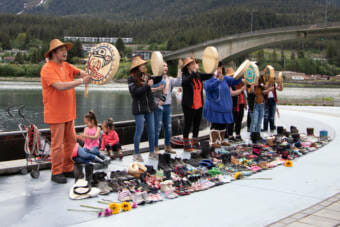
Drummers sing songs to honor the children found buried at a residential school in Kamloops, British Columbia. (Photo by Lyndsey Brollini/KTOO)
Drummers sing songs to honor the 215 children found buried at a residential school in Kamloops, British Columbia. People throughout Juneau donated shoes for the event, which are displayed to represent the 215 children. (Lyndsey Brollini/KTOO)

Last Saturday, the Alaska Native community and allies gathered at Overstreet Park in Juneau for a candlelight vigil honoring the 215 children found in unmarked graves at a residential school in Kamloops, British Columbia.

Indigenous people across Canada mourned when the news broke, but it wasn’t just a Canadian issue.

Jennifer Brown speaking at a candlelight vigil for the 215 children found buried at the Kamloops Indian Residential School in Kamloops, British Columbia.
Jennifer Brown speaking at a candlelight vigil she organized for the 215 children found buried at the Kamloops Indian Residential School. (Lyndsey Brollini/KTOO)

“The reason we sympathize with them is because the same thing that happened in Canada happened in Alaska. In Southeast,” Jennifer Brown said.

Brown is Tlingit from Sitka, and she organized the vigil held last Saturday. People burned sage and handed out orange ribbons and candles to everyone who showed up. Many came to the vigil dressed in orange, the color representing the missing children that never came home from residential and boarding schools, or red, the color representing Missing and Murdered Indigenous People.

Alaska Native children throughout the state were sent to boarding schools up until the 1980s with the goal of assimilating Native children. Some boarding schools were located right here in Southeast Alaska — Wrangell Institute in Wrangell and Sheldon Jackson College and Mt. Edgecumbe High School in Sitka.

In some cases, children were taken from their families and put into these schools, or  into foster homes.

Tlingit Elder Leona Santiago of the Kaagwaantaan clan is one of those children. She was taken from her family at age two and not returned until she was almost 15.

Leona Santiago at a vigil for the 215 children found buried at a residential school in Kamloops, British Columbia.
Leona Santiago speaking at a vigil for the 215 children found buried at a residential school in Kamloops, British Columbia. (Lyndsey Brollini/KTOO)

“And this loss of all, the discovery of all these children hurts. Because it makes us think. Makes me think of my pain, my tears, that I had to suffer,” Santiago said.

Santiago shared her personal experience to give people an idea of what it was like for a child to be taken away from their parents and put into government custody. And she said it was worse for the generations before her who went to boarding schools.

“I can’t even imagine the pain that they felt, my grandparents. They were told not to speak the language. They were disciplined, they were beaten with a ruler on their hand. Their mouths were washed out with soap,” Santiago said.

Yolanda Fulmer is Tlingit of the T’akdeintaan clan. She was another speaker at the vigil, and she said the discovery of the children in Kamloops only confirmed what Indigenous people already knew.

Yolanda Fulmer speaking at a vigil held for the 215 children found buried at the Kamloops Indian Residential School in Kamloops, British Columbia.
Yolanda Fulmer speaks at a vigil held for the 215 children found buried at the Kamloops Indian Residential School. (Lyndsey Brollini/KTOO)

“Kill the Indian. Save the man. These are all variants of the same sentiment that were passed throughout the U.S. and Canada. This was enacted through the genocide of boarding and residential schools,” Fulmer said.

The negative effects of boarding schools are not only felt by the children who attended, but by their families and communities as well.

“We see the residual damage, even into present day,” Fulmer said. “The painful stories we hold for our loved ones. The tears we try to catch. The heavy hearts and secrets we try to carry for them. They resonate throughout Indigenous country.”

People who attended boarding schools directly attribute alcohol and drug abuse, mental health struggles and trauma to the experience — as well as loss of culture, identity and language.

As a result of boarding schools, many people lost or stopped speaking their Indigenous language. Many Indigenous languages are now endangered because of it. But now that the history of boarding and residential schools is coming to light, people are starting to talk more about this past and begin the healing process.

Leona Santiago started the process in her twenties, and she says it’s not complete.

“So when we heal, we only don’t just heal ourselves. We heal what our ancestors had gone through,” Santiago said.

After the speeches, two songs were sung to honor and remember the children lost to residential schools.

On Monday June 21, there is a global memorial for the children found at the Kamloops Indian Residential School. And since more children have been found since the initial discovery in Kamloops, the memorial will honor them as well.

The memorial in Juneau will be held at 5pm at Overstreet Park.

‘Coming out of quarantine’: Pride Month kicks off in Juneau

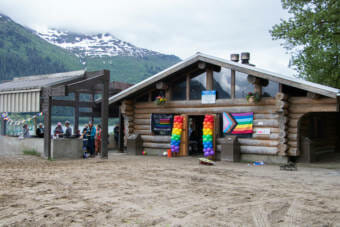
People gather around a shelter at Sandy Beach for a Pride picnic on May 11. The picnic is an annual event that Juneau's LGBTQ+ alliance group SEAGLA sponsors.
People gather around a shelter at Sandy Beach for a Pride picnic on June 11, 2021. The picnic is an annual event that Juneau’s LGBTQ+ alliance group SEAGLA sponsors. (Lyndsey Brollini/KTOO)

People are coming out of quarantine and into Pride Month in Juneau. After a delayed — and mostly virtual — Pride celebration last year, Juneau Pride is back and in-person.
The Coming Out of Quarantine picnic was one of the kickoff events of Pride Month. The picnic, held last Friday, was hosted by SEAGLA, the the LGBTQ+ alliance group in Juneau.

Gretchen Becker volunteered at the picnic with SEAGLA. She thinks the picnic is one of the most important events of Juneau Pride.

“So I’m happy to celebrate in a way that feels organic and real, like we would at any Pride year,” Becker said.

At the picnic, Becker was able to see friends she hadn’t seen in over a year. And meet new people.

“It feels really good. I’ve really appreciated the opportunity to reconnect with some long-time Juneau friends that, maybe I wouldn’t have had a Zoom call with, but I was able to meet here and have that reconnection,” Becker said.

The pandemic made it difficult for anyone to connect and gather safely. This impacted the LGBTQ+  community, especially during Pride.

In 2020, Pride in Juneau was delayed until August in hopes of being able to host the event safely by then.

But that didn’t happen. So Pride last year was scaled down and mostly virtual, with a couple of in-person, socially distanced events.

Becker thought it was difficult to stay connected with the community during the pandemic.

“With this last year, it really pared down, I think, a lot of our friend groups,” Becker said. “And I’m friends with a lot of the queer community here, which is helpful for me to keep going. But I think, honestly, I think everyone felt a little bit more lonely than usual.”

Becker gave a shout out to the drag community, which helped her meet other LGBTQ+ people in Juneau. And the drag community helped people stay connected during the pandemic by hosting virtual drag shows.

Now, drag shows are back and in-person for those who are fully vaccinated. And a drag show is just one of the many events lined up for the rest of Pride Month.

Upcoming events include kayaking, a drive-in movie and more. The full list of events can be found on SEAGLA’s Facebook or Instagram.

Alaska Gov. Mike Dunleavy signs bill protecting Unangax̂ cemetery in Funter Bay

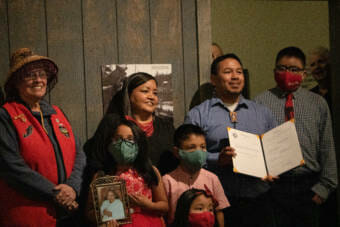
Martin Stepetin stands with his family holding House Bill 10. Alaska Gov. Mike Dunleavey signed the bill on June 8 at the Juneau-Douglas City Museum
Martin Stepetin stands with his family holding House Bill 10. Alaska Gov. Mike Dunleavy signed the bill into law on June 8 at the Juneau-Douglas City Museum. (Photo by Lyndsey Brollini/KTOO)

Alaska Gov. Mike Dunleavy signed a bill into law protecting the  Unangax̂ cemetery in Funter Bay on Tuesday at the Juneau-Douglas City Museum.

Martin Stepetin has been advocating to protect the Funter Bay cemetery since 2014.

“We’ve seen, so many times, all throughout our country, where our sacred grounds have been desecrated and disrespected and not cared for,” Stepetin said. “And that’s what this bill does. It protects it from happening, you know?”

A graphic in the Juneau-Douglas City Museum showing the forced internment of Unangax̂ people from the Aleutian Islands to Southeast Alaska. The graphic is part of an exhibit at the museum - Echoes of War: Unangax̂ Internment During WWII - which runs through October 18, 2021.
A graphic in the Juneau-Douglas City Museum showing the forced internment of Unangax̂ people from the Pribilof Islands to Southeast Alaska. The graphic is part of an exhibit at the museum – Echoes of War: Unangax̂ Internment During WWII – which runs through October 18, 2021. (Photo by Lyndsey Brollini/KTOO)

During World War II, the U.S. government forced Unangax̂ people to live in an internment camp in Funter Bay on Admiralty Island; 30-40 people died and are buried in a cemetery there.

The bill signed Tuesday adds the cemetery to the Funter Bay Marine Park. With the cemetery part of a state park, that land cannot be sold or developed, ensuring that the cemetery is protected.

In addition to lawmakers and other people already in Juneau, leaders from the Aleut Corporation and TDX Corporation, the village corporation of St. Paul, flew down to Juneau for the signing event.

For Constance Bergo, vice president of TDX Corporation, the feeling of the bill being signed was indescribable, in a good way. But it was also bittersweet.

“It’s sad because it took, the last time I guess the Elders that came down — there was four, five of them — they’re no longer with us. So it’s sad but it’s healing at the same time,” Bergo said.

Tara Bourdukofsky looks at the current exhibit on display at the Juneau-Douglas City Museum about Unangax̂ internment during World War II.
Tara Bourdukofsky looks at the current exhibit on display at the Juneau-Douglas City Museum about the Unangax̂ internment in Southeast Alaska during World War II. (Photo by Lyndsey Brollini/KTOO)

To Tara Bourdukofsky, director of Aleut Corporation, the bill is educational for everyone.

“Probably a lot of people, even my own fellow Unangax̂, much in the way that many still don’t understand what happened in World War II, that the bill is probably even a little foreign to them and what it means because people are still learning about it. Even my own people,” Bourdukofsky said.

Even though the bill is now law, Bourdukofsky thinks it will require continual education for people to understand the effects of the World War II internment on the Unangax̂ people to this day.

First women, trans skateboarding session comes to Juneau

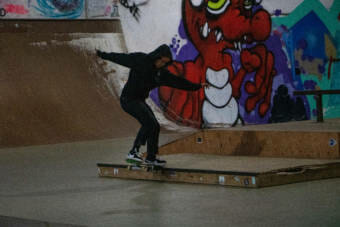
Skateboarders skate at the first women and trans skateboarding session in Juneau, Alaska
Skateboarders skate at the first women and trans skateboarding session in Juneau, Alaska. (Photo by Lyndsey Brollini/KTOO)

It was a rainy and cold Friday evening in Juneau — that wet cold that gets in your bones — but people still showed up to the community’s first-ever women and trans skateboarding session.

At the Pipeline in the Mendenhall Valley, music played through a portable speaker, echoing off the graffitied walls. Skateboarders and a few roller skaters glided down ramps and the halfpipe.

Around 20 women, trans and nonbinary-identifying people gathered at the Pipeline to skateboard. There were young kids there with the Zach Gordon Youth Center, young adults in their twenties — people who use she/her and they/them pronouns.
Sarah Leggitt skateboards at The Pipeline skatepark in Juneau. She hosted the first women and trans skateboarding session in town through her job at Skate Like A Girl.
Sarah Leggitt skateboards at The Pipeline skatepark in Juneau. She hosted the first women and trans skateboarding session in town through her job at Skate Like A Girl. (Photo by Lyndsey Brollini/KTOO)

Sarah Leggitt works for Skate Like A Girl, the nonprofit that sponsored the event. She was very happy with how many people showed up.

“Yeah I’m stoked, this is, like, not at all what I was expecting. Like the parking lot is full, and it’s kind of shocking,” Leggitt said.

Skate Like A Girl aims to create an inclusive community through skateboarding. Normally, they only serve Seattle, Portland and the San Francisco Bay Area. But when the pandemic broke out, the nonprofit switched to virtual programming and let Leggitt work outside those communities.

When outdoor activities became safer, Skate Like A Girl started hosting in-person events again. And since she was in Juneau when this change happened, Leggitt was able to bring the program to town.

Leggitt thinks it is important to have women, trans and queer visibility in the skateboarding community.

“Through Instagram, I started following Skate Like A Girl, Unity Skateboards, all these skater Instagrams, and just got really stoked on it. Finally seeing people that look like me,” Leggitt said. “And I just went to a couple events and was like ‘Yeah, this is where I want to be.’ These are, this is, like, where I feel the most comfortable in my body.”

Kids from the Zach Gordon Youth Center learn how to skateboard at Juneau's first women and trans skateboarding session
Kids from the Zach Gordon Youth Center learn how to skateboard. (Photo by Lyndsey Brollini/KTOO)

People of all genders and abilities came to Leggitt’s event, including young kids who were learning skateboarding for the first time.

This was not the normal crowd Leggitt usually finds at the Pipeline when she comes to skateboard.

“When I come to the park, it’s, like, teenage boys and maybe some dads. But I rarely find a femme-looking person,” Leggitt said.

For Leggitt, skateboarding is more about the community than the skateboarding itself. And seeing people identify similarly to her in that community is important.

Skateboard and Xtratufs on the side of the Pipeline, the skate park in Juneau.
Skateboard and Xtratufs on the side of the Pipeline, the skate park in Juneau. (Photo by Lyndsey Brollini/KTOO)

“Like, you go to the skate park alone as a woman or trans or nonbinary/gender-nonconforming person, and you just feel so isolated,” Leggitt said. “And so I think it’s really nice to have a sense of community, whether you’ve been skating for 15 years or three years or today is your first day.”

Leggitt hopes to host future women and trans skate events once a month. And if the weather is nice, she might even have events outside.

To see when the next event is announced, you can follow @wtsk8juneau on Instagram.

Bill protecting Unangax̂ cemetery in Funter Bay passes Alaska Legislature, awaits Gov. Dunleavy’s signature

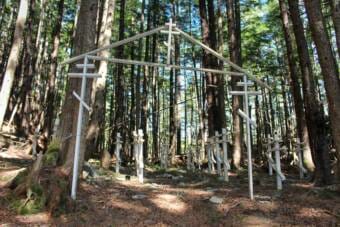
A recent photo of the Unangax̂ cemetery at Funter Bay. (Courtesy of the Juneau-Douglas City Museum)

A bill protecting the graves of Unangax̂ people forced to live in internment camps in Funter Bay passed the Alaska Legislature on May 17 and now awaits Gov. Dunleavy’s signature. 

When the Japanese military invaded the Aleutians during World War II, the U.S. government forced Unangax̂ people to live in two internment camps in Southeast Alaska. They were held there for two years and were not provided with basic necessities like clean water.

About 10% of people died at the Funter Bay internment camps. Most of them were children or elders.

House Bill 10 will protect the graves of Unangax̂ people who died in Funter Bay. Rep. Sara Hannan of Juneau sponsored the bill.

“This camp in particular, you know, it’s just a compounding of errors of history,” Hannan said.

The Unangax̂ people interned at Funter Bay were some of the first Unangax̂ people to come into contact with the Russians. The Russians enslaved them, forced them to relocate to the then-uninhabited Pribilof Islands and made them hunt seals for their fur.

A couple hundred years later, the U.S. government also forced the Unangax̂ in the Pribilofs to hunt seals.

“The men placed in internment in Funter Bay are still forced to return to the islands in the summer to seal for the government and told ‘If you don’t do this, we’ll never let you return home,’” Hannan said.

Not a lot of people know about this history. That is why the group Friends of Admiralty Island sought legislative action to protect these graves. They went to their Juneau representative at the time, former Rep. Sam Kito, to talk about the issue. Kito then passed the issue along to Hannan when she was elected. 

Hannan introduced a bill to protect the Funter Bay cemetery to last year’s Legislature. She and her staff, along with Unangax̂ elders and the Friends of Admiralty Island, worked hard to educate Alaska lawmakers about the Funter Bay internment camps and the lasting effects of these camps on the families.

The bill was making headway in the Legislature — until the pandemic disrupted the session.

When the bill was reintroduced this year as House Bill 10, it went pretty smoothly. Most Alaska lawmakers already knew about the bill from last year and were supportive.

Martin Stepetin advocated for the bill during last year’s and this year’s Legislatures. He is also a member of the Friends of Admiralty Island.

“It went kind of unnaturally fast in the legislature this year, which is really great, you know? We’re super proud of that,” Stepetin said.

Stepetin is Unangax̂ (Aleut) and Tlingit, and his grandparents were interned at Funter Bay. To Stepetin, the state recognizing the violent past of the land they own at Funter Bay was a crucial aspect of the bill. 

“What happened to the Aleuts in 1942 by the federal government was a really bad thing,” Stepetin said. “It was a really bad thing that we don’t ever want to happen again. And the only way we can ever protect ourselves from things that happened to us, by us, is to remember it. That’s why we have history class. That’s why we have history.”

To Stepetin and the Friends of Admiralty Island, the work has just started. There are other cemeteries in Southeast Alaska that are not protected, such as the cemetery in Killisnoo on Admiralty Island. Stepetin would like to seek protection of this cemetery next.

Juneau residents can visit the Juneau-Douglas City Museum throughout the summer to see an exhibit about the Unangax̂ internment camps during WWII. The exhibit is open through Oct. 18.

Site notifications
Update notification options
Subscribe to notifications