I bring voices to my stories that have been historically underserved and underrepresented in news. I look at stories through a solutions-focused lens with a goal to benefit the community of Juneau and the state of Alaska.
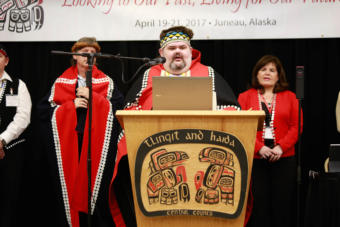
Tribal Assembly delegates at the 82nd Annual Tribal Assembly. (Photo courtesy of Central Council of Tlingit and Haida Indian Tribes of Alaska)
Tribal citizens and delegates gathered Friday for the Central Council of Tlingit and Haida Indian Tribes of Alaska’s annual Tribal Assembly.
It is the 86th year of the assembly. The time is used to update tribal delegates and citizens on the past year. It is also when the tribe adopts resolutions and holds elections for its delegates.
Right now, there are 119 delegates in the tribe’s assembly. They represent tribal citizens in 19 communities throughout Southeast Alaska, Anchorage, Seattle and San Francisco.
Chalyee Éesh Richard Peterson is Tlingit and Haida’s president. During his tribal address, he talked about the tribe’s advocacy efforts, tribal businesses, expanding the Tlingit and Haida campus and how the tribe has responded to the pandemic.
The tribe is retiring the term “service area” and is bringing back tribal liaisons to meet tribal citizens where they are, according to Peterson.
“We hope to work with the local tribe to establish and place them there so that not only can they help our citizens navigate our programs, but they can help them to navigate local programs,” he said.
A lot of people wanted to know more about the tribe’s broadband project. Its focus is to provide reliable Internet connections to help with education, health care and economic development.
Internet access was also a central issue in the U.S. Secretary of the Interior Deb Haaland’s keynote address.
She said Native communities were left behind long before the pandemic.
“The pandemic put a spotlight on the disparities that already existed, including a lack of basic resources like running water, adequate health care and functional broadband,” Haaland said.
The American Rescue Plan, the federal COVID-19 stimulus law passed in March this year, tries to make up for those disparities, according to Haaland. She said the law is the biggest investment in Native communities the U.S. has ever made.
Haaland also said the Biden administration wants to include Indigenous people in discussions on climate change and clean energy.
Haaland is the first Indigenous person to hold the U.S. Secretary of the Interior position. Delegates said it was momentous that she came to Tlingit and Haida’s tribal assembly and that no one of that position has come to their assembly before.
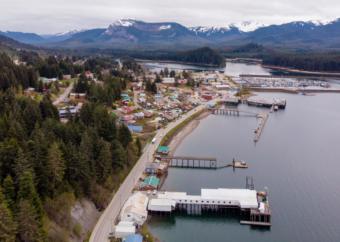
The city of Hoonah on May 2, 2019 (Photo by David Purdy/KTOO)
The City of Hoonah is having its worst COVID-19 outbreak to date. As of Wednesday morning, there are 38 active cases in a city of 790 people.
The mayor of Hoonah, Gerald Byers, said this is the first time there has been community spread in the city.
The next largest outbreak was just eight cases and was contained within one family.
Byers doesn’t want to name the place but said the source of spread for this outbreak came from one business.
“So much of it came from one place in particular, with so many people that were there that night,” he said.
The city moved the risk level to high on Sept. 21, when the number of active cases rose to 18.
Since then, that number has grown to more than 40 people. At the highest point in the outbreak, there were 41 active cases. Wednesday is the first day the case trend has gone down since the outbreak started.
Byers said that no one has needed to be medevaced so far.
“Half of them can’t even tell they have it,” he said. “They just have a little cold feeling or chills or something. In fact, one of them is still out deer hunting and everything.”
Right now, the city is on high alert. Restaurants and bars are limited to curbside or delivery service. The schools are currently shut down and indoor gatherings are not allowed.
The city is also encouraging people to get tested and to get the vaccine.
Individual data on Hoonah from the state is not available because Hoonah is lumped with Yakutat and Angoon. But for that census area, 84% of people eligible for the vaccine are fully vaccinated and 67% of the total population is vaccinated.
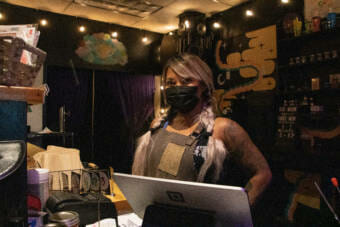
Aims Villanueva-Alf works in her restaurant Black Moon Koven on August 5, 2021 in Juneau, Alaska. (Lyndsey Brollini/KTOO)
Juneau restaurant Black Moon Koven opened up this spring very elusively and mostly through word of mouth. Its dark, moody ambiance has drawn a cult following.

Walking in, there is a lot to take in. There are large murals painted in the shop featuring eyes, skulls and mushrooms — art by local artist Jollene Chup. Other art and decorations in the restaurant include spiderweb macramé, skeletons, tentacles, coffins and an espresso machine with a Ouija board on it.
Aims Villanueva-Alf, the owner of the restaurant, said that the art is a reflection of her personality. And everything in the restaurant, from the art to the plants, comes from her friends and local businesses.
Mural painted by Jollene Chup inside of Juneau restaurant Black Moon Koven. (Lyndsey Brollini/KTOO)
After taking in all the art, you can see a food and drink menu with a lot of different items, like fried rice, soup, salad, bahn mi, coffee and bubble tea. On the side there is a selection of croissants and spam musubi that change from day to day.
“So I wanted it to be a space where you walk in and there was just so much,” Villanueva-Alf said. “There’s so much to look at that every time you come back, you’re like, ‘Oh I didn’t notice that’ or ‘I didn’t notice that.’ But an experience to just order food in itself.”
Villanueva-Alf said she gets weird reactions from people about the restaurant all the time. Some customers walk in very confused.
“They’ll come in there and they’ll kind of look at us and be like — like they don’t belong there and then they leave,” Villanueva-Alf said. “But then they end up coming back because they see somebody that had like a sandwich or a salad or some soup.”
Croissants on display in Juneau restaurant Black Moon Koven. (Lyndsey Brollini/KTOO)
The food at Black Moon Koven is made from scratch as much as possible. She also uses local ingredients, like chicken of the woods mushrooms and fiddlehead ferns, when they are in season. Other items on the menu, like ube scones, are influenced by her parents and her Filipino background.
The key, for her, is making nutritional food that tastes good and makes your body feel good too.
“I want to be able to provide a positive habit for somebody, or at least change their narrative on food and what it means to be healthy,” she said.
Villanueva-Alf does not want people to associate food with dieting or restricting. She hates those words. Instead, she is aiming for intentional eating and sustainability in the food she makes. In the future, she is hoping to provide this through food subscriptions, but those are currently still in the works.
In addition to offering healthy and tasty food, she wants the space to feelsafe for people.
“But I always think back on how everyone has, like, a favorite spot that they just like to chill,” she said. “And when I was thinking about my time in Portland, there was always that spot that just felt safe, even though I was away from home.”
The name of her restaurant came from that coffee shop. One day, Villanueva-Alf came in after a hard day. Another regular, a tarot card artist, said, “Oh no, Black Moon is having a rough day.”
When Villanueva-Alf asked what that meant, the artist told her that she would find out in time. She didn’t think anything of it in the moment. It was just a nickname someone called her once. But in March of 2020, the meaning of Black Moon changed completely. To her, it became a time when creativity and intentions are intensified.
The catalyst for that change was Villanueva-Alf’s old restaurant GonZo. It was this wildly popular, Auke Bay restaurant that she owned for nearly seven years. Like Black Moon Koven, it had an uncommon menu and a cult following.
When GonZo closed suddenly last year, a lot of people wondered why. On social media, they speculated that it was because of the pandemic. She told everyone that was not the main reason at all, but she was also not ready to talk about it yet.
Now, she is.
“I feel like this would be freeing for me to be like, ‘Yeah, at the end of 2019, a horrific assault happened in the space of GonZo. And it was physically and psychologically hard for me to be in a space where trauma was dwelling,’” she said.
A few months after she was attacked, the pandemic happened and pushed Villanueva-Alf into shutting down GonZo. At the time, it was a temporary closure.
But one night, while she was running downtown, she saw the empty space that would become Black Moon Koven.
The outside of Juneau restaurant Black Moon Koven. (Lyndsey Brollini/KTOO)
It was a full moon, so later that night she was planning to burn some old journals.
“So I was doing like a burning ritual and I was going through all my journals and the one from 2013 popped up and it said ‘Black Moon rising,’” she said.
At that moment, she knew something had to change. She decided to keep GonZo closed for good.
It’s a big risk to open a restaurant during the pandemic, but her gut told her to just do it.
“I feel like Black Moon was my way of healing through my trauma and continually is a place where it could be, and seems super dark to people, but it actually brought a lot of life and light into my own darkness,” she said.
When Black Moon Koven opened in April 2021, she had a Mary Oliver quote posted in the window. To Villanueva-Alf, it is the crux of her Black Moon Koven philosophy.
It reads: “Are you breathing just a little and calling it a life?”
Juneau’s Emergency Operations Manager Robert Barr and Rebecca Embler, a member of Bartlett Hospital quality team, work during Juneau’s COVID-19 vaccine clinic at Centennial Hall on Jan. 15, 2021, in Juneau. (Photo by Rashah McChesney/KTOO)
Updated at 8:21 p.m.
At the latest Juneau COVID-19 community update, people had a lot of questions; health officials spent about an hour answering them.
Some residents are concerned with the spread of COVID-19 in Juneau schools and questioned whether steps the district has taken to limit transmission of the virus are working.
“We’ve seen some limited transmission in schools,” said Emergency Manager Robert Barr. “But most of the case activities that we’ve seen in schools started outside of the schools.”
At the state level, data on new cases has been falling further and further behind in recent weeks. But state public health nurse April Rezendes said the state has mostly cleared the backlog. She said there is a one to two day lag now. That means the numbers being reported by the state give a fairly accurate picture of COVID-19 in communities.
Juneau’s case counts are trending up. On average in September, 27 new people a day test positive for the virus — the highest it has ever been.
As case counts have climbed higher around the state, the city has been cut off from the type of detailed information about each case that it used to get. Now, local officials rely on the state for numbers and broad trends in who is catching and transmitting the virus.
Barr said Juneau likely won’t go back to local reporting of positive cases unless the state’s reporting starts to lag again. He said the move frees up time for Juneau emergency staff to focus on testing and contact tracing.
With hospital capacity in Anchorage and Seattle at its limit, a lot of people also had questions about Juneau’s hospital capacity and about medevacing. So far, the hospital is strained but not overwhelmed.
“I mean our capacity really to handle a car crash or serious injury has not changed,” said Bartlett Regional Hospital’s Chief Nursing Officer Kim McDowell. “We are still very able to handle that. Our staff, you know, are very well trained and you know, are able to handle those situations.”
But she said medevacing is a little more tricky because hospitals in Anchorage and throughout the Pacific Northwest are seeing a surge of patients. While Bartlett can handle most emergency care, specialized care for things like trauma can require a medevac. And some hospitals might not be able to accept them.
She said if no hospital can accept a medevac, then all hospital staff can do is take care of the patient the best they can with the resources available.
Juneau officials will hold a COVID-19 community update at 4 p.m. today.
You can watch the meeting through Zoom or Facebook live. You can also call 1-253-215-8782 or 1-346-248-7799 with webinar ID 985 6308 5159.
Health officials will give a presentation and answer questions from community members afterward.
Over the weekend, Juneau officials reported 95 positive cases and the death of a Juneau resident. Yesterday, they also reported that there are “roughly 193 active cases” in Juneau.
Officials identified a few trends in how the virus is spreading — social gatherings, households, Juneau schools, daycares, some workplaces and travel.
Vaccines are still effective at preventing hospitalization and death from COVID-19. 80% of Juneau residents eligible for the vaccine are fully vaccinated and 69% of the total population is vaccinated.
Two beaded medallions, a pickle and a microphone, made by Kaasteen Jill Meserve for the show “Reservation Dogs.” (Photo courtesy of Jill Meserve)
There’s a new show out called “Reservation Dogs.” It follows four teenagers on a reservation in Oklahoma.
Even though there are only a handful of episodes out right now, this show is the talk of the Native community. It features distinctly Native humor, but in a way that anyone can understand.
A pickle medallion featured in the show is from Juneau. Kaasteen Jill Meserve beaded it. She is a Lingít artist of the Chookaneidí clan.
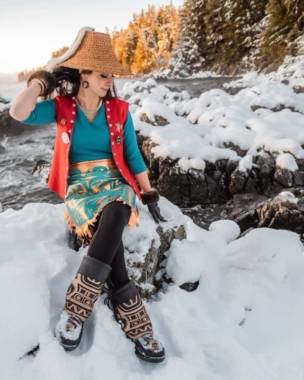
A portrait of Lingít artist Kaasteen Jill Meserve in Juneau, Alaska taken by Konrad Frank. (Photo courtesy of Jill Meserve)
The path to her beadwork being on the show started when the Native comedy group 1491s came to Juneau in 2019 for a show.
“And I like to say that I fangirled too hard because they must have remembered me and they, like, called me out by name in the show,” Meserve said.
Since that show, she kept in touch with Sterlin Harjo and Bobby Wilson of the 1491s.
Then in 2020, Meserve started sharing her beadwork to Instagram. Both Harjo and Wilson bought pieces from her.
Her beadwork often has some humor to it and she finds inspiration for her projects everywhere. For example, one of her projects was a pair of slides with a flower design she saw on toilet paper.
She also loves to bead things from her favorite TV shows. She beaded a lotus tile from “Avatar: The Last Airbender,” Pickle Rick from “Rick and Morty” and the Central Perk logo from “Friends.”
Meserve has been beading since she was a kid living in Hoonah. Before last year, her beading was mostly fun projects that she wanted to do. But she did not share these projects online often.
Lingít artist Kaasteen Jill Meserve in the process of making a pickle medallion that is featured in the show “Reservation Dogs.” (Photo courtesy of Jill Meserve)
That shifted during the pandemic. She started beading a lot more, posting her work and making it more of a business.
“You know, once COVID hit, I, for some reason, I really focused in on beading and that really became like my, almost my coping mechanism for COVID and to get through it. And it’s taken off since then,” Meserve said.
Sterlin Harjo is a co-creator and executive producer for “Reservation Dogs.” During the production of the show, he reached out to Meserve to make two medallions.
And those medallions are in the fourth episode of the show. The episode is called “What About Your Dad.”
One of them is that shiny pickle.
“The other one is a phallic-shaped microphone. That’s probably the best way that I can put it,” Meserve said. “And a lot of people who haven’t, like, seen the show, I think don’t really get the joke. They’re all like, ‘Wow that microphone looks kinda ‘sus’ there.’”
And what is it like to have her work featured on the show?
“Ah man, it’s still kind of surreal honestly,” Meserve said.
Online, it’s sparking conversations about Native identity and who is included in Native representation.
Not all tribes are the same, after all. Alaska Native people are different from Native American people, and there is so much diversity within Alaska Native tribes too.
Often, Native people are all grouped into one. But Meserve thinks this show will spur more individualized representation of Native tribes.
She said that, while all tribes are different, the show also draws on elements of being Native that all Native people can relate to.
And the show is just funny. The show is inspiring a lot of Native memes. Rotten Tomatoes also gave it a 100% rating.
Meserve is a huge fan. And growing up in Hoonah, she can relate to a lot of the show.
She said that everyone needs to watch this show not only because it’s funny or has good ratings, but because of the impact it has.
“In not just, like you know, in our Native communities but like for Hollywood and what it means to be really truly represented in media and on screens. It’s very monumental,” Meserve said.
It’s one of the first shows made for Native people, by Native people. Every writer, director and regular actor is Indigenous. And Meserve thinks this is just the beginning of an era of Native television.
Want to know more about the show? Watch it on FX on Hulu.
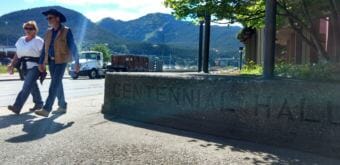
Passersby stroll by Centennial Hall, downtown Juneau’s convention center on June 18, 2018. (Photo by Jacob Resneck/KTOO)
Last weekend, Juneau’s convention center, Centennial Hall, was opened as a shelter for people experiencing homelessness to isolate after testing positive for COVID-19.
It’s the third time the facility has been used for sheltering people with the virus who do not have another place to isolate. Housing officials have also used hotels to put people up.
“The primary mechanism is referral to hotels for isolation, and then, you know, Centennial Hall is kind of there in case there’s a huge spike or overflow in the future,” said Scott Ciambor, Chief Housing Officer for the City and Borough of Juneau.
Since there was an uptick in cases in the unhoused population, the city’s quarantine and isolation task force did some surveillance testing in the Glory Hall.
But, with the tourist season still in full swing, there was no vacancy in the hotels.
If a bunch of people staying in the Glory Hall tested positive, there would be no place for them to isolate. So they opened up Centennial Hall as a backup shelter.
Just one person needed to stay the night at Centennial Hall last Friday. A hotel room opened up the next day so they were able to spend the rest of their isolation period there.
Ciambor is not expecting the same problem to happen this week.
“There’s some loosening of the vacancy rates at hotels so we’re hoping that future testing and need for isolation can be covered by hotels,” he said.
Ciambor said that Centennial Hall shouldn’t need to be used again as a shelter. But the building will still remain an option.
Close
Update notification options
Subscribe to notifications
Subscribe
Get notifications about news related to the topics you care about. You can unsubscribe anytime.