I bring voices to my stories that have been historically underserved and underrepresented in news. I look at stories through a solutions-focused lens with a goal to benefit the community of Juneau and the state of Alaska.
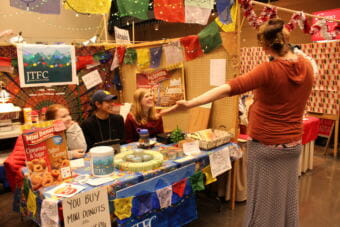
Kayla Simpson, Miguel Cordero and Mary Landes, members of Juneau Teens for Change sell treats and homemade goods at the 2017 Public Market. (Photo by Adelyn Baxter/KTOO)
Juneau Public Market is back. This year, the event is being held in person Nov. 26–28 at Centennial Hall and the Juneau Arts and Culture Center.
It’s one of the biggest events of the year, where people get their Christmas presents and support artists from throughout the state. About 140 vendors from across Alaska and the West Coast are currently signed up.
Last year, the market was online only and about 35 vendors participated.
Peter Metcalfe, the organizer of Juneau Public Market, started planning for an in-person public market earlier this year before the delta surge. When city officials moved Juneau’s risk level to high, he needed to adjust the event to meet the city’s mitigation strategies, which say that indoor events can have a maximum of 20 people, unlesseveryone is fully vaccinated.
So in order to hold the event in person, everyone is required to be fully vaccinated and wear a mask. There are no exceptions to the vaccination requirement.
That means children 11 or younger who are currently ineligible for the vaccine wouldn’t be able to go. An FDA panel recently recommended the Pfizer vaccine for children ages 5-11, but it is not authorized yet. And even if it is authorized next week, those children wouldn’t be able to be fully vaccinated before the event.
People can only take their masks off when they are eating in the food court and they will have to be socially distanced.
“This is nothing we’ve chosen to do,” Metcalfe said. “However, we are dedicated to public health and we would not hold this event if we thought it could be a, you know, mass spreading event of any sort.”
To prove vaccination status, people can either bring their vaccination cards or have a picture of it on their phones.
Metcalfe said about a dozen vendors have withdrawn because they aren’t vaccinated, or they want to avoid crowds for COVID-19 safety.
There will be people checking vaccination status at the doors of the event. Once they are checked in, people can pay for entry and get a wristband. The wristband has to be cut off to be removed, so it can’t be given to someone else.
Overall, Metcalfe is optimistic about the event and wants to bring back some celebration of the holidays.
“This is a first step in returning to normal,” Metcalfe said. “And we hope that in the succeeding year, 2022, we’ll be able to open all our venues and be back to normal.”
To be fully vaccinated before the public market, you would need a single dose or second dose of a vaccine by Nov. 11.
Correction: This story has been updated to include Peter Metcalfe’s full name and role at Juneau Public Market.
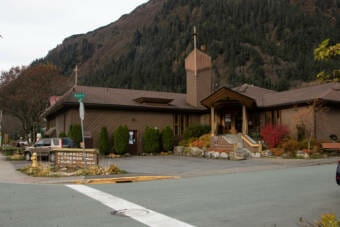
The Resurrection Lutheran Church on the corner of W. 10th St. and Glacier Avenue aims to be Juneau’s cold weather emergency shelter for the upcoming 2021-2022 winter. (Lyndsey Brollini/KTOO)
A church in a neighborhood near downtown Juneau has offered to be the location of this year’s cold weather emergency shelter.
Resurrection Lutheran Church submitted its proposal on Oct. 15 after a local nonprofit, St. Vincent de Paul Society of Juneau, pulled out of its contract to operate the shelter.
The shelter is scheduled to be open Nov. 15 through April 15 on nights when the temperature drops below 32 degrees.
Finding space for the warming shelter has been an ongoing problem. The shelter has changed locations four times since 2017. The shelter’s operator changed a handful of times in recent years as well.
St. Vincent de Paul Society of Juneau took it over from the city in 2019 and operated the shelter at the Juneau Arts and Culture Center from March 2020 through July 2021. But the JACC is no longer available as a shelter space.
Scott Ciambor, the city’s chief housing officer, said that after looking at options for shelter locations and considering the staffing involved, St. Vincent de Paul Society of Juneau decided it couldn’t operate the shelter this winter. The faith-based nonprofit only notified Ciambor about pulling out of the contract earlier this month.
Ciambor said he’s grateful for the nonprofit’s flexibility in providing shelter to those in need during the pandemic. But the change has left the city needing to find a new location fast, before the Nov. 15 deadline.
“We’re really just scrambling to make sure that something is available,” Ciambor said.
The Resurrection Lutheran Church says it has the space to have 28 socially distanced beds, and church staff have experience working with unhoused people through its food pantry. Pastor Karen Perkins and her husband also helped operate the cold weather shelter when it was run out of the old public safety building on Whittier Street.
The church is located in the Flats neighborhood, near the federal building in downtown Juneau.
The Flats neighborhood is located by the federal building in downtown Juneau. (Lyndsey Brollini/KTOO)
Last year, some residents of the Flats pushed back against a proposal to have a permanent cold weather shelter in their neighborhood. They did not want people who use emergency shelters to be in a neighborhood with lots of kids and schools nearby.
Perkins knows these are sentiments that may come up as the public comments on the proposal.
“A lot of people have an image of homeless people and risks that come with their presence that grow out of anecdotes of ‘I saw this happen’ or ‘I know that happened,’” Perkins said. “And so the idea of a shelter comes with, I think, some anxiety that isn’t really born out statistically.”
The church already operates a food pantry in the area, which provides food for some of the same people who would use the emergency shelter. And Perkins says Flats residents have been very supportive of the food pantry.
“Neighbors who live in the area, when they’re heading to Costco, will say, ‘What does the food pantry need?’” Perkins said.
Perkins thinks there are a lot of people who want to give and who want to help. But when it comes to people staying around longer to be sheltered, she thinks there could be some resistance.
The church plans to address safety concerns in a variety of ways — having experienced staff, having extra cameras and lights around the building, providing buses to transport people away from the church when the shelter closes, asking police to drive around the area, cleaning up trash and working with other shelters to make sure the church is only being used as a last resort.
Perkins hopes that talking with the community — outlining the church’s experience serving the unhoused population and educating people about how they’ll operate the shelter — will help ease any anxiety people might have.
Providing this shelter feels like an obligation to Perkins. She says that, as part of her faith, she was taught to love and care for her neighbors.
“Fundamentally, a loving neighbor means giving them shelter so they can survive the night,” Perkins said.
Perkins encourages empathy for people experiencing homelessness. She hopes that if anyone she loves were ever unhoused, people would see past their circumstances and acknowledge them as a person.
“People don’t choose to be homeless or choose to be in crisis or choose to be dependent,” Perkins said. “For many people, it’s a crushing way to exist. And being acknowledged as human beings is one of the most vital parts of surviving.”
The church is proposing to take over the contract that St. Vincent de Paul Society of Juneau had with the city, which would end in 2023. The church states in its proposal that it does not have any plans to be in the shelter business long-term.
Last year, the city looked into buying a building to use as a long-term cold weather emergency shelter, but the Assembly rejected all the proposals.
Ciambor said the city isn’t looking into any long-term emergency shelters at the moment. Right now, he’s focused on getting a shelter up quickly for this winter. And there aren’t any concrete backup plans if the Resurrection Lutheran Church doesn’t work out.
The church’s proposal should be up for public comment in a future city planning commission meeting before Nov. 15. The date is undecided right now.
The Resurrection Lutheran Church is holding a hybrid in-person and Zoom meeting on Oct. 27 at 7 p.m. to hear feedback about the proposal and answer any questions.
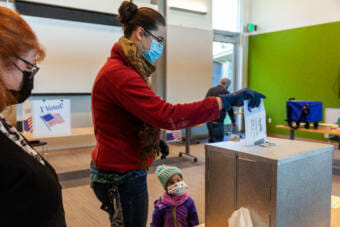
The Mendenhall Valley Public Library operates as a Juneau Voting Center for the Juneau municipal election on October 5, 2021. (Photo by Lyndsey Brollini/KTOO)
‘Wáahlaal Gíidaak Barbara Blake is leading for the Juneau Assembly District 1 seat over opponents Paul Kelly and Troy Wuyts-Smith. Blake had fundraised a significant amount more than other candidates.
Michelle Bonnet Hale is leading in the Juneau Assembly District 2 race over Kelly Fishler.
The top three candidates for the Juneau School Board are Elizabeth Siddon, Amber Frommherz and Ibn Bailey. There are eight candidates aiming for three seats on the school board.
Two of those people are write-in candidates. Votes for write-in candidates were not available in this first round of results. Those votes should be counted by Oct. 15, according to the City and Borough of Juneau. Official results will not be available until Tuesday, Oct. 19.
CBJ election workers are partnering with the Municipality of Anchorage to process the ballots. The Assembly voted to put $700,000 towards turning a city-owned warehouse into a local ballot processing center, so in the future ballots will not have to be brought to Anchorage to be processed.
Any questioned ballots will be sent back to Juneau to be examined by the Canvass Review Board.
Some voters may be receiving a “cure letter.” These letters are sent out when a ballot is missing information that makes it valid, such as a signature or a personal identifier. Voters will need to respond to the letter before Oct. 19, which is when the Canvass Review Board will certify the election.
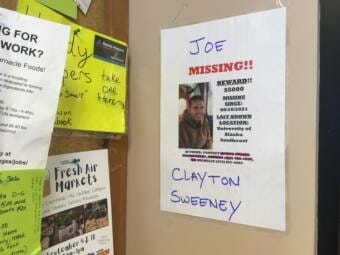
A missing poster for Joe Clayton on the downtown Foodland IGA bulletin board in Juneau, Alaska. Clayton has been missing since Aug. 20. (Matt Miller/KTOO)
There are two recent missing persons cases in Juneau. Officially, neither person has been found yet.
One of them is Joseph Clayton. He has been missing since he went on a hike on Aug. 20. Four days later, some of his belongings were found at an abandoned campsite near the University of Alaska Southeast.
Volunteers searched for him for days and Alaska State Troopers used dogs to search the area, but they were not able to find Clayton.
There has been no update from the Juneau Police Department on that case since. The silver alert activated for Clayton was canceled on Sept. 22.
Another person was reported missing more recently — Douglas Farnsworth. His family reported him missing on Sept. 29.
A graphic with details about Douglas Farnsworth who was last seen on Sept. 26. (Courtesy image)
His sister Kiersten Farnsworth thinks he might be dead. She flew up from Arizona to try and find her brother’s body.
Farnsworth’s family told Juneau police that he was driving someone else’s truck. That truck was later found by Perseverance Trail. A Coast Guard helicopter searched that area last weekend during a break in the weather, but they did not find anything.
Canine search teams were not able to pick up Farnsworth’s scent in the area. His sister does not think he is in that area either.
On Wednesday, a body was found near the Auke Bay Ferry Terminal. The Alaska Medical Examiner’s Office has not identified the body yet. JPD is not able to comment on whether the body is related to either of the missing persons cases until they get word from the medical examiner.
Farnsworth’s family does not think the body found is his. They are still asking people in Juneau to look out for him.
Anyone who knows something about a missing persons case can contact 907-586-0600 or make an anonymous report to Juneau’s Crime Line.
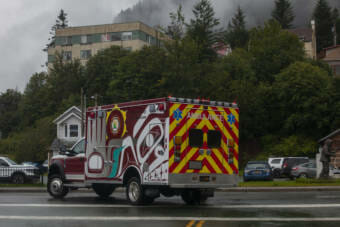
A newly refurbished ambulance decorated with art from Tlingit artists Mary Goddard and Crystal Worl drives through downtown on August 28, 2020 in Juneau, Alaska. (Photo by Rashah McChesney/KTOO)
A Juneau community health program has been easing the burden on the hospital’s emergency room during the current COVID-19 surge.
The program is called Community Assistance Response and Emergency Services or CARES — not to be confused with the federal COVID-19 stimulus law. Juneau’s CARES is run by Capital City Fire/Rescue.
CARES started at the beginning of the pandemic to help provide in-house care to people with COVID-19 so they would not take up beds in the emergency room.
“We have definitely limited traffic to the hospital,” said CARES Program Director Joe Mishler.
The CARES team did this with COVID-19 patients by monitoring people in their homes, helping them stay in quarantine and giving in-home COVID-19 tests.
The team also transports people to the hospital for monoclonal antibody treatment.
Currently, the program is experiencing one of the busiest times it has ever had, according to Mishler.
“We’re pretty much overwhelmed with referrals right now,” Mishler said.
This is also in part because the program has expanded to help non-COVID patients. The program now serves two other groups of people — frequent users of the ER and patients being discharged from the hospital.
Mishler works with the case manager at Bartlett Regional Hospital to identify these people. This is where a majority of referrals come from. Referrals also come from doctors’ offices, SEARHC, Juneau Public Health and ambulance crews.
If a patient is identified as a repeat user of the ER, usually by the hospital or the ambulance crew, they will be referred to the CARES team.
“We’re working with those folks to figure out what their specific needs are,” Mishler said. “And try to help them with more appropriate care perhaps than using emergency services.”
The CARES program is not taking any duties away from ambulances and it does not take calls from 911. Instead, the CARES team focuses on serving the callers of 911 who do not have an emergency but do have medical needs.
An ambulance will still arrive on the scene for all 911 calls. If the ambulance paramedic determines that the person does not require emergency care, at that point they will reach out to the CARES team.
Additionally, the CARES team helps people get out of the ER sooner by setting up care at home, educating people about their medications and providing resources to people waiting for hospice to start.
While the program started with the pandemic, Mishler said that he hopes to keep the program going after it’s over.
“The program does not need COVID in order to justify it, put it that way,” he said.
Close
Update notification options
Subscribe to notifications
Subscribe
Get notifications about news related to the topics you care about. You can unsubscribe anytime.