Lyndsey Brollini

Local News Reporter

I bring voices to my stories that have been historically underserved and underrepresented in news. I look at stories through a solutions-focused lens with a goal to benefit the community of Juneau and the state of Alaska.
Newscast – Thursday, Dec. 9, 2021

In this newscast:

  • Alaska Permanent Fund Corporation’s executive director was removed from her position
  • Kevin Meyer has been the focus of criticism from conservatives unhappy with last year’s election
  • Rasmuson Foundation gives funding to Juneau’s domestic and sexual violence shelter
  • Alaska crab boat captain who was on “Deadliest Catch” admitted to dealing heroin
  • Preliminary report on a fatal crash in Kodiak comes out

Owners of Gustavus Inn sell to Hoonah Lingít tribe

The Gustavus Inn is being sold to the Hoonah Indian Association by David and JoAnn Lesh, who have owned the property since 1980. (Photo by Lisa Phu/KTOO)

The owners of the Gustavus Inn sold their inn after a run of 41 years.

It’s been on sale for a couple of years, but the Hoonah Indian Association recently bought the property, giving the Hoonah Lingít a foothold in their homelands.

Gustavus is a gateway to visiting Glacier Bay National Park and Preserve, so the community gets a lot of tourists in the summertime. And one of the few places they can stay while visiting the park is Gustavus Inn.

The Lesh family has owned the Gustavus Inn since 1965 when Jack and Sally Lesh bought it. Their son David Lesh and his wife JoAnn took it over in 1980. 

And a lot has changed since then — at first, there wasn’t any power, no roads or phone service in Gustavus. JoAnne Lesh said it wasn’t easy to run the business back then. 

“Having a small business in a town like that is about being nimble and adaptable. You anticipate and you plan ahead and then you try and make it work when things happen,” Lesh said.

They’re going to miss the guests the most, but Lesh said they are looking forward to having their first summer off in 40 years. 

And she’s glad that the Hoonah Indian Association is taking the place over.

“We’re excited about the tribe having a place to call home in their homelands,” Lesh said.

Glacier Bay National Park and Preserve (Claire Stremple/KTOO)

Robert Starbard is the tribe’s tribal administrator and chief executive office. He said that’s the tribe’s main reason for buying the inn — for the Hoonah Lingít to have a place in their homelands.

“We’ve never actually had a claim for a sustained physical presence there since the little ice age. And this is part of correcting that,” Starbard said.

The Hoonah Indian Association started looking at buying the inn back in 2019. The pandemic put discussions on hold. In late spring this year, the tribe started negotiations again and eventually bought the property. 

Starbard said the inn will be different from when the Lesh’s ran it. They plan to focus more on cultural tourism.

“A place where the interpreters can bring clients to experience the richness of the Lingít culture outside of the confines of the park,” he said.

And they want to expand the operation. The building will give the tribe the infrastructure it needs for other projects in the area, like sustaining the tribe’s clan house, holding culture camps and providing job opportunities for tribal citizens. 

Starbard said the tribe wants its citizens to be able to take jobs at the National Park Service and work in Glacier Bay in the summer.

“We’re hoping to develop some small housing on the property that will give the ability for our tribal citizens to take jobs with the park to be able to get back and forth to and from Hoonah,” he said.

Starbard said one of the hardest parts of being in Gustavus is the isolation, which is why the tribe wants to create a daily ferry service from Hoonah to Gustavus, so citizens won’t be so isolated from their homes.

The tribe is aiming to have its Gustavus operation ready by the 2023 season, but that date is in flux and will depend on when they can get the ferry service running and when they get the staff they need.

“And because of the unknowns of this upcoming season with COVID, still COVID variants still very much wandering around the countryside, the crystal balls that we’re all operating with are very opaque,” Starbard said.

Despite the uncertainty on the timing, Starbard said that when the inn does reopen, it will be an economic engine for the tribe.  

Newscast – Monday, Dec. 6, 2021

In this newscast:

  • Delays in ferry repairs could cause Southeast Alaska communities to go without ferries for several weeks
  • Federal judge rejects Dunleavey administration’s legal challenge to a subsistence hunt in Kake
  • Nuclear regulatory commission chairman intrigued by Eielson Air Force Base nuclear power plant plans
  • Matanuska-Susitna Borough is suing the Alaska Redistricting Board

Juneau residents split over city’s response to impacts of tourism, according to survey

A view from the Goldbelt Tram of a Princess Cruises ship docked in Juneau on Aug. 31, 2021. (Photo by Jennifer Pemberton / KTOO)

The results of a public opinion survey on tourism in Juneau are out, and about 2,400 Juneau residents weighed in. 

To participate, people had to live in Juneau during the summer of 2019 — the last big tourism season before the pandemic. 

On the overall effects of tourism, 36% of people who responded said they thought it had a positive impact on them; 33% said tourism had both positive and negative impacts; 20% said it didn’t have any impact and just 8% of people said tourism has a negative impact. 

These trends are similar to results from past surveys in 2002 and 2006. The McKinley Research Group, formerly the McDowell Group, conducted the survey for the city. The McDowell Group had been conducting these surveys since the 1990s.

Heather Haugland from McKinley Research Group presented the survey findings to the Juneau Assembly on Nov. 29. She thought it was significant that the results were so similar for the past 19 years, considering how much the tourism industry has changed during that time. 

“So between 2002 and 2021, or 2019, we almost doubled our cruise passenger volume. But really, these responses did not change very much within four percentage points and some in just two or three percentage point change,” Haugland said. “So even though it might seem boring, it’s actually pretty remarkable that these responses are so consistent.”

Residents who live in downtown or Thane were more likely to respond with negative impacts of tourism than those who live in other parts of the city. And people who live in those areas or on Douglas said that they felt more impacts overall from tourism than people who lived in Lemon Creek, the Mendenhall Valley or Out the Road. 

More people also responded that they were negatively impacted by tourism online than through the phone survey. Haugland said this could be because people who felt impacted by tourism were more likely to take the survey. 

“Online responses were, felt more impacted by tourism. They also were twice as likely to be from downtown, you know, much less likely to be from the Valley,” Haugland said.

People are split on the city’s response to tourism. Almost half of the responses said the city isn’t doing enough to manage the impacts of tourism on the community. The other half said the city is doing enough or more than enough. 

Two pie charts showing result from a survey.
Slide from a presentation Heather Haugland from the McKinley Research Group gave to the Juneau Assembly committee of the whole on Nov. 29, 2021 about the results from a public opinion survey on tourism. (Screenshot)

Almost two-thirds of the people who responded said they support limits on the number of large cruise ships per day. When asked about what that limit should be, the top answer was five ships, then three, then four. 

Fifty-six percent of people support Norwegian Cruise Line’s plans for a new dock and 33% were opposed.

People were then asked if their support would change if certain things were incorporated into the project, like a cruise ship limit, a park and an ocean center.

Haugland said that these factors did change some people’s level of support between 20-40%.

“The number one preference would be a cap of five large ships per day in Juneau’s harbor,” Haugland said.

Lingít aluminum canoe sculpture now a permanent fixture at Juneau’s Overstreet Park

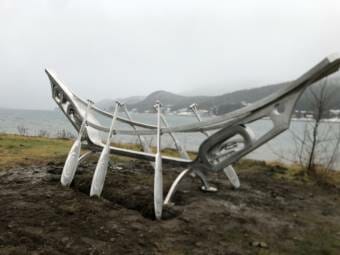
Robert Mills’ metal sculpture Yaadachóon was installed along the seawalk at Overstreet Park in November 2021. (Photo by Jennifer Pemberton/KTOO)

Lingít artist Robert Mills’ head is always up in the clouds, dreaming about projects. A canoe was one of those dream projects.

It came to life through a Juneau CARES ArtWorks grant. During the pandemic, the city set aside some of its federal CARES Act money to provide work for artists. This canoe was one of 35 projects that received funding, this one receiving $37,250

The 20-foot sculpture is all aluminum —  a silver outline of a boat with formline designs on the bow and stern. From the seawalk at Overstreet Park, the shiny metal stands out against the mountains and the Gastineau Channel.

The canoe is a representation of Lingít society. On one level, it represents the vessel that Lingít people used to travel. On another, it represents the binary of the Eagle and Raven and being in harmony with the opposite clan. 

On a third level, Mills said it represents the world we live in today.

“Because, you know, certainly coming out of some very contentious times in society, where we have seen some of the worst ills of humanity kind of play themselves out, that void is represented in the canoe sculpture by the negative space that normally would possess the body of the canoe,” Mills said.

In creating formline, Mills said that the negative space is used to help fill the positive. He compared the principle to this period of the pandemic. 

“Going forward, we can only hope that we use this negative period and can form it in a way that helps us shape the positive,” Mills said. 

Throughout Mills’ life, whether it was growing up in Kake or commercial fishing, he always found ways to make do with what he had. 

He said that mentality applied to making this canoe. 

“It was a lot of research and development, as far as applying what pressure where, at what points, at how many pounds. You know, bending it one way, going back the other. Just, man, it, it was a lot,” Mills said.

He partnered with fabricator Brian Crapo to mold the metal and bring the piece to life. The completed canoe, named Yaadachóon, hasn’t had a permanent home until now. It spent some of the pandemic in an empty store at the Nugget Mall. It was most recently at Centennial Hall, where it served as a backdrop for musicians who performed at the Indigenous music festival Rock Aak’w

Now, the canoe is permanently installed along the walkway in Overstreet Park at the original mouth of Gold Creek, or Dzantik’i Heeni. 

Robert Mills’ metal sculpture Yaadachóon was installed along the seawalk at Overstreet Park in November 2021. (Photo by Jennifer Pemberton/KTOO).

“You know, I think it’s pretty fitting in that, at one point, it used to possess many, many, many canoes,” Mills said.

Eventually, there will be lights that light up the canoe at night, but the Juneau Arts and Humanities Council is still raising money for that, so they are not installed yet.

In the past couple of years, the city has been investing more in Native public art, with the Elizabeth Peratrovich mural, the formline signs throughout downtown and now this canoe. 

Mills said it’s important to highlight Native artists, especially as they have been historically suppressed in their own lands.

“You know, when you grow up not seeing some of this artform that resides in, you know, some of the finest art collections in the history of the world, Lingít art stands next to them, and yet growing up you don’t see that in your own homeland,” Mills said.

To Mills, gaining more representation in art is a step in the right direction. With more Native public art, Native children can look up at these works and be inspired to become artists themselves one day.

Site notifications
Update notification options
Subscribe to notifications