Lyndsey Brollini

Local News Reporter

I bring voices to my stories that have been historically underserved and underrepresented in news. I look at stories through a solutions-focused lens with a goal to benefit the community of Juneau and the state of Alaska.
Hundreds of Alaska Airlines flights in Seattle canceled, delayed by snow

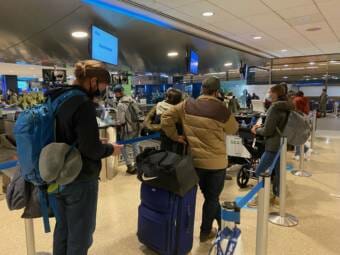
The departures displayed at the Seattle-Tacoma International Airport on Dec. 28, 2021. Flights are being delayed or canceled because of snowy conditions and staffing shortages. (Bridget Dowd/KTOO)

Hundreds of Alaska Airlines flights to and from Seattle have been canceled because of snowy weather conditions. But so far, no flights to or from Juneau have been canceled.

The weather is requiring the jets to be de-iced, which can take up to 30 minutes. That added time has ripple effects leading to delayed and canceled flights. Over 350 flights have been canceled so far. 

There are other delays related to COVID-19. According to Alaska Airlines’ blog, the omicron variant is contributing to staffing shortages with the airline. 

Almost all flights to Juneau from Seattle on Tuesday were delayed.

On social media, travelers are reporting long wait times at Alaska Airlines kiosks in the airport and on the airline’s customer service number. 

The delays are also tangling up luggage. Dozens of late bags were stacked at the Ted Stevens Anchorage International Airport on Tuesday as long lines formed at customer service.

And with delayed flights, it can mean missing a connecting flight. The airline is recommending travelers to do their rebooking online versus calling or rebooking at the airport. And if you don’t need to travel before Jan. 2, the airline is recommending pushing travel plans back. 

Travelers search for their bags and stand in line to talk to customer service at the Ted Stevens Anchorage International Airport on Tuesday. (Photo courtesy of Bart Rudolph)

Travelers impacted by the cancellations and delays might be eligible for reimbursement of their travel expenses. 

Editor’s note: This story has been updated with information about delays at the Ted Stevens Anchorage International Airport.

Juneau restaurant hit by Bristol Bay king crab season closure, skyrocketing prices

Derek Schneider at Tracy's King Crab Shack
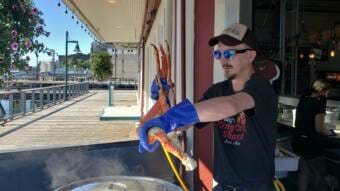
Derek Schneider works with some king crab legs at Tracy’s King Crab Shack in Juneau on June 8, 2021. (Photo by Jeremy Hsieh/KTOO)

Tracy’s King Crab Shack has served Alaska king crab below market price for years, but the restaurant isn’t able to do that anymore. Owner Tracy LaBarge said prices have gone up 100%. 

“It’s not a small increase. It’s double what it was in 2019. So that’s been a tough one to take,” LaBarge said.

Crab shortages and inflation are hitting seafood restaurants across the country.

Those crab shortages are being caused by multiple factors. One of the biggest ones in Alaska is that there are just not as many crabs. This year, all major stocks of crab in Bristol Bay were low, not just king crab. 

Forrest Bowers manages commercial fisheries for the Alaska Department of Fish and Game. He said that the number of mature male and female crabs has been declining for years.

Mature crabs are the ones that reproduce, and over the last 12 years, fewer and fewer crabs are reaching that age. 

“You know, in general, the reasons why productivity can be lower are that environmental conditions are unfavorable,” Bowers said.

Bowers said there are a lot of factors coming into play that can impact crab populations.

Environmental conditions could be related to effects of climate change — like warming water temperature or ocean acidification — or related to food scarcity or predators. Fishing and bycatch can also impact the crab stock.

The end result of this trend of declining crab stock is that Fish and Game closed the red king crab season in Bristol Bay, and that closure had a direct impact on LaBarge’s restaurant. 

“It’s kind of what we prided ourselves in, was always buying Alaska king crab, this Bristol Bay king crab,” LaBarge said. “So this is kind of the first time that we’re having to go, you know, buy Russian crab or Norwegian crab, basically, just to stay in business. Because the crab season is closed.”

Next season, she will still have other Alaska crabs, like Dungeness, snow or tanner. But not Bristol Bay king crab. 

And there’s still high demand for crab, especially overseas. LaBarge said live markets in China, Japan and South Korea are buying more crab, and that there is always a big push for crab around Lunar New Year.

Combine increase demand with the crab shortage and it’s made the price of all species of crab go up a lot

“We’re double in our pricing, which is a shock to people who have been longtime customers, you know, but it is what it is. We’re all just trying to survive,” LaBarge said.

Normally, LaBarge already has all her crab purchased for the next tourism season, but with the high prices, she said it didn’t make sense for her to do that. 

She hopes the prices will go down after the holidays and she can buy her crab then. But she also doesn’t want to wait too long and then not have enough crab either. 

LaBarge said this next tourism season will make or break her business. This year’s season was better than 2020 but she still operated at a loss and she can only do that for so long.

“The one thing we’re good at is we’re good at adjusting our menu, we’re good at adjusting our labor. This is 17 years now we’ve been doing this so we’re pretty good at adjusting to the market. But this has been a not a fun one,” LaBarge said.

LaBarge thinks sales next year will be better than this year, but that it’s still just a guessing game at this point.

Alaska Native leaders say tribal recognition is long overdue

Gov. Bill Walker talks with Central Council President Richard Peterson at the Indigenous Peoples Day celebration Oct. 9, 2017, at Elizabeth Peratrovich Hall. (Photo by Adelyn Baxter/KTOO)
Former Gov. Bill Walker talks with Central Council President Richard Peterson at the Indigenous Peoples Day celebration Oct. 9, 2017, at Elizabeth Peratrovich Hall. (Adelyn Baxter/KTOO)

At this year’s Alaska Federation of Natives convention, sponsors of a ballot initiative took the opportunity to say their piece on why tribal recognition in the state is long overdue.

Multiple attempts to pass a bill through the Legislature have been unsuccessful. This year, a tribal recognition bill was passed in the House but never went to a vote in the Senate. 

Chalyee Éesh Richard Peterson is the president of the Central Council of the Tlingit and Haida Indian Tribes of Alaska. He’s also one of the initiative’s sponsors. 

“A bill that did come forward from Rep. Tiffany Zulkosky to recognize tribes couldn’t make it because they were unable to really just get their business done,” Peterson said. “We thought it was better to just, let’s put this in the hands of the people.”

The initiative wouldn’t give tribes any new powers because they are inherently sovereign. Instead, the initiative aims to have the state acknowledge that sovereignty. 

Co-sponsor La quen náay Liz Medicine Crow said the relationship between the state and tribes needs to be solidified into law — otherwise tribes are caught in the middle of the politics of the current administration.

“The state of Alaska has too often used our Native communities and our tribes as a political hot potato,” Medicine Crow said.

The state and Alaska Native tribes already work together in a government-to-government capacity with tribal compacts. 

The state has a compact in child welfare that allows tribes to take charge in providing their own child welfare services. And earlier during the AFN conference, Gov. Mike Dunleavey spoke about creating tribal compacts in education. 

“I was very excited to hear that Governor Dunleavy is supportive of a government-to-government relationship with tribes,” Medicine Crow said. “That’s what this ballot initiative concretes and puts into law, we need to have that in order so that it is not just formal, but it is forever.”

To make it on next year’s ballot, the initiative needs over 36,000 signatures within a year after being approved. Two months in, over a third of those signatures have already been gathered. 

At AFN convention, families of people who died from cancer urge early screenings

The Alaska Native Tribal Health Consortium on June 30, 2021. (Lex Treinen/Alaska Public Media)

During the Alaska Federation of Natives convention this year, speakers on an American Cancer Society panel all had a unified call to action — get screened for cancer.

The panel was prompted by a report released by the Alaska Native Tribal Health Consortium earlier this year that compiled 50 years of data on cancer in Alaska Native people. It found that one in five Alaska Native people dies from cancer.
Jaeleen Kookesh is the vice president of policy and legal Affairs and corporate secretary at Sealaska, but she’s also a member of the advisory board for the American Cancer Society in Alaska. Her dad was former state senator and Alaska Native leader Albert Kookesh, who died from cancer early this summer.

“I joined this less than a year ago because my dad was in the middle of battling cancer. And I had two other uncles and other family members who succumbed to cancer,” Kookesh said. “Little did I know that my dad would pass within my first year of serving in this capacity.”

She said that her dad’s cancer was curable if caught early on, and that losing him made her even more dedicated to cancer education and prevention.

Eric Fox lost his mom to cancer. She was diagnosed with colorectal cancer in 2015. He remembered taking his mom to get treated for cancer and seeing a lot of elders there, just like his mom.

“I remember walking into the chemo room and just seeing tons of our elders hooked up to these, these machines. And they’re literally having poison put into their bodies to combat this thing. And there’s rows and rows of them. And I’m just at that time thinking, what’s going on?” Fox said.

He said that his mom’s generation is resilient, but that sometimes there’s also a sense of denial about needing help.

“But I think often with that, you know, there’s a certain sense of, you know, ‘Nothing’s wrong with me, I don’t I don’t need to do that.’ And oftentimes, it may be even taboo to have the discussion,” Fox said.

Fox says that people need to ask their families and their elders about being screened because it could save their lives, even if it’s an awkward conversation.

Sporadic equipment failure is leaving some travelers stranded in Yakutat

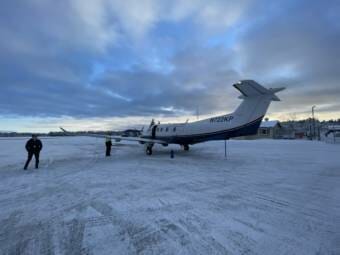
While being stuck in Yakutat because of malfunctioning National Weather Service equipment, Juneau resident Norton Gregory saw this Yakutat sunrise on Dec. 3, 2021. (Photo courtesy of Norton Gregory)

A day trip to Yakutat turned into a three-night extended stay for one Juneau resident because of a weather station malfunction preventing planes from taking off. This is a recurring problem for the community that, for most of the year, is only connected through air travel. 

Juneau resident Norton Gregory was going to Yakutat on a day trip for work on Dec. 1. The Alaska Airlines jet landed with him aboard. But when the jet took off later, only crew members were on board because a piece of equipment wasn’t working, and airlines can’t take off in Yakutat with passengers on the plane without it.

Federal Aviation Administration regulations require airlines to have information like wind speed, direction, temperature and cloud coverage in order to take off or land. 

Airlines can get this information from human weather observers or automated weather systems. Yakutat once had a weather observer but hasn’t had one in a long time. So airlines flying into the community have to rely on the automated weather system called an Automated Surface Observing System, or ASOS.

Because of FAA regulation, the airline can’t take off without it — even if the weather looks good. 

That left Gregory stranded in the remote community known — among other things — for its surfing.  

“You know, I was thinking that I could probably go get a surfboard from Icy Waves Surf Shop and give that a go,” he said. “Yeah, I think you’re kind of, you’re at their will, you’re at the will of the airlines when something like this happens.”

The only other option for Gregory to get home besides waiting for ASOS to be fixed was to charter a flight with Alaska Seaplanes. And it comes with a hefty price tag; it’s about $5,000 for the charter from Juneau to Yakutat and back. 

It wasn’t a completely negative experience for Gregory. During his three extra days, he got to see some friends he hasn’t seen in a while, meet the village dogs and see a Yakutat winter sunrise.

“You know, it’s a beautiful place to be stranded,” he said.

Gregory said he was lucky he didn’t have pressing commitments but said others may have needed to make flight connections or get to doctor’s appointments in other communities. 

“It’s just life in the village I think for these folks, I think they might be a little more accustomed to it than I. But, you know, I don’t think it’s something that we should be accustomed to, I think that these folks deserve regular air service,” he said.

The town’s mayor, Cindy Bremner, said this has been a problem for more than two years now, but this was the longest outage Yakutat has had. It created a lot of problems for residents trying to travel outside of the community. 

People were stranded in Anchorage, Juneau and Seattle. With an extra week added on to their travel, expenses can rise quickly. 

And it isn’t just a problem about residents wanting to be able to travel in and out of the community.

“We rely on the airline for everything from our groceries to go and see the doctor to, unfortunately during this last outage, we had a couple of deaths in our community and that’s also how they get transported to the medical examiner’s office and that was unable to happen for a few days,” Bremner said.

One resident ended up calling a charter for the deceased because they weren’t sure if the problem would be fixed in time. When the same problem happened in October, some residents were traveling to a funeral. They — and the deceased person — were stuck in Anchorage until ASOS was fixed.

Bremner wants to find a permanent solution to this problem because the community relies on air travel for almost everything. They can’t use a ferry as a backup option.

“We don’t get regular ferry service in the winter and fairly sporadic even in the summer,” Bremner said. “So it doesn’t really matter whether it’s summer or winter, we still need this fixed so we can get our airline in here daily.”

Chartering a plane is expensive and a lot of people can’t afford it. But in emergencies, sometimes people have to shoulder that cost.

“There was a gentleman who had to get out for his dialysis, and that’s not something you can just put off if you want to live,” she said.

Bremner hopes that with the community of Yakutat, Alaska Airlines and the National Weather Service working together, they can come up with a permanent solution.

Over the weekend, that weather-reporting equipment failed again, just days after it had been fixed. It caused another flight to be canceled. Though, by the evening of Dec. 11, Alaska Airlines flight trackers show that flights were able to land in the Yakutat airport again.  

Tlingit and Haida expands in the Aak’w Village District

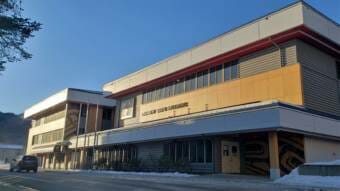
The Andrew Hope Building, pictured here on Feb. 10, 2021, houses the headquarters of the Central Council of Tlingit and Haida Indian Tribes of Alaska.
The Andrew Hope Building, pictured here on Feb. 10, 2021, houses the headquarters of the Central Council of Tlingit and Haida Indian Tribes of Alaska. It’s named after an Alaska Native leader who was a charter member of the Alaska Native Brotherhood, a territorial and state legislator and Central Council president. (Photo by Jeremy Hsieh/KTOO)

The Central Council of the Tlingit and Haida Indian Tribes of Alaska is expanding in the Aak’w Village District in downtown Juneau.

The tribe bought two buildings, one at 400 Willoughby Ave. and the other at 410 Willoughby Ave. Both are near the tribe’s headquarters.

Tribe President Chalyee Éesh Richard Peterson said that the move is a return of land to Indigenous people. The tribe committed to developing a tribal campus when a resolution from the Juneau Tlingit and Haida Community Council was adopted at this year’s Tribal Assembly.

Peterson said these new buildings are a step in that direction.

“Many of our clients fall under different programs, not just one program. So they have to kind of traverse all across town just to get services,” Peterson said. “It’s not the most conducive thing. So for us, it really does make things better if we can build and expand in a campus setting.”

The tribe is outgrowing its current building too. It now employs over 400 people in Juneau and elsewhere.

A lot of employees are working from home right now, and Peterson wants to be able to bring employees back to the office. But to do that safely, everyone will need to have their own offices.

“We’re running out of space. And we really can’t, with this pandemic, we  really can’t double up and put like two people to an office anymore, right?” Peterson said.

There’s some work to do before that happens, like redesigning the buildings inside and out.

There are currently leased spaces in the two buildings. But as the leases expire, Peterson says the tribe will consider each one and decide if they want to keep the leases or move the tribe’s employees into those spaces.

Site notifications
Update notification options
Subscribe to notifications