I bring voices to my stories that have been historically underserved and underrepresented in news. I look at stories through a solutions-focused lens with a goal to benefit the community of Juneau and the state of Alaska.
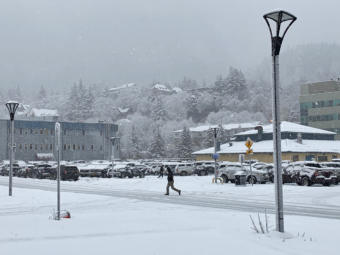
A man crosses Willoughby Avenue on Jan. 30, 2019 in Juneau, Alaska. (Photo by Rashah McChesney/KTOO)
A Juneau resident has started a new clothing drive to help people experiencing homelessness.
Alexis Ross Miller recently read a story in the paper by a woman named Laura Rorem about her daughter’s experience with homelessness.
“I, you know, was just motivated by Laura’s words as a mother,” Miller said. “And it’s just so sad to me that her daughter is not just one unique individual. There’s millions of stories like that.”
Miller started making calls to shelter providers around town to organize a clothing drive. It’s the first clothing drive she has organized. The Glory Hall, St. Vincent de Paul and Resurrection Lutheran Church are all participating.
Miller is hoping to hold the clothing drive through Dec. 15.
“But, you know, I tell people that you can donate all year long,” Miller said.
Winter items that the shelters need include coats, hats, snowsuits, scarves and gloves. Before donating, Miller asks people to wash or dry-clean any used items before donating, if possible. New items are also wanted.
People can bring winter items to The Glory Hall, located at 8715 Teal St. behind Nugget Mall, to St. Vincent de Paul next door or to the Resurrection Lutheran Church, located close to the Federal building at 740 W. 10th St.
Editor’s note: A previous version of this story included information about donating to Shéiyi X̱aat Hít. That information was removed at the request of the shelter supervisor because there is limited capacity for donations.
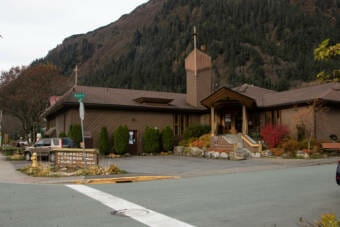
A sign with the dates of the next City and Borough of Juneau’s planning commission meeting hangs at the Resurrection Lutheran Church on Oct. 27, 2021 in Juneau, Alaska. At the commission’s Nov. 9, 2021 meeting, commissioners voted to approve the RLC’s conditional use permit to hold a cold weather shelter for the winter of 2021-2022. (Lyndsey Brollini/KTOO)
Juneau’s cold weather emergency shelter will be at the Resurrection Lutheran Church near downtown this winter. The city’s planning commission voted on Nov. 9 to approve the church’s conditional use permit to hold the shelter with some conditions.
The cold weather emergency use shelter was created in 2017 and has been run by a few organizations around town since. St. Vincent de Paul had run it since the end of 2019. Last month, the nonprofit pulled out of its contract with the City and Borough of Juneau to provide the shelter.
That is when the Resurrection Lutheran Church stepped in. Employees at the church have experience working with the unhoused population in Juneau. Without another viable option and with such short notice, Karen Lawfer and others at the church felt obligated to step up.
“We knew that it was going to get cold and we knew that people needed a place to go,” Lawfer said. “And as such, we have been working nonstop to get this process going so that those who are less fortunate than we will be able to have a place to stay and a meal.”
People living in the neighborhood surrounding the church said during the planning commission meeting that they have concerns. Most were related to safety around the neighborhood — for children going to school, people using the night drop at First National Bank, business owners and for residents in the Flats neighborhood.
Alicia Bishop called in as a representative of the Harborview Elementary Site Council, which includes parents and teachers at the school. She opposed the shelter location on behalf of the council and asked the city to find a different spot.
“Our biggest concern is the overlap of students with those exiting the shelter in the mornings, and especially at congregation points such as where school and public bus stops coincide,” Bishop said.
Naomi Davidson was conflicted about the proposal. She felt like the proposal was rushed but she also does not want unhoused people to be left out in the cold.
“I’m not against it. I’m against the way that this came about so quickly, with very little participation, and planning to, to create a whole plan to provide whole services for all of the participants and all of the partners,” Davidson said.
Some people suggested having more of a police presence in the neighborhood but Davidson doesn’t think that is the answer and doesn’t want to criminalize people experiencing homelessness.
Other people called in to offer their support. One of them was Doniece Gott. She said that people are building up a lot of fear for a problem that doesn’t exist.
“We need to model for our children and we should model compassion and love and respect for our fellow human beings instead of treating them poorly and othering them,” Gott said.
Jerrick Hope-Lang, an Indigenous homeowner in the Flats, also called into the meeting to support the shelter. He said that the concerns people are voicing really come with the territory of being downtown.
“And with the recent loss of some Native people in our community, I just think it’s really important that we not forget that there needs to be a secondary option, especially with the loss of shelter in the downtown area,” Hope-Lang said.
To address people’s comments, the planning commission put nine conditions on the permit. All the conditions were passed.
Three of those conditions were suggested by the city’s planner, Allison Eddins. Those conditions are:
Smoke detectors must be installed in the sleeping area and in bathrooms;
An alarm must be installed at the emergency exit near the sleeping area;
If new lights outside the church are installed, a light plan must be given to the community development department;
Six conditions were suggested by the planning commission:
Security cameras outside the building must be installed and operational before opening the shelter;
The shelter must operate no earlier than 9 p.m. and close 6:30 a.m. the next day;
The shelter can operate Nov. 1 – May 1;
When the shelter is operating, there must be two staff present at all times;
The permit will expire May 2022;
The facility will provide a contact number for people in the neighborhood that will be answered during the shelter’s operating hours
In the meeting, commissioner Nathaniel Dye said that this is the fastest moving conditional use permit he has ever seen and that the process felt rushed. That is why he wanted the expiration of the permit as a condition of approving it.
These permits don’t usually have an expiration date and some commissioners were concerned about setting a precedent for future permits.
“The precedent is relieved for me from the fact that there is an emergency situation for … It’s a life safety issue at this point,” Dye said.
Now that the church has its permit approved, it can start housing people when the weather gets below freezing. It is forecasted to be below freezing at night for most of next week.

To contact the church about the warming shelter, you can send an email or call 808-782-5795.
A previous version of this story mistakenly referred to Karen Lawfer as Karen Laughlin.
KTOO reporter Lyndsey Brollini reported this story as part of NextGenRadio: Indigenous, a week-long workshop from the Native American Journalists Association and NPR’s Next Generation Radio Project.
With a Christmas tree lighting up her dark apartment, Nancy Barnes logs in to join her advanced Tsimshian language class. She’s the first one there, even before the instructor Donna May Roberts.
With university class Mondays and Wednesdays, Tsimshian lullabies on Sundays and Tsimshian games on Fridays, Barnes is learning the Tsimshian language, Sm’algya̱x, almost every day of the week.
Learning Sm’algya̱x has helped Barnes through the pandemic. It keeps her busy so she doesn’t dwell on the rate of COVID-19 infections in Alaska, one of the highest in the U.S.
Nancy Barnes logs in to her advanced Sm’algya̱x class taught by Donna May Roberts at the University of Alaska Southeast on November 1, 2021. (Photo by Lyndsey Brollini)
Listen to this story:
“It has saved me in a way that it’s just filled my heart,” she said. “And it keeps me feeling grounded, is the best way that I could explain it. I’ve heard other language learners say the same thing.”

Barnes was lucky. She grew up hearing her grandmother, Clara Ridley, speak Sm’algya̱x. Ridley taught her a few phrases, but Barnes didn’t start learning the Tsimshian language herself until 2003. That year, Sm’algya̱x teacher Donna May Roberts came to Juneau, Alaska to host a language intensive program.
That spurred Barnes to start learning her language, but she wasn’t practicing regularly. Back then, a small group of people would meet in Barnes’ apartment every other week or once a month.
Nancy Barnes at her workplace, the Sealaska Heritage Institute. She’s standing beside a house front carved and painted by David A. Boxley and David R. Boxley. (Photo by Lyndsey Brollini)
In 2015, another Sm’algya̱x teacher David A. Boxley visited Juneau and asked Barnes if she thought anyone locally would be interested in a language intensive program.
“I thought … maybe we’ll get six people that I could get at my place,” Barnes said. “We ended up having… I’m gonna say 30 people. It was too many people for my little apartment.”
A few months after the program, Boxley returned to Juneau and wanted to hold another language session. The Sm’algya̱x learners realized that in a few short months they had forgotten so much. So they formed a group to use the language every Saturday. They almost never cancel a class, even as the pandemic moved everyone online.
In fact, the Juneau Sm’algya̱x learners group grew twice as big, and spans beyond the borders of Juneau to British Columbia, Anchorage, Ketchikan, Metlakatla and Washington state.
“The group got larger, and I would say stronger, because all of a sudden we had all this time,” Barnes said.
Juneau, Alaska on Oct. 4, 2021. (Photo by Lyndsey Brollini)
Even with years of lessons behind her, Barnes still sees herself as a toddler in the language. Through the years, though, she has learned enough to develop a new worldview.
“You see things a little bit different. You know, the words are so descriptive,” Barnes said. “And it seems like every week when we’re doing our Saturday class, I have a lot of those ‘aha’ moments.”
The Tsimshian language is critically endangered, like many Indigenous languages in the U.S. There are just a handful of speakers in Alaska, but there are more in Canada.
“Another reason I think we’re so passionate about this, doing language, is because we know we’re in a crisis situation” said Barnes.
In the past few years, fluent speakers have died. Barnes equates the loss of a fluent Sm’algya̱x speaker to losing a library of knowledge about her language and culture.
In 2003 when Donna May Roberts came to Juneau for a language intensive program, she gave a speech to the learners about the state of Sm’algya̱x. She said that there were only about 30 speakers left in Alaska.
“And I remember feeling that sense of ‘Oh my gosh, we got to keep this up,’” Barnes said. “I would love to have 30 speakers in Alaska right now.”
For those that died during the pandemic, Barnes said she has not been able to properly mourn these losses either. The first thing she wants to do when someone in her community dies is to gather with them. But she can’t.
“I haven’t been able to have the final farewells and comforting those family members and good friends. So that’s really hard,” Barnes said. “I’ve been to a couple of Zoom memorials. And it’s good that we did that. But it’s just not the same as being there in person. But what are we gonna do? We have to keep everybody safe.”
Normally, when someone dies, the family of the deceased hosts a party and invites other clans as guests — there are lots of people, food and dancing. It is also when clans give out Tsimshian names to people. It is similar with the other tribes of Southeast Alaska, Haida and Lingít too.
Nancy Barnes sings the Tsimshian Happy Song at the boardwalk in downtown Juneau, Alaska on Nov. 3, 2021. Barnes composed the song herself and she sings it often in her dance group Yées Ḵu.oo. (Photo by Lyndsey Brollini)
There have been a few ceremonies, either small or over Zoom during the pandemic, but to Barnes, they are no substitute for in person gatherings.
“I think that when this [the pandemic] is over, I’m thinking you’re going to just see parties galore,” Barnes said. “Traditional parties and memorials and gatherings and I think we’ll just go crazy with dancing.”
Despite all the loss experienced during the pandemic, Barnes still has hope. Even though gatherings are not happening, Native people have found ways to continue practicing culture and language. To Barnes, it shows how adaptive and resilient her ancestors were.
“And that’s what I keep saying,” Barnes said. “Okay, we can’t do exactly what we’ve been doing, but how do we get around it? And so I think it’s made us stronger.”
An order of pelmeni from the Anchorage Pel’meni restaurant. (Jeff Chen/Alaska Public Media)
Listen to this story:
The smell of curry, dumplings and butter seeps through the windows outside of Pel’meni in downtown Juneau. The restaurant is an Alaskan take on a classic Russian comfort food — dumplings.
Yana White is from Russia and moved to Juneau from there in 2009. White said that she likes the food at Juneau’s Pel’meni shop but to her, it is missing the taste of Russia.
She grew up making pelmeni with her family once a month on Sundays. It was a laborious process that took hours, rolling out every circle of dough and putting the meat filling in for a hundred or so pelmeni. As a kid, she would make up any excuse to get out of making pelmeni.
But looking back now, she misses those times. For White, making pelmeni isn’t really about the food.
“It’s more about the family time that I had with my parents,” White said. “It’s the idea of togetherness, you know, when you sit together in the kitchen, and you talk about life. You talk about your school. You talk about your family members. And at the same time you’re making this nutritious, filling food.”
White still makes pelmeni but not as often as she would like. Recently, her daughter asked to make pelmeni with her. White hopes to make pelmeni with her soon, just like White did with her parents and grandparents in Russia.
“My daughter loves them, and she doesn’t eat them with traditional condiments such as sour cream or vinegar. She eats them with ketchup,” White said.
The pelmeni you find in Juneau are not quite traditional. They have a lot more toppings besides vinegar and sour cream — lots of butter, curry powder, cilantro and sriracha. And on the side, there’s a slice of fluffy rye bread.
The nontraditional toppings are additions that the owner Dave Bonk made. Bonk bought the restaurant in 1998 from an American expatriate who started the restaurant with the primary goal of trying to sell it and get back to Russia.
“We went there one night after hours and he said, ‘Yeah, you wanna buy, you wanna take this over from me?’ And he’d only been doing it for like a month or two,” Bonk said.
All he wanted in return for the restaurant was a plane ticket to Russia.
Juneau’s Pel’meni restaurant, located in the Wharf in downtown Juneau. (Lyndsey Brollini/KTOO)
At first, business was slow. The first day of business for him was July 3, the busiest night of the year. That night he only sold three orders.
But he built a reputation throughout the years. He said part of the reason for his success is that he never advertises.
Bonk used to make all the dumplings by hand. Sometimes it would take all night. Eventually, he converted a German sausage machine to make pelmeni, so he does not have to do that anymore.
“It’s by far the most, been the most fun I’ve had in anything, any job or any kind of occupation. It’s also been the hardest thing I’ve ever done,” Bonk said.
One moment that really sticks out to Bonk to this day was when there was a huge line out the door to Pel’meni in 2001. He didn’t have TV where he lived at the time on North Douglas. Bonk asked people what was going on because that line wasn’t normal.
That was the day of 9/11. Someone in line told him what happened. When he asked them why they all came to Pel’meni, they said that it was the place they felt most comfortable. Or that they didn’t know where else to go.
This really showed Bonk what kind of place he had created with Pel’meni. And that day still remains one of the busiest lunches he’s ever had.
The restaurant has become a staple in the Juneau community. People who grew up in Juneau still reminisce about the times when pelmeni used to cost $5.
Pelmeni, Russian dumplings, are being boiled at the Juneau location of Pel’meni. (Lyndsey Brollini/KTOO)
The current manager of the Juneau Pel’meni is Leighton Bullock. He has been the manager since April of this year.
“Like realistically, it’s one of the chillest spots in the world,” Bullock said. “You can always come in and get some good food that’s gonna make you feel good. And you’re gonna want to come back when you walk out the door.”
Pel’meni is open pretty much every day of the year. Bullock said the restaurant has been open every day since 2011, even during the pandemic.
It is also one of the few restaurants in downtown Juneau that is open late. That, combined with the low price, has made it a popular spot.
“You know, you get your high schoolers and you get your hipsters and you get your late-night partiers that come in and they’re just tossing numbers to you and saying, you know, ‘I need three. I need four. I need five,’” Bullock said.
For a long time, Pel’meni was just a Juneau thing. But it grew. First to Bellingham, where the owner Bonk lives now.
When Bonk moved down to Bellingham, Mark Moore took over the Juneau location. After working there for a long time, he was given the blessing from Bonk to expand Pel’meni.
Moore first opened up a shop in Sitka and now he has a new location in downtown Anchorage, on 434 K St.
David Clark lives in Anchorage but has been to Juneau many times and is a big fan. During his latest visit to Juneau’s Pel’meni, Clark had not been to the Anchorage location yet and was not sure how to feel about it.
“Yeah I would say, you know, it’s pretty solidly a Juneau thing,” Clark said. “I’m not sure how well it’s gonna, how long it’s gonna stay in Anchorage.”
David Clark eats pelmeni at Juneau’s Pel’meni on Oct. 18, 2021. (Lyndsey Brollini/KTOO)
Clark remembers the first time he had Pel’meni in 2014. He flew to Juneau to do some advocacy work in the Legislature, and everybody on the trip with him told him to go to Pel’meni. Once he tried it, he was hooked.
“It’s not just about gastronomy or, you know, what’s particularly like vibrant compared to another place,” Clark said. “For me it’s really just about what memories do you make here.”
One of his favorite recent memories was when he went to Pel’meni after hanging out with friends at a downtown outdoor bar.
“We ended up closing out the shop, you know, just sitting and laughing and talking about anything and everything,” Clark said.
Later that week, Clark went to Anchorage Pel’meni for the first time to see how it compared to Juneau.
David Clark visits the Anchorage location of Pel’meni for the first time on Nov. 1, 2021. (Jeff Chen/Alaska Public Media)
The Anchorage shop is across the street from the Hotel Captain Cook in downtown and it’s set up to feel familiar for Pel’meni regulars. There is a vintage cash register at the counter and the essential question from the dumpling-slinger.
“Would you like meat or potato?” dumpling slinger Edouard Seryozhenkov asked Clark.
Waiting for his order, Clark looked around and said it is pretty easy to tell he is at a Pel’meni shop.
“Of course, just like in Juneau, there’s kind of like a little library going on of records and there’s also a record player …” Clark said. “This is definitely like a newer building I would say. So it doesn’t have that same rustic kind of homey feel like the Juneau Pel’menis does.”
Dumpling slinger Edouard Seryozhenkov prepares pelmeni at Anchorage Pel’meni on Nov. 1, 2021. (Jeff Chen/Alaska Public Media)
Behind the counter, it was dumpling slinger Edouard Seryozhenkov’s second week on the job. Seryozhenkov is Russian, born in Anchorage, and grew up making similar dumplings with his family, though he’s never been to the flagship shop in Juneau.
“Here you dress them with all kinds of stuff like curry powder and sriracha sauce and cilantro,” Seryozhenkov said. “The Russian style is a little richer, more soupy. Yeah, to each their own.”
He said the first weekend the shop was open, it was slammed. Lunchtime on a weekday is pretty slow, but Seryozhenkov said that doesn’t mean the dumplings won’t catch on in Anchorage.
“I think this place works best late-night. Like, for sure, this place, like a Christmas tree, it’s all lit up. And if you can get people to walk here from the bars, it’s going to be poppin’,” Seryozhenkov said.
A few minutes later, dumplings on the table, David said the only noticeable difference between the two shops is the half-slice of bread that accompanies the pelmeni. In Juneau, it’s marbled rye, but in Anchorage, it’s plain old white bread until the rye comes in.
“They definitely taste fresh. I honestly can’t really tell the difference between Juneau and Anchorage,” Clark said.
Still, Clark said he is not sure the Anchorage Pel’meni will take off in the same way as Juneau’s or whether it will fill a similar niche as a community-building, late-night spot. He says only time will tell.
Correction: An earlier version of this story misspelled expatriate as “ex-patriot.”
Juneau health officials are holding a COVID-19 community update at 4 p.m. today.
You can watch the meeting through Zoom or Facebook, or call 1-253-215-8782 or 1-346-248-7799 with webinar ID 985 6308 5159.
On Tuesday, there was one new death of a Juneau resident reported by state health officials — a male in his 60s who died outside of Alaska in October. To date, 15 Juneau residents have died from COVID-19.
Juneau health officials reported that there were seven new cases of COVID-19 among Juneau residents and about 74 active cases in the community.
This week, there are vaccine clinics being held for children ages 5-11. Federal officials recently recommended the Pfizer vaccine for that age group. Parents can sign up their children for the vaccine at juneau.org/vaccine or 586-6000.
Close
Update notification options
Subscribe to notifications
Subscribe
Get notifications about news related to the topics you care about. You can unsubscribe anytime.