I bring voices to my stories that have been historically underserved and underrepresented in news. I look at stories through a solutions-focused lens with a goal to benefit the community of Juneau and the state of Alaska.
Many people in Juneau have questions about the third dose of the vaccine that the Centers for Disease Control and Prevention recently approved for immunocompromised people.
Dr. Lisa Rabinowitz with the state health department visited Juneau’s COVID-19 community update with some answers.
First, she said a booster shot and the third dose of the vaccine are different. A booster shot is a third dose available to the larger public because initial immunity from the vaccine has declined.
“If we start to see immunity waning in a group, that’s when boosters will be considered,” she said.
These booster shots are not federally approved just yet.
The third dose of the vaccine that the FDA and CDC approved last week is specifically available to moderately to severely immunocompromised people.
“Many of these individuals with the third dose, or additional dose, will have a bump in their immunity,” Rabinowitz said.
Health officials consider this dose part of their first vaccination series because they may not have gotten full immunity from the vaccine.
People receiving active cancer treatment for tumors or cancers of the blood
People with an organ transplant and taking immunosuppressants
People with a stem cell transplant from the last 2 years OR are taking immunosuppressants
People with moderate or severe primary immunodeficiency diseases
People with advanced or untreated HIV infection
And people who are actively being treated with high-dose corticosteroids or other drugs that may suppress their immune responses
Rabinowitz said that anyone with questions on eligibility for a third dose should talk to a healthcare provider.
Proof from a doctor is not needed to get the third dose, you just need to attest that you are moderately to severely immunocompromised.
“And really, that’s so we can decrease barriers to these individuals getting that extra protection that they need,” she said.
She said the state is making plans in case a booster shot does become available. But the focus right now is getting unvaccinated people vaccinated and getting a third dose of the vaccine to that immunocompromised group.
Original story
Juneau officials are holding a COVID-19 community update at 4 p.m. today over Zoom.
Generally, they use this time to give an update on the city’s latest response to the pandemic and answer community questions. Today, Alaska’s Chief Medical Officer Dr. Anne Zink will join to give a presentation and answer questions.
City officials reported 34 new COVID-19 cases in Juneau today. There are currently 144 active cases.
From August 2 – 15, Juneau officials reported 204 cases and two deaths. About 62% of those were unvaccinated people and 38% were breakthrough cases — fully-vaccinated people who contracted COVID-19.
Masks are currently required indoors in Juneau. This follows the CDC’s recommendation for people to wear a mask inside in areas of substantial or high transmission.
Spirit Lodge Singers use a healing drum to offer songs and prayer for the safety of Geraldine Nelson as the search for her continues around Lemon Creek on Wednesday, May 19, 2021, in Juneau, Alaska. (Photo by Matt Miller/KTOO).
On May 16, Geraldine “Gerry” Nelson went missing in Juneau.
For several days, dozens of volunteers looked for her. They posted on social media, put up signs and organized with local law enforcement and Alaska State Troopers.
Barbara Cadiente-Nelson, a volunteer in the search party, asked the Alaska State Troopers on May 21 about whether a Silver Alert was sent out.
“Despite the communication and despite the effort, there are still people who are unaware that we have an elder that’s missing,” Cadiente-Nelson said. “And I have never received a Silver Alert. And the people I’ve spoken to have not either.”
According to the Silver Alert archive, the alert for Geraldine Nelson was active from May 17 at 10:37 p.m. until she was found dead on May 21.
But people said they never got one. One of those people was Nelson’s grandson, Preston Nelson. He had never even heard of a Silver Alert until Barbara Cadiente-Nelson asked about them.
Silver Alerts are meant to help the public locate vulnerable adults who go missing, like Preston Nelson’s grandmother who had dementia.
Nelson was able to get word out during the search for his grandmother through the Facebook group Juneau Community Collective. And though the group has about 18,000 members, not everyone in Juneau is a part of it.
When he asked the Facebook group if they got a Silver Alert for his grandmother, almost 100 people commented. Most of them said “no.” And there was a lot of confusion about how they would get the Silver Alert.
Nelson now has a lot of questions about how these alerts work.
“Basically, how does the system work?” he asked. “How should it work? Why didn’t it work when they sent an activation?”
A lot of people seem to think Silver Alerts are sent to their phones. But it turns out that’s a completely different system from Silver Alerts.
Tom Mattice, Juneau’s Emergency Program Manager, was in Anchorage before, and he had a Silver Alert sent to his phone. He thought that would happen in Juneau too, but it did not. So he went to the Alaska State Troopers to find out why. They manage the Silver Alert system.
He asked the Alaska State Troopers if Silver Alerts trigger the Wireless Emergency Alert system. WEA is what sends out emergency notifications to people’s phones.
Mattice got different responses to the question. At first, Alaska State Trooper Nicholas Zito said that, WEA should have been activated for Geraldine Nelson. But in an email a week later, Zito said that Silver Alerts do not trigger WEA.
“I honestly don’t know the answer to whether it is standard protocol for the Troopers to trigger WEA for Silver Alerts or not,” Mattice said.
The Silver Alert website isn’t helpful in clarifying this either, since there is no mention of WEA at all.
After that meeting, Mattice said he wants to look more into whether Silver Alerts work as intended.
“And then we have the ability to forward that up to the state’s Emergency Communications Committee and request that this be potentially reviewed, revised, or changed,” he said.
Mattice said that triggering WEA — sending a message to everyone’s cellphones for every Silver Alert — may not be the answer.
“But I think that having the ability to trigger WEA around those individual alerts actually has the potential to create amazing additions to response,” Mattice said. “So we definitely need to have the ability to trigger WEA if and when the shoe fits. The question is, when is that correct and appropriate?”
Silver Alerts are not a phone notification, at least not in Alaska, according to the Alaska State Troopers.
Some other states, including Arizona and Wisconsin, have the ability to send phone notifications for Silver Alerts. But they aren’t using WEA, and if they are — it’s only in very specific situations that meet the federal criteria for activating that wireless system.
In Alaska, WEA is only triggered for presidential alerts, severe weather alerts and AMBER Alerts. Alaska State Trooper Public Information Officer Austin McDaniel explained why AMBER Alerts get phone notifications and Silver Alerts don’t.
“A Silver Alert is usually, not all of the time, but usually not a kind of criminal nexus involved in it. Which is the difference between an AMBER Alert, which is for a child, under that criminal nexus is the child abduction,” McDaniel said.
This is the case for all cities in Alaska but Anchorage. Troopers say Anchorage police handle their own Silver Alerts and can choose to go outside the automated statewide system and broadcast alerts to a wider audience – like Mattice’s text message. Juneau police, however, need to go through the Troopers to issue a Silver Alert.
Generally, people can find Silver Alerts on social media pages, through an email list or through TV and radio broadcasts.
But those TV and radio broadcasts aren’t mandatory. And, it is not clear whether those emails automatically go to local media organizations. According to the state’s Silver Alert plan, they’re supposed to have an email list specifically for the media. And then media can share those alerts on their broadcasts.
But KTOO doesn’t appear to be on an email list. Troopers couldn’t confirm if we were on it.
And in an email, Trooper Public Information Officer Austin McDaniel said they don’t have a media list at all. He said it is local law enforcement’s job to keep local media informed.
Nelson is frustrated with this system. He wants the Silver Alerts to reach more people. And he thinks they should be automatic, not something you voluntarily sign up for.
“Not everyone is checking their email throughout the entire day looking for these alerts,” Nelson said. “A text message, you know, it dings and you look at your phone. It’s instantaneous, rather than, you know, opening your email a day later like, ‘Oh, this person went missing last night? I didn’t know.’”
Just last month, Nelson helped in locating another elder in Juneau who went missing.
Nelson was in the parking lot of Fred Meyer looking at his phone when he saw the Juneau Police Department post a picture of Karen Harris on Facebook asking Juneau residents to keep an eye out for her.
He shared the post to Juneau Community Collective and immediately left to search for her.
“She was about five years younger than my grandma was, so. The community of Juneau came out for me and so I decided to help with this situation,” Nelson said.
He was able to find her safe within a couple of hours. Afterward, Nelson commented on his post with some questions.
“But what if I didn’t see that JPD post? What if I didn’t have a Facebook account?” he asked.
His next step is contacting his state representatives to change the Silver Alert system. He does not want what happened with his grandmother to happen to anyone else.
This story has been updated to clarify the difference between the state’s Silver Alert program, the Wireless Emergency Alert system and how Anchorage alerts its residents when someone is missing.
The Ironman triathlon is coming to Juneau next year. It will be the first time the event is ever held in Alaska.
The race will be on August 7, 2022. It includes a 2.4-mile swim in Auke Lake, a 112-mile bike ride out the road and a 26.2-mile marathon in the Mendenhall Valley, in that order.
There isn’t even a 112-mile road in Juneau. But Ironman has been planning this race for over nine months now, and they were able to plan a course around the Auke Bay area.
They considered how to get all those bikes here, trail conditions and wildlife. And neither bears nor a lack of a road system to get to Juneau phased organizers.
They are partnering with Travel Juneau to plan the event.
“They’ve done this all over the world, so it really was impressive how much, things we would have considered possibly an obstacle, they’re like, ‘Oh no this is, we’re gonna work it this way,’” said Travel Juneau’s Destination Marketing Manager Kara Tetley.
Tetley said that Juneau has a unique appeal to racers as a travel destination.
“A lot of these athletes, my understanding, is that they are very excited to go to new places and that’s part of how they travel, you know? Their family vacation,” she said.
Up to 1,500 athletes, their family and their friends could be coming to Juneau for the triathlon. Tetley said it will be an economic boost for the city.
“Local businesses will be seeing a lot more visitors. The hotels will be probably full,” she said.
Priority registration begins about a week from now on Aug. 16 at 8 a.m. Alaska Daylight Time. You can find out more about the race on the Ironman website.
As the U.S. nears President Joe Biden’s August deadline to withdraw troops from Afghanistan, the politics and logistics of getting everyone out of there are complicated and shifting all over the country. And the effects of the U.S. military pulling out are still being discovered.
Former Juneau resident Heather Barr is keeping an eye on the region. She’s living in Pakistan now working for Human Rights Watch.
KTOO’s Lyndsey Brollini caught up with Barr during a brief visit back to town to find out more about her work in human rights and the current situation in Afghanistan.
Listen:
This transcript has been edited for length and clarity.
Brollini: I’m interested in hearing about your journey. Like, you know, you came from Juneau. How did you end up working with Human Rights Watch in Afghanistan?
Heather Barr, co-director of the Women’s Rights division at the Human Rights Watch. (Photo courtesy of Heather Barr.)
Barr: I left Juneau and moved to Seattle first. And then I went to London and the United Kingdom. And traveled around for about a year and a half in Africa and Asia. And then moved to New York for about 12 years, went to law school, worked as a prisoners rights lawyer in New York, and then decided to go back to school and study international human rights. Went back to London to do that. And then joined the United Nations. Firstly, in Africa, in a small country called Burundi, and then in Afghanistan. And then while I was in Afghanistan, I stayed there for six years, I left the UN and joined the organization I work for now, Human Rights Watch.
Brollini: So what is the kind of work that you do at the Human Rights Watch?
Barr: So we document human rights abuses and try to advocate for an end to human rights abuses. I moved over to the Women’s Rights Division about seven years ago. And since then, I’ve been working on lots of different issues, including girls’ access to education, child marriage. I worked in human trafficking. Our approach is always to collect evidence about what’s actually happening on the ground and then use that evidence to try and make governments or international organizations like the UN or companies stop whatever abuses are going on.
Brollini: How did you get involved in human rights?
Barr: I don’t know, I got really into punk rock music when I was a teenager in Juneau still. It was really hard to buy albums back then, but you can order them through the mail. And I started reading magazines about music, but also about politics. And so that made me think about things in some different ways. And then when I first got to New York, the first full-time job I had was working in the shelter for homeless women. After working there for a while, I was less interested in trying to change the clients and more interested in trying to change the way the government worked and how it was behaving in the sense that it was making it impossible for the women I worked with to get housing and to get health care and to get drug treatment and to get public benefits and so on. So I guess that’s how I got interested in human rights.
Brollini: Wow. I love that it started with, like, punk rock and magazines and stuff. How is the situation like in Afghanistan, you know, with the U.S. military leaving? And how is that impacting, like, the human rights there?
Barr: So, the last two months have been a disaster, honestly, since President Biden announced that the U.S. was withdrawing unconditionally. The Taliban have really gone on the offensive and tried to take over as many areas of the country as they can. It’s been really clear, from the way they behaved in those areas, that they haven’t changed at all since 2001. So everything you read about before 2001, about how they treated women, not allowing women out of the house without male family members escorting them, not allowing women and girls to go to school, not allowing women to work. All of that is happening again. That doesn’t mean that the US military should have stayed forever, or even that the US military should have stayed longer. But I think that the way that U.S. government has behaved is sort of as if they don’t really care what happens. They didn’t really do any planning or think very much about, you know, what the immediate consequences would be or what the long-term consequences would be, or what this would mean for women’s rights. And so I found that really frustrating.
Brollini: What would you say to people who think that, you know, this issue doesn’t really affect them too much because Afghanistan is such a faraway place?
Barr: Well, you know, we pay taxes, we vote. So when our government invades another country, drops bombs on another country, that’s our decision too, you know? We paid for that invasion, we paid for those bombs, we elected those politicians. So it’s not that far away, in a way. And one of the things that really gets me is that it’s been 20 years since the Taliban were pushed out of power. And in those 20 years, a whole generation of young women and girls have grown up, thinking that they were gonna have freedom and be able to study and be able to work and walk down the street if they wanted to. And thinking that, you know, this dark time during the Taliban period was a sad story that they heard from their mother and from their grandmother that would never happen again. And now it is happening again. And it’s our actions, as Americans that, you know, created this sequence of events and I don’t see how we can feel like, what’s happening to those girls and young women has nothing to do with us.
Brollini: What do you wish that people here knew about the war, the U.S. involvement, how that impacts the region and the world?
Barr: I think when you picture a war on the other side of the world, it’s easy to not really imagine humans there, you know? You just imagine bombs rolling all the time and things blowing up. But there are also people who are trying to feed their families or, you know, who have a big exam that they’re studying for or who applied for a job and are waiting to find out whether they got it or not. The way that families are trying to live in Afghanistan is actually not that different from how families are trying to live in Juneau or anywhere else in the U.S. We need to have compassion for those families the same as we would for the one across the road, you know?
Art by Tlingit artists Michaela Goade and Robert Mills at the coffee shop Sacred Grounds in Juneau, Alaska. (Lyndsey Brollini/KTOO)
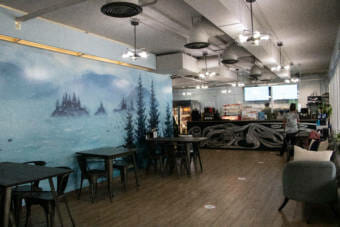
A vivid new mural greets customers who walk into Juneau coffee shop Sacred Grounds. It has lots of cool blue hues, dark trees and distant mountains. Small birds fly around in the misty sky, and seals pop their heads out of the water.
Artist Michaela Sheit.een Goade is Tlingit, Kiks.ádi and from Juneau. She has become well-known for her work illustrating a Google Doodle and winning the Caldecott Medal for illustrating the book “We Are Water Protectors.”
Sacred Grounds is owned by Central Council of the Tlingit and Haida Indian Tribes of Alaska. They wanted to commission tribal members for new art in the shop, which is why they reached out to Goade.
Goade said they had one central idea in mind for the art.
“When tribal members, and especially Elders, are visiting the building there, stopping in at Sacred Grounds, they really wanted something to help liven up the space and to help tribal members feel more at home,” Goade said.
Mural created by Tlingit artist Michaela Goade on the wall of the coffee shop Sacred Grounds in Juneau, Alaska. (Lyndsey Brollini/KTOO)
Goade thought a seascape would be a great way to do this.
She lives in Sitka now, so she did not paint the mural in-person. In fact, the actual mural is not a painting at all, but a giant sticker.
“For me, I have a hard time painting too large with watercolor. Just the nature of the paints — they dry quickly… And you have to kind of go faster, so it’s hard,” Goade said. “It can be trickier the bigger you scale up, and then I’m also limited by paper size.”
That is partly why it was created as a large vinyl sticker instead of painted in the shop. To make the mural, Goade painted a large watercolor painting. Then the painting was scanned at a very high resolution and touched up in Photoshop. After that, the image was blown up onto a large, wallpaper-like vinyl sticker and put on the wall.
Goade still has not seen her art yet in person, but Tlingit artist Robert Mills has. He was the other artist Sacred Grounds commissioned. He is Tsaagweidí and originally from Kake.
Mills was not sure which direction he wanted to go with his art, since the project was pretty open-ended. But when he saw the misty fog in Goade’s mural, it inspired him to depict the Tlingit story of Fog Woman.
In the story, Raven courts Fog Woman, who is a supernatural being. But he mistreats her.
Despite her situation, Fog Woman creates salmon. That process of creation during hardship really spoke to Mills.
“The norm, I think, is just to be like, ‘Well, this scenario sucks.’ Go on living a melancholy life because you don’t have X or Y. But she’s speaking this thing into existence,” Mills said. “And it just kind of blows me away because you know, she eventually manifests salmon, even despite her scenario in which she’s in where she’s being subpar.”
An aluminum carving created by Tlingit artist Robert Mills is mounted below the bar counter at the Sacred Grounds coffee shop in Juneau, Alaska. (Lyndsey Brollini/KTOO)
The entire aluminum carving reads from right to left, instead of left to right. On the far right is Raven. In the center of the sculpture is a human silhouette of Fog Woman. Her hair, which is fog, is coming out of Raven’s mouth because she is trying to escape from Raven. And salmon swim out of Fog Woman’s mouth — being spoken into existence, as Mills puts it. On the very left of the sculpture is a hand.
“And the hand is like, it’s there in a way to, say, pose the question, ‘Well, is that her hand or is that Raven’s hand — who’s trying to obviously still remedy that separation?’” Mills said.
Mills’ aluminum carving of this story is mounted right below the bar where you would order a drink.
The project was more complicated than Mills anticipated. The machine used to cut the metal, called a CNC machine, required a very large file — so large that the art had to be in vector format.
“So I’ve had to learn these different formats and vectorization skills to get the formline down and vector it and then convert it and then shoot it over to a machine,” he said.
But Mills was interested in learning more about what he could do with aluminum, so he stuck with the material. In this carving, he finished the aluminum in a way that makes it swirl and move like fog.
Along with learning new techniques to carve formline, Mills mixed realism and formline together in his carving — something he said is uncommon.
Rachel Barril works in the kitchen of Juneau Italian restaurant In Bocca Al Lupo for the event “Dinner with Friends: Womxn of Power edition” on June 26. (Photo by Lyndsey Brollini/KTOO)
Juneau Italian restaurant In Bocca Al Lupo staff wanted a dinner party. But they also wanted to highlight women chefs of color.
So, they hosted Dinner with Friends: Womxn of Power Edition.
When doors to the downtown Juneau restaurant opened, a long line of well-dressed people streamed in. It was clearly a fancy night out for the 40 people who packed into In Bocca Al Lupo’s dining room for the sold-out event. And they were excited. Between the conversation and kitchen noise, the room was loud.
Everyone was checked in at the front door by staff to make sure they were vaccinated — a requirement to attend.
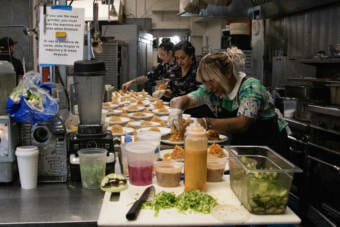
Back in the kitchen, music played loudly through the speakers while chefs prepared their dishes of the night. They were chopping vegetables, drizzling sauces over samosas, adding vegetable toppings to pancit.
Two chefs are Filipino: Aims Villanueva-Alf and Rachel Barril, and two are Mexican: Claudette Zepeda and Amara Enciso.
Claudette Zepeda works in the kitchen of Juneau Italian restaurant In Bocca Al Lupo for the event “Dinner with Friends: Womxn of Power edition” on June 26. (Photo by Lyndsey Brollini/KTOO)
Each chef made a dish that represented their culture. They also made some surprising twists to the dishes they grew up with.
And that noisy dining room? It got real quiet as people enjoyed the fusions.
Villanueva-Alf chose pancit as her dish because it represents how people made it through the pandemic.
“Pancit is about longevity,” Villanueva-Alf said. “And so, I just wanted to say that when the girls and I were here prepping everything, hearing all of you guys, and like the bustling and talking … We missed that.”
Villanueva-Alf, Barril and Enciso are all local chefs in Juneau. Zepeda is from San Diego.
Beau Schooler, co-owner of In Bocca Al Lupo, became friends with Zepeda through Instagram last year. When Schooler and Alicia Maryott started talking about bringing Zepeda up for the dinner, Maryott had the idea of centering women chefs of color in Juneau.
“White men, in particular, get a lot of support, you know, from big money and corporations and just like, being elevated by accolades that, I feel like, have been centering white men for a long time,” Maryott said.
So the evening was just as much about pushing back against race and gender barriers as it was about having a dinner party. It also gave the women involved some space to experiment in the kitchen.
“There are other ways to just uplift and center and celebrate people of color, but women of color in particular in this situation, without, you know, having to shout from the rooftops that they have Michelin stars or James Beard nominations or whatever,” Maryott said.
Diners wait for the first course of a six-course meal being served at In Bocca Al Lupo’s event “Dinner with Friends: Womxn of Power edition” in Juneau. (Photo by Lyndsey Brollini/KTOO)
Rachel Barril said that 10 years ago when she first started out, she thought the industry was more male-dominated, but that it is starting to change.
“The kitchen atmosphere has moved away from that, the very strict kind of like military-style, brigade style, old school French kind of hierarchy,” Barril said.
Barril works at In Bocca Al Lupo. She is a head chef at the restaurant, but she prefers going by cook. She said they don’t like using hierarchical terms in their kitchen.
Part of that change in kitchen dynamics, Barril thinks, is because a new generation of people are now owning restaurants and running kitchens. She also thought this change helped to make kitchens more inclusive.
“Haven’t really felt any, experienced any, like, I was at a disadvantage because I was female. Especially considering I dress very different for a female,” Barril said. “I never really felt that. And so, if anything, Juneau’s pretty accepting I think.”
The dish Barril prepared for the dinner was mushroom kare kare, a Filipino peanut stew. She added her own twist, and local ingredients, to the dish. She used a peanut miso she made for the base, wild mushrooms and beach greens collected locally.
“But it was, it was nice getting to do some creative stuff again. It was a relatively easy night. The food turned out pretty well. It seemed like the diners enjoyed the food,” Barril said.
And Barril really enjoyed working with the other chefs, who are all people she is friends with and admires.
Close
Update notification options
Subscribe to notifications
Subscribe
Get notifications about news related to the topics you care about. You can unsubscribe anytime.