I bring voices to my stories that have been historically underserved and underrepresented in news. I look at stories through a solutions-focused lens with a goal to benefit the community of Juneau and the state of Alaska.
A Sealaska corporate logo adorns the roof of the Southeast Alaska Native corporation’s headquarters in Juneau on May 2, 2018. (Photo by Jeremy Hsieh/KTOO)
Shareholders of Sealaska will vote in June on whether to get rid of a blood quantum requirement for descendant shareholders.
Sealaska is the regional Alaska Native Corporation of Southeast Alaska. When the corporation was formed under the Alaska Native Claims Settlement Act, only Alaska Native people in Southeast Alaska who were already born could be shareholders. Those people are original shareholders.
In 2007, those shareholders voted to allow their descendants to enroll — but only if they had one quarter Alaska Native blood and had proof of it on a Certificate of Indian Blood from the U.S. government.
Sealaska surveyed its shareholders in November 2021 and about 4,000 of the corporation’s 23,000 shareholders responded. Sixty-nine percent of respondents want to get rid of the blood quantum requirement, 23% want to keep it and 8% are neutral.
In the survey, people who want to get rid of the requirement said that it’s keeping their children and grandchildren out of the corporation, and it’s keeping them from learning about their culture. They said that blood quantum is a colonial construct created by the federal government to erase Native people and that it’s not how Native people identify themselves.
People who took the survey also have concerns about letting more shareholders in because it will dilute their stock and dividends will be smaller. And they don’t want smaller dividends to negatively impact elders.
If the requirement is eliminated, Sealaska estimates that about 10,000 more people would be eligible to enroll.
Shareholders will be able to vote online in early May up until Sealaska’s annual meeting on June 25. The meeting will be streamed live and in person at Centennial Hall in Juneau.
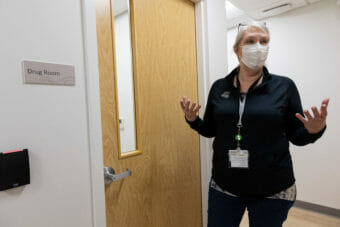
Claudette Thor gives a tour of the new opioid treatment clinic in Southeast Alaska Regional Health Consortium’s Front Street Clinic in Juneau, Alaska on April 1, 2022. (Photo by Lyndsey Brollini/KTOO)
Southeast Alaska Regional Health Consortium has a new opioid treatment clinic in Juneau.
The clinic opened on Feb. 28, and so far it’s working for people. Claudette Thor manages the Healthcare for the Homeless clinic for SEARHC, and she said it’s getting people in the program to bring others in.
“We have a patient here that’s brought in six people that he previously associated with or used with, and it works when nothing else has worked,” Thor said.
It’s a federally approved program to treat opioid use disorders using a medication called methadone. It’s prescribed to people who can’t get stabilized on other medications.
Thor said they have about 40 people in the program right now, and it’s a lot more than she was anticipating.
Dr. Corey Cox has been working with opioid use disorder patients at SEARHC for a while, and he thought he had seen most people in Juneau with a substance use disorder.
“And the people that have come here, some haven’t been touched by the medical system in a decade, they’ve been so pushed off to the corners of medicine,” Cox said.
The waiting area in a new opioid treatment clinic in Southeast Alaska Regional Health Consortium’s Front Street clinic in Juneau, Alaska on April 1, 2022. (Photo by Lyndsey Brollini/KTOO)
People seeking treatment for the first time can call the clinic or walk in. But to be eligible, they need to be diagnosed with moderate-to-severe opioid use disorder during an initial screening.
That doesn’t mean people with a less severe form of the disorder can’t get treatment. If they don’t qualify for the program, then they are referred to other treatments at SEARHC. And people won’t be turned away because they don’t have the ability to pay.
Cox said they take a disease model approach to opioid use disorder at SEARHC. He said that people with this disorder have a fundamentally different brain than people who haven’t used opiates.
Claudette Thor and Corey Cox sit in a conference room in Southeast Alaska Regional Health Consortium’s new opioid treatment clinic in downtown Juneau, Alaska on April 1, 2022. (Photo by Lyndsey Brollini/KTOO)
“Like, I could maybe take an opiate today and never use it again, because my brain isn’t changed in that way,” Cox said. “And we know that people who’ve experienced traumas, whether they be personal traumas, historical traumas, they’re at an even higher risk of that kind of brain remodeling that happens.”
People with the disorder need to have their opioid receptors activated to function at a basic level. And that’s what the medications do.
But some of the less potent medications like buprenorphine don’t work for everyone. Cox said when people are taking more drugs, or stronger drugs, even the maximum dose of buprenorphine isn’t working when people try to stop using. People can still have withdrawal symptoms and be really sick.
That’s why this new program uses methadone, but it is a highly regulated drug and has to be prescribed in a controlled setting with a lot of monitoring. In the beginning, people have to go in six to seven days a week.
Cox said that it is really hard for people to break the habit of using opioids. People are creatures of habit, and habits can be hard to break.
“And they’re particularly hard when you’re fighting with, you know, withdrawal symptoms,” Cox said. “You’re fighting stigma, and you’re fighting changes that have been made to your brain that you didn’t have any control over.”
Thor and Cox said this program is one way SEARHC is preparing for the future because the opioid use crisis is not over.
Last year, 245 people died from overdoses in Alaska. That’s more than 100 people more than the average from the past five years. Cox said that isn’t all from opioids, but opioids like fentanyl are contributing to that high number.
He said where he is from, in Appalachia, people are taking more fentanyl, and that will happen in Southeast Alaska eventually.
“And it’s going to make it harder for people to be in substance use treatments, and we’re going to see more overdoses,” Cox said.
Some things SEARHC is doing to prepare are providing places to dispose of needles, giving Narcan to anyone who wants it, educating people about safe injections and starting to destigmatize the disease of addiction.
Southeast Alaska Regional Health Consortium’s Front Street Clinic in downtown Juneau, Alaska on April 1, 2022. (Photo by Lyndsey Brollini/KTOO)
Being in a smaller community, stigma can hold people back from seeking treatment. Thor said part of destigmatizing addiction is stepping back and recognizing that everyone is a human being and that everyone deserves care.
“Most of these people didn’t ask for this, a lot of them,” Thor said. “They started out on pain medications for a very real pain.”
Cox said over 90% of people that come in for the program say they were prescribed pain medications when they were young — whether it was a broken leg or a wisdom teeth surgery.
“It was this whole push of opiates and pain on our society,” Cox said. “And we’re just now reaping all of the ill effects from that. And it’s on all of us to fix.”
Cox said that it could happen to anyone, and that gives him a lot of compassion for people suffering from the disorder.
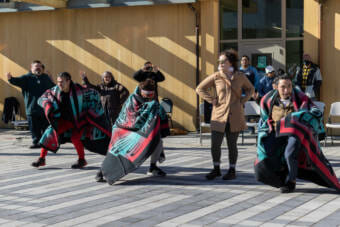
TJ Young, Joe Young, Andrea Cook and Greg Frisby dance at a celebration for a totem pole they completed in Juneau, Alaska on April 12, 2022. (Photo by Lyndsey Brollini/KTOO)
Sealaska Heritage Institute’s new arts campus isn’t quite open yet. But on a sunny Tuesday afternoon, about 50 people gathered there to celebrate the completion of a totem pole.
It’s called the Sealaska Cultural Values Totem Pole, and it’s been in the works for over half a year. It’s a 360-degree totem pole, which means it’s carved all the way around the pole instead of on one side.
People look at a newly finished totem pole carved by TJ Young, with help from apprentices and guest carvers, at the Sealaska Heritage Institute Arts Campus in Juneau, Alaska on April 12, 2022. (Photo by Lyndsey Brollini/KTOO)
The lead carver is Haida artist TJ Young, but he didn’t do it alone. He had help from his brother Joe Young and from apprentices Andrea Cook and Greg Frisby.
“We had a lot of support from different people throughout the project,” Young said. “I’ll feel a lot more relieved when the pole’s actually up. We are happy, we are happy to finish it.”
Young enlisted help from Tsimshian artist David R. Boxley and Lingít artist Robert Mills. He wanted a Tsimshian and a Lingít carver to carve a figure on the top of the pole since the three figures together represent the three Native tribes of Southeast Alaska.
TJ Young, Greg Frisby, Joe Young, Robert Mills and Andrea Cook attend a ceremony for the completion of a 360-degree totem pole they carved and painted in Juneau, Alaska on April 12, 2022. (Photo by Lyndsey Brollini/KTOO)
“We have Lingít, Haida and Tsimshian represented and initially we thought they were going to be all males,” said Sealaska Heritage Institute President Rosita Worl. “But then our artists thought about it and thought about diversity and equity. And do you know what they did? They put a woman on that totem pole.”
After the pole was finished, Worl asked the Yées Ḵu.oo Dancers to perform a few songs. Leader of the dance group Nancy Barnes says she was excited to be performing again.
The Yées Ḵu.oo Dancers perform for the celebration of TJ Young finishing a 360-degree totem pole at the Sealaska Heritage Institute Arts Campus in Juneau, Alaska on April 12, 2022. (Photo by Lyndsey Brollini/KTOO)
“We haven’t been together, we’ve been zooming every Saturday,” Barnes said. “But when Rosita asked us if we’d come out for this, we wanted to honor these awesome artists.”
People look at a newly finished totem pole carved by TJ Young, guest carvers and apprentices at the Sealaska Heritage Institute Arts Campus in Juneau, Alaska on April 12, 2022. (Photo by Lyndsey Brollini/KTOO)
The pole is still lying down where it was being carved and painted. It will be installed later and unveiled when the Arts Campus opens. Young said it will probably be in June.
Editor’s note: Reporter Lyndsey Brollini previously worked at Sealaska Heritage Institute.
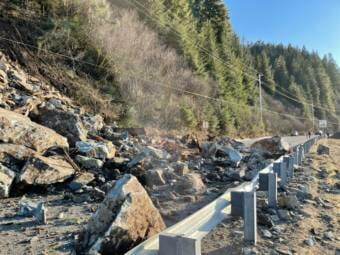
A rock slide blocks the road on the North Douglas Highway in Juneau, Alaska on Sunday, April 10, 2022. (Photo courtesy of the Alaska Department of Transportation & Public Facilities)
Juneau residents will have to hold off on the North Douglas bonfires for a couple days — the North Douglas Highway is closed because of a because of a rock slide.
One lane on the highway is open for emergency vehicles, but it is closed to the public past the North Douglas boat launch.
Alaska Department of Transportation spokesperson Sam Dapcevich said the start of the slide was at around 500 feet of elevation, and he doesn’t know yet when it will be safe to open the road.
“When material comes loose from that height, it builds up quite a bit of speed by the time it gets down to the road. So we’re keeping the road closed at this time,” he said.
A geologist will be going up to the start of the slide to see if more rocks could come down, Dapcevich said. They also want to get a drone up there to look around, but they won’t be able to do that until winds die down.
It’s the second rock slide on North Douglas in the past week. Both rock slides happened in the same spot on the North Douglas Highway: one on April 6 and a second on April 10.
Dapcevich said the first slide was substantial, but DOT was able to clear debris and open the road in a day. Sunday’s rock slide was bigger.
“This time the rocks actually made it all the way across the roadway. Some of them even made it down into the water nearby,” he said. “And some of the boulders I’m told are the size of cars.”
Nobody was hurt in either slide, and no cars were damaged. Dapcevich said to not try and climb around the slide because they aren’t sure how dangerous it is or if more rocks could come down.
The City and Borough of Juneau’s Emergency Manager Tom Mattice said the melting and freezing of water this time of year can make slide conditions worse.
“That water melting and freezing and melting and freezing acts like a jackhammer on the rock that it slowly breaks it apart,” Mattice said.
Mattice said that once rocks have slid in an area, it will be unstable there for a while. So even after the road is clear, people shouldn’t linger underneath the area of the slide anytime soon.
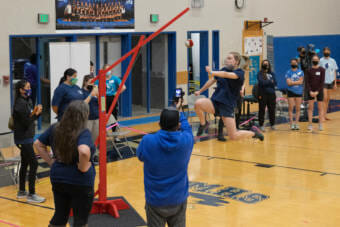
Athletes compete in the one foot high kick at the Traditional Games in Juneau, Alaska on April 2, 2022. (Photo by Lyndsey Brollini/KTOO)
This past weekend Juneau had its first Native Youth Olympics competition open to the public since the pandemic.
This was the fifth year of the Traditional Games, and for many people who went, it felt a lot like the games before COVID-19. The dance group Woosh.ji.een was back for their usual opening performance, there was an audience again and more people came to compete.
Athletes, coaches and spectators gather on the Thunder Mountain High School gym floor during the Woosh.ji.een dance group performance at the Traditional Games in Juneau, Alaska on April 2, 2022. (Photo by Lyndsey Brollini/KTOO)
Alexandria Toloff coaches a team representing the Qutekcak Native Tribe from Seward.
The team isn’t new, but it hadn’t competed in an event for a few years before COVID. The team struggled to find coaches. But then during the pandemic, Toloff’s cousin got a job as a head coach for the team and Toloff offered to help and got involved in NYO again.
“I think we were all just tired of COVID,” Toloff said. “And we wanted to get together and start doing stuff again.”
When they got the opportunity to compete at the Traditional Games in Juneau, they jumped on it. Toloff had never been to Juneau and some of her athletes had never been on a plane before.
She said Juneau felt a lot like Seward with the mountains, glacier and the water.
As for the games, Toloff competed in most of the events. Her favorite event is the scissor broad jump because it’s less stressful, but she also likes the kicking events too.
“They really push you. Like you really have to tone in, and it really just takes like a lot of energy and force,” Toloff said. “And it is really really stressful but it takes a lot of passion and everyone gets into it.”
A lot of athletes look forward to training for NYO and going to competitions. The events are more than just the games, Toloff said. They are also about the culture, the dancing, the food and seeing your community come together.

“Like food for the soul, I would say,” Toloff said. “Sounds a little corny, but I mean it’s like, it, like, makes my heart happy to come here.”
Alexandria Toloff sits with her team, the Qutekcak Native Tribe from Seward, after competing in the one-foot high kick event in the Traditional Games. (Photo by Lyndsey Brollini/KTOO)
When the pandemic came to Alaska and NYO events were being canceled, it was hard on the NYO community.
“These are things we look forward to all year, and never thought that it would just be canceled,” said Kyle Worl, a wellness coordinator at Central Council of the Tlingit and Haida Indian Tribes of Alaska.
Worl is also an NYO coach for athletes in Juneau and played a big role in revitalizing the sport in Southeast Alaska. He did a lot of work to keep NYO going during the pandemic. He did some practices on Zoom, and they made an NYO version of the brush challenge on TikTok.
The virtual events were needed and it helped people get through the pandemic, but it really doesn’t compare to in-person events, Worl said.
Kyle Worl speaks to athletes during the opening ceremony of the 2022 Traditional Games in Juneau, Alaska on April 2, 2022. (Photo by Lyndsey Brollini/KTOO)
And a lot of people were excited to be back. Worl said this year he had the most teams ever attending the Traditional Games, and about the same amount of athletes as the event before the pandemic.
It’s rubbed off on a lot of Worl’s athletes, including Ezra Elisoff.
“I think he is executing his goal very well because I share the same love and passion for the sport now,” Elisoff said.
Elisoff first started NYO at Thunder Mountain High School as a way to stay in shape, but he stayed because the community was so supportive of him.
A lot of the games are based on hunting and survival techniques Indigenous people in northern Alaska had. And Elisoff learned from Worl that the spirit of the games — that support you give the other athletes — is like hunting with fellow hunters in another community. People wouldn’t want other hunters to not bring home food for their families and elders.
“That spirit is still with us, even though times aren’t that extreme,” Elisoff said. “We still like to see each other succeed and we still like to support one another because that’s what our ancestors did so long ago.”
That’s why athletes give each other advice and share techniques instead of hiding them.
That spirit is what keeps Elisoff doing NYO.
“I actually plan on doing it until I’m like an old man and complaining about my eight keys,” Elisoff said.
There is no age limit for the World Eskimo Indian Olympics, though Elisoff said he probably doesn’t want to be doing it when he’s 90.
High school kids in Juneau, Alaska go to J & J Deli and Asian Mart during their lunch hour on April 4, 2022. (Photo by Lyndsey Brollini/KTOO)
A Juneau deli and Asian mart known for its sandwiches may be shutting down this year if the owners don’t find someone to take over the business.
Neil and Alma Doogan bought J & J Deli and Asian Mart from the original owners Jack and Jack in 2010, which is where the name J & J comes from.
The business opened in 1978. Back then, J & J mostly carried sandwiches and a few snacks. It wasn’t until a few years after the Doogans took over that they started carrying Asian products. The deli is a staple among Juneau high school students.
High school kids line up inside J & J Deli and Asian Mart in Juneau, Alaska for lunch. (Photo by Lyndsey Brollini/KTOO)
During the high school lunch hour on a sunny day in Juneau, J & J was packed. At least 20 students from Juneau Douglas High School: Yadaa.at Kalé came into the small space and lined up to get snacks, Red Bull spritzers and, of course, sandwiches.
Sandra Bouvier is a junior at the high school and has been going to J & J since she was a freshman. Bouvier said that if the deli shuts down, kids might not eat as much.
“Just because it’s, you know, a really close walk from the high school and most high schoolers don’t drive yet so they’d either walk all the way to IGA or you know, not eat,” Bouvier said.
Bouvier also thinks there really is something different about J & J sandwiches.
“I swear you can make these sandwiches at home, but they taste like 10 times better here, so it’s my favorite place to go for food,” she said.
And she has no idea why they taste so good because it’s still the same white bread and lunch meat you can buy on your own. Alma Doogan, who makes the sandwiches, has a pretty simple answer.
“Because we serve the best, I guess. Fresh every day,” she said.
The main reason the Doogans want to sell is because Alma has been struggling with health issues for the past couple of years, so it’s been hard to keep up with the business.
Alma Doogan is usually the only one behind the counter. She does get some help during the lunch rush from her husband, son and son’s girlfriend. But that is usually for about an hour, and then she is running the shop by herself again.
The pandemic also hit the business hard, Neil Doogan said. When COVID-19 first came to Juneau, they were barely making enough to pay the bills.
Neil Doogan, right, co-owner of J & J Deli and Asian Mart, works during the lunch hour in Juneau, Alaska on April 4, 2022. (Photo by Lyndsey Brollini/KTOO)
“It was a ghost town down here,” Neil Doogan said. “We were open every day. We made a little money not much.”
Pandemic-related supply issues have made it harder to get what they need for the business, especially the Asian products that come from the Philippines and Taiwan. He said that some businesses they’d get products from are shut down for good, so they can’t carry them anymore.
Neil Doogan said he and his wife don’t care so much about whether a potential buyer wants to carry the Asian products or not.
“As long as they keep the sandwiches and stuff. Because that’s what made this place,” Neil Doogan said.
Alma Doogan said it is hard to imagine J & J not being around anymore.
Alma Doogan, co-owner of J & J Deli and Asian Mart, makes sandwiches during the lunch hour in Juneau, Alaska on April 4, 2022. (Photo by Lyndsey Brollini/KTOO)
She said she has really enjoyed working at J & J and she’s stuck with it because of the customers. Sometimes people will come over just to say hi to her.
“My customer, it’s not just a customer,” Alma Doogan said. “They become my friend and family.”
Close
Update notification options
Subscribe to notifications
Subscribe
Get notifications about news related to the topics you care about. You can unsubscribe anytime.