I bring voices to my stories that have been historically underserved and underrepresented in news. I look at stories through a solutions-focused lens with a goal to benefit the community of Juneau and the state of Alaska.
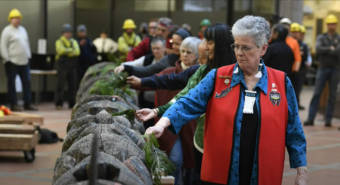
Screenshot from the Wooshkeetaan Kootéeyaa re-dedication ceremony at the State Office Building in Juneau, Alaska on March 11, 2022. This photo was one of a series shown after the ceremony showing the installation of the totem pole. (Photo courtesy of Micheal Penn)
A totem pole taken down for weather damage was rededicated at the State Office Building in downtown Juneau, which will be the pole’s new home.
Yéil Yádi Nathan Jackson carved the pole in 1980 with assistance from Steve Brown and Dorica Jackson, and the design was made with help from Yaanashtúk George Jim, Sr.
The Wooshkeetaan Kootéeyaa, meaning Wooshkeetaan totem pole, used to be located outside of Centennial Hall, but it was taken down in 2016 and put in a warehouse. Now the pole is inside.
During the rededication ceremony on Friday, Lingít Eagle leaders spoke about the pole, the artist and about their Raven opposites. Since Wooshkeetaan is an Eagle clan, to bring balance some leaders from Raven clans spoke too. They also brought out at.oow, which is clan property. Then they sang to end the ceremony.
Editor’s note: KTOO was under contract with the City and Borough of Juneau to livestream the totem pole raising.
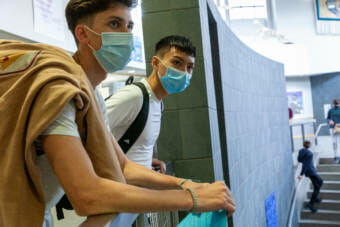
Thunder Mountain High School seniors Kafoa Maka and Ammon Kawakami watch students head to lunch on the first day of school on Monday, August 16, 2021, in Juneau, Alaska. (Photo by Rashah McChesney/KTOO)
Masks will be optional in Juneau School District buildings and on schools grounds starting on April 4.
Juneau School District Superintendent Bridget Weiss went over the results at a Board of Education meeting on March 8.
Weiss said that according to the survey, students at both high schools were about half for and half against requiring masks. But student representatives at the meeting said that most students they talked to want to keep masks, especially students in their third and fourth years.
Jowielle Corpuz is a student representative for Juneau-Douglas High School: Yadaa.at Kalé.
“It’s just that we are all excited for prom and we’re all excited for graduation. So if we had a sudden rise in cases, and prom has to be canceled because the masks being abolished, that’s not what we want,” Corpuz said. “We want prom, we want graduation, we want all the celebrations that we can have since we are in our final years of high school.”
Weiss said the survey indicated that 48% of school staff said yes, 22% said maybe and 30% said no to making masks optional. For families, 65% said yes, 10% said maybe and 25% said no.
The board held a second meeting on March 10 to make the final decision.
Most people who testified to the board meetings on March 8 and 10 wanted to end the mask mandate.
Those people argued that most masks don’t protect people from getting the virus, that not seeing people’s faces is preventing small children from learning. They said that masking should be a choice.
Maureen Hall is a school nurse at Harborview Elementary. She said she supports removing masks because the omicron variant is less severe than the delta variant. She also said people should consider how to protect children who can’t get the vaccine and high-risk children.
Christopher Coutu said too much voice is given to the minority of the population who want to keep masks.
“You’ve got super majorities of parents as well as staff that want to change the current mask policies,” Coutu said. “And with those who are still fearful in that percentage, there are masks that protect, that can protect them. And that’s the N95 masks.”
A few people called in asking the board to keep masks.
Some said it was too early to remove masks and that the board should make their decision based on public health guidance – not on parent and staff opinions.
Another supporter of masks, Anne Stepetin, said that mask-wearing shouldn’t only be about protecting yourself.
“I understand where other parents are coming from saying making an optional would still allow students to use their masks as they please. I come from a culture where we take care of each other and our masks, our mask wearing is about protecting others,” Stepetin said.
The board unanimously voted to end the mask mandate in schools. The new policy is linked to Juneau’s community level and to CDC guidelines. Masks will remain optional in schools if Juneau is at a medium or low risk level.
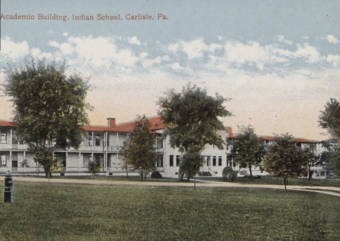
The Carlisle Indian Industrial School in Carlisle, Pennsylvania. The school was open from 1879 to 1918, and Native children from across the country went to the school to be assimilated into Western culture. (Public Domain image from National Archives and Records Administration)
An Anchorage resident is trying to find her great-aunt, who went to a boarding school for Native children and never returned.
Mary Kininnook was from Ketchikan. While she wasn’t forcibly taken to boarding school, the government heavily persuaded her parents to send her to one. She never came back.
Kininnook’s family has been looking for her for decades. Kininnook is Eleanor Hadden’s great-aunt, and she said the search for Kininnook started in the 1960s.
“My grandmother, probably in 1960, either late ’66, early 1967, and made a comment to my mother kind of in passing,” Hadden said. “My grandmother’s sister Mary had gone to school and died there. And that was basically the entire conversation.”
After Hadden’s mom heard that, she started to research what happened to Kininnook. Her mom first looked at Chemawa Indian School in Oregon, but there was no record of her.
Then, in the early 1980s, Hadden went on a trip to Pennsylvania. Her mom told her to stop at Carlisle Indian Industrial School to see if there was a record of Kininnook and if she’s buried there.
Hadden went to the graveyard and looked at the headstones. She didn’t find a headstone with Mary Kininnook’s name on it, but there were a lot of unknown graves.
A gravestone at the Carlisle Indian Industrial School marking the grave of an unidentified Native child. (Production still from Al Jazeera’s “Fault Lines”)
Then she went to the archives. There was nothing there, either. There were photos of children, but those didn’t help Hadden because she had no idea what Kininnook looked like as a child.
“That night I called my mother to tell her that we had looked and then we didn’t find her. And we both cried, and it felt like we had lost her even though we never knew her,” Hadden said. “It was just an incredibly sad evening because we thought we might find something. Found nothing.”
Eventually they found a record of Kininnook — an admission card to the hospital. It had her name, age, birth date and what she was in the hospital for.
“Just below her name, handwritten, it said ‘Died December 28,’” Hadden said.
Kininnok had just turned 14 when she died. She had been away from home since she was nine years old.
Once more of the school’s records were digitized, they found another. It was a letter written from the school to Kinannook’s father, saying that she wanted to stay one more year at Carlisle.
Kininnook didn’t make it that full year. Hadden said she likely died of tuberculosis six months after that letter was sent.
It’s been more than 100 years since she died, and Hadden is trying to bring Kininnook home to Alaska. That’s not easy because no one knows where she is buried.
The Carlisle Indian Industrial School now belongs to the U.S. Army, and Hadden has been working with them to try and find Kininnook’s body.
A forensic anthropologist who can identify the sex and age of a child by looking at bone structure will look at the unknown graves to see if they can find bones of a 14-year-old girl.
“So they’ll go through, and they’ll do the first one, and examine it. And she’ll take all the measurements and give her conclusion as to whether this is a male or a female or a boy or girl, or undetermined or whatever. And if it doesn’t seem to look like a 14-year-old girl, then they’ll go to the next unknown spot,” Hadden said.
The Army was supposed to do this two summers ago for Hadden’s family, but it was delayed because of the pandemic. The family hasn’t heard from them since.
They may not find Kininnook after looking at the unknown graves either. Hadden isn’t sure if there are plans to use ground-penetrating radar to find bodies, like they did at the Kamloops Indian Residential School in Canada.
Hadden said that because she doesn’t have family in Ketchikan anymore, the family will need to decide where to lay her to rest if they find her at Carlisle. But it’s hard to make plans when Hadden doesn’t know if they will find her.
She says the boarding schools had a lasting impact on her family — that it damaged their ability to connect with each other. She says that her grandmother, Kininnook’s sister, came home from boarding school and didn’t know how to be motherly. The schools were run military-style and without a lot of affection.
Hadden said that affected her mom, who wanted her own children to learn how to connect with each other.
“So it was her desire to make sure that her children knew they were loved, and knew that she was proud of whatever we did,” Hadden said. “We keep saying, break that cycle. Because mom knew she didn’t get the words of love and she wanted to make sure her children got it. So she broke that.”
Hadden thinks she feels connected to Kininnook because they share the same Lingít name – Aankeenaa.
“The rest of me is still in Pennsylvania,” she said.
An arm badge for the Juneau Police Department on an officer’s uniform, photographed in 2016. Juneau police on Friday identified the officer who shot at a Juneau resident Tuesday night. (Photo by Jeremy Hsieh/KTOO)
Officer Eric Hoffman shot at Juneau resident Art Whitney who said he was feeling suicidal at the time.
According to a written statement from the police, officers talked to Whitney on the phone before they arrived on scene and he told them that he had a gun and was going to hurt himself.
Police said they arrived just after 8 p.m., announced themselves as police officers and asked Whitney to walk towards them and show his hands.
At some point, Hoffman believed a gun was being pointed at him and he fired three shots at Whitney.
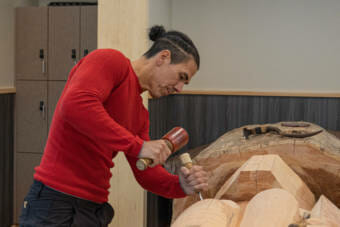
Haida carver TJ Young carves on a log that will eventually be a totem pole installed at the Sealaska Heritage Institute’s Arts Campus in downtown Juneau, Alaska on Feb. 22, 2022. (Photo by Lyndsey Brollini/KTOO)
A new totem pole is being carved in Juneau to represent the Lingít, Haida and Tsimshian tribes of Southeast Alaska. The carver is Haida artist TJ Young, and the pole will be installed at Sealaska Heritage Institute’s Arts Campus.
Young is working on carving the pole, chipping away at a massive log. Small, curled wood chips pile up on the floor. Some of it is still uncarved, but there are figures emerging along most of the pole.
A miniature model of the totem pole carver TJ Young is working on at the Sealaska Heritage Institute’s Arts Campus in Juneau, Alaska on Feb. 22, 2022. (Photo by Lyndsey Brollini/KTOO)
Most totem poles are carved on one side, but this one is carved on both sides. They’re calling it a 3-D totem pole, and it’s a lot more work.
This pole is 22 feet tall and almost four feet wide at the base. Young said it normally takes him three to four months to carve a one-sided totem pole. But for this project, he’s six months in and still has a couple of months to go.
“Yeah it’s been challenging, it’s been the most time-consuming project I’ve ever worked on but I think it’ll be worth it,” Young said. “And I think it’ll represent all of us. Not just my family or my clan or my nation even. It’s representing all three of us.”
Since the totem pole represents the Lingít, Haida and Tsimshian, Young said he only included elements onto the pole that all three tribes have in common. At the base of the pole, there is the man holding up the world. A little further up is the Strongman.
“He’s in there ripping a sea lion in half. It’s just a little glimpse of the story. It’s a long story,” Young said.
There’s also salmon, the sun, the moon, the stars, Eagle on one side and Raven on the other for balance. And on the top of the pole there are three figures representing the Lingít, Haida and Tsimshian nations.
Young is Haida from Hydaburg and has been carving for over 20 years now. He said he and his brother grew up idolizing master carvers like Robert Davidson, Bill Reid and Jim Hart. He and his brother started carving right around the same time.
“He got a set of tools. I got jealous, so I got a set of tools,” Young said.
Haida carver TJ Young carves onto a totem pole 22 feet tall and almost four feet wide at Sealaska Heritage Institute’s Arts Campus in Juneau, Alaska on Feb. 22, 2022. (Photo by Lyndsey Brollini/KTOO)
TJ Young’s brother Joe Young helped carve this pole, and Greg Frisby and Andrea Cook will help with the painting.
Young said the process of carving totem poles includes the whole community, especially when he is home in Hydaburg where the carving shed is like a community center.
“It was definitely a spot where people would come in and visit and share stories, even help on the pole,” Young said. “We have some younger kids coming and helping out.”
It’s the same when they raise totem poles too.
“Everyone’s holding the rope. They just want to feel like they’re a part of it,” Young said. “And it goes up easy if we all help out.”
Metal pole where a totem pole carved by TJ Young will be installed. (Photo by Lyndsey Brollini/KTOO)
Installing this pole will be different because it will be carved on both sides. There won’t be any ropes or pulling. Young said this pole will be lowered onto a metal pole facing Seward Street, and it will be more like an unveiling.
He doesn’t know when the totem pole will be unveiled. Right now he’s focused on getting the pole done before his deadline in mid-May.
Editor’s note: Reporter Lyndsey Brollini previously worked at Sealaska Heritage Institute.
Lingít activist Wanda Culp. (Photo by Melissa Lyttle, courtesy of Southeast Alaska Conservation Council)
It has been 21 years since the 2001 Roadless Rule for the Tongass National Forest was first established.
For the people involved in the battles between industry and subsistence, the tug-of-war over land use in the Tongass National Forest has been going on even longer.
KTOO’s Lyndsey Brollini sat down with Lingít activist Kashudoha Wanda Culp to talk about the impact of such a long history and the role that Indigenous women have played in this conflict.
Listen:
This interview has been edited for length and clarity.
Lyndsey Brollini: Do you think you could kind of go a little bit into the background on the issue? How it came up?
Wanda Culp: My involvement came about in the early 1980s when I moved from Juneau and into Hoonah and needed to know firsthand how to hunt, fish and gather. And through that process, I was literally taken under the wings of my Lingít grandmothers, who taught me a lot about the history of our people and where we come from.
When the clear cut started in Hoonah, it happened right in one of our hunting areas. We always, you know, would drive around when we had vehicles just for something to do. And I was up on Hoonah mountain, ran into one of my grandmas. Her and her husband were driving around, and she looked at the fresh clear cuts. And she was crying. And she said, “See what they’re doing to us. Do you see what they’re doing to us?” It broke my heart, and I did not realize because we’re so isolated in Hoonah — those days with no, you know, no access to internet technology like today — so I had no idea that others in Southeast were also voicing their objections to the clear cut business happening all around us. So it was our combined voices that I believe helped create the 2001 Roadless Rule. It was so politically controversial back then, after the 1990s when the boom basically busted. I became a recluse. It was pretty harsh.
Maybe six years ago, Osprey Orielle Lake in WECAN International — Women’s Earth in Action Climate Network — called me up, got my name somewhere, and literally pulled me out of moth balls as she made me aware of what was occurring politically with the Roadless Rule again. We’ve been to Congress through WECAN and partnering with Earth Justice. They helped us, four of us from Hoonah, in early 2019 to meet with 14 Congress people in D.C. face-to-face. We wore our regalia and spoke to them through our regalia representing who we are as Indigenous women.
So once it was a change of hands through our last administration, it beefed up the temperature, you know, in the realization that we can no longer allow the Roadless Rule to be a political puppet at their whim. We need to put it into law now.
There’s been plenty of silence to what we have brought forward and publicized. One of my elders told me when it comes to us, when I was worried about why isn’t anybody saying anything, she’s like, “It’s called tacit approval.” Silent approval. And we have that. The need for grassroots solutions, we just need a way to process it and get it out from the ground up all the way to D.C. this way, not from the top down.
Lyndsey Brollini: Do you think that the momentum is already there, that grassroots momentum?
Wanda Culp: It is. It was already there in the 80s and 90s. That momentum created the 2001 Roadless Rule. And that rule never stopped being challenged. This is old hat, what we’re doing, always defending the Roadless Rule. The momentum has only grown.
And at one meeting, there was ex-loggers, teachers, and, you know, they were so relieved to hear when I said, “You folks have a right to say your objections to what’s happening on this clear cut logging.”
They were being quiet because they thought — they didn’t want to step on our toes— and they thought that we initiated the clear cut logging to destroy our own land.
So once that conversation was opened, I began to realize how many people love the Tongass and realize that it’s not so controversial within our own region.
What’s controversial is the misuse of it.
Lyndsey Brollini: It was really good to hear from you.
Wanda Culp: Yeah, it’s good to talk about this. Thank you for the opportunity.
Close
Update notification options
Subscribe to notifications
Subscribe
Get notifications about news related to the topics you care about. You can unsubscribe anytime.