A group of first grade students play on the playground at Sayéik Gastineau Community School on Thursday, Jan. 14, 2021, in Juneau, Alaska. The city Assembly wants the public to weigh-in on how much funding it’s giving to the school district next year and other items as city leaders build the budget. (Photo by Rashah McChesney/KTOO)
Juneau city leaders are putting together next year’s budget and they want the public to weigh in on Wednesday.
Beginning at 5:30 p.m. residents can comment — via phone at 1-253-215-8782 and webinar ID: 914 3745 5050 or Zoom — on the city’s proposed tax hike, the plan for spending federal stimulus funds and using general funds, the school district budget and capital improvement project priorities. Written comments can be sent via email.
A broad overview of the budget that city manager Rorie Watt and the finance department proposed to the Assembly is at juneau.org/budget.
Right now, the city is proposing increasing the school district’s budget by $838,500 over last year for a total of $92,396,600. That includes state and federal funding as well. But this is likely not the final amount that the school district will have to operate next year. State statute requires that the Assembly figure out how much it’s going to put into local educational funding by the end of April.
The Assembly is also considering raisingthe mill rate by .20 to raise funds. That would bring the city’s total mill rate up to 10.86 mills — or $10.86 for every $1,000 of assessed property value
The budget process is far from over — an Assembly finance committee is still reviewing individual department-level budgets throughout April and May. A final vote on the city’s full budget isn’t required until mid-June.
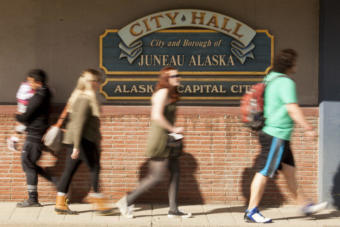
A group walks in front of Juneau City Hall on Tuesday May 10, 2016 in Juneau. City leaders are in the process of figuring out next year’s budget. (Photo by Rashah McChesney/KTOO)
It’s budget season again and Juneau city leaders are projecting another year of spending more than the city brings in.
But, city manager Rorie Watt told members of the Juneau Assembly’s finance committee that it couldbe worse. The city is supposed to get $12.8 million from the American Rescue Plan Act — that’s the latest federal economic stimulus bill.
“Not to say that it’ll be a slam dunk, but the position we find ourselves in — nearly $13 million to the better makes for a substantially different budget season,” Watt said.
Those funds could go a long way toward filling Juneau’s budget gap, depending on how Assembly members decide to spend them.
In his budget message to the Assembly, Watt said there will likely be public calls to instead use that funding to support Juneau’s struggling families and businesses. But he also noted that there is more than $1 billion coming to the state government that could benefit people who need help as well.
Last year, the city spent a lot of money during the pandemic that the Assembly hadn’t originally budgeted for — that’s everything from city busses running for free to standing up an emergency operations center.

It wasn’t bringing in as much money either. In addition to the massive hit from the loss of the cruise season, Juneau also lost funds from the closure of libraries and pools and city recreation facilities.
The city got federal stimulus funds from the CARES Act and reimbursement from the Federal Emergency Management Agency, but the end result of the unexpected expenses is a nearly $4.6 million gap between what the city made and what it spent.
Watt is recommending that some of the funds from the American Rescue Plan be used to backfill that loss.
The city’s finance office is projecting that it will bring in slightly more money next year than it did last year. But Watt’s budget assumes that life will be slow to return to normal, and while the city might see an uptick in independent travelers this year, the lack of a cruise season will still be a huge hit.
Still, Watt’s budget is not balanced. It anticipates a more than $7.8 million shortfall that the city will have to absorb.
This budget isn’t final. Assembly members ultimately must decide how money will be spent. They’ll be meeting every week to talk about it through the end of May — including this coming Wednesday when they’ll be hearing from the airport, hospital and Eaglecrest. They’ll also be talking about the American Rescue Plan Act and what it means for the city.
More than 400 people attended a rally in Juneau on the 11th day of protests against police violence and systemic racism following the death of George Floyd in late May. After marching from Marine Park to the roundabout on Douglas Island, demonstrators threw hundreds of flowers into Gastineau Channel on June 6, 2020. (Photo by Rashah McChesney/KTOO)
Six people have been chosen to lead the City and Borough of Juneau’s new systemic racism review committee. The Juneau Assembly picked the final members on Thursday.
The committee will review proposed laws and advise the assembly if they include a policy or implication that is racist.
Out of 16 applicants, six people were chosen by the Human Resources Committee:
David Russell-Jensen and Kelly Patterson for three-year terms.
Grace Lee, Lisa Worl and Gail Dabaluz for two-year terms.
Dominic Branson and Carla Casulucan for one-year terms.
The motion to approve the committee passed unanimously, with a 7-2 vote. In a separate motion, assembly members Michelle Hale and Greg Smith objected to the start date.
Editor’s note: This story has been updated to clarify the committee was approved unanimously by the Juneau Assembly and assembly members Michelle Hale and Greg Smith objected to a separate motion.
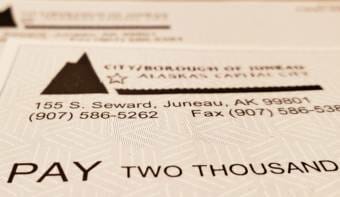
The City and Borough of Juneau cut checks like these to locals financially impacted by the pandemic in 2020. (Photo illustration by Jeremy Hsieh/KTOO)
Help is on the way for Juneau residents who need financial relief.
On Thursday, the Juneau Assembly voted 7 to 2 on an ordinance to pay out more individual grants in addition to those paid out last year. Assembly member Michelle Hale said the money is for Juneau’s lowest income residents.
“Those people often fall through all the cracks, they don’t qualify for unemployment often, they’ve been impacted by having to take care of children,” Hale said. “So those are the people that I want to get that money to.”
One of the no votes was assemblymember Loren Jones. He said the $700,000 used to make the payments is the last of the CARES Act money that congress passed in the first round of pandemic relief.
“This is a tough one to object to,” Jones said. “There [are] still a lot of unknowns. This is money that was given to the city from the first round of federal CARES funding. The second round provided no additional monies for cities or municipalities. So this is spending the last of our money.”
The other no vote was mayor Beth Weldon, who said she would have liked the city to wait. She also said residents will soon have another opportunity for relief from state aid through the Alaska House Financing Corporation which opens up the application period on Monday.
Assembly member Alicia Hughes-Skandijs said it wasn’t just about facts and figures but prioritizing relief.
“I cannot let the individuals who are most economically vulnerable in our society, be the people that we say, ‘I will wait and see before I provide aid to you,’” Hughes-Skadijs said.
Instead of a first come, first served approach, the money will go directly to the lowest income earners who applied for the individual assistance program last year.
People who received the city’s housing assistance grant last year are ineligible for this round. Base grants range from $500 to $1,000 and an additional $300 for each dependent child.
According to the city, 2,348 people applied for the individual assistance grants and 1,180 people are eligible for this added round of payments.
Correction: An earlier version of this story misspelled assembly member Alicia Hughes-Skandijs’ last name.
The City and Borough of Juneau cut checks like these to locals financially impacted by the pandemic in 2020. (Photo illustration by Jeremy Hsieh/KTOO)
Hundreds more Juneau residents with applications pending for individual assistance grants may get paid soon.
At a meeting Thursday night, the Juneau Assembly is expected to put more money into a second phase of the program for lower-income residents financially hurt by the pandemic.
The Assembly initially put $2 million of the city’s portion of the federal CARES Act money into the program last year. It was enough to pay grants to about 1,070 people. Grants began at $1,000 but scaled up for residents with lower income and with children.
Without Assembly action, 1,180 more eligible people won’t get paid. The Assembly is taking up two measures to address this group.
The other splits off the remaining people into a second pool with more restrictive eligibility criteria and smaller payouts.
Assembly member Michelle Hale walked through the proposed changes in committee last week.
“It’s just trying to make the money go farther,” Hale said.
People who received the city’s housing assistance grant last year would become ineligible. Base grants would be half what they were in the first phase, ranging from $500 to $1,000. Each dependent child would still be worth an extra $300.
Also, payouts in the second phase would prioritize the lowest income applicants, instead of a first come, first served approach.
The Assembly is scheduled to hold a public hearing and final vote on the changes tonight. The virtual meeting is scheduled to begin at 7 p.m. You can participate through Zoom, or by calling in to 1-669-900-6833 or 1-253-215-8782 with the webinar ID 984 1200 4515.
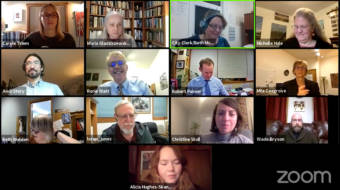
Juneau Assembly members, along with city clerk Beth McEwen, sign on for a regular meeting on Jan. 25, 2021 via Zoom. (Screenshot from Facebook)
Last year, as the world adjusted to the COVID-19 pandemic and city governments started meeting remotely, many turned to the video conferencing platform Zoom to conduct meetings.
Juneau’s city assembly started holding its committee and regular meetings via Zoom in early 2020. While many say it expanded access, allowing people from all over to weigh-in without having to travel to City Hall, it also opened up those meetings, and Assembly members, to potential abuse. And right now, it’s not easy to track down abusers and hold them accountable.
City officials estimate that there have been about a dozen instances of what’s known as “Zoom bombing” or disrupting a meeting. Zoom bombers have successfully hijacked other public meetings in Alaska and throughout the rest of the world, often with lewd, racist or pornographic material.
“We’ve had a few at the assembly level, we’ve had a few at the school board level, we’ve had a few in some committee board time meetings,” said City Attorney Rob Palmer during a Monday evening meeting.
City Assembly member Carole Triem was targeted during an Assembly meeting.
People who were listening describe a man calling in and making lewd comments about Triem’s body. There were also graphic sounds played at one point.
Triem described it as a startling and disgusting thing to have to listen to while she was at work.
“Certainly, as a woman, that kind of thing has happened before,” she said. “But, no. Not in any kind of official capacity and it was very embarrassing that it happened in this public meeting where I think probably hundreds of people were watching on Facebook.”
When it happened, no one seemed to know how to respond. The city clerk who was moderating immediately worked to remove the person from the meeting, but that took several seconds. No one hit the mute button.
“When it happened, I was just too shocked to kind of feel anything,” Triem said. “I had quite a few fellow assembly members who spoke up publicly in the meeting and who texted me. And I really appreciated that but I was just kind of like, I don’t know – ‘let’s just get on with the meeting’.”
City officials say they’ve changed the way they’ve run meetings, but they don’t want to describe exactly how they’ll respond when it happens again in order to prevent someone from circumventing their plans. They did say that someone’s hand is always near the mute button.
Juneau police launched a criminal investigation into who was harassing Triem. But, Palmer said Zoom, the company software the city is using to host the meetings, isn’t cooperating.
“It has been incredibly difficult working with Zoom to try to track down where those bombs came from,” he said.
That’s, in part, because the city doesn’t have anything in its local code that identifies Zoom bombing as a crime.
Palmer is working on that now. He said once that law gets on the books, they can force the company to turn over any identifying information the company has on Triem’s harasser and anyone else who bombs a city meeting.
Triem said she never really thought that they’d find the guy who called in to harass her, and she’s not really focused on that.
Instead, she wants to go through the process of making Zoom bombing a crime and send a message to the public that it isn’t acceptable. And, she wants the city to back her up, publicly.
“It would really mean a lot to me because I was a little disappointed that — other than my few fellow assembly members who spoke up at that meeting, it wasn’t really addressed at all,” she said.
Editor’s note: We’ve updated this story to reflect that while city officials initially refused to make a full recording of the Assembly meeting during which Carole Triem was harassed available, it has since agreed to provide it to KTOO.
Close
Update notification options
Subscribe to notifications
Subscribe
Get notifications about news related to the topics you care about. You can unsubscribe anytime.