CBJ Assembly Meetings

Resurrection Lutheran Church will be Juneau’s cold weather shelter this winter

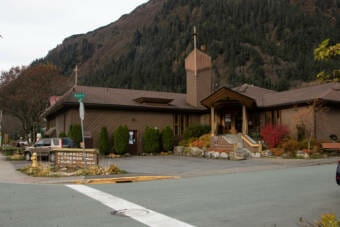
A sign with the dates of the next City and Borough of Juneau’s planning commission meeting hangs at the Resurrection Lutheran Church on Oct. 27, 2021 in Juneau, Alaska. At the commission’s Nov. 9, 2021 meeting, commissioners voted to approve the RLC’s conditional use permit to hold a cold weather shelter for the winter of 2021-2022. (Lyndsey Brollini/KTOO)

Juneau’s cold weather emergency shelter will be at the Resurrection Lutheran Church near downtown this winter. The city’s planning commission voted on Nov. 9 to approve the church’s conditional use permit to hold the shelter with some conditions.

The cold weather emergency use shelter was created in 2017 and has been run by a few organizations around town since. St. Vincent de Paul had run it since the end of 2019. Last month, the nonprofit pulled out of its contract with the City and Borough of Juneau to provide the shelter.

That is when the Resurrection Lutheran Church stepped in. Employees at the church have experience working with the unhoused population in Juneau. Without another viable option and with such short notice, Karen Lawfer and others at the church felt obligated to step up.

“We knew that it was going to get cold and we knew that people needed a place to go,” Lawfer said. “And as such, we have been working nonstop to get this process going so that those who are less fortunate than we will be able to have a place to stay and a meal.”

People living in the neighborhood surrounding the church said during the planning commission meeting that they have concerns. Most were related to safety around the neighborhood — for children going to school, people using the night drop at First National Bank, business owners and for residents in the Flats neighborhood.

Alicia Bishop called in as a representative of the Harborview Elementary Site Council, which includes parents and teachers at the school. She opposed the shelter location on behalf of the council and asked the city to find a different spot.

“Our biggest concern is the overlap of students with those exiting the shelter in the mornings, and especially at congregation points such as where school and public bus stops coincide,” Bishop said.

Naomi Davidson was conflicted about the proposal. She felt like the proposal was rushed but she also does not want unhoused people to be left out in the cold.

“I’m not against it. I’m against the way that this came about so quickly, with very little participation, and planning to, to create a whole plan to provide whole services for all of the participants and all of the partners,” Davidson said.

Some people suggested having more of a police presence in the neighborhood but Davidson doesn’t think that is the answer and doesn’t want to criminalize people experiencing homelessness.

Other people called in to offer their support. One of them was Doniece Gott. She said that people are building up a lot of fear for a problem that doesn’t exist.

“We need to model for our children and we should model compassion and love and respect for our fellow human beings instead of treating them poorly and othering them,” Gott said.

Jerrick Hope-Lang, an Indigenous homeowner in the Flats, also called into the meeting to support the shelter. He said that the concerns people are voicing really come with the territory of being downtown.

“And with the recent loss of some Native people in our community, I just think it’s really important that we not forget that there needs to be a secondary option, especially with the loss of shelter in the downtown area,” Hope-Lang said.

To address people’s comments, the planning commission put nine conditions on the permit. All the conditions were passed.

Three of those conditions were suggested by the city’s planner, Allison Eddins. Those conditions are: 

  • Smoke detectors must be installed in the sleeping area and in bathrooms;
  • An alarm must be installed at the emergency exit near the sleeping area;
  • If new lights outside the church are installed, a light plan must be given to the community development department;

Six conditions were suggested by the planning commission:

  • Security cameras outside the building must be installed and operational before opening the shelter;
  • The shelter must operate no earlier than 9 p.m. and close 6:30 a.m. the next day;
  • The shelter can operate Nov. 1 – May 1;
  • When the shelter is operating, there must be two staff present at all times;
  • The permit will expire May 2022;
  • The facility will provide a contact number for people in the neighborhood that will be answered during the shelter’s operating hours 

In the meeting, commissioner Nathaniel Dye said that this is the fastest moving conditional use permit he has ever seen and that the process felt rushed. That is why he wanted the expiration of the permit as a condition of approving it. 

These permits don’t usually have an expiration date and some commissioners were concerned about setting a precedent for future permits. 

“The precedent is relieved for me from the fact that there is an emergency situation for … It’s a life safety issue at this point,” Dye said.

Now that the church has its permit approved, it can start housing people when the weather gets below freezing. It is forecasted to be below freezing at night for most of next week.

To contact the church about the warming shelter, you can send an email or call 808-782-5795.

A previous version of this story mistakenly referred to Karen Lawfer as Karen Laughlin.

Unofficial results show write-in candidate Will Muldoon pulling ahead in Juneau school board race

Juneau voters wave signs at the corner of Egan and W. 10th St. for candidates running for Juneau Assembly and Juneau School Board. (Lyndsey Brollini/KTOO)

Juneau election officials spent Monday counting ballots from the local election. 

As of Friday, they’ve received nearly 9,200 ballots and counted nearly 6,400 of them. There are about 3,000 left to count, plus any that still may come in by-mail. 

Results from most races are unchanged, but in the race for the school board, write-in candidate Will Muldoon has pulled ahead of Ibn Bailey and is now one of the top three candidates. The other two are Elizabeth Siddon and Amber Frommherz. 

Barbara Blake is leading in the race for Assembly District 1. Michelle Hale is ahead in Assembly District Two. 

Official results will not be available until Oct. 19. 

Some voters may get a “cure letter.” Those are sent out when a ballot is missing information that makes it valid, like a signature or a personal identifier. About 376 of those letters have been sent out, according to a media release. 

Voters have to respond to those letters before Oct. 19, when the Canvass Review Board certifies the election. 

Juneau brings back penalty for violating COVID safety rules

A blue sign with off white lettering that says: "Masks & physical distancing required" in all capital letters.
A sign in Juneau reminding people about mask and physical distancing requirements. (Bridget Dowd/KTOO)

A lot of people turned out at Juneau’s special Assembly meeting last week to comment on the proposal to extend the city’s  COVID-19 mitigation strategies. Most of those opposed were upset over an added penalty for those who don’t comply with mask mandates or other policies.

When the Assembly voted to extend the safety measures, they also approved the use of a $25 fine for violators. While that was alarming to some, Juneau Emergency Manager Robert Barr said the city’s had it in place before. 

“The penalty section has been there in every iteration of the strategies so far, except for the last one,” he said.

By the last one, he means the set of strategies that expire at the end of October. But, even though the penalty has been an option in the past, no fines were ever issued. Barr said 90% of the time, just educating people about the policy and reminding them to follow it, is all that’s necessary.

“But those conversations with people about complying with the mitigation strategies were a little bit more challenging to have when we didn’t have that enforcement option,” Barr said.

That’s why city officials asked the Assembly to put the penalty section back in, which led to a debate amongst Assembly members, like Michelle Hale, during last week’s meeting. 

“I’m really torn by this,” Hale said. “I understand what staff is saying about the advantage of having the penalty. I’ve also spoken with a lot of people today and gotten a lot of information from people who really feel that the penalty goes too far.”

Hale went on to say that most of the city’s transmission had been in private gatherings and among families, where a compliance officer wouldn’t be going anyway.

The city also has civil enforcement options for businesses that don’t comply, but those steps have never been used either. The city says if anyone would like to report non-compliance, they can email covidquestions@juneau.org.

A second top-level Bartlett hospital staff member resigned

Bradley Grigg in his office on April 15, 2021. (Claire Stremple/KTOO)

A second top-level employee abruptly resigned from Juneau’s Bartlett Regional Hospital late last week. Chief Behavioral Health Officer Bradley Grigg tendered his resignation on Friday, after four years with the city-owned hospital. Neither the city or the hospital board acknowledged publicly that he’d left until Monday.  

In his letter to the hospital’s Board of Directors, he wrote that his position is no longer a good fit due to “personal issues.” 

Grigg’s letter came just after CEO Rose Lawhorne stepped down. Lawhorne left her role after six months and was subsequently fired for having an “inappropriate relationship” with a subordinate employee. City manager Rorie Watt declined to comment on whether the resignations are related.

Grigg’s resignation comes at a time when the hospital is inundated with behavioral health patients. He was also helming a $14 million expansion of the behavioral health department building.

The volunteer-run hospital board will meet on Friday to discuss a plan for hiring a permanent CEO. It is unclear whether the interim CEO, Kathy Callahan or the yet-to-be-hired permanent CEO will hire Grigg’s replacement.

This is a breaking news story that will be updated.

A previous version of the story misspelled Rose Lawhorne’s surname.

Juneau Assembly drops property taxes to the lowest rate since 2013

property tax bills
The Juneau Assembly passed a new budget earlier this week, dropping property taxes to the lowest rate since 2013. (Photo illustration by Jeremy Hsieh/KTOO)

The Juneau Assembly passed a new budget earlier this week, which will take effect in July. The plan includes money to expand child care services and funds the Capital Improvement Plan, among other things.

In addition, Juneau homeowners will pay the lowest property taxes since 2013.

The city uses two primary unrestricted funding sources to pay for its services: sales tax and property tax. In Alaska, property tax rates are recalculated each year after all property values have been assessed. The rate is calculated in “mills.”

The mill rate for the next budget year has been lowered from 10.66 mills to 10.56. If you move the decimal point one to the left you get a percentage of property values.

“So 10.56 mills is 1.056% of property value,” said city finance director Jeff Rogers. “So if you own a $100,000 house you would pay $1,056 a year in property tax.”

Juneau’s rate remained the same at 10.66 for the last six years, but at the end of last year’s budget cycle, some members said the rate would have to increase soon to pay for child care.

“[The assembly] wanted to establish a durable funding source for child care,” Rogers said. “So as the manager started to prepare the budget for next year, he incorporated that and proposed to increase the mill rate from 10.66 to 10.86.”

But Juneau’s property values went up more than expected this year.

“So increased property values means that you could potentially have a lower mill rate and still receive more in property tax,” Rogers said.

If the rate had stayed the same, instead of decreasing, that would’ve meant $540,000 more for the city. On a smaller scale, if you own a $500,000 home, you save $50 for the year.

The assembly’s initial budget assumed Juneau would continue to lose money without sales tax from tourism, but now late summer cruises are on the horizon. Assembly member Michelle Bonnet Hale said online sales tax is another thing to consider.

“Every quarter we bring in more vendors to pay online sales tax,” she said. “If people in Juneau, who are shopping online, are paying that sales tax, then in my mind, people in Juneau should have some drop in their property taxes.” 

Hale started pushing for a lower rate last year because she didn’t want the city to raise more money than necessary.

“We’re not in the business of making money,” she said. “What we’re in the business of is making enough revenue to support the government services that we decide we need and at a certain point, it’s not our job to keep sort of buffering the savings account.” 

Hale was outnumbered as recently as last month, but Juneau Mayor Beth Weldon and assembly member Maria Gladziszewski changed their votes on Monday.

“I’m just very pleased that we did this,” Hale said. “I think it really sends a strong message to the community and a strong message to the taxpayers in Juneau that we listen to them and we really work hard at balancing the budget correctly.”

Juneau Assembly turns down $2 million donation from Norwegian Cruise Line

Juneau’s cruise ship docks were empty last year after sailings were suspended due to the coronavirus pandemic. In May, the Norwegian Cruise Line company announced it would donate a total of $10 million to Alaska port communities. (Jennifer Pemberton / KTOO)

The City and Borough of Juneau Assembly turned down a $2 million donation from the Norwegian Cruise Line company during its regular meeting Monday night. 

Some assembly members were concerned about what the public would think of the city taking the money.

In May, Norwegian announced it would donate a total of $10 million to Alaska port communities. That included Ketchikan, Juneau, Hoonah, Sitka, Skagway and Seward. The funds were intended to support small businesses and those most impacted by the lack of cruise passengers last year.

The company has purchased an empty waterfront lot downtown, where it wants to build a dock. 

Carole Triem is one of six assembly members who voted against taking the donation. She said the proposed dock factored heavily in her decision.

“The whole process from start to finish requires decision-making from the assembly,” Triem said. “I just think that to accept money from NCL, even though it’s totally separate from the decisions we’d be making about this development project just is not a good look for us.”

Triem said even though she has faith in everyone involved, just the appearance of impropriety is enough to lose the public’s trust.

During the meeting, assembly member Wade Bryson disagreed with that argument.

“The opposition to the dock is still going to be there,” Bryson said. “The pro-tourism groups are still going to be there. Taking that $2 million changes not one number on either side of that equation.”

Bryson added that the path for Norwegian getting its dock is already in city code and charted out. 

“Yes, I would agree that we have to make a couple of decisions along the way, but they’re not going to be able to come up with some strategy or technique that’s going to help them circumvent the Juneau process,” Bryson said. “It would be foolish and fiscally irresponsible to reject this money that is going to go, at our decision, to helping our community.”

Ultimately, the motion failed by a six to three vote and the assembly asked City Manager Rorie Watt to go back to Norwegian, suggesting the company donate directly to an organization like the Juneau Community Foundation, instead of the city itself.

Site notifications
Update notification options
Subscribe to notifications