CBJ Assembly Meetings

Flood fighting experts share details about Juneau’s flood barrier plan

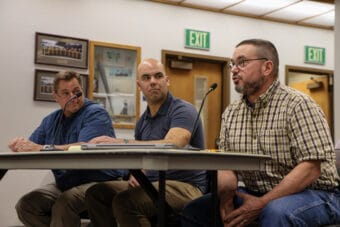
Dan Allard and Philip Martinez (left, center) from the Alaska branch of the U.S. Army Corps of Engineers join CBJ engineer John Bohan to speak to the Juneau Assembly on Monday, Nov. 4, 2024. (Clarise Larson/KTOO)

The City and Borough of Juneau is moving forward with phase one of their short-term plan to fight glacial outburst floods in the Mendenhall Valley. A proposal to construct a temporary levee along the Mendenhall River using flood barriers is already underway. 

At Monday evening’s Assembly committee of the whole meeting, flood fighting experts shared details about barrier installation and durability. The city has debated the best way to address Juneau’s outburst floods, but the U.S. Army Corp of Engineers recommended building the levee using barriers made by a company called HESCO.

“It’s quick, it’s really effective and it’s inexpensive. That’s why we’re suggesting the HESCO barriers,” said Dan Allard, an emergency management specialist for the Corps’ Alaska branch. 

The HESCO barriers were given to the city for free by the Corps. They are four feet tall and three square feet wide, made with heavy-duty fabric sandbags contained in a metal wire basket. For Juneau’s plan, they’d be used to line the riverbanks on the developed side of the Mendenhall River along Marion Drive, Killewich Drive and Meander Way. 

Some Juneau residents have expressed concern about the possibility that the flood barriers could be breached by debris, like the large trees that often come down during outburst floods.

Keith Anderson, a consultant with Flood Defense Group and a former HESCO employee, also addressed the Assembly. Anderson, who has built HESCO levees for military fortification and flood fighting across the nation, said that the barriers are able to withstand trees and all kinds of impacts. 

HESCO barriers with New York City in the background. (Photo courtesy of Flood Defense Group presentation)

“The bulk of these baskets, they can take floodwater, debris impact, car bombs, rockets, I mean, it’s amazing how strong they are,” he said.  

At least one catastrophic breach of HESCO barriers has been documented when the flooded Mississippi River broke through in Davenport, Iowa and surged into the city’s downtown. That incident, Anderson said, was attributed to a construction error.

The bigger concern, experts said on Monday, is not barriers failing, but bank failure due to erosion. During the rollout of the plan, the city has made it clear that significant site preparation on private property may be necessary. 

“You may think we’re eering in caution on recommending bank stabilization or armouring protection or scouring protection in front of these barriers, but we’re trying to provide a product at our best assurances that will last more than one event,” said John Bohan, chief engineer with the city’s capital improvement project. 

The Corps will fund the cost for engineering and design of the levee, as well as its temporary construction, but they can’t chip in for erosion protection in this case. So making the bank strong enough for the levee will likely demand some significant cost-share for property owners, and some invasive work. 

“You also have to provide rights of entry to people’s property so you can put these things up, and that might be an issue because it’s not area beautification, right? It’s flood protection,” Allard said. 

During August’s record-breaking glacial outburst, 289 homes in Mendenhall Valley were damaged by flood water. But some property owners in riverfront neighborhoods have already expressed opposition to the city’s plan

While some residents say they’re worried about the financial aspects, others worry about the possibility that flood barriers could redirect flood water in unexpected ways, potentially sending more powerful flows to downstream neighborhoods, for instance.

Bohan acknowledged that the city is working with incomplete information while designing the levee project, but an updated hydrologic study of the Mendenhall River, with accompanying inundation maps for the Mendenhall Valley, will be done by the engineering firm Michael Baker International. Preliminary results of that study are expected later this month, before flood barriers are installed. 

Some residents have also been pushing for more substantial flood fighting solutions, like dredging the Mendenhall River or building a levee around the lake. The city has already set aside $3 million to study those more permanent solutions, but experts from the Corps at Monday’s meeting said the agency would be unable to pursue those ideas without further investigation, including economic and environmental studies that could take years.

“Even if we do it quickly, it’s still going to be a long time. Much more time than you have to protect the people down on the river,” Allard said.

The HESCO levee, Allard said, is a way to buy time. The city plans to present more detailed plans on site preparation and potential cost sharing for the HESCO levee plan at the next regular Assembly meeting on Nov. 16.

The filing period has kicked off for Juneau’s local election. Some residents are eager to run

Nano Brooks (left) and Emily Mesch (right) file paperwork to run for a seat on the Juneau Assembly on Friday, July 12, 2024. (Clarise Larson/KTOO)

The candidate filing period for Juneau’s local election opened at 8 a.m. sharp on Friday. And like clockwork, Juneau residents Nano Brooks and Emily Mesch were patiently waiting outside of City Hall, sipping coffee and chatting till the time struck. 

Brooks and Mesch ran for seats on the Assembly last year but lost to Ella Adkison and Paul Kelly. This time around, they’re running against each other. But Brooks said he hopes to see more people turn out, too. 

“The more people that run the better. I love seeing people get involved and throwing their hat in the race,” he said. 

Emily Mesch (left) and Nano Brooks (right) wait outside City Hall to file paperwork to run for a seat on the Juneau Assembly on Friday, July 12, 2024. (Clarise Larson/KTOO)

In this October’s local election, there will be six open seats: three on the Assembly — including the mayor’s seat — and three on the school board. There are also a few ballot propositions.

All of the open seats can be filled by anyone who is qualified to vote in Juneau and has been a resident for at least one year. For the Assembly seats, you also have to live in the district you’re running for.

The deadline to file is on July 22 at 4:30 p.m.

Brooks and Mesch are vying for the Assembly seat that represents parts of the Mendenhall Valley, Auke Bay and Out-the-road. Mesch said she’ll advocate for the same things she did last year — more housing, supporting schools and balancing cruise ship tourism. 

She said what’s different this time is the rising stakes for those issues. 

“I think on some level, everything is being at least attempted, but I think those are the things that we need to redouble our efforts on and making sure that we really find a solution for them,” she said. 

Brooks said he and Mesch share similar goals, and he also wants to focus his campaigning on the recent hospital and school funding crises. And he said he hopes some of the ballot propositions can help boost voter turnout. 

“I think this is all good things for getting people engaged and getting into the topics of the community,” he said. “Regardless of the topic on the ballot initiatives, when ballot initiatives are brought forth like this, that shows active community members, and that’s always a great thing.”

City Clerk Beth McEwen was ready to go Friday morning to help the pair file their paperwork. She said she recommends that people file sooner rather than later. There’s more information on how to do that on the election tab on the city’s website. 

Juneau City Clerk Beth McEwen stamps the date on filing paperwork on Friday, July 12, 2024. (Clarise Larson/KTOO)

“Don’t wait until the last minute on the last day. Sometimes people get confused as to which forms to turn in,” she said. “We want to be able to help and facilitate that, and we don’t want to have to disqualify someone because they turned in the wrong form.”

The clerk’s office will be updating the website with certified candidates throughout the filing period. In an interview with KTOO in late June, incumbent Mayor Beth Weldon said that she planned to run for a third term this election. 

“It’s been an extremely tough decision to make, especially with my husband, Greg’s, passing,” she said. “But I just come back to the same thoughts that I’m committed to Juneau, and I think I still have some things to offer.”

But Assembly members Michelle Hale and Wáahlaal Gídaag Barbara Blake said they don’t plan to run again. 

The school board seats that are opening up are currently filled by Will Muldoon, Elizabeth Siddon and Amber Frommherz. All three told KTOO in May that they were still deciding whether to run again. 

Ballots will be mailed to registered voters beginning on Sept. 12 and must be postmarked or returned by Oct. 1. 

Juneau Assembly approves bigger grants for building mother-in-law apartments

Downtown Juneau seen from across Gastineau Channel on Aug. 11, 2023. (Andrés Javier Camacho/KTOO)

Juneau residents interested in building mother-in-law apartments can now get even larger grants from the city to help with construction costs. They’ll just have to wait a few more years until they can list them as short-term rentals.

At a meeting Monday night, the Juneau Assembly voted to update a grant program that helps residents build accessory apartments on their property. The previous version, which offered $6,000 grants, expired in June. The new grants will be $13,500.

The previous version of the program required that grant recipients wait three years before renting the unit as a short-term rental. Reading from the resolution, Deputy Mayor Maria Gladziszewski suggested that increasing the wait to five years could help prioritize new housing for Juneau residents.

“That’s the purpose of this,” she said. “It’s not to create short-term rentals.” 

Assembly member Michelle Hale worried that further restrictions would dissuade people from participating in the program.

“Communities that have a lot of rules and have a lot of restrictions in place are much less successful overall at building housing,” she said. “I think we need to accelerate housing building, rather than put requirements in place.”

The amendment passed in a 5-2 vote, with Hale and Wade Bryson voting against increasing the short-term rental limit. Assembly members Christine Woll and ‘Wáahlaal Gíidaak were absent from Monday’s meeting.

Once amended, the resolution passed unanimously.

Proposed Juneau budget raises spending and property tax revenue

Downtown Juneau, seen through the trees at Homestead Park on Feb. 20, 2023. (Photo by Katie Anastas/KTOO)

City leaders outlined a proposed budget to the Juneau Assembly’s finance committee Wednesday night that balances increased costs with higher tax revenue. Now, Assembly members will spend the next several weeks deciding how much property tax to collect through the mill rate.

City manager Rorie Watt said his proposed budget reflects increases in both revenue and expenses.

“Almost everything is up,” he said at the start of Wednesday’s meeting. “Costs are certainly up, inflation has driven up the price of everything – commodities, capital projects, labor. All revenues are up. We’re projecting a record number of tourists this summer.”

Property values are also up. Watt’s proposed total mill rate of 10.28 is slightly lower than last year’s, but because of higher property values, the city would still get nearly $6 million more in property tax revenue.
“The property tax burden is the mill rate times the value, so how you set the value will ultimately determine how much more people pay for municipal services,” Watt said. “They’re certainly not going to pay less for municipal services. That’s just not possible.”

Watt said demand for those services has increased, which is why he’s proposed adding some new positions, including a swim instructor, a recreation coordinator for the Treadwell Arena and HR staff.

Though the mill rate applies to all homeowners equally, the increases to property values varied depending on the neighborhood. Single-family home values in the Flats went up by 10%, while values downtown went up 21%. Some residents reported increases as high as 40%.

“Sure, we’re dropping the mill rate to the lowest level it’s been in decades,” Assembly member Greg Smith said. “Some people will still see very significant increases on their tax.”

City finance director Jeff Rogers said the Assembly may want to increase the mill rate further if it decides to add new recurring expenses.

“If you’re taking on a recurring cost that we should expect indefinitely, we would encourage you to set a mill rate that pays for that cost but doesn’t take in any unnecessary revenue either,” he told the Assembly.

He noted that most property tax goes to schools. The proposed budget includes $9.7 million more for the school district than last year’s.

“We are spending more property tax on the Juneau School District than we are spending on everything else that CBJ does in its general government,” he said. “More than half of the non-debt property tax is paying for schools.”

The proposed budget also increases general government spending by $6 million and capital improvement project spending by $7.7 million. The city would spend $6 million less on the hospital, airport, water utilities, docks and harbors, mostly because of cost reductions at the hospital.

Watt is also proposing a few one-time expenditures. They include $10 million toward building a new City Hall and $2 million toward upgrading the police department’s radio system. 

“I do not propose these investments lightly, and I suspect that these one-time investments will garner significant public and committee attention during the budget process,” Watt wrote in a message to the Assembly.

The proposed budget also pays off $3.2 million of a $6.6 million park bond approved last year. Assembly member Wade Bryson said they should consider paying it off more slowly in order to keep the mill rate as low as possible.

“That message going to the public would be huge,” Bryson said.

The proposed budget leaves the city with an unrestricted fund balance of $12 million, $20 million in restricted general fund reserves and a $15 million deficit. It uses savings to fill that budget gap.

Juneau residents will have the opportunity to comment on the proposed city and school district budgets, capital improvement plan and mill rate during the April 26 Assembly meeting. The Assembly plans to adopt the final budget on June 12.

Pickleball could be part of Juneau’s new commitment to better serve its older population

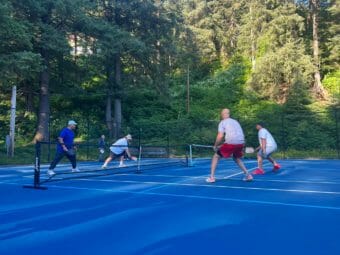
People play pickleball at Cope Park in Juneau. (Photo courtesy of Alaska Crimson Bear Pickleball Club)

Last week, Juneau joined a program that commits to making the city more livable for seniors.

AARP’s Network of Age-Friendly States and Communities recognizes cities that commit to serving their older populations better. Juneau is the second city in Alaska to join, following Anchorage.

Emily Kane, chair of the City and Borough of Juneau’s Commission on Aging, says the designation is more of a promise than a reward. 

“We have to earn that status. Every five years, we have to make a report to AARP,” she said.

Kane is a senior herself. She said that Juneau needs to be considering its rapidly growing population of older people. 

“Alaska is one of the fastest aging states in the nation,” she said. “And Southeast Alaska is the hub of the agingness of Alaska.”

To get the designation, the Juneau Assembly and Mayor Beth Weldon had to commit to make Juneau more accessible and to invest in infrastructure for older community members. Kane said part of that commitment is identifying a project that can be done in five years.

One thing older Juneauites want that she thinks is possible in that timeframe is a senior-focused pickleball court.

“I’m like, ‘let’s put in some senior fitness equipment,’” Kane said. “But then, when I really ask seniors, they’re like, ‘No, we want a pickleball court.’”

Kane said she also hopes that a volunteer hub for the organizations that serve older Juneauites would be a feasible goal. Now, she said, programs like Meals on Wheels or the now-defunct program Friends of Seniors are hard to coordinate and streamline. 

Kane said that despite the age-friendly designation, older people in Juneau face some big barriers like access to medical care and housing. 

Juneau’s only provider of in-home and end-of-life care closed last fall, which Kane said left a major gap in the needs of older people. She also pointed to the lack of medical specialists in town.

“Our neurologist is in her 80s,” Kane said. “She’s trying to retire.”

Housing in Juneau is also a personal issue for her. 

“I want to age in place, but my house is up 66 stairs,” she said. “I’m a pretty healthy senior — knock on wood — but there’s going to come a time where I just cannot carry my flat from Costco up all my stairs. I’m going to have to find a place to stay that has fewer stairs, and is more suitable for someone who’s becoming older. And those options are limited,” she said.

Assembly member Michelle Hale said the city has been working to address lack of housing for older people through projects like the Riverview Senior Living Facility, which will open sometime this spring.

But Hale said the city still has a ways to go.

“Elder people are here, and they’re going to continue to be here,” she said. “And the better we make Juneau for older people to live, then the better they are for Juneau as well.”

On Tuesday, AARP is hosting an event at the Baranoff Ballroom from 4:30-6:30 to celebrate Juneau’s senior community and the start of the 2023 Legislative session.

Juneau hospice provider appeals to city for financial help

A woman crosses Marine Way in front of Juneau City Hall on Sept. 25, 2017. (Photo by Jeremy Hsieh/KTOO)

Juneau’s only hospice and home care provider says it can’t sustain its services alone. Catholic Community Services has been seeking a partner to shore up the program since mid-summer.

CCS Executive Director Erin Walker-Tolles says that’s because the cost of labor has about doubled due to demand.

“Travel staff used to be $55 an hour, and now they’re quoting us at $120 or more an hour,” she said. “There’s just really no way to keep up with the cost of staffing the programs in the face of the shortage.”

She says staffing was hard before the pandemic, but over the last few years the situation has become dire. 

“Nurses, physical therapists, occupational therapists have been leaving the field — leaving the industry,” she said. “Whether they’re burned out or ready to retire, there are fewer nurses.”

Walker-Tolles says the program needs three more nurses. It has only one full-time staff nurse, and the contracts for its two traveling nurses will expire in late October. CCS hasn’t been able to find more travel nurses to replace them.

CCS has reached out to the City and Borough of Juneau for support, but there’s no plan yet in place. 

In a letter to the mayor dated Aug. 12, Walker-Tolles wrote that the service wouldn’t take new clients after this week if it couldn’t secure an additional $50,000 a month in funding. The letter also suggested current clients could be moved or discharged without new funding.

CCS already has contracts with CBJ and city-owned Bartlett Regional Hospital for transit and medical services. But Walker-Tolles says the amount of those long-standing contracts has not kept up with rising costs.

At a subsequent assembly meeting, Deputy City Manager Robert Barr said the city would assist the program through the hospital. Walker-Tolles met with the hospital’s new CEO, David Kieth, to talk about a partnership this week.

“Our main goal is to make sure that we remain able to provide care,” she said. 

Walker-Tolles told KTOO there are no plans to shut down services, nor should there be a break in services. But she says CCS would have to start “triaging referrals.” That means the hospice and home care program won’t be able to accept all new patients if there is not enough staff to support them.

CCS cares for roughly 50 home health patients and usually anywhere from four to twelve hospice patients at a time. Walker-Tolles says the program gets up to ten referrals a week.

Site notifications
Update notification options
Subscribe to notifications