Education

Skagway students are asking for time off school to participate in subsistence activities

A subsistence fisherman checking his net in the Chilkat River.
A subsistence fisherman checking his net in the Chilkat River. (Alaska Department of Fish and Game)

The federal government says 98% of rural Alaskans catch, hunt or gather at least some of their food. And much of that happens during the school year.

Now, students in Skagway are calling on their school district to adopt a policy that would let them take part in those activities — without it potentially counting against them.

The push originated with Ryder Calver, who is the treasurer of the Skagway student council. Calver said he’s gone moose hunting almost every year since he was six years old. But in his experience, taking part in an annual moose hunt eats up most of his allotted absences in one go – leaving little room for other absences later on.

“I’m gone for around 10 days each time, and the school only allows you to miss 15 days total per semester, whether that is a trip, you’re sick, excused or unexcused,” Calver said. “I got the idea to add a buffer.”

So this fall, Calver teamed up with Student Council Senior Parliamentarian Sam Munson to write a resolution they hope will push the school board in that direction.

Right now, students can be penalized after their fifteenth excused absence – unless they get a waiver from the superintendent or school board. The resolution makes a case for allowing students to take up to 7 “subsistence days” per semester, which wouldn’t count toward the 15 day limit.

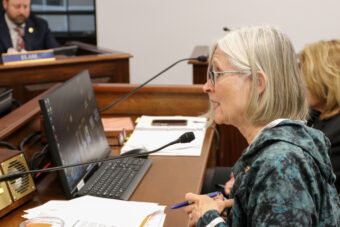
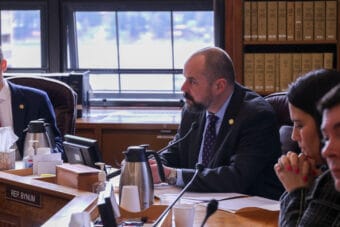
The board’s policy committee took up the issue during a recent meeting. Munson, Calver and Student Council President Lina Hischer spoke, saying the policy should specifically provide flexibility around subsistence activities.

The fact that the current policy doesn’t do that “negatively affects kids who do subsistence hunt or gather,” Hischer said. “We want to make it more even, or equal.”

During the meeting, Skagway School District Superintendent Josh Coughran said the policy could be updated to mention subsistence activities – and to allow students to proactively request days off for a moose hunt or other trip that wouldn’t count against their attendance record.

In that case, he said subsistence days could be treated like travel days for sports or debates – which don’t count as absences.

“We know they’re not in school, but it’s on a school-sanctioned event. And so this would be the school sanctioning subsistence activities and not counting it against families,” Coughran said.

The board is set to discuss the issue at a meeting this week.

Coughran said in an email on Monday afternoon that it’s still “early days” for the idea. If the board decides to move forward with the proposal, it would go back to the policy subcommittee and then return to the full board for consideration.

Disclosure: Sam Munson, the student council parliamentarian, is the son of KHNS News Director Melinda Munson.

A University of Alaska Fairbanks student is out on bail after tearing up and eating another student’s AI-generated art

Some pictures remained on the wall after Granger ate around 57 of the 160 images on display on Jan. 13.
Some pictures remained on the wall after Granger ate around 57 of the 160 images on display on Jan. 13. (Lizzy Hahn)

A University of Alaska Fairbanks student is out on bail after ripping almost 60 images off the walls of a university art gallery and eating some of them earlier this month.

The incident has since gone viral — prompting countless social media posts and even reaching national outlets. Lizzy Hahn, an undergraduate journalism student at UAF, broke the story in The Sun Star, the school’s student-run newspaper.

She said the incident is shaping culture and policy around AI on campus.

This interview has been lightly edited for length and clarity.

Lizzy Hahn: A student was tearing Polaroids off of an exhibit in the UAF Art Gallery and putting them in his mouth, chewing them, swallowing some bits, but spitting some bits out. This was a protest against the use of AI art, since this exhibit was made in collaboration between the artist, Nick Dwyer, and AI — like, he used ChatGPT to help him make it.

Shelby Herbert: Whoa. Tell me what happened to the protester.

LH: His name is Graham Granger. He was arrested by the UAF police and charged with criminal mischief in the fifth degree, and he was taken to the Fairbanks Correctional Center, where he was for about six or seven hours, I believe. So, he’s out on bail.

SH: That was quite a splashy headline, and that story has really sprouted wings. I’ve had folks texting me from the East Coast about it. How does it feel to see your work get so much exposure?

LH: It’s really insane to me. I am a young journalist here at UAF. I’m a senior graduating soon, so like this is my first story to go — some people have said that it’s going viral. It has definitely been picked up by multiple, multiple, multiple news sources. Art News for one, Brut America for another.

SH: I think I just saw it in the New York Post?

LH: Yeah. Just so many media sources that have taken the information and my images and spread them to their corners of the world.

SH: Tell me about where you were when you found out this was going down.

LH: That’s actually kind of a funny story. I’m in a pottery class, and it’s in the fine arts building. And as I was walking in, I noticed that there was a police car outside of the building. So, I walk into class, and then my editor, Colin, starts texting our whole staff’s Slack. And he’s like, “Hey, is anyone in the arts building? There’s a student protesting in the gallery.”

So I asked my pottery teacher, like, “Hey, do you know anything about this?” And she’s like, “Yeah, I do.” So we walk into the gallery together, and all we see is just these torn up, chewed up bits of Polaroids. The artist was there, Nick Dwyer, and he was like, “Yeah, someone came and he started chewing up my work.”

SH: And how does the artist feel about all of this?

LH: He was upset, and rightfully so. This was his MFA exhibit. It’s hard to see your art destroyed like this. He had put a lot of time and effort into this. He wanted to press charges, and he had begun to press charges. But then the next day, things had kind of cooled down, he had talked to some of the art professors, and had realized that pressing charges maybe wouldn’t be the best idea.

Pieces of chewed up artwork lie on the floor in the University of Alaska Fairbanks art exhibit on Jan. 13. (Lizzy Hahn)

SH: Lizzy, you’re a journalism student and a student-reporter, but you also have a foot in the art world — you’re an art minor. Can you tell me about how AI content and tools are being received on campus, especially in the humanities?

LH: Yeah, so every teacher has an AI policy. This has been a fairly new development to the syllabi that we are getting. It’s gone from teachers saying, “You’re not allowed to use AI, don’t use AI.” But in the past year, there’s been kind of a shift towards like, yes, you can use AI, but cite it.

Then also, in the art community, we’re starting to see a little more use of AI, and that has really been because of Nick. Like, Nick is really spearheading the use of AI. Art and AI is kind of an interesting mashup because you don’t really think of them going together, but Nick has really used AI in his pottery and now in this AI art exhibit.

I don’t know that many students personally, besides Nick, who are using AI art, but I think that in the future, it totally could change and the use of AI could become more common.

SH: You’re working on part two of the story. Can you give us a little tease about what comes next?

LH: Yeah, I’m kind of looking into what is happening here at UAF, because since this protest has occurred, there has been a lot of uprise. Our student government here on campus has actually proposed a resolution to ban AI art in the department. But at the same time, the art department is creating a statement about their AI policies. So, unsure where that will go, but bright futures ahead!

State education board OKs UAA program aimed at tackling school psychologist shortage

A group of students in the distance gather after exiting a yellow school bus.
Students exit a school bus outside of Juneau-Douglas High School: Yada.aat Kalé on Aug. 15, 2025 (Photo by Jamie Diep/KTOO)

The State Board of Education and Early Development unanimously approved a school psychology master’s program at the University of Alaska Anchorage aimed to address the state’s shortage of school psychologists. The approval took place during the board’s special virtual meeting on Thursday.

This comes after the board voted it down last October after some members brought up concerns about social justice mentioned in a sample syllabus.

Several people testified at the meeting in support of approving the program, including Palmer resident Rebecca Emerson. Her son Winston is a second grader with Down syndrome, and she said school psychologists are instrumental to make sure he gets the services he needs.

“I ask you to look past the ideological debate and see the faces of the students like Winston who rely on these services. Please approve this program so that more Alaskan students can have the support they need to succeed in the classroom,” Emerson said. 

Board member Kathryn McCollum originally brought up concerns about social justice in the program. After receiving clarification about how the program works, McCollum said she appreciates the efforts to create a homegrown program.

“I’m not thrilled that we have all these contractors from outside of our state. So I would much prefer to see people from Alaska serving Alaskans so I appreciate your efforts here,” McCollum said.

Board member Barbara Tyndall, who previously opposed the program, voted in favor this time around. She still had concerns about the focus on mental health.

“As I’m going through the health and safety stuff, it’s mental health, mental health, mental health,” Tyndall said. “And I don’t think we should just only be looking for mental health, because there are people out there just looking for problems.”

People have a few ways to become licensed school psychologists in Alaska. One main way is to graduate from a program accredited by the National Association of School Psychologists. Another is to go through a program approved by the state’s education board.

UAA’s program is on its way to getting NASP accreditation. The earliest it could achieve that is 2029, one year after the program’s first cohort graduates. Now, with the state board’s approval,  those students could become licensed and hired to work shortly after graduating.

New bill aims to bring stability to Alaska school districts’ budgeting process

school bus in front of building
A school bus waits outside the Alaska State Capitol after offloading a group of preschoolers, their parents, caregivers and advocates on Feb. 13, 2023. (Katie Anastas/KTOO)

Alaska’s state education funding formula is really complicated. It’s based on data, collected during the school year, that takes months to process. That can leave districts building budgets based on projections that might be inaccurate. Juneau Democratic Rep. Andi Story wants to address that through a bill that would change what data is used for funding calculations. 

Story, who served for years on Juneau’s school board, said there’s a level of uncertainty built into the way students are counted.

“When I was a school board member, when we were asking community members, parents to come and work on our budgets, we were always projecting cuts and not knowing what we were going to do,” she said.

Part of that uncertainty comes from not knowing exactly how many students are enrolled until later in the budgeting process. Right now, school districts count the number of students enrolled in October of their current school year. That count needs to be approved by the Department of Education and Early Development, and it determines how much state funding a school district will get for the following school year. 

Districts typically don’t receive the approved numbers until months later – in January. That lag means districts begin planning their budgets based on projections instead of actual data.

Story’s bill – House Bill 261 – would make several different changes to which student counts would be used when determining state funding for education.

Story said one of the main things her bill would do is to base student counts either on the previous school year or an average of the previous three years – numbers that would have already been processed by DEED and wouldn’t change throughout the budgeting process.

“I’ve been living in this roller coaster, and seeing how it does not build confidence in our public schools,” Story said. “And so we need to get on a more stable plan, a smart plan.”

This isn’t a new idea. Story is on the Legislature’s Task Force on Education Funding. She said this part of the bill came from a recommendation made by an education consulting agency more than 10 years ago. The idea came up again last November, during a task force meeting.

The bill also seeks to address budgeting for students with disabilities, keeping schools open

There are a couple of other pieces in this bill as well. One addresses how the state counts students that qualify for intensive services. Students with disabilities that require those services receive 13 times the amount of funding that’s typically allocated for a student. If the state determines there are fewer of those students than what the district counted, that can create serious shortfalls in its budget.

The new bill would offer four different options for how to count students who qualify for intensive services, to ensure districts receive the funding needed to support them.

Districts could count students in October or February of the current school year, in October of the previous school year, or take an average of the last three years. They could then use the number that would provide the largest amount of funding.

Story said this method would account for students who might move to other districts.

“Sometimes students move after the count date, they might move to another community, and all of a sudden that community is going to have to hire another staff person, but they’ve already budgeted,” she said. “So where do they pull that money? Because by law, we need to meet that student’s needs.”

Story’s bill also addresses how enrollment counts determine how many schools a district can have. She said small districts can sometimes fall below the threshold that allows for opening another school or keeping an existing school open if enrollment drops by just a couple students in a given year. She said taking an average would help stabilize numbers in situations where the difference of one student could have big financial consequences.

“Those big funding cliffs that really make— that really have communities on edge of, ‘Am I going to get a couple more or a couple less?’” she said.

Lon Garrison is the executive director of the Alaska Association of School Boards, a nonprofit organization that advocates for Alaska students. He said the bill would provide far more stability as school districts build out their budgets. But he said the issue of adequate education funding remains.

“That’s the piece that we have to be focused on,” Garrison said. “What are we going to do to ensure that we’re getting the student outcomes, and what resources do we need?”

It’s unclear if this bill will make its way through the Legislature. Story expects the House Education Committee, which she co-chairs, to take it up in a couple of weeks.

In lawsuit, 2 school districts say Alaska fails to meet its constitutional obligation on public education

Students end their school day in Aniak. Theirs is one of nine schools in the Kuspuk School District, which is a plaintiff in a lawsuit filed against the state Tuesday alleging years of inadequate education funding. (Photo by Emily Schwing)

Two Alaska school districts filed a lawsuit Tuesday in Anchorage Superior Court against the state, its governor and its education commissioner over what they say is a long-running failure to adequately fund public education.

In the complaint, the Kuspuk School District and the Fairbanks North Star Borough School District argue “the state is failing to meet its constitutional obligation” both to provide Alaska students “a sound basic education and meaningful opportunity for proficiency” in vital subjects, and “to fund schools and school districts at a level that is adequate to provide students with a sound basic education.”

The plaintiffs are seeking a declaratory judgment that the state is violating the Alaska Constitution by failing to sufficiently fund public education. They say the state is violating the plaintiffs’ and students’ rights to substantive due process. They’re also seeking an injunction directing the state to fulfill its constitutional obligations, and requesting a court-ordered adequacy study to determine what it costs to educate students.

“Alaska, we don’t believe, has ever done an adequacy study to really understand what it would take to allow Alaska students a fair opportunity to learn the skills they need to participate and contribute to society,” said Matt Singer, a trial attorney representing the plaintiffs. ”If you don’t know what something is going to cost, then you can’t have a conversation with the Legislature about how to fund it,” he said.

The lawsuit points to low proficiency assessment scores, reductions in teaching staff and the elimination of fine arts, career technical and vocational education programs as direct impacts due to years of chronic underfunding. It also cites dangerous conditions inside school buildings.

“The last eight years, we’ve experienced a governor that has put forward a zero dollar budget going into budgeting,” said Kuspuk School District Superintendent Madeline Aguillard. “That’s almost a decade of just starting at nothing and when you have to claw your way to even less than minimal funding, that takes a toll,” said Aguillard.

A spokesperson with the governor’s office deferred to the state Department of Law.

“The responsible path is legislation — not litigation,” Department of Law spokesperson Sam Curtis wrote in an email Tuesday night, noting that “we have not been served with this lawsuit and have not yet had an opportunity to review the claims.”

The education clause in Alaska’s constitution does not specify a dollar amount for education. Instead, wrote Curtis, the constitution “vests the power of the purse squarely in the Legislature and the Governor. The legislative session began today. That is where education policy and funding decisions are meant to be debated and resolved.”

Superintendent Madeline Aguillard oversees nine rural public schools in Western Alaska’s Kuspuk School District. (Photo by Emily Schwing)

It’s not a coincidence the suit was filed on the same day legislators convened in Juneau for this year’s legislative session, according to Fairbanks North Star Borough School District Superintendent Luke Meinert. “I think it sends the message that the work on education funding is not done,” said Meinert. “We’re calling on this year’s Legislature to continue to work on that issue. They have the power to do so. Nobody else does,” said Meinert.

Education Commissioner Deena Bishop did not respond to a request for comment as of Tuesday evening. When she was superintendent of the Anchorage School District, Bishop consistently advocated for increased state funding for public schools through a change to the state’s education funding formula. But Bishop changed her stance when she became education commissioner under Dunleavy, arguing that the state’s budget is strained and that she preferred a more targeted approach to increasing school funding, like providing more money for tutors.

In the past, Bishop has said her department is not responsible for allocating funds for education. “The levers that I can pull aren’t levers for funding,” Bishop said in a 2024 interview. “I don’t create the money. The Legislature creates that, but we can certainly support policy that would help support schools as their needs come up,” she said.

Caroline Storm, executive director of Alaska’s Coalition for Education Equity, a nonprofit organization that is helping finance the lawsuit, said that “legal action is not the only way, but it raises the public awareness.” Storm said years of advocacy from her organization and others simply “hasn’t moved the needle enough” in Alaska to pay for wide-ranging needs from curriculum to building maintenance.

Storm said the lack of financial support for public education should be central to this year’s election cycle. “In my mind I don’t frame that as using politics, but ensuring something that is in our constitution,” said Storm.

According to Article VII of Alaska’s constitution, “the legislature shall by general law establish and maintain a system of public schools open to all children of the State.” For years, the complaint alleges, the state has failed to do so.

“This does not come as a surprise to me,” state Sen. Löki Tobin, an Anchorage Democrat who chairs the Senate Education Committee, said Tuesday. “In this conversation around adequate school funding, our local school boards have been bleeding,” she said.

“They have come to Juneau, they have talked to our commissioner, they have elevated the desperate need that they are under to have adequate state funding. We know that the state support for schools has been slowly diminishing,” said Tobin, who is also a member of a task force formed at the end of last year’s legislative session to address education funding, among other issues.

Alaska’s public schools receive funding from two state budgets. Capital funds pay for building maintenance, upgrades and construction. Money for operations, often referred to as the Base Student Allocation, or BSA, buys things like textbooks and pays for teachers’ salaries. According to the complaint, Alaska allocated $5,800 per student in 2015. Over a decade, the number had risen only 2.2%, totaling $5,960 in 2025.

“The state is failing in all regards,” said Singer. “In order to provide a basic sound education, you need a lot of different things,” he said. “One of the things is a safe school building with a roof and heater. Another thing you need is a competent teacher standing in front of a classroom educating young people.”

After years of relatively flat state funding for schools amid rising operational costs, Alaska lawmakers during the 2025 legislative session passed a $700 increase to the BSA, then gained enough support to override Gov. Mike Dunleavy’s veto of the bipartisan education bill — and later overrode his veto of $50 million in education funding from the budget.

While advocates celebrated the funding increase, many education leaders have said it still falls short of what school districts need to effectively operate, and the plaintiffs in the lawsuit filed Tuesday said the increase in the BSA was “woefully insufficient to keep pace with inflation, which had eroded purchasing power by 37% in the preceding decade.” After last year’s protracted battle over school funding, and with state revenues projected to be lower than expected, it’s unclear whether there’s enough traction in the Legislature to pass another increase this year.

There are more than 50 school districts in Alaska, and most are located within cities or organized boroughs, which have access to local tax revenue to help fund education.

Nineteen districts are nearly entirely reliant on the state for funds, because they serve rural, unincorporated communities where money from local taxes is simply not available to help pay for schools. Dozens of those school buildings are owned by the state education department, including in the Kuspuk School District, which straddles the middle stretch of the Kuskokwim River and covers an area roughly the size of Maryland in Western Alaska.

State assessment data on student performance within the Kuspuk School District “are dire,” according to the complaint. The numbers show 90% of the district’s 330 students during the 2024-25 school year were not proficient in English language arts, math or science. Aguillard said chronic underfunding from the state is having an outsized impact on districts like hers, where the student population is predominantly Indigenous.

Bats sometimes fly through the hallway and classrooms in Sleetmute. The building’s roof had a leak for nearly two decades before state funds finally became available for repairs. (Photo by Emily Schwing)

Those students aren’t only struggling with classwork. For years, Aguillard said her district has had to pull funds from its operational budget to keep buildings open. Over the last two years, an investigation by KYUK Public Media, NPR and ProPublica uncovered a public health and safety crisis inside many of Alaska’s public schools and in particular, in rural schools that serve predominantly Indigenous student populations. In one school, bats occasionally fly through classrooms and the hallway. At a school above the Arctic Circle, maintenance staff struggled for years with a persistent toxic chemical leak from the heating system, and in several cases across the state, failing plumbing means kids have to leave school to go to the bathroom.

Dozens of studies cited by the U.S. Environmental Protection Agency highlight negative impacts on student performance as a result of poor maintenance and conditions inside schools. The investigation found black mold inside several Alaska schools. Exposure can increase the risk of asthma and is linked to higher rates of absenteeism. According to the agency, leaking roofs and problems with heating and ventilation can also impact academic performance.

The situation isn’t unique to rural school districts, however. In an interview, Meinert described at length the tangible impacts a $5 million budget deficit has had in the Fairbanks North Star Borough School District, one of the three largest in the state.

“The state does have a responsibility to provide safe and adequate facilities for our students not only in rural Alaska but also in urban Alaska,” said Meinert. In the last five years, seven schools in his district have been forced to close due to a budget shortfall. Meinert said the district opted to outsource its custodial jobs and eliminate more than 70 positions. Since 2019, Meinert said, his district has terminated more than 300 teaching positions districtwide, which means class sizes have swelled to more than double what the National Center for Education Statistics reported for the state five years ago.

Meinert contends that a lack of state financial support within his district is also disproportionately impacting the minority student population. State assessments show that more than 76% of Indigenous and economically disadvantaged students in the district are not proficient in English language arts.

On Monday, Aguillard got word from an architect that most of the roof joints that hold up the roof of the school gym in Aniak are broken. “We are closing the high school immediately and beginning plans to demolish before it collapses,” she wrote in a text message. In the last three years, experts have said at least three buildings in her district should not be occupied.

Aguillard has also been scrambling with maintenance staff over the last two weeks. This winter, communities across the state experienced a prolonged and extreme cold snap in December and January. Eight of the Kuspuk district’s nine buildings could not open in time for students to return from the holiday break because there was no running water, heat or electricity. The majority of the buildings in the district are owned by Alaska’s education department.

”It’s unsettling,” Aguillard said. “Our buildings should not be shutting down so easily. It’s really just evidence of the decline of the capacity of those buildings,” she said.

Juneau School Board delays returning $1 million to the city due to questions about after-school child care

A green metal play structure with two slides on a blue rubber flooring.
The Harborview Elementary School playground on July 9, 2025. (Photo by Jamie Diep/KTOO)

The Juneau School Board held off on returning $1.05 million in funding earmarked for child care to the City and Borough of Juneau this week amid questions about the current privately-run program and the possibility of an additional operator in the future.

Board Vice President Elizabeth Siddon said at a meeting Tuesday she still has questions around how things are going with Auke Lake Preschool, like the status of its state licensing. Auke Lake Preschool started running an after-school program at the beginning of this school year after the district stopped operating its own.

“I just think we’re not ready, especially in a final reading, to make this decision,” Siddon said. “We don’t have all the information about the programs and what options we have for kids at all of our sites.”

Siddon said there is also a possibility for YMCA Alaska to expand its child care program to Juneau, and that the city funding might be able to be used for that.

Nate Root is the CEO of YMCA Alaska. The organization currently runs after-school child care in Anchorage, the Mat-Su Borough and Kodiak.

In an interview with KTOO, Root said YMCA is looking into how feasible it would be to expand its after-school program to Juneau. He toured three schools last year and said the organization is working on surveys to see how many families are interested in the program.

He said running a program depends on how financially sustainable it will be. And it will still take a while to get licensed by the state if they move forward with starting a program in Juneau.

“To be completely transparent, it would look like the soonest we would open a program would be the beginning of the 26-27 school year,” he said.

Derik Swanson is the co-owner of Auke Lake Preschool, which runs the current after-school child care program out of Harborview Elementary, Auke Bay Elementary and Sít’ Eetí Shaanáx̱ – Glacier Valley Elementary.

He said in an interview Friday that the program is still currently unlicensed. Swanson said staffing issues have delayed the process, but with those now resolved, he plans to keep working on getting licensed.

“It’s been pretty successful overall,” Swanson said. “It was kind of a rush to get the program started and up and running, but now it seems to be running fairly smoothly.”

Swanson was unaware of the potential for YMCA to expand to Juneau, but said child care providers in the city generally work together to meet the high demand.

The school board unanimously agreed to discuss the state of the after-school child care program and the remaining city funding at its facilities committee meeting on Feb. 3.

Site notifications
Update notification options
Subscribe to notifications