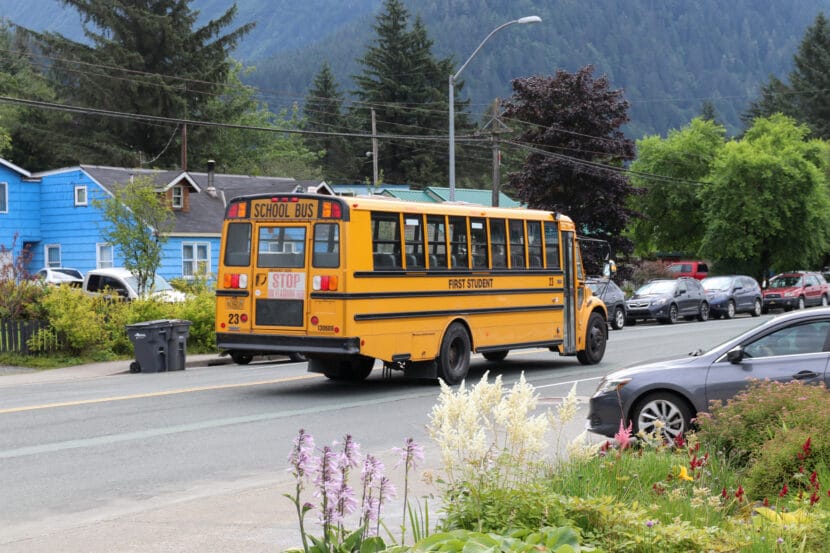
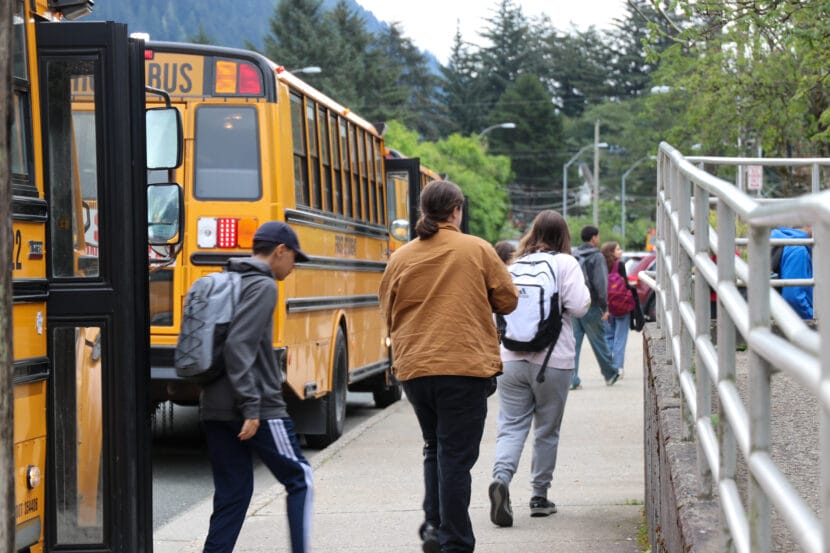
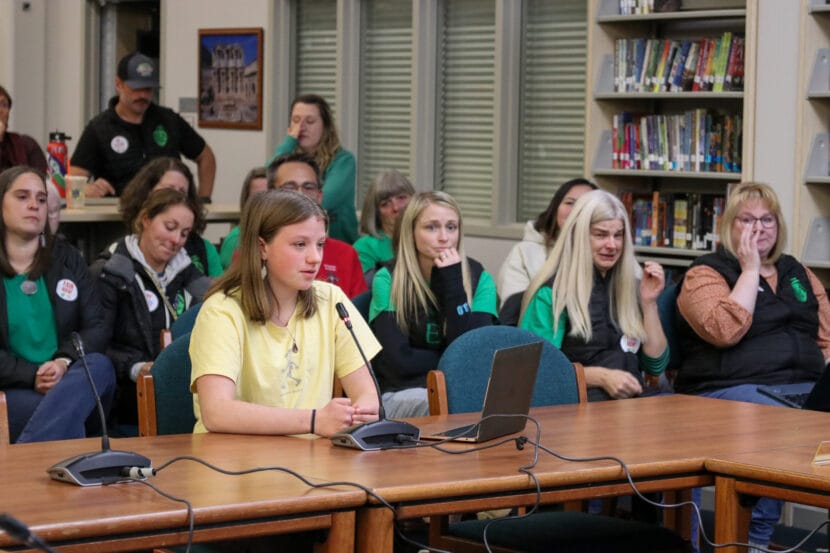
Juneau School District teachers, administrators and community members listen to public testimony during a budget public forum at Thunder Mountain Middle School on Feb. 5, 2026. (Photo by Jamie Diep/KTOO)
Support for grant-funded positions and teacher contracts became the main issue during the Juneau School Board’s budget public forum on Thursday.
Most of the 28 parents, elders, teachers, students and community members at the forum testified in support of funding positions in the Tlingit Culture, Language and Literacy program, as well as reaching a new union contract for teachers.
Jodie Gatti is the parent of a kindergartener at TCLL and said the program has allowed her son to bring the Lingít language home with him.
“I never imagined I would witness a child, let alone my own child, teaching my mother the language that was once denied to her,” she said. “That moment is deeply emotional for our family and shows how powerful this work truly is.”
Three positions at TCLL are funded through a federal grant, and that funding will end in September. The school district’s preliminary budget doesn’t include these three positions. But the school board last month directed administrators to include one of the three grant-funded positions in its budget. That leaves the program’s principal and biliteracy specialist positions without funding.
Jamie Shanley is the director of Sealaska Heritage Institute’s language and education departments. She oversees the grant for the district’s positions and testified in support of the district funding the positions while the nonprofit works on securing long-term funding.
She said the district’s Lingít culture and language program is growing.
“They are teaching their language, they’re writing curriculum, they’re creating resources,” Shanley said. “They’re writing Lingít language proficiency assessment. That’s a standardized assessment tool that people use in their classrooms. And they’re doing it all, really at little cost to the school district.”
Shanley said the program has doubled in size since the grant began in 2023, with 121 students currently enrolled.
In addition to grappling with grant-funded positions, the school board is working through contract negotiations with the district’s teaching and support staff unions. Both unions have not yet reached a new contract.
Deborah Rakos has taught for the district for more than 25 years. She testified before the board last year and testified again last week about contract negotiations. She said what teachers are asking for is not beyond contracts other districts have with teachers.
“Look at the salary schedules in the state – please look at Ketchikan, look at Fairbanks, look at Anchorage,” she said. “I urge you to do that, because we’re not out of our tree in what we’re asking. We’re not.”
The board will also consider an over $5.3 million dollar deficit in next year’s budget. That can either be filled through dipping into the district’s savings or by making cuts to services.
The district plans to release a budgeting tool this week that will allow community members to build their own school budget and provide feedback. There are also several meetings over the next month where the public can testify about the budget. The next opportunity is during Tuesday’s school board meeting. The board expects to approve a final budget by March 12.
A school bus drives away from Juneau-Douglas High School: Yadaa.at Kalé on Aug. 15, 2025. (Photo by Jamie Diep/KTOO)
Nineteen people have applied to be Juneau School District’s next superintendent, according to search firm McPherson & Jacobson.
The job posting to replace outgoing Superintendent Frank Hauser was open for more than three weeks before closing Thursday. The search firm will use data from surveys and stakeholder meetings to narrow down the candidates.
Meanwhile, the Juneau School Board is continuing to collect public feedback.
Consultants met with various groups inside and outside of the district. Board President Britteny Cioni-Haywood said the board is heavily relying on a community survey to understand what people want to see in a superintendent.
“We’re not going to catch everyone in one-on-one meetings, and so that default is back to that survey, that then anyone in the community can have their voice heard in the process by utilizing that tool,” she said.
As of Thursday afternoon, there had been more than 300 responses to the survey, said board member David Noon, who acts as a liaison between the consultants and the board.
Within the district, search firm consultants met with several stakeholder groups, including teachers, district staff, administrators, student governments, and site council parents. They also met with the University of Alaska Southeast, U.S. Coast Guard and Juneau’s delegation of state lawmakers.
The search firm plans to hold another meeting with the district’s site councils on Thursday, Feb. 12 at 6 p.m. Only a handful of parents attended the first one on Tuesday.
Noon said the board will conduct multiple interviews with finalists before selecting a new superintendent. He said there will be some type of public forum with finalists for the position, but the board hasn’t decided on a date or specific format yet.
“As a board, we haven’t talked about what that was going to look like,” he said. “It can take any shape that we want it to.”According to the timeline for the superintendent search on the district’s website, the board plans to select a new superintendent in the second week of March. The new superintendent is expected to begin on July 1.
Students exit school buses outside Juneau-Douglas High School: Yadaa.at Kalé on Aug. 15, 2025. (Photo by Jamie Diep/KTOO)
The Juneau School Board will take public testimony Thursday as it works on building out a budget. This comes as a preliminary budget projects a $5.37 million dollar deficit.
Nicole Herbert is the CFO for the district. She said during a board retreat last month that the deficit could be covered in a couple of ways. One method is taking from savings.
“We’re looking at needing about $5.3 (million) in fund balance and/or reductions in services provided to maintain our current level,” she said.
The preliminary budget includes all budgeted positions from the current fiscal year and assumes all employees will opt into the district funded health insurance plan. But some of those positions are not filled, and not all employees enrolled in the insurance plan this year.
That means there are unspent funds that can go into the district’s savings, which is projected to be $7.8 million at the end of the fiscal year in June. Those funds are not used to cover any expenses in the preliminary budget yet.
The projection also doesn’t include how union contracts and non-personnel costs could affect the budget. The district has not yet reached a new agreement with two unions representing teachers and support staff.
The preliminary budget makes a couple assumptions when it comes to city funding: one, that the City and Borough of Juneau will fund the maximum of what state law allows, which is about $35.8 million. And, two, that the city will also allocate more than $2 million for non-instructional programs, including student activities, transportation, food services and preschool.
The city is looking at an estimated $10 to $12 million gap in its own budget beginning this July. Because of that, Superintendent Frank Hauser said it’s uncertain how much money the city will contribute to the school district.
“The city might not have as much money to support the school district,” he said. “And so we’re not sure if that instructional funding is going to be coming back to the district, or even if maximal contribution is going to be coming to the district.
The board also decided to take universal free breakfast out of the preliminary budget. The board approved a budget without the program for this school year and added it back in September after the Alaska Legislature restored about $50 million in education funding through a veto override.
The public forum will take place Thursday at 5:30 p.m. at Thunder Mountain Middle School. Community members can also testify online through Zoom and by emailing the district at budgetinput@juneauschools.org.
During the forum, the district plans to give a presentation on the budget before taking testimony from school principals and the public. Chief of Staff Kristin Bartlett said in an email the district also plans to release Balancing Act next week, but no date is confirmed yet. The online tool allows people to try building a balanced budget and provide feedback for how they think the district should be funded.
According to the budget calendar, the board plans to approve the budget by March 12. City code requires the board to submit a budget to the Juneau Assembly by April 5.
Juneau School District Superintendent Frank Hauser talks during an Assembly committee of the whole meeting on Monday, Jan. 29, 2024. (Clarise Larson/KTOO)
The Juneau School Board is quickly moving through the search process for a new superintendent. And it’s working with a search firm to collect feedback from the community before it makes a hiring decision.
Board Member David Noon said at a super site council meeting last week that the board plans to hire a superintendent in March.
“It’s an aggressive horizon,” he said. “But we’re pretty sure we can do it.”
Current Superintendent Frank Hauser announced his resignation in October.
The board in December approved a $29,000 contract with national search firm McPherson & Jacobson LLC to recruit candidates for the position. The job post lists characteristics the board is looking for in a new superintendent, which Noon said includes being able to work with local stakeholders and look at “new educational pathways.”
“We want someone who can, you know, create and sustain a positive educational environment, someone who has a record of advocacy for families, for students,” Noon said.
The application for the position closes on Feb. 5.
Noon said consultants with the firm are also meeting with staff, administrators, students, families and businesses to get information on what they are looking for in a superintendent.
In addition to meetings and interviews, community members can fill out a survey by Feb. 13. According to the district’s website, the board plans to make an offer to a new superintendent in March, with a July 1 start date.
A road sign marks the road towards the Lower Kuskokwim School District offices and the Bethel High School. October 9, 2023. (Claire Stremple/Alaska Beacon)
While Alaska school districts are seeing improvements in kindergarten to third grade students’ reading proficiency, which officials credit to the Alaska Reads Act, some districts are struggling to access state managed funds for a federal grant program aimed at supporting literacy programs, teacher development, and student learning.
Lawmakers with the House Education Committee heard from two district superintendents about the successes and challenges of the Comprehensive Literacy State Development grant program — which in 2024 awarded $50 million to Alaska schools over five years.
In 2025, roughly half of Alaska’s districts, or 27 school districts, qualified for these grant funds administered through the Alaska Department of Education and Early Development, according to the department.
The program is aimed at advancing literacy for children from birth through 12th grade students, including pre-literacy skills, reading and writing. The program focuses on districts with disadvantaged children, including those living in poverty, English language learners and students with disabilities.
While all Alaska districts are required by state law to implement the Alaska Read’s Act, the policy did not come with additional state funding, said Rep. Rebecca Himschoot, I-Sitka, co-chair of the education committee, in an interview on Monday. She said some districts are struggling to fund the kindergarten through third grade reading initiatives. “I would like to see us supporting schools so that everybody gets the support they need to implement the law the way it was written,” she said.
The program isn’t new, but it has more money and it’s funding more districts now. In 2019, nearly one third of Alaska districts were awarded $25 million over five years, according to DEED.
“The literacy grant is a really powerful tool that is going to help the districts that it’s in, a lot,” Himschoot said. “I’ve heard a lot of gratitude from superintendents about having this opportunity for those who have it, but we did hear about some bumps in the rollout of it.”
District officials’ testimony prompted Himschoot to send a list of questions to DEED about how the grant is managed.
Michael Robbins, superintendent of the Bristol Bay Borough School District, which serves approximately 135 students, said the grant has been crucial for implementing the Alaska Reads Act, particularly supporting teachers’ training professional development, which helps retention. “The grant supports training, coaching and leadership development grounded in research-based instruction, including the science of reading,” he said.
“It creates consistency across classrooms in schools, helps prevent problems before they grow, and ensure that limited resources are utilized where that matters most,” Robbins said.
But Robbins said in implementing the grant, districts need more “clear, timely and reasonable guidance around allowable use of grant funds” from DEED.
He said the district would like to use the money for professional services vendors to provide training to teachers, and funding to attend conferences. “The approval process has been particularly cumbersome as some districts have had to resubmit their application multiple times, which takes valuable time from our grant leaders and administrators, as well as delaying the implementation of important activities,” he said.
Officials with DEED did not attend the legislative hearing, but department spokesperson Bryan Zadalis said by email on Monday that the department recognizes the importance of clear guidance, which is communicated through multiple channels including webinars and office hours. “DEED also aligns state-level guidance with federal updates as they are released to ensure accuracy and compliance, which can at times require sequencing information rather than issuing it prematurely,” he said.
In addition, Robbins, who formerly served as the superintendent of the Ketchikan Gateway Borough School District, said that that district did not qualify for grant funding. “The need was there, but the resources are not,” he said. “We need to find ways for all districts and all students to have access to the same level of support and opportunity.”
Robyn Taylor is superintendent of the Petersburg School District which serves approximately 420 students, and was awarded $350,000 per year through the grant program. She testified to lawmakers and echoed the need for equity in supporting reading programs across Alaska’s school districts. She said Petersburg still continues to have challenges with implementing the Alaska Reads Act, which she called “a real tension.”
“In Petersburg alone, between FY 25 and FY 26 we eliminated one of our three elementary reading interventionist positions, positions that were directly supporting Reads Act implementation and student outcomes,” she said. She said the district was told that CLSD funds were for supplementing programs not replacing funding.
“(The) restriction makes it difficult to use this grant to maintain positions or systems that are already working but are no longer financially sustainable under current funding structures,” she said.
Taylor and Himschoot both emphasized that districts who did not qualify for funding need support with the administrative work to apply. They said some schools should have easily qualified for the funding, but didn’t in part because they lack proper documentation of their students’ need for free or reduced school meals, which is one of the federal poverty guidelines. “It’s not that they don’t have kids in need,” Himschoot said. “It’s that they haven’t been identified through the paperwork, because they don’t have the capacity in their district to go chase that down.”
Zadalis said the grant process is a competitive one. He said the primary source of education funding is through the state’s funding formula, but districts may also access state or federal funding through other grants focused on literacy efforts.
Taylor said Petersburg students are making gains in reading proficiency, and the district is committed to continuing improvements beyond the grant cycle. “What we are asking for is greater flexibility, clearer and earlier guidance,” she said. “And increased trust in districts to make decisions that reflect local context and student needs.”
School districts awarded CLSD grants in 2025
Alaska Gateway School District
Aleutians East Borough School District
Anchorage School District
Bering Strait School District
Bristol Bay Borough School District / Chugach School District
Zoe Lessard testifies in support of teachers during a Juneau School District Board of Education meeting on Oct. 28, 2025. (Photo by Jamie Diep/KTOO)
Listen here:
Juneau high school students are speaking out about how unresolved contract negotiations are affecting them in the classroom.
It’s been nearly a year since contract negotiations officially began between the Juneau School District and its teachers’ union. During negotiations, they reached an impasse and the district declared it would enter arbitration with Juneau Education Association. But they haven’t yet reached a new agreement. The district also hasn’t reached an agreement with its support staff union.
Seventeen-year-old Zoe Lessard is a senior at Juneau-Douglas High School: Yadaa.at Kalé. She sits on the Juneau School District Board of Education as a student representative. At meetings, she typically gives updates on school dances and sports.
But during a meeting in October, she got up from where she normally sits for board meetings and sat at the testifier seat to speak as a student and not a representative.
“These people were and are my advocates, my friends, my support, and some of them, my family,” she said. “My teachers have pushed me to be better and go into my future with confidence. Please allow them to continue to do this.”
Lessard spoke after more than an hour of comments from teachers and community members sharing their experience about working without a new contract. Some spoke about taking multiple jobs to make ends meet. Others said they were overwhelmed with the workload.
Outside of the board setting, Lessard is continuing to speak out. She wants to send an even stronger message. So she turned to the high school’s student government last week with a drafted message.
“I cannot say what I really want to say at school board meetings, and I thought it would be a powerful statement if it was approved by the whole student council,” she said.
The high school’s governing body of 42 students unanimously approved the statement. Lessard is part of the student government because of her school board role.
The written statement speaks to the need to have contracts that adequately pay teachers.
“We, as the Juneau-Douglas High School: Yadaa.at Kalé Student Government, are completely appalled at the Superintendent and School Boards (sic) lack of action about this matter,” part of the statement reads. “We do not support your decision to leave teachers and support staff with insufficient contracts.”
Lessard has some personal insight into teachers’ lives; her dad is a teacher. But, she said, students in general notice and see the impact not having a new contract has on teachers.
“If they are stressed, if their needs aren’t getting met, if they need to work one or two other jobs, we notice, and we notice because they aren’t able to focus on teaching as much as they would like to, which is by no means their fault,“ she said.
The statement also brings up teacher vacancies. Based on reports from early January, the Juneau School District has more than 40 open teaching and staff positions. Vacancies and employees not opting into the district’s health insurance plan amounts to $8.5 million dollars in unused funding, according to board documents.
Bella Reyes-Boyer is the student body president at the high school. Her mom is a veteran teacher and now the school’s librarian. Last year, Reyes-Boyer volunteered at an elementary school and said she saw the effect teacher vacancies have on students.
“I really got to see firsthand how important having those paraeducators and, like, teachers who are actually able to accommodate each student individually, and how important that really is.” She said. “It was really apparent that there is a lack of, like, specialized teachers for certain students.”
Juneau-Douglas High School: Yakaa.at Kalé seniors Bella Reyes-Boyer and Zoe Lessard pose for a portrait at the high school library on Jan. 24, 2026. (Photo by Jamie Diep/KTOO)
Lessard said many students don’t know much about the contract negotiations, so she’s trying to educate her peers. She wants them to speak to the board in support of teachers.
“I would hope people come and testify for their teachers and support staff at the next school board meeting, that they tell the school board how much the teachers and the staff in the schools matter to them and how that’s what they need to be investing in for everybody’s future,” she said.
Juneau Education Support Staff, the union representing employees like paraeducators and custodians, had its latest negotiation meeting on Jan. 26. JEA met with the district last month, according to JEA negotiation support team co-chair Kelley Harvey. JEA and the district have an arbitration hearing scheduled April 27 and 28. As of Tuesday, JESS does not have any additional meetings scheduled with the district.
The school board is holding several budget-specific meetings in the coming weeks, including a budget work session on Tuesday evening and a budget public forum on Feb. 5.
Clarification: This story has been updated to reflect new information from the district.
Close
Update notification options
Subscribe to notifications
Subscribe
Get notifications about news related to the topics you care about. You can unsubscribe anytime.