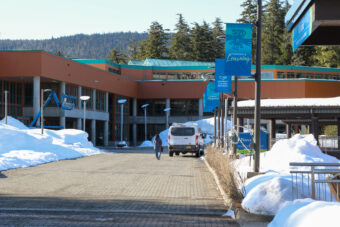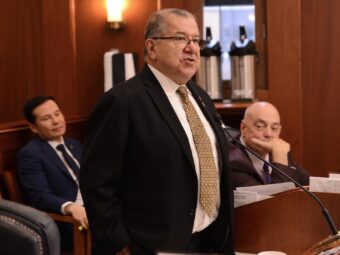
From left, Juneau School Board member Jenny Thomas, Juneau School District Superintendent Frank Hauser and Administrative Assistant Jessica Richmond listen to public testimony during a school board meeting at Thunder Mountain Middle School on Nov. 18, 2025. (Photo by Jamie Diep/KTOO)
The Juneau School District Board of Education took another step toward finding a new superintendent.
At a special board meeting Monday, the board approved a contract with a national search firm to find its next leader in a 5 to 1 vote, with board member Melissa Cullum absent.
The search comes after Superintendent Frank Hauser announced his resignation in September.
The board approved a $29,000 contract with search firm McPherson & Jacobson LLC. It previously worked with the Kenai Peninsula Borough School District and Valdez City School District to hire superintendents, according to the firm’s website.
Board member Amber Frommherz was the only no vote. She says she proposed having an interim superintendent in place following Hauser’s resignation, which the board decided not to do.
“I’m struggling with this vote right now and still, in the moment, still struggling in terms of the vote,” she said. “It’s not the lack of trust in the committee, but in the general route.”
During its last search, the board contracted with Ray & Associates and hired Hauser in 2023.
Hauser was hired with a yearly salary of $185,000. He currently makes $197,000.
The district will finalize the contract with the firm this week. Hauser’s last day as superintendent will be June 30.
Editor’s note: Amber Frommherz serves on KTOO’s Board of Directors.
Gov. Mike Dunleavy speaks to reporters ahead of his annual holiday open house on Tuesday, Dec. 10, 2024 in Juneau. (Eric Stone/Alaska Public Media)
Gov. Mike Dunleavy is dropping a longtime priority ahead of next year’s legislative session.
At his annual holiday open house on Dec. 9, the Republican governor told reporters he isn’t planning to revive his push to reform the state’s schools.
“I’ve always said this, for year after year after year, that once the issue of money is settled, nobody wants to talk about policy,” Dunleavy said. “So, unfortunately for us, I think we’re going to skip over that this year — not from my perspective, but I don’t think the Legislature enough for the people in the Legislature really have a desire to fix the outcomes.”
Improving the state’s public schools was the top issue in the last two legislative sessions. Dunleavy vetoed a series of bills seeking to boost public school funding, saying they didn’t do enough to improve student performance. He instead called for a variety of reforms that he said would help Alaska’s low test scores, in part by boosting charter schools and correspondence homeschool.
Sitka independent Rep. Rebecca Himschoot co-chairs the state House Education Committee. She said lawmakers will continue to look at ways to boost students’ test scores — even with budgets expected to be tight this year.
“We need to ensure the best value for the dollar. Obviously, accountability is very important,” Himschoot said. “At the same time, we need to make sure that our kids have opportunities. And if we look to other states, there’s a lot going on in other states that we could be doing here in Alaska.”
She said she’d also like to see a smaller boost to public school funding this year to keep up with inflation.
Rep. Andi Story, a Juneau Democrat who also co-chairs the House Education Committee, said she wants lawmakers to override Dunleavy’s veto of a corporate tax bill tied to education funding.
“Those dollars are scheduled to go for reading intervention and career-tech, and that would just, to me, be a game changer,” Story said.
Backers pitched the tax bill as a way to extract more state money from Outside tech companies who sell to Alaskans. Dunleavy said he couldn’t support it without a larger fiscal plan.
The Senate Education Committee chair, Democratic Anchorage Sen. Loki Tobin, said she planned to introduce a constitutional amendment that would “codify the right for every child in Alaska to learn about Indigenous peoples and cultures.”
“With the largest Indigenous population in the United States, it is high time Alaska guarantee a robust public education rooted in Indigenous knowledge,” she said via email.
Secure Rural Schools payments go to municipalities with large amounts of untaxed federal land — including those near the Tongass National Forest and the Chugach National Forest. (Sydney Dauphinais/KRBD)
Congress approved critical funding for rural schools Tuesday night with the Secure Rural Schools Reauthorization Act.
More than $12 million is set aside for Alaskan communities affected by the decline of the timber industry. That money goes to districts with large amounts of untaxed federal land, and is distributed in annual payments to rural boroughs and school districts — including those near the Tongass National Forest in Southeast and the Chugach near Prince William Sound.
“We had a big success,” said Rep. Jeremy Bynum (R-Ketchikan). “The legislature spoke with a unified voice that Secure Rural Schools needed to be reauthorized.”
Bynum sponsored a resolution earlier this year to renew and permanently reinstate the program. He said when the funding lapsed the past two years, those smaller rural communities felt the impact.
“We absolutely noticed that not having that funding available put an immediate pressure on, how do we backfill that funding?” he said.
In Ketchikan, the annual payments go to the borough and typically end up being between $1 million to $1.5 million. In smaller communities, like Wrangell, those payments end up being a big portion of their school budget.
The Secure Rural Schools Act initially passed in 2000 in response to the decline of the timber industry. But that funding lapsed at the end of the 2023 fiscal year. With overwhelming bipartisan support, the U.S. House of Representatives voted to reauthorize that program through September of 2026, including two years worth of back-pay.
Bynum says he knows this reauthorization isn’t a permanent fix, and that it will take work to find other ways to fill that gap and be less reliant on Secure Rural Schools funds.
“What I don’t want to have happen is I don’t want to end up in a situation where we let it lapse again, and then we’re really kind of scrambling to figure out how to effectively do the backfill for for our school funding,” he said.
Bynum says there has been discussion of filling that financial gap with longer-term logging contracts, but he doesn’t believe that will be close to enough. He says those logging contracts aren’t long enough to see forest industries revitalized.
The federal payment amounts are decided by how much money each community would have made in the height of the logging industry.
For rural municipalities that have counted on this funding for over 20 years, losing it has been a big financial blow.
In Ketchikan, Secure Rural Schools money goes directly into the Local Education Fund, a borough-managed account that funds schools and is primarily paid for with property taxes. There’s a $2 million floor for the Local Education Fund that, without a supermajority vote from the assembly, the borough’s required to stay above.
Charlanne Thomas, the finance director for the Ketchikan Gateway Borough, said that without the Secure Rural Schools money, the account went below the $2 million floor.
She says without those payments, they might have to pull from the borough’s general fund.
“So if we end up in a shortage in the Local Education Fund, it could result in property taxes being raised to make up the difference or supplementing it from the general fund, which could affect the sales tax needing to be increased,” Thomas said. “So it kind of has a domino effect. If one is shorted, it would definitely affect the other fund.”
The Secure Rural Schools Reauthorization Act now heads to the president’s desk. It is unclear when that will happen. Once it is signed into law, payments are expected to be distributed within 45 days.
A student empties the contents a Cup Noodles into a bucket at Thunder Mountain Middle School on Nov. 19, 2025. (Photo by Jamie Diep/KTOO)
Listen here:
This week, Thunder Mountain Middle School joined the growing number of schools composting food waste. Before rolling out the program, students in an environmental club led their peers through sorting out their trash and seeing how much of it can avoid the landfill.
Seventh grader Thalea Headings stuck her arm deep into a trash can, and seemed pretty grossed out by what she found. Dressed in aprons and blue plastic gloves, her science class sorts through the remains of lunch at Thunder Mountain Middle School.
They dug through trash cans filled with yogurt, half eaten sandwiches, loose vegetables and seemingly endless cartons of chocolate milk. They sort the trash into two separate buckets: one for food waste and one for everything else. At the end of the class, they weighed and kept a record of the different types of waste.
Thalea found some interesting items, to the disgust of her classmates. And sometimes it was hard to tell what’s what. She said sorting through trash hasn’t been as gross as she thought it would be.
“There’s more plastic than actual food,” Thalea said. “I was thinking there’s gonna be more food because when I’ve seen the trash cans before, there’s a lot of ranch and gross stuff in it.”
Thalea Headings tips over and reaches into a trash can during a waste audit at Thunder Mountain Middle School on Nov. 19, 2025. (Photo by Jamie Diep/KTOO)
What these students are doing is called a waste audit. All the food waste they sorted out will be composted. This effort is being led by a newly formed club at the middle school called Ocean Guardians. It’s part of a program from the National Oceanic and Atmospheric Administration that encourages schools to protect the ocean.
Seventh grader Maebell Bos helped bring the club to Thunder Mountain. She was part of the Ocean Guardian club at her former elementary school, Sayéik: Gastineau Community School, and didn’t want to give it up.
“When we went to middle school, we kind of thought to just bring it over, and we are excited that we can do that,” she said.
Maebell worked with her friends in the club to create presentations to all of the middle school science classes about what a waste audit is and what things are compostable before actually doing the audits.
Cheyenne Cuellar teaches science and math at the middle school and supervises the club. She worked with Monica Haygood, the Ocean Guardians teacher at Sayéik, to learn what the process was and applied for grant funding to bring composting to the middle school.
Though she’s in charge, she said it’s the club members that have done the bulk of the work for the waste audits.
“It’s not like I’m there helping to make sure this happened,” she said. “The Ocean Guardian kids are really just taking the lead of teaching these, for each science class, two to three class periods, of being the leaders within that class.”
The students are auditing their trash while Juneau is having its own reckoning with waste. Juneau’s landfill will likely fill up in the next decade. Composting is a way to keep food waste out of there. Maebell, the club member, said it was challenging to get some students to get on board with the waste audit and composting.
“Some people are either unaware of, like, the problems that are going on, like, on how fast our landfill is filling up and they aren’t aware. And then other people, they just don’t care for it as much,” she said. “We’re trying to make it something positive and something that we can do to help our environment.”
Still, some students simply didn’t want to go through trash. But, Aria Gribbin, another club member, said once the audit happened, those students realized it’s not that bad.
“It’s been a bit hectic trying to get all the classes to agree to it and not have a bunch of kids be like, ‘Oh, I’m gonna be sick tomorrow,’ so they don’t have to do it,” Aria said. “It’s been hectic trying to get that, but once they did it, I think they realized it’s a bit gross, but it’s also kind of fun.”
By the end of all the audits, students sorted out 319.88 pounds of food waste. And instead of going to the landfill, it was composted. Thunder Mountain joins four other schools in the district all composting their food waste.
The parking lot outside the Mt. Edgecumbe High School Aquatics Center in Sitka. (Photo by Katherine Rose/KCAW)
When the Alaska State Board of Education & Early Development met on December 3, several Mt. Edgecumbe High School alumni, as well as current and former staff said that budget and staffing cuts over the past year were putting students at risk. Several said that over 40 students have withdrawn their enrollment so far this year.
Tanya Kitka is a member of the school’s alumni advisory board. She said conditions at the school, like limited recreation opportunities and “excessively restrictive” dorm culture are negatively impacting students, and parents are worried.
“Parents, in general, feel left out or not included in the changes that have been made, and have a general mistrust of those in charge to where they don’t know who else to go to when their very real concerns don’t seem like they’re being addressed sufficiently,” Kitka said. “They’re worried for their children, and so far, the only recourse seems to be to pull their kids out of school.”
“We already started seeing issues with the budget, and we knew that there was going to be some cuts,” said fellow advisory board member Dorothy Chase of Bethel. “I didn’t think that it was going to be as bad as it is, and it’s really impacting students.”
Kristen Homer is a nurse practitioner who manages the school’s health center. But she said she was speaking as an individual. She said budget cuts this year resulted in staff resignations and turnover, including the loss of a mental health services position.
“Three days prior to the arrival of students in August, the superintendent chose to move the behavioral and mental health services coordinator position over to an academic counselor position. This left a huge gap in in the dorms,” Homer said. “There was no licensed mental health provider in the dorms, no female mental health provider in the dorms. This position was responsible for providing counseling, case management, suicide prevention and substance use programming.”
Homer said that from November 12 to the 26, eight students were hospitalized for suicidal ideation.
That information was a bright red flag to Chase.
“It’s really concerning to me to hear that there are more issues and occurrences regarding suicidal ideation,” said Chase. “[Just] one number, one person, that number is should be alarming to begin with. Alaska Natives have the highest rate of suicide. All of this should be taken seriously.”
Mt. Edgecumbe High School has two principals – an academic principal and a residential principal who oversees the dorms. Andrew Friske worked in the latter role, and as the schools activities director, for just over 20 years. He said his retirement last summer was spurred by major concerns about understaffing and student safety. He said just four of his 14 person staff from last year remain at the school. He echoed alumni testimony, and urged the board to take action by forming an ad hoc committee to investigate.
“Give the group the authority to ask hard questions and bring real transparency forward with this committee, and get the full picture, because I do feel that folks that make decisions are not getting the full picture of what’s happened at Mt. Edgecumbe,” Friske said. “I care deeply for the school, I raised my kids there. I worked there for over 20 years, and I’m asking you, as the only governing body at Mt. Edgecumbe to step up before another crisis occurs.”
At the end of the meeting, Board Chair Sally Stockhausen responded to the comments. She said the state’s commissioner of education, Deena Bishop, should get involved.
“I would like to ask Commissioner Bishop and related members of the department, to gather some more information regarding the concerns that we heard today, as well as more information regarding the ad hoc committee, and to come back to us in Jan at our January meeting, so that we can see what needs to be done,” she said.
KCAW reached out to Mt. Edgecumbe Superintendent David Langford, who is new this year, for comment
Editor’s Note: If you or someone you know is struggling with emotional distress or suicidal thoughts, you can call or text 988 to reach the Suicide Crisis Line for 24-hour support. Or contact the Alaska Careline at 1(877) 266-4357.
Close
Update notification options
Subscribe to notifications
Subscribe
Get notifications about news related to the topics you care about. You can unsubscribe anytime.