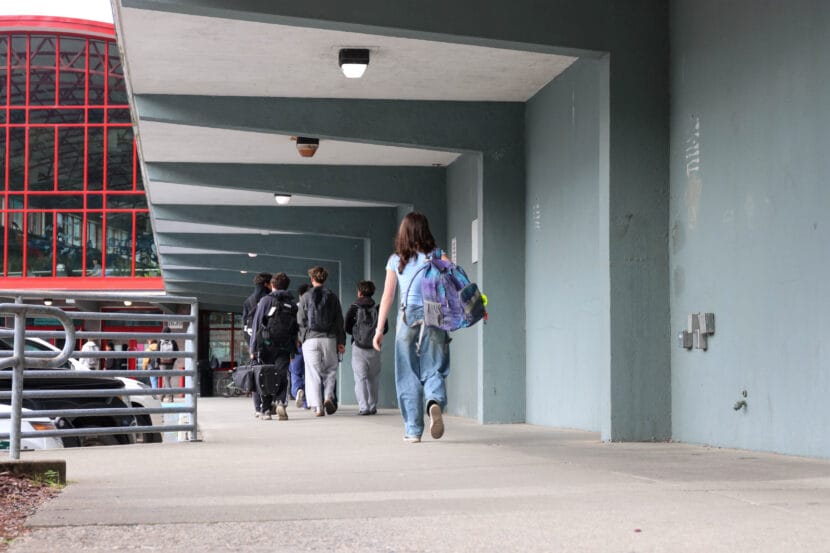
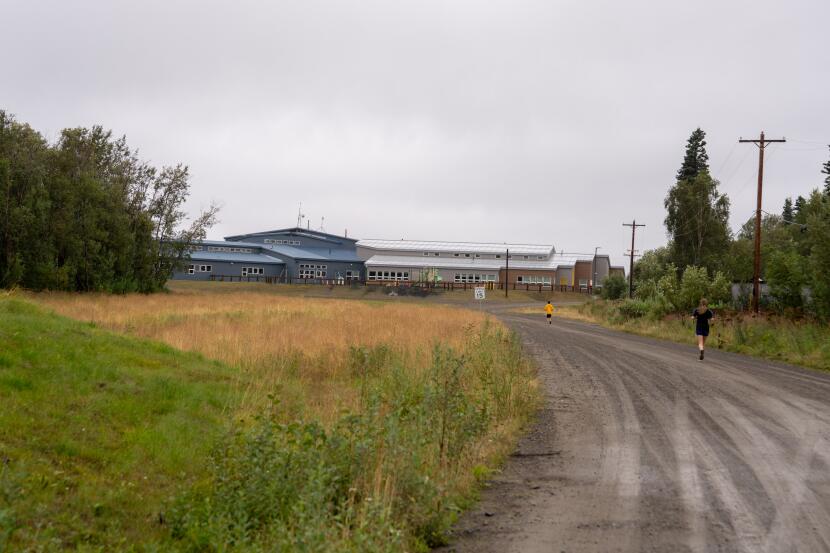
Students walk into Juneau-Douglas High School: Yadaa.at Kalé on Aug. 15, 2025. (Photo by Jamie Diep/KTOO)
Educator turnover rates in Alaska have increased overall, beyond levels preceding the COVID-19 pandemic, according to new data from the Institute of Social and Economic Research, or ISER. It comes as the state continues working on ways to improve teacher retention and recruitment in the state.
Dayna DeFeo is the director of the Center for Alaska Education Policy Research, a clearinghouse for education-related work with ISER. She said at a State Board of Education Meeting on Wednesday that the teacher and principal turnover rate has generally risen beyond rates seen before the COVID-19 pandemic.
“We’re seeing just a fairly steady, consistent upward trend,” she said. “We’re going to see this pattern no matter how we splice the data.”
In 2024, 17% of teachers and 27% of principals left their school districts. While turnover decreased during the pandemic, the new data marks an overall increase since 2013. The research builds on previous work from Regional Education Laboratory Northwest, which studied turnover rates in 2019 and 2021. While principal turnover is generally higher than teacher turnover, DeFeo said the trend depends on the type of community.
“When we start to dig into the data, they show that educator turnover is not a monolith,” she said. “It looks different. It looks different in different places, it looks different in different contexts. And as we develop policies and as we develop programs to interrupt these patterns, it’s kind of useful to look at the nuances of these data.”
For example, in 2024, principals left schools at a higher rate than teachers in communities outside of cities. But the opposite is true for urban schools, where about 30% of teachers left as opposed to 21% of principals.
According to a University of Alaska report to the state Legislature, teacher turnover rates statewide sat above the national average between 2012 and 2021. High turnover is associated with negative student outcomes.
The state has been working on improving teacher retention since at least 2020. That includes a teacher apprenticeship at the University of Alaska Anchorage and Fairbanks campuses. University of Alaska Southeast also expects to begin a principal training program next fall.
DeFeo said in an interview with KTOO on Thursday that her team plans on surveying teachers in February to see which factors play into their decisions to leave.
“What we can see pretty clearly is who stays and who goes. We can do that very accurately,” she said. “What we don’t know all the time is, why? Why they make those choices.”
ISER plans to publish a full report on turnover rates next spring.
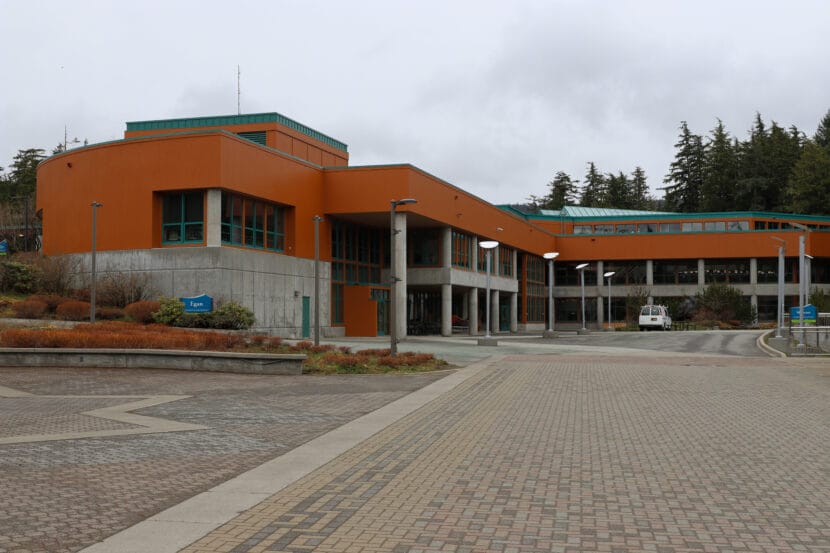
Egan Library at the University of Alaska Southeast in Juneau on April 16, 2025. (Photo by Jamie Diep/KTOO)
The University of Alaska will host listening sessions in Juneau, Fairbanks and Anchorage next week as it ramps up its search for a new president.
This comes after UA President Pat Pitney announced her retirement plans last month. The university contracted with WittKieffer, a global executive search firm, to help with the search. During the session, it hopes to get input on what the university community wants to see from the next president.
In Juneau, the firm will host sessions on Dec. 8. There will be four separate sessions, one each for University of Alaska Southeast faculty, staff, students and community members.
All Juneau sessions will be in the Glacier View Room Egan Library Classroom Wing at the University of Alaska Southeast at the following times:
UAS faculty — 9 to 9:50 a.m.
UAS staff — 10 to 10:50 a.m.
UAS students — 12 to 12:50 p.m.
Juneau community — 6 to 7 p.m.
The firm will then hold sessions at the University of Alaska Fairbanks. A community session will be held on Dec. 9 for the public. Faculty, students and staff will meet for sessions the following day.
Fairbanks community — Dec. 9, 5:30 to 6:30 p.m. at Schaible Auditorium
UAF faculty — Dec. 10, 9 to 9:50 a.m. at Schaible Auditorium
UAF students — Dec. 10, 10 to 10:50 a.m. at Schaible Auditorium
UAF and UA System Office staff — 1:30 to 3:00 p.m. in Room 106 at the Butrovich Building
Anchorage listening sessions will happen on Dec. 11 for students, faculty, staff and community members in the University of Alaska Anchorage Engineering and Industry Building Solarium at the following times:
UAA staff — 9 to 9:50 a.m.
UAA students — 10 to 10:50 a.m.
UAA faculty — 11 to 11:50 p.m.
Anchorage community — 6 to 7 p.m.
University students, faculty and staff will also be able to attend sessions over Zoom. Community members will only have an in-person option. Anyone unable to attend the meeting can also fill out an anonymous survey until Dec. 15 at 2 p.m.
According to a university press release, recruitment is expected to open in early January, with a president hired between April and May.
A 13-member search committee will review and interview candidates. Members of the community include university regents, governance representatives, as well as Alaska city and corporation leaders.
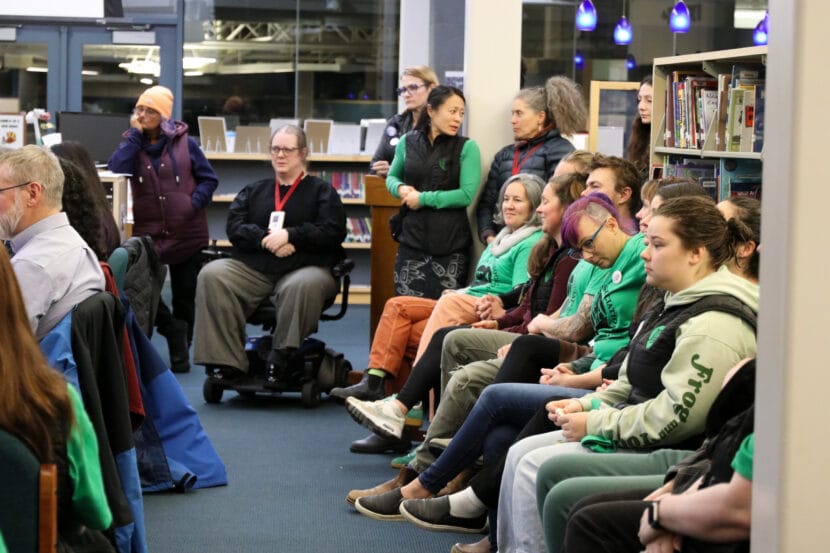
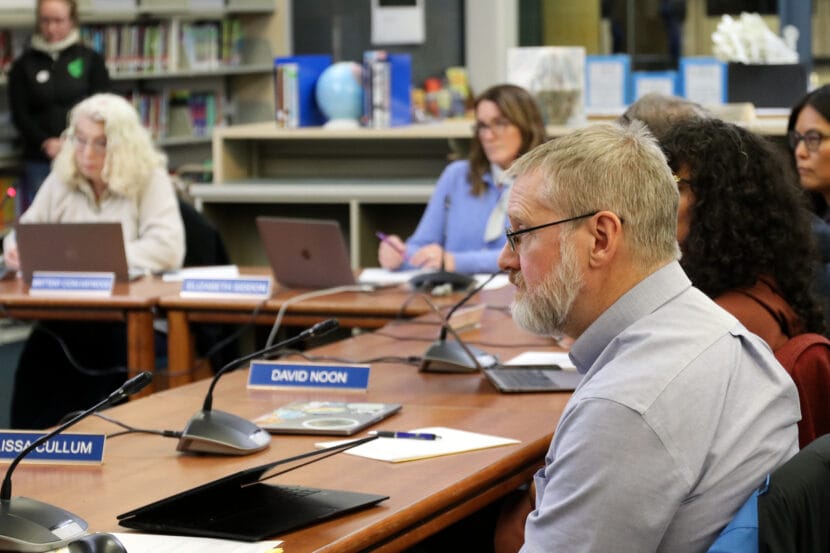
Educators sit and listen during a Juneau School Board meeting at Thunder Mountain Middle School on Nov. 18, 2025. (Photo by Jamie Diep/KTOO)
Listen here:
More than 70 educators and community members packed into the Thunder Mountain Middle School library last week during the Juneau School District School Board meeting.
During public testimony, teachers voiced their frustrations about contract negotiations.
“We’re now on the precipice of a true disaster. Dozens of your most experienced educators are waiting to see if they should stay or not,” teacher Amy Lloyd said.
Auke Bay Elementary teacher Kelley Harvey also spoke.
“It is not fair. It is not right, and you all have the power to solve this,” she said. “If you do not choose to respect your educators, this is what will happen.”
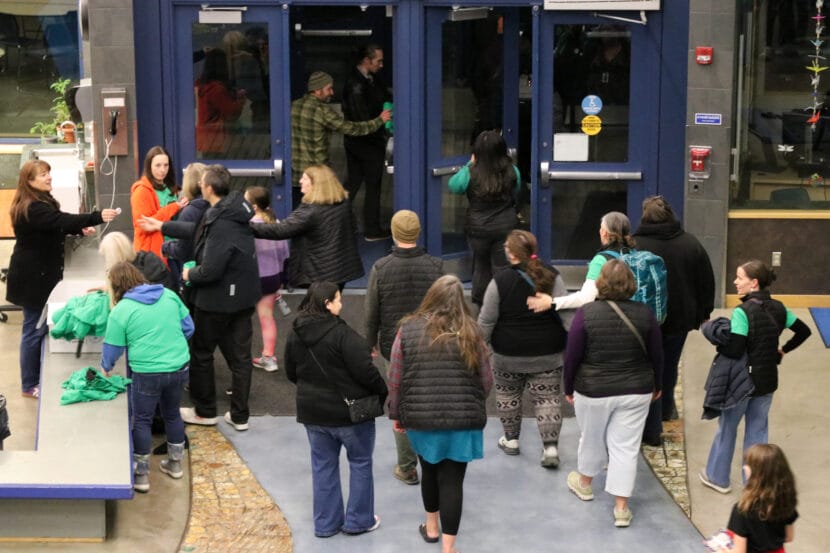
Harvey then stood up and began walking out of the library. A wave of more than 70 teachers silently followed in a mock walkout.
The teachers’ most recent contract ended at the end of June, but teachers are still working under its terms. The union and the district started negotiations for a new contract in February. Both parties declared an impasse in July and entered mediation, a voluntary process where a neutral third party facilitates discussions between both parties.
The parties had three mediation sessions before the mediator, a federal employee, was furloughed.
During the government shutdown, the district escalated the negotiation process and announced on its website earlier this month that it was initiating advisory arbitration with the union. During an advisory arbitration, a neutral third party evaluates both parties’ proposals and issues a recommendation on what to do.
Harvey, who also co-chairs the union’s negotiation support team, said the union was “completely blindsided” by the district’s announcement and that arbitration had not been discussed with the union prior.
Educators exiting Thunder Mountain Middle School after a mock walkout during a Juneau School Board meeting on Nov. 18, 2025. (Photo by Jamie Diep/KTOO)
“We do not feel that we’re at arbitration. We were still working with our mediator. They were furloughed, so we were forced to kind of stop, but we’ve been working,” she said. “We have a proposal.”
Harvey said in her 27 years with the district, she’s never seen the district move forward with arbitration without discussing it with the union.
In response to the district’s unilateral announcement, the union sent a letter saying it had not yet reached the point of arbitration.
In contract negotiations, the main sticking points for the teachers include salaries, health insurance and preparation time for middle school teachers, Harvey said.
The union’s latest proposal, which is for two years, increases salaries by 8% for the first year and 9% for the second year. It also increases the district’s monthly contribution to health insurance premiums by $25 for the first year and by another $271 for the second year.
In contrast, the district’s 1-year offer increases salaries by 3% and only includes a $10 increase to insurance contributions each month. It also cuts down how much time middle school teachers have to prepare lessons by 200 minutes each week.
The union is insured through the Public Employee Health Trust, and Harvey said insurance premiums have increased a lot for teachers, with some on family plans paying $800 more each month compared to last school year.
“Nationally, right, health insurance has gone up exponentially over the years, and contributions just have not kept up with that,” she said.
The district has increased its monthly contribution toward health insurance by $85 since 2016.
Juneau School District Superintendent Frank Hauser said the union’s latest proposal would cost the district about $12 million over the next two years, rather than the $1.84 million for one year with its previous offer. He said the district felt it has reached the right time to move forward with arbitration.
“We have spent almost 100 hours negotiating, and the time has come to schedule an advisory arbitration as required by Alaska statute and we’re ready to move forward again,” he said.
Hauser said arbitration is not a negative step and can help each side articulate what their position is.
“When negotiations is difficult, and it always is when the resources are limited, it frequently takes some kind of external deadline or external accountability,” Hauser said. “Otherwise we’d be negotiating forever to no effect.”
The district and union aren’t required to take the arbitrator’s recommendation, and Harvey, with the union, said it could open the door for the union to strike if they still can’t settle on a contract. But the union wants to avoid that “at all costs.”
The union and the district are scheduled to meet for another bargaining session Nov. 25.
Juneau School Board member Steve Whitney listens to public testimony during a meeting at Thunder Mountain Middle School on Nov. 18, 2025. (Photo by Jamie Diep/KTOO)
The Juneau School District Board of Education voted to hold off on returning $1.05 million meant for child care to the city on Tuesday.
The money makes up about two-thirds of the funds left over after the district ended its afterschool and summer child care Relationships and Leadership Learning for Youth program, known as RALLY, last summer.
Private child care provider Auke Lake Preschool now leases space at three elementary schools to provide care: Harborview Elementary School downtown, Sít’ Eetí Shaanáx – Glacier Valley Elementary School in the Mendenhall Valley and Auke Bay Elementary School.
Board Vice President Elizabeth Siddon said she wants to hold on to the funding in case the district needs to step in to provide afterschool child care again.
“I guess I’m waiting for a sort of an established track record with the Auke Lake Preschool in being successful in delivering good child care in case we have to step in and offer something to our students,” she said.
The board last month discussed ways to use the money for things like bussing students to the new RALLY program, but the district’s Chief Financial Officer Nicole Herbert clarified at Tuesday’s meeting that the bussing comes at no extra cost to the district.
Member Steve Whitney was the sole dissenting vote. He said he supports returning the money to the city to maintain a good relationship.
“These are dedicated, restricted funds from the city for a service we’re not providing or can’t provide,” he said.
The school board voted 6-1 to table the decision indefinitely. That means the district keeps the funding in the budget for now, but can only use it for child care. Herbert said there is no timeline from the city to return the funds.
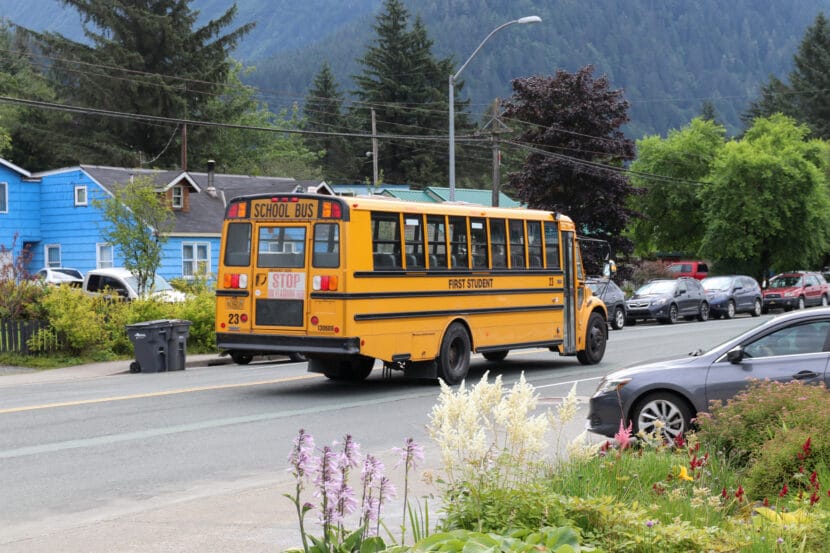
A school bus drives away from Juneau-Douglas High School: Yadaa.at Kalé on Aug. 15, 2025. (Photo by Jamie Diep/KTOO)
The Juneau School District Board of Education is considering giving $1.05 million dollars earmarked for child care back to the city at its regular meeting Tuesday.
The money was left over after the district ended its afterschool Relationships and Leadership Learning for Youth program, known as RALLY, last summer.
Private child care provider Auke Lake Preschool is now running a new program called Auke Lake RALLY, but instead of operating at four neighborhood elementary schools like the district did last school year, it’s at three: Harborview Elementary School downtown, Sít’ Eetí Shaanáx – Glacier Valley Elementary School in the Mendenhall Valley and Auke Bay Elementary School. Sayéik: Gastineau Community School on Douglas Island used to have a program.
The district is still paying to bus students from schools that don’t have the new RALLY program to schools that do. At the school board’s October meeting, members discussed the possibility of using some of the left over funds to pay for some bus transportation going to the new RALLY sites instead.
The district’s Chief Financial Officer Nicole Herbert said last month she could look into the feasibility of doing that.
The school board will also decide on its six-year capital improvement plan at Tuesday’s meeting. The proposed plan outlines the deferred maintenance and capital projects the district is prioritizing and requesting funding for over the next six fiscal years.
The board meets Tuesday at the Thunder Mountain Middle School library. The board will have a work session at 4:30 p.m. to discuss its new strategic plan draft before holding its regular meeting at 6 p.m.
Attendees can sign up to testify in person on a sheet provided by the district before the meeting begins, but anyone can provide public comment when prompted during the meeting.
The first week of school in Aniak, Alaska. Alaska’s education department has transferred ownership of 54 buildings to rural public school districts since 2003, including Aniak’s elementary school. (Gabby Hiestand Salgado/KYUK)
For more than a decade, the Kuspuk School District asked Alaska’s education department for the money to fix a rotting elementary school. The school, in the small and predominantly Indigenous community of Aniak in western Alaska, was in deep need of repairs. The nearby Kuskokwim River had flooded the 88-year-old building several times. The walls were moldy. Sewage was leaking into a space below the school’s kitchen.
In 2018, the department finally approved the school district’s $18.6 million funding request to build a new elementary school wing onto Aniak’s middle and high school building, which was owned by the state.
But on Page 4 of the funding contract for the project, Alaska’s education department included a catch.
“The State would only build the new school if the local school board agreed to own it when completed,” former superintendent James Anderson said in an email to KYUK Public Media, NPR and ProPublica.
In the end, Anderson agreed. He worried that if he didn’t, it would jeopardize kids’ health and safety. But he said he also worried about the financial and legal implications of the agreement for the school district, where nearly 30% of families live in poverty. If the state owned the building, it would be responsible for repairs and liability. Anderson worried that if the district took ownership of the school, it might be on the hook.
According to a review of deeds and project funding agreements, Alaska’s education department has transferred ownership of 54 buildings to rural public school districts since 2003. That’s nearly four times as many compared with the two decades prior. That same year, a new clause appeared in the funding agreements that districts sign with the state: In return for the money to make repairs to run-down schools or to build new ones, school districts would have to agree to own the buildings.
Alaska education department spokesperson Bryan Zadalis said in an email that the department didn’t have documentation about why the contract language changed. He wrote that “the main clauses of the project agreement are boilerplate language” and were last reviewed by Alaska’s Department of Law in 2019.
Seven current or former superintendents representing rural school districts with student populations that are predominantly Alaska Native said it’s unclear whether a change of ownership also changes a school district’s responsibility to maintain its facilities. The districts can’t use tax revenue to pay for education because the communities they serve are unincorporated. As a result, the state is required by law to pay for construction and maintenance in many rural school districts, but it often takes years to secure that money. Because the funds are hard to come by, superintendents have also said they feel pressure to sign the contracts.
“We’re all sort of trying to find the best, most optimal use of very lean resources,” said Hannibal Anderson, superintendent of the Lower Kuskokwim School District, Alaska’s largest rural district, covering an area nearly the size of West Virginia. “There’s very little room for negotiation.”
Last summer, after nearly two decades, two more Kuspuk district schools, upriver from Aniak, received funding from the state to remedy severe structural problems and serious health and safety risks that the district has reported to the state’s education department for years. In both cases, the money wasn’t enough to fix everything, but superintendent Madeline Aguillard said it was better than nothing, so she signed contracts that also required the district to own those schools.
“What choice did I have?” she asked.
Madeline Aguillard, superintendent of the Kuspuk School District, is negotiating with the state over ownership of school buildings. (Gabby Hiestand Salgado/KYUK)
Over the last year, KYUK, NPR and ProPublica have documented a health and safety crisis inside many rural school buildings across Alaska. Water lines and sewer systems are backing up. Roofs are leaking and foundations are crumbling. Until this summer, at least one school was in danger of collapse. The state has largely ignored hundreds of requests from rural school districts to fix deteriorating buildings. Some of the worst conditions exist at state-owned schools.
Losing Sleep Over Liability
Unlike most other U.S. states, where schools are owned locally, Alaska’s education department owns nearly half of the 128 rural schools open in the state today. In most cases, school districts own the remainder.
In an interview, education department staff said shifting ownership from the state to districts cuts red tape and gives districts more local control over how the building is maintained and used.
“We’re very much a hands-off landlord, as it were,” said Lori Weed, the education department’s school finance manager. “So the hope was that districts would take title to sites so that they could have the control, because we’ve been so hands off.”
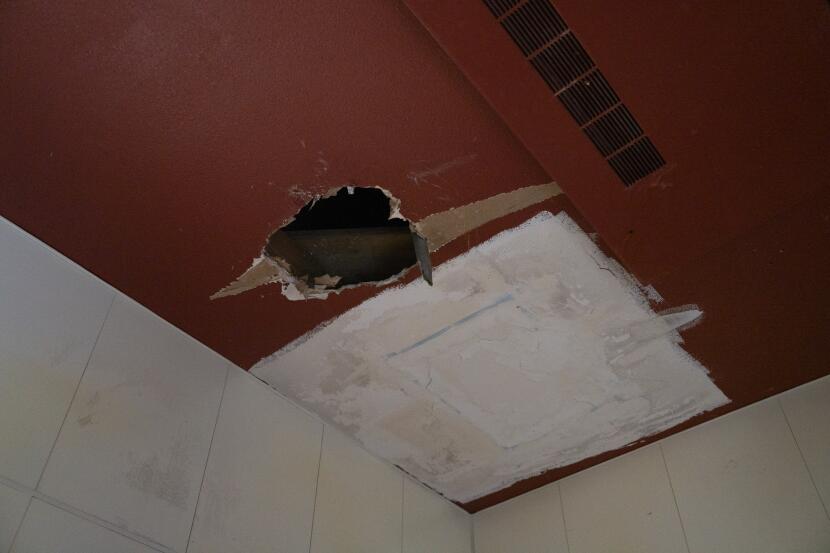
A damaged ceiling in Aniak’s high school in August. (Gabby Hiestand Salgado/KYUK)
There are several overlapping Alaska laws governing school ownership. Collectively, they allow school districts to take over supervision of school construction or maintenance projects and to initiate a transfer of ownership. None of those laws require schools to accept ownership; one says a school board “may” take that action.
However, in some cases, the education department’s contracts say that school boards “shall” take over ownership in order to receive funding.
Howard Trickey, an attorney who has spent most of his career representing public schools in Alaska, said the state could be misinterpreting the law. “‘May’ means you don’t have to do something,” he said. “So to interpret that statute to say it’s mandatory is overreaching.”
The contract for Aniak’s elementary school project says the district “agrees to comply” with several conditions and “shall request title interest of the new facility.” According to the education department, districts are permitted to request the removal of this provision, and it doesn’t require the transfer in order for a district to receive project funding.
Aguillard said she’s still trying to negotiate with the state. Records show Alaska’s education department still owns the facilities used for education in Aniak.
Trickey also believes that such ownership changes could create huge risks for rural school districts in Alaska.
“Suppose a facility was in such disrepair and had such life safety issues as inadequate electrical system, and the school catches on fire and burns down and children are injured,” Trickey said. “If the state owned it, the state would be liable for those injuries.”
A staff member with the education department said there hasn’t been a recent case where someone got hurt. “I would argue that if something happens, it’s going to become a legal battle,” said Heather Heineken, the department’s director of finance and support services, who previously was finance director for a district in Alaska’s Interior.
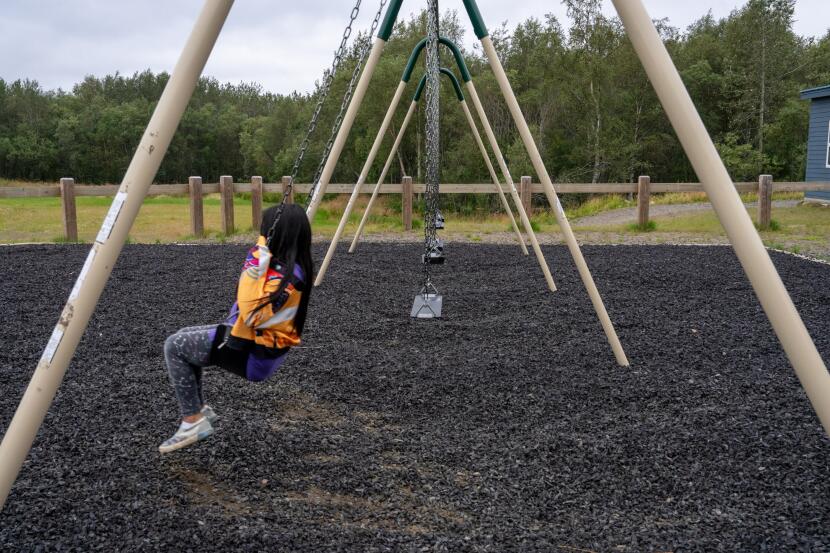
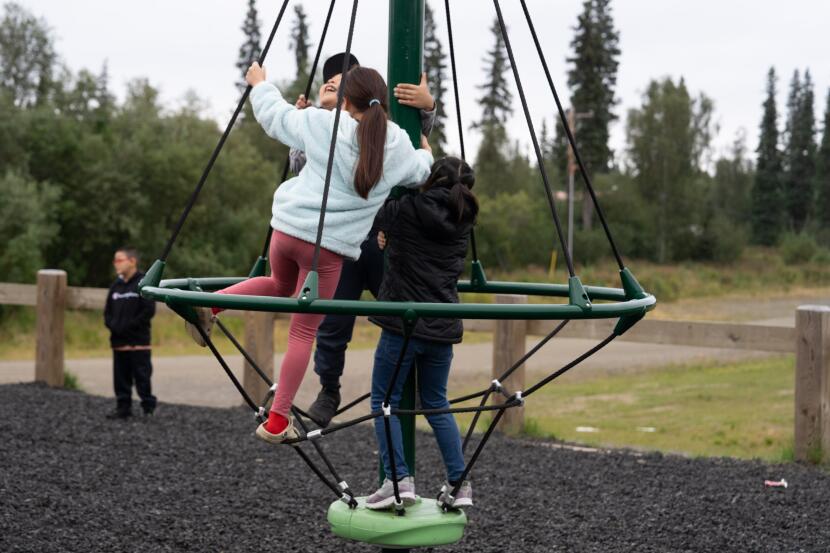
Aniak students play outside on the playground. (Gabby Hiestand Salgado/KYUK)
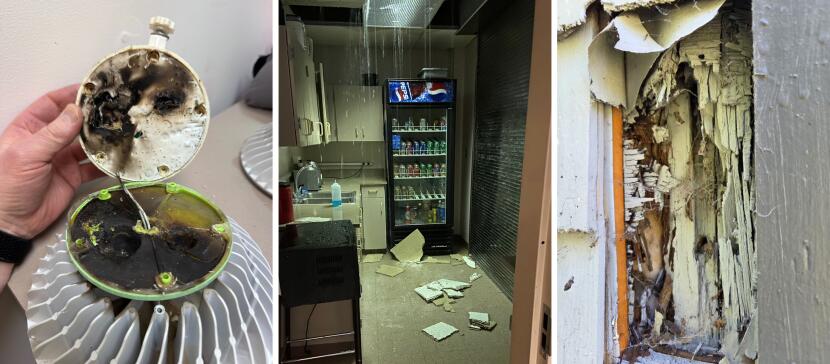
Rod Morrison, superintendent of the Southeast Island School District, said he loses sleep over liability in his schools, which suffer from leaking roofs, black mold and, at one school, a nonfunctional fire suppression system. The state transferred ownership of that school, in Thorne Bay, to the district in 1998.
In August, Morrison asked the state to allow him to use $300,000 left over from a state-funded project at another school in his district to address the fire suppression system. In September, Michael Butikofer, facilities manager for Alaska’s education department, denied the request, saying it may not be legal. He encouraged Morrison to submit a new application for the funds to fix the suppression system instead.
“When they denied the transfer of the funds or refused to fix my fire suppression system, then I requested the state to take liability of that facility,” Morrison said. “Then of course they said no, they’re not going to take liability for that.”
In a response letter, Butikofer told Morrison that the “ultimate responsibility for day-to-day safety and facility operations lies with the district.”
The district has made 17 funding requests to the state since 2009 for the money to replace the system. During a Senate Finance Committee hearing in Juneau this spring, Morrison presented lawmakers with a giant light bulb, blackened by a short in the electrical wiring in the school’s gymnasium ceiling. Morrison said it’s not a matter of if, but when, a fire might consume the building.
Rod Morrison, superintendent of the Southeast Island School District, said he loses sleep over liability in his schools, including fire hazards (left), leaking roofs (center) and structural damage (right). (Rod Morrison)
Decades of Contamination
Alaska inherited dozens of schools from the U.S. Bureau of Indian Affairs (BIA) in the three decades after it gained statehood in 1959. During those decades, state officials complained about being burdened with schools that were already in bad shape.
Those schools also came with other liability risks. Some buildings stand on land previously used by the military, where highly toxic and volatile chemicals have been found. And leaking fuel tanks have contaminated the property at dozens of rural schools, according to the Alaska Department of Environmental Conservation.
That was the case with a BIA school in the Bering Sea community of Toksook Bay, which the state acquired in 1990. There, a corroded pipe leaked 5,000 gallons of fuel into the crawl space of a maintenance building associated with the elementary school. The city of Toksook Bay sued both the school district and the state, arguing that the leak contaminated the city’s water system, damaged land and caused illness. The state Legislature approved over a million dollars in settlement funds for the city.
In response, the Legislature passed a law in 1997 that limited the state and rural school districts’ liability for chemical spills on their land. However, the law does not absolve the state or districts from paying for cleanups, which can cost millions.
Bill O’Connell, who manages contaminated site cleanup for the state Department of Environmental Conservation, said paying for cleanups is harder in rural districts. In municipal school districts, local taxes can help cover the cost. But rural districts rely on the state for nearly all of their funding.
“The money that the school districts get is just to educate the students,” O’Connell said. “There’s no consideration of contaminated site cleanup. It’s really just kind of an unmet need.”
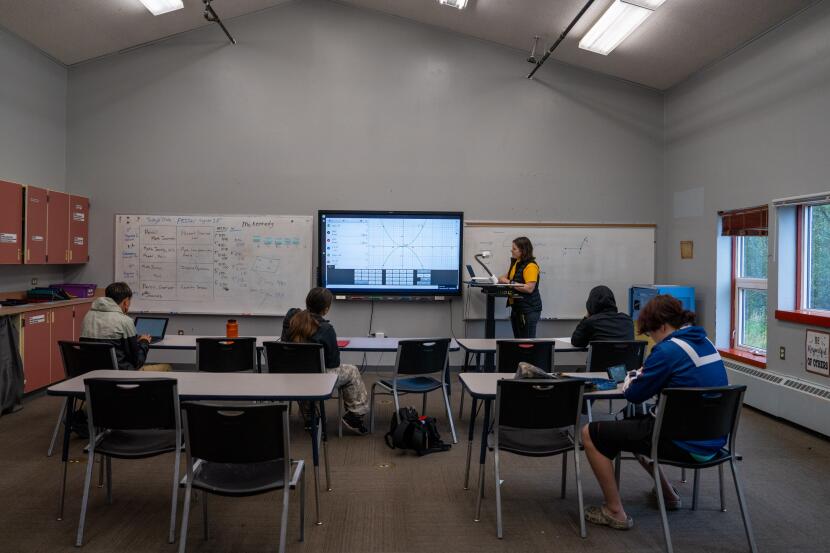
Students eat lunch during the first week of school at Aniak. (Gabby Hiestand Salgado/KYUK)Students in math class during their first week of school in Aniak. The superintendent says the state required the school district to take ownership of the new elementary school. (Gabby Hiestand Salgado/KYUK)
He pointed to an old building in Aniak that served the U.S. Air Force during the Cold War as particularly concerning. He said the legacy of highly toxic contaminants started before the building was used for education. The state-owned building, once used by the school district for vocational training, has been demolished, but its foundation stands about 200 yards from the school where kids still take classes everyday. O’Connell said cleanup at the site was officially completed this year, but there are still contaminants below the surface and it is unlikely any new construction will ever be allowed there.
In 1997, the same year the liability law passed in Alaska, a group of parents sued the state over conditions inside rural public schools where their kids spent their days. When the case was settled in 2011, the judge’s consent decree called on the state to pay for five new schools. At the time, the state owned four of those buildings. The state paid to build the schools but required each of the districts to accept a transfer of ownership.
Ken Truitt, an attorney who represented the education department in 2003, when the ownership requirement appeared in construction and maintenance funding agreements, said he does not recall being consulted on the contracts or the addition of that language.
Tim Mearig, a former facilities maintenance director for the education department, said that in the early 2000s, leadership believed “it was of no benefit to the state to hold title, and it was a significant benefit to districts to manage their own property.”
Mearig said a change of ownership was eventually “baked in” to project agreements.
Some ownership and liability questions come down to what the state’s constitution requires. Alaska’s education commissioner, Deena Bishop, said the constitution is intended to give local communities maximum control and that the department is following the law. But Trickey, the longtime attorney for Alaska school districts, said the transfers “don’t relieve the state of that ongoing, continuing constitutional duty.”
“The constitution says the state has a duty to establish and maintain a system of public schools open to the children of the state,” he said. “And that just fundamentally and basically starts with adequate schools.”
Students run toward the finish line in a cross-country race in Aniak this August. (Gabby Hiestand Salgado/KYUK)
This story is a collaboration from NPR’s Station Investigations Team, which supports local investigative journalism, member station KYUK, and ProPublica’s Local Reporting Network.
Emily Schwing reported this story while participating in the University of Southern California Annenberg Center for Health Journalism’s National Fellowship. She also received support from the Center’s Fund for Reporting on Child Well-being and its Dennis A. Hunt Fund for Health Journalism.
Close
Update notification options
Subscribe to notifications
Subscribe
Get notifications about news related to the topics you care about. You can unsubscribe anytime.