Education

University of Alaska Southeast students gather to watch sci-fi film starring campus handyman

UAS employee Karl Sears in a scene from the 2014 film “Space Trucker Bruce.” (Screenshot)

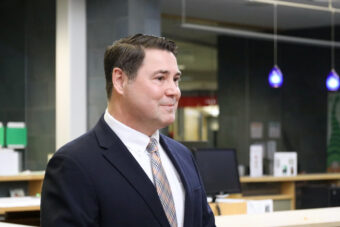
A beloved maintenance employee at the University of Alaska Southeast starred in a low-budget sci-fi comedy a decade ago. This week, some UAS students screened “Space Trucker Bruce” to honor their friendly campus handyman, and to satisfy their own curiosity.

It’s about a space trucker hauling hog fat through the galaxy who picks up a hitchhiker whose ship has broken down. Hijinks ensue.

The low budget sci-fi comedy just so happens to star UAS handyman Karl Sears. It was made by local filmmaker Anton Doiron. He and Sears are old high school friends who reconnected in adulthood. 

Years ago, they wanted to make a short film for the JUMP Society festival in Juneau. On a drive one day, they came up with the idea of making a comedy about a space trucker. 

But the ideas kept coming, and it spiraled into something bigger, said Doiron.

“It grew from making a short to making, like, a full-length movie,” he said. 

Six years later, “Space Trucker Bruce,” starring the two of them, debuted at Juneau’s Gold Town Theater. 

Sears said it’s neat that the kids wanted to show it and invited them, but he finds their interest a bit odd. 

“It’s a little strange, and like, ‘what are you guys doing with your lives?’” he said.

The film has been out for 11 years now, and it’s available for free on YouTube, so sometimes people stumble upon it. 

“People talk about it,” Sears said. “And occasionally a student will come up to me and say, ‘I just watched it. It was so funny,’ or ‘it was good,’ you know, or, ‘I watched it,’ and they don’t elaborate.”

The 2014 film “Space Trucker Bruce” stars director Anton Doiron and Karl Sears. (Screenshot from film)

Sears said the film has been shown before, but this is the first screening he decided to come to. 

Ella Kelly is a residential advisor at UAS. She organized this screening and, like many students, she considers Sears a friend.

“He’s the only maintenance guy for housing,” she said. “So everybody’s had an encounter with Karl, and they’re all like good interactions, because he’s so nice and friendly.”

Kelly said she didn’t know about the film until she saw the poster for it outside of Sears’ office

“It’s always made me very curious,” she said. “Because I’m a big fan of a low budget film.”

About a dozen students came to the screening, and they filled the room with laughter.

Doiron said he has a new project coming soon that Kelly may like. It’s called “Girl, Yeti, and a Spaceship,” and there are some thematic similarities to his first film.

“There’s a bored state worker,” he explained. “He’s in management, and he’s bored, and he takes his dog out hiking one day, and he sees Bigfoot, and he starts following Bigfoot, and he finds this cave with a big spaceship in it, and the spaceship is broken.”

Hijinks ensue. Doiron said the new project comes out next year.

Newly-elected Juneau school board members officially begin terms

From left, Jenny Thomas, Melissa Cullum and Steve Whitney get sworn in as Juneau School Board Members at the Thunder Mountain Middle School library on Oct. 28, 2025. (Photo by Jamie Diep/KTOO)

The Juneau school board swore in three members and honored two outgoing members at a meeting Tuesday. 

In this fall’s municipal election, Steve Whitney was reelected to the board after being appointed to fill a seat vacated earlier this year. Jenny Thomas and Melissa Cullum were elected to the board for the first time.

The board honored outgoing members Emil Mackey and Deedie Sorensen. Mackey initially joined the board in 2015. In his outgoing remarks, he said he hopes to see an end to what he called an “attack on our public servants” nationwide. 

Sorensen worked as a teacher for the district for more than 35 years and was elected to the board in 2019. She ran unsuccessfully as a write-in candidate this fall.

Deedie Sorensen and Emil Mackey exit the Juneau School Board meeting at Thunder Mountain Middle School on Oct. 28, 2025. (Photo by Jamie Diep/KTOO)

Both Sorensen and Mackey survived a failed recall effort last year following the district’s school consolidation last year. Mackey commended Sorensen for attending meetings while undergoing cancer treatment during that time.

“She could have died during that process, and she did not miss a single meeting,” he said. “She would have chemo in the morning, and she would be on the Zoom call later that night.”

Sorensen thanked the public and her colleagues before leaving and said she plans to enjoy some time off.

“I got my all clear from my oncologist last week, and so, you know, so for the knowable future, things are looking really good,” she said.

Once the new members were sworn, the board immediately got to work on district business, including formally accepting Superintendent Frank Hauser’s resignation and listening to more than an hour of public comment about union contracts.

UAA school psychology program faces hurdle in state approval over social justice concerns

A skybridge at the University of Alaska Anchorage campus as pictured on April 12, 2025. (Photo by Jamie Diep/KTOO)

Listen here:

The University of Alaska Anchorage kicked off its new school psychology masters program this fall to address a shortage in school psychologists.

But the program has so far failed to get approval from the state Board of Education over concerns about social justice advocacy. That could make it harder for students to get jobs after they graduate. 

Alaska has very few local school psychologists. They are trained to evaluate students to see if they qualify for special education services, and provide mental health support.

But very few work directly for school districts. To fill the gap, UAA professor Hattie Harvey said districts contract with school psychologists instead.

“So that often looks like someone from Lower 48 coming up two to three times a year for special education testing, which is a very small percentage of the capacity of the role of a school psychologist, they could provide,” Harvey said.

Alaska is one of two states that didn’t have an in-state school psychology program. Harvey spearheaded efforts to launch the state’s first program at UAA.

The goal is to train school psychologists locally, in a state where they currently serve more than three times the national recommended average of students. In the 2023-2024 school year, the ratio of school psychologists to students in Alaska was 1 to 1,576. The national standard is 1 to 500.

But the first cohort of students might struggle to find work immediately after graduating because of licensing requirements.

Harvey said state law requires school psychologists to get their license to work in the state in a couple ways.  

“They can graduate from a NASP-accredited program, which is the National Association of School Psychologists,” she said. “It’s the one accrediting and the only accrediting body for school psychology programs across the nation. And then the second way is graduating from a state-approved program.”

Harvey said the university is in the accreditation process. The earliest they can achieve accreditation is in 2029, which is a year after the current cohort is expected to graduate.

The state Board of Education makes the decision on approving the program, in order for students to be able to get licensed through the state. But the board voted down the approval earlier this month in a split vote and asked the university to make changes based on their feedback.

Students still have an option to apply for a national certification after graduating that would allow them to get licensed in the state. But Harvey said the process is much longer than the other two pathways. That could mean students would have to wait a year after graduating before being hired by a district.

Board member Kathryn McCollum was one of the members who voted against approval. She said at the meeting she was concerned about an article from a sample syllabus that focused on social justice, as well as the structure of the program.

“I really do know that we need school psychologists, and I do appreciate the work that they do in the schools,” McCollum said. “I don’t want a program that is designed to create, basically activists.”

She said she was concerned the program could become overly political or divisive. 

Sally Stockhausen chairs the board and voted in favor of the program. She’s the special education director for the Ketchikan Gateway Borough School District and said school psychologists need to learn about social justice as part of their education.

“I would much rather us educate and have graduates leave who know what’s out there, rather than, than, than remove all exposure to, to these thoughts.”

Social justice and advocacy is a part of a framework for practicing school psychology as laid out by NASP. Emily Wendling is a school psychologist for the Anchorage School District and the state’s delegate for NASP.

She said social justice plays a big role in her daily work, which is largely about supporting student mental health and making sure they have equitable access to education.

“A part of that is making sure that we are understanding social justice and helping to prevent barriers or address barriers to students’ education and create equitable opportunities for all of our students.”

Ella MacRae moved to Alaska last summer and is enrolled in the new program. She called the program “life-changing” and hopes to stay in the state after graduating. She said accredited programs from outside the state touch on these topics, and hiring school psychologists from those programs means they will also be learning about topics of social justice.

“Why are we stopping our school psychs here, or trying to stop them from touching on those themes, especially when it’s so important that we have this program and include other things that out-of-state programs might not touch on, like, have an emphasis on rural communities,” MacRae said.

Megan Beattie is also a student in the program and works as a special education teacher for the Fairbanks North Star Borough School District. Beattie said the program has already helped her work as a teacher, where she spends her day advocating for her students.

“I advocate for my students all day, every day, whether it’s working with my co-teachers and trying to get accommodations in place for my students that have special education needs, or if it’s working with our counseling department to make sure that my kids’ mental health needs are met,” she said. “Sometimes it’s even literally just getting them fed.”

 She said it’s been frustrating to see the board vote down the program.

“Yes, we’re exposed to different ideologies, we’re exposed to different research methods, but ultimately, our job is to advocate for our students and meet their best needs,” she said. “And so having one article that came up as kind of a primary reason for not approving the program as a whole is really frustrating.”

Beattie said she’s concerned about the lack of state approval and the idea of not being able to work as a school psychologist right after graduating. The program has a full-time internship that means students like her won’t be able to work their normal jobs for a school year. And they might not be able to get their old jobs back if they need to go through a longer certification process.

Beattie said she hopes the board will approve the program at its next meeting. She said she wants to stay in the state to continue to support students.

“This is home, and Alaska can sometimes get the short end of the stick on resources and everything anyways,” she said. “So to be able to give back to the state that has raised me and given me the opportunities that I have had in life is really important for me.”

The state board is expected to meet again in December.

Typhoon displaced students, teachers from Western Alaska continue school across the state

An Alaska Air National Guard C-17 Globemaster III, assigned to the 176th Wing, arrives at Joint Base Elmendorf-Richardson, Alaska, with approximately 300 evacuated residents from western Alaska, Oct. 15, 2025. (Alaska National Guard photo by Alejandro Peña)

Hundreds of students displaced by the storm devastation of ex-Typhoon Halong in Western Alaska are entering school in other communities, including Bethel and Anchorage.

Deena Bishop, commissioner of the Alaska Department of Education and Early Development, said most displaced students have enrolled in Bethel or Anchorage schools. She estimates 100 students have enrolled in Bethel, remaining in the regional hub of Western Alaska and the Lower Kuskokwim School District. State officials estimate 140 students have enrolled in the Anchorage School District so far, according to an update on Sunday.

Students have also enrolled in other schools across the state, but in smaller numbers, depending on where families have relocated after the storm, Bishop said. Those include the Nenana and Fairbanks areas, the Kenai Peninsula, Matanuska-Susitna Valley Borough, and other rural areas, as well as boarding schools.

“All the support from the state, including from the Department of Education, has been in support of what the family would like to do,” Bishop said.

For those in Anchorage, she said the Anchorage School District is coordinating with state, tribal and non-profit partners to provide services to students and families — including transportation from emergency shelters to schools, health services, meals, and English translation services for predominantly Yup’ik families.

Alaska Air National Guard C-17 Globemaster III aircrew, assigned to the 176th Wing, arrive at Joint Base Elmendorf-Richardson, Alaska, with 62 evacuated residents from western Alaska, Oct. 17, 2025. (Alaska National Guard photo by Alejandro Peña)

The Anchorage School District said it is trying to keep displaced students together. It has enrolled a number of students in the Yup’ik immersion program at College Gate Elementary, which provides bilingual classes and cultural activities, as well as the Alaska Native Charter School, Lake Otis Elementary, A.J. Wendler Middle School, Bettye Davis East Anchorage High School and King Tech High School.

Bishop said teachers and school communities are welcoming students, and “doing an excellent job in just a devastating situation.”

Anchorage Superintendent Jharrett Bryantt was not available for an interview, but echoed the district’s commitment in an update to the school board on Oct. 21. “There was one common trend, which is that our teachers, our principals and our community members are standing with Western Alaska, and they were there to greet the students and make them feel as welcome as possible during this difficult time,” he said.

Many students left their villages in the mass evacuation in the days after the storm devastation, with just one bag they could carry. Bryantt acknowledged the culture shock and trauma of the displacement as families relocate and resettle. Evacuees face challenges like finding housing and replacing clothing and personal belongings. Some are reuniting with family, neighbors and pets.

“We’re not just here to teach them. We need to address the whole child, and in this moment, as strong as these students are, they’re going through trauma and it’s going to take a lot of work,” he said. “But we’re going to put that in, because these kids are worth it, and they deserve a wonderful education that we want to offer them, in ASD, for as long as they’d like to be here.”

Lower Kuskokwim School District Superintendent Andrew “Hannibal” Anderson said the re-enrollment of their students into other schools in Bethel and Anchorage is going well, and added the districts are working with families through the ongoing logistics of replacing documentation and finding long term housing. Particularly in Anchorage, he said there’s an effort to keep Lower Kuskokwim students and classes together.

“So Anchorage [School District] has really very much been the key in helping our students find places and to find opportunities for more of our students to be together rather than randomly spread throughout the Anchorage community,” he said.

Anderson said some teachers and paraprofessionals who evacuated from the west coast region have even begun working for ASD, but the majority have stayed in their district and communities where they’re working out new positions.

He said as the students flow to different parts of the state, the district is working  to reassign the teachers who stay. That involves considering their certifications and any vacant positions that already exist in the district, as well as new positions that have emerged as displaced students enroll.

“The primary effort is to support as well as we can the already existing relationships between students and teachers, and then see what we can do with that as time moves forward,” Anderson said.

Rural schools at center of Typhoon recovery

The Lower Kuskokwim School District encompasses most of the region hardest hit by ex-Typhoon Halong. Many of its 22 village schools served as emergency shelters in the days after the storm, and are now centers for the recovery and relief efforts. The region is accessible only by boat and plane.

The Lower Kuskokwim School District encompasses the region hardest hit by ex-Typhoon Halong, and includes 22 community schools and five schools in Bethel, all only accessible by boat and plane. (Screenshot)

Some 400 people sheltered in the school in Kwigillingok, and more than 500 people in Kipnuk, two of the hardest-hit communities in the first days after the storm, before mass evacuations began.

Anderson commended the schools and staff on the frontlines of the disaster for “receiving so many of the community members into the shelters and there and taking care of them, providing all they could for the needs of large numbers of people.”

Residents sort donations at the school in Kipnuk, which provided emergency shelter to the community of nearly 700 in the days after ex-Typhoon Halong devastated the community, and before most residents evacuated. (Photo courtesy of Jacqui Lang)

And now he said many school staff are involved in the relief efforts, as schools have utilities and space to serve as central community sites and house emergency crews responding to storm damage. Anderson said schools are often the largest and most stable facilities in their communities, so it is a “great contribution” to the recovery effort.

Some schools in the region are still grappling with power outages, including Kipnuk, Kwigillingok, Kotlik, Nightmute and Akiak. Akiak has been without power since a power plant failure in mid September. Others that suffered less storm damage are up and running, Anderson said. “Far and away, most of the schools in the district are functioning,” he said.

Disaster funding for rural schools

Bishop said disaster relief is the state’s immediate priority. But as students and families find more permanent housing and get settled into schools, she said DEED is applying to federal grants so that the state can fund districts’ extra costs.

She said school districts are taking care of students and making sure they don’t have to wait for services, so now the state will work with districts to figure out financial support that adheres to statute.

She said “it was definitely the message of the governor that either receiving schools, as well as the Lower Kuskokwim schools, should be compensated, and we are to work on figuring that out.”

She said districts will also qualify for disaster relief from FEMA, the Federal Emergency Management Agency, under the federal disaster declaration. “Each of the schools affected could get upwards of a $250,000 grant,” she said.

Bishop said the long term impacts remain to be seen, and the ultimate goal is to get residents back to their communities. “We don’t want anyone to get lost in a big city, and we don’t want anyone to get lost anywhere. We want to be able to work with the state and those other divisions to restore those communities, to create healthy communities again, where they can live and work and go to school together,” she said.

State officials estimate more than 1,500 people are displaced by the storm disaster. The state has received 1,104 applications for state individual assistance, according to a statement from the Alaska Division of Homeland Security and Emergency Management on Tuesday. Applications are open on the state’s website, through Dec. 9. Individual assistance is also available from FEMA and from the American Red Cross.

Alaska cities and school districts scramble to close budget gaps after state cuts bond debt payments

Dillingham City School District Middle/High School building.
Dillingham City School District Middle/High School building. (Margaret Sutherland/KDLG)

The City of Dillingham and the Lake and Peninsula Borough government are two of 17 Alaska municipalities and school districts that are trying to close budget shortfalls after the state cut its payments for school construction and renovation projects by roughly 25-30% this year.

The payments are part of the state’s School Bond Debt Reimbursement Program, which started in the 1970s. Local governments borrowed money to pay for new or improved school facilities, and the state committed to help repay the debt over time.

The proposed reduction to the bond reimbursement program originated in the Senate Finance Committee last session. Bristol Bay Representative and House Speaker Bryce Edgmon says the Legislature had to cut costs for several projects to balance the budget and avoid dipping into the state’s savings account, the Constitutional Budget Reserve.

The cost for the state to fully fund projects under the program would have been roughly $47 million a year. The reduction cut roughly $12 million of that.

“When you start looking at the finances of a small, first-class community like the city of Dillingham, that reduction is quite meaningful to their bottom line,” Edgmon said. “I would also point out it signifies how tight the budget really is getting down in Juneau, with costs increasing at every turn.”

‘A huge chunk of money’ from Dillingham’s budget

In 2015, the Alaska Legislature paused funding of new projects for 10 years, a moratorium that expired on July 1. But the state kept paying for pre-moratorium debt, like for a $15 million bond Dillingham voters approved in 2008 to pay for repairs to Dillingham school facilities.

“The state said, ‘Listen, we’ll help support you, you go out and get the bond. We are going to reimburse you for 70% of that bond,'” said Anita Fuller, finance director for the City of Dillingham.

Fuller said that in normal years, the city paid the remaining 30%, primarily with local tax revenue. But this year, the state cut its help with the debt by $231,000, roughly 30% of its commitment to Dillingham’s schools.

“That’s a huge chunk of money because that’s $231,000 that we just lost,” Fuller said. “Somebody’s paying that school bond. If the state’s not, then that means we are.”

All 17 districts and municipalities in the program face the same roughly 30% cut. In the Lake and Peninsula Borough, district officials say that amounts to a roughly $250,000 cut — about 8.5% of the borough’s total education budget for the year.

Lake and Peninsula Borough officials say they will have to shift money from other commitments or drain their reserves to close the gap.

Meanwhile, Dillingham’s city council introduced a revised budget at a special meeting earlier this month to make up for the lost funding.

Various departments are facing cuts, though Fuller says they can’t all be attributed to the loss in bond reimbursement because there were other budget changes to account for.

But she says the cut pulls from the finite amount of money available for all departments.

“All of that money comes from our general fund,” Fuller said. “So money that was going in there to help us with the library or the senior center or the school, all that comes from our general fund.”

Other changes to the budget include a $200,000 increase to the estimated FY26 income tax revenue and a $111,000 annual lease-to-own payment for a new grader.

Fuller said the librarian and senior center director positions were consolidated into one position, and the two full-time staff members at the senior center have been reduced to part-time.

After the moratorium, questions about the program remain

This isn’t the first time lawmakers have shorted the reimbursement program. In 2019, the governor cut the program and left districts to shoulder the majority of the debt payment from 2020 through 2022. Then, in 2023, they back-paid districts and municipalities for those three years.

Edgmon says that it is possible that will happen with this reduction as well. He says funding next year and possible retroactive payments depend on state revenue, especially the price of oil. Alaska’s oil prices are currently lower than what lawmakers budgeted for.

“That makes me a little nervous in terms of what our budget situation is going to look like next year,” said Edgmon. “My hope is next year we can come back and fully fund the bond debt reimbursement program and really maintain our commitment to municipalities and school districts.”

The reduction in funding coincides with the expiration of the 10-year moratorium on the program. Organizations have been calling for the state to lift the moratorium and reopen the bond debt reimbursement program for years.

“There’s this pent-up need for money to build school infrastructure or repair school infrastructure that hasn’t been addressed since the moratorium,” said Carole Triem, government affairs manager for the Alaska Municipal League.

On the other hand, Triem said the fluctuation in state funding makes the program risky for communities.

“It’s hard for them to say, ‘I feel confident that if we go out and bond for a new school building or fixing a school building, that the state will honor its obligation to repay that debt,'” she said.

But Triem said the need may be great enough for districts to take that risk.

New podcast from Juneau youth debuts with a spooky interview

Penny Maes as Little Red Riding Hood interviews the Big Bad Wolf, Lucas Kelleher on Oct. 21, 2025. (Photo by Yvonne Krumrey/KTOO).

In Juneau, young people have a new way to find their voice. 

This fall, a digital media club for youth is teaching technical skills and encouraging kids to explore their creativity through audio and video. And their first big project — inspired by Halloween — puts a new twist on an old fairy tale. 

“Quiet on set! Roll tape,” said Levi Spaulding as he directed a room full of middle schoolers in front of mics and mixing boards wearing headphones and costumes.

The kids meet in the new Indigenous Sciences Building on Sealaska Heritage Institute’s campus, which features a recording studio. 

Penny Maes practiced her interviewing skills under a bright red hood.

“Hi, everybody, it’s me, Little Red Riding Hood, and we’re here today with Mr. Wolfie Wolf Wolferson,” she said into the microphone. “Give a hand and get your bear spray out.” 

Recording their on-camera interview in front of a green screen, Penny demanded answers to the hard questions. 

“So, Wolf, why did you eat my grandma?” she said.

Lucas Kelleher answered her through a plastic wolf mask. 

“I didn’t!” he said.

Cory Wolf is the instructor. He has a background in documentary film, and wants to use his skills to help kids find theirs. 

“By giving them a space where they can learn the technical skills, it also gives them a space where they’re working with others as a team,” he said. “So just allowing each of the different gifts that come into the room, allowing those gifts to flourish.”

He said the kids are inspired by podcasts, which have blown up for younger audiences over the last few years. 

“All of the kids have their favorite podcasts,” Wolf said. “A lot of them that come to my class actually have a vision for their own podcast.”

And while they’re working on a Halloween-themed exclusive interview now, upcoming programs will continue to build the skills they need to launch their own projects. 

“Kind of the motto of that space is to give our young people a voice,” Wolf said.

The podcast – audio and video – will debut on Halloween at the Zach Gordon Youth Center. 

Site notifications
Update notification options
Subscribe to notifications