Education

Preliminary results show Juneau voters in favor of affordability measures, against seasonal tax

Assembly District 2 candidate Nano Brooks smiles as he waves signs in the Mendenhall Valley on Election Day on Tuesday, Oct. 7, 2025. (Photo by Clarise Larson/KTOO)

Preliminary results are in for Juneau’s 2025 municipal election. 

They show that most residents don’t want to implement a new seasonal sales tax system in Juneau next year, but are in favor of the two measures that aim to reduce the tax burden on individual residents.

According to the results shared by the city, 3,534 people voted no on Proposition 3 while 2,514 people voted yes — a 1,020-vote difference. 

Proponents say the change would take advantage of 1.7 million cruise passengers that come to town each summer, while giving year-round residents a break during the winter. Opponents say the system won’t actually save residents money in the long run. 

Meanwhile, early results show both Propositions 1 and 2 passing. Both were put on the ballot by an advocacy group called the Affordable Juneau Coalition.

Proposition 1 seeks to cap the rate the city uses to determine how much residents pay in property taxes each year. Results show yes votes are leading by less than 100 votes. 

Proposition 2 would exempt essential food and residential utilities from local sales tax. Votes in favor of the proposition led handily, with 4,173 people voting yes, while 1,867 people voting no.

District 2 Assembly candidate Nano Brooks narrowly outpaces incumbent Wade Bryson for his seat on the Assembly. Brooks is leading by a mere three votes. 

Incumbent Assembly members Greg Smith and Ella Adkison ran unopposed for their seats. Smith is seeking his third, three-year term on the Assembly, while Adkison is seeking her first full term. She was originally elected to the Assembly in 2023 to fill the remaining two years in the term of a member who resigned. 

Steve Whitney, Melissa Cullum and Jeremy “JJJ” Johnson are leading in the race for the three open seats on the Juneau Board of Education. Write-in candidate and current board president Deedie Sorensen trails behind all four candidates on the ballot by nearly 1,000 votes. 

Voter turnout as of Tuesday’s results was just under 22%. However, things could change significantly. The tally shared on Tuesday only includes ballots that were mailed in or dropped off before Election Day. That means there could be thousands of votes left to be counted. 

The results shared Tuesday night are subject to change —  more updated preliminary results will be shared by the city in the coming weeks. Results won’t be certified by election officials until Oct. 21. 

Find the latest election news at ktoo.org/elections.

Juneau high school students vote in annual mock elections. How will they stack up against final results?

a woman in a black shirt and blue scarf looks down in front of students in a classroom.
Juneau-Douglas High School: Yadaa.at Kalé teacher Amy Lloyd instructs a government class on Oct. 2, 2025. (Photo by Jamie Diep/KTOO)

Listen here:

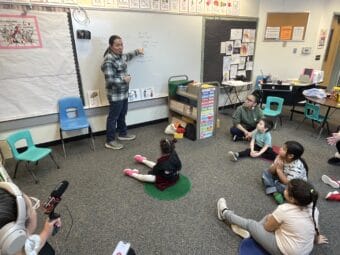
Yaaḵoosgé Daakahídi High School teacher Electra Gardinier talked to students during a recent mock election in her fourth period U.S. Government class. She had spent the week explaining the different candidates and propositions. Now the students – most of whom are too young to vote – were casting their votes on sample ballots.

“So you have a ballot in front of you, and it looks like what I have in my hand, and on that ballot, it is asking us to vote on Proposition One, Two and Three,” Gardinier told the class. “We just talked about those propositions. It also asks you to vote for your Assembly member and school board members.”

Gardinier tallied up the votes in the school board race after class.

“For the last candidate, it looks like we would not be able to come to a consensus. Oh, no. Jeremy — J. J. J. So J. J. J., Steve Whitney and Jenny Thomas,” she said.

Students also approved all three ballot propositions in this year’s election. 

Gardinier said students that attend Yaaḵoosgé do so because they have been unsuccessful in some part of their education. She said that makes it really important for her to give her students a voice in this class.

“Sometimes that can mean that we have a population that already feels marginalized, academically, let alone how they’re feeling in other aspects of their life,” she said. “And so a lot of times, I fear that that creates this apathetic mentality of like, ‘nothing ever gets better for me. It doesn’t matter how I think. Nobody cares what my views are.’”

Gardinier said she wants students to feel engaged and heard, while also understanding what they are voting on.

“When I’m teaching, I try not to put anything above a sixth grade level. And it’s fascinating to me that a ballot is absolutely written at a level beyond that,” she said. “So I mean, I have kids who are not going to understand what they’re voting for, and that is something that I’m trying to combat.”

How did government students’ votes stack up over at Juneau-Douglas High School: Yadaa.at Kalé?

Eighty students voted in that mock election. They “elected” Jenny Thomas, Melissa Cullum and Steve Whitney to the school board.

For the Juneau Assembly, Nano Brooks eked out a narrow victory over Wade Bryson by one vote in the only contested race. 


As for the ballot propositions, the students approved the first two questions, but narrowly voted down the proposed seasonal sales tax. 

At least one student at JDHS will actually be able to vote this year. 

Samuel Lagerquist filled out his ballot ahead of Election Day. He said the structure of the class helped him learn more about the different candidates and ballot propositions. He said he also learned about how his peers are thinking.

“In this class, I was kind of presented with some different perspectives that I didn’t really think about, mainly concerning the first two ballot measures,” Lagerquist said. “It also offered a really good place to, like, kind of stay updated, and motivated me to stay updated into the actual news.”

Lagerquist said he feels it’s important to vote in a local election, even when statewide and national elections often see larger turnouts.

“The sales tax or ballot initiative ones are gonna have a more, like, day-to-day, actual, real effect on me. And so I think that, honestly, it’s probably more important than, like, your national elections, even though, you know, those are really important,” Lagerquist said.

While he doesn’t plan to be in the state for college, Lagerquist said he plans on voting absentee in next year’s Alaska election, when the governor and two congressional seats will be up for grabs.

Amy Lloyd teaches government at JDHS. She said the results for the mock election were a bit unexpected.

“I thought it was going to be 70/30 and it was more like 50/50 which shows me that they understand the value of their vote, and even if they didn’t say anything in the conversation, they voted how they wanted to vote,” Lloyd said. “So that was pretty cool.”

 She said it’s a big responsibility to teach students about the government. 

“We are living in America, we’ve got to understand the government,” she said. “It’s really exciting to teach a class that is so obviously in their best interest to know and learn and pay attention to.”

Real ballots in Juneau’s by-mail election must be returned by 8 p.m. Tuesday. Initial results are expected later in the evening.

From boxes to bookshelves: Kax̲dig̲oowu Héen Elementary reopens library after repairs

A man in a black T-shirt extends his arm toward picture books on short, wooden shelves.
Kax̱dig̱oowu Héen Elementary School librarian and arts specialist Davin Savikko gestures at picture books at the school’s library on Oct. 1, 2025. (Photo by Jamie Diep/KTOO)

Davin Savikko wears a lot of hats at Kax̲dig̲oowu Héen Elementary School. In addition to teaching integrated arts, he also works as the school’s librarian. And the library looks really, really different this year.

On Wednesday, Savikko walked around and pointed out handmade signs marking different sections and genres, from “spooky stories” to historical fiction and staff picks. Sunshine streamed through stained glass windows, lighting up the “everybody books” section of the library. Picture books filled cubby-like shelves on top, with books filed in a traditional manner on lower shelves. 

“It was really cool to get these new bins like you see at the public library that are accessible for young kids,” he said. “Before it was just, everything looked spines out and it was just really overcrowded.”

The school closed temporarily in 2022 after flooding from burst pipes. While students could go back to the school a couple months later, the library needed more repairs.  Instead of bookshelves, books sat in cardboard boxes that Savikko dug through as needed.

 The school received the final insurance reimbursement earlier this year. About $94,000 went toward buying materials for the library, according to meeting minutes from an April Facilities Committee meeting.

Between waiting on insurance payouts and getting supplies, it took more than three years to reopen the library.

“Imagine, like, three years of dread just looking at these boxes and knowing, like, you don’t really have the power to do anything with them,” Savikko said. “I didn’t have the shelving, we didn’t have the insurance money, etc, and so now it’s just so freeing to have this really beautiful space that I am really proud of. “

Numerous wooden shelves full of graphic novels and fiction books.
The Kax̱dig̱oowu Héen Elementary School library on Oct. 1, 2025. (Photo by Jamie Diep/KTOO)

Shortly after the flood, Savikko turned half of the library into an integrated arts classroom. Students learn different art skills and connect it with what they’re learning in classes. Savikko said it’s built as a fluid space where students can come and go. But there was a bit of confusion when the library first opened. He said many students didn’t know how a library worked.

“They’ll be like, ‘how much does this book cost?’ You know, and things like that. And so it’s like, ‘Ah, well, the library books are for free. You get to check out books,’” he said. “So I’m really excited to give them this opportunity that they deserve.”

Savikko said the library can support classroom teachers by being a space for students to explore their interests. Since the Alaska Reads Act passed in 2023, Savikko said teachers have more focused skills to teach. While teachers can still build in more flexible time in their days, Savikko said the library is a place that’s well suited to support students on that front.

“The kids want two things. They want a choice in their education, and they want to have a voice in their education. 

Principal Katie Koski said it was a community effort in the school to get the library back together. The previous principal helped to work out the insurance settlement. In the meantime, teachers kept classroom libraries, and students would also go to the Mendenhall Valley Public Library nearby with their class. Koski said she’s excited to see what students can do in the new space.

“The library, in many ways, can be like the heart of a school,” she said.

And now, that heart is beating again.

Suit challenging use of Alaska homeschool funds for private school tuition moves forward

Pedestrians pass the Nesbett Courthouse, located in downtown Anchorage on August 31, 2022. (Valerie Kern/ Alaska Public Media)

A high-profile lawsuit challenging a key part of Alaska’s homeschool system moved ahead this week after an Anchorage judge denied a motion to dismiss the case.

The lawsuit centers on what are known as correspondence school allotments, cash payments to families who homeschool their kids in the state’s public correspondence school system. They’re meant to pay for things like lessons and supplies, and some parents use them to pay for private school tuition.

A group of parents sued the state in 2023, saying the use of allotments on private school tuition violates the state Constitution. Article 7 bars state spending “for the direct benefit of any religious or other private educational institution.”

At first, a judge ruled the allotment system as a whole was unconstitutional. That was later reversed by the state Supreme Court, which sent it back to a lower court for a closer look at how school districts allow allotments to be spent.

Then, earlier this year, a group of correspondence school parents represented by the legal nonprofit Institute for Justice asked the lower court judge to dismiss the case. They argued allotments are a direct benefit to correspondence school families, not private schools, and that the use of allotments for private school tuition is protected by the U.S. Constitution.

“The reality is that the Alaska Legislature has provided parents with funds to ensure that they can choose the education that fits their families’ needs, regardless of each family’s income,” they wrote. “That is a fully constitutional objective and the Program is a fully constitutional way to pursue that goal.”

But in an eight-page order on Monday, Superior Court Judge Laura Hartz disagreed. She said the Supreme Court’s decision requires a review of how allotments are actually spent in practice. The plaintiffs, the state and the school districts added to the case following the Supreme Court ruling all argued against dismissing the case and said a final ruling would require more evidence.

“Litigation of this case requires a factual record establishing actual authorized allotment expenditures,” Hartz wrote.

The ruling moves the case into the discovery phase, where attorneys for the parties will exchange evidence as they build a case for a possible trial.

Alaska Gov. Dunleavy vetoes corporate tax bill intended to fund public education programs

Alaska Gov. Mike Dunleavy shakes hands with Rep. Andrew Gray, D-Anchorage, following the annual State of the State address on Tuesday, Jan. 28, 2025, in the Alaska Capitol.
Alaska Gov. Mike Dunleavy shakes hands with Rep. Andrew Gray, D-Anchorage, following the annual State of the State address on Tuesday, Jan. 28, 2025, in the Alaska Capitol. (James Brooks/Alaska Beacon)

Alaska Gov. Mike Dunleavy on Monday vetoed his ninth bill of the year, canceling Alaska lawmakers’ efforts to fund public schools by rewriting a portion of the state’s corporate tax code.

Senate Bill 113, passed by the Alaska House and Senate in May by a combined vote of 42-18, would have required internet companies to pay corporate income taxes based on the location of their sales, not the location of their server farms or offices.

That shift, already enacted by 36 other states, would have required companies like Netflix and Hulu, which do not have any in-state business presence, to pay corporate taxes based on sales to Alaskans. That shift was expected to generate between $25 million and $65 million per year for the state treasury once fully implemented.

In House Bill 57, which increased the state’s per-student public school funding formula, lawmakers included provisions that directed much of that money to vocational and technical instruction, as well as grants intended to help elementary school students improve their reading.

Without SB 113, those programs will not receive additional money.

In 2022, Dunleavy and the Legislature collaborated on the Alaska Reads Act, legislation intended to boost the reading skills of young Alaskans. Initial results have shown some benefits, and funding in SB 113 was intended to expand upon that effort.

But in a message accompanying Monday’s veto, Dunleavy said he will not approve any tax measures unless they are part of a larger plan intended to bring state income and expenses into line over the long term.

Dunleavy said he wants to see a “truly durable fiscal plan” that includes “not only revenues but also clear guardrails: spending limits, statutory and regulatory reviews, and policies that make Alaska the most competitive state in the nation for investment and new business growth.”

Dunleavy called SB 113 “a simple tax bill that does not consider the comprehensive fiscal approach outlined above.”

The Legislature could override Dunleavy’s veto of SB 113, which would require 45 votes when lawmakers reconvene for the regular session in January, but that’s a level of support larger than the bill received when it originally passed.

Sen. Robert Yundt, R-Wasilla, sponsored the amendment that would have diverted SB 113 funding to education. He did not answer a phone call seeking comment on Monday afternoon.

Sen. Bill Wielechowski, D-Anchorage, sponsored SB 113 in the Senate and lambasted the governor’s decision in a written statement.

“SB 113 was a common-sense, bipartisan solution to help close our revenue gap without costing Alaskans or Alaska businesses a penny,” Wielechowski said. “The Governor had the opportunity to stand with Alaska families, students, and communities – but instead, he chose to side with tech corporations that profit from Alaskans and utilize our infrastructure, while paying nothing back to our state.”

Wielechowski said that the bill would have modernized Alaska’s corporate tax structure using reforms already adopted by other states.

“Every Alaskan knows Alaska is facing a revenue crisis, and that our education system needs critical resources. This bill would have been a step towards closing those gaps without taxing Alaskans while asking these corporations to contribute to the state that they use for their business ventures,” Wielechowski said. “The Governor’s veto sends the message that outside corporations come before Alaska’s schools, Alaska’s workforce, and Alaska’s future.”

Asked whether the governor had a comment about the veto’s effects on education funding, his communications director responded by email.

“Governor Dunleavy continues to encourage lawmakers, as he has done for the past several years, to work with him on a durable and comprehensive fiscal plan,” said Jeff Turner, the communications director. “Passing more taxes without spending limits and policies that give existing businesses the confidence they need to expand and new businesses the confidence they need to invest in Alaska will make our state less competitive.”

SB 113 was the last bill awaiting gubernatorial action this year. Of 33 bills passed by the House and Senate this year, Dunleavy vetoed nine, or 27%, the highest proportion since statehood. Legislators overrode two of Dunleavy’s vetoes during a special session in August.

The White House upped the cost of H1B visas. Alaska Schools could face major consequences.

Gutierrez answers questions about the immigration process to a crowd of teaching candidates.
Serjoe Gutierrez, one of the first H1B recipients at the Kodiak Island Borough School District, on a recruiting trip to the Philippines in February 2025. (Brian Venua/KMXT)

In an executive order, President Donald Trump announced he would hike the price of H1B work visas, which used to cost about $5,000. Those visas will now cost $100,000 per person, per year, according to the new executive order.

H1B visas are generally used to fill high-skill jobs, like nurses, and allow for longer careers in the U.S. by providing a path to permanent residency, like a green card. In recent years, H1B visas have become increasingly popular for Alaska schools to hire teachers from abroad.

But there’s concern that many Alaska school districts can’t afford the price hike.

“With a pen stroke, we possibly have ruined the future of education for Alaska students,” said Cyndy Mika, the Kodiak Island Borough School District’s superintendent. She said she texted that to another superintendent in Alaska after she heard the news this weekend.

“I can’t imagine what our classes would look like without our classes would look like without those international teachers filling the need.”

There are over 30 teachers in Kodiak’s school district who were hired abroad, many of whom currently hold H1B visas. And earlier this year, Mika organized a recruiting trip to the Philippines for administrators representing the Nome, Bering Strait, and Kenai Peninsula school districts.

Districts across the state have faced shortages for teaching staff and struggled to fill positions with domestic hires, including from the Lower 48. For some, international hiring efforts are a sort of stopgap measure to ensure classrooms and kids’ needs are met.

Much of the justification outlined in Trump’s executive order, however, targets large information technology firms. But immigration lawyers, like Anchorage attorney Margaret Stock, say multiple industries – like Alaska’s public education system – are collateral damage.

“It’s been complete chaos since last Friday,” Stock said.

She said Alaska’s university system, healthcare, accounting, and financial service, and tourism sectors all use H1B visas, too. And Trump and his team haven’t had consistent messaging about how they might be affected.

“It’s hard to figure out what to do when the president issues a proclamation that is then contradicted by everybody who works for the president,” said Stock. “It’s just hard to advise clients.”

She’s seen the White House and various federal agencies issue conflicting statements surrounding the new H1B fees. A staffer with Sen. Dan Sullivan’s office said via email on Tuesday that previously approved visa applications won’t be subject to the new fees. Mika’s heard something similar from the school district’s legal team.

But it’s unclear what final decisions will be made.

“They seem to be motivated mainly by collecting a lot of money from people, but they didn’t even roll out a way to pay this $100,000 per person fee,” Stock said.

Mika said she’s already working with Alaska’s congressional delegation to find some kind of solution for Kodiak and other school districts.

Rep. Nick Begich III, who was in Bethel this week, said he’s already brought up how important internationally hired teachers are with the Trump administration.

“I do support the ability to bring in J1 and H1Bs to support as a supplement to local Alaskans and Americans generally,” Begich said on a visit to KYUK in Bethel on Tuesday. “The education workforce in rural Alaska – we know it’s a hard job to fill and when you’ve got positions that go unfilled, it means kids are going uneducated.”

Staffers for Senators Sullivan and Lisa Murkowski both also said via text and email on Sept. 23 that there’s a lack of clarity and want schools to have the resources they need.

For now, the consensus is that everyone’s waiting for more details from the White House.

KYUK’s Sage Smiley contributed to this reporting. 

Site notifications
Update notification options
Subscribe to notifications