Education

Deedie Sorensen joins Juneau School Board race less than two weeks before Election Day

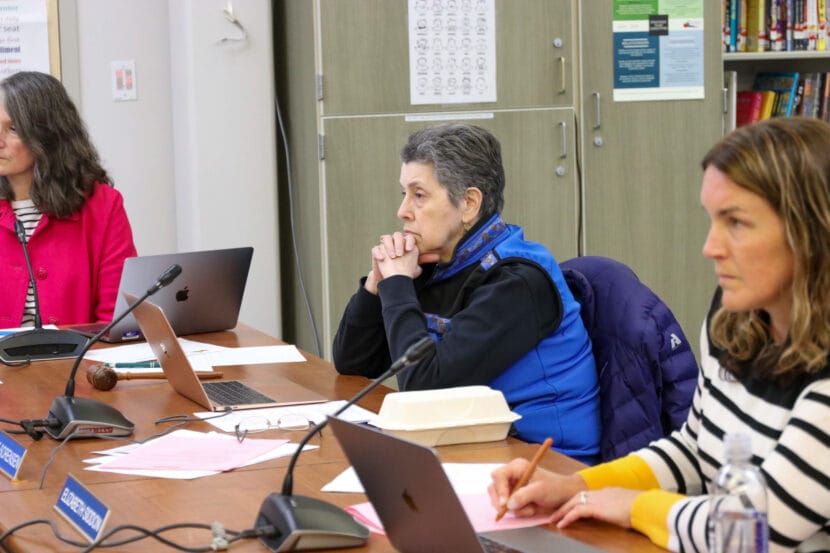
Deedie Sorensen sits with her hands clasped on a wooden table with Juneau School District Chief of Staff Kristen Bartlett to her left and Board Vice President Elizabeth Siddon to her right.
Board President Deedie Sorensen at a Juneau School District Board of Education meeting at Thunder Mountain Middle School on April 8, 2025. (photo by Jamie Diep)

Listen here:

Deedie Sorensen did not plan on running for another term. But earlier this week, rumors circulated that she would run as a write-in candidate. Sorensen said on a call with KTOO Monday that she hadn’t heard the rumors. She also said she didn’t plan to run.

“Apparently, I was the only person that hadn’t heard the rumor that you called me about,” she said during a phone interview Wednesday.

Two days later, things had changed. Sorensen said people reached out to encourage her to run.

“The message I got on Monday was – from way too many people – was that they wanted another choice,” she said.

Sorensen filed with the city to run as a write-in candidate Wednesday. She’s now the fifth candidate vying to fill three seats on the board. This would be her third term if elected. 

Sorensen’s tenure coincided with a tumultuous period for the Juneau School District. She spent her first term largely working through the COVID-19 pandemic. She also served as board president when the district decided to close and consolidate Juneau schools to fill a $9.7 million budget deficit. She survived a recall effort following the consolidation last year.

Sorensen said she thinks the district is making progress since the consolidation. If elected, she said she’s interested in following the academic performance of sixth graders, who were lumped in with elementary school instead of middle school after the closures. 

She said the candidate forum hosted by KTOO and the League of Women Voters of Juneau last week influenced her decision.

“The overall message to me, for some of the candidates, was not an overwhelming desire to promote public education,” she said.

She said that commitment is necessary to serve on the school board.

“You need to be a real advocate for (the) best public education and for, you know, all the students,” Sorensen said.

Sorensen worked as a teacher for the district for more than 35 years.

This isn’t the first time someone has filed to be a write-in candidate for the school board in recent memory. Former school board member Will Muldoon ran a successful write-in campaign for his first term in 2021.

Sorensen is the only write-in candidate so far this year. As of Thursday morning, no one else has filed as a write-in candidate for the school board and Juneau Assembly races, according to the city clerk’s office. The city mailed ballots to registered voters on Sept. 19. Juneau voters have until Oct. 7 to return them.
Juneau Assembly approves Dzantik’i Heeni playground funding amid potential budget concerns

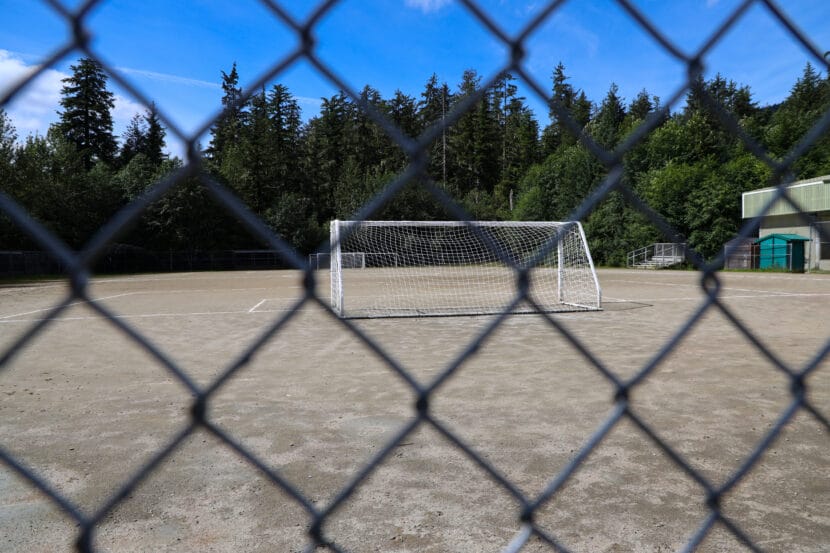
A field next to the Dzantik’i Heeni building from behind a chainlink fence in Juneau on Aug. 7, 2025. (Photo by Clarise Larson/KTOO)

The Juneau Assembly approved funding to get started on a new playground at the Dzantik’i Heeni campus in Lemon Creek. But the decision brought up budget concerns as voters consider reducing taxes in the upcoming municipal election. 

The $735,000 project is the next step in what’s turned into a yearslong process to build a new playground for the campus that houses Yaaḵoosgé Daakahídi High School, Montessori Borealis and Juneau Community Charter School. 

The building used to be a middle school before the district consolidated middle and high schools, so no playground was necessary until elementary-aged students moved in. The money will go toward installing safety surfacing and fencing. But the school district will be on the hook to fundraise for playground equipment.

The final decision hit a brief bump in the road when one Assembly member asked the body to consider potential reductions to the city’s tax revenue. There are three ballot propositions in this year’s election that could change how much money the city brings in annually. Assembly member Neil Steininger moved to table the decision until October. Steininger said he wants to wait until after the election to see what the city’s budget looks like.

“I think it’d be prudent when we’re talking about a dollar value this large to wait until we have a better understanding of the revenue available to the city before we make this commitment,” he said.

Juneau School District Superintendent Frank Hauser said a delay in the decision could make it harder for the district to get that equipment. He said the district needs to order it in December or January to get things installed in time for next school year.

“It just makes it really tight to do the fundraising, not sure if we’re going to be able to move forward with this until the October 27 [meeting] and then trying to put all that together and get pieces in place for installation hopefully for the next school year,” Hauser said.

The district received a donation from the Juneau Rotary Club to put some musical play equipment and Gaga ball pits at the school in the meantime.

Other Assembly members agreed with Steininger’s point but said they should still move forward with the site preparations. Member Wade Bryson said the neighborhood as a whole has access to far fewer playgrounds than other parts of the city.

“So we’re not doing this just to make sure that a school has a playground,” Bryson said. “We’re doing this for social equality to one of the most socioeconomic depressed parts of our community.”

Steininger ultimately backtracked after the Assembly members opposed him. He said he wanted to make a point.

“This is the kind of thing that is at stake at the ballot box here in October, and these are the types of considerations and questions we have to ask,” Steininger said. “And the comments before me about equity in Lemon Creek and the count of playgrounds is very apt.”

The Assembly unanimously approved the funding. In a Finance Committee presentation Wednesday, Juneau School District Director of Operations Kristy Germain said the district plans to begin work on the playground next summer.

Sayéik students harvest vegetables and knowledge at school garden

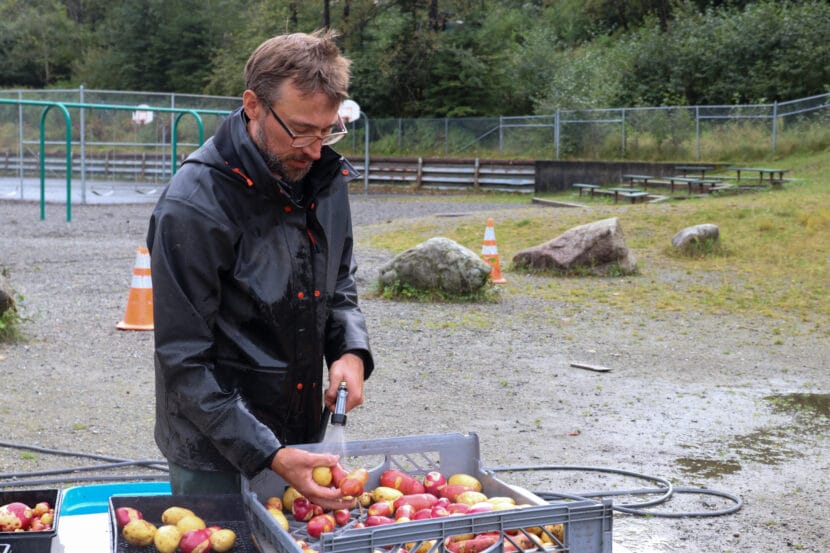
A man in a black jacket uses a hose to rinse a tray full of yellow and red potatoes.
Joel Bos uses a hose to rinse trays of potatoes outside Sayéik: Gastineau Community School on Douglas on Sept. 16, 2025. (Photo by Jamie Diep/KTOO)

Listen here:

Joel Bos stands outside Sayéik: Gastineau Community School, rinsing tray after tray of freshly harvested potatoes with a hose. He’s a naturalist with Discovery Southeast, a nonprofit that connects Juneau residents to the outdoors. They partnered with the school to build and maintain a garden.

Bos has been working with students on the project. He said they participate in every part of the process, from planting seeds to eating the crops.

“Now this is not just something that one person is doing here as, like, kind of on the side, this is an entire school event, and that, to me, is really special,” Bos said.

There’s still more to harvest, including several beds of carrots. Bos said those are his favorite vegetables to grow in Juneau. 

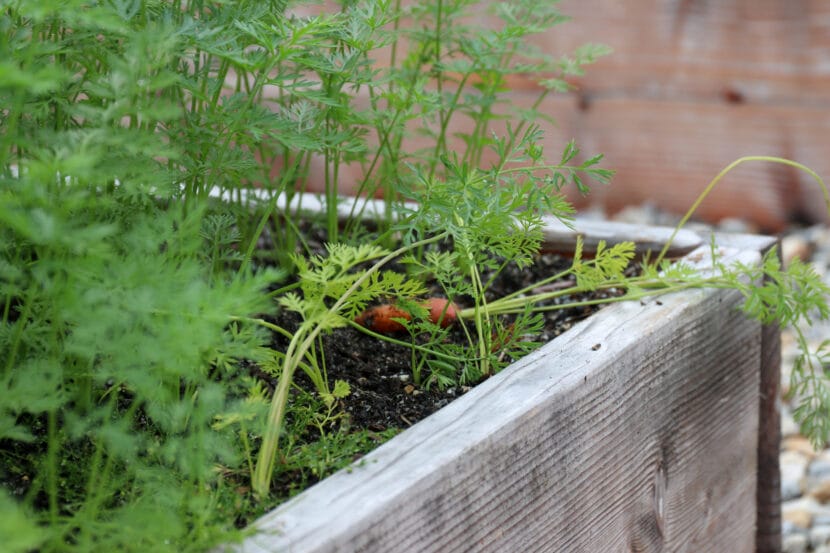
An orange carrot lies on its side in soil surrounded by green carrot tops in a wooden garden bed.
An exposed carrot in a garden bed of carrot tops at Sayéik: Gastineau Community School on Douglas on Sept. 16, 2025. (Photo by Jamie Diep/KTOO).

“They’re super sweet if you grow them up north,” he said. “The kids just absolutely go bananas for them. I think we all do. Everybody who’s had a carrot that was picked and washed and eaten in the same day understands the difference in sweetness and flavor.”

Sayéik: Gastineau Community School librarian Monika Haygood walks through the school garden, pointing out the different crops separated by type.

“This side, the left side here, we have, of course, onions, kale,” she said. “And so they’re just dedicated to one crop, because you can just get so much more out of it.”

The garden is a project for the Ocean Guardian School program run by the Office of National Marine Sanctuaries. Schools commit to protect local watersheds and the ocean through various conservation projects and schoolwide practices. Schools can also get start-up funds for projects like a school garden.

Sayéik has been an Ocean Guardian School for the past seven years. Haygood is also the lead teacher for the program. She says the school garden in particular teaches students more beyond math and reading in the classroom.

“It’s science. It gets them outside. It gets them working together, gets them thinking and talking, and all those pieces are just such an important part of  learning as a whole picture,” she said.

Building and maintaining the garden is a school and community-wide effort. Teachers incorporate the garden into the curriculum: students might try their hand at scientific illustrations or calculate the volume of a garden bed to find out how much soil it needs. Local businesses also donated materials for the garden.

The garden even runs when school is out. Haygood said teachers and some families water the plants through the summer. Bos also brought students from a summer camp to maintain the garden.

Haygood said she’s proud of the garden the school has created.

“I love to just see kids out here and learning and digging and, yeah, just making those connections,” she said. “I think that is the most powerful, just seeing the kids out here, and how inspiring that is for me. But it’s also so inspiring for them.”

Most of the vegetables will go toward a schoolwide dinner next week. The garden activities will continue to run after the big harvest. Students will start growing different plants indoors from seed under grow lights through the winter. The garden will also continue to grow. Next to it is a field peppered with dirt and weeds. Haygood said they’ll fill the area with native plants.

“We’ll develop this trail over here with some signage so that we have some plants that students can learn about, that are local, that grow here,” she said.

As for the remaining uneaten veggies, Haygood said they won’t go to waste. Students and teachers will take the leftovers home to their families.

Trump administration terminates University of Alaska grants for Alaska Native, Indigenous students

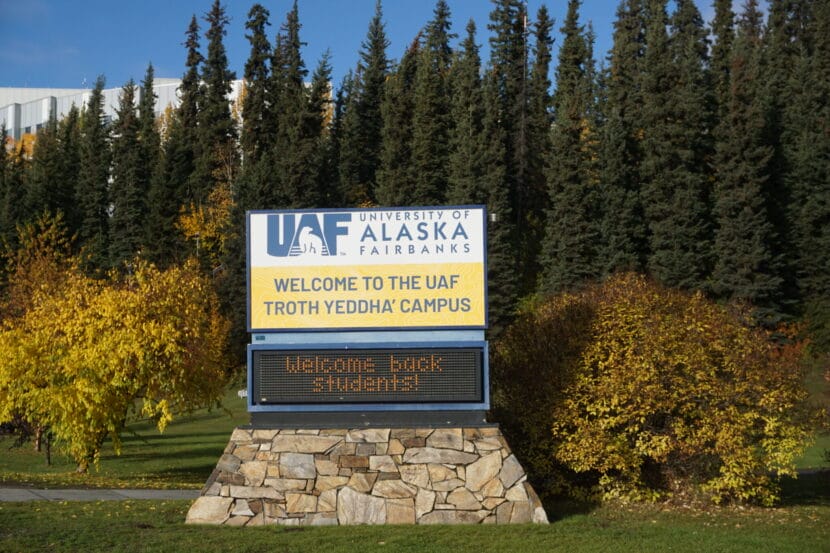
The sign at the entrance to the University of Alaska Fairbanks campus welcomes students on Sept. 20, 2023. (Photo by Yereth Rosen/Alaska Beacon)

The U.S. Department of Education has terminated grant funding for universities’ Alaska Native and Native-Hawaiian-serving programs and support services, an act that University of Alaska Fairbanks Chancellor Mike Sfraga said “will have a substantial and negative impact on a large number of Alaskans, including our Alaska Native students.”

Sfraga announced the federal decision in a campus-wide email on Thursday.

Sfraga said the funding cut for UAF is estimated at $2.9 million, and the full effects are still under review. More than 20%, or an estimated 1,450 students at UAF are Indigenous, Sfraga noted.

The full extent of the grant funding freeze across the University of Alaska system is still being analyzed, said Jonathon Taylor, UA director of public affairs, by email on Friday.

UA President Pat Pitney said in an emailed statement on Friday that the university will continue to create a welcoming environment for all students.

“We are evaluating the impact these changes will have on our services to Alaska Native students, and are communicating directly with students, staff, and faculty who may be affected,” Pitney said. “A significant part of UA’s identity is our commitment to Alaska Native culture, language, art, heritage, business, and tribal management and governance; that remains unchanged. We proudly embrace our global leadership in Alaska Native and Indigenous studies, and will continue to sustain a welcoming environment where all – including our Alaska Native and Indigenous students – can thrive and succeed.”

Taylor said the University of Alaska Southeast has at least one grant-funded program on the Sitka campus aimed at improving student services, and university officials are waiting to hear whether it will be eliminated. Taylor said the University of Alaska Anchorage does not have any programs funded by this federal grant.

Taylor said on Monday the University of Alaska Anchorage has at least one program funded by the grant, but it is based on different eligibility requirements, and the university does not expect it to be affected.

As of fall 2024, there were 3,254 students enrolled at the University of Alaska that identified as Alaska Native or American Indian, and 266 that identified as Hawaiian Native or Pacific Islander, according to the university, and 19,629 students total across the UA system.

The University of Alaska announcements came after the Trump administration said Wednesday it will withhold an estimated $350 million of congressionally-approved funding for minority serving colleges and universities, saying the money will be allocated elsewhere. The measure continues President Donald Trump’s initiative to eliminate programs that focus on diversity, equity and inclusion.

Sfraga said the federal government is allowing up to a year to close out the programs. UAF has multiple grants which fall under the program, Sfraga said, and most are under the College of Indigenous Studies and the UAF Community and Technical College.

Sfraga said the grant program does not fund student aid, but it does support degree programs and support services like student advising and recruiting, workforce development and student success initiatives across campuses.

University officials report that to date, the Trump administration has cancelled $6.6 million in research grants and almost $45 million has been frozen.

Each year, the university receives an estimated $250 million in federal research funds, Taylor said, adding that “95% of the university’s broad research portfolio remains intact. UA has experienced only minor disruptions as a result of the rapidly shifting policy picture in Washington, D.C., and we are closely monitoring developments as they evolve.”

Correction: A previous version of this story said that University of Alaska Anchorage does not have any programs funded by this federal grant. Taylor clarified that UAA does have a grant funded program, the SAGE Success program, but it is awarded based on different eligibility, and so it is not expected to be affected by the funding elimination announcement.

Annual TCLL field trip connects students to Lingít culture through foraging and language

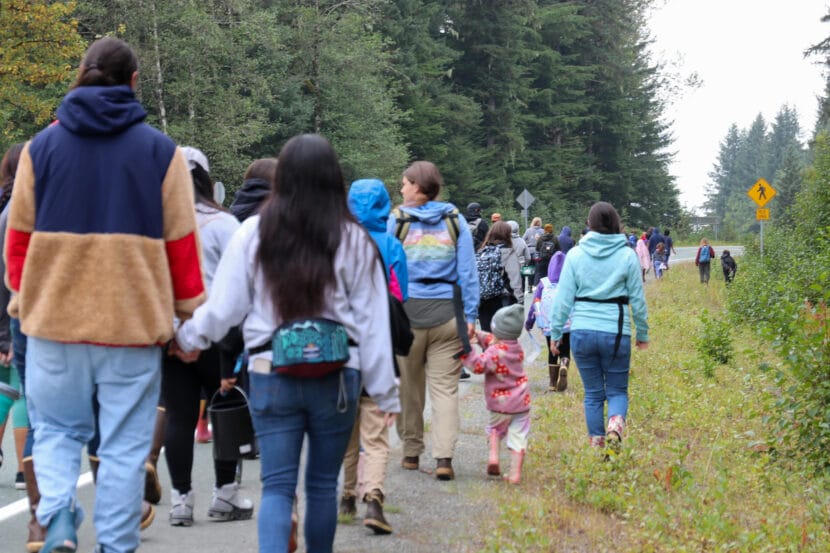
A couple holds hands in the back of a large group of people walking near a road.
Families, students and teachers hold hands and walk toward a trail to pick tea leaves next to Eagle River United Methodist Camp near Juneau on Sept. 5, 2025. (Photo by Jamie Diep/KTOO)

Listen here:

Learning outdoors is nothing new for students in Juneau’s Tlingit, Culture, Language and Literacy program. That’s what they did on their first field trip of the year, where they learned about Lingít language and values through foraging and processing local foods. 

Students, teachers and families walk through squishy, mossy muskeg near the Eagle River United Methodist Camp north of Juneau. First grader Owen Roehl crouches over small, short bushes peppered throughout the area, putting green and yellow leaves into an empty yogurt container looped around his neck.

“We’re picking s’ikshaldéen, also known as Hudson Bay tea,” he said.

Owen said picking tea has been his favorite part of the day so far.

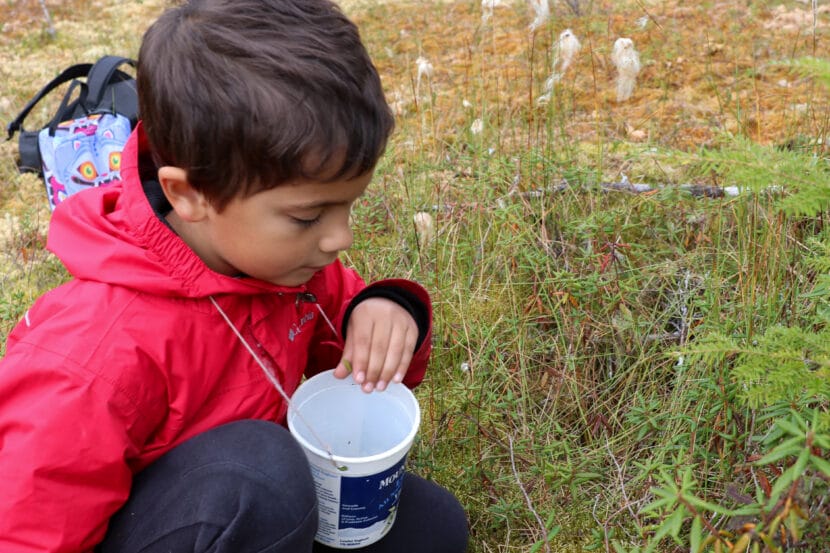
A child in a red rain jacket puts tea leaves in a yogurt carton hanging from his next on string.
First grader Owen Roehl picks s’ikshaldéen, or Hudson Bay tea, anear Juneau on Sept. 5, 2025. (Photo by Jamie Diep/KTOO)

Seventh grader Cassius Allen is one of the older students picking tea. Cassius said he thinks the tea will taste good once they process it. 

“Probably gonna have to mix it up with some other flavors so it tastes not plain and normal,” he said.

Cassius got help from eighth grader Leighton Heppner to identify the tea leaves. Leighton said he learned from friends and teachers.

“They said, ‘always make sure it’s yellow at the bottom, like fully yellow or partially yellow, and it will still work,’” he said.

Overall, Cassius appeared to have some fun while picking tea, getting part of a leaf up Leighton’s nose when holding it out for him to smell.

This is part of a longstanding field trip for students at Tlingit Culture, Language and Literacy, a Lingít language immersion school. It’s not just for the students. They’re joined by families and volunteers, as well as students from Haa Yoo X̱’atángi Kúdi, a Lingít language preschool. That’s a language immersion preschool where children primarily speak in Lingít.

Things have changed slightly after the program expanded to middle school. While it’s normally a day trip, it’s turned into an overnight field trip for the older students.

A student in a brown shirt sets clear plastic cups on a table full of individual servings of fish soup, berries and bread.
A student helps to set a table full of fish soup, bread and berries at Eagle River United Methodist Camp near Juneau on Sept. 5, 2025. (Photo by Jamie Diep/KTOO)

Naakil.aan Hans Chester is a biliteracy specialist at the school. He said getting students out of the classroom opens the door for a lot of learning. 

“In this context, it’s real living, and they hear us using the language with each other and communicating, or just even expressions, to say when you’re doing something, and it’s in context and it makes sense,” he said.

In addition to tea, students also learned to fillet salmon and make jam. Chester said the jam was going to be given to guests at a Ku.éex’ – or potlatch – the next day.

“When we do our Ku.éex’, it’s to honor our lost clan members,” Chester said. “And so, you know, it’s really important for us to teach these skills to our kids, so when they grow up and they lose their mom or their sister or their cousin or whoever that’s in their family, they’ll have these skillsets to rely on so that they can do what we do.”

Chester said this field trip makes him feel like the school is in a stronger place than it was before.

“Hearing them use the language more, some of them stepping up and becoming leaders out here, is really awesome to see”

A teacher with green and black hair scoops soup from a large stock pot into a paper bowl.
TCLL teacher Nae Tumulak scoops fish soup into a bowl at Eagle River United Methodist Camp near Juneau on Sept. 5, 2025. (Photo by Jamie Diep/KTOO)

In the camp kitchen, Lingít language teacher Nae Tumulak portions out bowls of fish soup. The middle schoolers filleted coho salmon for it the night before. Tumulak said she likes getting to know the students more, both new and old.

“Just seeing them in their element, being able to witness a lot of their growths and everything like that, it’s been a lot of fun,” Tumulak said. “They’re also incredibly hilarious. So it’s been entertaining.”

Once they’re back at school, Chester said they will process the tea and give it away to community members.

Universal free breakfast to start up again at Juneau schools

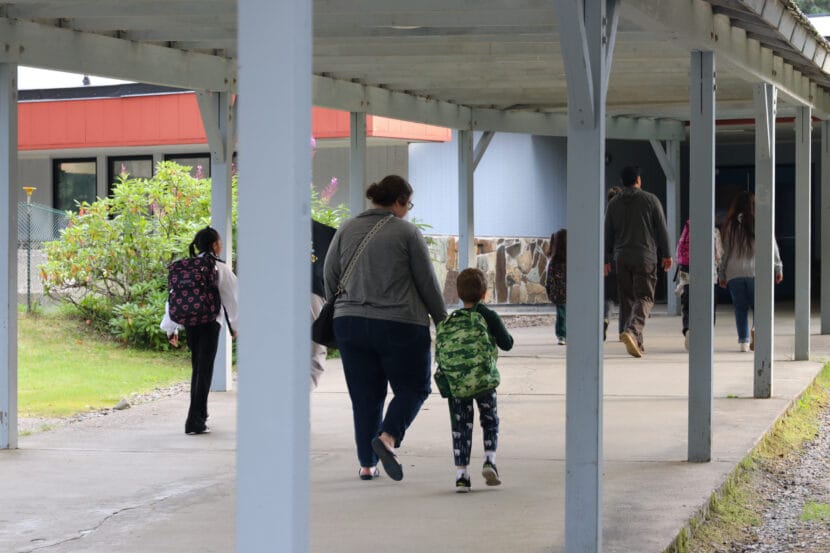
An adult in a gray sweater walks next to a child carrying a green camouflage backpack with their backs facing the camera.
Families enter Mendenhall River Community School on Aug. 15, 2025. (Photo by Jamie Diep/KTOO)

The Juneau School District Board of Education greenlit bringing back the district’s universal free breakfast program this week.

The school board unanimously approved reinstating the program a little over a month after the Alaska Legislature restored state education funding previously vetoed by Gov. Mike Dunleavy. The district received more than $1.5 million in additional funding. It’s putting  $230,000 of that toward universal free breakfast this school year.

The district is hoping to keep program costs down by encouraging families to apply for free and reduced lunch. That’s a federal program that reimburses schools for providing free meals to qualifying students. Juneau School District Chief Financial Officer Nicole Herbert said there’s still an incentive to apply, even if universal free breakfast is restored.

“We’re not providing universal free lunch, so that’s a direct incentive to the families to fill it out so their students can still have a free or reduced lunch,” she said.

Herbert said getting more students in the program helps the district get more federal funding, such as Title I grants and internet reimbursements. She says students who qualify can also get discounts and fee waivers for tests like the SAT.

Other district staff and parents brought up concerns about challenges in accessing the application and school meals in general.

Heather Miller is the meal coordinator at Mendenhall River Community School.  She said a delay in working with families on applications could be due to turnover in office staff at the schools.

She says fewer students this year ate school breakfast without the free program.

“I have kids that are obviously dipping into piggy banks, their own money,” she said. “I have kids who are like, ‘I’m hungry, Miss Heather, but I know I can’t — my parents can’t afford the breakfast. I have to choose whether or not I eat lunch or breakfast.’”

Miller hopes to see changes to make it easier for families to apply for free and reduced school meals.

The district plans to reinstate the program Monday.

Site notifications
Update notification options
Subscribe to notifications