Education

University of Alaska projects up to 10% increase in health care costs this fiscal year

One of the outdoor sculptures at the University of Alaska Anchorage campus is integrated into a fountain, pictured here on May 16, 2022. More than half of the University of Alaska system schools attend UAA or one of its satellite campuses.
One of the outdoor sculptures at the University of Alaska Anchorage campus is integrated into a fountain, pictured here on May 16, 2022. More than half of the University of Alaska system schools attend UAA or one of its satellite campuses. (Yereth Rosen/Alaska Beacon)

The University of Alaska is anticipating an increase of up to 10% for health care costs this fiscal year, on par with what employers are anticipating nationally, according to officials presenting to the Board of Regents at their meeting on Nov. 6.

Nikole Conley, chief of human resources for the university system, gave a presentation outlining the university system’s health care costs so far, and projections for the rest of this fiscal year, ending in July 2026. Her presentation included medical, dental and pharmacy care.

“We do see health care costs across the nation going up and increasing, and we’re not necessarily expecting this to decline anytime soon,” she said.

The university is projecting 8% to 10% overall cost increases across the system for this fiscal year. That means health coverage for 3,442 employees is estimated to cost $85.5 million.

A screenshot from a University of Alaska presentation on health care costs on Nov. 6, 2025, shows a rise in costs in recent years. (Alaska Beacon)

“We are seeing trend increases of 8% for medical, 13% for pharmacy and 4% for dental. We’ll do another recast in January of 2026 and hopefully try to firm up that figure and what that’s going to look like,” Conley said.

Nationally, employers are expecting an 8.5% increase in medical costs and an 11% increase in pharmacy costs, she said, so the university’s costs and projections are mirroring that trend.

Health care costs in Alaska are among the highest in the nation, according to state data. Since 2023, the average cost of a health insurance marketplace plan in Alaska rose by more than 16% each year. In 2023 alone, the cost went up by an average of 18.4%.

The university has a cost split for health care with 18% paid by employees in premiums, and 82% paid by the universities. Conley presented total cost projections to the board.

Conley said the number of university employees isn’t growing, but more people are opting into the university’s health care plan. She said system-wide the largest cost increase is in pharmacy claims, but her department is expecting to renegotiate pharmacy costs, which could save the university about $3 million.

Last year, the university saw pharmacy spending increase 11.2% from the year before. Over the last five years, overall pharmacy costs more than doubled from $9.2 million to $19.2 million, she said.

Conley said that’s partly due to a rise in prescriptions for drugs used for weight loss and to treat diabetes, known as GLP-1 drugs like Ozempic. They were the second highest pharmacy claim within the university’s plan, totaling $4.1 million last fiscal year.

“We’re also looking at the potential elimination of GLP-1s, because they are a major cost driver for us,” she added.

University of Alaska Regent Karen Perdue pushed back against that idea, pointing out that weight loss can also improve employees’ health outcomes and result in less health care costs. “It’s not just a plus, there can be a minus on the bottom line as well,” she said.

A screenshot from a University of Alaska presentation on health care costs on Nov. 6, 2025 shows the highest claims for medical and pharmacy care. (Alaska Beacon)

University of Alaska President Pat Pitney also pointed out other high pharmacy costs last year. The largest costs were on inflammatory diseases, with the highest cost at $4.3 million, and cancer treatments at $1.3 million.

The highest medical costs for the university last fiscal year were for muscle, joint and bone claims at $10.7 million, followed by cancer at $7 million, and behavioral health and disorder treatments at $5.3 million.

Last year, the university’s total costs came in at $80.1 million, which was $1.1 million over the university’s projection. Conley said next year’s premiums will go up to recover those costs.

Conley said her department is working to push more education and use of wellness programs and preventative health care.

“Not only are we seeing this growth of 8% to 10% in cost, but we’re also seeing less use, for some reason, of our preventative health care. And so we’re really trying to encourage folks to use preventative health care, because that will help minimize some of our costs in the future,” she said.

According to university data presented by Conley, only half of health care participants used preventative screenings, like annual physical exams or checkups; nearly 38% of emergency room visits could have been avoided with better primary care or urgent care use; and 38% of participants are categorized as pre-obese or obese.

The university is insured through Premera Blue Cross, and Conley said her department discusses health care plan changes with the university’s Joint Health Care Committee, an advisory committee made up of representatives from the faculty union, management and staff.

The university is also expecting a health care rebate, which is a benefit paid back to employees if they utilize the prevention programs throughout the year, like cancer screenings, dental care, and regular check ups.

“We’re estimating about a $1.5 million rebate,” Conley said, for this year, ending in July 2026. “We’re going to see up to a $2.5 million rebate increase in FY27 with new rates. So that’s a good positive.”

The debate around national health care, federal tax credits, and costs for Americans has been at the heart of bitter negotiations around ending the longest government shutdown in U.S. history. This week, the U.S Congress approved a stopgap spending bill ending the shutdown. Democrats have introduced a discharge petition to force a vote to extend tax credits for three years under the Affordable Care Act. White the Senate Majority leader has promised a vote by the end of the year, leaders of the Republican-majority House have remained opposed, and discussions on health care are ongoing.

University of Alaska President Pat Pitney to retire in May

University of Alaska Regent Joey Crum and UA President Pat Pitney listen during a meeting at the University of Alaska Southeast in Juneau on Sept. 4, 2025. (Photo by Jamie Diep/KTOO)

University of Alaska President Pat Pitney will retire this spring. 

Following an Olympic gold medal in air rifle, Pitney began working for the university in 1991 and served in several positions between the system office and the University of Alaska Fairbanks. During that time, Pitney and her then-husband also coached the UAF rifle team. She was also director of the state Office of Budget and Management from 2014 to 2018.

Pitney worked as the state Legislative Finance Director before being appointed as interim president at UA in 2020, following the resignation of Jim Johnsen. She permanently took on the role in 2022, becoming the university’s first permanent female president.

Pitney said she took on the role during a difficult period, thanks to the COVID-19 pandemic and declining state funding.

“There was a lot of uncertainty and a lot of unrest at the university, and just navigating through that to bring the institution back around to enrollment, enrollment growth, and, you know, positive reputation,” she said.

During her time as president, the university increased its enrollment and expanded the UA Scholars Program and Alaska Performance Scholarship.

The university saw enrollment increase by 4% from fall 2022 to fall 2024. Enrollment is projected to keep going up by another 4% this school year.

Pitney said federal uncertainty remains a challenge. According to an update at the UA Board of Regents meeting last week, the federal government has frozen, delayed and terminated close to $25 million in federal grants. That leaves about 95% of the university’s research portfolio intact.

“We’re positioned well and doing well in this environment, and so for the most part, just keeping people focused on what it is that we can do,” she said.

University of Alaska Southeast Chancellor Aparna Palmer was hired during Pitney’s tenure. Palmer says she appreciates Pitney recognizing the importance of all campuses in the university.

“When it comes to UAS, she has been really supportive of our success as an institution, and also really, like, supportive of innovative ideas,” she said.

Palmer said those included UAS’s decision to offer in-state tuition to all undergraduate students starting next year.

The university is contracting with executive search firm WittKieffer to help with finding a new president.

Pitney plans to retire after the May Board of Regents meeting.

Correction: A previous version of this story misidentified UA Board of Regents member Karen Perdue as Pat Pitney in the photo. Regent Joey Crum’s name was also misspelled in the caption and former UA President Jim Johnsen’s name has been corrected. The story has also been updated to reflect that Pitney and her husband are now divorced. 

Juneau is facing a housing shortage. These high school students are helping combat it.

Juneau-Douglas High School: Yadaa.at Kalé senior Isaac Phelps measures cedar shingles during his house build class on Wednesday, Nov. 12, 2025. (Photo by Clarise Larson/KTOO)

Juneau high school students are getting real-world building experience while creating much-needed affordable homes in the community. That’s thanks to a house build program that’s a partnership between the Juneau Housing Trust and Juneau School District.

On Wednesday, Raegan Adams fed pink fluffy insulation into a machine in the garage of a partially built home in Lemon Creek. The machine pushed the insulation through a long spiraling tube through the house and into its attic. She and her classmates are building the house she’s standing in.

Adams is a junior at Juneau-Douglas High School: Yadaa.at Kalé and one of the students enrolled in the district’s House Build program.

The district has offered many house building projects to students on and off, dating back to the 1970s. The program has seen multiple iterations over the years. Students who take the semester-long class get to learn hands-on construction skills by building new, energy-efficient homes that then go back into the community. Adams says she was hesitant to take the class at first, but now she’s glad she did. 

“I think it’s a very important class that teaches skills everyone should have. Like, I’ve been telling my mom about stuff we do in the class. And she’s like, ‘Oh, you can do this to our house next,’” she said. 

Students in this class are currently finishing up the sixth house in a small neighborhood of homes constructed by the program in Lemon Creek. Soon, they’ll begin laying the foundation for the seventh. The houses are located just past the Dzantik’i Heeni campus.

Juneau-Douglas High School: Yadaa.at Kalé students measures cedar shingles during their house build class on Wednesday, Nov. 12, 2025. (Photo by Clarise Larson/KTOO)

The City and Borough of Juneau made the land available for sale to the Juneau Housing Trust in 2017. The trust manages the land through a community land trust and works to ensure the homes can be purchased by low and middle-income community members. 

Tamara Rowcroft is the board vice president of the Juneau Housing Trust. She said housing geared for low and middle-income buyers is unique, but desperately needed. 

“I’ve been working in affordable housing for about 35 years here in Juneau. I lived here as a kid,” she said. “I know how hard it is to get housing that’s affordable.’

For the past two years, Juneau has had the highest average sale price for a single-family home in the state, according to a study by the Alaska Department of Labor and Workforce Development. 

Juneau-Douglas High School: Yadaa.at Kalé senior Jace Kihlmire cuts insulation during his house build class on Wednesday, Nov. 12, 2025. (Photo by Clarise Larson/KTOO)

Nathan Dutton is the school district’s career and technical education coordinator. He says offering alternative learning opportunities is crucial for students who may be looking for another path to a well-paying job after graduating that isn’t a traditional four-year degree.

“We have seen a drop in tradesmen throughout the nation, so being able to make this skillset available to our students is so important,” he said. 

He said the house build program lets students explore if a trades career is for them.

“They’re getting amazing real-world experience that in other places you typically have to pay for or get accepted into a program,” Dutton said. 

Jace Kihlmire is a senior at JDHS. He took the class to learn more skills to use when working at his dad’s construction company. But, he said, the takeaways from the class go beyond that. It gives him the confidence to take on what used to be difficult tasks.  

“It applies to future careers as well as home life,” he said. “Like ‘oh, I put a hole in my drywall.’ Oh, cool. I know how to patch it up. Or ‘oh, I need to re-shingle my roof.’ Well, I know how to do that.”

And, though he’s learned a lot of skills during the class, he said he definitely has a favorite: 

“Everything is fun about drywall,” he said. “As much as I hate removing it, installing it is the best.”

The class hopes to finish construction by the end of the year. The trust hopes to put the home on the market soon.

University of Alaska Board of Regents approves 4% tuition increase for next academic year

The University of Alaska Southeast campus in Juneau on Monday, March. 4, 2024. (Clarise Larson/KTOO)

Listen here:

The University of Alaska will increase tuition for the entire system for a second year in a row, and it’s higher than what its administrators recommended.

The Board of Regents approved increasing tuition across the board by 4% next year during a meeting Friday, despite an initial proposal from administrators of only 3%.

Student Regent Fernando Escobar proposed the additional increase to fund mental health initiatives. He said mental health services have not been funded for five years and suggested higher tuition as another way for the university to meet the need.

“I’m optimistic this legislative session, but I have to be realistic, and I think this may be our best approach for right now in order to support student needs in the system,” he said.

The board is requesting $965,000 in mental health services across the three campuses for the next fiscal year. State funding for the university goes through the Alaska Legislature for approval.

UA President Pat Pitney said the 4% increase is beyond what she considers to be a “modest” increase. She said they recommended the 3% increase as a way to avoid a large increase while factoring in rising costs.

“It also balances that there are anticipated fee increases in housing and dining services as we’re working on our auxiliary enterprises,” she said.

Regent Karen Purdue said she wants to see a way for progress to be made on providing mental health support to students.

“One way to think about this is it could be the students’ skin in the game to go ahead and continue to advocate at the Legislature for some, so some portion of the mental health would, there would be progress made, finally, on this issue,” she said.

Payton Callahan is the chair of the Coalition of Student Leaders, a group that represents students across the university system. She testified that many students already oppose any increase, and that the 4% figure might “blindside” students.

“I don’t know that that aligns with trying to keep retention, because I don’t know that students, frankly, can afford that increase, considering the current economic state,” Callahan said.

Union of Students University of Alaska Anchorage, the student government for the Anchorage campus, passed a resolution last month requesting the board increase the tuition by just 2% instead.

But not every incoming student will see higher tuition next year. Out-of-state undergraduate students at the University of Alaska Southeast will pay in-state tuition for the first time. That’s still a lower rate than what they currently pay.

But UAS Chancellor Aparna Palmer said the additional increase might affect the campus’ ability to recruit Alaskans.

“My sense is that we would still be a great deal in terms of out-of-state students,” she said. “But in terms of in-state students, we may not get that buy-in if we go to 4%”

Regents approved the increase unanimously, with Regent Seth Church absent. The new tuition rates will go into effect next fall.

University of Alaska unions ask Board of Regents not to sign federal higher education compact

University of Alaska Regent Joey Krum and UA President Pat Pitney listen during a meeting at the University of Alaska Southeast in Juneau on Sept. 4, 2025. (Photo by Jamie Diep/KTOO)

Listen here:

A controversial higher education compact from the Trump administration has sparked a petition from several University of Alaska unions, who say they’re worried about political overreach stifling academic freedom. 

Several University of Alaska staff and community members testified against the Compact for Academic Excellence in Higher Education on Monday, ahead of the UA Board of Regents meeting later this week. A petition from unions representing faculty, graduate workers and university staff opposing the compact also received 659 signatures.

Jill Dumesnil is a mathematics professor for University of Alaska Southeast and the president of the faculty union United Academics AAUP/AFT. She said in an interview that the compact ties federal funding to a political agenda.

“It restricts the freedom to teach, research and learn,” she said. “It undermines institutional autonomy and self governance, and it ties benefits, research benefits, to factors other than scientific merit.”

The compact lays out requirements for universities to receive federal funding. Part of the compact instructs universities “to seek such a broad spectrum of viewpoints not just in the university as a whole, but within every field, department, school, and teaching unit.” It also includes a 5-year tuition freeze and limits how many international students a university can admit.

The U.S Department of Education initially sent the compact to nine universities, and most of them rejected it. In a Truth Social post last month, Trump said any higher education institution in the country could sign on to it.

Even though the UA Board of Regents has not made any move to accept the compact so far, Dumesnil said they want to make their voices heard on the issue. In February, the board suddenly approved a motion to scrub mentions of diversity, equity and inclusion in a process that didn’t give the public an opportunity to comment

“We didn’t want that to happen again. So that’s why we, we went ahead and told them what we, what we thought,” she said. “And you know, that’s all we can do.”

Kate Quick works for United Academics at the university, but testified on Monday as an individual. She says the February motion had a “chilling effect” on people in the university and community.

“When the compact came out, people started to say, ‘Oh, just wait. The board will be the first to sign,’” Quick said. “And so that’s why this petition went around, and that’s why people are calling tonight to ask you not to sign.”

But Jonathon Taylor, the director of public affairs for the university, says the motion from February is different from the compact because it was based on a direct communication from the federal Department of Education.

“If there’s a question as to whether or not the university needs to take action on particular direction or guidance changes or policy changes that have been made, we need to see those official communications to the university, because that’s what the standard practice is,” Taylor said.

Taylor said the agenda for this week’s meeting doesn’t include discussion or action items on the compact. The board is scheduled to meet on Thursday and Friday in Anchorage.

Juneau schools work to keep students fed as federal government shutdown continues

Seig̱óot Jessica Chester and Naakil.aan Hans Chester dance to Goosú Wa.é and donate money for a snack fund at Tlingit, Culture, Language and Literacy in Juneau on Oct. 30, 2025. (Photo by Jamie Diep/KTOO)

Listen here:

As the federal government shutdown stretches into its second month, federal workers remain furloughed. Now, SNAP benefits are also likely delayed for November. Two judges on Friday ordered the Trump administration to release emergency funds for SNAP, or food stamps, but it’s unclear if the money will come through.

Given that uncertainty, the Juneau School District is working to make sure students stay fed. Elizabeth Seitz is the district’s food service supervisor. She said the district is reaching out to families to apply for free and reduced-price school meals.

“We want to make sure that the Juneau School District students have nutritious and balanced meals so that they can focus and learn and thrive,” she said.

Qualifying students will be able to receive those benefits for the rest of the school year. Seitz says there are paper applications available at schools. Families can also apply online at School Café, which can be reached on the district’s website.

“Families who have never done an online application, they would just need their student’s ID number to establish an account to set that up,” Seitz said.

Seitz said her office can process applications as soon as they receive them, and qualifying students can receive the benefits as soon as the same day. SNAP recipients also automatically qualify for free and reduced lunch, which Seitz says they will continue to receive regardless of the federal delays to SNAP benefits. 

The district will continue to offer universal free breakfast to all students. The Juneau School Board Vice President Elizabeth Siddon brought up offering universal free lunch in November, but the school board tabled that action after the district estimated it would cost more than $200,000.

Individual schools are also stepping up to keep students fed.

On a Thursday evening, families and teachers at Juneau’s Tlingit Culture Language and Literacy program danced and sang to Goosú Wa.é as Naakil.aan Hans Chester, the school’s biliteracy specialist, called out different clan names. When families heard their father’s clan called out, they danced up to a blanket draped over a table and placed cash donations on it. 

Chester said a dance group from the Lukaax.ádi Clan used the song in the 1960s as a way to raise money.

“Goosú Wa.é is a Lukaax.ádi song,” he said. “It was brought down to the coast by a man named Aak’é Éesh. He was one of their ancestors, and he would go up into the Interior to trade, and one of the things that he would trade for are songs. And he brought a lot of different songs down to the coast.”

The event was meant to be a family night, but at the last minute, the teachers added a fundraiser to pay for snacks for all students during the school day. Chester said the Central Council of the Tlingit & Haida Indian Tribes of Alaska typically pays for snacks.

But the money didn’t come through and the school started pulling funds from its activities budget to pay for snacks. Chester said he feels grateful to families for stepping up and making sure students are fed during the day.

“It’ll help alleviate some of the pressure we as staff feel, because it is just a basic need that we’re trying to meet,” he said. 

He said the school approaches life with humor and finds the opportunities to laugh even when things are challenging.

“The strength that we have, that we’re taught and that we foster, I think, really shines in times like this,” he said.

TCLL isn’t the only school stepping up to support students. Deborah Cordero is the community schools coordinator for Kax̲dig̲oowu Héen Elementary. She says the school receives a grant that allows them to provide more resources to families, like getting students clothes or connecting them to food pantries. 

“When that comes, like, I’m able to help transport people or take them to food banks and things like that. So as the need arises, we do have some things in place that we can do for families.”

David Villarreal is a counselor at Kax̲dig̲oowu Héen. He says the school is one of several in the district that receive weekend food bags from Gastineau Human Services. Students who are signed up can get bags of food they can eat through the weekend. Families can sign up on the school’s website.

As a counselor, Villarreal said he’s being proactive in reaching out to make sure families are getting the resources they need. But he says it’s not just about making sure children’s physical needs are met.

“I’m kind of, like, expecting, you know, just more emotional strain from students in the coming weeks as this sort of plays out, because we don’t know what’s going to really happen,” he said.

He said he’s keeping his classroom open for students to come in and process their emotions as needed.

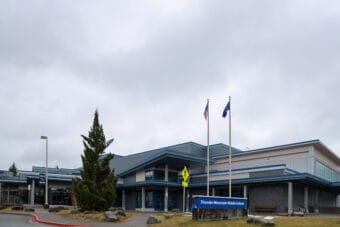
Both Kax̲dig̲oowu Héen and Thunder Mountain Middle School are holding food drives beginning on Nov. 3, and counselors at the schools are ready to help students who need it.

Families in need of assistance with free and reduced lunch applications can contact the Food Services office by calling 907-7969-5812 or emailing food.services@juneauschools.org.

Site notifications
Update notification options
Subscribe to notifications