KYUK - Bethel

KYUK is our partner station in Bethel. KTOO collaborates with partners across the state to cover important news and to share stories with our audiences.

Canonized on the Kuskokwim: Orthodox faithful descend on Kwethluk for the glorification of St. Olga

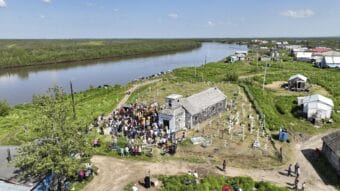
Orthodox pilgrims and clergy gather in the old St. Nicholas Russian Orthodox Church cemetery to take part in the glorification ceremony for St. Olga in Kwethluk on June 19, 2025.
Orthodox pilgrims and clergy gather in the old St. Nicholas Russian Orthodox Church cemetery to take part in the glorification ceremony for St. Olga in Kwethluk on June 19, 2025. (Photo by Katie Baldwin Basile)

Shots rang out over the Kwethluk River as a mass of pilgrims lining the muddy banks sang a hymn of blessing on the eve of the summer solstice. At last, leaders of the Orthodox church had arrived in Kwethluk for the glorification of St. Olga – the first-ever Yup’ik saint and first female Orthodox saint in North America.

Metropolitan Tikhon, leader of the Orthoodox Church in America arrives in Kwethluk, Alaska for the glorification of St.Olga on June 19, 2025. (Katie Baldwin Basile)

For Kwethluk, the glorification is a long-awaited honor for Olinka “Arrsamquq” Michael, or Matushka Olga, a local midwife who gained a reputation as a gifted healer of deep-seated trauma during her life. Since her death in 1979, accounts of her miracles have spread throughout the Orthodox world, culminating in this historic moment.

In the crumbling cemetery of the old St. Nicholas Russian Orthodox Church, priests set Olga’s wooden casket on blocks, just feet from the spot where they exhumed her remains seven months earlier. It’s something that hadn’t been done in Alaska since the exhumation of St. Herman on Spruce Island near Kodiak in 1970.

As local priest Fr. Vasily Fisher explained, before Olga could be venerated as a saint, her final funeral rite, or panikhida, needed to be performed. Going forward, the day of her death will be celebrated instead as her birth as a saint.

“Everything is done as if going backwards; they come back to the church in the presence of life. Our faith is about life. Sainthood is about life,” Fisher said.

Some gathered in the cemetery had tears in their eyes. Others patted beads of sweat from their foreheads. Olga’s descendants stood transfixed among headscarved pilgrims from nearby villages and from as far away as Romania and Australia. The head of the Orthodox Church in America (OCA), Metropolitan Tikhon, traveled from Washington, D.C.

As Archbishop Alexei of Alaska read a passage from the Book of Psalms, a sudden gust of wind from nowhere cut through the otherwise still afternoon. It was hard to not get swept up in the feeling that something miraculous was afoot.

After the funeral rite, a procession featuring flowing robes, golden banners, puffs of incense, and a couple curious village dogs bore the casket along a short dusty track to the church in the section of Kwethluk known as downtown.

During the four-hour service that followed, it was standing room only, which worked out well for a religious tradition that doesn’t make use of pews. The chanting and choreography, what Alexei referred to as an “elaborate, beautiful dance,” ended when St. Olga’s casket was opened for pilgrims to kiss her sacred relics and receive her blessing.

One of Olga’s nieces, Bertha Howard, summed up her memories of her aunt succinctly.

“Ikayurluki yuut, naklegtarluni (she helped, she was compassionate), that’s all I can say,” Howard said.

For Olga’s granddaughter, Atan’ Winkelman, the inclusion of Yugtun in many of the glorification services was a highlight.

Atan’ Winkelman, granddaughter of St. Olga. (Katie Baldwin Basile)

“It’s very cool to see actual Yugtun words… to recognize the Yupik people, to use the word ‘Elders’ in song. I’ve never heard that anywhere else in any of our venerating any other saint,” Winkelman said.

As pilgrims filed by outside the church, Winkelman said that the scene was a lot to process.

“I’m finding the whole exhuming of her body, the whole glorification, canonization, very strange. Because she was an actual person to me that would hold me, and piggyback me, and we would sit and eat together, or I would sit and watch her sew,” Winkelman said.

Olga’s youngest surviving daughter, Matushka Helen Larson, remembers the many women who would pay visits to her childhood home in Kwethluk to sit down to tea with her mother.

Matushka Helen Larson is the youngest daughter of St. Olga of Kwethluk, Alaska, who was glorified as a saint in the Orthodox Church in America this past week, June 19-20, 2025. (Katie Baldwin Basile)

“They’d talk for hours, but I wouldn’t listen because she wouldn’t want me to listen,” Larson said. “But I knew she was helping someone. [They would] come in looking very heavy, you know. And then when they go, they’re lighter.”

With Kwethluk cast further into the spotlight of the Orthodox world, Larson said that she hasn’t lost perspective.

“I still think of her as just my mom,” Larson said.

For many others, Olga has become “St. Olga, Matushka of All Alaska,” a symbol of compassion, modesty, and empathy that appears to resonate just as much across the Yukon-Kuskokwim Delta as it does the world.

Katie Basile contributed reporting to this story.

Although everyone has moved, Newtok’s relocation is far from over

Families first started moving from Newtok into new homes in Mertarvik in 2019. (Emily Schwing/KYUK)

The village that people know as Newtok is basically a ghost town today. What’s left of the public school has been packed into more than two dozen shipping containers. It will get shipped south later this year.

No one lives in any of the houses that remain in Newtok. The only thing still operating there is the diesel generator that keeps the local cell phone tower powered.

Newtok had to move because the permafrost under the community was deteriorating. As a result, the ground was sinking and the banks of the Ninglick River were eroding rapidly – about 70 feet of land washed away each year. It’s all the result of a changing climate. And in August 2024, the Newtok Village Council voted to evacuate the last of Newtok’s residents. The community had become too dangerous.

The ground under Newtok has been eroding for decades.
The ground under Newtok has been eroding for decades. (Emily Schwing/KYUK)

In the fall of 2024, the final residents of Newtok moved from the low lying tundra near the Bering Sea coast to higher, safer ground on a bluff 9 miles away. It’s an effort that’s been ongoing for decades, involving several federal and state agencies, private partners, and the local tribal government.

Another move

This wasn’t the first time people who called Newtok home were forced to move. Andy Patrick, 77, is one of the oldest living residents who still remembers the old village, Kayalivik.

“One day I was probably in the sled, I don’t know, probably two years old,” Patrick remembered. “I see dogs in front of me and I feel the wind. I looked back and asked my granny, and she told me, ‘We are moving.'”

Andy Patrick is one of only two people in Mertarvik who remember life in Kayalivik, an old village where people lived before they were forced by the federal Bureau of Indian Affairs to move to Newtok in the 1950s.
Andy Patrick is one of only two people in Mertarvik who remember life in Kayalivik, an old village where people lived before they were forced by the federal Bureau of Indian Affairs to move to Newtok in the 1950s. (Emily Schwing/KYUK)

When Patrick was a toddler, the United States government sent a barge loaded with construction materials up the Ninglick River. The goal was to build a school that would be operated by the U.S. Bureau of Indian Affairs (BIA). It got stuck near present-day Newtok, so the BIA decided to stay put and build the school there.

Even 70 years ago, Patrick said that Elders knew it wasn’t a spot that would be good for permanent settlement because the low-lying ground wasn’t stable.

“That’s what my grandma used to tell me,” Patrick said. “It’s going to start wobbling.”

Over the next three decades, it became clear that the Elders were right. In 1984, a consulting firm assessed erosion along the river bank on behalf of the Newtok tribe. The cover letter to the report stated: “Relocating Newtok would likely be less expensive than trying to hold back the Ninglick River.”

Just like the land, homes in Newtok were also deteriorating for many years. None of them were ever designed or built to withstand the harsh climate along the Bering Sea coast, which is known for driving wind and rain, unpredictable blizzards, and dramatic storms, particularly in the fall.

Xavier Paniyak felt the impact firsthand.

“When bad weather hits, I used to deal with it all the time. My floor always used to flood,” Paniyak said. “When I walked you could hear the water, like a squishy sound, and toward spring, when the weather started getting warm, you could smell that black mold and white mold aroma.”

Xavier Paniyak says he's happier and healthier in his new house in Mertarvik after moving across the Ninglick River from Newtok in 2024.
Xavier Paniyak says he’s happier and healthier in his new house in Mertarvik after moving across the Ninglick River from Newtok in 2024. (Emily Schwing/KYUK)

A new house

Planning for this most recent move, away from Newtok, got underway in the 1990s.

One of the biggest barriers to a complete relocation has been building enough housing at the new village site, Mertarvik.

Newtok residents started moving to Mertarvik back in 2019 and continued to do so, slowly, as houses became available.

In 2024, Paniyak and his daughters finally got their turn to head across the Ninglick River. “I’m very, very, very much at home now. And this is for my kids. I’m not doing it for me,” he said.

Now, his family lives in a big blue house with a red metal roof at the end of Mertarvik’s new main road. The move has been revolutionary. His new house isn’t moldy. He’s had asthma for years, but he said that a lot of his symptoms are going away.

“Even my girls noticed I’m not grabbing for my rescue inhaler,” Paniyak said. He used Albuterol inhalers regularly back in Newtok because the mold in the walls of his old house affected his breathing. “[Now] I feel way better,” he said.

Three designs

Three different organizations have designed and built housing in Mertarvik. There are significant differences between Paniyak’s new house, built by the Association of Village Council Presidents, Regional Housing Authority, and his next door neighbor’s.

“I’m only gonna start paying when they fix this thing up,” said Philip Carl, who lives next door. His house was designed and built by an Anchorage-based company that the Newtok Village Council hired. Carl said that he stopped making payments to the tribe a few months ago because of the house’s poor condition.

Carl and his wife, Frieda, have noticed lots of problems, including water damage and gaps developing between the tops of the walls and the ceilings. There’s mold coming through the wood paneling on the ceiling, around window casings, and in the corner along the floor in one of the bedrooms. Frieda said that she does what she can to clean with bleach regularly to keep it from spreading.

Fifteen people live in her four-bedroom house. It’s less than three years old. While she said that she’s relieved her family is safe from the erosion over in Newtok, Frieda doesn’t think that her family is healthy in their new house in Mertarvik. She’s set up three air purifiers in her house to keep the air clean, but it’s not a permanent fix.

Frieda Carl and her granddaughter, Faith, are two of the15 people that live in a new house in Mertarvik that has some serious problems.
Frieda Carl and her granddaughter, Faith, are two of the15 people that live in a new house in Mertarvik that has some serious problems. (Emily Schwing/KYUK)

It’s not only the new houses that have problems. As the population in the new community has increased, the critical infrastructure, including water, sewage treatment, and electricity, has all been challenged in the last two years. These are all problems a move from Newtok was supposed to solve.

This reporting was supported by the Alaska Center for Excellence in Journalism.

A new school takes shape in Mertarvik

The new front of the new school in Mertarvik on March 19, 2025. (Glennesha Carl)

Editor’s note: This story is part of “Lessons from Newtok,” which connects youth from Newtok (Niugtaq), Alaska and Provincetown, Mass. through a pen pal exchange exploring the impacts of climate change. Students will document their communities with photography and writing, sharing insights on Indigenous knowledge, science, and local responses. Though Provincetown and Newtok’s new townsite of Mertarvik seem worlds apart, both coastal communities face rising seas, erosion, and environmental change. “Lessons From Newtok” offers a unique perspective on how youth are navigating our changing climate.

This fall season, an essential part of the Newtok relocation project happened. Barges bringing construction materials for the new school arrived at the Mertarvik Project Site.

I watched the barges arrive before ice formed on the river. The arrival of additional school children as the last families moved over to Mertarvik means that a new school must be built. A couple of pickup trucks were pulling a trailer with the school construction materials on them. I watched as they carefully drove from the barge landing to the new school site.

This move was challenging, especially as winter set in and the river is covered with lots of ice regardless of the tide. My family moved from Niugtaq to Mertarvik last fall, and on our last trip we took seven hours to get to Mertarvik from Niugtaq because we were stuck in the ice until the tide moved out.

The new school in Mertarvik is under construction. March 19, 2025. (Rayna Charles)

The Lower Kuskokwim School District (LKSD) has full funding approved by the state for school construction, and now the foundation and basic structure are underway. Students are currently attending school in the Mertarvik Evacuation Center (MEC) while we wait for the new school to be built. The new school is named the Mertarvik Pioneer School and is located by the generator, not too far from the Evacuation Center. It will be a little smaller than the old school at Niugtaq. According to Kim Sweet, LKSD’s director of operations, the new school will hopefully be completed in August 2026. The total cost of new construction for the school is roughly $56 million, but that is not all the school district has to pay for. There is a demolition that has to be paid for as well.

“So part of this project agreement is also the demolition of Newtok. So it’s not just about ‘do I have enough money to build a school, it’s do I have enough money to build a school and demo Newtok?’” Sweet said.

LKSD and the State of Alaska came to an agreement to fund the new school in Mertarvik. The agreement also states that the district has to demolish the old school in Newtok and keep students in school until the new building is ready. The total cost of the project is over $81 million, with $68 million going to new construction and the rest going to demolition and maintenance of the MEC building for educational purposes.

The back of the new school in Mertarvik on March 19, 2025. (Rayna Charles)

The original project agreement between LKSD and the State of Alaska budgeted for a 24,000-square-foot school.

“The original project agreement was much less, like 24,000 square feet, which is barely enough for, I mean, basically it eliminated two classrooms, and then the amount spent was about $55 million,” Sweet said.

After LKSD officials went back to the State of Alaska and said that they needed a bigger school, the district was granted additional funds to build a 31,000-square-foot school.

According to Mertarvik Site Administrator Dawn Lloyd, the building is still in progress with about 30% completed. She said the gym will be three quarters the size of a standard high school basketball court. We are all excited about the gym because basketball is our favorite sport!

State lawmakers seek answers after report finds squalid conditions at rural public schools

Sleetmute residents especially worry in the winter when snow and ice build up on the school’s roof. The back end of the building is buckling under the weight. (Emily Schwing/KYUK)

For decades, dozens of rural school districts have been asking the state for money to fix a range of serious health and safety problems. Only a small percentage of that money has come through.

Southeast Island School District Superintendent Rod Morrison got a chance to be heard. He was in Juneau to testify before the powerful Alaska Senate Finance Committee when he lifted a large lightbulb from a plastic shopping bag and showed it to committee members.

“You’ll see it almost caught on fire,” Morrison said, pointing out black marks on the top of the lightbulb. “This happened with six of our gymnasium lights and it’s obvious our fire suppression system was inoperable.”

Morrison’s district has made at least 17 funding requests to the state for financial assistance to replace the fire suppression system in the school at Thorne Bay, a small community northwest of Ketchikan.

“I would assume that we are on the brink of another Kasayulie 2.0 coming to us that may be more costly to the state than if we came forward and tried to do something about the condition of these schools,” said Alaska Senate Finance Committee co-chair Lyman Hoffman, a Democrat from Bethel.

Hoffman was referring to a successful lawsuit brought by a group of Alaska Native parents in 1997. They argued that Alaska’s education funding system violated its constitution and the federal Civil Rights Act. In 2011, a judge agreed and ruled that the Alaska Legislature had to find a more equitable way to fund infrastructure in rural school districts.

KYUK and ProPublica have spent the last year visiting rural schools and found the same kinds of conditions that spurred the case: leaking roofs, failing heating systems, and broken sewer lines.

“I would say that schools throughout the state, regardless of whether they are rural or urban, are likely not in a properly maintained state,” said Alaska Department of Education and Early Development Finance Manager Lori Weed during a presentation to lawmakers. In 2025, rural and urban schools have requested nearly $800 million for construction and maintenance from the state.

Republican Gov. Mike Dunleavy has requested $6.5 million for a plane that he says will be used for emergency response and for the executive branch, but the governor’s budget does not include any capital investment for schools. That stands out to senator and Alaska Senate Finance Committee co-chair Bert Stedman, a Republican from Sitka. “My concern is the priorities of the requests to the Legislature are questionable,” he said.

“We’ve crossed the Rubicon of sanity here when it comes to school maintenance, Mr. Chairman,” said Sen. Jesse Kiehl. The Democrat from Juneau said that he was frustrated by the state’s lack of capital investment. “It sounds like the efficient frontier is fires and insurance claims, Mr. Chair, when I look at the financial incentives I see,” he said.

Senators did not make any final financing decisions on Friday. Several committee members noted the absence of Alaska Department of Education and Early Development Commissioner Deena Bishop, and noted that they were unable to ask follow-up questions of her staff; they left the meeting immediately following their presentation.

Rural schools in Alaska are crumbling. The state is the likely culprit.

Photo illustration by Shoshana Gordon/ProPublica. Photos by Emily Schwing/KYUK, Michael Grabell/ProPublica

Nearly two dozen children in the tiny village of Sleetmute, Alaska, arrive for school each morning to a small brown building that is on the verge of collapse.

Every year for the past 19 years, the local school district has asked the state for money to help repair a leaky roof. But again and again, the state said no. Over time, water ran down into the building, causing the supporting beams to rot. A windowpane cracked under pressure as heavy snow and ice built up on the roof each winter. Eventually, an entire wall started to buckle, leaving a gaping hole in the exterior siding.

In 2021, an architect concluded that the school, which primarily serves Alaska Native students, “should be condemned as it is unsafe for occupancy.”

The following year, Taylor Hayden, a resident who helps with school maintenance, opened a hatch in the floor to fix a heating problem and discovered a pool of water under the building, where years of rain and snowmelt had reduced several concrete footings to rubble.

“Just like someone took a jackhammer to it,” Hayden said.

The Sleetmute school, nestled on the upper reaches of the Kuskokwim River, amid the spruce and birch forest of Alaska’s Interior, has few options. Like many schools in Alaska, it’s owned by the state, which is required by law to pay for construction and maintenance projects.

Yet over the past 25 years, state officials have largely ignored hundreds of requests by rural school districts to fix the problems that have left public schools across Alaska crumbling, according to an investigation by KYUK and ProPublica.

In a tight crawl space under the Sleetmute school, Taylor Hayden discovered that the building's foundation has deteriorated.
In a tight crawl space under the Sleetmute school, Taylor Hayden discovered that the building’s foundation has deteriorated. (Emily Schwing/KYUK)

Local school districts are generally responsible for building and maintaining public schools in the United States and largely pay for those projects with property taxes. But in Alaska, the state owns just under half of the 128 schools in its rural districts, a KYUK and ProPublica review of deeds and other documents found. These sparsely populated areas rely almost entirely on the state to finance school facilities because they serve unincorporated communities that have no tax base.

To get help for repairs, school districts are required to apply for funding each year, and then the state compiles a priority list. Since 1998, at least 135 rural school projects have waited for state funding for five years or more, an analysis of data from Alaska’s Department of Education and Early Development shows. Thirty-three of those projects have languished on the state’s funding list for more than a decade.

The state’s Indigenous children suffer the greatest consequences because most rural school districts are predominantly Alaska Native — a population that was long forced to attend separate and unequal schools.

A small atrium is one of the few spaces Sleetmute students can use. They eat breakfast and lunch here, surrounded by portraits of the village's Yup'ik and Athabascan elders.
A small atrium is one of the few spaces Sleetmute students can use. They eat breakfast and lunch here, surrounded by portraits of the village’s Yup’ik and Athabascan elders. (Michael Grabell/ProPublica)
Sleetmute students play soccer during recess last spring. In the coldest months, when temperatures fall well below zero, the kids can't have recess because the gym is closed.
Sleetmute students play soccer during recess last spring. In the coldest months, when temperatures fall well below zero, the kids can’t have recess because the gym is closed. (Emily Schwing/KYUK)

State education Commissioner Deena Bishop acknowledged that the state’s capital improvement program isn’t working. But she said her department is limited by state lawmakers’ funding decisions.

Rep. Bryce Edgmon, an Alaska Native and speaker of the Alaska House of Representatives, also said the program isn’t working.

“I think the evidence speaks for itself,” he said after touring the Sleetmute school in October. “These bright young children show up every morning to go to school in a building that’s not fit for even anything but being ready to be demolished.”

Edgmon, who co-chaired the House Finance Committee for the past two years, conceded he and other lawmakers could have done more and promised to “raise some Cain” in the state Capitol. This year’s legislative session has seen a lot of debate about education funding. Alaska has no statewide income or sales tax and instead relies on oil revenue, which has declined in recent years.

As rural school districts wait for funding, the buildings continue to deteriorate, posing public health and safety risks to students, teachers and staff. Over the past year, KYUK and ProPublica crawled under buildings and climbed into attics in schools across the state and found black mold, bat guano and a pool of raw sewage — health hazards that can cause respiratory problems, headaches and fatigue. The conditions exacerbate the risks for Alaska Natives, who already face some of the highest rates of chronic illness in the nation.

In Venetie, a village 30 miles north of the Arctic Circle, exposed electrical wiring hangs close to flammable insulation. Thorne Bay, on an island in Southeast Alaska, has requested money to replace the fire sprinklers 17 times, without success. And in the Bering Sea coastal village of Newtok, the school’s pipes froze and broke, so for most of the last school year, kids rode a four-wheeler, known as the “bathroom bus,” twice a day to relieve themselves at home.

Students in Newtok, near the Bering Sea, ride home to use the bathroom last spring after the school's water pipes froze and broke, leaving the school without running water. 
Students in Newtok, near the Bering Sea, ride home to use the bathroom last spring after the school’s water pipes froze and broke, leaving the school without running water. (Emily Schwing/KYUK)

After Hayden’s discovery in Sleetmute, the portion of the building that posed the most serious safety risk, which includes the wood shop, the boys’ bathroom and the gym, was closed. Now, kids ranging in age from 4 to 17 are confined to three classrooms and an atrium lined with portraits of the community’s Yup’ik and Athabascan elders.

“There’s not much we can do anymore,” said Neal Sanford, 17, who misses playing basketball and learning carpentry and woodworking. He left the village of fewer than 100 people after his sophomore year last spring to attend a state-run boarding school more than 800 miles away.

In October, it was quiet outside the Jack Egnaty Sr. School in Sleetmute, save for a dog that barked now and then and the distant revving of a four-wheeler. The air smelled of wood smoke and two-stroke engine exhaust. Without a gym to play in, the kids bundled up for recess as temperatures dipped below freezing.

“Cold hands,” said fourth grader Loretta Sakar, as she shook out her fingers after crossing the monkey bars. Her squeals and giggles echoed across the playground while other kids played soccer or spun on a tire swing.

Andrea John, a single mom whose three kids, including Loretta, go to the Sleetmute school, said the state wouldn’t treat Alaska’s urban kids this way.

“They should have helped us when we needed help in the beginning, not wait 20 years,” she said. “They are choosing to look the other way and say the hell with us.”

“Arbitrary, inadequate and racially discriminatory”

When Alaska became a state in 1959, its constitution promised a public school system “open to all children of the State.” But for decades, it was far from that. Many Indigenous children attended schools owned and operated by the U.S. Bureau of Indian Affairs.

Alaska’s plan was to eventually take over those schools, but the state repeatedly argued it didn’t have enough money to pay for them. The development of Alaska’s oil industry, starting in the 1960s, brought in revenue for education, but state officials noted that BIA schools were in bad shape and insisted the federal government fix them before the state assumed responsibility.

Many Alaska children “go to school in buildings that should be condemned as fire traps or unsafe dwellings,” then-U.S. Sen. Mike Gravel said during a 1971 congressional hearing. It wasn’t until well into the 1980s that all BIA schools were transferred to the state.

At a 1971 congressional hearing, Sen. Mike Gravel described conditions in public schools operated by the U.S. Bureau of Indian Affairs.
At a 1971 congressional hearing, Sen. Mike Gravel described conditions in public schools operated by the U.S. Bureau of Indian Affairs. Obtained by KYUK and ProPublica. Annotated by ProPublica.

Yet even as the state began to take over, education remained inequitable for Alaska Natives. Many small villages didn’t have high schools, so students had to attend boarding schools or receive and submit assignments by mail. A group of those students sued the state in the 1970s to change that. Known as the Molly Hootch case, the suit resulted in a consent decree that forced the state to build 126 new schools in rural communities.

Teenagers board a plane in Shungnak, Alaska, on their way to Oregon to attend boarding school. The people were identified as, from left, George Cleveland Sr., Lena Commack Coffee, Angeline Douglas, Genevieve Douglas Norris, Wynita Woods Lee, Virginia Douglas Commack and Harold Barry.
Teenagers board a plane in Shungnak, Alaska, on their way to Oregon to attend boarding school. The people were identified as, from left, George Cleveland Sr., Lena Commack Coffee, Angeline Douglas, Genevieve Douglas Norris, Wynita Woods Lee, Virginia Douglas Commack and Harold Barry. (Kay J. Kennedy Aviation Photograph Collection, archives of the University of Alaska Fairbanks)

In the early 1990s, the Alaska Legislature started a program to fund school construction and major maintenance projects. Schools districts would apply for grants, and the state education department would rank projects based on need. But the Legislature provided little money for the need-based program. Instead, a small group of powerful lawmakers allocated funding to projects in their own districts, favoring urban areas.

In 1997, a group of Alaska Native parents sued the state, arguing that the funding system violated Alaska’s constitution and the federal Civil Rights Act. State Superior Court Judge John Reese agreed.

“Because of the funding system, rural schools are not getting the money they need to maintain their schools,” he wrote in a 1999 order. “Deficiencies include roofs falling in, no drinkable water, sewage backing up, and enrollment up to 187% of capacity. Some rural schools have been at the top of the priority list for a number of years, yet have received no funding.”

In another order, he called the state’s system “arbitrary, inadequate and racially discriminatory,” and said the state had a responsibility to provide education to Alaska Native children “even if it costs more in the rural areas.”

A 2001 order from Alaska Superior Court Judge John Reese.
A 2001 order from Alaska Superior Court Judge John Reese. Obtained by KYUK and ProPublica. Annotated by ProPublica.

A 2011 consent decree and settlement required the state to build five new rural schools, and the Legislature passed a bill that was supposed to more equitably allocate funds to rural districts.

Yet more than a decade later, the problems pointed out by Reese persist. Every year, rural school districts make more than 100 requests, totaling hundreds of millions of dollars. But the Legislature funds only a tiny fraction of those projects. In five of the last 11 years, it has approved fewer than five requests.

An analysis by KYUK and ProPublica shows that Alaska’s education department has received 1,789 funding proposals from rural school districts since 1998. But only 14% of them have received funding. This year, requests from rural school districts to the state’s construction and maintenance program stand at $478 million.

Edgmon acknowledged that the Legislature’s funding decisions don’t come close to meeting the needs of Alaska’s rural public schools. “We have not upheld our constitutional duty to provide that quality of education that the courts have said time and again we’re bound to be providing,” he said.

When pressed on why funding is so hard to secure, state education commissioner Bishop told KYUK last year that rural schools were good for the community. “But, at the same token, it’s unsustainable to have $50 million go to 10 students,” she said. “I mean, think about the unsustainability of that in the long run.”

Allowing projects to sit on a waitlist for years also means they can become more expensive over time. The Kuspuk School District’s first request to repair Sleetmute’s school was for just over $411,000 in 2007. By 2024, the request had climbed to $1.6 million — more than twice the original cost, even after adjusting for inflation.

“To me that’s neglectful,” Kuspuk Superintendent Madeline Aguillard said. “Our cries for help haven’t been heard.”

"Just seeing the conditions that the districts and the state were expecting students to thrive in," said Madeline Aguillard, the superintendent of the Kuspuk School District. "They're not conducive for academic achievement."
“Just seeing the conditions that the districts and the state were expecting students to thrive in,” said Madeline Aguillard, the superintendent of the Kuspuk School District. “They’re not conducive for academic achievement.” (Emily Schwing/KYUK)

Roughly 200 miles southwest, the coastal village of Quinhagak waited 15 years for a renovation and addition to its Kuinerrarmiut Elitnaurviat School that would allow it to meet the state’s space requirements. The school serves 200 students, more than twice the number it was designed for.

In addition to its fire sprinklers, Thorne Bay in the Southeast Island School District has asked the state 18 times to replace a pair of aging underground heating-fuel tanks that the district worries could start to leak. Superintendent Rod Morrison, whose district spans an area of Alaska’s southern archipelago that’s roughly the size of Connecticut, said his district’s list of maintenance needs is seemingly endless.

“Education is supposed to be the big equalizer,” said Morrison. “It is not equal in the state of Alaska.”

Rural school district officials say, given their scarce resources, the state’s construction and maintenance program creates burdens. The application for funding comes with a 37-page guidance document, loaded with references to state statute and administrative code. It also requires districts to include a six-year capital improvement plan. Meeting these requirements can be challenging in rural school districts, where administrative turnover is high and staffing is limited.

To increase the likelihood that a project gets funded, some rural superintendents say they feel pressure to provide engineering inspections or site condition surveys with their applications.

“There’s only a few needles that you can move,” said David Landis of the Southeast Regional Resource Center, a nonprofit that, among other things, helps school districts compile their applications for a fee.

Landis said inspections and surveys are likely to increase the ranking for a project proposal, but “those documents are really foundational and expensive. They might very well be over $100,000.”

The Kuspuk School District has spent more than $200,000 since 2021 to beef up its applications for the Sleetmute school, Aguillard said. It’s also paid tens of thousands of dollars to a lobbyist to persuade legislators to increase maintenance funding for schools the state itself owns.

Some school districts said they simply can’t afford such costs. “We don’t have that ability,” said Morrison of the Southeast Island School District. “We’d have to cut a teacher or two to make that happen.”

“Too little, too late”

Last summer, Sleetmute got some good news. After ignoring 19 requests, the state had finally approved its roof repair after Alaska legislators passed a bill that boosted school maintenance and construction funding to its highest level in more than a decade.

But it’s “too little, too late,” Aguillard said. The building’s condition has deteriorated so much that Sleetmute now needs a new school.

As a result, the district has asked if it could use the roof repair money to shore up the school to prevent a collapse, to bring in modular classrooms or to have school in another community building. But, Aguillard said, Alaska’s education department has been reluctant to approve any of those options. Instead, she said, the department made a baffling request: It asked for proof that the state had never paid to repair Sleetmute’s leaking roof — something clearly outlined in state records — and that the neglect had caused the additional damage.

In an email, the education department wrote, “This step was taken to ensure proper use of funds and to understand the full scope of work required.”

A KYUK and ProPublica analysis found that in at least 20 cases, funding requests waited for so long that cheaper repairs morphed into proposals to tear down and replace schools. Those schools that were rebuilt cost the state tens of millions of dollars more than the initial estimates.

The Auntie Mary Nicoli Elementary School project in Aniak, about 100 miles downriver from Sleetmute, started as a $9.5 million renovation in 2007. But after waiting 11 years, the state spent $18.6 million to replace it in 2018.

A few districts are still waiting for schools they say need to be replaced. The first request for the Johnnie John Sr. School project in Crooked Creek, 40 miles downriver from Sleetmute, in 1998 was for a $4.8 million addition. But by 2009, the district was asking for a $19 million replacement. The Legislature failed to fund the project even after the district pared down its request. Unable to secure funding for a new school, the district is now trying to stretch $1.9 million it received from the state last year to make the most necessary repairs: upgrades to heating and electrical systems and the removal of hazardous materials.

In most of Alaska’s rural communities, life often requires making do with what’s available: People keep piles of old machinery in their yards to mine for parts. In villages that aren’t on the road system, almost everything is either shipped in by barge or delivered by air. In Sleetmute, a 24-pack of soda costs $54 — about four times the price in the Lower 48.

Sleetmute, home to fewer than 100 residents, is nestled alongside the upper reaches of the Kuskokwim River in Alaska's Interior. There are no roads to and from Sleetmute, so residents rely mostly on airplanes to travel and receive goods. When the Kuskokwim River thaws, a barge makes summer deliveries.
Sleetmute, home to fewer than 100 residents, is nestled alongside the upper reaches of the Kuskokwim River in Alaska’s Interior. There are no roads to and from Sleetmute, so residents rely mostly on airplanes to travel and receive goods. When the Kuskokwim River thaws, a barge makes summer deliveries. (Emily Schwing/KYUK)

This is also why construction projects are extremely expensive: Skilled workers have to be flown in, housed and fed. Heavy equipment has to zigzag up the Kuskokwim River, which is frozen for half the year. The school district was hoping to reduce costs by sharing machinery with a project to upgrade the community’s runway. But when that project wrapped up this fall, the state transportation department shipped its equipment out of Sleetmute.

So the school is left to make do. Everyone has to share one bathroom. A manila folder hangs from a pink thread on the door. It reads “Boys” on one side and “Girls” on the other to indicate whose turn it is.

After an architect said Sleetmute's school "should be condemned," half the building was closed. Now students, staff and teachers all share one bathroom, and a sign lets students know whose turn it is to go.
After an architect said Sleetmute’s school “should be condemned,” half the building was closed. Now students, staff and teachers all share one bathroom, and a sign lets students know whose turn it is to go. (Emily Schwing/KYUK)

Sleetmute’s school is also full of black mold that covers the buckling wall in the woodshop, a gear closet in the gym and a huge section of drywall in the ceiling just above the door to the kitchen.

Water from a leaky roof has seeped into the walls and floor of the Sleetmute school's woodshop.
Water from a leaky roof has seeped into the walls and floor of the Sleetmute school’s woodshop. (Emily Schwing/KYUK)

This fall the community discovered another problem. Sheree Smith, who has taught in Sleetmute for 12 years, found herself swinging a tennis racket at a bat that swooped through her classroom as her middle and high school students sat reading quietly. The bats live above the gym bleachers in a small utility closet, where the floor is covered in guano.

Black mold had spread through the Sleetmute school, including in a utility closet, a hallway ceiling and the back wall of a gear closet in the gym.
Black mold had spread through the Sleetmute school, including in a utility closet, a hallway ceiling and the back wall of a gear closet in the gym. (Emily Schwing/KYUK)
Playtime in the Sleetmute school gym is rare. The space, which also served as an emergency shelter and a place for social functions, has been closed for two years.
Playtime in the Sleetmute school gym is rare. The space, which also served as an emergency shelter and a place for social functions, has been closed for two years. (Emily Schwing/KYUK)

Without a gym, students miss out on events that connect the school to both the community and the outside world. Every year, the Sleetmute school would host basketball tournaments and movie nights to raise money for field trips to places like Anchorage and Washington, D.C. — a luxury for many families in Sleetmute and other rural communities in Alaska. The students “feel the pain of that, like just not having the extra opportunities,” said Angela Hayden, Sleetmute’s lead teacher.

Over the holiday break, the school district reinforced the back end of the building with floor-to-ceiling supports to keep the woodshop from collapsing.

But it’s only a temporary fix. The roof has been leaking since Hayden started teaching there 17 years ago.

Students start their day with the Pledge of Allegiance in Sleetmute, where the school's roof has been leaking for longer than they've been alive.
Students start their day with the Pledge of Allegiance in Sleetmute, where the school’s roof has been leaking for longer than they’ve been alive. (Emily Schwing/KYUK)

“When I come in the building, especially after a lot of rain or a lot of snow,” she said, “I just think, ‘OK, what am I going to have to deal with before I can deal with my classroom?'”

This story is a collaboration from NPR’s Station Investigations Team, which supports local investigative journalism, member station KYUK, and ProPublica’s Local Reporting Network.

Emily Schwing reported this story while participating in the University of Southern California, Annenberg Center for Health Journalism’s National Fellowship. She also received support from the Center’s Fund for Reporting on Child Well-being and its Dennis A. Hunt Fund for Health Journalism.

Videos by Emily Schwing/KYUK.

If you have information about school conditions in Alaska, contact Emily Schwing at emilyschwing@gmail.com.

How a warming climate is part of a shift in sled dog genetics

Sled dogs line up along the frozen Kuskokwim River for the start of the 2025 Holiday Classic sled dog race on Jan. 16, 2025. (MaryCait Dolan/KYUK)

In an archival video of the 1988 Kuskokwim 300 Sled Dog Race or K300, the start line of the race looks distinctly of its time: spectators wear aviator glasses, turtlenecks, and a lot of teal. But it’s not just the people that look different from today, it’s also the dogs.

Broad-chested sled dogs bark at the start line, black and white fuzzy arctic coats alive with energy. Decades later, the dogs at the 2025 start of the K300 Race Committee’s Season Opener look different. They sport slender builds and thinner fur of brown and black.

Spectators gather and dogs bark eagerly at the 1988 Kuskokwim 300 start line. (KYUK File)

The tradition of dog mushing has changed a lot throughout its rich history in Alaska. While some changes come from development in the sport, others have been forced by a changing climate. One part of the story is told in the DNA of the dogs themselves.

It’s a shift Carl Erhart has noticed. His personal history with mushing goes back to his grandmother, a Koyukon Athabaskan Alaska Native from Tanana.

“She was the one who originally had dogs back then for transportation,” remembered Erhart. “Everybody had dogs.”

Erhart, a third-generation musher, lives in Fairbanks with his team of 35 dogs. He and his wife, Jennifer Probert Erhart, train and compete in global competitions. They’ve raised their kids on the sport and Erhart said that he cooks for his dogs daily. To say it’s a huge part of their lives would be an understatement. Dog sled racing is their life, as is true for mushers across Alaska.

But growing up in Tanana, Erhart heard stories about a different time. His dad remembers days when dogs pulled sleds to haul wood and water, protect from predators, and travel between villages. Back then, most families had a small team of three to five Alaskan malamutes, and later Siberian huskies, built for the Alaskan cold with thick fur coats and strong builds.

“But these weren’t race dogs by any means,” Earhart distinguished. “These were your companions, your work dogs, you know. A lot different, a different breed than we have now.”

Today, Erhart’s dog team and the life he leads as an Alaskan musher is a game of telephone away from what it was mere generations ago. A series of, in some cases, literal mutations have re-molded the mushing his dad remembers.

“How dog mushing and racing kind of came about in the villages a long time ago was exactly that. In the springtime, they would have carnivals and festivals where everybody gathered,” Erhart said. “And then it would just be human nature to say, ‘Hey, I bet my team is faster than yours.’ ‘Well, oh no, I bet my team is faster than yours.’”

As snowmachines were introduced and commercial goods became a more reliable supplement to subsistence, the tradition survived primarily as a competitive sport. And that posed a problem for work dogs.

“Those dogs could survive the elements really well, not burn a lot of food to stay warm,” said Erhart. “And they were really strong, but something they lacked was those big Siberian huskies don’t have good stamina, so they can’t go on long, long runs like we do nowadays.”

Suddenly, new traits emerged as favorable in the sled dog gene pool. A dog that was lean and fast and could muster a lot of energy was the kind of dog you needed to win a race. Around the early 1900s, the breeding game began.

The Alaskan husky, with ancestral roots in the native village dogs of Alaska’s interior and coast, began being bred selectively to yield a faster race dog. But Erhart said that at the same time, a shifting set of climate conditions played a role in what traits could make for the most competitive canine athlete.

“And then global warming kind of comes around, right? And we get less favorable snow conditions in the winter, and then we’re a little bit warmer in the spring. So now, when we’re having these races, these old Alaska(n) huskies, we’re having to perform in this hotter climate,” Erhart said.

A 1940s Pictoreels film depicts Chinook sled dogs , a popular breed at the time, frolicking in New Hampshire snow. (Courtesy of Pictoreels)

Genes from dogs in climates around the world entered the mix to match the Arctic’s shifting conditions. The Alaskan huskies have been mixed and matched with Irish setters, greyhounds, German shorthaired pointers, and Saluki hounds.

“And the result of that is you have dogs that can perform well in hot, humid weather,” Erhart said.

On the Yukon-Kuskokwim Delta, musher Myron Angstman was a long-time competitor in the K300 and now chairs the race’s committee.

“The basic dog in Bethel in the 1970s was bigger, thicker. Heavier dogs with way more hair, and those kinds of dogs had existed in the villages for a long time,“ Angstman recalled.

Angstman said that in the K300 race specifically, you can still find some dogs that have lineage from breeds along the Yukon River. Less stocky than the Bethel village dog, he said that they were some of the earliest successful dogs in long distance racing, and had the kind of sleekness usually attributed to sprint dogs.

But Angstman remembers when a wave of sleeker breeds hit races in the ’70s, ’80s, and ’90s. Often, the faster breeds of dogs would come in with teams from Anchorage or Fairbanks. They quickly changed the game.

“And they’d look at the dog and they say, ‘Boy, that’s a fast dog,’” Angstman remembered. “And so rather than breed those, interbreed those with the slow dogs from the villages, they would often just breed the ones from Anchorage and Fairbanks with another Anchorage, Fairbanks dog. So they did a whole team full of faster dogs. And so the changeover was quick and dramatic.”

Mushers Maurice Andrews (left) and Aaron Alexie take off in the mass start of the 2024 Akiak Dash on Jan. 27, 2024. (Josiah Swope/KYUK)

But breeding for a warmer climate has had a ripple effect. The modern breeds can’t all be kenneled outside like the Alaskan malamute or the Siberian husky can. Some of the fastest dogs need to live in the house, which Erhart said isn’t feasible for someone like him with kids and grandkids. He said that it has caused a shift in the sport and who can do it.

“I’m like, ‘Yeah? At what cost to the Alaska(n) Husky are you the best right now?’” Erhart said. “Your dog literally cannot live outside. So in definition, it’s not an Alaska(n) husky sled dog. It’s a pet dog that’s fast.”

What was meant to keep a tie to the old ways has in some ways caused a divide. The tradition looks different than it once did, but there are also other domino effects at play when it comes to mushing and climate change.

The process of fueling dogs has changed as salmon crises build along the Yukon and Kuskokwim rivers. And shifts in the training of the sport are a new piece of the champion’s puzzle as snow has become more of a question than an Alaska staple. We’ll dive into those developments in stories to come.

This story is part of a series looking at the development of sled dog racing and the impact of climate change on mushing in the lead-up to the 2025 K300 race on Feb. 7. Stay tuned for the next parts of the series on KYUK 640AM and online at KYUK.org.

Site notifications
Update notification options
Subscribe to notifications