KYUK is our partner station in Bethel. KTOO collaborates with partners across the state to cover important news and to share stories with our audiences.
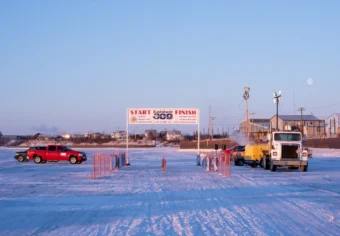
The finish line of the 45th annual Kuskokwim 300. (MaryCait Dolan/KYUK)
The 2025 Kuskokwim 300 has been pushed back two weeks because of poor snowfall and looming above-freezing temperatures, according to a release from the K300 Race Committee.
The 300-mile race from Bethel upriver to Aniak and back will now start on Friday, Feb. 7.
Race officials say that limited snowfall and unseasonably warmtemperatures in the Yukon-Kuskokwim Delta throughout the winter have made it near-impossible to check or mark trails.
And that pattern is set to continue. In the lead-up to the region’s premier sled dog race, the race committee wrote that the “current forecast for Bethel and checkpoint communities of Tuluksak, Kalskag, and Aniak calls for 5 days of temperatures in the 30s and 40s leading into the middle of next week, which made it impossible to determine whether there would be a trail that is safe for human and canine athletes come race time.”
It’s not yet clear whether the February running of the K300 will have a modified trail route, but race officials say no route modifications were planned as of Jan. 16.
As of late Wednesday evening, no registered teams had dropped out of the race despite the reschedule.
A two-week delay for the K300 is not common. In its 46-year history, the race committee says it’s been delayed “several” times due to extreme weather, usually for a day or two. And in 2021, the Kuskokwim 300 was delayed as part of COVID-19 mitigation plan.
This is a developing news story and may be updated with additional information.
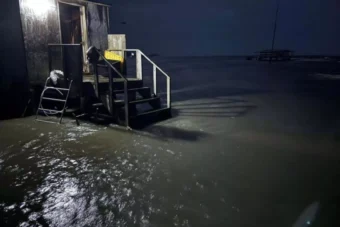
Flooding in Kwigillingok on Jan. 10, 2025. (Courtesy Lewis Martin)
Strong tidal action and fierce southerly winds inundated low-lying areas of the Kuskokwim Delta coastal community of Kwigillingok on Friday evening.
Michael Brown, with the National Weather Service in Anchorage, said that wind gusts as high as 55 miles per hour pushed waters well above the normal high tide line.
“When you combine 3 to 4 feet of extra water with a tide that’s already 2 feet above the normal high tide, we’re looking at 5 to 6 feet all of a sudden above the average high tide line. And that’s what we had,” Brown said.
According to Native Village of Kwigillingok Tribal Administrator Gavin Phillip, multiple boardwalks were submerged in the lower part of the community and water levels were on par with severe flooding seen in August 2024.
Phillip did not report any significant damage as of Sunday afternoon, but said that he had to act quick Friday to move his snowmachine and boat to higher ground.
“While me and my son were moving that boat, the tide was incoming and it was very swift. Maybe on a matter of half hour I almost lost my trail to home,” Phillip said. “Roughly maybe 27 homes were isolated.”
Phillip said that on Friday evening, the tribe put out the word on VHF radio and social media to residents of the low-lying areas to shelter in place until waters receded.
Phillip said that dozens of Orthodox followers observing Slaviq starring and feasting, including his wife, had to wait out the high waters in one community member’s home for around three hours. He said that both Slaviq celebrations and Moravian church services are on hold until a coastal flood advisory expires late Monday.
The community of roughly 600 people has grappled for decades with flooding, permafrost thaw and erosion of as much as 15 feet per year of the banks of the Kwigillingok River, which empties into the Bering Sea just below the community.
On Saturday Kwigillingok’s tribe joined Kipnuk in being among the first Alaska tribes ever to receive a federal disaster declaration from the Federal Emergency Management Agency for damage wrought by the August 2024 floods.
Chinook, or king salmon. (Michael Humling/U.S. Fish and Wildlife Service)
Not all fisheries research begins at a dinner table — but this study did.
A recent study from the University of Alaska Fairbanks found a correlation between chinook salmon size and their population numbers in a changing climate, but that correlation has been clear to the people fishing Western Alaska waters for years. The study took a new approach, looking to the knowledge of locals to inform its path of research.
In early 2022, researchers from the University of Alaska Fairbanks were interested in looking at the number of chinook salmon offspring that survive to adulthood in the Yukon and Kuskokwim rivers. Instead of setting out with their own set of questions, they decided to ask a quorum of what biologist Megan Feddern referred to as “salmon experts.”
“Agency employees at the state and federal level, community members, Elders — whoever was interested in sharing with us things that they had observed and things that they were interested in as it relates to Yukon and Kuskokwim salmon populations,” Feddern said.
At the time, Feddern was a postdoctoral researcher. She’s now a research fish biologist with the National Oceanic and Atmospheric Administration (NOAA). She and the other researchers hosted a virtual listening session as part of the 2022 Alaska Forum on the Environment and held a workshop in Fairbanks, asking the people who knew best what they were seeing change.
What stood out, in addition to the decline in salmon population, was the qualityof the fish. Many people observed that fish populating the rivers in recent years were smaller than what they’d remembered.
“One of the really cool things about this project is just the extent to which we combined different data sources,” Feddern said.
Feddern said that with the help of hydrologist Rebecca Shaftel, one of the paper’s co-authors, the research cross referenced climate data — like precipitation and temperature reports — with locally collected salmon reports from over the past 30 years.
By using both types of data to examine a total of 26 chinook salmon populations, a link emerged between the decline in population productivity with smaller spawner body size and climate impacts. Salmon that are smaller are less likely to produce as many, or as nutritious of eggs as larger fish. In both rivers, the study was able to connect size to productivity, which represents the population’s ability to sustain itself over time.
The study also found a correlation between above average temperatures in the Yukon River and lower productivity. But temperatures in the Kuskokwim River did not seem to directly affect the chinook populations.
“Working with fish, you know, you often are just thinking about the climate and the fish themselves, but you can’t remove that from the communities, and the culture, and everything that those fish support and that those fish are a part of,” Feddern said.
Feddern said that they were able to find success in honoring the knowledge of others by informing a path of research with the testimonies of those impacted by the changing climate.
“And the true experts in this region aren’t folks like me who are sitting at their computer coding and modeling to try and address these questions, but are the people who have been observing these fish for generations. And so doing this work together, I think, is what is really important to have success,” Feddern said.
According to Feddern, on the second evening of the workshop that kicked off this study, the researchers and salmon experts shared a potluck meal, with local folks preparing dishes and out-of-towners bringing sharable snacks.
People from the Kuskokwim and Yukon rivers, including from the Canadian Yukon, were seated at the table, some passing over a day’s travel to bridge testimonies, hard data, and as Feddern put it, “ways of knowing.”
Fr. Michael Nicholai pauses to offer the shovel to another clergyman while uncovering the grave of Matushka Olga during the process of her exhumation in Kwethluk on Nov. 16, 2024. (Courtesy Katie Baldwin Basile)
Puffs of feathery snow drifted among the crowd gathered at the cemetery of the St. Nicholas Orthodox Church in Kwethluk on a bitter cold Saturday, Nov. 16. Clergy, Kwethluk residents, and people from as far away as Eastern Europe stood packed between the tight rows of graves, while dogs weaved through the crowd. The people sang a final blessing to St. Olga of Alaska before the task at hand began.
“We’re going to begin now the process of uncovering the relic of a saint,” said Bishop Alexei, the head of the Russian Orthodox Diocese of Sitka and Alaska, wearing a heavy fur-lined robe and holding a golden crozier topped with two serpents.
Bishop Alexei traveled to Kwethluk alongside clergy from across the state. With the blessing of Orthodox faithful from the region, the church is completing the next step in making Olinka “Arrsamquq” Michael, or Matushka Olga, the first female Orthodox saint in North America, and the first-ever Yup’ik saint.
“All of us, I think, must ask in our heart that holy Matushka Olga will help us, will bless us to do this thing which is not done anywhere,” Alexei said.
Fr. Nicholai Larson (third from left) advises his fellow clergymen to dig safely so no one is hurt during the process of uncovering Matushka Olga in Kwethluk on Nov. 16, 2024. (Courtesy Katie Baldwin Basile)
Half a dozen priests huddled under a tarped enclosure and drove steel bars into the frozen tundra where St. Olga was laid to rest 45 years ago. The ground quickly began to crack and peel away to reveal soft, sandy soil that the mid-November frost hadn’t yet touched.
For the entire, hours-long exhumation process, clergy took turns continuously chanting from the Gospels, the biblical account of the life and teachings of Jesus. Others kept a constant supply of incense and charcoal burning, which wafted through the crowd and over the growing hole.
Orthodox disciples from up and down the Kuskokwim and as far away as Slovakia watch as the remains of Olinka Arrsamquq Michael, known as Matushka Olga, are unearthed over several hours in Kwethluk on Nov. 16, 2024. (Courtesy Katie Baldwin Basile)
St. Olga’s granddaughter, Margaret Michael, stood placidly as the pile of dirt grew next to the grave. She said it’s an honor to see her grandmother made a saint, and to hear faraway accounts of her healing powers after her death. But Michael said, for her, St. Olga simply represents the strength and compassion of Yup’ik culture.
“For the most part, Yup’ik people are like how she was. So I thought of her, like, as a normal human being until those people started dreaming about her,” Michael said.
At the graveside, dirt from the grave was carefully packed into Ziploc bags, which were distributed through the crowd and tucked into backpacks and coats. The holy soil will be used as a tool for healing among the people that fill the cemetery and their congregations back home.
It’s been more than 50 years since a saint’s remains were exhumed in Alaska, but soil from St. Herman’s resting place on Spruce Island near Kodiak is still used in the same healing way today.
Dirt from Matushka Olga’s grave, a holy relic to Orthodox disciples that will be used for healing and ceremonial purposes, is carefully packed and distributed throughout the crowd during her exhumation in Kwethluk on Nov. 16, 2024. (Courtesy Katie Baldwin Basile)
At one end of the growing pile, Zoya Ayapan gathered up soil. She said she became sick as a newborn in Kwethluk, and that when she suddenly got well her parents named her after Matushka Olga.
“One of my names is Arrsamquq. I was born like a month before she passed away,” Ayapan said.
Ayapan said that the recognition of St. Olga is a blessing for Kwethluk.
“The stories that I’ve heard of Matushka Olga, she goes to anybody, and I think the healing is for everybody that needs healing,” Ayapan said. “I was talking to Fr. Vasily (Fisher) before all this, and I said, ‘I think Kwethluk is going to be on the map for a good thing this time, you know.’”
Up from the grave
After more than four hours of digging down into the tundra, the splintered wood cover overlaying St. Olga’s metal casket came up from the grave.
The priests fastened ropes to the corners of the casket, just as they were fastened on Nov. 8, 1979, when Matushka Olga was lowered into the ground.
The ropes stretched tight and held fast to the casket as it rose from the grave. Laypeople, priests, and pilgrims who persevered through the bitter cold suddenly began to sing a prayer for mercy in the ancient Church Slavonic language used throughout the Orthodox world.
A crowd of roughly 100 people follow Orthodox clergy as they carry the unearthed remains of Matushka Olga into St. Nicholas Orthodox Church in Kwethluk on Nov. 16, 2024. (Courtesy Katie Baldwin Basile)
There was some anxiety in the air. Despite detailed plans for the first exhumation by the church in Alaska in more than 50 years, it wasn’t clear what the condition of the grave would be, or whether the casket might fall to pieces under its own weight.
But under the bishop’s direction, a dozen priests found a way to carry the casket through the decaying headstones and along the snowy lane leading the short distance to the new church as the crowd followed behind, transfixed.
The priests worked as a team to make a final push up the stairs. As St. Olga’s relics disappeared inside, the church bell triumphantly rang out to announce her arrival.
The crowd was too large to fit inside the St. Nicholas Orthodox Church, and it spilled down the stairs and onto the boardwalk below. Inside, the bishop and priests transferred St. Olga’s relics to a new wood coffin crafted by monastic nuns from California.
When the nave of the church finally opened – more than five hours after the ceremony began – there was no speech or grand exaltation. The mood was solemn. Tears flowed across some of the faces in the crowd.
Matushka Olga’s body is laid to rest in a wooden coffin made by monastic nuns in California and adorned with her image, salmonberries and the words “God is wonderful in his saints” in Kwethluk on Nov. 16, 2024. (Courtesy Katie Baldwin Basile)
The new resting place was adorned with an icon of St. Olga, surrounded by salmonberries. Matushka Olga’s relatives were first in line to kneel and kiss the coffin. The blessings they received from their family member turned saint will soon be shared with pilgrims from across the world.
In June 2025, Bishop Alexei and leaders throughout the Orthodox Church in America will be back in Kwethluk for the final step in making her sainthood official, a process known as glorification.
“This is to allow the larger church to also show their love for blessed Matushka Olga. But the primary service is really for the Yup’ik people who have been so extremely gracious, so very giving,” Alexei said. “Our entire time here, they have literally given everything they have, precisely the way Matushka Olga had taught them.”
The glorification will be unprecedented. But the same can be said for everything that has happened over the past year to the woman and wife of a priest from Kwethluk known as a mother, a midwife, a healer, and now a saint.
Matushka Olga’s relics will remain on display in the nave of the Kwethluk church as the community prepares for the final step in her canonization.
The lower Yukon River community of Pilot Station is seen in 2005. (Courtesy Amy Clapp/ARCUS)
The former mayor of the Yukon River community of Pilot Station has pleaded guilty to felony election interference.
As part of a plea agreement accepted on Nov. 14, 68-year-old Arthur Heckman Sr. faces five years of probation for one count of unlawful interference with an election. The charge relates to inducing or attempting to induce an election official to fail in the official’s duty by force, threat, intimidation, or offers of reward.
Heckman Sr. began serving as acting mayor of Pilot Station in May 2022 following the death of then-mayor Nicky Myers, according to the state Office of Special Prosecutions. Assistant Attorney General Erin McCarthy, who prosecuted the case, said that Heckman Sr. broke state election laws in both of the municipal elections that followed.
“After the October 2022 election in Pilot Station, Heckman directed that the ballots be placed in a locked filing cabinet and not counted,” McCarthy said. “And then in October 2023, Heckman directed officials not to hold an election at all.”
Pilot Station City Clerk Ruthie Borromeo was indicted alongside Heckman Sr. in July, and still faces eight felony counts for alleged violations of state election laws for the same time period. Her next hearing is scheduled for Dec. 5 in Bethel Superior Court.
Borromeo is still serving as city clerk for Pilot Station. On Nov. 14, she confirmed that Heckman Sr. had resigned as acting mayor, and that a new mayor and new city council had been elected in municipal elections held on Oct. 1.
McCarthy, with the Office of Special Prosecutions, said that the community deserves recognition for bringing the election violations to light.
“It was investigated by the (Alaska) State Troopers, but the reason that this came to law enforcement attention was because the citizens of Pilot Station and the Pilot Station City Council brought it to their attention. And I think that’s really commendable,” McCarthy said.
The state dismissed seven other felony counts related to election violations as part of Heckman Sr.’s plea agreement. If he violates his probation, he could face up to a year in prison.
Heckman Sr.’s sentencing is scheduled for March 18 in Bethel Superior Court in Judge Nathaniel Peters’ courtroom.
A sample ballot from the 2022 special election. (Liz Ruskin/Alaska Public Media)
An absentee in-person voting location in Bethel ran out of official ballots on Monday and started recording votes with sample ballots. The move prompted some concern on a popular community Facebook page, but the state said that it was perfectly legal.
A screenshot of a post that briefly appeared (since deleted) on a popular Bethel community Facebook page on the afternoon of Nov. 4. (Facebook)
“If a location runs out of official ballots they are permitted to use sample ballots as official ballots, and any voter voting on those samples, their votes will still be counted,” Jackson said.
Alaska Division of Elections Director Carol Beecher said that her office was notified that official ballots had run out at the Orutsararmiut Native Council (ONC) building in Bethel at some point on Tuesday afternoon, just hours before the absentee in-person polling location closed.
Beecher said that the shortage of official ballots was a result of historic high voter turnout. She said that the number of ballots sent to early and absentee in-person polling locations across the state was based on numbers seen in the 2020 United States presidential election.
According to Beecher, the early polling location for Dillingham also reported running out of official ballots on Monday.
Beecher said that the state did not anticipate any shortage of official ballots on Election Day, Nov. 5.
Anyone with concerns about voting is urged to contact the Alaska Division of Elections at 907-465-4611, or by email at elections@alaska.gov.
Close
Update notification options
Subscribe to notifications
Subscribe
Get notifications about news related to the topics you care about. You can unsubscribe anytime.