KYUK - Bethel

KYUK is our partner station in Bethel. KTOO collaborates with partners across the state to cover important news and to share stories with our audiences.

Without quorum, tribal delegates push AVCP demands to October

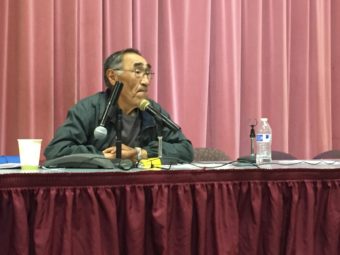
Newly appointed meeting Chair Ivan M. Ivan at the Yupiit Piciryarait Cultural Center in Bethel. (Photo by Charles Enoch/KYUK)
Newly appointed meeting Chair Ivan M. Ivan at the Yupiit Piciryarait Cultural Center in Bethel.
(Photo by Charles Enoch/KYUK)

Tribal delegates in Bethel this week tried to hold an emergency meeting of the Association of Village Council Presidents.

They want the AVCP administration and executive board to provide answers on financial matters and respond to what some delegates see as a mismanagement of power and lack of transparency within the organization.

AVCP administration and executive board members did not attend nor sanction the meeting, which began Tuesday and ended Wednesday.

Only 13 tribes sent delegates; 38 were needed to constitute an official meeting under AVCP bylaws. For lack of quorum, the delegates are pushing their questions and demands to the October annual meeting.

AVCP acting president and legal counsel did not respond to KYUK’s emails seeking comment on the meeting.

Broken ice machine stymies commercial fishing in Marshall and Russian Mission

Maserculiq's broken ice machine. (Photo by Nick P. Andrew Jr.)
Maserculiq’s broken ice machine. (Photo by Nick P. Andrew Jr.)

The first commercial fishing opening for fall chum started Wednesday for Marshall and Russian Mission, but still no solution has been found for the villages’ broken ice machine, forcing fishermen to either stop fishing or travel 60 miles and back to the village of St. Mary’s to get ice.

Marshall’s Maserculiq Native Corp. owns the machine but has made no effort to fix it since the compressor quit working two weeks ago. Replacing the part would cost $15,000.

Ten fishermen testified at the Maserculiq monthly board meeting Tuesday, asking the corporation to replace or repair the ice maker’s compressor. One of the fishermen was Nick P. Andrew Jr.

“Majority of the fishermen stated lost fishing time, used the words ‘affecting the economy,’ and basically stating that for a lot of fishermen this is their only income opportunity,” Andrew said.

Andrew is also the Marshall tribal administrator and said he’s applying for a grant to buy a new machine that would be owned and operated by the tribe. If awarded, the grant he’s considering would deliver in fiscal year 2018.

Maserculiq board member Lena Sergie said the corporation is trying to find ways to purchase a new ice machine but haven’t solidified anything so far.

St. Mary’s-based Boreal Fisheries can buy the chum, but only with the right ice.  Owners Randy and Edna Crawford won’t send a boat to pick up the fish unless it’s in flake ice, which fishermen can’t make at home and which Edna calls a necessary industry standard.

“It has to be flake ice,” Edna Crawford said, “because that’s the only way you’re going to keep the temperature of the fish down, especially with the weather we’ve had over here.”

Since the machine broke, Marshall commercial fisherman Leonard Fitka Sr. has missed two fishing openings. He’s been boating the four and a half hours to fetch ice and fears the trips are unsustainable.

“Fishermen are working harder, staying up longer, (spending) more time away from family. It’s hurting the economy,” Fitka said.

Fishermen in Russian Mission travel even further for ice. Myron Edwards, a commercial fisherman there, said with gas over $4 a gallon he won’t make a profit, and he doesn’t know when he’s going to fish next.

“We’re not too sure how we’re going to do this,” Edwards said. “Some of us don’t have enough money to pay for gas to pitch in for one boat to go all the way up to Boreal to pick up ice.”

The Crawfords, who own Boreal, have known the commercial fishermen in Marshall and Russian Mission for decades and have built a close relationship with them. Boreal has provided free labor multiple times to fix their ice machine, and last year the Crawfords donated a generator. They run a small operation and Randy Crawford said they’ve done all they can.

“Edna and I are really frustrated because we’ve put so much effort into it, and we can give no more,” he said.

Boreal pays an average of $400,000 a year to Marshall fishermen. Randy said it’s an important part of the Marshall economy and he wants Maserculiq to invest in its community.

Marshall commercial fisherman Nick Andrew Jr. had sent letters to shareholders and fishermen in Marshall and Russian Mission asking them to attend Tuesday’s meeting.

“We are imploring the village corporation for them to take ownership and invest in the ice machine,” Andrew said.

The Maserculiq CEO and board members did not respond to KYUK’s emails asking about the machine.

Akiachak prepares to inventory land for trust status

After a federal appeals court last week dismissed the state of Alaska’s challenge in a tribal land rights case, the four Alaska tribes that sued the Interior Department may proceed with land petition proceedings. That includes Akiachak and Tuluksak.

Alaska tribes can start asking the federal government to take their lands into trust. If approved, the lands would essentially be taken out of state jurisdiction, like Lower 48 Indian Country.

Phillip Peter Sr. chairs the Akiachak Native Community Council. He said trust status would fulfill generations of desire for greater tribal sovereignty.

“Our elders in the past wanted a land base in order to control our jurisdiction,” Peter said. “Land is really important, because all those years we didn’t have any recognition from the state of Alaska. We need a jurisdiction in order to control our village.”

Peter hopes trust status will offer that control through improved public safety and policing. He said defined land jurisdiction and federal funding that comes with trust status will make those changes possible.

The Interior Department will publish a list of tribes that have filed for trust status later this year. Tribes contacted by KYUK would not say if they are among those tribes. But Peter said the Akiachack tribe and Akiachack Native Corp. are meeting after the height of the summer subsistence season to inventory their lands for trust status. Peter said they’ll look at restricted lands, unrestricted lands and corporation lands in the town site.

Peter said trust status advances the Akiachack tribe’s self-determination and fulfills at least one of their elders’ teachings.

“It will be helpful, especially for the younger generation, from my son to granddaughter and grandsons. We are paving the way. And our elders before they passed on, they told us and instructed us to take care of our land, even though we had hard times, not to give up. It’s our right,” he said.

Peter would not comment on the trust legal case. The Tuluksak Native Community would not comment on any land trust issues.

Bethel high school gets $7 million for new cafeteria

school lunch
A school lunch of turkey taco salad, iced tea, mashed potatoes and peach cobbler. (Creative Commons photo by Laura Taylor)

Seven million dollars for a brand new kitchen and cafeteria at the Bethel Regional High School survived the governor’s veto pen this week.

BRHS does not have a cafeteria. At lunch, some students sit at tables in the gym while they eat, and others wander the halls.

“But the trouble is the gym at BRHS is used from 6 p.m. in the morning until 8 p.m. at night, including lunch time,” said Susan Murphy, who chairs the Lower Kuskokwim School Board.

At lunch, the gym is split into two sections. And while some students are eating, some have class on the other side. Murphy said this arrangement is not working for kids.

But the biggest reason for building a new kitchen is to consolidate all the different kitchens the district is presently using.

“You have to have store rooms at each of the facilities. You have to have cooks at each of the facilities. It’s much cheaper to have one central kitchen, with one storage area, where all the meals are prepared and then sent out,” said Murphy.

Some of these kitchens may not even be available for the school district’s use for much longer, Murphy said.

“We are now leasing space from BNC for our immersion school Ayaprun. And that lease includes the lease of the kitchen in the BNC building. However, when that lease is up, we won’t have access to that kitchen anymore. And we need a kitchen,” she said.

Murphy said the construction of the building probably won’t happen until next year, but when it does, maybe lunchtime will feel more like a lunch break for Bethel students.

Bethel nonprofits will no longer get a pass on sales taxes

broken dollar cash pieces
(Photo illustration by photosteve10)

Starting Aug. 1 the city of Bethel will begin enforcing sales taxes on nonprofits unless the nonprofit gets an exemption. But no one can get an exemption, because one of the legal requirements is impossible to fulfill.

By city law, nonprofits were supposed to be paying sales taxes since 2001. But the trend didn’t catch on for everyone, and the city didn’t enforce the change. Until now.

“Just because we’ve done something wrong for 20 years does not mean we should continue to be doing it wrong,” Bethel City Manager Ann Capela said.

This month the city sent a letter to all Bethel businesses telling them nonprofits are not exempt from city sales taxes. And any business not paying taxes will be held liable starting Aug. 1.

LaTesia Guinn is the executive director of the nonprofit Bethel Family Clinic. She said instead of collecting, the taxes the city council should change the law and look elsewhere for revenue.

“It’s not a right way for people, when they’re looking for extra funds to pay bills and to meet the budget of the city, to be focusing on nonprofits,” Guinn said.

Eileen Arnold is the executive director of the nonprofit Tundra Women’s Coalition, a shelter and resource center for survivors of domestic violence and sexual assault. Arnold said the tax would cost the nonprofit between $15,000 and $16,000 a year and affect services.

“That would make us have to chose between fixing something in our building versus providing travel for somebody to leave a domestic violence situation or food for the pantry,” Arnold said. “We’d have to make really difficult decisions.”

Under city law, nonprofits can be exempt from city sales taxes if they meet three criteria:

  • be a 501(c) with the IRS,
  • use what it purchases for its organization, and
  • receive Alaska Revenue Sharing.

That last part — about having to receive Alaska Revenue Sharing — that bars all nonprofits from exemption because Alaska Revenue Sharing, by that name, doesn’t exist.

Danielle Lindoff is with the Alaska Department of Commerce, Community, and Economic Development. In an email, she said that the state has had many revenue sharing programs, but none by the name Alaska Revenue Sharing. And even if the program did exist, Lindoff said Bethel nonprofits don’t qualify for state revenue sharing.

City Manager Capela said even if the city’s law doesn’t make sense, her job is to enforce it as written.

“Whether this is outdated or there are different intentions or meaning, I don’t know,” Calepla said. “But so far we’ve determined legally and factually that indeed in order to be exempt there are three conditions that must be present. And it doesn’t state one of the conditions or two of the conditions must be present. It states all the conditions must be present.”

Capela said the city has no estimates on how much revenue it expects to collect from nonprofit sales taxes. Several nonprofits have asked Bethel City Council to amend the law before enforcement begins.

Building in a wetland is never easy. In Bethel, it just got harder.

bethel aerial
Bethel on July 23, 2012. Much of the Yukon-Kuskokwim Delta is wetland, so development is subject to permitting through the U.S. Army Corps of Engineers. (Creative Commons photo adapted from Holy Trinity Orthodox Church)

Construction in the Yukon-Kuskokwim Delta has never been easy. It’s hard to build things in a wetland, and the construction season is short. For some, that season just got shorter. A federal change could mean waiting months to get a construction permit that used to take only days.

Whether you realize it or not, every time you do any new construction in Bethel, you have to get the permission of the federal government — the U.S. Army Corps of Engineers, to be exact.

“We’re in a wetland everywhere here, and so any new construction you do is most likely in a wetland,” Ted Meyer, director of Bethel city planning, said.

Meyer said this permitting process is one way the federal government protects wetlands. But with that protection comes red tape that Bethel residents are now going to have to cut through themselves.

Ryan Winn, chief of the Corps’ regulatory division, said Bethel used to have something called a Regional General Permit. That’s like a blanket permit for all construction that happens over five years. It gave the city the authority to approve construction permits without going through the Corps every time. But Winn said that Bethel’s general permit was taken away because of disuse.

“To actually issue a regional general permit takes a lot of time and work load, right? So in order to justify spending that time, there needs to be a high volume of similar activities in a certain area that would justify us doing this work up front,” Winn said.

Winn said Bethel doesn’t meet that volume, so now individuals will have to go through the Corps to get a construction permit. That permit only took around 10 days with the city, but Winn said a project could take years to approve if the building site could have a significant effect on aquatic habitat. There’s no straight answer. Every site is different.

“Individual permits within 120 days, but sometimes depending on the continuous nature of a project, it could take longer,” Winn said.

Bethel City Manager Ann Capela asked the Corps to take over the permitting process for the city last spring.

“And the Corps said, well, we were moving towards taking that over anyway, so I had sent a letter that the city will no longer administer the Corps permits as of last year,” Capela said.

According to the Corps, Bethel’s general permit would have expired Aug. 31, even if Capela hadn’t requested the change. Capela said she asked for the switch because the city didn’t have a planner last year and couldn’t properly do its own reviews. She added that the city had been getting a bad deal by taking on that responsibility in the first place.

“The Corps wanted us, the city, to do this for free. We are busy with our own required issues, let alone do the extra work for the Corps,” Capela said.

Bethel is now in the second month of the new review process. Winn said the Corps will reexamine Bethel’s general permit at the request of the city in the future, but until then, residents should plan on planning ahead.

Site notifications
Update notification options
Subscribe to notifications