Housing

Juneau is facing a housing shortage. These high school students are helping combat it.

Juneau-Douglas High School: Yadaa.at Kalé senior Isaac Phelps measures cedar shingles during his house build class on Wednesday, Nov. 12, 2025. (Photo by Clarise Larson/KTOO)

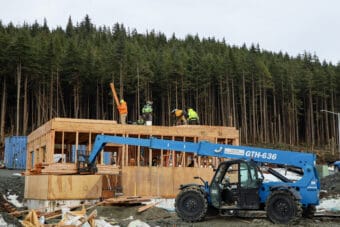
Juneau high school students are getting real-world building experience while creating much-needed affordable homes in the community. That’s thanks to a house build program that’s a partnership between the Juneau Housing Trust and Juneau School District.

On Wednesday, Raegan Adams fed pink fluffy insulation into a machine in the garage of a partially built home in Lemon Creek. The machine pushed the insulation through a long spiraling tube through the house and into its attic. She and her classmates are building the house she’s standing in.

Adams is a junior at Juneau-Douglas High School: Yadaa.at Kalé and one of the students enrolled in the district’s House Build program.

The district has offered many house building projects to students on and off, dating back to the 1970s. The program has seen multiple iterations over the years. Students who take the semester-long class get to learn hands-on construction skills by building new, energy-efficient homes that then go back into the community. Adams says she was hesitant to take the class at first, but now she’s glad she did. 

“I think it’s a very important class that teaches skills everyone should have. Like, I’ve been telling my mom about stuff we do in the class. And she’s like, ‘Oh, you can do this to our house next,’” she said. 

Students in this class are currently finishing up the sixth house in a small neighborhood of homes constructed by the program in Lemon Creek. Soon, they’ll begin laying the foundation for the seventh. The houses are located just past the Dzantik’i Heeni campus.

Juneau-Douglas High School: Yadaa.at Kalé students measures cedar shingles during their house build class on Wednesday, Nov. 12, 2025. (Photo by Clarise Larson/KTOO)

The City and Borough of Juneau made the land available for sale to the Juneau Housing Trust in 2017. The trust manages the land through a community land trust and works to ensure the homes can be purchased by low and middle-income community members. 

Tamara Rowcroft is the board vice president of the Juneau Housing Trust. She said housing geared for low and middle-income buyers is unique, but desperately needed. 

“I’ve been working in affordable housing for about 35 years here in Juneau. I lived here as a kid,” she said. “I know how hard it is to get housing that’s affordable.’

For the past two years, Juneau has had the highest average sale price for a single-family home in the state, according to a study by the Alaska Department of Labor and Workforce Development. 

Juneau-Douglas High School: Yadaa.at Kalé senior Jace Kihlmire cuts insulation during his house build class on Wednesday, Nov. 12, 2025. (Photo by Clarise Larson/KTOO)

Nathan Dutton is the school district’s career and technical education coordinator. He says offering alternative learning opportunities is crucial for students who may be looking for another path to a well-paying job after graduating that isn’t a traditional four-year degree.

“We have seen a drop in tradesmen throughout the nation, so being able to make this skillset available to our students is so important,” he said. 

He said the house build program lets students explore if a trades career is for them.

“They’re getting amazing real-world experience that in other places you typically have to pay for or get accepted into a program,” Dutton said. 

Jace Kihlmire is a senior at JDHS. He took the class to learn more skills to use when working at his dad’s construction company. But, he said, the takeaways from the class go beyond that. It gives him the confidence to take on what used to be difficult tasks.  

“It applies to future careers as well as home life,” he said. “Like ‘oh, I put a hole in my drywall.’ Oh, cool. I know how to patch it up. Or ‘oh, I need to re-shingle my roof.’ Well, I know how to do that.”

And, though he’s learned a lot of skills during the class, he said he definitely has a favorite: 

“Everything is fun about drywall,” he said. “As much as I hate removing it, installing it is the best.”

The class hopes to finish construction by the end of the year. The trust hopes to put the home on the market soon.

Juneau plans to clear its largest homeless encampment ahead of first snow

Campers pack up their belongings on Teal Street in the Mendenhall Valley on Wednesday, Nov. 12, 2025. (Photo by Clarise Larson/KTOO)

More than a dozen people without permanent housing living in Juneau’s largest unhoused encampment will be forced to leave on Friday morning, ahead of the season’s first expected snowfall. 

The City and Borough of Juneau gave notice to the people camping on Teal Street in the Mendenhall Valley earlier this week. The notices says the city is prohibiting camping in the area due to winter maintenance and safety concerns. 

Right now, the street is lined with more than a dozen campsites. Some campers don’t want to leave.

“I assumed that they would let us stay through the winter. I didn’t anticipate them doing this now — it just seemed like the worst timing,” said Darian Bliss, who’s been living in the Teal Street area in a makeshift shelter since about May. 

People without housing in Juneau set up camp here because it’s close to social services and other resources provided by the Glory Hall and St. Vincent de Paul. 

“I think it’s the safest, best place out of everywhere in town, because you’re right across from the homeless shelter anyway, and so I don’t know where a better place could possibly be,” he said. 

Tents line the sidewalks along Teal Street in the Mendenhall Valley on Wednesday, Nov. 12, 2025, (Photo by Clarise Larson/KTOO)

Bliss said he’s frustrated with the timing of the city’s eviction. He doesn’t want to have to uproot his life again, even as winter comes. He’s spent the last week or so insulating his campsite, and recently installed a wooden door with a lock. 

Campers like Bliss have few options for where they can stay. One option is the city’s cold weather emergency shelter, which opened for the season in mid-October. It’s located in a warehouse in Thane, about a mile from downtown and about nine miles across town from the services on Teal Street. 

The shelter accepts anyone who comes in search of a place to sleep at night, as long as they aren’t disruptive to other patrons. City officials say it’s a stopgap and meant to be a last resort for unhoused people when the weather gets cold. 

Bliss said he doesn’t plan on going there. He doesn’t like how crowded it is and the distance from resources. 

“I don’t like going out there at all. I just stay perfectly fine here,” he said. 

Logan Henkins works at the Glory Hall shelter. He was playing music and handing out hot chocolate and coffee to people who passed by on Wednesday afternoon.  

“I’m just out here this morning trying to touch base with as many people as I can touch on base with about the extended services that St. Vincent de Paul is offering on Friday to catch the people who are being displaced,” he said. 

St. Vincent de Paul operates the city’s emergency shelter. In light of the clearing, the shelter will open earlier on Friday and offer a meal.

He’s not the only one trying to help out. Claire Richardson stood outside her car next to a campsite on Teal Street, waiting to help a woman she met the day before move her belongings from an encampment and into a family member’s apartment. 

“You start to realize that people (are) living on the margins, and the snow is coming, and really, I don’t know what they’re going to do, and there’s a lot of stuff here,” she said. 

Richardson is with ReSisters, a local group of women who work for social justice and equality. She said when she heard about the encampments being cleared, she felt drawn to help the people who were about to be displaced. 

“It’s going to start snowing here in a few days, and the thought of me being safe in my home, sipping my hot coffee and knowing that people are living like this. Well, it’s just hard to sleep at night,” she said. 

Other groups in town are helping out too, like the Haa Tóoch Lichéesh Coalition, which is asking the community to offer storage space or funds to those being displaced. 

Deputy Police Chief Krag Campbell said the police department plans to have officers arrive at 8 a.m. on Friday to ask people to leave the area. Then at 9 a.m., they’ll start throwing people’s belongings away. He encouraged campers to pack up their belongings beforehand.

“Hopefully, we’ve given them ample time, ample notice, and they can start making those arrangements to go somewhere else,” he said. 

Deputy City Manager Robert Barr said the city will continue to monitor the area after Friday in the event that people set up camp again. 

Telephone Hill tenants file lawsuit as city plans next steps for redevelopment project

A sign leans against a tree in the Telephone Hill neighborhood on Tuesday, Nov. 4, 2025. (Photo by Clarise Larson/KTOO)

Tenants living in Juneau’s historic Telephone Hill neighborhood had until last weekend to move out.

But some didn’t, and three of them are now suing the city to reverse the evictions. At the same time, city officials are discussing the next steps for the downtown neighborhood’s redevelopment into new, denser housing.

The city’s Nov. 1 eviction date for Telephone Hill tenants has come and gone, and now, the city is laying out the plan for what lies ahead for the neighborhood.

“It is really the only piece of property that is large enough to be able to support maximum density housing and really move the needle on housing in Juneau,” City Manager Katie Koester said at a Juneau Assembly committee meeting Monday night.

She and Assembly members discussed what’s next for the controversial redevelopment project.

City Manager Katie Koester speaks during a Juneau Assembly committee of the whole meeting on Monday, Nov. 4, 2025. (Photo by Clarise Larson/KTOO)

The discussion came just days after three tenants living on Telephone Hill filed a joint civil lawsuit against the city on Halloween, seeking to reverse the evictions. City leaders did not mention the lawsuit at the meeting.

The plaintiffs claim the city improperly evicted people on the hill, illegally phased the redevelopment and that the project fails to comply with federal and state historic preservation acts.

Joe Karson is one of the plaintiffs. He’s 80 years old and, as of Tuesday, hadn’t moved out of his apartment on the hill.

“They came and told me today that I have to be out by eight o’clock tomorrow morning, and I won’t be,” Karson said.

He says he plans to fight the evictions and demolition as long as possible. He pointed out that the city doesn’t have a developer lined up yet.

“The idea is that at some point, someone will build something — that’s their idea of a project? What on earth is that?” he said.

City Attorney Emily Wright says the city’s law department is reviewing the lawsuit and plans to file a response shortly. She says the city believes it has no merit.

All of the residents of Telephone Hill were renters and had been since the state took ownership of the neighborhood in the 1980s. The state transferred ownership to the city in 2023. Last year, the Assembly voted to redevelop the neighborhood to build denser housing on prime downtown real estate to ease Juneau’s housing crunch.

The city wants to find a developer willing to build four mid-rise apartments, which could create an estimated 155 new housing units. But, right now, there’s no developer signed onto the project.

“This is a unique gem that a community doesn’t get an opportunity very often to have property so centrally located with utilities with infrastructure in their community,” Koester said.

Trees outline the Telephone Hill neighborhood in downtown Juneau on Monday, June 9, 2025. (Photo by Clarise Larson/KTOO)

According to a 2024 assessment, Juneau is in immediate need of at least 400 new housing units.

The project has come with a lot of pushback from local advocates. That’s in part due to the history of the hill — it was home to Alaska’s first commercial telephone service, and many of its houses were a part of the original Juneau townsite in the late 1800s. All seven structures are slated for demolition this winter.

This past spring, the Assembly approved spending $5.5 million to tear them down and prepare the land for new buildings. The Assembly chose to front that cost in order to attract developers and tack on some affordable housing requirements.

Koester said the city plans to select a developer early next year so that construction can begin in 2027.

At Monday’s meeting, she spoke to an audience filled with advocates against the plan. She said that the decision to redevelop the neighborhood is not an easy one, but added it has the potential to dramatically move the needle on the city’s lack of housing availability and affordability.

“Telephone Hill really does represent some of the most developable property, well-located in our community, and it’s been really hard to struggle with those decisions,” Koester said.

According to Wright, as of Tuesday tenants are still occupying three residences on Telephone Hill. The city plans to take legal action against those tenants on Wednesday.

Telephone Hill tenants must vacate homes by Saturday ahead of demolition plans

This is a preliminary concept drawing of what the Telephone Hill neighborhood redevelopment could look like. (Courtesy/City and Borough of Juneau)

Renters living in Juneau’s Telephone Hill neighborhood have until Saturday to vacate their homes before the city evicts them.  

That will clear the way for the city’s plan to demolish the houses in December and redevelop the area to build newer, denser housing there in response to the city’s housing crunch.

The evictions were originally slated for Oct. 1, but the city postponed them until this Saturday due to a legal hiccup. The evictions come after outcry by local advocates, who asked the city to halt them until it produces a clearer redevelopment plan. Right now, a developer has not signed on to the project. 

Advocates collected more than 800 signatures opposing the redevelopment plan ahead of the Juneau Assembly meeting on Monday. There, more than a dozen people testified in hopes of persuading members to reverse course and save the historic downtown neighborhood. However, no action was taken on the topic. 

The Juneau Assembly is slated to discuss the project and next steps for the redevelopment at a committee meeting on Monday at 6 p.m. The discussion will include the timeline for demolition and finding a developer, and will address several other questions about the project brought forth by advocates. 

A developer’s plan to build dozens of new downtown apartments failed. He blames the city.

This is a drawing of the proposed Gastineau Lodge Apartment complex in downtown Juneau. (Courtesy/City and Borough of Juneau)

A project meant to bring more than 70 units of new workforce housing to downtown Juneau is dead before it could even break ground. The developer blames the city for stopping it. The city says the project was a risk to public safety.

In late 2023, the city’s planning commission approved a conditional land-use permit for the construction of a 72-unit apartment building downtown.

The six-story building was set to be located on three vacant lots on Gastineau Avenue, just uphill from the downtown library. It was meant to be workforce housing – all furnished and ready to go by the summer of 2025. 

But it’s been nearly two years, and the summer of 2025 has come and gone. The lots where the development was supposed to be are still empty. Steve Soenksen, the private developer behind the project, said it’s the city’s fault.

“We don’t have a stuck market. We have a stuck municipality — and they’re stuck on saying no,” he said. 

A sign sits at the site of a future 72-unit apartment building downtown on Wednesday. The project was OK’d for a conditional land-use permit by the city planning commission on Tuesday, Dec. 12, 2023. (Clarise Larson/KTOO)

The project was approved by the commission despite several safety concerns brought up by some neighbors, city officials and the fire department because of its hazardous location — an area subject to landslides — and lack of easy access for emergency services. 

But while the planning commission approved that permit in a 7-1 vote, in order to get a building permit from the city’s Community Development Department, he needed to agree that the project could meet the city’s fire and life code.

Gastineau Avenue is a dead-end street, and it’s hard to turn a vehicle around there. The project’s site is also on a downhill slope toward South Franklin Street on the Mount Roberts hillside, close to where multiple landslides damaged homes and displaced residents in recent years. 

“Most every section in the fire code was written because there was some kind of disaster that necessitated it,” said Capital City Fire/Rescue Chief Rich Etheridge.

He said the fire code requires at least two access points for a road that has more than 100 units. The new construction would push Gastineau over that threshold. 

“Housing is needed and we support development as much as we can,” he said. “We do have to hold the fire code — it was written for us to enforce, not for us to decide whether it’s legitimate or not.”

A potential second access point would go through privately owned land south of Gastineau Avenue. Soenksen argues that the city should help create that second access point, but he said it’s unwilling to work with him. He said the secondary access wouldn’t just benefit his project, but the entire street, which is prone to hazards. 

“A big part of our housing crisis is that the city’s been making unrealistic requirements on housing projects for 40 years that I can count,” he said.

This is a photo of the site for a future 72-unit apartment building downtown on Wednesday. The project was OK’d for a conditional land-use permit by the city planning commission on Tuesday, Dec. 12, 2023. (Clarise Larson/KTOO)

Jill Lawhorne, the director of the Community Development Department, said Soenksen was aware of the code requirements throughout the process, and he was the one unwilling to accept the requirements that came with developing at that location.

“Not all land is appropriate for housing if it can’t be made safe,” she said. “I think egress is that bare minimum of safety that we would want to see for housing and for our residents.”

She also pushed back against his allegations that the city is to blame.

“It’s not our Community Development’s responsibility to make a project happen,” she said. “We can help you through the process. We can help you obtain the permits if you meet the requirements of code, but it’s on the developer to bring their development to fruition.”

The project’s planning commission permit has since expired, and Soenksen said he has no intention to keep trying to make the project happen.

“I had plans for over 220 apartments to go in downtown,” he said. “But once they killed this one, I have no resources to try and do anything else, nor desire, because of the treatment I got with the city.”

Despite that, he’s on the hook to repay a quarter of a million dollars from a predevelopment loan he received from the city’s affordable housing fund in 2022.

Advocates collect more than 600 signatures to halt looming Telephone Hill evictions

The Telephone Hill neighborhood in downtown Juneau on Wednesday, Oct. 22, 2025. (Photo by Clarise Larson/KTOO)

Local advocates have gathered more than 600 signatures in an effort to pause the looming evictions and demolition of the historic Telephone Hill neighborhood in downtown Juneau. 

The petition is called “Stop the Bulldozers on Telephone Hill.” The city plans to demolish the houses on the hill in December to make way for newer, denser housing in response to the city’s housing crunch. Renters on the hill have until Nov. 1 to move out, but a developer has not signed on to the project. 

Mary Alice McKeen is one of the advocates leading the effort. She said the petition asks for the city and Juneau Assembly to consider postponing the project until they have a more credible plan that includes things like clearer cost estimates. 

“We think they are really putting the cart before the horse. After the buildings are demolished, that is irrevocable,” she said. “So, before we think they should pause what they’re doing until they have a credible plan for the future of telephone Hill.”

McKeen said advocates intend to present the signatures and testify at the Juneau Assembly’s upcoming meeting on Monday night. That’s when its newest member, Nano Brooks, will be sworn in. Brooks openly campaigned against the demolition plan. 

The eviction of renters on the hill was originally slated for Oct. 1, but the city postponed it until Nov. 1 due to a legal hiccup. 

City Attorney Emily Wright said the signatures themselves can’t stop the plan from moving forward — it’s up to the Juneau Assembly.

“In general, the signature gathering push and initiative is fully within the political realm and putting pressure on the Assembly to rescind their action or change where things go,” she said. “But it doesn’t have any weight legally to stop the eviction.”

A majority of the nine-member Assembly would have to be on board with rescinding the evictions in order for a motion to pass. However, at a meeting last month, many Assembly members stood behind their decision.

Demolition is slated to begin in December. City officials say they hope that a developer will begin construction as soon as next summer.

Site notifications
Update notification options
Subscribe to notifications