Housing

‘We got hope’: The few who remain in storm-ravaged Kipnuk race to rebuild

Debris sits in a pile in storm-ravaged Kipnuk, Alaska on Oct. 19, 2025, a week after the remnants of Typhoon Halong brought catastrophic flooding and hurricane-force winds to the village.
Debris sits in a pile in Kipnuk, Alaska on Oct. 19, 2025, a week after the remnants of Typhoon Halong brought catastrophic flooding and hurricane-force winds to the village. (Eric Stone/Alaska Public Media)

It’s Sunday in Kipnuk.

And like a lot of folks on Sundays, Tony Paul is headed to the hardware store.

“We’re making progress every day, seems like,” he said.

Unlike a lot of folks, he needs a boat to get there.

“It floated away,” he said, gesturing upriver. “There’s a couple stores down past that way, a bunch of houses.”

A week earlier, on Sunday, Oct. 12, Kipnuk endured the worst storm anyone can remember. It’s one of dozens of communities in Western Alaska working to restore essential infrastructure and repair damaged homes after the remnants of Typhoon Halong devastated coastal communities.

According to preliminary damage assessments, Kipnuk fared the worst.

The few residents who remain are determined to rebuild — but the task ahead is immense, and the future is unclear.

Homes and other buildings that floated off their foundations in Kipnuk, Alaska rest on tundra miles upriver on Oct. 19, 2025, a week after the remnants of Typhoon Halong brought record flooding and high winds to the Western Alaska village. (Eric Stone/Alaska Public Media)

In this village, four miles from the Bering Sea on the east bank of the Kugkaktlik River, Halong’s high winds and storm surge left a catastrophe. Halong’s hurricane-force winds pushed seawater more than six and a half feet above the normal high tide line.

Water poured into houses. It lifted homes off their foundations and deposited some of them miles away. It toppled four-wheelers and snowmachines, and left freezers full of food for the winter without power.

The state Department of Transportation estimates that 90% of the structures in the community were destroyed. Most of Kipnuk’s residents evacuated on military helicopters in the days after the storm.

Now, Kipnuk is in ruins. Piles of debris are everywhere.

Houses and other buildings sit jumbled and surrounded by debris in Kipnuk on Sunday, Oct. 19, a week after the remnants of Typhoon Halong brought record flooding and high winds. (Eric Stone/Alaska Public Media)
A building sits on a boardwalk among other debris on Oct. 19, 2025 in Kipnuk, Alaska, a week after the worst storm on record. (Eric Stone/Alaska Public Media)
An all-terrain vehicle sits overturned on a boardwalk in Kipnuk on Sunday, Oct. 19, a week after the remnants of Typhoon Halong washed ashore. (Eric Stone/Alaska Public Media)

Anna Kashatok was with her boyfriend, his family and her two kids when the storm hit.

“We floated away pretty far,” she said. “A mile or two.”

They escaped from a window and trudged to the community’s school. She recalled seeing the destruction for the first time.

“So heartbreaking, devastating,” she said. “Kipnuk’s not Kipnuk anymore.”

Kashatok was only back in town for a couple days, retrieving some belongings and important documents from her parents’ house. It also floated away with them inside. She evacuated to the hub community of Bethel with her boyfriend, parents, and two children.

Only a handful of people remain in this village that just a week ago was home to 700.

In spite of the widespread destruction, the school remains a place of refuge. It escaped major flood damage. It’s elevated on pilings with a dedicated backup generator.

All-terrain vehicles and a dog sit outside the Chief Paul Memorial School in Kipnuk, Alaska on Oct. 19, 2025. (Eric Stone/Alaska Public Media)


Supplies sit in the lobby of the Chief Paul Memorial School in Kipnuk, Alaska on Oct. 19, 2025, a week after the remnants of Typhoon Halong devastated the community. (Eric Stone/Alaska Public Media)

James Paul III sat at a table in the cafeteria, speaking with a local Yup’ik teacher.

“It happened so fast. Everything changed, like in a day,” he said. “The rest of their lives are changed in one day.”

The school remains, but the kids are gone. Many evacuated to Anchorage. Others are with friends and family in Bethel, surrounding villages or other communities around the state.

So for now, the Chief Paul Memorial School is a hub for the recovery effort. Packaged food lines the walls. Cafeteria workers prepare hot meals — chili was on the menu for dinner.

The state Department of Transportation told Paul some heavy equipment was on the way, he said, things like small excavators, skid-steers and all-terrain vehicles. That would help crews working to connect the school and a water treatment plant to power, he said.

“That’s our main objective right now,” he said.

James Paul III poses for a photo in the cafeteria of Kipnuk’s Chief Paul Memorial School on Oct. 19, 2025. Paul is one of a handful of residents racing to rebuild Kipnuk after the remnants of Typhoon Halong struck a week earlier. (Eric Stone/Alaska Public Media)

But time is running short. Winter is well on its way. Bits of frost lined ponds on the tundra. That, and an oily sheen.

State emergency officials say they believe the fresh water supply is contaminated. A stiff breeze brought some relief Sunday from what residents said had been a lingering stench of fuel and sewage.

A big question looms ahead: Can evacuees return before winter — or at all?

“The way that their houses are right now, I don’t think they want to come back, especially people whose houses were pulled off their foundation,” Paul said.

There are a few dozen homes built on pilings that survived the storm and are still livable. They number 40 or 50, Paul estimated.

Paul wants to stay in Kipnuk if he can, he said. He’s spent most of his life here.

“Kipnuk means family, (it) means values, traditions. It’s my culture. I grew up here, and my dad taught me to hunt and live off the land here,” he said. “I do know some about city life, but I’d rather be here.”

From left to right, Tony Paul, Anna Kashatok, Benjamin Kugtsun, Logan Paul and Joshua Dock stand outside the Chief Paul Memorial School in Kipnuk, Alaska on Oct. 19, 2025. (Eric Stone/Alaska Public Media)

Outside the school, standing with a group of young men working to restore basic services to the community, Benjamin Kugtsun was unequivocal.

“We’re going to stay here in the winter,” he said. “We can survive. How did our ancestors survive? Without nothing. But they did.”

But when — or whether — large numbers can return is unclear. Gov. Mike Dunleavy, in a request to the federal government, said some evacuees from villages across the vast, low-lying Yukon-Kuskokwim Delta might not be able to return for 18 months.

For now, Kugtsun and his crew are taking it one day at a time. One task at a time. One boat ride to the hardware store at a time.

But he’d like to see more residents return to help out.

“With teamwork, it can happen,” he said. “We got hope.”

Will Juneau regulate short-term rentals any time soon? Probably not.

Downtown Juneau on Friday, Aug. 29, 2025. (Photo by Clarise Larson/KTOO)

The mayor’s task force on short-term rentals wrapped up four months ago. It was mostly made up of homeowners, not renters. And its findings offered no immediate recommendations on regulations or restrictions for the Juneau Assembly to consider. 

Juneau has been grappling with a housing shortage for decades — studies pointing to Juneau’s acute lack of it date back to the 70s. 

City officials have tried finding ways to create new housing for long-term renters. In recent years, there’s also been a push to crack down on short-term rentals, like Airbnbs and Vrbos. City data and other analyses suggest there are likely around 300 to 400 short-term rentals in Juneau, but that the number could be even higher.

“There is very distinct opinions on it — and some people are for them, and some people are against them,” said Mayor Beth Weldon.

Right now, short-term rentals are largely unregulated, although the city started requiring people to register them in 2023. Weldon launched a short-term rental task force in January to assess the market and make recommendations that improve housing availability.

Of the 11 members, only one was a renter. The group concluded its meetings in early June and offered some imprecise recommendations to the Assembly. But, Weldon said she had hoped for clearer direction. 

“They were pretty benign recommendations, and if that’s what the Assembly wants, that’s good. But I was hoping to see a little bit more,” she said.

Assembly member Wade Bryson, who chaired the committee, said one positive change that did come out of the task force was requiring rental sites to take care of sales taxes on behalf of local operators. The Assembly approved that change back in May.

The task force also recommended non-regulatory actions for the Assembly to take, like conducting an economic impact study on short-term rentals.

But members couldn’t agree on what else to implement, or when. Bryson said the committee faced a lot of hurdles. Not everyone on the 11-member task force showed up to every meeting. He says that made it hard to gauge a consensus and led to a lot of split votes. 

“It was difficult to get support to take such a hard stance one direction or the other,” he said. 

He said he thinks a better use of city time and resources is to focus on creating new housing opportunities, like the Telephone Hill redevelopment project. 

“The data says they’re not causing the housing crisis, and even if we restrict them, that’s not going to move the needle and get more houses into the market,” he said. 

The task force suggested basing its recommendations on Juneau’s rental vacancy rate — the overall number of vacant rental units. In a final report shared with the Assembly, it concluded that the current 3.9% vacancy rate is low — meaning there isn’t enough open housing to go around. But, they left it up to the Assembly to decide what rate would justify taking action.

The City and Borough of Juneau’s rental vacancy rate between 2010 and 2024. (City and Borough of Juneau)

If at some point the Assembly decides on what that threshold is and that it has been met, then the task force recommends two things: the city institute a fee for permits and cap the number of rentals permitted to a person or business. But, it also didn’t recommend a specific fee rate or cap to consider. 

Bryson said it’s unlikely that the Assembly will pick this topic back up any time soon. 

“It did not appear with the data that we were in a crisis mode because of short-term rentals,” he said. “It just isn’t making that level of impact.”

Assembly member Alicia Hughes-Skandijs also served on the task force. In a text message, she said she “wasn’t satisfied by the amount of outputs from the task force” and intends to take the topic back up in the coming years.

Juneau’s cold weather emergency shelter opens for the winter season

A patron walks out of Juneau’s emergency warming shelter on its last morning open for the season on Wednesday, April 16, 2025. (Photo by Clarise Larson/KTOO)

Juneau’s cold weather emergency shelter opens Wednesday night. 

It’s the third year the shelter will be located in a warehouse in Thane, about a mile from downtown. It’s funded by the city and operated by staff from St. Vincent de Paul, a local nonprofit that works to help people affected by homelessness. 

Jennifer Skinner is the executive director of Juneau’s St. Vincent de Paul chapter. She said the shelter is critical to keeping people alive during the cold winter months. 

“The most important part of having this option for our unhoused population is that it gives them a safe, dry, warm place to be overnight, where otherwise they would be out in the elements,” she said. 

The shelter accepts anyone who comes in search of a place to sleep, as long as they aren’t disruptive to other patrons. City officials say it’s a stopgap and meant to be a last resort for unhoused people when the weather gets cold. 

Last season, the shelter saw an average of 45 people per night. But, some nights, staff saw up to 70 people in need of shelter. 

This summer, Juneau saw an influx of encampments throughout the borough, particularly near the Glory Hall shelter in the Mendenhall Valley. That’s in part due to the closure of the city-run campground near downtown two years ago. 

The increase in campers this year led the Glory Hall to reduce its services in late August due to what staff say was a deteriorating and unsafe environment in the neighborhood. The Juneau Assembly grappled with several ideas this summer to address the larger issue of homelessness in Juneau. 

Skinner said she expects many campers near the Glory Hall shelter to head to the emergency shelter in Thane as the temperatures in Juneau begin to fall. 

“It kind of just takes that lift and that burden off of our unhoused population, and allows for them to have a little bit of peace of mind for six months out of the year, knowing that there’s always a place open,” she said. 

The shelter will be open every day starting Wednesday from 9 p.m. until the early morning. There will also be free shuttle transportation from the Mendenhall Valley and downtown to the shelter. The shelter will stay open through April of next year. 

Juneau upzoned land for denser housing throughout the borough. Will anything get built?

North Douglas Highway near Grant Creek on Monday, Oct. 6, 2025. (Photo by Clarise Larson/KTOO)

The Juneau Assembly upzoned more than 200 acres of city land for sale earlier this year in hopes of creating more housing opportunities throughout the city and borough. 

The rezones included land north and south of Grant Creek and west of the Bonnie Brae and Blacktail Subdivisions on Douglas Island, and some land in the Auke Bay area.

The hope was that by allowing for denser housing in those areas, it would entice private developers to build units there. But so far, nobody’s biting. That might be because a lot more work needs to be done to make the land buildable, and that work could be expensive. 

Dan Bleidorn, the city’s lands and resources manager, said the rezoning is just another strategy the city is using to try and tackle Juneau’s chronic housing shortage. 

“The goals of the rezones were to initiate a process in which those properties could be disposed of by the city, and developers could acquire them, or people could acquire them to build housing on,” he said. 

That’s especially needed as a U.S. Coast Guard Icebreaker is slated to be homeported in Juneau, bringing more than 100 crewmembers and their families to town in the coming years. It also comes as annual glacial flooding of the Mendenhall River threatens homes in the Mendenhall Valley, and major development projects are being proposed on North Douglas. 

High-density, multi-family is generally cheaper to buy or rent than a traditional single-family home. According to a study by the Alaska Department of Labor and Workforce Development, Juneau has had the highest average sale price for a single-family home in the state for the past two years.

“I think the rezones are important because it provides opportunity that wasn’t present prior to the rezones,” he said. 

Bleidorn said the rezones are just the first step in a long process to get housing built in those areas. But, just because the land is technically now up for sale, it doesn’t necessarily guarantee developers will want — or be able to afford — to build there. Bleidorn said just preparing the land to be developable will be a significant investment.

“I think some of the barriers to development include the fact that there’s no road frontage on a lot of these properties, and utilities are far away in some cases,” he said. 

That, paired with high interest rates and the cost of materials, continues to block developers from breaking ground on new projects.

For other city housing projects like the redevelopment of the Telephone Hill neighborhood downtown, the Assembly controversially chose to front millions of dollars to fund the first phase of demolition and site preparation in order to entice developers to build housing there. The city does not yet have a developer signed on to the project. Demolition is scheduled to begin in December. 

The Juneau Assembly similarly infused millions of dollars to spur the development of the Pederson Hill subdivision in 2017 to create more housing. Since then, private developers and individuals have bought some of the 86 lots to build single-family homes. 

Both projects have been met with skepticism, with people questioning the city’s role in influencing the housing market. Deputy City Manager Robert Barr said public subsidies on projects like these are a way to tuck in affordability requirements. 

“If it’s just left up to developers to kind of front all that principle, all that cash, that investment on their own, we’re gonna end up with one type of housing, right? Housing that they can make a profit on,” he said. 

Bleidorn said it’s not clear which direction the Assembly will choose to go on the land it rezoned. It depends largely on the interest – or lack thereof — from the private sector. He said, regardless, the rezones lay the groundwork for a future Juneau where more housing could finally be on the horizon.

“I really do think that these rezones will make a difference,” he said. “Maybe they’re more mid-term to long-term projects, but I think lining them up for future development is key.”

Juneau Assembly looks to Telephone Hill, Pederson Hill for potential Coast Guard housing

The U.S. Coast Guard icebreaker Storis passes Portland Island on its way to Juneau on Wednesday, Aug. 7, 2025. (Photo courtesy/ gillfoto)

The Juneau Assembly is considering offering a portion of the future Telephone Hill redevelopment to house U.S. Coast Guard families moving to Juneau. The city expects more than 100 families to join the community when a U.S. Coast Guard Icebreaker homeports in the coming years. 

At a committee meeting Monday night, City Manager Katie Koester said both the city-owned Telephone Hill and Pederson Hill subdivisions could meet the Coast Guard’s housing needs.

“We have been meeting with Coast Guard leadership and Coast Guard staff here on what their needs are for homeporting the Storis, knowing that housing is a major obstacle and that there’s a high priority for the community to bring that ship home,” she said. 

The Coast Guard announced last summer that Juneau would be the homeport for the new polar icebreaker Storis. The 360-foot ship is built to operate in the Arctic and is meant to increase U.S. presence in the region. 

Coast Guard officials say it will likely be a few more years before the ship is officially homeported in Juneau. But it will bring at least 110 personnel and their families to town.

Koester says Juneau’s housing stock is not enough to take care of its current housing needs. The crisis will only be exacerbated once Coast Guard families begin to arrive.

She suggested the Assembly look to sign an agreement with the Coast Guard that a portion of the housing at the Telephone Hill and Pederson Hill subdivisions would go to its personnel. She says that would make the land more attractive to developers.

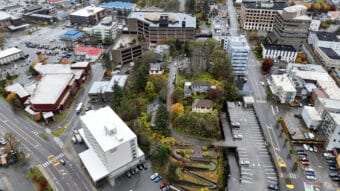
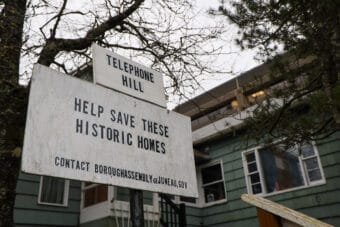
The historic Telephone Hill neighborhood downtown is slated to be demolished beginning in December. Renters are still living there, and have until Nov. 1 to move out. The plans open up the area for newer, denser housing in response to the city’s housing crunch. The city does not yet have a developer signed on to the project. 

“Telephone Hill has an opportunity to provide a lot of multi-unit housing that’s really conveniently located across from the subport,” she said. “So, for those service members that maybe don’t have a car, maybe they’re single — close to public transportation, close to work — it could provide a really attractive option.”

Pederson Hill is about 26 acres of city-owned land, a half mile past Brotherhood Bridge on Glacier Highway. In 2017, the Juneau Assembly approved developing the 86-lot subdivision to create more housing. Since then, private developers and individuals have bought some of the lots to build single-family homes. Tlingit Haida Regional Housing Authority is also working on developing housing on a portion of the land. 

The Assembly voted to direct Koester to work on creating a memorandum of understanding to potentially offer land at Pederson Hill and Telephone Hill for private developers to build Coast Guard housing.

Juneau Assembly postpones eviction of Telephone Hill residents, citing legal hiccup

Trees outline the Telephone Hill neighborhood in downtown Juneau on Monday, June 9, 2025. (Photo by Clarise Larson/KTOO)

The City and Borough of Juneau has pushed back the eviction deadline for renters living in the historic Telephone Hill neighborhood in downtown Juneau. 

Residents now have until Nov. 1 to move out. 

City Attorney Emily Wright told the Juneau Assembly during an executive session Monday night. Mayor Beth Weldon announced the change to the public during an Assembly committee meeting that followed.

It comes just two days before residents were supposed to vacate the neighborhood. 

According to Wright, the city received two notices in the past week from attorneys indicating that it did not properly and legally serve residents with eviction notices.

Upon review, the city discovered the property management company in charge of alerting residents on the hill that their rental agreement was ending did so, but did not properly document it.

The City and Borough of Juneau sent out an Oct. 1 eviction notice in late May. The city plans to demolish the houses on the hill this December in hopes of making way for newer, denser housing in response to the city’s housing crunch. The city does not yet have a developer signed on to the project. 

Last week, dozens of residents attended the Juneau Assembly meeting to protest the plan to evict residents. Assembly members could have chosen to rescind the eviction notices sent to residents at the meeting, but they declined. 

The city plans to put out new notices to vacate on the hill on Tuesday. 

Site notifications
Update notification options
Subscribe to notifications